Herbs
The Thirteen Herb Categories
Every herb sits under what it is traditionally used for, on disk and in the URL, so a path reads Herbs → category → herb and the sub-menu above shows the herbs reached for in the same situation. A category records use, not proof: each herb page states its own evidence tier and its documented harms.
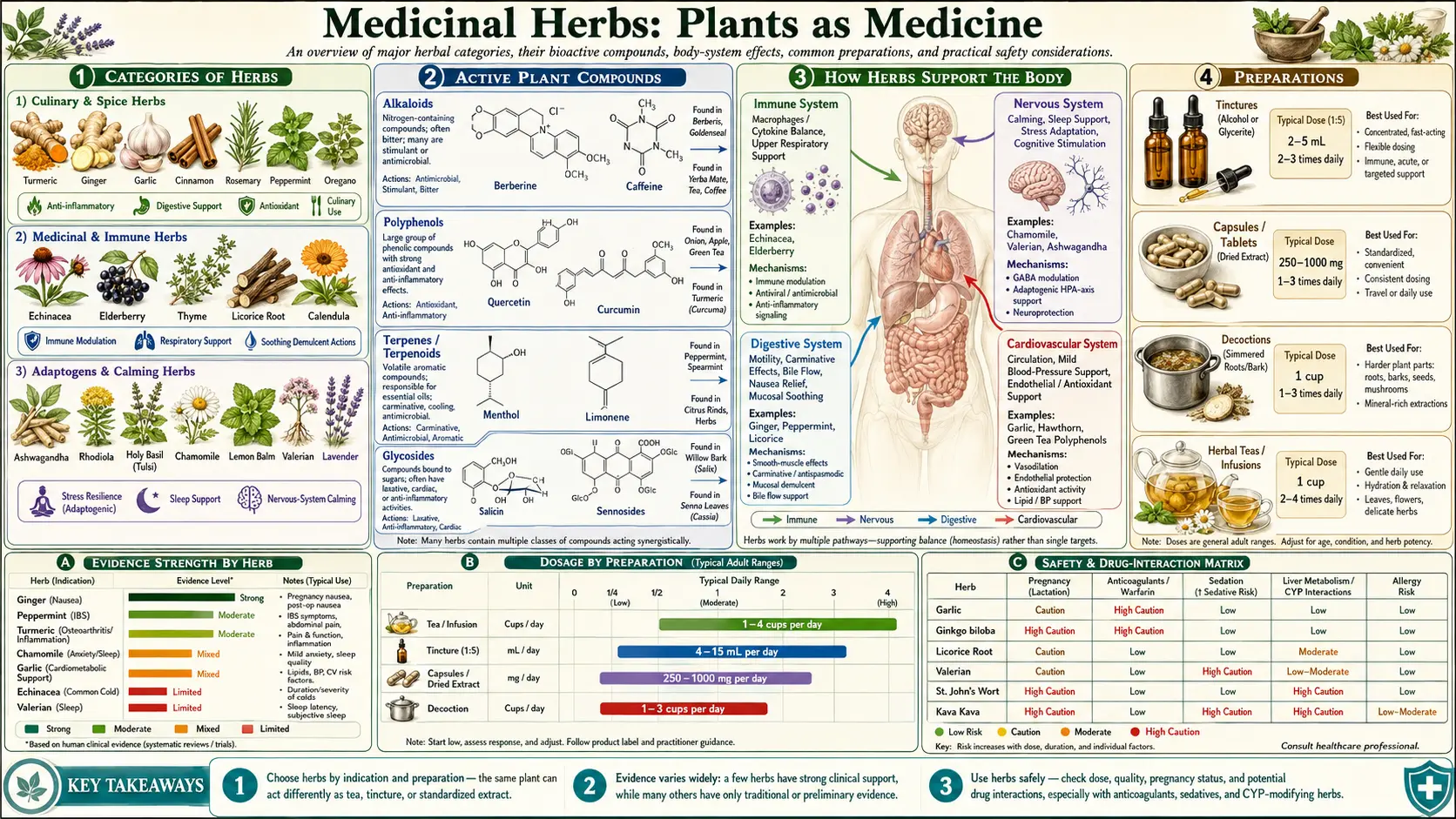
A comprehensive guide to nature's most powerful healing herbs — from ancient Buddhist seed remedies to adaptogenic powerhouses, antimicrobial defenders, and cognitive enhancers used across thousands of years of traditional medicine worldwide.
Table of Contents
Natural Antibacterial Herbs
- Natural Antibacterial Herbs — 22 herbs with proven antibacterial properties, active compounds, research, and clinical evidence
Sacred Seeds — Buddhist Monk Tradition
- Fenugreek — "The Seed That Strengthens Everything"
- Coriander Seeds — "The Holy Herb That Cools the Destructive Inner Fire"
- Cumin — "The Herb That Ignites the Inner Digestive Fire"
- Carum / Ajwain — "Ultimate Digestive Remedy & Supreme Pain Reliever"
- Fennel — "The Herb That Harmonizes Everything"
Medicinal Herbs & Botanicals
- Turmeric — The golden root with extraordinary anti-inflammatory power
- Ashwagandha — The king of adaptogens for stress, sleep, and vitality
- Ginger — Ancient digestive healer and anti-nausea remedy
- Garlic — Nature's most potent antimicrobial superfood
- Echinacea — Native American immune system stimulant
- Moringa — The nutrient-dense “drumstick tree” studied for blood sugar and inflammation
- Milk Thistle — The premier herb for liver protection and regeneration
- Ginkgo Biloba — The living fossil that enhances brain circulation
- Valerian — Nature's gentle sedative for sleep and anxiety
- St. John's Wort — The sunshine herb for mood and depression
- Holy Basil (Tulsi) — The sacred adaptogen and "Queen of Herbs"
- Oregano — One of the strongest natural antibiotics known
- Rosemary — The herb of remembrance for brain and body
- Parsley — The garnish that outnutrients the meal: per-gram vitamin K champion with the flagship dietary apigenin
- Mastic Gum — Chios resin chewed for the stomach since antiquity; honest H. pylori and dyspepsia evidence
- Black Seed (Nigella Sativa) — "The remedy for everything except death"
- Peppermint — Cooling hybrid mint with strong evidence for IBS and headache
- Licorice — Five-thousand-year-old root for ulcers, adrenal support, and respiratory care
- Dandelion — Medicinal weed prized for liver, gallbladder, and kidney support
- Mullein — The classic pre-antibiotic lung herb: a soothing demulcent and expectorant for coughs, bronchitis, and respiratory irritation
- Marshmallow Root — Soothing mucilage (demulcent) root for dry cough, sore throat, and irritated gut lining
- Yarrow — The ancient “soldier's woundwort” — a storied styptic and bitter tea, mostly traditional in evidence
- Wormwood — The intensely bitter absinthe herb — a traditional digestive bitter and “worm” remedy; the thujone essential oil is neurotoxic, so tiny doses only
- Horsetail — A silica-rich “living fossil” used traditionally as a diuretic and for bones, hair, and nails (short-term only — it contains thiaminase)
- Senna — An effective, FDA-recognized OTC stimulant laxative (sennosides) for occasional, short-term constipation relief
- Plantain (Herb) — The humble lawn weed (not the banana) — a classic wound-healing “nature's band-aid” and soothing demulcent
- Motherwort — A mint-family “nervous heart” herb traditionally used for palpitations and calm (see a doctor for real arrhythmias)
- Skullcap — A gentle Western nervine for anxiety and sleep — choose reputable brands (historic germander adulteration)
- Red Raspberry Leaf — The classic pregnancy “uterine tonic” tea — popular and low-risk in late pregnancy, though its labor benefits are unproven
- Meadowsweet — The salicylate herb that gave aspirin its name — a traditional fever, pain, and stomach remedy (the usual aspirin cautions apply)
- Mugwort — The moxibustion and “dream herb” Artemisia — a traditional bitter and women's herb (and a major pollen allergen)
- Damiana — A traditional Mexican aphrodisiac and mood tea — pleasant, but its reputation outstrips the evidence
- Lemongrass — The lemony Southeast-Asian culinary grass — a calming, digestive tea with strong antimicrobial lab data
- Epimedium (Horny Goat Weed) — A TCM libido and bone tonic (icariin) — a real lab mechanism but weak human data; caution with ED and heart drugs
- Vervain — A folklore-rich European “herb of grace” — a traditional calming nervine and digestive bitter
- Blessed Thistle — A medieval monastery digestive bitter (not the same as milk thistle) with a folk breast-milk reputation
- Elecampane — A traditional warming lung and cough herb — an inulin-rich root with antimicrobial lab data (watch for daisy-family allergy)
- Lovage — A celery-scented culinary herb and traditional urinary and digestive remedy (photosensitizing in large medicinal doses)
- Angelica — A fragrant carrot-family digestive and liqueur herb (European angelica, not Chinese dong quai) — watch for photosensitivity
- Marjoram — Sweet marjoram — a milder, calming cousin of oregano used as a digestive and PCOS-tea herb
- Horehound — The old-fashioned cough-drop herb — a traditional expectorant and intensely bitter digestive tonic
- Tribulus terrestris — The popular “testosterone booster” — but controlled trials show it doesn't raise testosterone; a modest libido herb at best
- Muira Puama — Amazonian “potency wood” — a traditional aphrodisiac and nerve tonic with intriguing but weak, mostly-uncontrolled evidence
- Savory — A peppery, carvacrol-rich culinary cousin of oregano used traditionally as a digestive and antiseptic
- Self-Heal — The edible “heal-all” woundwort (Xia Ku Cao) — a storied sore-throat and wound herb with interesting antiviral lab data
- Agrimony — A tannin-rich astringent herb traditionally used for mild diarrhea, sore throats, and as a mouth-and-gum gargle
- Artemisia annua (Sweet Wormwood) — The plant behind the Nobel-winning antimalarial artemisinin — but the purified drug, not the raw herb or tea, is what treats malaria
- Wood Betony — A revered medieval European nervine for headaches and nervous tension — huge in folklore, thin in modern trials
- Lungwort — A spotted-leaf “doctrine of signatures” respiratory herb — a gentle traditional demulcent (use short-term for the trace pyrrolizidine alkaloids)
- Boneset — The classic North American “break-bone fever” flu herb — a traditional diaphoretic with intriguing immune lab data
- Cleavers — The clingy “sticky-willy” weed — a classic folk lymphatic and diuretic “spring cleanse” tonic, though its detox reputation far outruns the clinical evidence
- Sorrel — The tart, lemony culinary leaf of sorrel soup — a vitamin-C green historically eaten against scurvy, but high in oxalates, so a moderation herb for anyone prone to kidney stones
- Coltsfoot — A traditional cough herb — but it contains liver-toxic pyrrolizidine alkaloids and is best avoided internally; several countries restrict it
- Comfrey — The classic topical “knitbone” for sprains and bruises — genuinely helpful on intact skin, but never taken internally (liver-toxic pyrrolizidine alkaloids)
- Chen Pi (Tangerine Peel) — Aged tangerine peel for digestion and phlegm, prized by vintage like fine tea
- Vietnamese Herbal Formulas — Decode a Vietnamese herbal label — what Radix, Herba and Pericarpium mean, what “equivalent to” really claims, and a worked nine-herb example
Heart, Liver & Metabolic Herbs
- Hawthorn — European heart herb for mild heart failure and hypertension
- Hibiscus — Tart red-tea flower (roselle) with good evidence for modestly lowering blood pressure
- Berberine — Yellow alkaloid with metformin-like effects on blood sugar and lipids
- Bitter Melon — Tropical bitter gourd with insulin-mimetic activity for type 2 diabetes
- Gymnema — The Indian "sugar destroyer" that blocks sweet taste and lowers glucose
- Chanca Piedra — The "stone breaker" of Amazonian and Ayurvedic medicine for kidney stones, gallstones, and hepatitis B
- Uva Ursi — Bearberry leaf traditionally used as a short-course urinary antiseptic (arbutin); strict use limits
- Japanese Knotweed (Hu Zhang) — The world's richest natural source of resveratrol, cornerstone of Buhner's Lyme protocol
- Nhan Tran — Vietnam's everyday liver tea (Adenosma caeruleum) and the species confusion around it
Pain & Men's Health Herbs
- Feverfew — The classic migraine-prevention herb, from the daisy family
- Arnica — The alpine bruise-and-sprain topical — effective on unbroken skin, toxic taken orally; the herbal-vs-homeopathic confusion untangled
- Butterbur — An effective migraine and hay-fever herb — but ONLY as a certified PA-free extract (raw butterbur is liver-toxic)
- Devil's Claw — Southern African root with moderate evidence for osteoarthritis and low-back pain
- Willow Bark — The original aspirin: 3,500-year-old natural pain reliever
- Stinging Nettle — Root for prostate and urinary symptoms, leaf for seasonal allergies
- Saw Palmetto — Florida palm berry for benign prostatic hyperplasia and prostate health
- Tart Cherry — Anthocyanin-rich fruit for gout, muscle recovery, and natural-melatonin sleep support
Southeast Asian & Tropical Herbs
- Amla (Indian Gooseberry) — One of the three fruits of Triphala; the vitamin C claim survives with a haircut
- Bael — Unripe fruit binds, ripe fruit loosens — and the aegeline liver-injury story
- Baheda — The second Triphala fruit — and two real urate-lowering trials nobody replicated
- Betel Leaf — Piper betle — the leaf, not the carcinogenic nut it is chewed with
- Betel Nut — An IARC Group 1 carcinogen chewed by 600 million people — the honest page
- Bhringraj — South Asia's classic hair oil, and why the rodent data never reached humans
- Black Ginger (Krachai Dam) — Thai polymethoxyflavone tonic; small trials on blood flow and stamina
- Black Turmeric — Curcuma caesia — rare, endangered, and usually adulterated
- Butterfly Pea — The pH-indicating blue flower behind colour-changing drinks
- Cardamom — True green cardamom — and why black cardamom is a different genus
- Cassia alata (Ringworm Bush) — A folk antifungal the Philippine DOH actually endorses — topically
- Cat's Whiskers (Java Tea) — Orthosiphon — a urinary herb with an EMA traditional-use monograph
- Chiretta — Swertia chirayita — NOT the same plant as Green Chiretta
- Chrysanthemum — Ju hua — the cooling flower tea of China and Vietnam
- Cissus quadrangularis — The “bone-setter” vine, and what the fracture trials really showed
- Coleus forskohlii — Forskolin is a real pharmacological tool — and a poor oral supplement
- Costus (Crepe Ginger) — Diosgenin does not become a hormone in your body — a persistent myth
- Crape Jasmine — Not a jasmine — an alkaloid-rich Apocynaceae, and not a tea herb
- Curry Leaf — Nothing to do with curry powder; a citrus relative with carbazole alkaloids
- Elephant's Foot — Jamu and Vietnamese folk herb; the anticancer literature is all cell-line
- Fingerroot (Krachai) — Boesenbergia rotunda — panduratin A, and its translation gap
- Galangal — Greater vs lesser galangal — the rhizome behind tom kha gai
- Haritaki — The “king of medicines” in Tibetan practice; first fruit of Triphala
- Houttuynia (Fish Mint) — Vietnam's diếp cá; the injection withdrawal is not the leaf
- Jasmine — Jasminum sambac — and the poisonous plants sold under the name
- Javanese Turmeric (Temulawak) — Indonesia's national medicinal plant and the backbone of Jamu
- Jewel Vine — The botanical source of rotenone — a pesticide, not a remedy
- Kacip Fatimah — Malaysia's women's-health root; the oestrogen question is unresolved
- Kencur — Kaempferia galanga — not the same plant as black ginger
- Long Pepper — Worth more than black pepper in Rome; piperine and its drug interactions
- Makrut Lime — The double-lobed leaf of tom yum — and a note on the older name
- Marsh Barbel — Ayurvedic kokilaksha — animal data only, and a potassium caution
- Mulberry Leaf — DNJ inhibits the same enzyme as acarbose — taken with the meal
- Noni — Polynesian fruit juice with published hepatitis case reports
- Nutmeg and Mace — Two spices from one fruit — and genuinely toxic in quantity
- Pandan — The vanilla of Southeast Asia; the same aroma molecule as jasmine rice
- Perilla (Shiso / Tía Tô) — Richer in ALA than flaxseed — and the chemotype that poisons cattle
- Sabah Snake Grass — On the Thai essential-medicines list for herpes lesions — topically
- Sacred Lotus — Seed, embryo, leaf and rhizome — four medicines from one plant
- Shallot — Higher in polyphenols than onion — and dominated by isoalliin, not alliin
- Shampoo Ginger — Zingiber zerumbet — and why “wild ginger” is a dangerous name
- Sida cordifolia (Bala) — Contains ephedrine; became the legal-looking substitute for ma huang
- Silk Cotton Tree — Bombax ceiba — four different parts, four different uses
- Soursop Leaf — Annonacin and the Guadeloupe atypical-parkinsonism signal
- Star Anise — Phở spice — and why it does not treat flu, and never for infants
- Stevia — Purified glycosides are approved; whole leaf is not — a useful distinction
- Tamarind — Sour from tartaric acid, not citric; a genuinely evidenced mild laxative
- Thai Basil — Horapha — not holy basil, not lemon basil, not Genovese
- Tinospora (Guduchi) — Giloy — and the liver-injury case series that split Indian medicine
- Tongkat Ali — Malaysia's famous root; the supply chain is the risk, not the plant
- Torch Ginger — The pink flower bud in Penang asam laksa — a food, honestly framed
- Vietnamese Balm — Kinh giới — a Vietnamese herb-plate staple with almost no literature
- Vietnamese Coriander — Rau răm — a knotweed, not a coriander; the laksa leaf
- White Turmeric (Zedoary) — Curcuma zedoaria — camphoraceous, bitter, and low in curcumin
Adaptogens, Nootropics & Calming Herbs
- Rhodiola Rosea — The golden root for stress resilience, mental performance, and fatigue
- Mucuna Pruriens — The velvet bean whose seeds carry real L-DOPA — dopamine support with genuine pharmacology and genuine cautions
- Astragalus — Premier qi-tonifying root of TCM for deep immune and adrenal support
- Ginseng — The 2,000-year-old "man root" for energy, cognition, and male sexual health
- Schisandra — Five-flavor berry adaptogen for liver protection and stamina
- Maca — Andean cruciferous root for libido, fertility, and energy
- Gotu Kola — Ayurvedic herb for wound healing, circulation, and calm focus
- Bacopa Monnieri (Brahmi) — The Ayurvedic nootropic for memory, learning, and neuroprotection
- Chasteberry (Vitex) — Vitex berry that lowers prolactin for PMS and cyclical breast pain
- Chamomile — One of the oldest medicinal herbs for sleep, digestion, and calm
- Elderberry — Hippocrates' "medicine chest" for immune support and antiviral defense
- Passionflower — GABA-modulating vine for anxiety, insomnia, and nervous tension
- Lavender — The queen of calming herbs for anxiety, sleep, and pain relief
- Lemon Balm — Paracelsus' "elixir of life" for calm, cognition, and antiviral support
- Kava — The Pacific Islands' sacred root for deep relaxation and social anxiety
- He Shou Wu — The legendary longevity herb of Chinese medicine
- Black Cohosh — Native American root with strong evidence for menopausal symptoms
- Red Clover — Isoflavone-rich legume studied for menopausal hot flashes (the evidence is genuinely mixed)
- Atractylodes (Bai Zhu) — Bai Zhu, the premier spleen-qi and digestion tonic of Chinese medicine
- Codonopsis (Dang Shen) — Dang Shen, the gentle non-stimulant qi tonic used in place of ginseng
- Dong Quai — Dang Gui, the classic Chinese blood tonic — and an honest look at the menopause evidence
- White Peony (Bai Shao) — Bai Shao, and the source of Total Glucosides of Paeony, which is an approved rheumatoid-arthritis drug in China — the herb and the drug are not the same thing
General Guidelines for All Herbs
Preparation Method (Universal)
- Measure the appropriate amount of seeds
- Crush lightly if recommended for that herb
- Place in clean glass with filtered room-temperature water
- Cover with breathable cloth or loose lid
- Let soak overnight (8-12 hours minimum)
- Drink on empty stomach the next morning
Key Rules
- NEVER use hot or boiling water (destroys delicate healing compounds)
- ALWAYS soak for minimum 8 hours for full extraction
- Drink on empty stomach for maximum absorption
- Consistency is key — commit to 30 days minimum
30-Day Commitment Expected Results
- Digestion improves dramatically
- Energy increases significantly
- Chronic pains may decrease or disappear
- Better, deeper sleep
- Skin glows with radiant health
- Mind becomes clearer and sharper
Options
- Start with ONE herb if less intimidating
- Combine ALL FIVE for complete transformation
IMPORTANT DISCLAIMER: This information is educational, based on ancient Buddhist wisdom and published scientific studies. It does NOT replace medical consultation. Never stop prescribed medications based on this information alone. Consult your doctor about using these herbs as supplements to current treatment and ask about any contraindications or interactions.
Source: Buddhist Monk Healing Traditions
Connections
- Remedies — practitioners, protocols and practices — the non-botanical side of natural medicine.
- Medicinal Mushrooms, Energy Mushrooms and Culinary Mushrooms — fungi rather than plants, in three categories of their own.
- Food — culinary plants that double as medicine.
- Vitamins — the nutrient side of supplementation.
- Minerals — mineral status, which many herbal protocols quietly depend on.
- Antioxidants — the polyphenols and flavonoids behind much of herbal pharmacology.
- Conditions — the conditions these herbs are traditionally and clinically used for.
- Infections — antibacterial, antiviral and antiparasitic herbs in context.
- Turmeric — curcumin, inflammation and the bioavailability problem.
- Ashwagandha — the best-studied adaptogen, with real cortisol trial data.
- Ginger — nausea, digestion and inflammation.
- Milk Thistle — silymarin and liver protection.
- Garlic — allicin, blood pressure and antimicrobial action.
- Echinacea — the immune herb, and what the trials actually show.
- Astragalus — the qi-tonifying root for deep immune and adrenal support.
- Ginkgo biloba — cerebral circulation and cognition.