How to Read a Vietnamese Herbal Formula Label
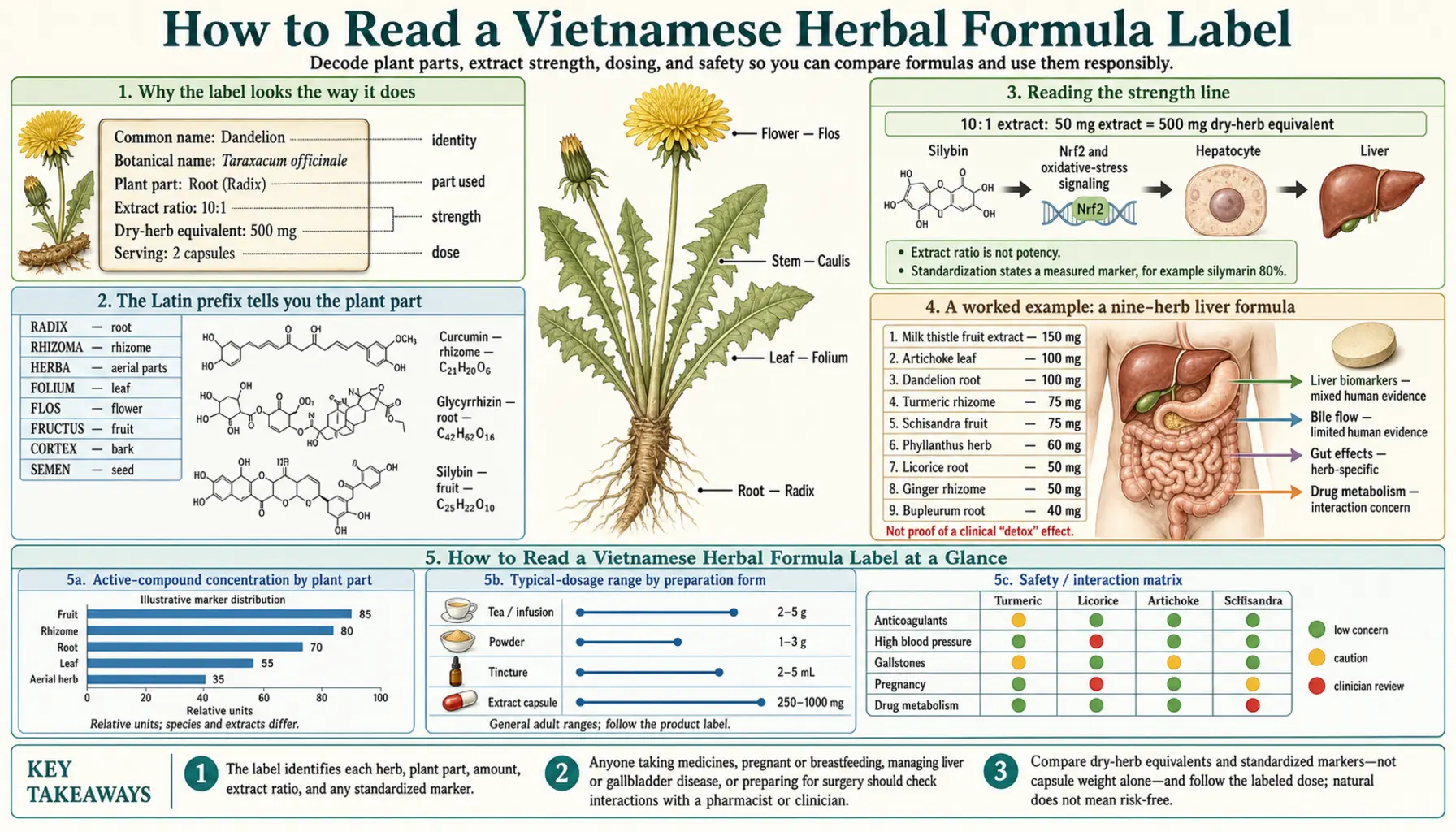
You are holding a box of Vietnamese herbal tablets. Someone gave it to you, or you bought it at an Asian grocery, or a relative brought it back from Ho Chi Minh City. The ingredient panel is a column of Vietnamese words, each followed by a phrase in italic Latin and a number in grams, and none of it means anything to you.
This page decodes that panel line by line. By the end you will be able to name every plant in the box, say which part of the plant was used, work out how much actual herb a tablet represents, and know what to ask about quality. It is a reference page, not a recommendation: it endorses no product and tells you neither to take nor to avoid anything.
Table of Contents
- Why the label looks the way it does
- The Latin prefix tells you the plant part
- Reading the strength line
- A worked example: a nine-herb liver formula
- What the formula is doing structurally
- Names that mean more than one plant
- Quality and safety questions worth asking
- A short Vietnamese-to-English glossary
- Key Research Papers
- Connections
- Featured Videos
Why the label looks the way it does
Almost every registered Vietnamese herbal product uses the same three-part pattern, once per ingredient: the Vietnamese common name (đảng sâm, bạch thược, trần bì), the Latin pharmacopeial name in italics (Radix Codonopsis, Radix Paeoniae lactiflorae), then a weight in grams or milligrams.
This is a labelling convention with legal force, not decoration. Vietnam's Ministry of Health (Bộ Y tế) regulates herbal medicines as pharmaceutical products, and a registered product must declare each medicinal material (dược liệu) by its pharmacopeial name, so that an inspector, pharmacist or customs officer anywhere can identify it without knowing Vietnamese. The same convention runs through the Chinese, Japanese, Korean and European herbal pharmacopoeias, which is why a Vietnamese box and a Taiwanese box often print the identical italic Latin phrase.
The Latin name is the part to trust. Vietnamese common names are ambiguous, sometimes badly so — see names that mean more than one plant. The Latin name exists precisely to remove that ambiguity.
It is a drug name, not a species name
Radix Codonopsis is not a botanical binomial. It does not follow the Linnaean rules and you will not find it in a plant database. It is pharmaceutical Latin, naming a material rather than an organism: read literally it says "root of Codonopsis", with the plant part as the noun and the plant behind it in the genitive case.
Once you see that grammar the panel unlocks. Radix Angelicae sinensis = "root of Angelica sinensis". Herba Phyllanthi urinariae = "aerial parts of Phyllanthus urinaria". Pericarpium Citri reticulatae = "fruit peel of Citrus reticulata". The endings shift (Angelica → Angelicae) because Latin declines its nouns, not because the plant changed. Newer pharmacopoeias, including the English Chinese Pharmacopoeia, reverse the order — Codonopsis Radix, Citri Reticulatae Pericarpium — which carries identical information. Vietnamese labels usually keep the older part-first style.
One bonus: most of these names are Sino-Vietnamese readings of Chinese characters, so they translate one-to-one into the pinyin used in research — đảng sâm = 党参 = dang shen, bạch thược = 白芍 = bai shao, cam thảo = 甘草 = gan cao, trần bì = 陈皮 = chen pi. The first syllable is often a plain adjective (bạch = white, trần = aged), and those adjectives frequently distinguish two different drugs made from closely related plants.
The Latin prefix tells you the plant part
If you remember one thing from this page, make it this table. The first word of the Latin name says which part of the plant is in the box, and the part determines the chemistry. Two products can name the same species and contain almost entirely different compounds.
| Latin word | Plant part | Example as printed | What it is in plain English |
|---|---|---|---|
| Radix | Root | Radix Codonopsis | The true root — the tapering underground organ that stores starch and sugars |
| Rhizoma | Rhizome | Rhizoma Atractylodis macrocephalae | An underground stem, not a root. Ginger and turmeric are rhizomes |
| Radix et Rhizoma | Root and rhizome | Radix et Rhizoma Glycyrrhizae | Both underground parts, dug and used together |
| Herba | Whole aerial part | Herba Phyllanthi urinariae | Everything above ground — stem, leaf, flower, often small fruit — cut and dried |
| Folium | Leaf | Folium Perillae | Leaf only, stems stripped out |
| Flos | Flower | Flos Chrysanthemi | The flower head, dried whole |
| Fructus | Fruit | Fructus Lycii | The whole fruit, flesh and seed together |
| Semen | Seed | Semen Coicis | Seed or kernel only, flesh and husk removed |
| Cortex | Bark | Cortex Cinnamomi | Bark — of trunk, stem or root |
| Pericarpium | Fruit peel / rind | Pericarpium Citri reticulatae | The outer wall of the fruit only; flesh and juice discarded |
| Ramulus | Twig | Ramulus Cinnamomi | Young twigs and small branches, not trunk bark |
| Bulbus | Bulb | Bulbus Fritillariae | A layered underground storage bulb, like garlic or an onion |
| Caulis | Stem | Caulis Spatholobi | The above-ground stem or vine, leaves removed |
| Spora | Spore | Spora Ganodermae | The dust-fine spores of a fungus, not the mushroom body |
Rarer ones include Lignum (heartwood), Stigma (flower stigmas, as in saffron) and Sclerotium (a dense fungal survival body). Animal materials use their own nouns — Cornu (horn), Concha (shell) — the words to scan for if you are vegetarian.
Why the part matters more than you would guess
The clearest example is stinging nettle. Nettle root (Radix Urticae) contains lignans and plant sterols and is studied for benign prostatic enlargement. Nettle leaf (Folium Urticae) contains flavonoids and minerals and is used as a nutritive tea and studied for hay fever. Same species, two products, two literatures, essentially no overlap — which is why a supplement labelled only "nettle 500 mg" has told you nothing.
The Asian tradition pushes this further. Ma hoàng (Herba Ephedrae), the aerial stems of ephedra, contains ephedrine and was used to induce sweating; ma hoàng căn (Radix Ephedrae), the root of the same plant, contains almost none and was traditionally used to stop sweating.
Radix et Rhizoma means the commercial material genuinely contains both, because that is how the plant is dug and traded. Licorice is the textbook case: older monographs said Radix Glycyrrhizae, but what arrives in a warehouse is a mixture of roots and creeping rhizomes, so modern pharmacopoeias renamed the drug to match reality. Ginseng, rhubarb and salvia carry the combined designation for the same reason.
Reading the strength line
Above the ingredient list, most Vietnamese herbal tablets print one line that governs everything under it. A typical one reads 700 mg cao đặc hỗn hợp dược liệu tương đương với: — word by word, cao = extract; đặc = thick or concentrated, so cao đặc is a soft extract, a paste typically still holding 15–30% water; hỗn hợp = mixed; dược liệu = medicinal herb material, the crude drug; tương đương với = equivalent to. The whole line means "700 mg of concentrated mixed herbal extract, equivalent to the following amounts of raw herb." Everything below it describes raw herb, not what is physically inside the tablet.
What "equivalent to" actually means
This is the most misread number on the box. When the list underneath adds up to 7.2 g, people conclude the tablet contains 7.2 grams of herb. It does not. A swallowable film-coated tablet weighs roughly 0.4–1.2 g in total, coating and fillers included; 7.2 g of dried herb is about a heaped tablespoon and would not fit.
What the manufacturer is saying is: we started with 1.2 g of one herb, 1.2 g of another and so on, decocted and concentrated the batch, and the 700 mg of extract paste in this tablet is the yield from that starting material. The gram figures state provenance — what went into the pot — not mass in your hand.
Divide total crude weight by extract weight and you get the drug-to-extract ratio (DER): 7.2 g ÷ 0.7 g = about 10.3 : 1, printed on European labels as DER 10:1. Ratios of 4:1 to 12:1 are ordinary for a water decoction of mixed herbs. Two caveats, because DER is easy to over-read. First, a ratio is a concentration factor, not a quality measure — a 20:1 extract is not twice as good as a 10:1 one; it may just mean the herbs yielded less soluble matter. Second, extraction is selective: hot water pulls out polysaccharides, glycosides, organic acids and water-soluble alkaloid salts, but leaves most volatile oils and fat-soluble constituents behind, and boiling drives off aromatics. That matters for a herb like trần bì (aged tangerine peel), whose traditional character comes largely from its essential oil. Nothing dishonest has happened, but "equivalent to" is equivalence of starting material, never of content.
Watch which extract is named, too: cao đặc still carries water, while cao khô (dry extract) has been dried to a powder, so an identical "equivalent to" figure implies a different ratio depending on which word is printed. And note what is almost always missing — a marker compound content such as "standardised to 4% glycyrrhizin". Without one, batch-to-batch potency is not pinned down by anything you can read.
The rest of the small print
| Vietnamese | Literal meaning | What it tells you |
|---|---|---|
| tá dược: vừa đủ 01 viên | excipients: sufficient for 1 tablet | The Latin q.s. in disguise. Fillers, binders and the film coat are declared as a group and not itemised, so if you must avoid lactose, gluten, gelatin or a dye, ask the manufacturer. |
| viên nén bao phim | film-coated tablet | viên nén = compressed tablet, bao phim = film coating, which hides bitterness and keeps moisture out. Viên nang = capsule; viên hoàn = traditional pill or bolus. |
| bảo quản | storage | Usually followed by nơi khô ráo, thoáng mát, tránh ánh sáng — dry, cool and airy, protect from light — often with a ceiling such as dưới 30°C. |
| tiêu chuẩn | standard | The specification the product is made and released against. What follows this word matters. |
| TCCS (tiêu chuẩn cơ sở) | in-house standard | The manufacturer's own written standard, filed with the regulator, rather than a public national monograph. |
| DĐVN (Dược điển Việt Nam) | Vietnamese Pharmacopoeia | The national pharmacopoeia, usually with an edition number (DĐVN V) — a public monograph anyone can look up. |
The TCCS distinction is worth stating neutrally, because it is neutral: an in-house standard is legal, extremely common, and often the only option, since national pharmacopoeias publish monographs for individual herbs and rarely for one company's nine-herb blend. It does mean, though, that you cannot look up the acceptance criteria. With a DĐVN or Chinese Pharmacopoeia monograph the identity tests, assay limits and permitted contamination levels are published and fixed; with TCCS the tests exist and the regulator has seen them, but the public cannot read what they are. That is a difference in transparency, not automatically in quality.
One more line worth finding: a Vietnamese product is either thuốc, a registered medicine, or thực phẩm bảo vệ sức khỏe, a "health-protection food" — a dietary supplement, which must carry the disclaimer "Thực phẩm này không phải là thuốc…", "this product is not a medicine and does not replace medical treatment." Finding that sentence tells you how much regulatory review stands behind whatever the front of the package implies.
A worked example: a nine-herb liver formula
Here is a real ingredient panel of the kind sold in Vietnam as a liver-support tablet, fully decoded. Read it as a demonstration of the method rather than a product recommendation — the point is that every line can be resolved.
| Vietnamese name | Latin pharmacopeial name | Plant part | English / Chinese name | Amount | Our page |
|---|---|---|---|---|---|
| Diệp hạ châu | Herba Phyllanthi urinariae | Whole aerial part | Phyllanthus urinaria — a close relative of chanca piedra | 1.2 g | Phyllanthus species compared |
| Đảng sâm | Radix Codonopsis | Root | Codonopsis pilosula, dang shen | 1.2 g | Codonopsis |
| Nhân trần | Herba Adenosmatis caerulei | Whole aerial part | Adenosma caeruleum | 1.2 g | Nhan Tran |
| Bạch thược | Radix Paeoniae lactiflorae | Root | White peony, bai shao | 0.6 g | White Peony |
| Bạch truật | Rhizoma Atractylodis macrocephalae | Rhizome | Atractylodes, bai zhu | 0.6 g | Atractylodes |
| Cam thảo | Radix et Rhizoma Glycyrrhizae | Root and rhizome | Licorice, gan cao | 0.6 g | Licorice |
| Đương quy | Radix Angelicae sinensis | Root | Dong quai, dang gui | 0.6 g | Dong Quai |
| Phục linh | Poria | Fungal sclerotium (not a plant) | Poria cocos, fu ling | 0.6 g | Poria |
| Trần bì | Pericarpium Citri reticulatae perenne | Aged fruit peel | Chen pi, aged tangerine peel | 0.6 g | Chen Pi |
Three herbs at 1.2 g and six at 0.6 g gives 3.6 + 3.6 = 7.2 g of crude-herb equivalent per tablet; against 700 mg of soft extract, that is the ~10.3:1 ratio calculated earlier. The dose hierarchy is deliberate and readable: diệp hạ châu, đảng sâm and nhân trần are the chief herbs by dose, together supplying exactly half the crude weight, while the other six share the rest equally.
Four details in the Latin column repay attention. urinariae pins the species — diệp hạ châu ("the pearl beneath the leaf", named for the tiny fruits strung under the leaf axis) is used for at least three Phyllanthus species, and the epithet tells you which. Radix Paeoniae lactiflorae is also a processing statement: white peony (bai shao) and red peony (chi shao) both come from Paeonia lactiflora, white peeled and briefly boiled, red dried raw and unpeeled, and the tradition treats them as two different drugs. macrocephalae does critical work: bare Rhizoma Atractylodis means cang zhu, from Atractylodes lancea — a different herb with a different role. And perenne means aged, specifying peel stored for years, which is the whole point of chen pi (陈皮 literally means "aged peel"). The same logic runs across genera: Radix Angelicae sinensis is dong quai, while Radix Angelicae dahuricae and Radix Angelicae pubescentis are entirely different medicines.
Poria is a fungus, not a plant
One entry has no plant-part prefix at all: it reads simply Poria. That is not an omission. Phục linh is the dried sclerotium of Wolfiporia extensa (long known as Poria cocos), a wood-decay fungus growing on pine roots — a hard, compacted survival mass of fungal tissue, roughly the size of a coconut, dug out of the soil around pine stumps. Because a fungus has no roots, leaves or fruit, none of the botanical part-nouns apply, so the pharmacopoeial name is just the fungal name.
A single bare Latin word in an otherwise two-word column is usually the tell that an ingredient is not a plant — the same happens with Ganoderma (linh chi, reishi) and with minerals such as Gypsum fibrosum. This matters if you have a mould or fungal sensitivity, and filing phục linh under "herbs" sends you to the wrong literature: its pharmacology is fungal polysaccharide and triterpene chemistry.
What the formula is doing structurally
Classical Chinese and Vietnamese formulas are not lists of ingredients each chosen because it "helps". They are built to a stated architecture, roughly a thousand years old, borrowed from the structure of an imperial court — which explains why a nine-herb blend has three herbs at one dose and six at another:
- Quân (君, jūn) — the sovereign or chief: aimed squarely at the main problem, usually at the largest dose.
- Thần (臣, chén) — the minister or deputy: reinforces the chief, or handles a major secondary aspect.
- Tá (佐, zuǒ) — the assistant: covers lesser aspects, moderates a harsh chief herb, or deliberately opposes it to prevent overshoot.
- Sứ (使, shǐ) — the envoy or guide: directs the formula toward a target and harmonises the other herbs.
Dose is one signal of role, not the only one — a small dose of a very potent herb can still be the sovereign — but in a straightforward tonic formula the two line up fairly well. In the example above, the three at 1.2 g are what the formula is built around: diệp hạ châu and nhân trần are both herbs the tradition directs at the liver (nhân trần corresponds to the Chinese category 茵陈, yin chen, the standard liver-directed herb for many centuries), while đảng sâm is a qi tonic supplying strength rather than direction.
The six at 0.6 g form a recognisable classical scaffold. Four of them — đảng sâm, bạch truật, phục linh and cam thảo — are the four ingredients of Tứ Quân Tử Thang (四君子湯, Si Jun Zi Tang, "Four Gentlemen Decoction"), the foundational qi-tonifying formula and one of the most-copied bases in the materia medica; add trần bì and you have Dị Công Tán (異功散, Yi Gong San), its classical tangerine-peel variant, present here intact. Bạch thược and đương quy are the classic blood-nourishing pair at the core of Tứ Vật Thang (四物湯, Si Wu Tang) and a fixture of formulas such as Tiêu Dao Tán (逍遙散, Xiao Yao San), which pairs liver-directed herbs with blood-nourishing ones in exactly this way. Cam thảo is the archetypal envoy: licorice appears in a very large share of classical formulas because its assigned job is to harmonise the others and sweeten a bitter decoction — charming as pharmacy history, and a real problem as toxicology, for reasons in the next section.
An important boundary. All of that describes how the formula was designed — the logic a formulator followed and the building blocks they assembled. It is architecture, not evidence, and it is not a claim that this product treats liver disease or anything else; traditional design logic tells you nothing reliable about clinical efficacy. What it is good for is orientation: once you can see that a formula is Four Gentlemen plus a liver-directed pair, you know which literature to search, which herb is present in the largest amount, and which ingredients are supporting players.
Names that mean more than one plant
Here is the trap that makes the Latin column non-negotiable. Vietnamese herb names are frequently descriptive or functional rather than taxonomic, so one name can cover several unrelated plants — sometimes plants in different families.
Nhân trần — one name, at least three plants, two families
- In most of Vietnam, nhân trần means Adenosma caeruleum, a small aromatic herb in the figwort/plantain lineage (Plantaginaceae, formerly placed in Scrophulariaceae).
- Nhân trần Tây Ninh, from the south, is Adenosma bracteosum — same genus, different species, traded separately.
- But nhân trần is the Sino-Vietnamese reading of 茵陈 (yin chen), and in Chinese medicine 茵陈 means Artemisia capillaris — a wormwood, in the daisy family (Asteraceae), not remotely related to Adenosma.
So a product labelled only "nhân trần" could contain a plantain-family herb or a wormwood, depending on who wrote the label and where they sourced. Two families, two chemistries, two research literatures. Herba Adenosmatis caerulei settles it in three words; "nhân trần" alone does not.
Diệp hạ châu — a genuine taxonomic muddle
The name means "pearl beneath the leaf" and describes the growth habit, not the species. It is applied to Phyllanthus urinaria (often the red-stemmed one, and what the worked example specifies); Phyllanthus amarus, sold as diệp hạ châu đắng, "bitter diệp hạ châu"; and Phyllanthus niruri, the name most used in English-language commerce as "chanca piedra" — though a substantial share of material sold internationally as P. niruri has on closer identification turned out to be P. amarus. These species are small, look alike, grow in the same disturbed ground, and have been confused in the botanical literature as well as in trade for over a century. They are not chemically identical; our Phyllanthus species comparison lays out the differences.
Sâm — a job description, not a genus
Sâm is best translated not as "ginseng" but as "tonic root". It is a category word attached to plants from many unrelated families:
- Nhân sâm — Panax ginseng, true Asian ginseng (Araliaceae)
- Đảng sâm — Codonopsis pilosula (Campanulaceae, the bellflower family)
- Đan sâm — Salvia miltiorrhiza, a sage (Lamiaceae)
- Huyền sâm — Scrophularia species (Scrophulariaceae)
- Sa sâm — Glehnia or Adenophora species, depending on region
- Khổ sâm — "bitter sâm": in Chinese use Sophora flavescens (a legume), but in Vietnamese use often khổ sâm cho lá, Croton tonkinensis (a spurge)
- Thổ cao ly sâm — Talinum paniculatum, sometimes sold as a cheap ginseng substitute
- Sâm Ngọc Linh — Panax vietnamensis, Vietnamese ginseng: genuinely a Panax, and genuinely expensive
Legumes, sages, bellflowers, spurges and true ginseng all wear the word sâm. A product that says only "sâm" on the front has told you almost nothing, and given the price gap between Panax vietnamensis and Talinum paniculatum, the ambiguity is commercially consequential.
Two further hazards
Missing epithets. The Latin name resolves ambiguity only if the maker printed the species epithet. A bare Radix Codonopsis leaves open C. pilosula, C. tangshen and C. lanceolata, all accepted sources in various pharmacopoeias. A bare Poria is fine because there is only one drug. A bare Rhizoma Atractylodis is not fine, as shown above.
Stripped diacritics. Vietnamese tone marks carry meaning, and export packaging and websites often drop them, collapsing distinct names into one string of letters. Transcribing a label for a pharmacist, copy the diacritics exactly — or better, photograph the panel.
The practical rule: if a label gives only a Vietnamese common name with no Latin binomial, you cannot be certain what you have. That is not hypothetical — it is the routine condition of loose herbs sold from sacks in a market, and of many products aimed at the domestic rather than the export trade.
Quality and safety questions worth asking
None of what follows is an accusation against any particular product. These are the standing, well-documented issues in the herbal-products sector generally, and the questions a pharmacist or toxicologist would ask about any imported herbal preparation.
1. Which standard, and can you read it?
TCCS is the manufacturer's own filed specification; DĐVN or a foreign pharmacopoeia is a public monograph. TCCS is legal and normal, but the acceptance limits are not published, so "meets TCCS" is a claim you cannot independently check. If you want to check, ask the seller for a certificate of analysis (COA) for the batch number printed on your box.
2. Heavy metals and pesticide residues
Two structural reasons this deserves a question. Root and rhizome drugs concentrate what is in the soil — lead, cadmium and arsenic are taken up by underground storage organs, so a root-heavy formula carries more soil-derived exposure than a flower or seed formula. And Herba drugs carry surface residue: the whole above-ground plant is cut and dried without washing or peeling, so anything sprayed or deposited on it comes along. Traditional medicines from several traditions have repeatedly been found on testing to contain heavy metals — sometimes as deliberate mineral ingredients, sometimes as contamination — so the right answer to this question is a batch COA showing heavy-metal, microbial and pesticide results.
3. Undeclared pharmaceutical adulteration
This is the most serious systemic problem in the sector, thoroughly documented in the regulatory and toxicology literature including by hospital laboratories that receive the patients. It is a general finding about the category, not a claim about anything specific in your cupboard.
The pattern is consistent: an "herbal" product is spiked with a conventional drug so that it works, and works fast. The recurring adulterants:
- Corticosteroids (dexamethasone, prednisolone) in arthritis, back pain, asthma, eczema and "strength" products
- NSAIDs (diclofenac, indomethacin, phenylbutazone) in pain and arthritis products
- Sildenafil and its chemical analogues in "tonic" and male-vitality products
- Sibutramine (a withdrawn appetite suppressant) and stimulant laxatives in weight-loss products
- Glibenclamide and related sulfonylureas in "blood sugar" herbals — capable of causing dangerous hypoglycaemia
- Sedating antihistamines and benzodiazepines in sleep and calming products
The red flag is dramatic, rapid effect. A water extract of nine tonic herbs does not abolish arthritis pain in two hours, drop blood sugar sharply, or produce reliable sedation within thirty minutes. If a herbal product does, the likeliest explanation is an undeclared drug. The corticosteroid case is worth spelling out: weeks to months of hidden steroid produces a recognisable picture — rounding of the face, weight gain around the trunk, easy bruising, thinning skin, rising blood pressure and blood sugar — and it suppresses your own adrenal glands, so stopping abruptly can precipitate an adrenal crisis, a genuine medical emergency. If you have taken an unidentified herbal product daily for months and develop those features, see a doctor with the box rather than quietly throwing it away.
4. The licorice problem, and why it compounds
Licorice deserves its own heading because of arithmetic, not because it is unusually dangerous per gram.
The mechanism. Licorice contains glycyrrhizin, which the gut converts to glycyrrhetinic acid. That compound inhibits a kidney enzyme, 11β-hydroxysteroid dehydrogenase type 2, whose job is to deactivate cortisol in kidney tissue so cortisol cannot stimulate the mineralocorticoid (aldosterone) receptor. Block it, and cortisol reaches that receptor and acts like aldosterone. The result is pseudoaldosteronism — the body behaves as though aldosterone were high while actual aldosterone is suppressed: sodium and water retention (swelling, weight gain); potassium loss, causing muscle weakness, cramps and, when severe, dangerous heart rhythms and even muscle breakdown; and rising blood pressure, sometimes substantially, with a metabolic alkalosis on blood gases.
The dose picture. European food-safety guidance has treated roughly 100 mg of glycyrrhizin per day as unlikely to cause problems in most healthy adults, with the explicit caveat that sensitive individuals respond at lower intakes; controlled studies have reported blood-pressure effects at intakes in the low milligrams-per-kilogram-per-day range. Sensitivity varies severalfold between people.
Why it compounds. A single 0.6 g crude-herb equivalent per tablet is small. But cam thảo is the envoy herb of the tradition and appears in an enormous share of Vietnamese and Chinese formulas, so someone taking three different herbal products, all containing licorice as a minor harmoniser, accumulates it across all three — and is probably also drinking herbal or "cooling" tea, and possibly eating real licorice confectionery (the black kind flavoured with actual licorice root, not anise-flavoured imitations, which contain none). Licorice is common in throat lozenges and digestive teas too. The exposure adds up across the whole shelf, which is exactly why nobody notices it. The effect also builds over weeks and resolves slowly — the enzyme inhibition is long-lasting, and blood pressure and potassium can take weeks to months to normalise after stopping — so the link between product and symptom is easy to miss in both directions.
Highest risk: anyone with hypertension, heart failure, kidney disease or existing low potassium; anyone on diuretics, which also waste potassium; anyone on digoxin, because low potassium sharply increases digoxin toxicity; anyone on corticosteroids, whose effect licorice potentiates; and anyone pregnant, since high licorice intake in pregnancy has been associated with adverse outcomes in observational research.
5. Interactions travel with the whole formula
People look up "is herb X safe with my medication" one herb at a time. A nine-herb formula has to be assessed whole, because any single ingredient can carry the interaction:
- Đương quy (dong quai) contains coumarin-type compounds and carries a longstanding caution with warfarin and other anticoagulants and antiplatelets; bleeding events have been reported.
- Cam thảo (licorice) interacts with diuretics, digoxin, corticosteroids and antihypertensives, as above.
- Đảng sâm and other tonic herbs are used as immune modulators, raising a theoretical question with immunosuppressants.
- Bạch truật and phục linh are both traditionally diuretic, stacking with prescription diuretics and with licorice's potassium losses.
- Herbal mixtures as a class can affect the CYP450 enzymes and the P-glycoprotein transporter that handle a large share of prescription drugs — the general mechanism behind most herb–drug interactions.
One more worth naming: a product marketed for the liver can still injure the liver. Herb-induced liver injury is a recognised clinical entity with its own NIH reference database, LiverTox. Warning signs are yellowing of the eyes or skin, dark urine, pale stools, persistent nausea, itching, or pain under the right ribs — reasons to stop and get liver enzymes checked, not to push through.
6. What to actually do
- Photograph the box — front, back, the full ingredient panel, and the batch number and expiry — before you open it, while the printing is clean.
- Show it to your doctor or pharmacist and have it added to your medication list. Most people never mention herbal products at all, which is precisely how interactions get missed.
- Keep the box until the product is finished. If something goes wrong, the batch number is the only thing that lets anyone trace it.
- Ask the seller for a batch COA covering heavy metals, microbial limits and pesticides. A serious supplier can produce one; the answer you get is itself information.
- Get advice first if you are pregnant or breastfeeding, have liver or kidney disease, take warfarin, digoxin, a diuretic, an immunosuppressant or chemotherapy, or have surgery scheduled within two weeks.
A short Vietnamese-to-English glossary
These words cover most of what is printed on a Vietnamese herbal package outside the ingredient names themselves.
| Vietnamese | English | Note |
|---|---|---|
| dược liệu | medicinal herb material | The crude drug — the dried plant part itself |
| cao khô | dry extract | Dried to a powder; usually contains a carrier such as maltodextrin |
| cao đặc | soft (thick) extract | A paste, typically still 15–30% water |
| tá dược | excipient | Fillers, binders, coating; declared as a group, not itemised |
| viên nang | capsule | viên nang cứng = hard capsule; viên nang mềm = softgel |
| viên nén | tablet | Compressed tablet |
| bao phim | film-coated | A thin polymer coat over the tablet core |
| liều dùng | dosage | Often paired with cách dùng, "how to take" |
| chỉ định | indications | What the product is registered for; only medicines carry these |
| chống chỉ định | contraindications | Who must not take it. Read this line first |
| tác dụng phụ | side effects | Sometimes printed as tác dụng không mong muốn |
| hạn dùng | expiry date | Often abbreviated HD; usually day/month/year |
| số lô | batch (lot) number | Often SL or Lô SX. Record this |
| nơi khô ráo | a dry place | Storage instruction |
| tránh ánh sáng | avoid light | Keep in the original opaque container |
| để xa tầm tay trẻ em | keep out of reach of children | Mandatory warning |
| đọc kỹ hướng dẫn sử dụng trước khi dùng | read the instructions carefully before use | The standard Vietnamese package warning line |
| thành phần | ingredients / composition | The heading over the ingredient panel |
| số đăng ký (SĐK) | registration number | The regulator's file number for the product |
| thực phẩm bảo vệ sức khỏe | health-protection food (supplement) | Carries the mandatory "not a medicine" disclaimer |
Key Research Papers
Bibliographic detail is given in plain text so you can find each paper by title. Each link is a PubMed search rather than a direct article ID — search links never rot and never point at the wrong study.
- Ernst E. Adulteration of Chinese herbal medicines with synthetic drugs: a systematic review. Journal of Internal Medicine. 2002;252(2):107–113. PubMed PMID: 12190885
- Posadzki P, Watson L, Ernst E. Contamination and adulteration of herbal medicinal products (HMPs): an overview of systematic reviews. European Journal of Clinical Pharmacology. 2013;69(3):295–307. PubMed PMID: 22843016
- Ching CK, Chen SPL, Lee HHC, et al. Adulteration of proprietary Chinese medicines and health products with undeclared drugs: experience of a tertiary toxicology laboratory in Hong Kong. British Journal of Clinical Pharmacology. 2018;84(1):172–178. Find on PubMed
- Newmaster SG, Grguric M, Shanmughanandhan D, Ramalingam S, Ragupathy S. DNA barcoding detects contamination and substitution in North American herbal products. BMC Medicine. 2013;11:222. Find on PubMed
- Saper RB, Phillips RS, Sehgal A, et al. Lead, mercury, and arsenic in US- and Indian-manufactured Ayurvedic medicines sold via the Internet. JAMA. 2008;300(8):915–923. Ayurvedic rather than Vietnamese, but the standard demonstration that traditional-medicine products need heavy-metal testing. PubMed PMID: 18728265
- Omar HR, Komarova I, El-Ghonemi M, et al. Licorice abuse: time to send a warning message. Therapeutic Advances in Endocrinology and Metabolism. 2012;3(4):125–138. PubMed PMID: 23185686
- Sigurjónsdóttir HÁ, Franzson L, Manhem K, et al. Liquorice-induced rise in blood pressure: a linear dose-response relationship. Journal of Human Hypertension. 2001;15(8):549–552. PubMed PMID: 11494093
- Størmer FC, Reistad R, Alexander J. Glycyrrhizic acid in liquorice — evaluation of health hazard. Food and Chemical Toxicology. 1993;31(4):303–312. PubMed PMID: 8386690
- Li S, Zhang B. Traditional Chinese medicine network pharmacology: theory, methodology and application. Chinese Journal of Natural Medicines. 2013;11(2):110–120. The main framework for studying multi-herb formulas as systems rather than single actives. Find on PubMed
- Yu X, Sun S, Guo Y, et al. Citri Reticulatae Pericarpium (Chenpi): botany, ethnopharmacology, phytochemistry and pharmacology of a frequently used traditional Chinese medicine. Journal of Ethnopharmacology. 2018;220:265–282. PubMed PMID: 29628291
PubMed Topic Searches
- PubMed: Vietnamese traditional medicine — quality control
- PubMed: Herbal adulteration with undeclared pharmaceuticals
- PubMed: Heavy metals in traditional herbal medicines
- PubMed: Glycyrrhizin, pseudoaldosteronism and hypokalaemia
- PubMed: 11β-HSD2 and glycyrrhetinic acid
- PubMed: Phyllanthus urinaria / amarus / niruri identification
- PubMed: Adenosma caeruleum and Artemisia capillaris
- PubMed: Si Jun Zi Tang (Four Gentlemen Decoction)
- PubMed: Herb–drug interactions: CYP450 and P-glycoprotein
- PubMed: Herb-induced liver injury
- PubMed: DNA barcoding for medicinal plant authentication
- PubMed: Poria cocos / Wolfiporia extensa chemistry
Connections
- All Herbs
- Nhan Tran — the name that means three plants
- Codonopsis (đảng sâm) — the "ginseng" that is not one
- White Peony (bạch thược) — the peeled, boiled root
- Atractylodes (bạch truật) — where the epithet decides the herb
- Dong Quai (đương quy) — the anticoagulant interaction
- Licorice (cam thảo) — the envoy herb and pseudoaldosteronism
- Chen Pi (trần bì) — why perenne is on the label
- Poria (phục linh) — the fungus with no plant-part prefix
- Phyllanthus species compared — urinaria vs amarus vs niruri
- Toxins — heavy metals and what testing covers