Torch Ginger (Etlingera elatior)
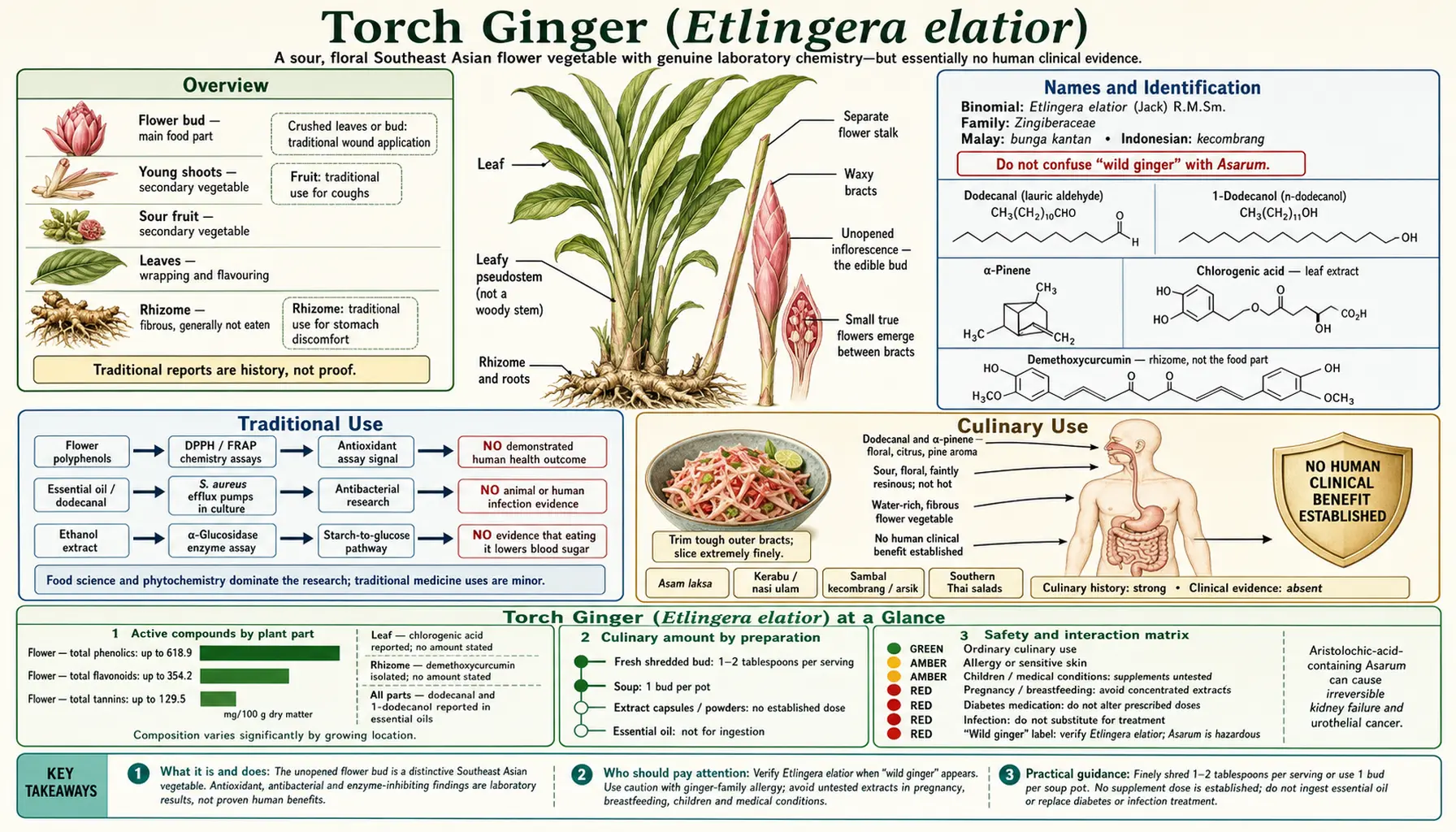
Torch ginger is the flower of Etlingera elatior, a giant clumping member of the ginger family whose waxy pink inflorescence rises straight out of the ground on its own stalk, apart from the leaves, like a lit torch pushed into the soil. Across maritime Southeast Asia the unopened bud is not an ornament but a vegetable and a souring aromatic — shredded fine into Penang asam laksa, pounded into Sumatran sambal, tossed raw through Malay and southern Thai salads. This is a plant of the kitchen, not of the pharmacy: the part used is the flower bud, not a rhizome.
It is worth being blunt about the evidence up front, because torch ginger is increasingly sold as a "superfood" powder on the strength of laboratory antioxidant numbers. There is essentially no human clinical literature on this plant. Its antioxidant, antibacterial and enzyme-inhibiting activities have been measured in test tubes and cell lines, and that work is real, but nobody has shown that eating torch ginger changes any health outcome in a person. It is a nutritious, characterful vegetable with a modest laboratory profile, and that is the accurate description of it.
Table of Contents
- Overview
- Names and Identification
- Traditional Use
- Culinary Use
- Active Compounds
- Antioxidant Activity
- Antimicrobial Activity
- Other Laboratory Findings
- Forms and Preparations
- Dosage
- Cautions and Contraindications
- Key Research Papers
- Connections
- Featured Videos
Overview
Etlingera elatior (Jack) R.M.Sm. is one of the largest herbs anyone is likely to cook with. The leafy pseudostems — sheathed leaf bases, not true woody stems — grow in dense clumps to four, five, sometimes six metres. The flower does not appear among them. Instead a separate, much shorter stalk pushes up directly from the rhizome, thirty centimetres to a metre tall, topped by a cone of thick, waxy, overlapping bracts in shocking pink, coral or deep red. That cone is the inflorescence, and in bud — before the small true flowers emerge from between the bracts — it is the part that goes into the pot.
The plant is native to the Malay Peninsula, Sumatra, Java and Borneo, and is now grown throughout the humid tropics, including Central America and Brazil, largely as a cut flower. It wants heat, constant moisture and part shade, and once established a clump throws flower stalks more or less continuously, which is why the bud is a market vegetable rather than a seasonal treat.
The part used matters, and it is not the rhizome. This distinguishes torch ginger from almost every other plant in the ginger family that reaches a kitchen. Ginger, galangal, turmeric, fingerroot and kencur are all rhizome crops. Torch ginger's rhizome is fibrous and generally not eaten; the harvest is the unopened flower bud, with the young shoots and the sour fruit eaten locally as secondary vegetables. In a market it is sold by the bud, wrapped like a cut flower, and it wilts fast — good buds are firm, tightly closed and heavy for their size.
Names and Identification
Binomial: Etlingera elatior (Jack) R.M.Sm. Family: Zingiberaceae. Part used: unopened inflorescence (flower bud); secondarily the young shoots, fruit and leaves.
Older botanical literature places it in genera that have since been merged, so you will meet it in references as Nicolaia elatior, Nicolaia speciosa, Phaeomeria magnifica and Alpinia elatior. These are synonyms for the same plant, not different species.
- Malay: bunga kantan (literally "kantan flower"); also bunga siantan.
- Indonesian: kecombrang; Sundanese honje; in parts of Java bongkot; Batak (North Sumatra) rias or kincung.
- Thai: ดอกกาหลา (dok kahlaa), a southern Thai ingredient more than a central Thai one.
- Vietnamese: hoa gừng ("ginger flower").
- English trade names: torch ginger, ginger flower, torch lily, red ginger lily, Philippine wax flower, and — in ornamental horticulture — "porcelain rose".
One name to be careful with: torch ginger is occasionally listed as "wild ginger" in English-language plant catalogues. That phrase is a genuinely hazardous label, because in North America and Europe "wild ginger" normally means Asarum, a group of plants that contain aristolochic acid — a nephrotoxin and human carcinogen. The two plants have nothing to do with each other. If a product is sold to you as "wild ginger", find out the binomial before you touch it. The problem is explained in full on the Shampoo Ginger (Zingiber zerumbet) page.
Traditional Use
Torch ginger's traditional record is overwhelmingly culinary, which is unusual and worth stating plainly: this is a food plant that has picked up a few folk-medicine uses, rather than a medicine that is occasionally eaten. Where medicinal uses are recorded across Malaysia and Indonesia they are domestic and minor — the crushed leaves or bud applied to wounds, a decoction used for earache or as a wash, the fruit taken for coughs, the plant used to sweeten breath and body odour, and the bud regarded as a digestive and appetite-stimulating vegetable. Two more specific uses turn up in the pharmacological literature and are worth naming: the rhizome (not eaten, but occasionally prepared as a folk remedy) has a documented traditional use for stomach discomfort, and in Aceh Province, Sumatra, the plant is recorded as a traditional treatment for diabetes. Neither is a culinary use, and neither is proof the remedy works — see Benefits: Digestive Complaints and Gastric Protection for what modern research has and has not shown.
The 2026 systematic review of torch ginger research by Zendrato and Masruchin makes the same point from the other direction: the plant enters the scientific literature only in 1997, and the research that followed has been driven mostly by food science and phytochemistry rather than by a deep ethnomedical tradition demanding explanation. There is no classical materia medica entry to point at here, no Ayurvedic or Chinese-medicine lineage. It is a vegetable that is very good in a laksa.
As always on this site: traditional use is history, not proof. In this case there is not even much history to over-interpret.
Culinary Use
This is the real subject of the page. Torch ginger bud is one of the defining flavours of the Malay-Sumatran culinary world, and it does something no other ingredient quite does: it is simultaneously sour, floral and faintly resinous, with a crisp, layered texture like a firm onion. It is not hot. People expecting ginger's heat are surprised — the flavour sits much closer to a citrus-and-herb note, with a soapy-floral edge that is either the best thing in the bowl or an acquired taste, depending on the eater.
Preparation. The bud is trimmed of its tough outer bracts and the base, then sliced extremely finely — a proper Penang cook shreds it into threads almost like tobacco. Fine shredding is not decoration; the bracts are fibrous, and a coarse cut is unpleasant to chew and releases far less aroma. Whole or halved buds are also simmered in broths and then removed or eaten soft.
Penang asam laksa
Asam laksa is the dish that makes torch ginger famous, and it is a genuinely essential component rather than a garnish that could be dropped. The soup is built on poached and flaked mackerel or sardine in a broth soured with tamarind (asam, which is what gives the dish its name) and often asam gelugur, the dried slices of Garcinia fruit. Into that goes a rempah of chilli, shallot, lemongrass, galangal, belacan (fermented shrimp paste) and daun kesum (Vietnamese coriander/Persicaria odorata), which is the other irreplaceable herb in the dish.
Thick rice noodles are ladled over, and the bowl is finished with a raw crown of shredded cucumber, pineapple, red onion, red chilli, mint, lettuce and — the aromatic that ties it together — finely shredded bunga kantan. Many cooks also drop a split bud into the simmering broth. The role it plays is to lift a heavy, funky, sour fish broth with a high floral top note; without it the bowl tastes flat and closed-in. Ask in Penang whether you can leave it out and the answer is no.
Malay and Nyonya kerabu and nasi ulam
Kerabu are Malay raw salads dressed with lime juice, chilli, toasted grated coconut (kerisik) and sometimes fish sauce — kerabu mangga with green mango, kerabu taugeh with bean sprouts. Shredded bunga kantan is a standard component. Nasi ulam — rice tossed with a dozen or more finely chopped raw herbs — is practically a showcase for it, sitting alongside daun kesum, turmeric leaf, kaffir lime leaf and wild pepper leaf. Nasi kerabu, the blue rice dish of Kelantan and Terengganu, uses it in the same way.
Sumatran and Batak cooking
In North Sumatra the plant is rias or kincung, and it appears in arsik — the Batak dish of carp (or other fish) simmered dry with a paste of turmeric, garlic, shallot, lemongrass, candlenut, torch ginger and the citrus-numbing Batak pepper andaliman. In Javanese and Sundanese kitchens kecombrang or honje goes into sambal kecombrang, into pepes (banana-leaf parcels steamed or grilled), into urap vegetable-and-coconut salads, and into oseng stir-fries with tempeh or anchovy. The sour bud does the job that tamarind or unripe fruit does elsewhere, with aroma attached.
Southern Thailand
As dok kahlaa the bud is a southern Thai ingredient rather than a national one, sliced raw into salads and served as one of the raw vegetables alongside nam phrik chilli dips and the rice-noodle-and-curry spreads of the deep south. Its sourness makes it a natural partner to the region's very hot, very salty curries.
Other parts
The young shoots are eaten as a vegetable, and the fruit — a clustered, sour, fig-like structure at the base of the spent flower — is eaten in Sumatra and used to sour dishes. The leaves are used as a wrapping and flavouring rather than eaten.
Nutritional character
As a food, torch ginger bud is what a fibrous, water-rich flower vegetable would be expected to be: very low in calories, high in water and fibre, with modest amounts of minerals and a meaningful load of the phenolic compounds discussed below. It is not a protein, fat or micronutrient powerhouse, and it is eaten in the quantities of a garnish, so its dietary contribution is mostly flavour and fibre. Nobody eats a bowl of it.
Active Compounds
The flower is the best-studied part, and its chemistry splits into two fractions that behave very differently.
Phenolics and flavonoids (the water- and ethanol-soluble fraction). The bud is rich in phenolic acids and flavonoids, which is what drives its antioxidant assay numbers. Ghasemzadeh and colleagues measured flowers grown in three Malaysian states and found total phenolic content up to 618.9 mg/100 g dry matter, total flavonoids up to 354.2 mg/100 g and total tannins up to 129.5 mg/100 g in the best-performing aqueous extracts, from Kelantan. The same study found the figures varied significantly by growing location, which is the single most useful practical finding in the phytochemistry: torch ginger's composition is not a fixed property of the species. Chan and colleagues separately characterised a standardised chlorogenic acid extract from the leaves — chlorogenic acid being the same polyphenol that dominates coffee.
Essential oil (the volatile fraction). This is what you actually smell. Analysis of the oils from three cultivars by gas chromatography–mass spectrometry identified 43 constituents, with α-pinene, dodecanal and n-dodecanol as the major components in every cultivar. Dodecanal (lauric aldehyde) is a long-chain aldehyde with a distinctive soapy-citrus-floral odour used in perfumery, and it explains the bud's characteristic waxy-floral note far better than any ginger-family cliché would. α-Pinene is the pine-and-rosemary terpene found across the plant kingdom. The 2026 systematic review reports dodecanal and 1-dodecanol in essential oils from all parts of the plant, and n-hexadecanoic acid (palmitic acid) throughout the extractives, across a literature describing some 85 major compounds.
Notably near-absent from the edible flower and its aroma: gingerols, the pungent principle of ginger itself, have not been reported here, and the flower's own volatile chemistry runs to α-pinene and dodecanal rather than galangal- or turmeric-type compounds — which is exactly why it tastes the way it does. One exception is worth naming precisely rather than glossing over: phytochemical work on the rhizome — not the part anyone eats — has isolated diarylheptanoids, including the curcuminoid demethoxycurcumin, that inhibited lipid peroxidation more potently than alpha-tocopherol in vitro. That is a real finding about a real part of this plant; it is just not the part in anyone's laksa. See Benefits: Antioxidant Activity and Organ Protection for the citations.
Antioxidant Activity
What has been shown: aqueous and ethanolic flower extracts scavenge the DPPH radical (up to 76.4% in the best Kelantan aqueous extract) and reduce ferric iron in the FRAP assay (6.88 mM Fe(II)/g), with essential oils also showing antioxidant activity in the work of Abdelwahab and colleagues. Activity tracks the phenolic content, as it almost always does.
What that means: DPPH and FRAP are chemistry experiments in a tube. They measure how readily a mixture donates electrons to a coloured indicator. They do not measure absorption, they do not measure what happens to the compounds after a liver sees them, and they do not predict any effect in a body. Plenty of substances that score brilliantly in these assays do nothing useful when eaten, and the broader story of antioxidant supplements over the past three decades is that high assay scores have repeatedly failed to translate into clinical benefit.
The honest reading of torch ginger's antioxidant data is that it is a polyphenol-containing vegetable, like most vegetables. That is a reason to eat it happily as food. It is not a reason to buy a capsule.
Antimicrobial Activity
Torch ginger extracts and essential oils inhibit the growth of common test bacteria in culture, including Staphylococcus aureus and Escherichia coli. The most mechanistically interesting work is that of de Sousa Ferreira and colleagues, who examined the essential oil against efflux pumps in S. aureus — the molecular machinery bacteria use to pump antibiotics back out before they can act. Compounds that block efflux pumps are of real interest because they could, in principle, restore the potency of existing antibiotics rather than replace them.
But the limits here are absolute. Every one of these findings is in vitro: a plant extract at a defined concentration in direct contact with bacteria in a dish. Nothing has been tested in an infected animal, let alone a person. The concentrations that inhibit growth in a dish are frequently unachievable in human blood or tissue at any tolerable dose. Torch ginger has no role in treating any infection, and an infection is not a condition to experiment on. The plausible near-term application of this work is food preservation — a natural antimicrobial in a food matrix — and that is how most of the papers frame it.
Other Laboratory Findings
- α-Glucosidase inhibition. Zumaidar and colleagues reported that an ethanol extract of E. elatior from the Gayo Highlands of Aceh inhibits α-glucosidase in vitro. α-Glucosidase is the intestinal enzyme that breaks starch fragments into glucose; blocking it is how the diabetes drug acarbose works. This is a test-tube enzyme assay. It is not evidence that eating torch ginger lowers blood sugar, and it must not be used to justify altering diabetes treatment.
- Cell-line cytotoxicity. Flower extracts show activity against cultured cancer cell lines in MTT assays. Almost every plant extract does at sufficient concentration — killing cells in a dish is a low bar, which is why this class of finding rarely progresses. There is no animal or human anticancer data.
- Anti-inflammatory, anti-aging, anti-hyperuricemic and anti-obesity signals. The 2026 systematic review catalogues reports of all of these, concentrated in flower extracts, and notes that stem, rhizome and fruit extracts sometimes outperform the flower. All of it is preclinical, and the review's own conclusion is a call for further research, not a statement of established effect.
- Mosquito oviposition deterrence. The essential oil at 100 ppm deterred gravid Aedes aegypti females from laying eggs, with electroantennography identifying dodecanal among the constituents that trigger a response in the mosquito's antennae. A neat piece of chemical ecology, and the finding least likely to be misread as a health claim.
Forms and Preparations
- Fresh flower bud. The only form with a real track record. Sold in Southeast Asian markets and in well-stocked Asian grocers abroad, sometimes frozen. Choose firm, tightly closed, brightly coloured buds; refrigerate wrapped in damp paper and use within a few days, as they wilt and lose aroma quickly.
- Frozen or vacuum-packed shredded bud. Common in export markets. Aroma survives freezing better than texture.
- Dried bud or powder. Widely sold, and much of the volatile character — dodecanal is what you are paying for — is lost on drying. Useful for colour and sourness, not a substitute in a laksa.
- Extract capsules and "superfood" powders. Sold on the strength of the antioxidant assay numbers. There is no human trial of any of these products, no established dose and no standardisation. There is no good reason to prefer them to eating the vegetable.
- Essential oil. A research and fragrance material, not something to ingest.
Dosage
There is no established dose, because there is no established therapeutic use and no human trial to derive one from. Any number printed on a supplement label for torch ginger is a manufacturing decision, not a clinical finding.
The sensible framing is culinary: torch ginger is eaten as a shredded aromatic in the quantity of a tablespoon or two per serving, or as one bud split into a pot of soup. It has been consumed in those amounts by very large numbers of people for a very long time, and that is a reasonable basis for confidence that eating it as food is fine. It is not a basis for confidence about concentrated extracts, which nobody has a comparable history with.
Cautions and Contraindications
Torch ginger's safety record is, on the whole, the reassuring kind: a widely eaten vegetable with no signal of harm from ordinary culinary use. The cautions worth stating are correspondingly modest but not zero.
- Identification is the real risk. The only genuinely dangerous thing about torch ginger is the name "wild ginger" occasionally attached to it in catalogues. If you are buying a dried or powdered product, buy it under the binomial Etlingera elatior. Aristolochic-acid-containing Asarum species travel under the same English label and cause irreversible kidney failure and urothelial cancer. See Shampoo Ginger for the full explanation.
- Allergy. Reactions to the ginger family are uncommon but real, and contact with the sap of large Zingiberaceae can irritate sensitive skin. Anyone who reacts to ginger, turmeric, galangal or cardamom should approach a new family member cautiously.
- Pregnancy and breastfeeding. Culinary quantities of a common vegetable are reasonably regarded as fine, and it is eaten routinely by pregnant women across Southeast Asia. Concentrated extracts and supplements are a different matter and should be avoided — there is no safety data on them at all, in anyone.
- Diabetes medication. Given the α-glucosidase finding, do not treat a torch ginger supplement as a blood-sugar therapy or as a reason to change any prescribed dose. The evidence does not remotely support it, and unmanaged diabetes causes real harm.
- Children and medical conditions. As a food, unremarkable. As a supplement, untested — which is a reason to skip it rather than a reason to worry.
- Do not treat infections with it. The antibacterial data is entirely in vitro. Delaying antibiotic treatment for a real infection in favour of a plant extract is how minor infections become serious ones.
Key Research Papers
- Zendrato HM, Masruchin N. Trends and multidisciplinary research of torch ginger [Etlingera elatior (Jack) R.M.Sm.]: a systematic review. Journal of Ethnopharmacology. 2026;360:121160.
- Ghasemzadeh A, Jaafar HZ, Rahmat A, Ashkani S. Secondary metabolites constituents and antioxidant, anticancer and antibacterial activities of Etlingera elatior (Jack) R.M.Sm grown in different locations of Malaysia. BMC Complementary and Alternative Medicine. 2015;15:335.
- Abdelwahab SI, Zaman FQ, Mariod AA, Yaacob M, et al. Chemical composition, antioxidant and antibacterial properties of the essential oils of Etlingera elatior and Cinnamomum pubescens Kochummen. Journal of the Science of Food and Agriculture. 2010;90(15):2682–2688.
- Bezerra-Silva PC, Dutra KA, Santos GK, Silva RC, et al. Evaluation of the activity of the essential oil from an ornamental flower against Aedes aegypti: electrophysiology, molecular dynamics and behavioral assays. PLoS ONE. 2016;11(2):e0150008.
- de Sousa Ferreira F, de Araújo Neto JB, de Morais Oliveira-Tintino CD, de Araújo ACJ, et al. Chemical composition and antibacterial effects of Etlingera elatior (Jack) R.M. Smith against Staphylococcus aureus efflux pumps. Chemico-Biological Interactions. 2023;386:110751.
- Chan EW, Lim YY, Tan SP. Standardised herbal extract of chlorogenic acid from leaves of Etlingera elatior (Zingiberaceae). Pharmacognosy Research. 2011;3(3):178–184.
- Zumaidar Z, Asmilia N, Saudah S, Husnah M. In vitro alpha-glucosidase inhibitory effect of Etlingera elatior ethanol extract growing in Gayo Highland, Aceh Province, Indonesia. F1000Research. 2024;13:489.
- Lima APP, Lima EB, Florêncio NB, Freitas DV, et al. Antibacterial activity of ZnBTC-MOF combined with essential oil from Etlingera elatior and major compounds against Staphylococcus aureus and Escherichia coli. Chemistry & Biodiversity. 2025;22(10):e03261.
Live PubMed Searches
- Etlingera elatior — all results
- Etlingera elatior antioxidant activity
- Etlingera elatior antibacterial activity
- Etlingera elatior essential oil
- Etlingera elatior clinical trials
- Bunga kantan
- Kecombrang
- Dodecanal in essential oils
- Edible flowers of the Zingiberaceae
- Chlorogenic acid as a dietary polyphenol
Connections
- All Herbs
- Galangal — the other big Southeast Asian Zingiberaceae aromatic, and a rhizome rather than a flower.
- Ginger (Zingiber officinale) — the family reference plant, and a useful contrast: torch ginger contains none of ginger's pungent gingerols.
- Shampoo Ginger (Zingiber zerumbet) — read this before buying anything sold as "wild ginger".