White Turmeric / Zedoary (Curcuma zedoaria)
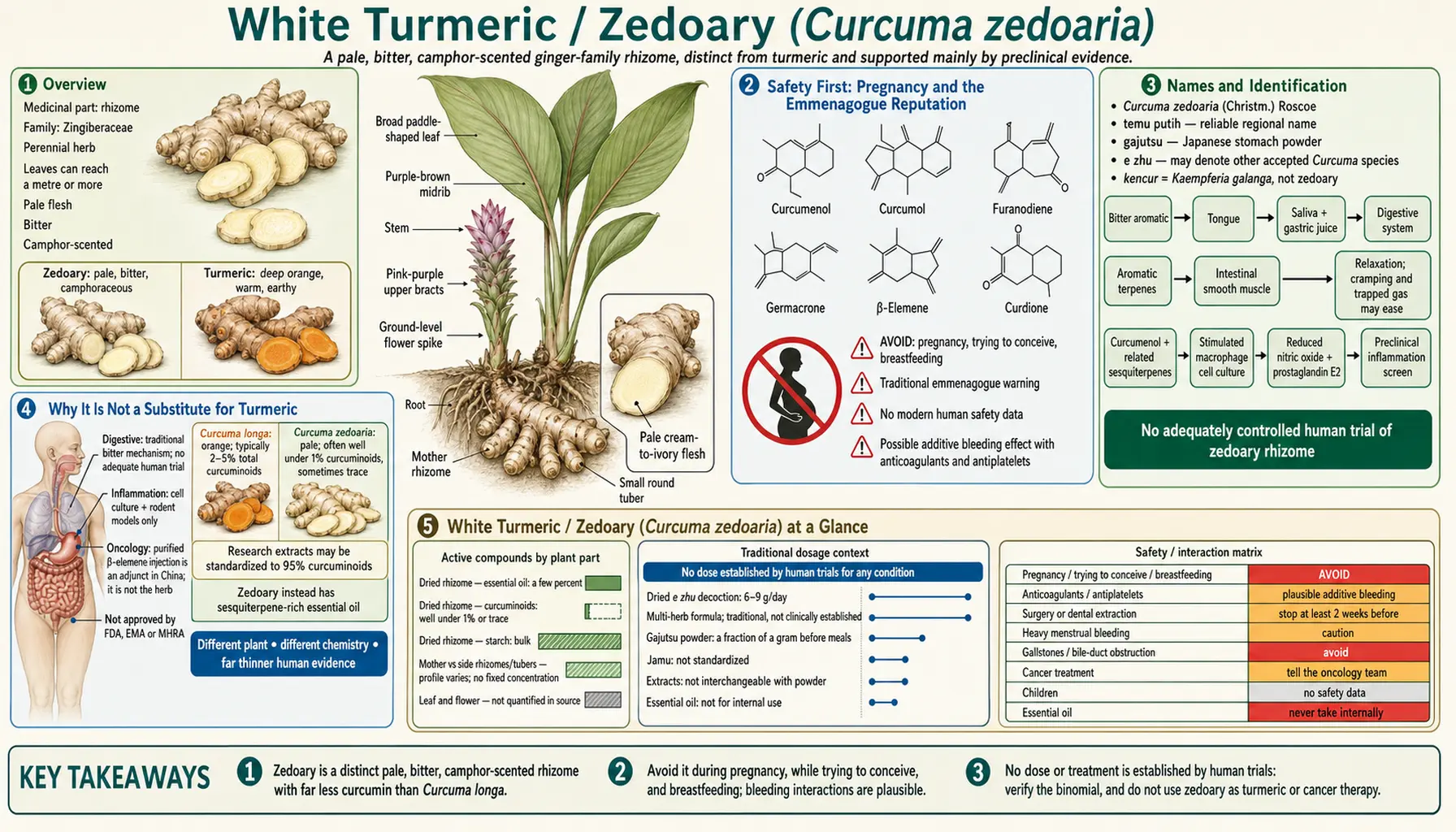
Zedoary is a ginger-family rhizome sold as “white turmeric,” and that name is the source of almost every problem on this page. It is Curcuma zedoaria, a different species from the turmeric in your spice cupboard (Curcuma longa): pale-fleshed instead of orange, sharply bitter and camphor-scented instead of warm and earthy, and containing far less curcumin — which is precisely why it cannot stand in for turmeric, in a curry or in a supplement.
⚠ Two things belong in the first paragraph rather than buried at the bottom. First, zedoary is traditionally contraindicated in pregnancy in both Chinese and Indian medicine, on the grounds that it moves blood and provokes menstruation; there is no modern human safety data to overturn that caution or to confirm it, and “no data” is a reason to avoid a herb in pregnancy, not a reassurance. Second, the human evidence for taking zedoary rhizome for any condition is essentially absent. Almost everything you will read about it comes from cell-culture and rodent work, or from a purified compound given by injection in a hospital — which is a very different thing from a capsule of powdered root.
Table of Contents
- Overview
- Safety First: Pregnancy and the Emmenagogue Reputation
- Names and Identification
- Why It Is Not a Substitute for Turmeric
- Traditional Use
- Active Compounds
- β-Elemene and the Chinese Injectable
- Digestive and Anti-Inflammatory Claims
- Antimicrobial and Antioxidant Laboratory Work
- Culinary Use
- Forms and Preparations
- Dosage
- Cautions and Contraindications
- Key Research Papers
- Connections
- Featured Videos
Overview
Curcuma zedoaria (Christm.) Roscoe is a perennial herb in the ginger family, Zingiberaceae — the same family as ginger, galangal, cardamom and turmeric. Like its relatives it grows from an underground rhizome, sending up broad paddle-shaped leaves that can reach a metre or more, often with a purple-brown flush along the midrib. The flowers appear on a separate spike at ground level, with showy pink or purple upper bracts that make the plant popular as an ornamental in tropical gardens.
The part used is the rhizome. Two grades exist in the trade: the fat central “mother” rhizome, and the finger-like side rhizomes and the small round tubers that hang off the roots. Cut open, the flesh is pale — cream, ivory, or a washed-out greenish-yellow — sometimes with a faint bluish or grey cast toward the centre. That pallor is the whole reason for the English name. Beside a slice of ordinary turmeric, which is a saturated traffic-cone orange, zedoary looks bleached.
The species is thought to have originated in northeast India and the Indonesian archipelago, and it has been carried by cultivation and trade across South and Southeast Asia, southern China, Taiwan and southern Japan. It is grown commercially at modest scale in India, Bangladesh, Indonesia, Thailand, Vietnam and Japan. In practice a Western reader meets it in one of four ways: as dried grey-brown slices in a Chinese herbal pharmacy labelled e zhu; as a Japanese stomach powder called gajutsu; as a Southeast Asian market rhizome called temu putih; or — most misleadingly — as a capsule or powder sold online under the name “white turmeric” with marketing copy quietly borrowed from the curcumin literature.
Its smell is the fastest way to tell it from turmeric without a laboratory. Fresh zedoary is camphoraceous and slightly mango-like, with a bitterness that lingers at the back of the tongue. Turmeric is warm, peppery and earthy, and its bitterness is mild. If a powder sold as “white turmeric” tastes like nothing much, you are probably holding starch.
Safety First: Pregnancy and the Emmenagogue Reputation
⚠ Zedoary should not be taken during pregnancy. This is the one instruction on the page that carries real weight, and it deserves explaining rather than asserting.
In traditional Chinese medicine, e zhu belongs to the category of herbs that “break blood stasis and dissipate accumulations.” That is a strong classification. It sits with the most forceful blood-movers in the pharmacopoeia, and classical texts pair it with an explicit warning: it is contraindicated in pregnancy and used only with caution in women with heavy or prolonged menstrual bleeding. Ayurvedic and Southeast Asian traditions describe the rhizome in similar terms, as an emmenagogue — a substance that brings on menstruation. Several regional traditions have used related Curcuma preparations postpartum, to help clear the uterus, which is the same pharmacological reputation viewed from the other side of delivery.
What we do not have is modern data. There are no controlled human studies of zedoary in pregnancy, no pharmacovigilance series worth the name, and no reproductive toxicology package of the kind a drug would need. That leaves two facts standing side by side: centuries of traditional practitioners independently flagging this rhizome as dangerous to a pregnancy, and no modern evidence either way. The reasonable reading of those two facts together is avoidance — during pregnancy, while trying to conceive, and while breastfeeding, where there is likewise no data.
The same “moves blood” reputation is the basis for a second caution that applies to everyone: a theoretical additive effect with anticoagulant and antiplatelet drugs. That is discussed in full under Cautions and Contraindications.
Names and Identification
The binomial is Curcuma zedoaria (Christm.) Roscoe, family Zingiberaceae. The genus name comes from the Arabic kurkum, the species name from the medieval Latin zedoaria, itself traced back through Arabic zadwar to a Persian root. The word reached Europe long before the plant was botanically described — zedoary was a recognised article of the medieval European spice and drug trade, arriving overland with pepper and ginger.
Local names, and the traps in them:
- Indonesian and Malay: temu putih (“white temu”). Temu is the generic Malay-Indonesian word for a Curcuma rhizome, and the colour word after it does the identifying work. Temu putih is the reliable regional name for this species.
- A name to be careful with: kencur (older Dutch-era spelling kentjoer / kentjur). Some older colonial-period drug lists and trade glossaries print this alongside zedoary, and it is still occasionally repeated in supplement copy. In modern Indonesian usage kencur means Kaempferia galanga — aromatic ginger or sand ginger, a different genus with a completely different aroma and chemistry. If a listing offers you “kencur (zedoary),” the seller is working from a bad glossary. Use temu putih when you want this plant.
- Chinese: 莪术 é zhú. Also a trap, and a more technical one. In the Chinese Pharmacopoeia the drug Curcumae Rhizoma (莪术) is not one species — it is accepted from Curcuma phaeocaulis, Curcuma kwangsiensis or Curcuma wenyujin. Older literature frequently treats C. zedoaria and C. phaeocaulis as the same plant or as close synonyms, which is why Chinese e zhu research is routinely cited on Western “zedoary” pages. It is usually close, but it is not necessarily the identical species, and the essential-oil profiles of these plants differ. Note also that 姜黄 jiāng huáng is ordinary turmeric (C. longa), and 郁金 yù jīn is the root tuber of this same group of plants — three different Chinese drugs from one small group of species.
- Thai: khamin oi (ขมิ้นอ้อย). Khamin is turmeric; khamin chan is C. longa. Again, the qualifier carries the species.
- Vietnamese: nghệ đen or nga truật. Nghệ đen translates literally as “black turmeric” — but in Vietnam it means this plant, not Curcuma caesia. This is one of the reasons the black turmeric market is such a mess.
- Hindi and Bengali: kachur / kachura; Sanskrit karchura. In Bengal the starch extracted from the rhizome is sold as shoti.
- Japanese: gajutsu (ガジュツ), cultivated notably on Yakushima and sold as a bitter stomach powder.
To identify a rhizome in hand: C. zedoaria is pale-fleshed and camphoraceous; C. longa is deep orange and earthy; C. zanthorrhiza (temulawak) is large, dark orange-brown and distinctly bitter; C. caesia has a bluish-black core. Powders are much harder — colour is the only cue most buyers have, and colour is trivially faked.
Why It Is Not a Substitute for Turmeric
This is the practical heart of the page. People buy “white turmeric” expecting a turmeric-like product, and it is not one.
The curcumin gap. The three curcuminoids — curcumin, demethoxycurcumin and bisdemethoxycurcumin — are the orange pigments in turmeric and the compounds behind nearly all of the modern turmeric research. Dried C. longa rhizome typically runs somewhere around 2–5% total curcuminoids by weight, and selected cultivars can go higher. Published analyses of C. zedoaria report curcuminoids at a small fraction of that — often well under one percent, and in many samples only trace amounts. Exact figures vary with cultivar, growing region, harvest age and the analytical method used, so no single number should be treated as definitive; but the direction and the size of the gap are consistent across the literature and are visible with the naked eye. The colour is the curcumin. A pale rhizome cannot contain much of it.
That has a blunt consequence. If you are taking turmeric because of what you read about curcumin — the joint-pain trials, the inflammatory-marker studies, the standardised 95%-curcuminoid extracts used in research — then zedoary does not deliver any of it. Substituting white turmeric for turmeric is not a lateral move to a gentler version of the same herb. It is a switch to a different plant with a different chemistry and a far thinner evidence base.
The flavour gap. In cooking the substitution fails for the opposite reason: zedoary is too assertive, not too weak. It is bitter and camphoraceous where turmeric is mild and earthy, and it will dominate a dish that expected turmeric to sit in the background. It also will not colour anything.
What zedoary has instead is a rich sesquiterpene essential oil — a genuinely interesting chemistry in its own right, described in the next section. The honest framing is that zedoary is a distinct medicinal plant with its own traditions and its own (mostly preclinical) research, not a variant of turmeric.
Traditional Use
Traditional use is history. It tells you what people believed and what they did, which is genuinely worth knowing, but it is not evidence that a treatment works.
Chinese medicine. E zhu is classified among the blood-invigorating, stasis-breaking herbs. Classical indications centre on palpable abdominal masses, fixed stabbing pain, amenorrhoea with clotting, and food stagnation — the pattern language of stubborn, static accumulations. It is usually paired with san leng (Sparganium) in formulas of this type, and often prepared with vinegar (醋莪术) on the theory that vinegar directs the herb toward the liver. Because of its strength, classical sources restrict it in the weak and depleted, and forbid it in pregnancy.
Ayurveda and Indian folk medicine. Karchura / kachur appears as a digestive and carminative, for bloating, poor appetite and sluggish digestion, and in preparations for coughs and for skin complaints. The starch was and is a food for infants, convalescents and people with sensitive digestion — a use rooted in the rhizome being an easy source of calories rather than in any pharmacological claim.
Southeast Asia. In Indonesian jamu, temu putih features in bitter tonic mixtures for appetite and digestion, and in postpartum preparations. Thai and Malay traditions use it similarly, and in Thailand young rhizomes and shoots of several Curcuma species are eaten fresh as a bitter vegetable alongside chilli pastes.
Japan. Gajutsu is a folk stomach remedy on Yakushima and in the Kagoshima region, taken as a bitter powder for indigestion and poor appetite — the classic use of a bitter aromatic anywhere in the world.
Medieval Europe. Zedoary is one of the few Southeast Asian rhizomes that made it into the European materia medica early, arriving through Arab traders. It appears in medieval herbals as a warming stomach drug and a component of compound electuaries. It then largely dropped out of Western use, displaced by cheaper and more palatable ginger.
Active Compounds
The pharmacologically interesting fraction of zedoary is its essential oil, which typically makes up a few percent of the dried rhizome and is dominated by sesquiterpenes — fifteen-carbon terpenoid molecules, larger and less volatile than the ten-carbon monoterpenes that give citrus peel its smell. The named constituents that recur across analyses include:
- Curcumenol — a guaiane-type sesquiterpene, one of the compounds most often used as a chemical marker for zedoary. Studied in cell and rodent models for anti-inflammatory effects.
- Curcumol — another guaiane sesquiterpene, and a major component of the essential oil in many samples. The bulk of the published work on curcumol is cancer cell-line and rodent tumour research.
- Furanodiene and curzerene / curzerenone — furanogermacrane-type sesquiterpenes; furanodiene in particular has been the subject of a body of Chinese cell-culture cancer work.
- Germacrone — a germacrane sesquiterpene found across the genus; studied in vitro for anti-inflammatory and antiviral activity.
- β-Elemene — the compound with the largest clinical footprint of anything in this plant, for reasons explained in the next section. It is also partly an artefact of processing: furanodiene and related compounds rearrange into elemene-type structures on heating, so the elemene content of a distilled oil depends on how it was distilled.
- Curdione, isocurcumenol, zedoarone and related sesquiterpenes.
- Monoterpenes — 1,8-cineole, camphor, borneol — which supply the camphoraceous top note.
- Curcuminoids — present, but as discussed above at levels far below C. longa.
- Starch — the bulk of the dried rhizome by weight, and the basis of shoti flour.
One caveat runs through all of this: the essential-oil composition of Curcuma species varies enormously between cultivars, growing regions, harvest times and even between the mother rhizome and the side tubers of the same plant. Two papers on “Curcuma zedoaria oil” can describe chemically different substances. This matters for anyone hoping to translate a laboratory finding into a product, because the product may not contain much of whatever was tested.
β-Elemene and the Chinese Injectable
This is the single most misrepresented fact about zedoary, so it is worth stating carefully and in full.
What is true: β-elemene, a sesquiterpene obtained from Curcuma species, has been developed in China into an approved anticancer product. It is marketed as an elemene emulsion injection and as oral capsules, approved by the Chinese drug regulator as an adjunct — used alongside chemotherapy or radiotherapy rather than instead of them — in settings that have included malignant pleural and peritoneal effusions and as a supportive agent in certain advanced cancers. It has been in Chinese clinical use for decades and has an associated body of Chinese-language trial literature.
What that does and does not mean:
- It is an isolated purified compound, not the herb. The injection contains β-elemene formulated as an emulsion. It does not contain zedoary rhizome.
- It is given parenterally — intravenously or instilled directly into a body cavity — precisely because β-elemene is poorly water-soluble and poorly absorbed by mouth. This is the crux. A compound that had to be emulsified and injected to reach useful blood levels is not going to reach those levels from a teaspoon of powder.
- It is approved in China. It is not approved by the FDA, the EMA or the MHRA, and it is not available as a prescription medicine in the United States or Europe.
- It is an adjunct. Approval in that role does not establish that it cures anything on its own.
- Much of the supporting trial literature is published in Chinese-language journals and has been criticised on methodological grounds — small sample sizes, open-label designs, surrogate endpoints. That is a reason for measured interpretation, not dismissal, but it is part of the honest picture.
Therefore: the existence of an approved β-elemene injection in China is not evidence that taking zedoary powder or capsules treats cancer. It is evidence that one molecule found in this genus, purified and injected, has a defined role in one country's oncology practice. Anyone with cancer should treat herbal zedoary as what it is — an unevaluated supplement with a plausible interaction risk — and should tell their oncology team about anything they are taking, because Curcuma constituents are metabolised by the same liver enzymes as many chemotherapy drugs.
Digestive and Anti-Inflammatory Claims
Mechanism. Zedoary's traditional digestive use has a straightforward and unglamorous explanation: it is a bitter aromatic. Bitter compounds on the tongue trigger reflex secretion of saliva and gastric juice and stimulate bile flow, and aromatic terpenes relax intestinal smooth muscle, which is why they ease cramping and trapped gas. Ginger, gentian, wormwood and artichoke leaf all work through some version of this, and none of it is unique to zedoary. It is also why the effect is felt within minutes and does not require any exotic chemistry.
On the inflammatory side, laboratory work has reported that sesquiterpenes from the rhizome — curcumenol and related compounds — reduce production of nitric oxide and prostaglandin E2 in stimulated macrophage cell cultures, the standard first-pass screen for an anti-inflammatory candidate. Rodent studies using paw-oedema and similar models have reported reductions in swelling from zedoary extracts.
What kind of evidence this is. Cell culture and animal. There is no adequately controlled human trial of zedoary rhizome for indigestion, bloating, irritable bowel symptoms, arthritis or any inflammatory condition that we can point to. A macrophage in a dish is exposed to a concentration of a purified compound that an oral dose would never produce in a human joint. A carrageenan-injected rat paw is a screening model, not arthritis. These findings are a reason to study the plant. They are not a reason to claim it works.
If you use zedoary as a digestive bitter and it settles your stomach, that is a real and unremarkable effect of bitters, and there is no harm in the observation. What should not follow is the leap to anti-inflammatory or anti-cancer claims on the strength of it.
Antimicrobial and Antioxidant Laboratory Work
Zedoary extracts and essential oil have been screened repeatedly against bacteria and fungi, mostly by disc diffusion and broth dilution, with reported activity against common test organisms including Staphylococcus aureus, Escherichia coli, Bacillus subtilis and Candida albicans. Antioxidant screens — DPPH and similar radical-scavenging assays — consistently return positive results.
Both of these deserve a caution that applies across the whole herbal literature. Almost every aromatic plant essential oil is antimicrobial in a Petri dish, because concentrated terpenes disrupt microbial membranes at concentrations that have no relationship to what circulates in a person after an oral dose. Likewise, virtually every plant extract containing phenolic compounds scavenges DPPH radicals in a test tube; the assay measures chemistry, not physiology, and a positive result says close to nothing about antioxidant activity in human tissue. These studies are cheap and easy to run, which is why there are so many of them, and their volume is not a measure of their weight.
The honest summary is: zedoary has the in-vitro profile you would expect from any strongly aromatic rhizome, and no clinical work has followed it up.
Culinary Use
Zedoary is a marginal food plant rather than a mainstream spice, but its food uses are real.
- Shoti starch. In Bengal and Bangladesh the rhizome is grated, washed and settled to yield a fine white starch sold as shoti, used like arrowroot to thicken gruels and puddings. It is traditionally given to infants, to people recovering from illness and to anyone with a delicate stomach, on the reasoning that it is bland and easily digested. The starch carries essentially none of the essential oil, so it is a food, not a medicine.
- Fresh rhizome as a vegetable. In Thailand and parts of Indonesia, young rhizomes and shoots are eaten raw or lightly blanched as a bitter vegetable with chilli pastes and dips — a use category (Thai phak) with no Western equivalent.
- Pickles and relishes. In parts of India the fresh rhizome goes into sharp pickles, where bitterness is a feature.
- Bitter drinks. Small amounts appear in Indonesian jamu tonics and, historically, in European bitter liqueurs and stomach cordials.
What it is not is a colouring or curry spice. If a recipe wants turmeric, it wants Curcuma longa.
Forms and Preparations
- Dried sliced rhizome — the standard Chinese-pharmacy form, grey-brown, hard, sold as e zhu. Usually decocted (simmered in water) as part of a multi-herb formula rather than taken alone.
- Vinegar-processed e zhu (醋莪术) — the same slices stir-processed with rice vinegar. This is a genuine pharmacological difference, not just tradition: heating with an acid changes the terpene profile.
- Powder — sold as “white turmeric powder,” gajutsu powder, or temu putih. Quality is highly variable and this is the form most exposed to substitution and adulteration.
- Fresh rhizome — available in Southeast Asian markets; the most reliable form because you can see and smell what you are buying.
- Capsules and standardised extracts — widely sold online. Very few disclose which species was used, what solvent, what ratio, or any marker-compound content. Treat an unlabelled “white turmeric” capsule as an unknown.
- Essential oil — steam-distilled, sold for aromatherapy. Not for internal use. It is a concentrated terpene mixture including camphor.
- Starch (shoti) — a food thickener, not a medicinal preparation.
What to look for on a label: the full binomial (Curcuma zedoaria), the plant part (rhizome), the extract ratio or the fact that it is whole powder, the country of origin, and third-party identity testing. A product that says only “white turmeric” is telling you nothing verifiable, and given the naming chaos documented above, could plausibly contain C. aeruginosa, C. zanthorrhiza, Kaempferia galanga or ordinary turmeric.
Dosage
There is no dose of zedoary established by human trials for any condition. That is the honest headline, and everything below is context rather than a recommendation.
The traditional reference point is the Chinese Pharmacopoeia dose for e zhu, which is on the order of 6–9 grams of dried rhizome per day, decocted, and in practice always as one component of a multi-herb formula prescribed for a specific pattern — not taken alone and not taken indefinitely. Japanese gajutsu stomach powders are used in far smaller amounts, typically a fraction of a gram taken as a bitter before meals. Southeast Asian jamu preparations are not standardised at all.
Three practical points follow:
- These are traditional doses, not tested doses. They tell you what practitioners have used without producing obvious harm; they do not tell you what is effective, and they were not established with modern safety monitoring.
- Extracts are not interchangeable with powder. A “10:1 extract” capsule is not comparable to raw rhizome on a milligram basis, and most products do not give you enough information to convert.
- Duration matters and is unstudied. Traditional use of a strong blood-moving herb is short-course and symptom-directed. There is no data on taking zedoary daily for months, which is exactly how supplements tend to be used.
If you are working with a trained practitioner of Chinese medicine, follow their prescription — that is the context this herb was developed in. If you are self-treating from an online capsule, understand that you are outside any tradition and outside any evidence base at the same time.
Cautions and Contraindications
⚠ Do not use in pregnancy. Restated deliberately. Zedoary carries a strong, cross-cultural traditional contraindication in pregnancy on emmenagogue grounds, and there is no modern human data to weigh against it. Avoid while pregnant, while attempting to conceive, and while breastfeeding.
Bleeding risk and anticoagulants. The traditional “breaks blood stasis” classification, together with what is known about Curcuma constituents generally, makes an additive effect with warfarin, direct oral anticoagulants (apixaban, rivaroxaban, dabigatran), clopidogrel, aspirin and other antiplatelet agents plausible. This interaction has not been quantified for zedoary specifically. Avoid if you have a bleeding disorder, and stop at least two weeks before any planned surgery or dental extraction, telling the surgical team what you have been taking.
Heavy menstrual bleeding. Classical sources caution against it in menorrhagia, for the same reason.
Gallstones and bile-duct obstruction. Curcuma species stimulate bile flow. Where a duct is obstructed, that is not a benefit. Avoid with known gallstones, biliary obstruction or after gallbladder surgery unless your doctor says otherwise.
Cancer treatment. Do not use zedoary as a cancer treatment or as a proxy for the β-elemene injection. If you are on chemotherapy, targeted therapy or immunotherapy, tell your oncologist about it — Curcuma constituents can affect drug-metabolising liver enzymes and drug transporters, which can push a chemotherapy drug's blood levels in either direction.
The essential oil. Never take steam-distilled zedoary oil internally. It contains camphor and other monoterpenes that are neurotoxic in overdose; camphor poisoning in particular causes seizures and is a well-documented paediatric emergency.
Children. No safety data. The starch (shoti) is a traditional infant food and is a different matter entirely, but powdered rhizome and extracts should not be given to children.
Liver disease. No specific signal for zedoary, but concentrated Curcuma supplements as a class have been implicated in rare cases of drug-induced liver injury. Anyone with existing liver disease should avoid unmonitored herbal extracts, and anyone who develops jaundice, dark urine, pale stools, persistent nausea or right-upper-abdominal pain while taking a supplement should stop it and seek medical advice.
Identity risk. Given the naming chaos described above, the most likely thing to go wrong with a “white turmeric” purchase is that it is not Curcuma zedoaria at all. That is a safety issue as well as a value one, because you cannot apply any of the cautions on this page to an unidentified plant.
Key Research Papers
A note on the links below. For several of these papers a stable PubMed identifier could not be confirmed at the time this page was written, and this site has a firm rule against printing an identifier we are not certain of — a wrong PMID sends you to a real but different paper, which is worse than no link at all. Where that is the case the citation's year links to a PubMed search on the paper's own title, which cannot resolve to the wrong article. Full author, title and journal details are given in plain text so you can verify each one independently.
- Lobo R, Prabhu KS, Shirwaikar A, Shirwaikar A. Curcuma zedoaria Rosc. (white turmeric): a review of its chemical, pharmacological and ethnomedicinal properties. Journal of Pharmacy and Pharmacology. 2009;61(1). The standard overview of the species; a useful starting point for the chemistry and the ethnobotany.
- Syu WJ, Shen CC, Don MJ, Ou JC, Lee GH, Sun CM. Cytotoxicity of curcuminoids and some novel compounds from Curcuma zedoaria. Journal of Natural Products. 1998;61(12). Cell-line work; frequently cited as the origin of the “zedoary is cytotoxic” claim, which is a statement about cultured cells.
- Hong CH, Noh MS, Lee WY, Lee SK. Inhibitory effects of natural sesquiterpenoids isolated from the rhizomes of Curcuma zedoaria on prostaglandin E2 and nitric oxide production. Planta Medica. 2002;68(6). The macrophage cell-culture basis for the anti-inflammatory hypothesis.
- Makabe H, Maru N, Kuwabara A, Kamo T, Hirota M. Anti-inflammatory sesquiterpenes from Curcuma zedoaria. Natural Product Research. 2006;20(7). Isolation and characterisation of the sesquiterpene fraction.
- Wilson B, Abraham G, Manju VS, Mathew M, Vimala B, Sundaresan S, Nambisan B. Antimicrobial activity of Curcuma zedoaria and Curcuma malabarica tubers. Journal of Ethnopharmacology. 2005;99(1). Representative of the in-vitro antimicrobial literature discussed above.
- Chen W, Lu Y, Gao M, Wu J, Wang A, Shi R. Anti-angiogenesis effect of essential oil from Curcuma zedoaria in vitro and in vivo. Journal of Ethnopharmacology. 2011;133. Cell and rodent work on the essential oil.
- Zhai B, Zhang N, Han X, Li Q, Zhang M, Chen X, Li G, Zhang R, Chen P, Wang W, Li C, Xiang Y, Liu S, Duan T, Lou J, Xie T, Sui X. Molecular targets of β-elemene, a herbal extract used in traditional Chinese medicine, and its potential role in cancer therapy. Biomedicine & Pharmacotherapy. 2019;114. A review of the β-elemene mechanism literature; read it alongside the caveats in the section above about route of administration.
- Lakhan SE, Ford CT, Tepper D. Zingiberaceae extracts for pain: a systematic review and meta-analysis. Nutrition Journal. 2015;14. Covers the ginger-family human pain literature as a whole — useful mainly for showing how little of it involves zedoary.
Live PubMed Searches
These links run a live search each time you click them, so they stay current as new papers appear.
- Curcuma zedoaria — all publications
- Curcuma zedoaria — clinical trials
- Curcumol — pharmacology
- Curcumenol
- Furanodiene in Curcuma species
- Germacrone
- β-elemene injection — clinical studies
- Curcumae Rhizoma (e zhu)
- Curcuma species — authentication and adulteration
- Curcuma zedoaria essential oil composition
Connections
- All Herbs
- Turmeric (Curcuma longa) — the orange, curcumin-rich species zedoary is constantly confused with, and the one nearly all “turmeric” research actually studied.
- Javanese Turmeric / Temulawak (Curcuma zanthorrhiza) — a third species in the same genus, Indonesia's flagship medicinal plant, with its own marker compound.
- Black Turmeric (Curcuma caesia) — the rare bluish-black relative, and the species most affected by substitution. Note that Vietnamese nghệ đen, literally “black turmeric,” means zedoary, not C. caesia.
- Ginger (Zingiber officinale) — the other great rhizome of the Zingiberaceae, and the one member of the family with a substantial human trial record.
- Conditions on this site that reference this page: Gallstones · Oncology · Chronic Obstructive Pulmonary Disease (COPD)