Japanese Knotweed (Polygonum cuspidatum / Reynoutria japonica)
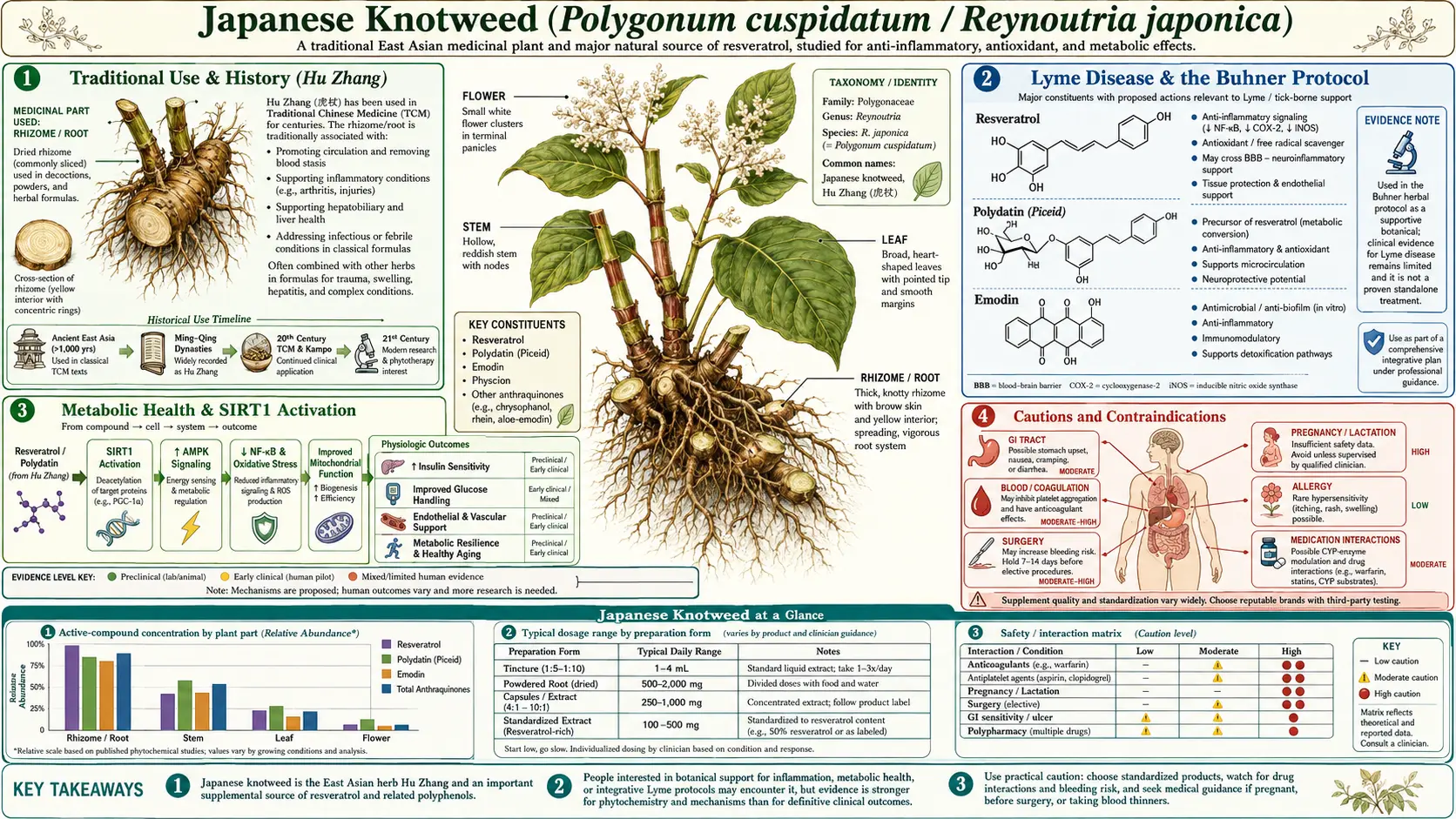
Table of Contents
- Traditional Use & History (Hu Zhang)
- Active Compounds (Resveratrol, Polydatin, Emodin)
- Cardiovascular Protection & Resveratrol
- Lyme Disease & the Buhner Protocol
- Anti-Inflammatory & Antioxidant Effects
- Neuroprotection & Brain Health
- Metabolic Health & SIRT1 Activation
- Forms and Preparations
- Recommended Dosage
- Cautions and Contraindications
- Research Papers and References
- Connections
- Featured Videos
Traditional Use & History (Hu Zhang)
Japanese knotweed (Polygonum cuspidatum, also classified as Reynoutria japonica or Fallopia japonica) is a perennial native to Japan, China, and Korea, used for centuries in Traditional Chinese Medicine as Hu Zhang (虎杖, "tiger cane") to move stagnant blood, clear heat, and ease pain, and known in Japan as itadori. Outside East Asia it is infamous instead as one of the world's most destructive invasive weeds — yet the same robust roots make it the main commercial source of resveratrol. — the fuller story is told in the dedicated History & Traditional Use article.
Active Compounds (Resveratrol, Polydatin, Emodin)
The medicinal value of Japanese knotweed comes from a distinctive combination of stilbenes, anthraquinones, and flavonoids concentrated in the root. The most pharmacologically significant constituents are:
- Resveratrol (trans-3,5,4'-trihydroxystilbene) — the polyphenol made famous by red-wine research. Japanese knotweed root contains the highest commercially viable concentration of resveratrol in nature, dwarfing the trace amounts found in grape skins. It activates sirtuin pathways (especially SIRT1), modulates inflammatory signaling, and supports endothelial function.
- Polydatin (also called piceid, resveratrol-3-O-β-D-glucoside) — a glycosylated form of resveratrol that is more water-soluble, more bioavailable than free resveratrol, and resistant to oxidation. Polydatin is converted to resveratrol in vivo by intestinal glycosidases.
- Emodin — an anthraquinone with antiviral, antimicrobial, mild laxative, and anti-tumor effects in laboratory studies. Emodin is one of the constituents responsible for the herb's effect on the bowel at higher doses.
- Physcion and chrysophanol — additional anthraquinones contributing to the herb's antimicrobial and circulatory effects.
- Quercetin, catechins, and proanthocyanidins — flavonoid antioxidants that complement the stilbene profile.
Stilbenes and anthraquinones are structurally simple molecules with broad mechanistic reach — they cross the blood-brain barrier, bind to many cellular targets at once, and produce additive effects rather than a single dominant action. This is part of why Japanese knotweed shows up in protocols for conditions as different as Lyme disease, atherosclerosis, neurodegeneration, and metabolic syndrome.
Cardiovascular Protection & Resveratrol
The cardiovascular research on resveratrol — and by extension Japanese knotweed extract — is one of the most extensive bodies of work on any plant polyphenol. Resveratrol acts on the vascular endothelium, the inner lining of every blood vessel, where it upregulates endothelial nitric oxide synthase (eNOS) and reduces the oxidative stress that contributes to stiff arteries and atherosclerotic plaque formation.
Documented cardiovascular effects include:
- Improved endothelial-dependent vasodilation in patients with metabolic syndrome and type 2 diabetes
- Mild reductions in systolic blood pressure, particularly in hypertensive individuals
- Reduction in oxidized LDL and inhibition of LDL-cholesterol oxidation, a key early step in atherosclerosis
- Antiplatelet activity through inhibition of cyclooxygenase and platelet aggregation
- Reduction in vascular inflammation markers including C-reactive protein and IL-6
- Cardioprotection against ischemia-reperfusion injury in animal models, partly through SIRT1-mediated mitochondrial protection
Japanese knotweed is the practical source of resveratrol for most supplements on the market — isolating resveratrol from grapes or wine is not economically viable. Whole-root extracts deliver resveratrol alongside polydatin and the anthraquinones, which differs pharmacologically from purified resveratrol isolates.
Lyme Disease & the Buhner Protocol
Japanese knotweed is a cornerstone of Stephen Buhner's herbal protocol for Lyme disease, one of the most widely followed integrative approaches to chronic and post-treatment Lyme illness. Buhner, an American herbalist and author of Healing Lyme, selected Japanese knotweed for its unusual combination of properties: it modulates the cytokine storm that drives chronic Lyme symptoms, crosses the blood-brain barrier where Borrelia burgdorferi can sequester, supports vascular and connective-tissue repair, and exhibits direct activity against several tick-borne organisms in laboratory studies.
The herb is typically used alongside other Buhner-protocol staples including cat's claw, andrographis, cryptolepis, and Chinese skullcap. The protocol's rationale is mechanistic rather than antimicrobial alone — Japanese knotweed addresses the inflammatory cascade that produces the joint pain, neurological symptoms, and post-exertional fatigue characteristic of post-treatment Lyme disease syndrome (PTLDS).
Specific actions relevant to tick-borne illness include:
- Inhibition of pro-inflammatory cytokines (TNF-alpha, IL-1β, IL-6) implicated in chronic Lyme symptoms
- Modulation of matrix metalloproteinases (MMPs) that Borrelia exploits to invade collagen-rich tissue
- Demonstrated in vitro activity against Borrelia burgdorferi, Bartonella, and Mycoplasma species
- Protection of vascular endothelium from cytokine-mediated injury, particularly relevant in Lyme carditis
- Penetration across the blood-brain barrier to address neurological sequelae
Patients with suspected or confirmed Lyme disease should work with a Lyme-literate clinician familiar with herbal protocols. Self-treatment of tick-borne illness without diagnostic confirmation is not appropriate; Japanese knotweed is best understood as a complement to, not a replacement for, conventional evaluation.
Anti-Inflammatory & Antioxidant Effects
Independent of the Lyme application, Japanese knotweed has a substantial track record as a broad-spectrum anti-inflammatory and antioxidant herb. Resveratrol and polydatin both inhibit the NF-κB signaling pathway, the master regulator of inflammatory gene expression, and downregulate COX-2 and inducible nitric oxide synthase (iNOS) activity.
Animal and laboratory studies have documented benefit in models of:
- Arthritis and joint inflammation, where the herb's traditional name itadori ("remove pain") appears to be supported by modern mechanism
- Inflammatory bowel disease (ulcerative colitis and Crohn's disease) through gut-barrier protection and cytokine modulation
- Periodontal inflammation, where resveratrol reduces gingival cytokine production
- Skin inflammation including psoriasis-like dermatitis in animal models
- Pulmonary inflammation, including acute lung injury and asthma models
The antioxidant action operates at the level of direct free-radical scavenging and through upregulation of the body's endogenous antioxidant defenses via the Nrf2 transcription factor. This is the same pathway activated by sulforaphane (from broccoli sprouts) and by exercise, and it is increasingly recognized as a critical mechanism for healthy aging.
Neuroprotection & Brain Health
Resveratrol crosses the blood-brain barrier, a property that makes Japanese knotweed extracts of interest in neurodegenerative research. Laboratory and small clinical studies have explored applications in Alzheimer's disease, Parkinson's disease, stroke recovery, and traumatic brain injury, though firm clinical conclusions remain premature.
Proposed neuroprotective mechanisms include:
- Reduction of amyloid-beta aggregation and clearance support in Alzheimer's models
- Mitochondrial protection in dopaminergic neurons, relevant to Parkinson's disease
- Inhibition of neuroinflammation via NF-κB downregulation in microglia
- Activation of SIRT1 and AMPK signaling in neurons, supporting cellular energy metabolism
- Reduction of oxidative damage to neural lipids and proteins
The Buhner protocol leverages this neuroprotective capacity for the cognitive and neurological symptoms of late-stage Lyme disease, but the same mechanisms underlie ongoing interest in resveratrol-rich extracts for age-related cognitive decline more generally.
Metabolic Health & SIRT1 Activation
One of the most-discussed actions of resveratrol is its activation of the sirtuin family of NAD+-dependent enzymes, particularly SIRT1. Sirtuins regulate cellular responses to energy stress, including the metabolic adaptations triggered by caloric restriction. This is the molecular basis for the popular claim that resveratrol "mimics caloric restriction."
Documented and proposed metabolic effects include:
- Improved insulin sensitivity in patients with type 2 diabetes and metabolic syndrome
- Activation of AMPK, the cellular energy sensor that promotes fat oxidation and glucose uptake
- Modest reductions in fasting glucose and hemoglobin A1c in trials of resveratrol supplementation
- Support for healthy mitochondrial biogenesis through PGC-1alpha activation
- Reduction of hepatic steatosis (fatty liver) markers in non-alcoholic fatty liver disease studies
The effects are typically modest in magnitude but consistent in direction across studies. Resveratrol is not a substitute for diet and exercise, but Japanese knotweed extract is one of several plant polyphenols with a credible scientific basis for inclusion in a metabolic-health regimen.
Forms and Preparations
- Whole root powder — coarsely ground rhizome, used in capsules or stirred into water; preserves the full constituent profile including anthraquinones
- Tincture (1:5) — alcohol-based liquid extract, the form most often specified in the Buhner Lyme protocol; rapid absorption and easy dose titration
- Standardized resveratrol extracts — concentrated to 8%, 50%, or 98% trans-resveratrol; the 50% and 98% products approach being purified resveratrol rather than a whole-root preparation
- Polydatin extract — standardized to the more bioavailable glycoside form; favored in some clinical research products
- Decoction — traditional Chinese preparation of the dried sliced root simmered in water; bitter taste and rarely used outside formal TCM contexts
- Combination Lyme formulas — commercial products combining Japanese knotweed with cat's claw, andrographis, and other Buhner-protocol herbs
Recommended Dosage
- Whole root powder (capsules) — 500 mg to 2 g daily in divided doses for general use; the Buhner Lyme protocol works up gradually from 1/4 teaspoon to 1 teaspoon three to four times daily of powdered root in water
- Tincture (1:5) — 1/4 to 1 teaspoon (1 to 5 mL) three to four times daily for therapeutic indications; start low and increase gradually to assess tolerance
- Standardized resveratrol extract — typical research doses are 100 to 500 mg daily; some longevity-oriented protocols use up to 1 g daily, but evidence above 500 mg is limited
- Decoction — 6 to 12 g of dried sliced root simmered in water, taken once or twice daily; traditional Chinese dosing range
- Duration — long-term use is common in chronic-illness protocols; rotate or pulse periodically rather than maintaining continuous high doses indefinitely
Cautions and Contraindications
Japanese knotweed is generally well tolerated when dosed appropriately, but it is biochemically active and carries meaningful interaction potential. Important considerations include:
- Loose stools or diarrhea — the anthraquinone content (emodin, physcion, chrysophanol) can produce mild laxative effects, especially at higher doses; reduce the dose if loose stools develop
- Anticoagulant and antiplatelet drugs — resveratrol has measurable antiplatelet activity and may compound the effects of warfarin, aspirin, clopidogrel, dabigatran, rivaroxaban, and apixaban; surgical bleeding risk warrants discontinuation 1 to 2 weeks before procedures
- CYP450 interactions — resveratrol inhibits CYP3A4, CYP2C9, and CYP2D6 in laboratory studies, theoretically altering the metabolism of statins, calcium channel blockers, immunosuppressants, and many psychiatric medications
- Estrogen-sensitive conditions — resveratrol has weak phytoestrogen activity; patients with estrogen receptor-positive breast cancer, endometrial cancer, or endometriosis should use only under clinical guidance
- Pregnancy and breastfeeding — insufficient safety data; avoid in the absence of specific clinical indication
- Kidney stones (oxalate) — Japanese knotweed contains significant oxalate; individuals with calcium-oxalate kidney stones may want to limit intake or use polydatin/resveratrol extracts rather than whole root
- Drug-induced liver injury (rare) — rare case reports of hepatotoxicity have been associated with high-dose resveratrol supplementation; baseline liver enzymes are reasonable before long-term high-dose use
- Quality and adulteration — standardized resveratrol products vary widely in actual content; reputable third-party testing is worth seeking out, particularly for Buhner-protocol use where consistent dosing matters
Research Papers and References
The following PubMed search links provide curated entry points into the published clinical and mechanistic literature on Japanese knotweed (Polygonum cuspidatum) and its principal constituent resveratrol. Each link opens directly in PubMed at the National Library of Medicine.
- Polygonum cuspidatum phytochemistry and bioactivity — PubMed: polygonum cuspidatum resveratrol
- Resveratrol cardiovascular protection — PubMed: resveratrol cardiovascular endothelial
- Resveratrol and SIRT1 activation — PubMed: resveratrol SIRT1 longevity
- Polydatin pharmacology and bioavailability — PubMed: polydatin piceid bioavailability
- Resveratrol anti-inflammatory mechanisms (NF-κB) — PubMed: resveratrol NF-kB inflammation
- Resveratrol neuroprotection and Alzheimer's disease — PubMed: resveratrol alzheimer neuroprotection
- Resveratrol insulin sensitivity and metabolic syndrome — PubMed: resveratrol insulin sensitivity diabetes
- Japanese knotweed and Borrelia / Lyme disease — PubMed: polygonum cuspidatum borrelia
- Emodin pharmacology and antimicrobial activity — PubMed: emodin antimicrobial anti-inflammatory
- Resveratrol safety and adverse events — PubMed: resveratrol safety adverse effects
External Authoritative Resources
- NCCIH — Herbs at a Glance
- MedlinePlus — Herbs and Supplements
- PubMed — All research on Polygonum cuspidatum
- PubMed — All research on Reynoutria japonica
Connections
- All Herbs
- Japanese Knotweed Benefits Deep Dive
- Lyme Disease
- PTLDS and Chronic Lyme
- Andrographis
- Cat's Claw
- Astragalus
- He Shou Wu
- Turmeric
- Ginkgo Biloba
- Berberine
- Atherosclerosis
- Cardiovascular Disease
- Oxidative Stress
- Longevity Protocols
- Anti-Inflammatory Diet
- Metabolic Syndrome
- Alzheimer's Disease