White Mulberry Leaf (Morus alba)
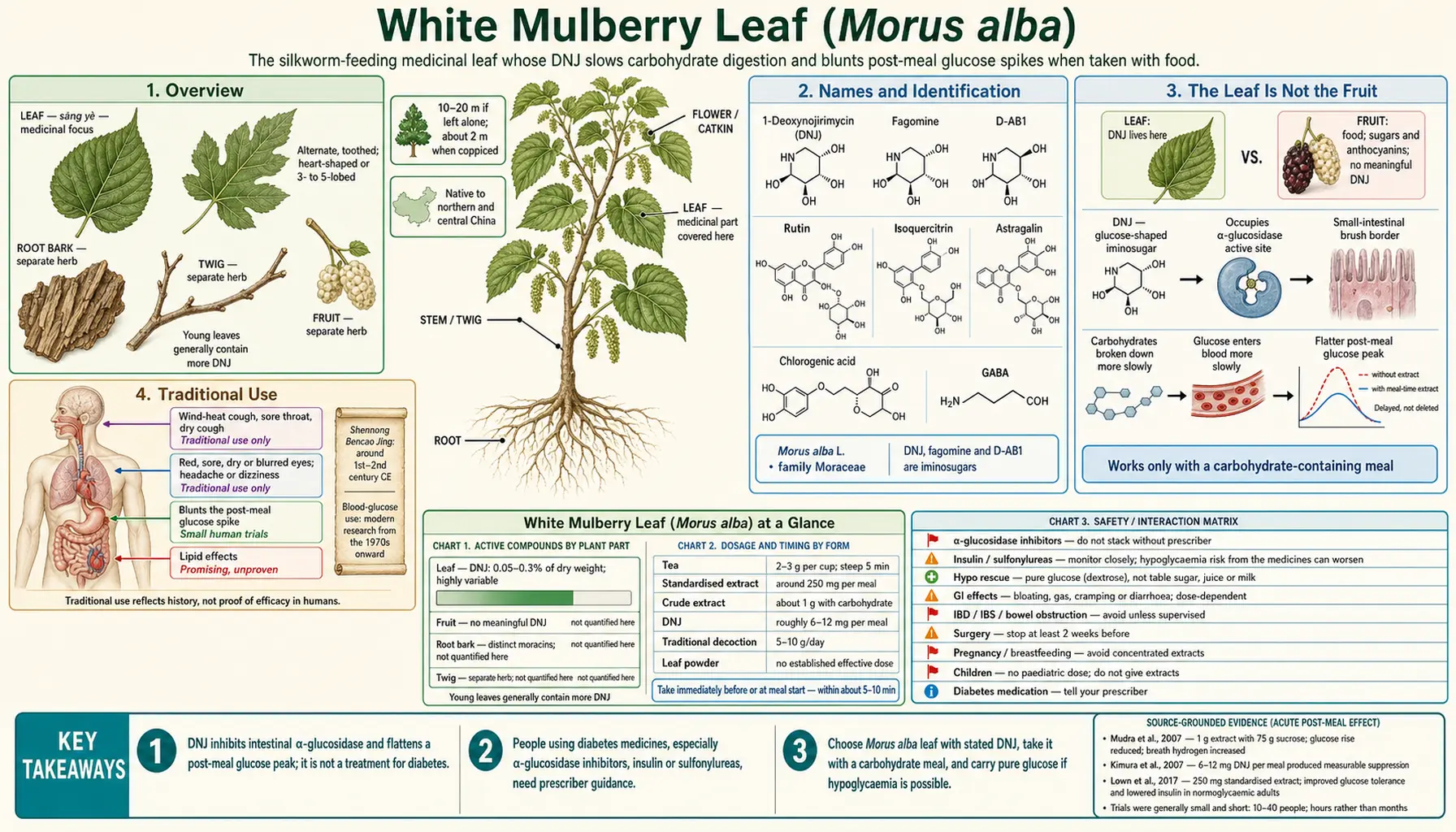
White mulberry leaf is the leaf that feeds silkworms — the reason the tree was carried out of China and planted across Asia and eventually Europe. It is also 桑葉 sāng yè, a standard herb of traditional Chinese medicine, and, unusually for a folk remedy for blood sugar, it has a clear and well-understood mechanism behind it.
That mechanism is 1-deoxynojirimycin, or DNJ — a sugar-shaped molecule that blocks the intestinal enzyme α-glucosidase. This is the same enzyme targeted by the prescription drugs acarbose and miglitol; miglitol is in fact a chemical derivative of DNJ itself. Several small human trials show that mulberry leaf extract taken with a carbohydrate meal reduces the post-meal glucose spike. Be precise about what that means: it blunts a spike, it does not treat diabetes, and it does nothing at all unless taken with food.
And the same mechanism carries a real drug interaction. Mulberry leaf can add to the effect of prescription α-glucosidase inhibitors and other glucose-lowering drugs, and it produces acarbose-like digestive side effects. Anyone on diabetes medication needs to read the Cautions section before taking it.
Table of Contents
- Overview
- Names and Identification
- The Leaf Is Not the Fruit
- Traditional Use
- Active Compounds
- DNJ and α-Glucosidase: How It Actually Works
- What the Human Trials Show
- What It Does Not Do
- Lipids, Weight and Other Claims
- Culinary Use
- Forms and Preparations
- Dosage and Timing
- Cautions and Contraindications
- Key Research Papers
- Conditions It Is Used For
- Connections
- Featured Videos
Overview
Morus alba L. is a fast-growing deciduous tree in the Moraceae — the fig and breadfruit family — reaching 10 to 20 metres when left alone, though in cultivation it is kept coppiced to a shrubby two metres so the leaves can be stripped by hand. The leaves are alternate, toothed, and famously variable in shape: on the same tree you will find plain heart-shaped leaves and deeply three- or five-lobed ones, which makes identification by leaf outline unreliable.
The species is native to northern and central China and has been in cultivation there for at least four thousand years. Its spread is one of the clearest cases in botany of a plant travelling because of an insect: Bombyx mori, the domesticated silkworm, feeds essentially only on mulberry leaves. Wherever silk was produced, mulberry was planted — across China, into Korea and Japan, through Central Asia along the Silk Road, into India, Persia, the Ottoman lands, Italy and France, and eventually to the Americas. The tree is now naturalised on every continent except Antarctica, and in parts of North America it is regarded as an invasive weed.
The part used medicinally is the leaf, traditionally collected after the first frost in autumn — the classical Chinese instruction, on the reasoning that frost-touched leaves are best. Modern analytical work points the other way for DNJ specifically: young leaves and early-season growth generally contain more of it than mature autumn leaves, so a tea made to the classical specification and an extract made to maximise DNJ are not the same product.
Other parts of the same tree are separate herbs with separate uses in Chinese medicine: 桑白皮 sāng bái pí (root bark), 桑枝 sāng zhī (twig), and 桑椹 sāng shèn (fruit). This page covers only the leaf.
Names and Identification
- Binomial: Morus alba L., family Moraceae. "White" refers to the fruit colour of the typical form and to the white buds, not to the leaf.
- Chinese: 桑葉 / 桑叶 (sāng yè) — the pharmacopoeial name for the leaf. The tree is 桑 (sāng).
- Vietnamese: lá dâu tằm — literally "silkworm mulberry leaf". The tree is cây dâu tằm.
- Malay / Indonesian: daun mulberi, daun besaran, daun murbei.
- Japanese: 桑 (kuwa); the leaf tea is 桑茶 (kuwa-cha).
- Korean: 뽕잎 (ppongnip).
- Thai: ใบหม่อน (bai mon).
- Hindi: shahtoot (usually referring to the fruit).
Species that get confused with it. Several Morus species are used more or less interchangeably in commerce and in traditional practice, and they are not identical:
- Morus alba — white mulberry, the silkworm species and the one in the Chinese pharmacopoeia and in essentially all the DNJ research.
- Morus nigra — black mulberry. Grown for its far superior fruit, mostly in the Middle East and Europe. Its leaf is not the research subject.
- Morus rubra — red mulberry, native to eastern North America, and hybridising freely with introduced M. alba, which is a conservation problem and a supply-chain identification problem.
- Morus australis, M. indica, M. macroura — used regionally in Asia.
Also worth separating: the paper mulberry (Broussonetia papyrifera) is a different genus in the same family, used for bark paper and tapa cloth, and is not this plant.
The Leaf Is Not the Fruit
Mulberry fruit and mulberry leaf are two different topics that share a tree, and conflating them is the most common error in consumer writing about the plant.
The fruit is a food — sweet, perishable, containing sugars, vitamin C, iron and, in the dark cultivars, anthocyanins such as cyanidin-3-glucoside. It is eaten fresh, dried, juiced and made into wine. In Chinese medicine the dried fruit is sāng shèn, a blood- and yin-nourishing tonic. It contains no meaningful quantity of DNJ.
The leaf is not a food in the same sense, is not sweet, and is where the DNJ lives.
The practical consequence: eating mulberries does not blunt your postprandial glucose. In fact, dried mulberries are a concentrated sugar source. Nothing in this page applies to the fruit.
Traditional Use
Traditional use is history and clinical tradition, not proof of efficacy. It is, however, unusually well documented for this plant.
Traditional Chinese medicine. Mulberry appears in the Shennong Bencao Jing, the foundational Chinese materia medica compiled around the first to second century CE. Sāng yè is classified as cool in nature, sweet and bitter in taste, entering the Lung and Liver channels. Its classical indications are:
- Wind-heat patterns — the early stage of a feverish upper respiratory illness with sore throat, headache and cough.
- Dry cough from what is described as dryness injuring the Lung.
- Red, sore, dry or blurred eyes, and headache or dizziness attributed to Liver heat rising.
The best-known formula containing it is Sang Ju Yin — "Mulberry Leaf and Chrysanthemum Decoction" — which pairs sāng yè with chrysanthemum flower for exactly that early wind-heat cough. Sang Xing Tang pairs it with apricot kernel for dry autumn cough.
Note what is missing from the classical picture: blood sugar. Diabetes as understood today did not exist as a category; the nearest classical concept, xiāo kě or "wasting-thirsting disorder", was more often treated with other herbs. The use of mulberry leaf for blood glucose is a modern application, driven by Japanese and Chinese research from the 1970s onward that identified DNJ. This is the reverse of the usual pattern — not a traditional claim later validated, but a chemical discovery later attached to a traditional herb.
Japan and Korea. Kuwa-cha, mulberry leaf tea, has been drunk in Japan for centuries and is now heavily marketed there specifically for post-meal blood sugar. Korea drinks ppongnip-cha similarly.
Vietnam. In thuốc nam, lá dâu tằm is used for coughs, night sweats and eye complaints, and young leaves are eaten as a vegetable — a use that overlaps food and medicine.
Active Compounds
1-Deoxynojirimycin (DNJ) is the compound that matters, and it deserves its own explanation, given below. Content in the leaf is low — broadly 0.05% to 0.3% of dry weight, varying substantially with cultivar, leaf age, season, and how the leaf was dried. Young leaves generally carry more. That low and variable content is exactly why a standardised extract and a cup of leaf tea are not equivalent.
DNJ does not travel alone. The leaf contains a set of related iminosugars — also called azasugars — including fagomine and 1,4-dideoxy-1,4-imino-D-arabinitol (D-AB1), which share the same general mode of action against carbohydrate-processing enzymes.
Other constituents:
- Flavonoids — rutin, isoquercitrin (quercetin-3-O-glucoside), astragalin (kaempferol-3-O-glucoside) and related glycosides. These are the leaf's antioxidant fraction and are present in far larger amounts than DNJ.
- Chlorogenic acid and other phenolic acids.
- γ-Aminobutyric acid (GABA) — accumulates in mulberry leaf, and can be increased substantially by anaerobic processing. Some Japanese mulberry teas are marketed on GABA content. Whether orally consumed GABA has any central effect in humans is genuinely doubtful, since it crosses the blood–brain barrier poorly; treat those claims sceptically.
- Polysaccharides, studied mostly in cell and animal models.
- Nutritional content — mulberry leaf is a genuinely nutritious green, high in protein for a leaf (roughly 15–25% of dry weight), and a good source of calcium, iron and carotenoids. This is why it is used as animal fodder and as a vegetable.
Note that the root bark of the same tree contains a distinct group of prenylated compounds and 2-arylbenzofurans (the moracins) that are absent or minor in the leaf. Research on mulberry root bark does not transfer to leaf products.
DNJ and α-Glucosidase: How It Actually Works
This is the strongest section of the mulberry leaf story, so it is worth understanding properly.
What has to happen for a carbohydrate to raise your blood sugar. Starch and table sugar are not absorbable as they are. They must be broken down into single sugar molecules — glucose, fructose, galactose — before the small intestine can take them up. The final step happens at the brush border, the fuzzy absorptive surface of the small-intestinal lining, where enzymes collectively called α-glucosidases (sucrase, maltase, isomaltase, glucoamylase) snip the last bonds. Only then does glucose cross into the blood.
What DNJ does. DNJ is an iminosugar: a molecule shaped almost exactly like glucose, except that the oxygen atom in the ring has been swapped for a nitrogen. That single substitution is decisive. The enzyme's active site recognises the shape and binds it — but the nitrogen carries a positive charge at physiological pH that mimics the transition state of the reaction, so DNJ binds far more tightly than glucose does and does not get cut. It sits in the active site and blocks it.
A useful analogy: it is a key cut to fit the lock but with the tip fused solid. It goes in, it will not turn, and while it is in there nothing else can use the lock.
The consequence. Disaccharides and oligosaccharides are broken down more slowly, glucose enters the bloodstream more slowly and over a longer period, and the sharp post-meal peak is flattened. The carbohydrate is not destroyed or blocked from ever being absorbed — much of it is absorbed later and further down the intestine. What changes is the shape of the curve.
The same target as prescription drugs. Three licensed drugs work on exactly this enzyme:
- Miglitol — chemically an N-hydroxyethyl derivative of DNJ. It is a modified version of the mulberry compound.
- Acarbose — a pseudo-tetrasaccharide originally isolated from Actinoplanes bacteria. Structurally different, same enzyme target.
- Voglibose — a valiolamine derivative, used mainly in Japan.
This shared target is why mulberry leaf has a better mechanistic footing than most folk hypoglycaemics — and, equally, why its side effects and its drug interactions are predictable rather than speculative.
Why timing is everything. The enzyme sits in the gut wall and its substrate is the meal. If the DNJ is not present in the intestine at the same time as the carbohydrate, it has nothing to do. Taken on an empty stomach or between meals, mulberry leaf extract has no glucose effect whatsoever. This is not a supplement that builds up.
What the Human Trials Show
Mulberry leaf has more human data than most herbs on this site, though the studies remain small, short and mostly focused on a single acute measurement.
- Mudra and colleagues (2007), Diabetes Care. The most-cited trial. Participants with type 2 diabetes and healthy controls took 75 g of sucrose with or without 1 g of mulberry leaf extract. The extract significantly reduced the rise in blood glucose in both groups. Critically, the investigators also measured breath hydrogen, which rose — direct confirmation that unabsorbed carbohydrate was reaching the colon and being fermented by bacteria. That is the mechanism being observed rather than inferred, which is what makes this study worth more than its size suggests.
- Kimura and colleagues (2007), Journal of Agricultural and Food Chemistry. A DNJ-enriched mulberry powder given with 50 g of sucrose suppressed the postprandial glucose rise in healthy volunteers, with a clear dose relationship across DNJ doses in the single-digit to low-double-digit milligram range. This is the study most often cited for "how much DNJ do you actually need".
- Lown and colleagues (2017), PLoS ONE. A randomised double-blind placebo-controlled crossover study in normoglycaemic adults in the UK using a standardised mulberry leaf extract at 250 mg. Glucose tolerance improved and insulin concentrations fell, in people without diabetes — evidence that the effect is not confined to those with impaired glucose handling.
- Systematic reviews and meta-analyses of mulberry leaf for glycaemic control have generally concluded that the acute postprandial effect is real and reasonably consistent, while longer-term effects on HbA1c and fasting glucose are weakly supported by small, heterogeneous, often low-quality trials.
The honest quality assessment. Most of these trials involve 10 to 40 people, run for hours rather than months, and use different extracts with different DNJ content and different comparators. There is no large, long, well-powered trial of mulberry leaf with a hard clinical endpoint. What we can say with reasonable confidence is narrow but real: a standardised mulberry leaf extract, taken with a carbohydrate load, measurably reduces the glucose peak that follows. Everything beyond that is less certain.
What It Does Not Do
Because this is a herb where the mechanism is genuinely good, it is especially important to mark the boundary.
- It is not a treatment for diabetes. No trial has shown that mulberry leaf controls diabetes, prevents diabetic complications, or substitutes for metformin, insulin or any other prescribed therapy. Even acarbose — the pharmaceutical version of the same mechanism, at a licensed dose — is a second- or third-line adjunct, not a primary therapy, and typically lowers HbA1c by only a modest amount.
- It does not lower fasting glucose. The mechanism operates on carbohydrate arriving in the gut. There is no carbohydrate in the gut when you are fasting, so there is nothing to act on.
- It does not work if taken away from meals. Repeating this because it is the most common practical mistake. A capsule swallowed at bedtime, or with a morning routine of supplements, does nothing for a lunch eaten five hours later.
- It does not cancel a meal. The carbohydrate is delayed, not deleted. Most of it is still absorbed. This is not a licence to eat differently.
- It does not cause hypoglycaemia on its own. Blocking an enzyme that breaks down incoming carbohydrate cannot push glucose below baseline. It can, however, contribute to hypoglycaemia caused by other drugs — see Cautions.
- The other traditional uses have almost no human evidence. The cough, sore throat, eye and night-sweat indications rest on clinical tradition and a small amount of cell and animal work. They may be reasonable; they are not demonstrated.
Lipids, Weight and Other Claims
Lipids. Some small human studies of mulberry leaf preparations have reported reductions in total and LDL cholesterol and in triglycerides, and animal work supports a lipid effect. The human trials are few, small, and inconsistent, and often used whole-leaf powder at high doses rather than a DNJ-standardised extract. Treat this as promising and unproven.
Weight. There is no good human evidence that mulberry leaf produces weight loss. The theoretical route — reduced carbohydrate absorption — is weak, since delayed absorption is not the same as blocked absorption. Products marketed for weight loss on this basis are outrunning the data.
Antioxidant and anti-inflammatory activity. The flavonoid content is genuine, and cell-culture and animal studies duly report antioxidant and anti-inflammatory effects. That is true of almost every green leaf ever assayed, and it does not translate to a clinical claim.
Blood pressure, liver protection, neuroprotection, antimicrobial activity. All reported in cell-culture or rodent models. None supported by human trials. These belong in the hypothesis column.
Culinary Use
Mulberry leaf is a genuine food across East and Southeast Asia, which is part of why its safety record for ordinary consumption is reasonable.
- Leaf tea — kuwa-cha in Japan, ppongnip-cha in Korea, 桑叶茶 in China. Made from dried and often lightly roasted leaves. Mild, faintly grassy, caffeine-free.
- Young leaves as a vegetable — in Vietnam, blanched or added to soups such as canh lá dâu; in parts of China and Thailand similarly. Young shoots are the ones eaten; older leaves are tough and fibrous.
- Leaf powder in food — in Japan, mulberry leaf powder is added to soba noodles, mochi, ice cream and confectionery for its green colour and its marketing association with blood sugar.
- Fodder — mulberry leaf is a high-protein livestock feed, quite apart from silkworms.
Note the dose gap: a cup of mulberry leaf tea contains a small and unmeasured amount of DNJ, likely far below the quantities used in the trials. Drinking the tea is a pleasant, low-risk habit; it should not be assumed to reproduce the trial results.
Forms and Preparations
- Dried leaf tea. Roughly 2–3 g per cup, steeped 5 minutes in water just off the boil. Very low risk. DNJ delivery is small and unquantified.
- Whole leaf powder. Sold in Japan and Korea by the gram, sometimes taken by the spoonful before meals. Higher DNJ delivery than tea, still unstandardised.
- Standardised extract. The form used in the research and the only one with predictable dosing. Look for a stated DNJ content — commonly expressed as a percentage (for example 1% DNJ) or as milligrams of DNJ per serving. Branded standardised mulberry leaf extracts used in clinical trials are typically dosed at 250 mg of extract per meal.
- Traditional decoction. In Chinese practice sāng yè is decocted with other herbs at roughly 5–10 g per day, for the classical wind-heat and cough indications rather than for glucose.
- Tinctures. Uncommon and poorly characterised for DNJ, which is water-soluble and highly polar. Not the sensible choice for this mechanism.
What to look for on a label: the species (Morus alba), the plant part (leaf, not fruit, not root bark), and a DNJ figure. A product that names none of these is telling you nothing usable.
Dosage and Timing
Timing is not a refinement, it is the whole thing. Take mulberry leaf extract immediately before, or at the start of, a carbohydrate-containing meal — within about five to ten minutes. That is how the trials dosed it, and it is the only timing that makes mechanistic sense. Taken at any other time it does nothing.
Doses used in human research:
- Standardised extract: around 250 mg with each carbohydrate-containing meal, in the pattern used by the UK crossover trial.
- Crude extract: about 1 g with a carbohydrate load, as in the Diabetes Care sucrose study.
- Expressed as DNJ: roughly 6–12 mg of DNJ per meal produced measurable suppression of the glucose rise in the Japanese dose-ranging work. This is the most transferable number, because it is independent of extract strength.
- Leaf tea or powder: no established effective dose. Traditional Chinese decoction doses of the dried leaf are 5–10 g/day, but that is for entirely different indications.
Start low. The gastrointestinal side effects are dose-dependent and are worst at the beginning. Starting at a lower dose with a smaller meal, and building over a week or two, is the same strategy used to make acarbose tolerable, and for the same reason.
Cautions and Contraindications
The interactions in this section are real and mechanistically predictable, not theoretical boilerplate. Read them if you take any medication for diabetes.
- Prescription α-glucosidase inhibitors — acarbose, miglitol, voglibose. Mulberry leaf hits the identical enzyme. Combining them means additive enzyme blockade, additive glucose lowering, and additive gastrointestinal side effects, which at that point can become severe. Do not stack them without a prescriber's involvement.
- Insulin and sulfonylureas (gliclazide, glimepiride, glipizide) and other glucose-lowering drugs. Mulberry leaf will not cause hypoglycaemia by itself, but it lowers the glucose curve these drugs are dosed against, so it can unmask or worsen hypoglycaemia caused by them. If you are on insulin or a sulfonylurea and add mulberry leaf, monitor closely and tell your prescriber. Dose adjustment may be needed.
- How to treat a hypo while taking it — this one is genuinely important. If hypoglycaemia occurs while an α-glucosidase inhibitor is on board, it must be treated with pure glucose (dextrose tablets or gel), not with table sugar, sweets, fruit juice or milk. The whole point of the mechanism is that sucrose and other complex sugars are broken down slowly — so the usual rescue foods will not raise blood glucose fast enough. This is standard, non-negotiable advice for anyone on acarbose or miglitol, and by the same mechanism it applies to mulberry leaf extract. Anyone at risk of hypoglycaemia who takes mulberry leaf should carry glucose tablets specifically.
- Gastrointestinal side effects. Bloating, flatulence, abdominal cramping, borborygmi and loose stools or diarrhoea — the signature of carbohydrate reaching the colon and being fermented there. These are dose-dependent, usually settle over one to two weeks, and are worse with high-carbohydrate meals. They are not a sign of harm; they are the mechanism being audible. But they can be genuinely unpleasant and are the most common reason people stop.
- Inflammatory bowel disease, IBS, or existing bowel obstruction. Deliberately increasing colonic fermentation is a poor idea in an inflamed or obstructed bowel. Avoid unless supervised.
- A widely reported 2022 death. A California county coroner listed dehydration due to gastroenteritis as a cause of death in a case where white mulberry leaf was found in the stomach; the case received extensive press coverage and prompted regulatory attention to mulberry leaf supplements. Causation was not established, and a single case with a plausible alternative explanation is not evidence that mulberry leaf is dangerous. We report it because it is a real, documented event that readers will encounter, and because it is a reminder that the gastrointestinal effects described above are not always trivial — severe diarrhoea causes dehydration.
- Surgery. Stop at least two weeks before scheduled surgery, as with any glucose-affecting supplement.
- Pregnancy and breastfeeding. Mulberry leaf as a food or ordinary tea has a long history of use. Concentrated standardised extracts have not been studied in pregnancy or lactation and should be avoided.
- Children. No paediatric dosing has been established. Extracts should not be given to children.
- Allergy. Uncommon, but mulberry pollen is a recognised allergen in some regions, and the milky latex in the plant's stems and leaves can irritate skin.
- Quality and identity. Because DNJ content varies enormously with cultivar, leaf age and processing, two products at the same milligram dose can differ severalfold in actual activity. Prefer products stating a DNJ percentage and, ideally, carrying third-party testing.
- Tell your doctor. Not as a formality. A supplement that flattens your post-meal glucose curve will change your glucose readings, may change your HbA1c slightly, and may change what medication dose you need. Your prescriber cannot interpret your numbers correctly if they do not know you are taking it.
Key Research Papers
Identifiers below are given as PubMed topic searches rather than as individual record numbers, so that a link cannot resolve to the wrong paper. Author, year and journal are stated only where we are confident of them.
- Mudra M, Ercan-Fang N, Zhong L, Furne J, Levitt M. Influence of mulberry leaf extract on the blood glucose and breath hydrogen response to ingestion of 75 g sucrose by type 2 diabetic and control subjects. Diabetes Care, 2007. The key trial: reduced glucose rise with 1 g of extract, plus a rise in breath hydrogen directly confirming carbohydrate malabsorption. Find on PubMed.
- Kimura T and colleagues. Food-grade mulberry powder enriched with 1-deoxynojirimycin suppresses the elevation of postprandial blood glucose in humans. Journal of Agricultural and Food Chemistry, 2007. Dose-ranging work in healthy volunteers; the source of the 6–12 mg DNJ figures. Find on PubMed.
- Lown M and colleagues. Mulberry-extract improves glucose tolerance and decreases insulin concentrations in normoglycaemic adults: results of a randomised double-blind placebo-controlled study. PLoS ONE, 2017. Crossover trial of a 250 mg standardised extract in people without diabetes. Find on PubMed.
- Systematic reviews and meta-analyses of Morus alba leaf preparations for glycaemic control, assessing postprandial glucose, fasting glucose and HbA1c across the small-trial literature. Find on PubMed.
- Chemistry and pharmacology of 1-deoxynojirimycin and related iminosugars, including the structural basis of α-glucosidase inhibition and the relationship to miglitol. Find on PubMed.
- Analytical studies of DNJ content in mulberry leaves across cultivars, leaf ages, harvest seasons and processing methods — the basis for the statement that leaf DNJ is low and highly variable. Find on PubMed.
- Clinical literature on acarbose and miglitol, including the requirement to treat hypoglycaemia with glucose rather than sucrose while on an α-glucosidase inhibitor — the pharmacological basis for the equivalent caution with mulberry leaf. Find on PubMed.
- Phytochemical reviews of Morus alba leaf describing the flavonoid, phenolic acid, iminosugar and polysaccharide fractions and distinguishing leaf chemistry from root bark and fruit chemistry. Find on PubMed.
Live PubMed Searches
- Morus alba leaf — all literature
- Mulberry leaf and postprandial glucose
- 1-Deoxynojirimycin (DNJ)
- Acarbose and miglitol — the prescription comparators
- Mulberry leaf and blood lipids in humans
- Mulberry leaf flavonoids and antioxidant activity
- Mulberry leaf — safety and adverse effects
- Mulberry fruit and anthocyanins (the separate topic)
- Sang ye in traditional Chinese medicine
- Mulberry leaf tea and GABA content
Conditions White Mulberry Leaf Is Used For
Each condition below links to its page. The coloured half of every capsule shows how much human evidence supports this herb for that specific use — traditional use is history, not proof, and is marked as such.
Connections
- All Herbs
- Gymnema — the other classic blood-sugar herb, with a completely different mechanism: gymnemic acids act on sweet taste and on sugar absorption rather than on brush-border enzymes. Worth comparing directly.
- Bitter Melon — another widely used Asian plant for blood sugar, with a more mixed and less mechanistically tidy evidence base than mulberry leaf.
- Endocrinology — diabetes, prediabetes and metabolic conditions, and the medical context for everything on this page.
- Chrysanthemum — mulberry leaf's classical partner in Sang Ju Yin, the Mulberry Leaf and Chrysanthemum Decoction.