Arabian Jasmine (Jasminum sambac)
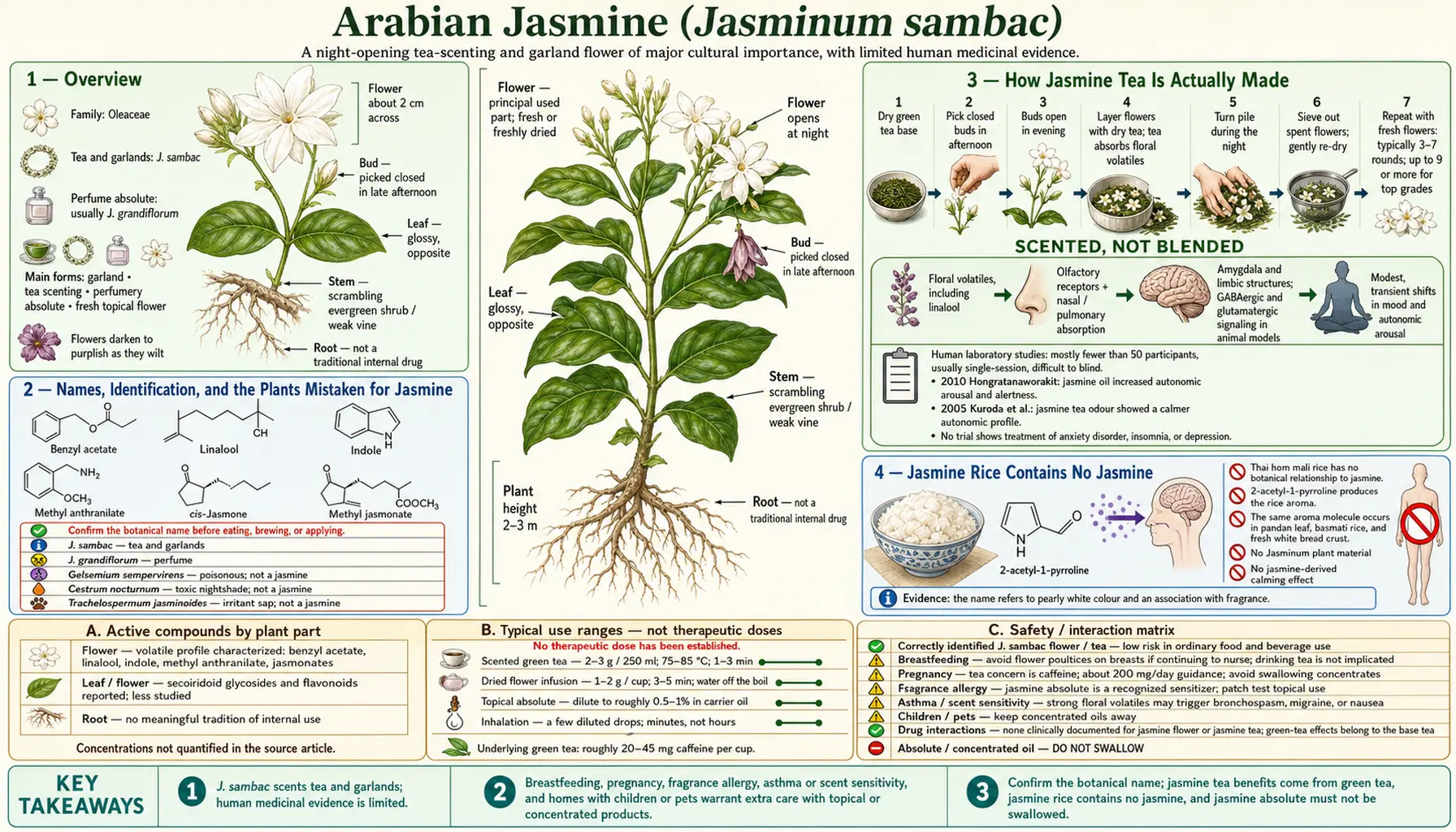
Arabian jasmine, Jasminum sambac, is the small white flower that scents jasmine tea, that is strung into garlands from Manila to Chennai, and that serves as the national flower of both the Philippines (sampaguita) and Indonesia (melati). It is one of the most culturally loaded plants in Southeast Asia and one of the least studied as a medicine: the human research on it amounts to a handful of small aromatherapy-style experiments on mood and nervous-system arousal, plus a thin, old body of Indian clinical work on suppressing breast-milk production. There is no good human trial showing that drinking or eating jasmine flowers treats any disease.
Before anything else, the names. "Jasmine" is attached to at least five unrelated plants, two of them poisonous, and the confusion is not academic — it is the single most useful thing this page can give you. J. sambac is the jasmine of tea and garlands. J. grandiflorum is the jasmine of perfume. Jasmine rice contains no jasmine at all. And "yellow jasmine" and "night-blooming jasmine" are not jasmines and can kill you.
Table of Contents
- Overview
- Names, Identification, and the Plants Mistaken for Jasmine
- How Jasmine Tea Is Actually Made
- Jasmine Rice Contains No Jasmine
- Traditional Use
- Active Compounds
- Aroma, Mood, and Autonomic Arousal
- What Belongs to the Tea, Not the Flower
- Traditional Use for Suppressing Lactation
- Topical and Antimicrobial Claims
- Culinary Use
- Forms and Preparations
- Dosage
- Cautions and Contraindications
- Key Research Papers
- Connections
- Featured Videos
Overview
Jasminum sambac is a scrambling evergreen shrub or weak vine in the olive family, Oleaceae — the same family as olive, ash, lilac, forsythia and privet. It grows two to three metres, has glossy opposite leaves, and produces waxy white flowers about two centimetres across that darken to purplish as they wilt. The flowers open at night. That single habit governs almost everything about how the plant is used: pickers take the buds in the late afternoon while they are still closed, and the flowers do their scenting work in the dark hours afterwards.
The species is thought to have originated in the eastern Himalayan region of the Indian subcontinent, and it has been carried by trade and cultivation across South Asia, Southeast Asia, southern China and the Pacific for well over a thousand years. It cannot survive frost, so its range is essentially the humid tropics and subtropics. Several distinct cultivar forms exist — the single-flowered "Maid of Orleans", the semi-double "Belle of India" with elongated petals, and the fully double "Grand Duke of Tuscany", which looks more like a small gardenia and is comparatively scentless.
The part used is the flower, almost always fresh or freshly dried. There is no meaningful tradition of using the root or leaf of this species internally, and the plant is not a bark or root drug in the way that most of the herbs on this site are. In practice, J. sambac reaches people in four forms: as a garland or offering flower, as the scenting agent in jasmine tea, as a solvent-extracted absolute for perfumery, and as a fresh flower applied to the body in a few folk practices.
Commercially, the flower is a serious agricultural crop. Hengzhou in Guangxi, China, is now the dominant world source of jasmine blossom for tea scenting, having overtaken the historic centre in Fuzhou, Fujian. Tamil Nadu in southern India supports a large fresh-flower garland industry, and the Philippines grows sampaguita almost entirely for garlands sold at churches, shrines and traffic intersections.
Names, Identification, and the Plants Mistaken for Jasmine
The binomial is Jasminum sambac (L.) Aiton, family Oleaceae. Local names include:
- Tagalog / Filipino: sampaguita — declared the national flower of the Philippines in 1934.
- Indonesian / Malay: melati or melati putih — designated Indonesia's puspa bangsa, the flower of the nation, and central to Javanese and Sundanese wedding dress.
- Vietnamese: hoa nhài in the north, hoa lài in the south.
- Thai: มะลิ (mali) — associated with Thai Mother's Day.
- Chinese: 茉莉花 (mòlìhuā), the flower of the folk song and of 茉莉花茶, jasmine tea.
- Hindi / Marathi / Gujarati: mogra, motia, bela.
Now the confusions, in order of how much they matter.
1. Tea jasmine vs. perfume jasmine. J. sambac is the species used to scent tea and to make garlands. Jasminum grandiflorum — Spanish jasmine or royal jasmine, sometimes treated as J. officinale f. grandiflorum — is the species grown at scale in Grasse, Egypt and Tamil Nadu for jasmine absolute, the perfumery material. The two smell recognisably different: grandiflorum is the richer, more indolic, "classic" jasmine of French perfumery, while sambac is greener, sweeter and more citrus-tinged. A sambac absolute does exist and is sold, but when a perfumer says "jasmine absolute" without qualification they usually mean grandiflorum. If you are buying an aromatherapy oil and the label says only "jasmine", you do not know which species you have.
2. Plants called jasmine that are not Jasminum at all. This is where the risk lives:
- Yellow jasmine / Carolina jasmine — Gelsemium sempervirens (Gelsemiaceae). Contains gelsemine and related alkaloids. Genuinely poisonous; ingestion of the flowers or a tea made from them has caused severe, sometimes fatal poisoning. Not a jasmine.
- Night-blooming jasmine / night jessamine — Cestrum nocturnum (Solanaceae, the nightshade family). Intensely fragrant at night, widely planted in Southeast Asia, and toxic if eaten. Not a jasmine.
- Star jasmine / confederate jasmine — Trachelospermum jasminoides (Apocynaceae). A common ornamental vine with milky irritant sap. Not a jasmine.
- Crape jasmine / pinwheel flower — Tabernaemontana divaricata (Apocynaceae). A separate medicinal plant in its own right with its own alkaloid chemistry. Not a jasmine.
- Madagascar jasmine — Stephanotis floribunda (Apocynaceae). Ornamental. Not a jasmine.
The practical rule: if you intend to eat, brew or apply a "jasmine", confirm the botanical name is Jasminum. A white, night-scented flower in a Southeast Asian garden is at least as likely to be Cestrum as Jasminum.
How Jasmine Tea Is Actually Made
This is the most interesting thing about the plant, and it is routinely described wrongly.
Jasmine tea is scented, not blended. The finished tea usually contains no jasmine flowers at all — or a token few added back for appearance. What happens is this:
- A base tea is made first, almost always a green tea, and dried thoroughly. Dry tea leaf is intensely hygroscopic and readily absorbs volatile aromatics — the same property that makes tea go stale next to spices in a cupboard is the property being exploited here.
- Jasmine buds are picked in the afternoon, while still closed, and held until evening.
- In the evening, as the buds begin to open and release their volatiles, the flowers and the dry tea are layered together in alternating beds, or mixed and piled. The pile is turned during the night to control the heat the flowers generate as they respire.
- In the morning the spent flowers are sieved out and discarded. The tea, now damp from the flowers' moisture, is gently re-dried.
- The whole cycle is repeated with a fresh batch of flowers — typically three to seven times for good tea, and up to nine or more for the top grades. Each round costs a re-drying, so each round costs a little of the base tea's own character.
The result is a green tea carrying jasmine's volatile fingerprint. Grades are quoted in scenting rounds; a tea sold as "seven-times scented" has been through the cycle seven times. Styles include the loose mo li hua cha, the tightly hand-rolled dragon pearls, and the tied "blooming" flowers, which are usually more theatre than aroma.
Why this matters medically: the health literature on jasmine tea is overwhelmingly a literature about green tea. Catechins, caffeine, L-theanine, the cardiovascular and metabolic epidemiology — all of that belongs to Camellia sinensis. The jasmine contributes aroma compounds in vanishingly small quantities. Anyone claiming that jasmine tea's benefits are jasmine's benefits has confused the scent for the substance.
Jasmine Rice Contains No Jasmine
Thai hom mali rice — "jasmine rice" in English — has no botanical relationship to jasmine and contains none of it. The name refers to the rice's colour, which is a bright pearly white like the mali flower, and to the general association with fragrance. The aroma itself comes from 2-acetyl-1-pyrroline, a compound produced by the rice plant itself and the same molecule responsible for the smell of pandan leaf, basmati rice and fresh white bread crust. Some Thai sources emphasise the colour association specifically rather than the scent.
This is worth stating plainly because "jasmine rice contains jasmine" appears in a great deal of wellness writing, sometimes attached to claims that eating jasmine rice delivers jasmine's calming effects. It does not, because there is no jasmine in it.
Traditional Use
Traditional use is history and cultural practice. It is not evidence of efficacy, and for this plant almost none of it has been tested.
Ayurveda and Siddha. J. sambac and its relatives appear in Indian medicine under names such as jati, mallika and navamallika. Traditional applications include chewing the leaves or applying flower preparations for mouth ulcers and gum complaints, flower or leaf infusions for sore eyes, and the well-documented practice of binding fresh flowers over the breasts to stop milk production. Jasmine oil — usually meaning an infused or macerated oil rather than a distillate — is used in abhyanga massage as a cooling, calming preparation.
Traditional Chinese medicine. 茉莉花 is a comparatively minor and late entrant to the Chinese materia medica, used as a light, aromatic, qi-moving flower to relieve a stuffy or oppressed feeling in the chest, calm irritability, and settle the stomach. It is characteristically drunk rather than decocted at drug strength.
Southeast Asia. In Indonesian jamu, melati appears in cooling and postpartum preparations and in bathing waters. In Thai and Vietnamese folk practice the flower is chiefly a fragrance and a cooling drink, and mali water — flowers steeped overnight in water — is a traditional base for Thai desserts and offerings. In the Philippines, sampaguita is culturally enormous and medicinally almost absent; folk uses are limited and localised.
Across all of these traditions the flower is used gently. It is not a purgative, not a strong hypotensive, not an anti-infective given at drug doses. That fits its safety record and it also fits the fact that nobody has found a dramatic pharmacological effect to test.
Active Compounds
The chemistry that has been characterised in detail is the volatile chemistry — the scent — because that is what the tea and perfume industries pay to analyse. The flower's headspace and its solvent extracts contain, among others:
- Benzyl acetate — typically one of the largest single components of jasmine volatiles. Sweet, fruity, floral. Also the dominant note of many commercial "jasmine" fragrances, which is why cheap jasmine perfume smells thin: it is largely benzyl acetate without the rest.
- Linalool — a monoterpene alcohol shared with lavender, coriander seed and bergamot. Linalool is the compound most often invoked when jasmine aroma is credited with calming effects, and it has been studied in its own right far more than jasmine has.
- Indole — present at low percentages but pharmacologically and perceptually decisive. Indole is faecal and animalic in isolation and floral at trace dilution; it is what makes real jasmine smell alive rather than like soap. It is also formed by gut bacteria from tryptophan, which is unrelated to its role here.
- Methyl anthranilate — grape-like, slightly medicinal. Best known outside perfumery as a bird repellent and a grape-flavour compound.
- cis-Jasmone and methyl jasmonate — the jasmonates, which in the plant world are genuine signalling hormones governing wound and defence responses. Their presence in jasmine is why the class is named after the flower. Methyl jasmonate has been studied heavily in cancer cell lines; that work is about the isolated molecule at experimental concentrations and says nothing about drinking jasmine tea.
- (Z)-3-hexenyl benzoate, benzyl alcohol, benzyl benzoate, α-farnesene, eugenol, linalool oxides — the supporting cast that gives the flower its green, balsamic and spicy edges.
The non-volatile fraction is less studied. As an Oleaceae member, J. sambac contains secoiridoid glycosides (jasminosides and sambacosides have been described from the species) and flavonoids including rutin and quercetin and kaempferol glycosides. These are the compounds that would matter for any swallowed preparation, and they are the compounds about which we know least. No standardised extract of J. sambac defined by a marker compound is in general use.
Aroma, Mood, and Autonomic Arousal
Mechanism. Inhaled volatiles reach olfactory receptors, and olfactory input has an unusually direct route to the amygdala and limbic structures — a shorter path than the other senses take. Odours can therefore shift emotional state and autonomic tone (heart rate, blood pressure, skin conductance, breathing rate) quickly and measurably. Some volatiles, linalool prominently, are also absorbed into the bloodstream through the nasal and pulmonary mucosa and have shown direct effects on GABAergic and glutamatergic signalling in animal models. Both routes are plausible; they are difficult to separate in a human study.
What the human studies show. The relevant work is a small set of laboratory experiments, mostly with fewer than 50 participants, mostly single-session, and almost never blinded in any meaningful sense — you cannot conceal a strong floral odour from the person smelling it.
- Work by Hongratanaworakit examined jasmine oil applied in massage and by inhalation and reported increases in breathing rate, blood oxygen saturation, blood pressure and self-rated alertness and "vigour" — that is, an arousing profile rather than a sedating one. This is the finding most often reported backwards in wellness writing, which describes jasmine as relaxing.
- Japanese work on the odour of jasmine tea and on (R)-(−)-linalool reported the opposite direction — reduced heart rate and a calmer autonomic profile — using the tea's aroma rather than a concentrated absolute.
- Thai EEG work on jasmine oil inhalation reported changes in beta wave activity alongside self-reported increases in alertness and positive mood.
How to read this honestly. The direction of effect is not consistent across studies, and the likely reason is that the stimuli were not the same thing: a concentrated absolute rubbed on the skin, an ambient tea aroma, and an inhaled diluted oil are three different exposures. Effects on heart rate and blood pressure in these experiments are small, short-lived, and measured over minutes. There is no trial showing that jasmine aroma treats anxiety disorder, insomnia or depression as clinical conditions. What the literature supports is modest, transient shifts in mood and autonomic arousal from smelling a pleasant, strong floral scent — which is real, and is roughly what anyone would predict.
What Belongs to the Tea, Not the Flower
Search for "jasmine tea benefits" and you will get an account of catechin polyphenols, cardiovascular risk, weight management, oral health, alertness without jitter, and cancer epidemiology. Every one of those threads is green tea research. It concerns Camellia sinensis — its catechins, above all EGCG, plus caffeine and L-theanine. None of it was generated by studying jasmine flowers, and none of it transfers to jasmine.
Keeping the two apart has two practical consequences:
- If you drink jasmine tea for the green-tea benefits, you are getting them — jasmine scenting does not remove the catechins, though the repeated re-drying is generally held to cost some freshness and some of the base tea's own quality. Caffeine content is that of the underlying green tea, roughly 20–45 mg per cup depending on leaf, quantity and brew.
- If you buy a caffeine-free "jasmine flower tea" made only of dried jasmine blossoms with no tea leaf, you are getting a pleasant floral infusion with essentially no evidence base at all. That is not a criticism of the drink. It is a correction of the expectation.
Traditional Use for Suppressing Lactation
This is the one internal-medicine claim for J. sambac with any clinical literature behind it, and it deserves accurate reporting because it is old, small, and cuts against most readers' interests.
The practice. In southern India, fresh jasmine flowers are bound over both breasts, held in place with a cloth or brassiere, and renewed periodically, to stop milk production in a woman who is not breastfeeding — after a stillbirth, a neonatal death, a decision not to nurse, or at weaning.
The evidence. A small body of Indian clinical work from the 1980s, principally from Christian Medical College Vellore, compared applied jasmine flowers with the dopamine agonist bromocriptine for suppressing puerperal lactation. The reported result was that jasmine flowers produced a comparable reduction in milk output and in serum prolactin, at a fraction of the cost, though bromocriptine was more effective on some measures. These were small, open studies from a single region, published roughly four decades ago, and as far as we can establish the work has never been replicated in a modern randomised trial or reproduced outside India.
What that justifies. Enough to say the practice is not baseless and has been formally studied. Not enough to call it an established therapy, and not enough to explain the mechanism — how a topical flower would lower serum prolactin is not resolved, and absorption of any relevant compound through intact breast skin has not been demonstrated.
The caution that follows. If you are breastfeeding and want to continue, do not bind jasmine flowers to your chest. This is a small but genuine reason for nursing mothers to treat jasmine flower poultices with care, and it is the practical takeaway from a literature almost nobody reads.
Topical and Antimicrobial Claims
Mechanism. Jasmine's volatile constituents — benzyl acetate, linalool, eugenol and the rest — do inhibit bacteria and fungi in a dish. That is unremarkable: most aromatic plant volatiles do, because they are membrane-disrupting lipophilic molecules and that is largely what they evolved to be.
Evidence. Published work on J. sambac antimicrobial activity is cell-culture and agar-plate work — extracts and essential oils tested against Staphylococcus aureus, Escherichia coli, Candida albicans and similar organisms, with the usual pattern of moderate activity at concentrations far above anything a human tissue would see from ordinary use. There are also animal-model and in-vitro reports of wound-healing and anti-inflammatory activity for leaf and flower extracts. Taken together this is hypothesis, not efficacy. There are no controlled human trials of jasmine preparations for wound healing, skin infection, oral ulceration or eye infection.
A practical note about the mouth-ulcer and eye traditions: putting plant material in an eye is a poor idea regardless of the plant, and mouth ulcers resolve on their own within one to two weeks, which makes any uncontrolled remedy look effective.
Culinary Use
Jasmine is a genuine culinary ingredient across Asia, though almost always as aroma rather than as bulk.
- Jasmine tea — the dominant food use worldwide, and the one described above.
- Thai nam loi mali — jasmine-scented water, made by floating fresh flowers on cooled boiled water overnight in a covered vessel and then removing them. It is the traditional liquid for Thai desserts such as khanom chan and for the syrup in lot chong, and the same overnight-scenting logic as the tea.
- Filipino and Indonesian sweets and drinks — jasmine appears in gulaman and in scented syrups and rice preparations, again as an infusion.
- Fresh flowers as garnish — edible in the small quantities used, and used decoratively on desserts and rice dishes.
What jasmine is not used for is cooking in quantity. The scent turns coarse and soapy with heat and concentration, which is exactly why the tea method uses cold, slow, repeated transfer rather than boiling.
Forms and Preparations
- Jasmine tea (scented green tea). The mainstream form. Brew as green tea: about 2–3 g per 250 ml, water around 75–85 °C, 1–3 minutes. Boiling water scorches both the green tea and the jasmine volatiles.
- Dried jasmine flower infusion. Flowers only, no tea leaf; caffeine-free. About 1–2 g of dried flowers per cup, 3–5 minutes, water off the boil.
- Fresh flower water. Flowers steeped in cool water overnight, then removed. Culinary, not medicinal.
- Jasmine absolute. Solvent-extracted (hexane to a "concrete", then ethanol to an "absolute"); historically by enfleurage into fat. Jasmine is essentially never steam-distilled, because the heat destroys the character — which is why real jasmine absolute is one of the most expensive perfumery materials there is, and why almost everything sold cheaply as "jasmine essential oil" is a synthetic reconstruction or a dilution in jojoba. An absolute retains traces of extraction solvent and is a perfumery material, not an oral one.
- Infused or macerated jasmine oil. Flowers steeped in a carrier oil. Mild, safe for topical use, and unrelated in strength to an absolute.
- Jasmine hydrosol / flower water. Cosmetic use.
There is no standardised J. sambac extract with an agreed marker compound and no capsule product with a meaningful evidence base behind it.
Dosage
No therapeutic dose of jasmine has been established for any condition. That is the honest answer, and it follows directly from the absence of dose-ranging human trials.
What can be said:
- As a beverage: jasmine tea is drunk in ordinary tea quantities — one to several cups a day — with no known upper limit beyond the caffeine of the underlying green tea. Standard caffeine guidance applies: up to about 400 mg a day for most healthy adults, and about 200 mg a day in pregnancy.
- As an aromatherapy inhalation: a few drops of diluted oil on a tissue or in a diffuser, for minutes rather than hours. Studies used brief exposures.
- Topically: jasmine absolute should be diluted to roughly 0.5–1% in a carrier oil — lower than the 2–3% typical for many oils, because jasmine is both potent and a recognised sensitiser.
- Internally, as an oil or absolute: do not. Concentrated aromatic extracts are not food, and jasmine absolute in particular is a solvent-extracted perfumery material.
Cautions and Contraindications
Identify the plant first. This is the leading safety point for anything called jasmine. Gelsemium sempervirens ("yellow jasmine", "Carolina jasmine") is seriously poisonous and has caused deaths; Cestrum nocturnum ("night-blooming jasmine") is a toxic nightshade; Trachelospermum and Tabernaemontana ("star jasmine", "crape jasmine") are unrelated Apocynaceae with irritant latex. Only Jasminum species are the plant this page describes. Never brew, eat or apply a plant identified only by the English word "jasmine".
The flower itself is low-risk. J. sambac is consumed daily by very large numbers of people as tea and used constantly as a garland flower, with no meaningful record of toxicity. Treat that as reassuring for ordinary food and beverage use.
Specific cautions:
- Breastfeeding. Because of the traditional and clinically studied use of topical flowers to suppress lactation, women who intend to keep nursing should avoid applying jasmine flowers or flower poultices to the breasts. Drinking jasmine tea is a different matter and is not implicated.
- Pregnancy. Jasmine tea as a beverage is not a known concern beyond its caffeine. Concentrated absolutes and essential oils have not been evaluated in pregnancy and should be avoided internally; aromatherapy use in pregnancy is a matter for individual judgement, and strong scents commonly trigger nausea in the first trimester.
- Fragrance allergy and contact dermatitis. Jasmine absolute is a recognised fragrance sensitiser and appears on standard cosmetic-allergy patch-test series. Benzyl benzoate, benzyl salicylate, benzyl alcohol and eugenol — all present — are individually labelled allergens under EU cosmetics rules. Anyone with known fragrance allergy should patch test before topical use and should expect cross-reaction.
- Asthma and scent sensitivity. Strong floral volatiles can provoke bronchospasm, migraine or nausea in susceptible people. Diffused jasmine in a shared room is not a neutral act.
- Children and pets. Keep concentrated oils away from children. Ingested essential oils are a well-recognised paediatric poisoning route. Note that the toxic look-alikes above are common garden plants where children play.
- Drug interactions. No clinically documented drug interactions are established for jasmine flower or jasmine tea. Any interaction attributed to jasmine tea belongs to the green tea in it — most relevantly, green tea reduces non-heme iron absorption when drunk with a meal, and high-dose green tea extracts (not brewed tea) have been associated with liver injury. Neither is a jasmine effect.
- Do not swallow the absolute or the essential oil. Repeating this because it is the realistic route to harm from a plant that is otherwise benign.
Key Research Papers
The identifiers below are given as PubMed topic searches rather than as individual record numbers. That is deliberate: a topic search always resolves to the right subject area, whereas a mis-transcribed PMID silently points at the wrong paper. Where we name authors and journals, we have stated only what we can state with confidence.
- Shrivastav P, George K, Balasubramaniam N, and colleagues. Suppression of puerperal lactation using jasmine flowers (Jasminum sambac). Australian and New Zealand Journal of Obstetrics and Gynaecology, 1988. The principal clinical report comparing topically applied jasmine flowers with bromocriptine for suppressing lactation after delivery. Find on PubMed.
- Hongratanaworakit T. Stimulating effect of aromatherapy massage with jasmine oil. Natural Product Communications, 2010. Human study reporting increased autonomic arousal and self-rated alertness after transdermal and inhaled jasmine oil — the source of the "jasmine is stimulating, not sedating" finding. Find on PubMed.
- Kuroda K and colleagues. Sedative effects of the jasmine tea odour and (R)-(−)-linalool on autonomic nerve activity and mood states. European Journal of Applied Physiology, 2005. Human study reporting the opposite, calming direction using tea aroma rather than concentrated absolute. Find on PubMed.
- Reviews of the phytochemistry and reported pharmacology of Jasminum sambac, covering the secoiridoid glycosides, flavonoids and volatile profile, and the in-vitro antimicrobial and anti-inflammatory reports. Find on PubMed.
- Volatile-profile and headspace analyses of J. sambac flowers documenting benzyl acetate, linalool, indole, methyl anthranilate and the jasmonates, and the changes in volatile output across the night-opening cycle. Find on PubMed.
- Analytical studies of the jasmine tea scenting process, tracking transfer of floral volatiles into the tea matrix over successive scenting rounds. Find on PubMed.
Live PubMed Searches
- Jasminum sambac — all literature
- Jasminum grandiflorum (the perfumery species)
- Jasmine aromatherapy, mood and anxiety
- Linalool — inhalation and anxiolytic effects
- Jasmine tea and green tea catechins
- Jasminum sambac antimicrobial activity
- Gelsemium sempervirens ("yellow jasmine") poisoning
- Cestrum nocturnum ("night-blooming jasmine") toxicity
- Jasmine absolute and fragrance contact dermatitis
- 2-Acetyl-1-pyrroline — the aroma of "jasmine" rice
Connections
- All Herbs
- Chrysanthemum — the other great Asian flower tea, and the closest parallel: an infusion valued as a cooling drink with a similarly thin trial literature.
- Lavender — the aromatic flower whose calming claims do have human trial support, and the natural comparison for anyone interested in jasmine's mood effects. Both are rich in linalool.
- EGCG — the green-tea catechin that carries essentially all of the health evidence attributed to "jasmine tea".