Star Anise (Illicium verum)
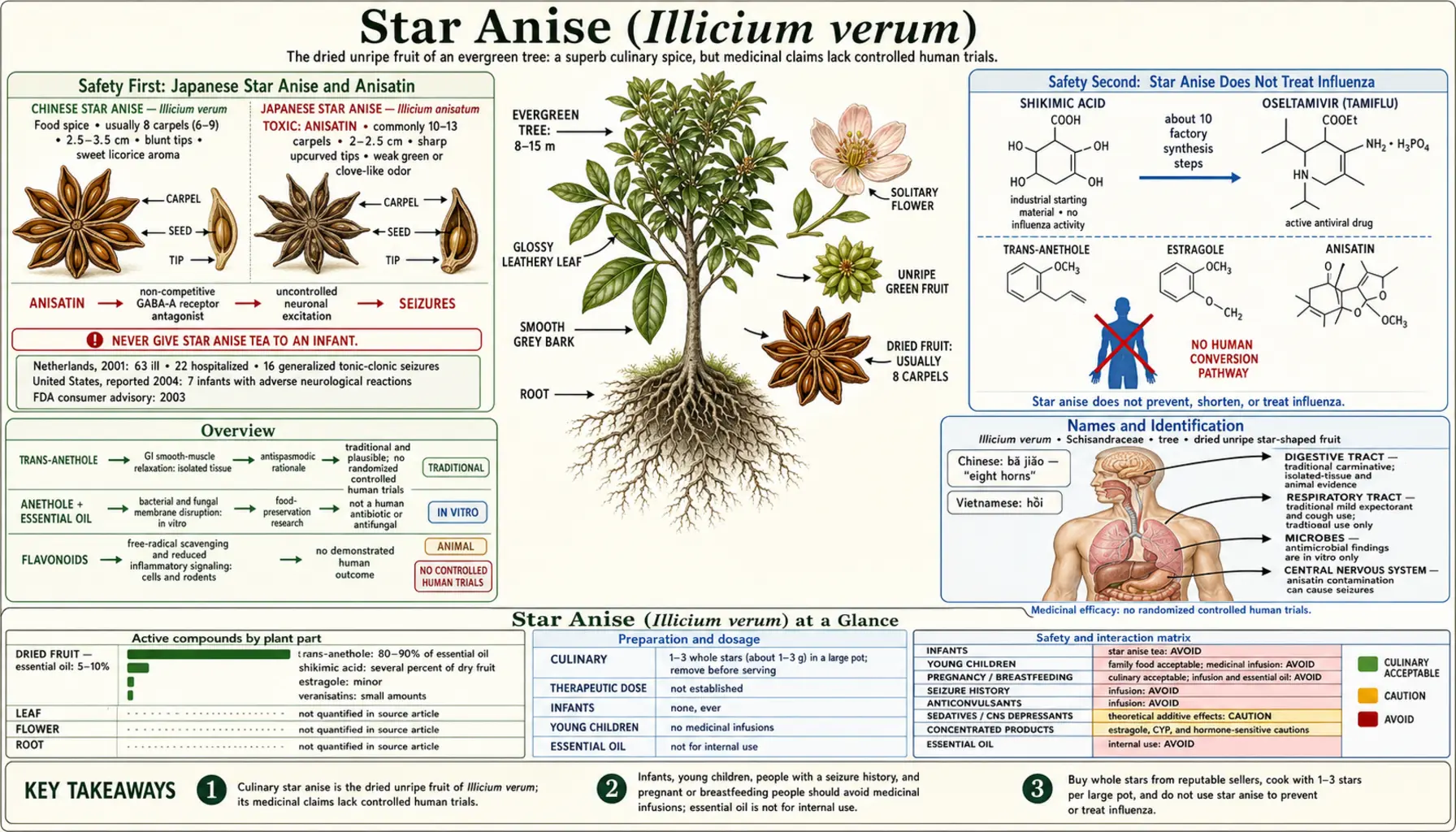
Star anise is the dried, unripe fruit of Illicium verum, a small evergreen tree grown almost entirely in southern China and northern Vietnam. It is the eight-pointed star that gives phở its unmistakable sweet-licorice depth, one of the five spices in Chinese five-spice powder, and the backbone of red-braised pork.
This page carries two safety warnings, and they come before everything else because both cause real harm every year. First: a closely related tree, Japanese star anise (Illicium anisatum), is toxic, looks very similar, and has repeatedly been found contaminating and adulterating commercial star anise — causing seizures in adults and documented neurological illness in infants given star anise tea for colic. Star anise tea should never be given to an infant. Second: star anise is the industrial starting material for the antiviral drug oseltamivir (Tamiflu), and an enormous number of people have concluded from this that the spice treats influenza. It does not, and the section below explains exactly why the reasoning fails.
On the rest of the evidence: star anise is a superb culinary spice with a long record in Chinese and Vietnamese medicine and, for its medicinal claims, almost no human trial data. Nearly everything published on its pharmacology is laboratory or animal work. That is labelled clearly throughout.
Table of Contents
- Safety First: Japanese Star Anise and Anisatin
- Safety Second: Star Anise Does Not Treat Influenza
- Overview
- Names and Identification
- Where It Grows
- Traditional Use
- Active Compounds
- Digestive and Carminative Effects
- Antimicrobial Activity in the Laboratory
- Antioxidant and Anti-Inflammatory Research
- Culinary Use
- Forms and Preparations
- Dosage
- Cautions and Contraindications
- Key Research Papers
- Connections
- Featured Videos
Safety First: Japanese Star Anise and Anisatin
This is the most important thing on the page.
Two trees, one shape
Chinese star anise (Illicium verum) is the food spice. Japanese star anise (Illicium anisatum, known in Japan as shikimi) is not food. It is toxic, it is traditionally used in Japan as a ritual and funerary plant — grown at temples and graves, burned as incense — and it has never been a culinary spice anywhere. The two trees are close relatives and their dried fruits look broadly alike, which is the entire problem.
Anisatin
Illicium anisatum contains anisatin, a sesquiterpene dilactone that is a potent non-competitive antagonist at the GABA-A receptor. GABA is the brain's principal inhibitory neurotransmitter — the brake pedal. Anisatin works much like picrotoxin: it jams that brake. The result is uncontrolled neuronal excitation, and the clinical consequence is seizures, along with vomiting, tremor, agitation and, in infants, jitteriness, abnormal eye movements and abnormal muscle tone. It is potent enough that rodent models of anisatin-induced convulsive seizures are used as a standard experimental tool for studying seizure biochemistry.
What has actually happened to people
- The Netherlands, 2001. A herbal tea on the Dutch market caused an outbreak of illness. Sixty-three people reported malaise, nausea and vomiting two to four hours after drinking it. Twenty-two required hospital admission, sixteen of them for generalised tonic-clonic seizures. NMR analysis of the tea confirmed the presence of anisatin. The product was withdrawn. All patients recovered with supportive care.
- United States, reported 2004. Paediatricians in Miami described seven infants with adverse neurological reactions after being given star anise tea at home — a widespread folk remedy for colic in Hispanic and Asian communities. The investigators found evidence that Chinese star anise on the US market had been contaminated with Japanese star anise, called for stricter import regulation, and concluded plainly that star anise tea should no longer be given to infants.
- France and Switzerland. Paediatric case reports describe star anise poisoning in infants, including one presenting as an apparent life-threatening event — a baby found unresponsive — traced back to star anise.
The regulatory response
The US Food and Drug Administration issued a consumer advisory in 2003 warning against consumption of star anise teas, with particular emphasis on infants, after the cluster of paediatric cases. European authorities imposed tightened import controls and testing requirements on star anise consignments following the Dutch outbreak. Neither action banned the culinary spice, and neither needed to — the problem is adulteration and infusion strength, not star anise in a stockpot.
Can you tell them apart by eye?
Sometimes, imperfectly, and not reliably enough to bet a baby on. In general:
- Illicium verum — usually 8 carpels (occasionally 6 to 9), plump, relatively smooth, with blunt or gently curved tips; roughly 2.5 to 3.5 cm across; a strong sweet licorice-anise smell.
- Illicium anisatum — often more numerous carpels (commonly 10 to 13), thinner and more shrivelled, with sharper, more strongly upcurved points; smaller, roughly 2 to 2.5 cm; weakly aromatic, and what smell there is tends to be green, clove-like or cardboardy rather than sweetly anise.
But this only helps with intact whole stars. Broken fragments, and above all ground star anise or pre-bagged "star anise tea," cannot be identified visually at all. Laboratory analysis is the only reliable check, and that is why the practical advice below is about sourcing and use rather than about squinting at pods.
What to actually do
- Never give star anise tea to an infant. Not for colic, not for gas, not diluted, not "just a little." There is no benefit that justifies it and there is documented harm.
- Do not give star anise tea to young children either. Culinary star anise in a shared family dish is a different exposure entirely and is not the concern.
- Buy whole stars from a reputable seller — a supermarket, a well-known spice merchant, an established Asian grocer. Avoid loose, unlabelled, or unknown-origin material, and avoid ground star anise.
- Cook with it; do not brew strong medicinal infusions of it. A star or two simmered in a large pot of broth is the traditional and safe use pattern, and it has been for centuries.
- If someone has a seizure after drinking a herbal tea, tell the emergency team what they drank. This is a diagnosis that is easily missed and easily made if you mention it.
Safety Second: Star Anise Does Not Treat Influenza
This is the single most persistent myth in the spice aisle, and it is worth dismantling piece by piece because the underlying facts are all true — it is only the conclusion that is wrong.
What is true
Star anise is unusually rich in shikimic acid, an organic acid that plants make as a normal intermediate in the shikimate pathway — the route by which plants build aromatic amino acids. Star anise accumulates enough of it to be worth extracting industrially, and for years the world's supply of pharmaceutical shikimic acid came largely from the Chinese star anise harvest. During the avian influenza scare of the mid-2000s and the 2009 pandemic, demand for the drug oseltamivir (Tamiflu) surged, and news coverage widely reported that most of the world's star anise crop was being diverted to drug manufacture. That was accurate reporting.
What does not follow
Shikimic acid is not an antiviral drug and has no activity against influenza. It is a starting material — a cheap, convenient supply of a particular carbon skeleton with the right stereochemistry. Turning it into oseltamivir takes on the order of ten separate chemical steps in a factory, including reactions that introduce entirely new functional groups and, historically, a hazardous azide intermediate. The part of the oseltamivir molecule that blocks the influenza neuraminidase enzyme — the reason the drug works — does not exist in shikimic acid at all. It is built during synthesis.
Two analogies that make the point stick:
- Sand is the starting material for computer chips. Eating sand does not give you a laptop.
- Crude oil is the starting material for paracetamol. Drinking crude oil does not relieve a headache.
The relationship between star anise and Tamiflu is exactly of that kind. There is no metabolic pathway in the human body that converts dietary shikimic acid into oseltamivir or into anything resembling it.
Two more facts that finish the argument
Shikimic acid is not special to star anise. It is a universal plant metabolite, present in ginkgo, sweetgum, pine needles, coffee, and most fruits and vegetables in smaller amounts. Star anise is merely a commercially convenient concentrated source.
The pharmaceutical industry moved on. Precisely because depending on a single agricultural crop grown in a few provinces is a bad way to secure a strategic drug supply, manufacturers developed fermentation routes using engineered Escherichia coli to produce shikimic acid in bioreactors. That work is well documented in the metabolic-engineering literature. Modern oseltamivir production does not need the star anise harvest.
The bottom line
Drinking star anise tea will not prevent, shorten or treat influenza. If you have influenza and you are in a group at risk of complications — pregnancy, age over 65, chronic lung, heart, kidney or immune conditions — the treatment that helps is an actual antiviral started early, and that means seeing a clinician. Star anise in your soup is a pleasure, not a prophylactic.
Overview
Illicium verum is a small to medium evergreen tree, generally 8 to 15 metres, with smooth grey bark, glossy leathery leaves, and solitary flowers ranging from pale yellow through pink to dark red. It belongs to the family Schisandraceae — the same family as the adaptogenic berry Schisandra chinensis — though older references place it in its own family, Illiciaceae, or lump it near the magnolias. It is a botanically ancient lineage, one of the early-diverging branches of the flowering plants.
The fruit is not a single structure but a ring of individual carpels fused at the centre, radiating outward like the points of a star — usually eight of them, each holding one shiny brown seed. Confusingly for cooks, most of the aroma is in the woody carpel wall, not in the seed.
Fruits are harvested before they ripen, while still green, and then sun-dried until they turn the familiar rust-brown and go hard and brittle. A tree begins bearing at around six years old and may keep producing for a century. Because the spice is dried whole and hard, it keeps its aroma remarkably well — a jar of whole stars stays good for a year or two, far longer than most ground spices.
Names and Identification
Binomial: Illicium verum Hook.f. Family: Schisandraceae. The genus name comes from the Latin illicio, "to entice" — a reference to the smell.
Regional names:
- Chinese: 八角 bā jiǎo ("eight horns"), 八角茴香 bājiǎo huíxiāng ("eight-horned fennel"), or 大料 dà liào ("the big spice") in northern kitchens
- Vietnamese: hồi, đại hồi, or fully bát giác hồi hương — the same "eight-horned fragrance" idea
- Hindi / Urdu: chakra phool or badian — "wheel flower"
- Thai: poy kak bua; Malay / Indonesian: bunga lawang — "clove flower"
- Tagalog: sanke / anis
- Japanese: hakkaku for the edible Chinese species; the toxic native relative is shikimi
Three different plants that all taste of licorice
This is the ambiguity worth carrying away. Three unrelated plants share the flavour because they share one molecule, anethole:
- Star anise — Illicium verum, family Schisandraceae, a tree. A dried fruit shaped like a star.
- Anise or aniseed — Pimpinella anisum, family Apiaceae, a small annual herb related to carrot and parsley. A tiny grey-brown seed.
- Fennel — Foeniculum vulgare, also Apiaceae. A larger, greener, sweeter seed, plus an edible bulb.
They are not botanical relatives in any meaningful sense — the resemblance is purely chemical convergence. In cooking they are not straight substitutes: star anise is heavier, warmer and more assertive, and it stands up to hours of simmering in a way anise and fennel do not. Recipes that call for one and get another usually taste wrong rather than merely different.
And the toxic look-alike
See the safety section above. Illicium anisatum, Japanese star anise, is a genuine relative, genuinely similar-looking, and genuinely poisonous. It is the one identification error on this page that has landed people in hospital.
Where It Grows
Star anise has an unusually concentrated geography for a globally traded spice. The overwhelming majority of the world crop comes from a narrow band of subtropical southern China and adjacent northern Vietnam.
- Guangxi Zhuang Autonomous Region, China is the dominant production centre by a wide margin, with additional output from Yunnan, Guangdong and Fujian.
- Lạng Sơn province and neighbouring provinces in northern Vietnam supply most of the rest, and star anise is one of the region's signature agricultural exports.
Small plantings exist in Laos, the Philippines, Jamaica and India, but they are marginal. This concentration is exactly why the Tamiflu supply question mattered in the 2000s: a global pharmaceutical input depended on the weather in a couple of Chinese provinces.
Trade practice is worth knowing as a buyer. Whole star anise moves in bulk, is repacked many times before it reaches a shelf, and broken carpels and dust from the bottom of sacks are the material most likely to end up in cheap ground spice or bagged tea. Since that is also the material in which adulteration cannot be spotted, "buy whole stars" is both a flavour recommendation and a safety recommendation.
Traditional Use
Traditional use is history and it is culturally meaningful. It is not evidence of efficacy, and virtually none of it has been tested in controlled human trials.
- Traditional Chinese medicine uses ba jiao hui xiang as a warm, pungent, sweet herb entering the liver, kidney, spleen and stomach channels, given for cold-type abdominal pain, hernia pain, vomiting and poor appetite. It sits in the "warming the interior and dispelling cold" category alongside dried ginger and clove.
- Vietnamese thuốc nam uses đại hồi similarly for digestive complaints and cold aches, and star anise oil in warming liniments.
- Ayurveda and Unani know it as badian, used for flatulence, colic and as a breath freshener.
- European herbal practice adopted star anise after it reached Europe in the sixteenth century, chiefly as a carminative for bloating and as a mild expectorant in cough preparations. The European Medicines Agency maintains a traditional-use herbal monograph for star anise fruit covering mild spasmodic digestive complaints and cough — a "traditional use" designation, which means the indication rests on long-standing use rather than on clinical trial evidence, and which comes with age restrictions excluding young children.
- Folk paediatric use for infant colic is the one traditional application this page actively advises against, for reasons set out at the top.
Active Compounds
Star anise fruit yields roughly 5 to 10 percent essential oil, and one compound dominates it overwhelmingly.
trans-Anethole
Typically 80 to 90 percent of the essential oil. This single molecule is star anise's flavour. It is also the dominant compound in aniseed and a major one in fennel, which is why all three taste related. Anethole is roughly thirteen times sweeter than sucrose on the tongue, which explains why star anise reads as "sweet" even in a savoury broth. In laboratory and animal work it shows antispasmodic, antimicrobial and anti-inflammatory activity.
Shikimic acid
Present at several percent of the dry fruit — high enough for commercial extraction, and the reason for the Tamiflu story addressed above. It is a metabolic intermediate with no antiviral activity of its own.
Estragole (methyl chavicol)
A minor constituent, and one worth naming honestly. Estragole is the same compound found in basil and tarragon, and at high doses it is a rodent liver carcinogen; European food-safety assessments have flagged it and recommended limiting exposure to concentrated sources such as essential oils and strong herbal infusions. Culinary use of the whole spice is not considered a meaningful risk. This is a reason not to drink concentrated star anise infusions daily, and not to take star anise essential oil internally.
Veranisatins
A detail most sources omit. Illicium verum itself contains small amounts of sesquiterpene lactones called veranisatins, which are neurotoxic in mice at high doses — the same broad chemical family as anisatin, though far less potent and present in far smaller quantities. This does not make culinary star anise dangerous. It does mean that even genuine, unadulterated Chinese star anise is not a completely inert plant when brewed as a strong infusion for a very small body, and it strengthens the case against infant teas independently of the adulteration issue.
Others
- Limonene, linalool, α-pinene, foeniculin, anisaldehyde — supporting aromatics
- Flavonoids, chiefly quercetin and kaempferol glycosides — responsible for most of the antioxidant activity measured in chemical assays
- Phenylpropanoids, lignans and tannins
A widely used 2011 review in the Journal of Ethnopharmacology pulls together the botany, traditional use, chemistry and pharmacology of Illicium verum and is the standard reference for this material.
Digestive and Carminative Effects
Mechanism. Anethole relaxes gastrointestinal smooth muscle in isolated-tissue preparations, which is the standard antispasmodic mechanism shared by fennel, anise and caraway. Aromatic volatiles also stimulate salivary and gastric secretion. This is the rationale behind star anise's use for bloating, colic and cramping across every tradition that has used it.
Evidence. Isolated tissue and animal studies for star anise itself; somewhat better human evidence exists for the related plants, particularly fennel-seed preparations. There are no randomised controlled human trials of star anise for digestive symptoms. The European traditional-use monograph is explicitly based on long-standing use, not on trial data, and it says so.
What that means for you. A star anise in a pot of broth is a fine thing and may well settle a heavy meal. The claim is traditional and plausible; it is not demonstrated. Persistent digestive symptoms need investigation, not spice.
Antimicrobial Activity in the Laboratory
Mechanism. Anethole and star anise essential oil disrupt bacterial and fungal cell membranes. In culture, star anise oil inhibits a broad range of organisms, including common food-spoilage bacteria and Candida species, and this is of genuine practical interest to food scientists working on natural preservatives.
Evidence. In vitro, essentially without exception. Studies typically apply concentrated essential oil directly to organisms on a plate at concentrations that could never be achieved in a human body by eating the spice. There are no human trials showing that eating or drinking star anise treats any infection.
What that means for you. Star anise is not an antibiotic and not an antifungal. If you have an infection that needs treating, it needs actual treatment. The laboratory work is legitimate research with a legitimate application — food preservation — and it does not transfer to human therapeutics.
Antioxidant and Anti-Inflammatory Research
Mechanism. The flavonoid fraction — quercetin and kaempferol derivatives — scavenges free radicals in chemical assays, and star anise extracts reduce inflammatory signalling in cell models and in rodents, lowering markers such as TNF-α and interleukin-6.
Evidence. Cell culture and animal models. Rodent studies also report anticonvulsant, analgesic and sedative effects of star anise extracts, which sits oddly alongside the fact that its toxic relative causes seizures — a good illustration of how different two closely related plants can be, and of why "it's natural and related to something useful" is never an argument.
What that means for you. "Star anise is rich in antioxidants" is a true statement about a chemical assay and an unproven statement about your health. No human outcome has been demonstrated. Star anise contributes to a varied, plant-rich diet in the same modest way any aromatic spice does, and that is where the claim should stop.
Culinary Use
This is where star anise genuinely excels, and where its history is deepest.
- Phở. The defining spice of Vietnamese phở broth, toasted alongside cinnamon, clove, coriander seed, black cardamom and fennel, then simmered for hours with charred onion and ginger. Take star anise out and the broth stops being phở.
- Chinese five-spice powder. Star anise is the lead, with Chinese cinnamon (cassia), clove, Sichuan pepper and fennel seed. Formulations vary by region and by household.
- Red braising (hóng shāo). Chinese pork belly, beef shin and whole ducks braised in soy sauce, rock sugar, wine and star anise — a technique in which the spice's ability to survive hours of cooking is the whole point.
- Vietnamese bò kho and other slow beef stews.
- Indian cooking. Chakra phool in biryani, some garam masala blends, and Kashmiri and Mughlai dishes.
- Malay and Indonesian cooking. Bunga lawang in rendang, curries and spice pastes.
- Master stocks. The perpetually reused, endlessly replenished Chinese braising liquid, which is unimaginable without star anise.
- Western sweet use. Poached pears and quinces, mulled wine, plum and apple compotes, spiced syrups; and it flavours some anise-type liqueurs and soft drinks.
Technique. Use whole stars and remove them before serving. One to three stars is plenty for a large pot — each whole star weighs roughly a gram, and star anise overwhelms a dish fast, turning medicinal and bitter if overdone. Dry-toast briefly in a pan before adding to release the aroma. Broken pieces work fine for flavour; buy them intact anyway so you can see what you are getting.
Forms and Preparations
- Whole dried stars. The only form worth buying. Identifiable, long-keeping, and the traditional culinary form.
- Ground star anise. Loses aroma quickly and, more seriously, cannot be checked for adulteration. Grind your own if you need powder.
- Five-spice powder. A blend, ubiquitous and useful; the same sourcing logic applies — buy from a brand you trust.
- Star anise tea and bagged herbal infusions. This is the form implicated in every documented poisoning outbreak. If you drink it at all, use whole stars from a reputable source, keep it weak, and never give it to a baby or a young child.
- Essential oil. Very concentrated, high in anethole and containing estragole. Used in flavouring and perfumery under strict limits. Not for internal use.
- Shikimic acid extract. An industrial pharmaceutical intermediate, not a consumer supplement. If you see it sold as a flu remedy, that is the myth addressed above being sold back to you.
Dosage
There is no established therapeutic dose for star anise, because there are no controlled human trials from which to derive one. Anyone giving you a precise medicinal dosage is repeating tradition.
What can be said:
- Culinary: one to three whole stars — roughly 1 to 3 grams — in a large pot serving several people, removed before serving. This is the exposure pattern with centuries of safe use behind it.
- European traditional-use monographs describe adult infusions made from small quantities of crushed fruit taken a few times daily for short periods, with explicit age restrictions excluding young children. Because that framework is built on tradition rather than trials, it is a boundary rather than a recommendation.
- Infants: none. Ever. This is the one hard number on the page.
- Young children: star anise in family food is fine; medicinal infusions are not.
- Essential oil: not to be taken internally.
Cautions and Contraindications
Infants — absolute
Do not give star anise tea to infants under any circumstances. Documented cases include seizures, jitteriness, abnormal eye movements, vomiting and an apparent life-threatening event. The risk comes both from adulteration with toxic Japanese star anise and from the small amounts of neuroactive compounds in the genuine spice acting on a very small body. Colic is distressing and it is also self-limiting; there is no version of this trade-off that favours the tea.
Adulteration — everyone
Japanese star anise contamination has repeatedly reached commercial supply. Buy whole stars from established retailers; avoid loose, unlabelled or unknown-origin material and pre-ground powder. If a batch smells weak, green or clove-like rather than sweetly licorice, do not use it.
Seizure disorders
Anyone with epilepsy or a seizure history has an extra reason to avoid star anise infusions entirely, given that the realistic contamination hazard is a GABA antagonist.
Pregnancy and breastfeeding
Culinary amounts in food are considered acceptable. Avoid medicinal infusions and essential oil in pregnancy and while breastfeeding. The reasons are the adulteration risk, the estragole content, and the complete absence of safety data. Star anise tea is used in some cultures to promote milk supply; there is no good evidence it does, and infants can be exposed through breast milk.
Estragole and long-term use
Star anise contains estragole, a rodent hepatocarcinogen at high doses. Occasional culinary use is not a concern. Daily strong infusions or essential-oil ingestion over long periods are a reason for caution.
Drug interactions
- Anticonvulsants — avoid star anise infusions on the contamination argument alone.
- Sedatives and CNS depressants — theoretical additive effects with the sedative activity reported in animal studies.
- Hormone-sensitive conditions — anethole has been described as weakly oestrogenic in laboratory systems; the relevance to culinary intake is almost certainly nil, but people taking gram-level doses of concentrated products should know it exists.
- Cytochrome P450 — anethole and estragole are metabolised by and can affect CYP enzymes; concentrated extracts could in principle alter clearance of other medicines.
Allergy
Rare. People with known allergy to anise or fennel may react to star anise despite the plants being botanically unrelated, because of shared compounds.
The claim to distrust
Any product marketing star anise, star anise tea or shikimic acid as a flu treatment or flu preventive is making a claim that is not supported and not chemically coherent. See the section above.
Key Research Papers
Every citation below has been checked against its PubMed record. Where an identifier could not be verified, a PubMed topic search is given instead, since a search link cannot resolve to the wrong paper.
- Ize-Ludlow D, Ragone S, Bruck IS, Bernstein JN, Duchowny M, Peña BM. Neurotoxicities in infants seen with the consumption of star anise tea. Pediatrics. 2004;114(5):e653–e656.
- Johanns ES, van der Kolk LE, van Gemert HM, Sijben AE, Peters PW, de Vries I. An epidemic of epileptic seizures after consumption of herbal tea. Nederlands Tijdschrift voor Geneeskunde. 2002;146(17):813–816. (In Dutch.)
- Minodier P, Pommier P, Moulène E, et al. Star anise poisoning in infants. Archives de Pédiatrie. 2003;10(7):619–621. (In French.)
- Perret C, Tabin R, Marcoz JP, et al. Apparent life-threatening event in infants: think about star anise intoxication! Archives de Pédiatrie. 2011;18(7):750–753. (In French.)
- Wang GW, Hu WT, Huang BK, Qin LP. Illicium verum: a review on its botany, traditional use, chemistry and pharmacology. Journal of Ethnopharmacology. 2011;136(1):10–20.
- Wei DD, Ge D, Guo PP, et al. A bird's eye view of anisatin-induced convulsive seizures in brain by a 1H NMR based metabolic approach. Molecular BioSystems. 2014;10(11):2923–2934.
- Li P, Wei DD, Wang JS, et al. 1H NMR metabolomics to study the effects of diazepam on anisatin-induced convulsive seizures. Journal of Pharmaceutical and Biomedical Analysis. 2016;117:184–194.
- Martínez JA, Bolívar F, Escalante A. Shikimic acid production in Escherichia coli: from classical metabolic engineering strategies to omics applied to improve its production. Frontiers in Bioengineering and Biotechnology. 2015;3:145.
- Cui YY, Ling C, Zhang YY, Huang J, Liu JZ. Production of shikimic acid from Escherichia coli through chemically inducible chromosomal evolution and cofactor metabolic engineering. Microbial Cell Factories. 2014;13:21.
Live PubMed Searches
- Illicium verum pharmacology
- Illicium anisatum and anisatin toxicity
- Star anise adulteration and detection methods
- Anisatin as a GABA receptor antagonist
- trans-Anethole pharmacology
- Shikimic acid and oseltamivir synthesis
- Estragole safety assessment
- Veranisatins and neurotoxicity
- Star anise essential oil antimicrobial activity
- Herbal teas for infant colic and adverse effects
Connections
- All Herbs
- Fennel — shares anethole and the licorice flavour, and shares the phở spice pot; botanically unrelated.
- Cinnamon — star anise's partner in five-spice powder and in every good broth.
- Clove — the third of the five spices, and another warming aromatic with a real toxicity ceiling.
- Conditions on this site that reference this page: Epilepsy · Bronchitis · Influenza · Pulmonology · Chronic Cough