Chrysanthemum (Chrysanthemum morifolium)
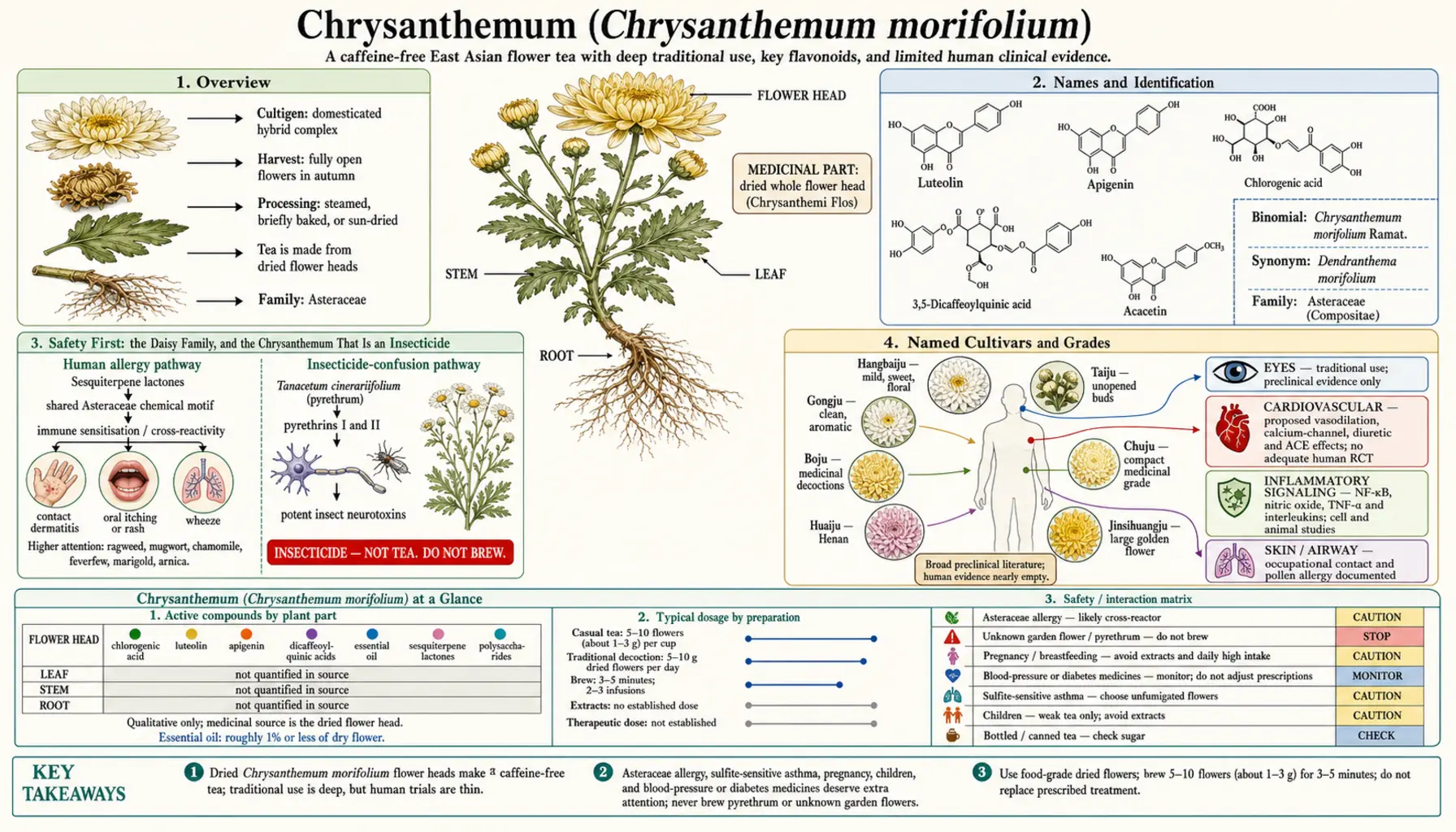
Chrysanthemum tea — 菊花 ju hua in Chinese, cúc hoa in Vietnamese — is made from the dried flower heads of Chrysanthemum morifolium and is one of the most widely drunk herbal infusions on earth. In China, Vietnam, Hong Kong, Taiwan, Malaysia and Singapore it is an ordinary daily beverage, sold chilled in cans and brewed loose in offices and homes. It is caffeine-free, faintly sweet, and traditionally reached for when someone's eyes are tired, their head aches, or the weather is oppressive.
Two safety points lead this page rather than trail it. First, chrysanthemum is a member of the Asteraceae — the daisy and ragweed family — and cross-reactivity within that family is real and documented. If you react to ragweed, mugwort, chamomile, feverfew, marigold or arnica, chrysanthemum can set you off too, and contact dermatitis from handling the flowers is a recognised occupational problem among florists and growers. Second, do not confuse the tea chrysanthemum with pyrethrum (Tanacetum cinerariifolium, once classified as Chrysanthemum cinerariifolium), the daisy that natural insecticide is made from. They are different plants that have shared a genus name in the past, and one of them is not a beverage.
On effectiveness: the traditional record is unusually detailed and goes back nearly two thousand years, but the modern human evidence is thin. Most of what is published is cell and animal work on the flavonoids. Treat what follows as a good herb with a long history and a small trial literature, not as a treatment.
Table of Contents
- Overview
- Names and Identification
- Safety First: the Daisy Family, and the Chrysanthemum That Is an Insecticide
- Named Cultivars and Grades
- Traditional Use
- Active Compounds
- Eyes, Headache and "Clearing Liver Heat"
- Blood Pressure and the Cardiovascular Claims
- Antioxidant, Anti-Inflammatory and Antimicrobial Activity
- Culinary Use
- Forms and Preparations
- Dosage
- Cautions and Contraindications
- Key Research Papers
- Connections
- Featured Videos
Overview
Chrysanthemum morifolium Ramat. is not a wild plant. It is a cultigen — a domesticated hybrid complex bred in China over something like fifteen hundred years, probably from Chrysanthemum indicum crossed with other wild species of the genus. There is no natural population of it. Everything sold as ju hua descends from Chinese horticulture, and the ornamental chrysanthemums in a garden centre are the same species, bred for show rather than for the cup.
The part used is the dried flower head (Chrysanthemi Flos in pharmacopoeial Latin) — the whole composite inflorescence, not individual petals. Harvest is in autumn when the flowers are fully open. The traditional processing steps matter to the final product: flowers are steamed or briefly baked and then dried, or sun-dried, depending on the region and the grade. The steaming step deactivates enzymes that would otherwise brown the flower and it is part of why good Hangbaiju stays pale.
Cultivation is concentrated in a handful of Chinese counties with protected geographical-indication status — Tongxiang in Zhejiang, Shexian and Bozhou in Anhui — and the flowers reach consumers through the same channels as tea: loose by weight in dried-goods shops and pharmacies, in tea bags, and increasingly in canned and bottled ready-to-drink form, usually sweetened with rock sugar.
Names and Identification
Binomial: Chrysanthemum morifolium Ramat. Synonym: Dendranthema morifolium (Ramat.) Tzvelev — the genus was split and re-merged during the twentieth century, so older and Russian-influenced literature uses Dendranthema. They are the same plant. Family: Asteraceae (Compositae), tribe Anthemideae.
Local names: Chinese 菊花 (júhuā, ju hua); Vietnamese cúc hoa (and trà hoa cúc for the tea); Japanese 菊 kiku; Korean 국화 gukhwa; Thai kāo huāi / เก๊กฮวย kek huai, borrowed from Teochew Chinese, which is also the Malaysian and Singaporean hawker term.
Three plants that get confused with it:
- Chrysanthemum indicum — 野菊花 ye ju hua, "wild chrysanthemum". A separate pharmacopoeial drug with a separate entry. Smaller, deeper yellow flowers, markedly more bitter. Traditionally it is the stronger heat-clearing and "toxin-resolving" herb, used for boils, sore throats and skin infections rather than as a daily drink. If your tea is aggressively bitter, check which species you bought.
- "Kunlun snow chrysanthemum" / snow daisy — sold as a premium red-brewing chrysanthemum tea from Xinjiang. It is Coreopsis tinctoria, a North American plant in the same family but a different genus. Not ju hua, whatever the packaging says.
- Chrysanthemum greens — tong hao in Chinese, shungiku in Japanese, the leafy vegetable in hot pot. That is Glebionis coronaria (formerly Chrysanthemum coronarium), a different species eaten as a vegetable. Its leaves are food; it is not the tea flower.
And the important one, which gets its own section below: pyrethrum.
Safety First: the Daisy Family, and the Chrysanthemum That Is an Insecticide
Asteraceae cross-reactivity is not a formality. Plants in this family make sesquiterpene lactones, a class of compounds that are among the best-characterised contact allergens in dermatology. "Sesquiterpene lactone mix" is a standard reagent on patch-test panels precisely because sensitisation to it is common. Once sensitised to one Compositae plant, people frequently react to others — the immune system is recognising a shared chemical motif, not a species.
The family includes ragweed, mugwort, chamomile, feverfew, tansy, yarrow, marigold and calendula, arnica, echinacea, dandelion, sunflower, lettuce and artichoke — and chrysanthemum. If you have ragweed hay fever or a known chamomile reaction, you belong to the group most likely to react to chrysanthemum, whether as tea, as pollen, or on contact.
Chrysanthemum dermatitis in florists and growers is well documented. Work in the 1970s identified the sesquiterpene lactone allergens responsible — arteglasin-A among them — and occupational hand and airborne facial dermatitis in people who handle cut chrysanthemums remains a recognised occupational problem. Handling the flowers is a higher-exposure route than drinking a weak infusion of them.
There is an interesting wrinkle worth reporting because it cuts the other way. A 2007 letter in Contact Dermatitis noted that sesquiterpene lactone sensitivity was less common in a patch-tested population in Asia than in Europe, and the authors raised the possibility that lifelong chrysanthemum-tea drinking might induce oral tolerance. That is speculation, explicitly framed as such, and it does not license anyone with a known Compositae allergy to start drinking the tea. It does suggest the picture is more complicated than "daisy family, therefore dangerous".
Now pyrethrum. The natural insecticide sold as pyrethrin comes from the dried flower heads of Tanacetum cinerariifolium, Dalmatian pyrethrum — a plant that was formerly placed in the genus Chrysanthemum and is still sometimes called "pyrethrum daisy" or "Dalmatian chrysanthemum". A related species, Tanacetum coccineum (Persian or painted daisy), is also a pyrethrin source. These flowers contain pyrethrins I and II, potent insect neurotoxins, and they are the chemical template for the entire synthetic pyrethroid class — permethrin, deltamethrin, cypermethrin.
Pyrethrum is not a tea plant and must never be brewed as one. It is unlikely you will meet it in a Chinese grocery, but it is entirely possible to meet it in a garden centre or a seed catalogue labelled "chrysanthemum". The rule is simple: buy tea chrysanthemum from a food or herb supplier, as dried flower heads sold for drinking, and do not brew flowers from the garden unless you are certain of the species.
Named Cultivars and Grades
Chrysanthemum is graded and traded much like tea, and the named types are commercially meaningful rather than marketing invention. The classical set is the "four famous chrysanthemums" (四大名菊):
- Hangbaiju (杭白菊) — "Hangzhou white chrysanthemum", grown mainly around Tongxiang in northern Zhejiang despite the name. Steamed and dried, pale ivory, opens into a large soft flower in the cup. Mild, sweet, floral, low bitterness. The default drinking chrysanthemum in southern China and the most common export grade. The best-known sub-grade is taiju (胎菊), the unopened or barely opened buds, which brew sweeter and are sold at a premium.
- Gongju (贡菊) — "tribute chrysanthemum", from Shexian county in the Huangshan (Yellow Mountain) region of southern Anhui, which is why it is often sold as Huangshan Gongju. Small, tight, very white flowers, baked rather than steamed. Cleaner and slightly more aromatic than Hangbaiju, and the grade most associated with the traditional eye indication.
- Boju (亳菊) — from Bozhou in northern Anhui, one of China's great herb-trading cities. Loose, shaggy white flowers, sun-dried. Historically the herbalist's chrysanthemum — the grade favoured in medicinal decoctions rather than for casual drinking.
- Chuju (滁菊) — from Chuzhou, Anhui. Compact ball-shaped white flowers, traditionally regarded as the finest medicinal grade of the four.
Also traded: Huaiju (怀菊) from Henan, counted among the province's "four Huai medicines", and Jinsihuangju (金丝皇菊), a large golden single-flower type from Jiangxi sold one blossom to a cup as a visual showpiece.
What to look for when buying. Whole intact flower heads rather than crumbs; a natural creamy or pale-gold colour rather than a uniform bleached white; and no sharp sulfurous smell when you open the bag. Sulfur fumigation is a real and documented quality problem in the dried-herb trade — it is used to bleach and preserve flowers — and heavily fumigated material can carry sulfite residues. Unnaturally bright, uniform white flowers with an acrid smell are a reason to buy elsewhere, and this matters especially for anyone with sulfite sensitivity or asthma.
Traditional Use
Chrysanthemum has an unusually deep textual record. It appears in the Shennong Bencao Jing, the foundational Chinese materia medica compiled around the first to second century CE, classified among the upper-grade drugs — the category reserved for substances considered safe for long-term use. It is one of the "four gentlemen" of Chinese painting alongside plum, orchid and bamboo, and chrysanthemum wine is the traditional drink of the Double Ninth festival.
In traditional Chinese medicine, ju hua is described as sweet, bitter and slightly cold, entering the lung and liver channels, with four stated actions:
- Disperses wind-heat — the early stage of a feverish cold with sore throat, headache and cough. The classic formula here is Sang Ju Yin, "Mulberry Leaf and Chrysanthemum Decoction", from Wu Jutong's Wen Bing Tiao Bian of 1798, in which chrysanthemum is paired with mulberry leaf, mint, apricot kernel and forsythia.
- Clears the liver and brightens the eyes (清肝明目) — the indication most people actually use it for: red, dry, gritty, tired or sore eyes, and blurred vision attributed to "liver" patterns. Paired with goji berries in the well-known formula Qi Ju Di Huang Wan, and drunk with goji as an everyday tea.
- Calms liver yang — headache, dizziness, irritability, a flushed face and a pounding head. This is the traditional description that maps most closely onto what a modern reader would call hypertensive symptoms, and it is why chrysanthemum appears in TCM formulas used for high blood pressure.
- Clears heat and resolves toxicity — boils and sores, though for this indication the wild species ye ju hua is preferred.
Common pairings tell you how it is thought about: with goji (gou qi zi) for the eyes; with honeysuckle flower (jin yin hua) in cooling summer drinks and sore-throat teas; with mulberry leaf for colds; with rock sugar simply to make it pleasant.
In Vietnam, trà hoa cúc plays the same role — a cooling everyday tea, often blended with licorice root or honey. Across Malaysia and Singapore, iced kek huai with luo han guo (monk fruit) is standard hawker-centre fare in hot weather.
Two thousand years of consistent use tells you the drink is well tolerated by most people and that its perceived effects are consistent enough to have kept the tradition stable. It does not tell you those effects are pharmacological.
Active Compounds
- Flavones — luteolin and apigenin. These are the headline constituents, present both free and as glycosides (luteolin-7-O-glucoside, apigenin-7-O-glucoside), together with acacetin and diosmetin derivatives. Luteolin and apigenin are among the most studied plant flavones and have their own substantial literature on anti-inflammatory, antioxidant and neuroprotective activity in cell and animal systems. Analytical work comparing chrysanthemum flower teas of different colours has quantified these compounds and shown that cultivar and flower colour meaningfully change the profile.
- Chlorogenic acid and dicaffeoylquinic acids. Chlorogenic acid — the same phenolic acid that makes coffee a major dietary polyphenol source — is typically the most abundant single phenolic in chrysanthemum flowers, alongside 3,5-dicaffeoylquinic acid. These are the compounds that dominate most "total antioxidant" measurements of the tea.
- Essential oil. Roughly a percent or less of the dry flower, and the source of the aroma: camphor, borneol, bornyl acetate, chrysanthenone, 1,8-cineole, α-pinene and germacrene D among many others. Composition varies sharply by cultivar, which is why Gongju and Hangbaiju smell different.
- Sesquiterpene lactones. Present in small amounts. Pharmacologically interesting, and — as covered above — the compound class responsible for Compositae contact allergy.
- Polysaccharides. A large recent literature examines chrysanthemum polysaccharides for immunomodulatory and gut-microbiota effects. All of it is preclinical, and polysaccharides are poorly extracted by a short hot-water steep anyway.
- Carotenoids and other pigments in the yellow cultivars, contributing colour and some antioxidant capacity.
Chrysanthemum tea contains no caffeine. This is worth stating because it is the single most reliable practical difference between it and green tea, and it is why it is drunk in the evening.
Eyes, Headache and "Clearing Liver Heat"
The eye indication is the reason most people reach for this tea, so it deserves a straight answer.
What is plausible. Luteolin and apigenin have documented anti-inflammatory activity in cell and animal models, and there is a body of preclinical work on flavonoids from chrysanthemum and related plants in models of retinal and ocular injury — oxidative stress, inflammatory signalling, light-induced retinal damage. Reviews of Chinese medicinal flowers used for liver and eye complaints have collected this literature. Mechanistically, there is nothing absurd about the traditional indication.
What is missing. Human trials. I am not aware of a well-designed randomized controlled trial showing that drinking chrysanthemum tea improves dry eye, eye strain, visual fatigue or any measurable ophthalmic outcome. What exists is preclinical work, small studies published largely in Chinese-language journals that are difficult to appraise, and two thousand years of people saying it helps.
What is real but not pharmacological. If your eyes hurt because you have been at a screen for six hours, then stopping, making a hot drink, sitting somewhere else for ten minutes and letting warm steam rise past your face will help — and none of that requires the flower to do anything. That is a genuine benefit and it is worth naming rather than dismissing. The tea is a good vehicle for a break. Just do not conclude from feeling better that the luteolin did it.
The same applies to the headache and dizziness indication. Warm fluid, rest and a caffeine-free drink are reasonable self-care for a tension headache. Chrysanthemum has not been shown to treat migraine or any defined headache disorder.
Blood Pressure and the Cardiovascular Claims
Chrysanthemum is a genuine classical herb for hypertension in Chinese practice — not in the modern diagnostic sense, but through the "liver yang rising" pattern, whose signs (throbbing headache, dizziness, flushed face, irritability, tinnitus) overlap heavily with how hypertension has traditionally presented in the clinic. It appears in a number of TCM antihypertensive formulas and in Chinese dietary-therapy recommendations, and a narrative review of the Chinese-language literature on food therapy and blood pressure control lists it among the commonly used items.
Proposed mechanisms from preclinical work include vasodilation, calcium-channel effects of flavonoid fractions, mild diuresis, and inhibition of angiotensin-converting enzyme by phenolics — the last being a very common finding for polyphenol-rich extracts in vitro and a very weak predictor of clinical effect.
The honest position: there is no adequately powered, well-designed randomized controlled trial demonstrating that chrysanthemum tea lowers blood pressure in humans. Compare this with hibiscus, where several randomized trials have measured real, if modest, reductions — that is what the evidence looks like when it exists. For chrysanthemum, it does not yet exist.
What to do with that. Drink the tea if you enjoy it. Do not stop or reduce antihypertensive medication because of it. Do keep measuring your blood pressure at home, which is the only way anyone finds out what is actually happening.
Antioxidant, Anti-Inflammatory and Antimicrobial Activity
This is the largest published literature on the plant and also the least clinically decisive.
Antioxidant. Chrysanthemum flower tea scores well on standard chemical antioxidant assays — DPPH, ABTS, FRAP — which is entirely expected of any beverage carrying that much chlorogenic acid and flavone. Analytical comparisons of different-coloured chrysanthemum teas have quantified this and linked it to phenolic content. Remember what these assays measure: the chemical reducing power of an extract in a test tube. It is a compositional fact, not a health outcome, and decades of trials have shown that high antioxidant capacity does not reliably translate into disease prevention.
Anti-inflammatory. Chrysanthemum extracts and their isolated flavones suppress inflammatory signalling — NF-κB activation, nitric oxide production, TNF-α and interleukin release — in cultured immune cells, and reduce inflammation in rodent models. Comprehensive reviews of the species catalogue anti-inflammatory, hepatoprotective, antiviral and antitumour activity across dozens of such studies. Every one of those is preclinical.
Antimicrobial. The essential oil and extracts inhibit various bacteria and fungi in culture. This is most pronounced for Chrysanthemum indicum (ye ju hua), which matches its traditional use for boils and infections. Inhibiting a bacterium on an agar plate is not evidence that drinking the tea treats an infection.
The pattern to notice across all three: the preclinical literature is broad, consistent and genuinely interesting, and the human literature is nearly empty. That gap is the most important thing this page can tell you about chrysanthemum, and it is the same gap that exists for most herbal teas.
Culinary Use
- The tea itself is the main culinary use — hot or iced, plain or with rock sugar, goji berries, monk fruit, honeysuckle or licorice.
- Chrysanthemum tea jelly and desserts — the infusion set with agar is a common Cantonese dessert; chrysanthemum also flavours syrups and sorbets.
- Chrysanthemum wine — the traditional Double Ninth festival drink, historically flowers steeped in rice wine.
- Edible flowers in Japan. Shokuyō-giku are cultivars of this same species grown specifically for eating — the purple mottenohoka is the famous one from Yamagata prefecture. The petals are blanched briefly with a splash of vinegar (which fixes the colour), dressed, and served as a small side dish, or scattered raw over sashimi. This is real food use, not garnish theatre.
- In hot pot and salads — petals are occasionally added, though the leafy vegetable in most hot pots is tong hao, a different species as noted above.
Flavour notes: good Hangbaiju is honeyed and faintly like chamomile with a clean, slightly herbal finish; Gongju is drier and more aromatic; wild chrysanthemum (ye ju hua) is distinctly bitter and is not a pleasure drink. Over-steeping any of them brings out bitterness — five minutes is plenty.
Forms and Preparations
- Whole dried flower heads — the standard and the best form. Buy by cultivar name where you can.
- Taiju (buds) — unopened Hangbaiju buds; sweeter, less bitter, more expensive, and they do not unfurl attractively in a glass.
- Tea bags — convenient, usually made from broken flowers, generally weaker and more bitter.
- Canned and bottled chrysanthemum tea — ubiquitous in Asian groceries. Check the sugar: many contain as much as a soft drink. This is the form most people actually consume most often, and its sugar load is a far more consequential health variable than its flavone content.
- Extract capsules and powders — sold for the eye and blood-pressure claims. Unstandardised, unstudied in humans, and the form where the allergy risk is concentrated because the dose is concentrated.
- Blends — with goji (the classic eye pairing), honeysuckle, monk fruit, licorice, or in "eight treasures" tea (ba bao cha).
How to brew. Five to ten dried flowers per cup, water just off the boil rather than fully boiling, three to five minutes. Good flowers take two or three infusions. If it turns bitter, you have steeped too long or bought ye ju hua by mistake.
Dosage
There is no evidence-based therapeutic dose, because there are no trials establishing an effect to dose for. What exists is pharmacopoeial and traditional practice:
- Decoction, traditional/pharmacopoeial: in the region of 5–10 g of dried flowers per day, decocted, which is the range given for Chrysanthemi Flos in Chinese pharmacopoeial practice.
- As a casual tea: five to ten flowers per cup is roughly 1–3 g. Two or three cups a day sits comfortably inside traditional use.
- Wild chrysanthemum (ye ju hua): used at lower amounts and for shorter courses, as a stronger and more bitter herb.
- Extracts: no established dose. Follow the label and treat unstandardised extracts with more caution than the tea.
Traditional practice regards it as suitable for long-term daily use — the upper-grade classification in the Shennong Bencao Jing means exactly that. That is a two-thousand-year observational record rather than a toxicology study, but it is not nothing.
Cautions and Contraindications
Asteraceae allergy — the main issue, restated. Chrysanthemum belongs to the daisy and ragweed family and shares its sesquiterpene lactone allergens.
- If you are allergic to ragweed, mugwort, chamomile, feverfew, marigold, calendula, arnica, echinacea, tansy or yarrow, treat chrysanthemum as a likely cross-reactor. Reactions range from oral itching and rash through to, rarely, anaphylaxis — anaphylaxis to Compositae plants is documented, most familiarly with chamomile.
- Contact dermatitis from handling the flowers is a recognised occupational condition in florists, nursery workers and chrysanthemum growers, including airborne facial dermatitis from working near the plants. If you handle them at work and have persistent hand or face dermatitis, ask about patch testing to the sesquiterpene lactone mix.
- Pollen. Chrysanthemum pollen can provoke respiratory allergy in sensitised people. Loose flower heads in a jar release pollen when handled.
- Try a small amount first if you have any Compositae history, and stop at the first sign of itching, rash, lip or tongue tingling, or wheeze.
Do not brew pyrethrum. Tanacetum cinerariifolium and T. coccineum — pyrethrum daisy, painted daisy, formerly classified in Chrysanthemum — are insecticide plants, not tea plants. Buy dried flowers sold as food from a food or herb supplier. Do not brew flowers of unknown species from a garden, a florist or an ornamental pot.
Pregnancy and breastfeeding. Chrysanthemum tea is drunk in pregnancy across East Asia and is not regarded traditionally as an abortifacient. However, it is classed as a cooling/cold herb, and traditional practice cautions against cold herbs in pregnancy and in the postpartum period. There is no modern human safety data at all. Occasional tea is very unlikely to be a problem; avoid concentrated extracts and daily high intake.
Blood pressure and diabetes medication. If chrysanthemum has genuine hypotensive activity — unproven — the effect would be additive to medication. Monitor rather than assume, and do not adjust prescribed doses on your own.
Cold constitution and digestion. In traditional terms, chrysanthemum is cold and can aggravate loose stools, poor appetite and cold hands and feet if drunk heavily. Practically: if strong chrysanthemum tea gives you stomach discomfort or diarrhoea, drink less of it. This is a real, commonly reported effect.
Sulfite sensitivity and asthma. Sulfur-fumigated dried flowers may carry sulfite residues. Anyone with sulfite-sensitive asthma should buy from suppliers who state that their material is unfumigated, and should avoid unnaturally bleached-white flowers with a sharp smell.
Bottled and canned versions are frequently heavily sweetened. If you drink several a day, the sugar is the health issue, not the flower.
Children. Weak chrysanthemum tea is given to children across East Asia and is generally regarded as benign. Concentrated extracts have not been studied in children and should not be used.
Key Research Papers
- Liu Y, Lu C, Zhou J, et al. Chrysanthemum morifolium as a traditional herb: a review of historical development, classification, phytochemistry, pharmacology and application. Journal of Ethnopharmacology. 2024;330:118198. The most comprehensive recent review of the species.
- Yuan H, Jiang S, Liu Y, et al. The flower head of Chrysanthemum morifolium Ramat. (Juhua): a paradigm of flowers serving as Chinese dietary herbal medicine. Journal of Ethnopharmacology. 2020;261:113043.
- Han AR, Nam B, Kim BR, et al. Phytochemical composition and antioxidant activities of two different color chrysanthemum flower teas. Molecules. 2019;24(2). Quantifies the flavones and phenolic acids in the actual drink.
- Han AR, Kim HY, So Y, et al. Quantification of antioxidant phenolic compounds in a new chrysanthemum cultivar by HPLC with diode array detection and electrospray ionization mass spectrometry. International Journal of Analytical Chemistry. 2017;2017:1254721.
- Xiong S, Xie J, Xiang F, et al. Research progress on pharmacological effects against liver and eye diseases of flavonoids present in Chrysanthemum indicum L., Chrysanthemum morifolium Ramat., Buddleja officinalis Maxim. and Sophora japonica L. Journal of Ethnopharmacology. 2025;338(Pt 2):119094. Directly addresses the traditional eye indication — and shows how preclinical the evidence is.
- Zhang ZJ, Hu WJ, Yu AQ, et al. Review of polysaccharides from Chrysanthemum morifolium Ramat.: extraction, purification, structural characteristics, health benefits, structure–activity relationships and applications. International Journal of Biological Macromolecules. 2024;278(Pt 3):134919.
- Bleumink E, Mitchell JC, Geissman TA, et al. Contact hypersensitivity to sesquiterpene lactones in chrysanthemum dermatitis. Contact Dermatitis. 1976;2(2):81–88. Foundational work on the allergy risk.
- Hausen BM, Schulz KH. Chrysanthemum allergy III: identification of the allergens. Archives of Dermatological Research. 1976;255(2):111–121.
- Mak RK, White IR, White JM, et al. Lower incidence of sesquiterpene lactone sensitivity in a population in Asia versus a population in Europe: an effect of chrysanthemum tea? Contact Dermatitis. 2007;57(3):163–164. The oral-tolerance hypothesis — explicitly speculative.
- Zou P. Traditional Chinese medicine, food therapy and hypertension control: a narrative review of Chinese literature. American Journal of Chinese Medicine. 2016;44(8):1579–1594. Context for the blood-pressure claim, and a fair illustration of how weak the underlying evidence is.
Live PubMed Searches
- Chrysanthemum morifolium — everything
- Chrysanthemum morifolium clinical trials
- Chrysanthemum indicum (ye ju hua) pharmacology
- Luteolin and the eye
- Apigenin anti-inflammatory mechanisms
- Chlorogenic acid and blood pressure in humans
- Compositae dermatitis and sesquiterpene lactone mix
- Ragweed and mugwort cross-reactivity
- Pyrethrum and pyrethrins
- Sulfur fumigation of Chinese herbal materials
Connections
- All Herbs
- Luteolin — the signature flavone of chrysanthemum, covered in depth on its own page.
- Apigenin — the other major chrysanthemum flavone, and the one chamomile is best known for.
- Chamomile — the other great Asteraceae flower tea, sharing both the apigenin and the allergy caution.
- Sacred Lotus — a frequent blending partner, and another East Asian plant with deep tradition and thin trial data.
- Conditions on this site that reference this page: Common Cold · Glaucoma · Age-Related Macular Degeneration (AMD) · Ophthalmology · Allergic Rhinitis (Hay Fever) · Allergies · Headache · Sore Throat