Codonopsis (Dang Shen)
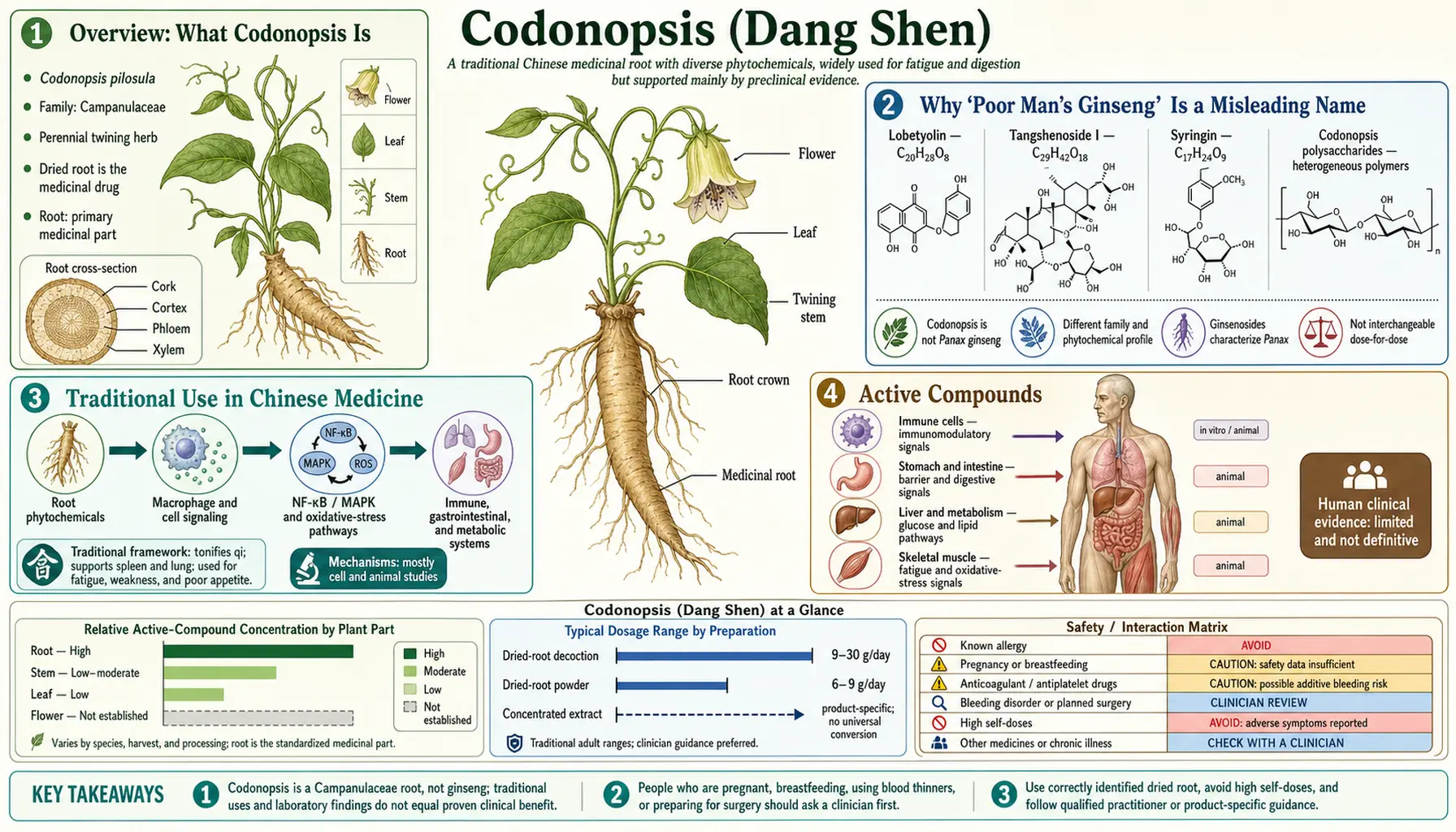
Codonopsis, known in Chinese as dang shen (党参), is the dried root of Codonopsis pilosula — a climbing bellflower from the mountains of northern and western China. It is the single most-used "qi tonic" in Chinese herbal practice, largely because it became the affordable stand-in for ginseng, and it is sold in the West under the marketing names "poor man's ginseng" and "bastard ginseng." Both names are misleading: Codonopsis is not a ginseng, is not in the ginseng family, contains no ginsenosides, and is not a stimulant.
This page covers what Codonopsis actually is, what is in it, what the laboratory evidence shows, and — just as importantly — where the human evidence runs out. That last part matters here more than it does for most herbs: the clinical literature on Codonopsis as a stand-alone remedy is genuinely thin, and any page that tells you otherwise is selling something.
Table of Contents
- Overview: What Codonopsis Is
- Why "Poor Man's Ginseng" Is a Misleading Name
- Traditional Use in Chinese Medicine
- Active Compounds
- The State of the Evidence — Read This First
- Immune Modulation
- Digestion, the Stomach Lining, and the Gut Microbiome
- Energy, Fatigue, and Endurance
- Blood, Circulation, and the Anemia Question
- Lung Qi, Cough, and Breathlessness
- Forms and Preparations
- Recommended Dosage
- Quality, Grades, and Label Reading
- Cautions and Contraindications
- Key Research Papers
- Conditions It Is Used For
- Connections
- Featured Videos
Overview: What Codonopsis Is
Codonopsis is a perennial climbing herb. Above ground it is unremarkable — a twining vine with soft, slightly hairy heart-shaped leaves and drooping, pale-green to cream bell-shaped flowers veined in purple. The genus name says so directly: Codonopsis comes from the Greek kodon (bell) and opsis (appearance). The species name pilosula means "finely hairy," describing the fuzz on the young stems and leaf undersides.
Below ground is the part that matters. The root is a long, cylindrical, pale yellowish-brown taproot, tapering like a slim carrot or a parsnip, typically 15 to 30 cm long and 0.5 to 2 cm thick. The top of the root carries a dense cluster of old stem scars that herb traders call the "lion's head" (狮子头) — a knobby crown that is one of the classic marks of a well-grown root. Cut it across and a good root shows a radiating pattern in the cross-section that the trade calls a "chrysanthemum heart" (菊花心).
Botanical identity. The official plant is Codonopsis pilosula (Franch.) Nannf., in the family Campanulaceae — the bellflower family, the same family as harebells, Canterbury bells and balloon flower. This is worth pausing on. Panax ginseng belongs to the Araliaceae, the ivy family. Codonopsis and ginseng are not close relatives; they are not in the same order. They look superficially alike as dried roots, and they were used for overlapping purposes, and that is the whole of the connection.
Which species are official. The Chinese Pharmacopoeia recognises Radix Codonopsis (Codonopsis Radix, dang shen) as coming from three sources:
- Codonopsis pilosula (Franch.) Nannf. — the principal species
- Codonopsis pilosula var. modesta (Nannf.) L. T. Shen — the "su hua dang shen" variant
- Codonopsis tangshen Oliv. — the Sichuan/Hubei species, traded as chuan dang shen
Other Codonopsis species circulate regionally and are not the same drug. Codonopsis lanceolata is deodeok in Korea and is eaten as a vegetable root. Codonopsis javanica is the plant most often sold as đảng sâm in Vietnam. Codonopsis clematidea grows through Central Asia and the western Himalaya and is the species from which the herb's characteristic alkaloids were first isolated. If a product simply says "Codonopsis," you do not know which of these you have.
Where it grows and what is harvested. Wild and cultivated Codonopsis is concentrated in Shanxi, Gansu, Shaanxi, Sichuan, Hubei, Inner Mongolia and the Chinese northwest generally, mostly on mountain slopes and forest margins between roughly 1,500 and 3,000 metres. The harvested part is the dried root, dug in autumn from plants that are usually at least three to four years old — younger roots are thin, less sweet, and fetch a lower price. After digging, the roots are washed, then sun-dried in stages, and during drying they are repeatedly rolled or rubbed by hand or between boards. That rubbing is not decorative: it compresses the root, drives out moisture evenly, and gives finished dang shen its slightly pliable, faintly sticky texture and its transverse wrinkles.
Common names. Chinese 党参 dǎng shēn; Korean 만삼 mansam; Vietnamese đảng sâm; Japanese tōjin. In English you will see "codonopsis root," "poor man's ginseng," "bastard ginseng," and occasionally "bellflower root."
Why "Poor Man's Ginseng" Is a Misleading Name
Most people arrive at Codonopsis because a label or a herbalist told them it is a gentler, cheaper ginseng. That framing gets one thing right and three things wrong, and it is worth untangling before you spend any money.
What it gets right: in Chinese herbal practice, Codonopsis is genuinely used as the routine, economical replacement for Ren Shen (Panax ginseng) inside classical formulas. That substitution is real, it is centuries old, and it is standard practice today. Most Four Gentlemen Decoction sold in China contains dang shen, not ren shen.
What it gets wrong:
- It is not botanically related to ginseng. Campanulaceae versus Araliaceae. Different family, different chemistry, different everything. The confusion comes from the Chinese suffix shen (参), which is not a botanical term — it is a functional word applied to any fleshy, tonic-tasting root. Chinese medicine has at least eight unrelated "shen" herbs: ren shen (Panax), dang shen (Codonopsis), xuan shen (Scrophularia, a figwort), dan shen (Salvia, a sage), ku shen (Sophora, a legume), sha shen (Adenophora or Glehnia), tai zi shen (Pseudostellaria, a chickweed relative) and bei sha shen. Calling all of them "ginseng" in English is a translation accident, not a fact about plants.
- It contains no ginsenosides. Not a trace. Ginsenosides are the triterpene saponins that define Panax, and every claim you have read about ginsenoside Rg1 or Rb1 is irrelevant to Codonopsis. Codonopsis has its own, entirely different marker compounds — polyacetylene glycosides and pyrrolidine alkaloids. If a Codonopsis supplement label mentions ginsenoside content, that is either a labelling error or adulteration.
- It is not a stimulant, and it is not an energiser in the way people expect. Panax ginseng has a mild activating, sometimes over-activating quality — some people get restless or sleep badly on it. Codonopsis does not do that. In traditional terms it is sweet and neutral, meaning it neither heats nor cools; practitioners use it precisely because it can be given in larger amounts and for longer periods, to older people, to children, and to people who are too depleted to tolerate ginseng. If you take Codonopsis expecting a lift within an hour, you will conclude it does nothing — because in that sense it does nothing.
The honest summary: Codonopsis occupies ginseng's job in the formula, not ginseng's pharmacology. It is its own herb, and it deserves to be assessed on its own evidence rather than on borrowed ginseng research.
Traditional Use in Chinese Medicine
In the vocabulary of Chinese medicine, Codonopsis is sweet in flavour, neutral in temperature, and enters the Spleen and Lung channels. Its stated actions are to tonify Spleen and Lung qi, generate fluids, and — secondarily — nourish blood.
Translated out of that idiom: it was given to people who were tired, pale, short of breath on exertion, poor eaters with loose stools, prone to catching every cold going round, and slow to recover afterwards. That is a recognisable clinical picture — the depleted, post-illness, low-appetite, low-stamina patient — and it is the picture Codonopsis has been used for consistently for around 250 years.
The classical formulas. Codonopsis is rarely used alone. It appears (usually as a substitute for ginseng) in:
- Si Jun Zi Tang (四君子汤, Four Gentlemen Decoction) — the foundational qi tonic: ginseng or Codonopsis, Atractylodes, Poria, and Licorice.
- Bu Zhong Yi Qi Tang (补中益气汤, Tonify the Middle and Augment the Qi) — the classic formula for exhaustion with a sensation of sinking or prolapse, adding Astragalus, Dong Quai, bupleurum and cimicifuga.
- Shen Ling Bai Zhu San (参苓白术散, Ginseng, Poria and Atractylodes Powder) — the standard formula for chronic loose stools, poor appetite and fatigue.
One historical point that most supplement pages get wrong: all three of those formulas predate Codonopsis by centuries. Si Jun Zi Tang and Shen Ling Bai Zhu San come from the Song dynasty imperial formulary of the twelfth century; Bu Zhong Yi Qi Tang is from Li Dongyuan in 1249. All of them were written with ren shen in the formula. Codonopsis was not described as a distinct medicine until the mid-eighteenth century. It moved into these formulas as a later, economically driven substitution — which is a perfectly reasonable thing for a medical tradition to do, but it means Codonopsis cannot claim the clinical track record of the formulas it now sits inside. The History page traces exactly how that happened.
As food. Codonopsis has a long life outside the pharmacy. The root is mildly sweet and faintly earthy, and in northern China it goes into everyday soup: simmered with chicken, astragalus slices, jujube dates and goji berries for two hours, then eaten as a convalescent broth. This is genuinely how most people in China encounter it — as food-grade tonic cooking, not as a capsule.
Active Compounds
Codonopsis root is chemically busy but not dominated by one blockbuster molecule. The classes that matter are polyacetylene glycosides, pyrrolidine alkaloids, phenylpropanoid glycosides, polysaccharides, and a small set of terpenoids.
| Compound class | Named constituents | Why it matters |
|---|---|---|
| Polyacetylene glycosides | Lobetyolin, lobetyolinin, lobetyol | The modern marker compounds. Lobetyolin is the analyte used in HPLC assays to certify that a batch of dang shen is genuine and potent. Most contemporary pharmacological work on the isolated chemistry starts here. |
| Pyrrolidine alkaloids | Codonopsine, codonopsinine (and related codonopsinols) | The herb's signature alkaloids, first characterised from C. clematidea. Note carefully: pyrrolidine, not pyrrolizidine — see Cautions. |
| Phenylpropanoid glycosides | Tangshenoside I, syringin | Tangshenoside I is named for C. tangshen; syringin (eleutheroside B) is shared with eleuthero and several other tonic roots. |
| Polysaccharides | Codonopsis pilosula polysaccharides (CPP), inulin-type fructans | The large-molecule fraction. Water-extracted, which means a traditional decoction captures them and an alcohol tincture largely does not. Nearly all the "immune" research is on this fraction. |
| Terpenoids and sterols | Atractylenolide III, taraxerol, α-spinasterol, stigmasterol | Minor by weight. Atractylenolide III is better known from Atractylodes and has been studied for anti-inflammatory activity. |
| Nutritive fraction | Free amino acids, trace minerals, simple sugars | Part of why it behaves as a food. Contributes the sweetness that defines the herb in traditional terms. |
Two practical consequences follow from this table. First, the extraction method decides what you get. The polysaccharides — the fraction behind most of the immune research — are water-soluble and heat-stable, so they end up in a decoction or a hot-water extract. A 40% alcohol tincture pulls the alkaloids and some of the polyacetylenes but leaves most of the polysaccharide behind. These are, in effect, two different products.
Second, lobetyolin is the only realistic potency marker. If you ever see a Codonopsis extract standardised to anything, it will be lobetyolin. It is unusual to find on a Western label, but it is the standard the Chinese herb trade uses.
The State of the Evidence — Read This First
Everything below this heading should be read through the following filter, because it applies to every section that follows.
There is no large, well-designed, placebo-controlled randomised trial of Codonopsis as a single herb for any condition. Not for fatigue, not for immunity, not for digestion, not for anemia. What exists instead is:
- Cell-culture studies — polysaccharide fractions or isolated compounds applied to macrophage lines, gastric epithelial lines, or cancer cell lines. These tell you a molecule can do something in a dish. They do not tell you what happens after the molecule meets a human digestive tract, which for a large polysaccharide is a significant question.
- Rodent studies — mice and rats given Codonopsis extract, then subjected to a forced-swim test, an induced ulcer, chemotherapy-induced immune suppression, or an induced anemia. Doses in these studies are frequently far above what a person takes, scaled per kilogram.
- Chinese-language clinical reports of multi-herb formulas — where Codonopsis is one of eight or twelve ingredients. Even when these are well conducted, they cannot tell you what Codonopsis itself contributed. If Bu Zhong Yi Qi Tang helps a group of patients, the credit could belong to the astragalus, the licorice, the atractylodes, or the combination.
That is the honest picture. It is not a claim that Codonopsis does nothing — a very long traditional record with a strikingly low adverse-event profile is worth something, and the mechanistic work is real work. It is a claim that the specific, quantified, "take this and X will improve by Y percent" statements you may have read are not supported. Where a section below says "mechanism study," take that literally.
Immune Modulation
What the traditional claim is. Codonopsis was given to people who kept getting sick and took a long time to recover — what Chinese medicine calls weak wei qi (defensive qi), roughly the idea of a leaky first line of defence.
What the laboratory work shows. The best-characterised activity belongs to the polysaccharide fraction (CPP). In cultured macrophages, Codonopsis polysaccharides increase phagocytic activity and stimulate release of nitric oxide and the signalling cytokines TNF-α, IL-1β and IL-6. The receptor most often implicated is TLR4, with downstream activation of the NF-κB and MAPK pathways. This is the same general mechanism reported for astragalus polysaccharides and for many mushroom beta-glucans, and it is one reason these herbs are grouped together in modern reviews.
In mice, Codonopsis polysaccharide given alongside cyclophosphamide (a chemotherapy drug that suppresses bone marrow) has been reported to partially preserve white cell counts, spleen and thymus index, and antibody responses. Some studies also report increased secretory IgA in the gut and improved responses to vaccination models.
What this does and does not mean. Two hard limits. First, all of the above is in animals and cell cultures. Second — and this is the limit people skip — "stimulates macrophages in a dish" is not the same as "will help you get fewer colds," and it is not obviously desirable in every person. Raising TNF-α and IL-6 is exactly what you do not want in an inflammatory or autoimmune condition. The honest position is that Codonopsis appears to interact with innate immune signalling, that the direction of that interaction in a specific human being with a specific condition has not been established, and that "immune boosting" is a marketing phrase rather than a measurable clinical outcome.
Read more: Codonopsis and Immune Modulation.
Digestion, the Stomach Lining, and the Gut Microbiome
What the traditional claim is. This is Codonopsis's home territory. "Tonifies Spleen qi" describes, in modern terms, poor appetite, bloating after eating, loose stools, and fatigue that is worse after meals. Of all its traditional indications, digestive weakness is the one it was used for most.
What the laboratory work shows. Rodent gastric-ulcer models are the strongest strand. In rats with ulcers induced by ethanol, stress, or indomethacin, Codonopsis extracts and polysaccharide fractions have repeatedly been reported to reduce the area of mucosal damage. The proposed mechanisms are increased gastric mucus and bicarbonate secretion, increased prostaglandin E2 in the mucosa, improved mucosal blood flow, and reduced oxidative damage — essentially, thickening and maintaining the protective gel layer rather than blocking acid.
A newer and genuinely interesting strand concerns the gut microbiome. Codonopsis is rich in inulin-type fructans, which are established prebiotic fibres — the same class found in chicory root and jerusalem artichoke. In mouse studies, Codonopsis polysaccharide feeding shifts community composition, typically increasing Lactobacillus and Bifidobacterium and raising short-chain fatty acid production, particularly butyrate. Butyrate is the primary fuel for colonocytes and is central to gut barrier integrity, which offers a plausible, non-mystical account of how a slowly-acting root taken for weeks could improve digestive symptoms.
The honest caveat. Prebiotic fibre is a double-edged tool. The same fermentable fructans that feed beneficial bacteria are FODMAPs, and in someone with SIBO or fructan-sensitive IBS they can make bloating and gas distinctly worse. There are no human trials of Codonopsis for gastritis, ulcer, or IBS. If you have a fermentation-driven gut problem, start low and treat any increase in bloating as a signal to stop.
Read more: Codonopsis for Digestive and Gut Health.
Energy, Fatigue, and Endurance
What the traditional claim is. Codonopsis is a qi tonic, and "qi deficiency" maps closely onto the everyday complaint of low stamina — tired on waking, worse after exertion, needing to sit down partway through ordinary tasks.
What the laboratory work shows. The standard experiment is the mouse weight-loaded forced-swim test: mice are given herb extract for one to four weeks, then swim to exhaustion. Codonopsis extracts have been reported to extend swim time, lower blood lactate and serum urea nitrogen after exercise, and increase liver and muscle glycogen stores. Some studies add antioxidant markers — higher superoxide dismutase and glutathione peroxidase activity, lower malondialdehyde — in muscle tissue after exertion.
How much weight to put on this. Honestly, not much on its own. The weight-loaded swim test is the standard screening assay for anything marketed as an "anti-fatigue" agent in the Chinese pharmacological literature, and a very large number of plant extracts pass it. Glycogen sparing and lactate clearance are real measurable effects, but the leap from "mice swam longer" to "you will feel less tired" is not supported by human data for this herb.
What can be said fairly: Codonopsis is not a stimulant, has no caffeine-like or amphetamine-like action, does not raise heart rate, and does not cause the jitteriness or insomnia that Panax ginseng can. If it does anything for fatigue in people, it acts as a slow nutritive tonic over weeks — closer in kind to correcting an iron or B12 deficiency than to drinking coffee. Anyone selling it as a pre-workout is misrepresenting it.
Read more: Codonopsis for Energy and Fatigue.
Blood, Circulation, and the Anemia Question
What the traditional claim is. Beyond qi, Codonopsis is described as gently nourishing blood, and it is often paired with Dong Quai or White Peony for pale complexion, dizziness on standing, and palpitations.
What the laboratory work shows. In rodent models of induced anemia — bleeding models, chemotherapy models, and radiation models — Codonopsis extracts and polysaccharides have been reported to raise red blood cell counts, hemoglobin, and reticulocytes, and to support bone marrow progenitor colony formation. Some cell work reports effects on erythropoietin signalling.
The critical caveat, stated plainly. Codonopsis is not a treatment for anemia in humans, and there is no human trial showing that it corrects one. This matters more than the usual "more research is needed," because anemia is a symptom with causes — iron deficiency, B12 or folate deficiency, chronic kidney disease, thalassemia, occult gastrointestinal bleeding, malignancy — and several of those are serious and eminently treatable. Taking a herb for pallor and fatigue instead of getting a blood count and iron studies is a genuinely bad trade. The traditional concept of "blood deficiency" is a pattern description that overlaps with, but is not identical to, laboratory anemia.
On circulation, animal work reports mild vasodilation and modest blood-pressure lowering, with some reports of reduced blood viscosity and platelet aggregation. These are unconfirmed in people and are the basis for the theoretical drug interactions listed under Cautions rather than a claim of benefit.
Read more: Codonopsis for Blood and Circulation.
Lung Qi, Cough, and Breathlessness
Codonopsis enters the Lung channel as well as the Spleen, and traditionally it was given for a weak, breathy cough with a quiet voice and shortness of breath on mild exertion — the picture of someone depleted after a long illness, not someone with an acute chest infection. It is a tonic used between illnesses, not during them; classical practice explicitly avoids qi tonics during an active external invasion (in modern terms, an acute febrile infection), on the reasoning that tonifying at that moment "traps the pathogen inside."
The modern evidence here is the thinnest of any section on this page. There are scattered reports of Codonopsis-containing formulas in chronic bronchitis and COPD in the Chinese literature, and some animal work on airway inflammation, but nothing that isolates the herb. Codonopsis also has a small niche reputation for high-altitude acclimatisation in Tibetan and northwestern Chinese practice; that reputation is folk-level and has no controlled human data behind it. Treat this section as traditional context rather than as an indication.
Forms and Preparations
What you buy substantially changes what you are taking. Because the polysaccharides are water-extracted and the alkaloids and polyacetylenes are alcohol-friendly, a decoction and a tincture are not interchangeable products.
| Form | What it is | Notes |
|---|---|---|
| Whole dried root ("sticks") | Long, pliable, wrinkled roots, sold by weight | The traditional article and the best value. Easiest to inspect for quality. Used for decoction and for soup. |
| Sliced root | Cross-cut discs | Convenient; lets you see the "chrysanthemum heart" pattern. Slightly faster to lose aroma than whole root. |
| Decoction | Root simmered in water 30–60 minutes | The reference preparation. Captures polysaccharides and fructans. This is the form nearly all traditional dosing refers to. |
| Honey-fried (mi zhi dang shen, 蜜炙党参) | Root stir-processed with honey | A classical processing method said to strengthen the Spleen- and Lung-tonifying action and moisten. Sweeter, darker, stickier. |
| Concentrated granules | Spray-dried water extract, usually 4:1 or 5:1 | The standard modern clinical form in Chinese practice. Dissolve in hot water. Check the stated extract ratio — it determines the dose. |
| Capsules of powdered root | Milled raw root in gelatin or veg caps | Usually 400–500 mg per capsule. The catch: matching a 15 g decoction would take roughly 30 capsules. Most capsule products deliver a small fraction of a traditional dose. |
| Tincture | Typically 1:5 in about 40% alcohol | Western herbalists' preferred form. Extracts alkaloids and polyacetylenes well; extracts polysaccharides poorly. Not equivalent to a decoction. |
| Culinary / soup grade | Root sold for cooking, often with jujube and goji | Simmered with chicken or pork for 1.5–3 hours. The most common real-world use, and a reasonable way to try it. |
Recommended Dosage
These figures come from traditional practice and from pharmacopoeial convention, not from human dose-finding trials — no such trials exist for this herb. They describe what practitioners use, which is a different kind of information from what a clinical trial provides.
| Preparation | Typical amount | Comment |
|---|---|---|
| Dried root, decoction | 9–30 g per day | The standard TCM range. 9–15 g is ordinary; 15–30 g is used for marked depletion. Simmer in 500–750 mL water for 30–60 minutes, often with other herbs. |
| Soup / food use | 10–20 g per pot | Serving 2–4 people. The gentlest and most traditional entry point. |
| Concentrated granules (5:1) | 2–6 g per day | Equivalent to roughly 10–30 g of raw root. Divide into two or three doses in hot water. |
| Powdered root capsules | 1–3 g per day | Well below a traditional decoction dose. Set expectations accordingly. |
| Tincture (1:5) | 3–5 mL, two to three times daily | Typical Western herbalist practice. Different constituent profile from a decoction. |
Timeframe. Codonopsis is a tonic, not an acute remedy. Traditional use is continuous for four to twelve weeks. Nobody should expect a same-day effect, and the absence of one is not evidence the herb is inert — it is what the herb is supposed to do.
Timing. Usually taken between meals or with food; there is no strong tradition either way. It has no stimulant effect, so evening dosing is not a problem.
Starting sensibly. If you have a sensitive gut, begin at the low end — a 9 g decoction or a single 10 g soup portion twice a week — and increase over two or three weeks. The fructan content is the usual reason people feel bloated on it.
Quality, Grades, and Label Reading
Codonopsis is a commodity root with a wide price range and real adulteration pressure, so quality is worth a paragraph of its own.
Traditional trade grades are named for where the root grew:
- Lu dang shen (潞党参) — from the historic Lu'an/Shangdang area of Shanxi. The most prestigious grade, and the origin of the herb's name.
- Xi dang shen (西党参) — "western," principally Gansu and Shaanxi. The bulk of commercial supply.
- Chuan dang shen (川党参) — Sichuan and western Hubei; this is C. tangshen, a different official species with a somewhat different constituent profile.
What a good root looks like. Pliable rather than brittle; a dense knobby "lion's head" crown of stem scars; close transverse wrinkles on the upper root; a sweet smell; a radiating "chrysanthemum heart" pattern in cross-section; and a sweet taste with no sourness or chemical sharpness.
What to be wary of.
- Sulfur fumigation. A real and persistent problem in the Chinese root trade — sulfur dioxide is used to bleach roots and deter insects. Sulfured dang shen looks unnaturally pale and smells faintly acrid or of struck matches. It is worth asking a supplier directly whether their stock is sulfur-free, and it is the single most useful question you can ask.
- Species substitution. Campanumoea and other Campanulaceae roots, and occasionally Platycodon, have been found sold as dang shen. This is one place where the Latin binomial on the label genuinely matters.
- Heavy metals and pesticide residue. Root herbs accumulate soil contaminants more than leaf or flower herbs. Ask for third-party testing.
- Missing binomial. A label saying only "Codonopsis" could be pilosula, tangshen, lanceolata or javanica. Insist on the species.
Cautions and Contraindications
Codonopsis has an unusually good safety record across a long history of food-level use, and serious adverse events are not a feature of its literature. That is genuinely reassuring — but "traditionally well tolerated" is not the same as "studied for safety," and there are specific situations that deserve care.
Pyrrolidine is not pyrrolizidine — clearing up a real confusion
Codonopsis contains pyrrolidine alkaloids (codonopsine, codonopsinine). Some readers see that word and think of pyrrolizidine alkaloids — the compounds in comfrey, coltsfoot, borage and butterbur that cause hepatic veno-occlusive disease and are the reason those herbs carry liver warnings. These are different chemical classes and the concern does not transfer.
A pyrrolidine is a single saturated five-membered ring containing one nitrogen — the same simple ring found in the amino acid proline and in nicotine. A pyrrolizidine is a fused bicyclic system, and its toxicity comes specifically from unsaturated 1,2-dehydropyrrolizidine esters that the liver converts into reactive pyrrole intermediates. Codonopsis is not known to contain pyrrolizidine alkaloids, and it is not on any hepatotoxicity watchlist. If you have read a warning that appeared to link Codonopsis to liver damage on this basis, it was a name-similarity error.
Drug interactions to take seriously
- Immunosuppressant drugs — the most important caution. If you take tacrolimus, cyclosporine, mycophenolate, azathioprine, methotrexate for autoimmune disease, or long-term corticosteroids, or if you have had an organ transplant, do not add Codonopsis without clearing it with the team managing that therapy. The rationale is direct: the herb's best-documented laboratory activity is stimulation of innate immune signalling, which is precisely the thing those drugs are prescribed to suppress. There is no clinical study showing an interaction — and equally none showing safety. The stakes of graft rejection make this the wrong place to experiment.
- Immune checkpoint inhibitors (pembrolizumab, nivolumab and similar) — same reasoning. Discuss with your oncology team first.
- Blood-pressure medication. Animal studies report mild blood-pressure lowering and vasodilation. If you take antihypertensives, the theoretical effect is additive. Monitor your readings for the first couple of weeks after starting; this is easy to do and settles the question.
- Anticoagulants and antiplatelet drugs. Some animal reports describe reduced platelet aggregation and blood viscosity. The human relevance is unestablished, but if you take warfarin, a DOAC, or daily aspirin, mention Codonopsis to your prescriber and watch for unusual bruising.
- Diabetes medication. Some animal work reports modest glucose-lowering. If you are on insulin or a sulfonylurea, check your readings more often when starting.
Who should avoid it or be careful
- Pregnancy and breastfeeding. There is no established human safety data. Codonopsis does appear in some traditional pregnancy formulas, but traditional use is not a safety study, and the pyrrolidine alkaloids have not been evaluated for developmental effects. The reasonable default is to avoid it, unless a qualified practitioner who knows you are pregnant has specifically prescribed it.
- Autoimmune disease. Lupus, rheumatoid arthritis, multiple sclerosis, psoriasis, autoimmune thyroid disease. The direction of effect in an already-overactive immune system is genuinely unknown. Be cautious, and stop if symptoms flare.
- Acute infection with fever. Classical practice avoids qi tonics during acute illness. Whatever one makes of the theory, there is no reason to start a slow tonic mid-fever.
- Fructan-sensitive gut conditions. SIBO and fructan-sensitive IBS — the inulin content can worsen bloating and gas.
- Bellflower-family allergy. Rare, but Campanulaceae sensitivity exists.
- Children. Codonopsis is used in children in Chinese practice at reduced doses, but there are no formal pediatric safety data. Involve a practitioner.
Reported side effects
Uncommon and usually mild: bloating or gas (the fructans), loose stools at high doses, and — in traditional reports at very large doses — palpitations or a feeling of chest fullness. Codonopsis is described in classical texts as unsuitable for people with strong "excess heat" patterns, in which case it can produce a stuffy, uncomfortable feeling. If you feel worse rather than neutral in the first two weeks, that is a reason to stop rather than push through.
Key Research Papers
Citations below fall into two kinds. Where a specific paper has been verified against the PubMed record — title, first author, journal and year all confirmed — the year and page numbers link directly to that record. Where no single paper covers the point, the citation deliberately links to a PubMed topic search instead. This site has previously carried a large number of incorrect identifiers, so an unverified link is never guessed at: a topic search always resolves to the real literature and cannot silently point you at the wrong paper. Author, journal and title are given as plain text so you can verify each one independently.
- He JY, Ma N, Zhu S, Komatsu K, Li ZY, Fu WM. The genus Codonopsis (Campanulaceae): a review of phytochemistry, bioactivity and quality control. Journal of Natural Medicines. 2015;69(1):1–21. The standard modern review of the genus; the best single starting point for chemistry and quality control.
- Gao SM, Liu JS, Wang M, Cao TT, Qi YD, Zhang BG, Sun XB, Liu HT, Xiao PG. Traditional uses, phytochemistry, pharmacology and toxicology of Codonopsis: a review. Journal of Ethnopharmacology. 2018;219:50–70. Broad ethnopharmacological review including the toxicology literature.
- Luan F, Ji Y, Peng L, Liu Q, Cao H, Yang Y, He X, Zeng N. Extraction, purification, structural characteristics and biological properties of the polysaccharides from Codonopsis pilosula: a review. Carbohydrate Polymers. 2021;261:117863. The polysaccharide fraction is where nearly all the immune mechanism work sits; note that essentially all of it is cell-culture or rodent work.
- Bailly C. Anticancer properties of lobetyolin, an essential component of Radix Codonopsis (Dangshen). Natural Products and Bioprospecting. 2021;11(2):143–153. Review of the principal polyacetylene glycoside marker of the root, including the cell-culture work on glutamine transport in tumour lines. For the HPLC quality-control methods, browse the analytical literature on PubMed.
- El-Nezhawy AOH, Alrobaian M, Khames A, El-Badawy MF, Abdelwahab SF. Design and total synthesis of (−)-codonopsinine, (−)-codonopsine and codonopsinine analogues. Bioorganic & Medicinal Chemistry. 2019;27(7):1263–1273. Confirms the pyrrolidine (not pyrrolizidine) structural class discussed in Cautions.
- Chen Q, Sun Y, Hu X, Xie Q, Liu W, Lei J, Cheng X, Li W, Wang C. The effect and mechanism of Codonopsis Radix and its active components tangshenoside I and lobetyolin on preventing gastric ulcer based on spectrum-effect relationship. Journal of Ethnopharmacology. 2025;353(Pt A):120281. Ethanol-induced rat ulcer model; antioxidant and anti-inflammatory endpoints, with tangshenoside I and lobetyolin identified as active constituents. Gastroprotection is the strongest single strand of preclinical work on the herb.
- Zhou J, Yang Q, Wei W, Huo J, Wang W. Codonopsis pilosula polysaccharide alleviates ulcerative colitis by modulating gut microbiota and SCFA/GPR/NLRP3 pathway. Journal of Ethnopharmacology. 2025;337(Pt 2):118928. The newest and most mechanistically plausible line of research on the digestive claims — still a rodent study.
- Xie Q, Sun Y, Cao L, Chen L, Chen J, Cheng X, Wang C. Antifatigue and antihypoxia activities of oligosaccharides and polysaccharides from Codonopsis pilosula in mice. Food & Function. 2020;11(7):6352–6362. Swim tests, glycogen and lactate endpoints. No human equivalent exists.
- Comparative pharmacology of Codonopsis pilosula and Panax ginseng as substitutes in classical formulas. View the literature on PubMed. Directly addresses the "poor man's ginseng" question. No single head-to-head study could be verified, so this remains a topic search.
- Liang W, Sun J, Bai G, Qiu D, Li Q, Dong P, Chen Y, Guo F. Codonopsis radix: a review of resource utilisation, postharvest processing, quality assessment, and its polysaccharide composition. Frontiers in Pharmacology. 2024;15:1366556. Relevant to the quality section above.
Live PubMed Searches
- Codonopsis pilosula — all literature
- Codonopsis polysaccharide + immune
- Dang shen — clinical trials
- Codonopsis — gastrointestinal effects
- Codonopsis tangshen (chuan dang shen)
- Tangshenoside chemistry
- Si Jun Zi Tang (Four Gentlemen Decoction)
- Bu Zhong Yi Qi Tang
- Codonopsis — anemia and hematopoiesis
- Codonopsis — toxicity and safety
Conditions Codonopsis (Dang Shen) Is Used For
Each condition below links to its page. The coloured half of every capsule shows how much human evidence supports this herb for that specific use — traditional use is history, not proof, and is marked as such.
Connections
- All Herbs
- Codonopsis Benefits — the four deep-dive articles
- Codonopsis: History and Traditional Use
- Immune Modulation
- Digestive and Gut Health
- Energy and Fatigue
- Blood and Circulation
- Astragalus — the herb most often paired with Codonopsis in qi tonics
- Ginseng — the herb Codonopsis substitutes for, and its true pharmacology
- Atractylodes — the second ingredient of Four Gentlemen Decoction
- Poria Mushroom — the third ingredient of Four Gentlemen Decoction
- Licorice — the fourth ingredient, the harmonising herb
- White Peony — paired with Codonopsis in blood-nourishing formulas
- Dong Quai — the classic blood tonic partner