Mugwort
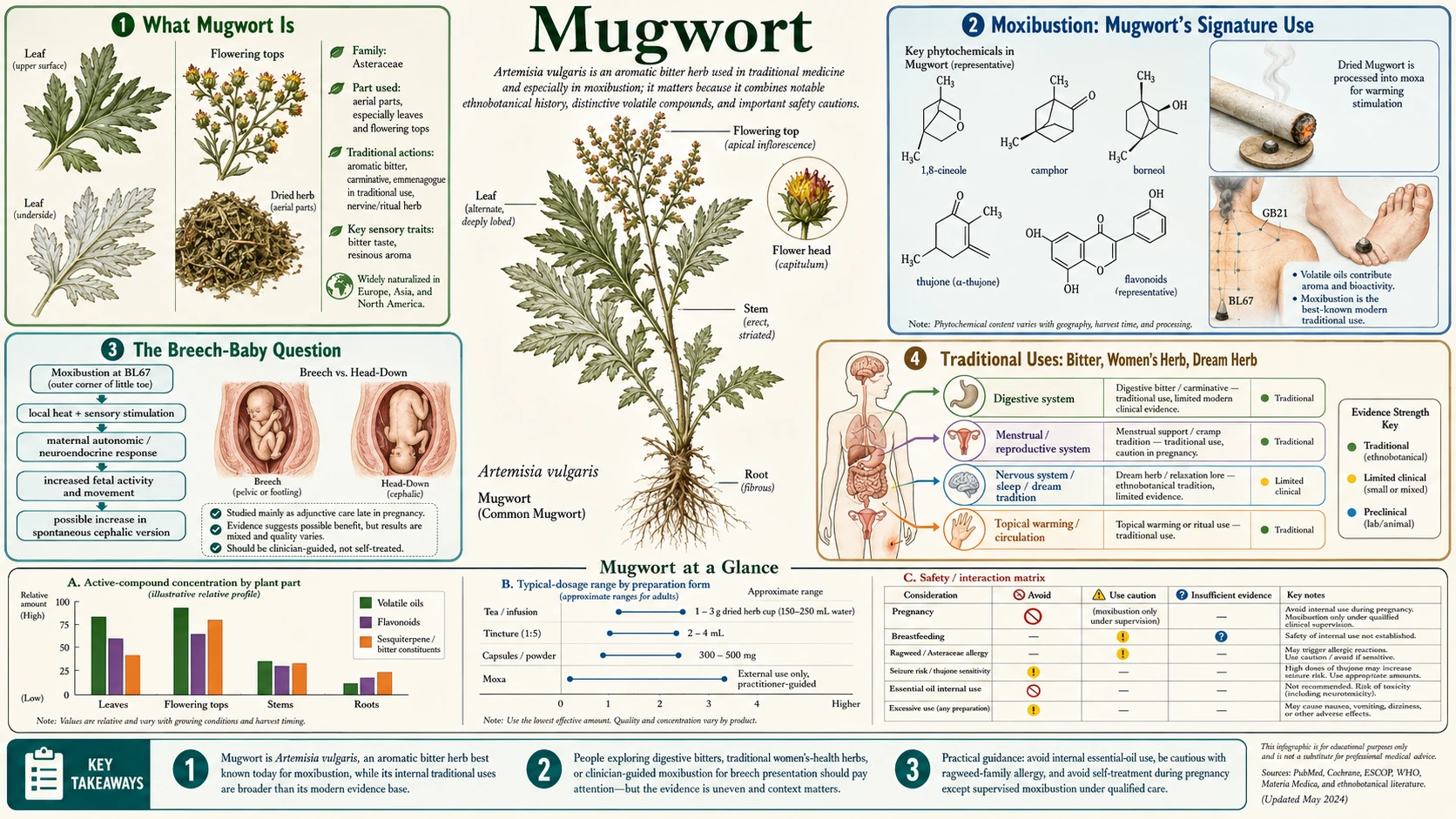
Mugwort (Artemisia vulgaris) is one of those humble roadside plants that carries an enormous amount of history. You have almost certainly walked past it — a tall, weedy perennial with jagged green leaves that are silvery-white underneath — without giving it a second look. Yet across Europe and Asia it has been a bitter digestive tonic, a "women's herb," a plant famous for stirring vivid dreams, and, most distinctively, the source of the smoldering herb used in moxibustion, a warming practice tied to acupuncture. This page walks through what mugwort actually is, its signature use as moxa, the surprisingly well-studied question of whether it can help turn a breech baby, its active compounds, what modern research does and does not support, and its genuine safety concerns — because mugwort is also a major pollen allergen and a herb to avoid in pregnancy. The honest theme throughout: this is a storied traditional plant with real biological activity but limited modern clinical evidence, so keep folklore and fact clearly separated.
Table of Contents
- What Mugwort Is
- Moxibustion: Mugwort's Signature Use
- The Breech-Baby Question
- Traditional Uses: Bitter, Women's Herb, Dream Herb
- The Active Compounds
- What the Evidence Shows
- Forms and How It's Used
- Safety, Allergy, and Who Should Avoid It
- The Honest Bottom Line
- Research Papers
- Connections
- Featured Videos
What Mugwort Is
Common mugwort is a tall, hardy perennial in the daisy family (Asteraceae), often reaching four to six feet along fence lines, railway banks, and vacant lots. Its deeply cut, dark-green leaves have a distinctive two-tone look: green on top and coated with fine white down underneath, so a breeze reveals a silvery flash. Crush a leaf and you get a faint, slightly bitter, sage-like aroma. In late summer it throws up spikes of small, unshowy reddish or yellowish flowers whose wind-blown pollen is a notable hay-fever trigger.
Mugwort belongs to the genus Artemisia, which places it in remarkable company. Its close relatives include wormwood (Artemisia absinthium), the intensely bitter herb behind absinthe; tarragon, the kitchen herb; and the aromatic sagebrush that blankets the American West. Named — depending on which story you prefer — for the Greek goddess Artemis or from Old English roots, mugwort has collected folk names like felon herb, St. John's plant, chrysanthemum weed, and cronewort. Native to Europe and Asia, it has naturalized widely across North America, where it is often treated as an invasive weed rather than the revered herb it is in traditional Chinese, Japanese, Korean, and European practice.
Moxibustion: Mugwort's Signature Use
If mugwort is known for one thing in the wider world, it is moxibustion. Dried, aged mugwort leaves are ground and sifted into a soft, fluffy wool called moxa. In traditional Chinese medicine this moxa is burned to deliver gentle, penetrating heat to specific acupuncture points — so closely paired with needling that the Chinese term for acupuncture, zhēnjiǔ (针灸), literally means "needle-moxa."
There are several styles. A practitioner may shape a small cone of moxa and burn it on or just above the skin; roll the wool into a cigar-like stick and hold the glowing tip near a point until the area feels pleasantly warm; or perch a bead of moxa on the handle of an inserted acupuncture needle so the heat travels down the shaft. In the language of TCM, moxa is used to "warm the channels" and add yang where there is cold or deficiency. Stripped of the traditional framework, what is objectively happening is straightforward: localized radiant heat plus aromatic smoke applied to a nerve-rich point on the skin. That warming, counter-irritant effect is real and pleasant; the energetic explanation is traditional rather than something modern physiology has confirmed. For the practice mugwort is paired with, see Acupuncture.
The Breech-Baby Question
The most rigorously studied use of mugwort anywhere is a specific one: burning moxa near the acupuncture point BL67 (Zhiyin), at the outer corner of the little-toe nail, to encourage a breech (feet- or bottom-down) baby to turn head-down before delivery. Treatment is typically done daily for one to two weeks around 33 to 35 weeks of pregnancy.
This is where mugwort steps out of folklore and into clinical trials. A widely cited 1998 randomized trial in JAMA by Cardini and Weixin found that women who received moxibustion at BL67 had more head-down babies than those who did not. Later studies have been more mixed. A multicentre European trial by Vas and colleagues (2013) again reported a benefit, while other trials found little effect, and results depend heavily on how and when the moxa is applied. The Cochrane systematic review (Coyle, Smith, and Peat), most recently updated in 2023, concludes cautiously: moxibustion — often combined with acupuncture or usual care — may reduce the number of breech births and the need for external cephalic version, but the evidence is low-certainty and inconsistent.
The honest summary is that this is a plausible, low-risk, and genuinely researched adjunct that some obstetric and midwifery services offer, but it is not proven to work reliably. Crucially, it is done under professional supervision, timed to a specific week of pregnancy, and applied externally at a toe point — it is not a case for self-experimenting at home, and it does not mean drinking mugwort tea while pregnant (which, as the safety section explains, is exactly what to avoid). Anyone facing a breech presentation should discuss options with their maternity team; see also Reproductive Medicine.
Traditional Uses: Bitter, Women's Herb, Dream Herb
Beyond moxa, mugwort's herbal reputation rests on three overlapping traditions.
The digestive bitter
Mugwort's leaves are genuinely bitter, and bitterness has long been prized as a digestive aid — the taste alone can prompt saliva, stomach acid, and bile to flow. European folk practice used mugwort as a stomach tonic to stir a sluggish appetite and to help digest heavy, fatty meals. This is why it was traditionally cooked with rich meats like roast goose: the bitter herb was thought to cut the fat and ease digestion. Mugwort still appears in some herbal bitters formulas today.
The "women's herb"
Across many cultures mugwort earned a reputation as a women's herb, used traditionally as an emmenagogue — something believed to bring on or regulate menstruation — and in folk childbirth practice. This same uterine-associated tradition is precisely why herbalists have always flagged mugwort as a herb to avoid during pregnancy. Traditional reputation is not proof of effect, but here the folklore and the safety warning point the same direction.
The dream herb
Mugwort is perhaps most romantically known as a dream herb. Folk traditions in Europe and beyond held that drinking mugwort tea in the evening, or tucking a sachet of the dried herb under the pillow, encourages unusually vivid, memorable, or even lucid dreams. It also featured in midsummer and St. John's Eve customs and in folk divination. It is a lovely piece of lore — and it is essentially only lore. There are no good clinical studies showing mugwort reliably alters dreams; any effect people notice may relate to its aromatic, mildly bitter, sleep-adjacent qualities, or simply to expectation. Enjoy the tradition, but hold the claim loosely.
The Active Compounds
Mugwort's activity comes from a handful of chemical families, and their exact mix varies a great deal by region, soil, and chemotype.
- Essential (volatile) oil. Steam-distilled mugwort oil is dominated by small aromatic molecules — chiefly thujone (both α- and β- forms), 1,8-cineole (eucalyptol), camphor, and borneol. Thujone is the same neuroactive compound famous from wormwood and absinthe, which is a major reason the concentrated oil should never be swallowed.
- Sesquiterpene lactones. These bitter principles — including compounds such as vulgarin and related lactones — give mugwort much of its characteristic bitterness and some of its anti-inflammatory activity in the lab. They are also, unfortunately, among the molecules that can provoke allergic skin and immune reactions.
- Flavonoids and other polyphenols. Mugwort contains quercetin and related flavonoids, which act as antioxidants and account for a lot of the antioxidant readings seen in test-tube studies.
- Coumarins and other minor constituents round out the profile.
The takeaway is that mugwort is not chemically inert — it carries a real, biologically active essential oil and genuine bitter compounds — but "biologically active in a beaker" is a long way from "proven to treat something in people."
What the Evidence Shows
Here is the honest state of the science. The overwhelming majority of mugwort's uses rest on tradition, supported by laboratory and animal studies rather than human trials.
In the lab, mugwort essential oil shows measurable antioxidant and antibacterial activity against a range of microbes (for example, Munda and colleagues, 2019), which is consistent with its aromatic terpene content. In animals, whole-plant extracts have shown anti-inflammatory and even cholesterol-lowering effects — El-Tantawy's 2015 study in hypercholesterolemic rats is a representative example — and related work across the Artemisia genus reports anti-nociceptive (pain-dampening) and antipyretic activity. A comprehensive 2020 review by Ekiert and colleagues in Molecules catalogs this literature and reaches a familiar conclusion: promising chemistry and preclinical signals, but few well-designed human trials to confirm any specific benefit.
The best-documented exception — where mugwort has the most substantial controlled human trial data — is moxibustion for breech presentation, discussed above, and even there the evidence is mixed and low-certainty; a smaller, separate trial has also tested Artemisia vulgaris moxa directly against a comparator and found no significant effect on skin temperature. One caveat applies to this entire trial literature and is rarely stated plainly: commercial moxa, in most published trials, is manufactured from the closely related East Asian species Artemisia argyi ("Ai Ye"), not necessarily the European Artemisia vulgaris this page covers — the two are labeled loosely and inconsistently as interchangeable in clinical papers, and essentially no trial verifies species by chemical or genetic testing. See the Moxibustion benefits deep-dive for the full picture. As for the celebrated dream-herb effect, there is no credible clinical evidence at all. So the fair verdict is: interesting, active, and worth respecting, but no herb-in-a-teacup use is proven for mugwort in humans.
Forms and How It's Used
Mugwort turns up in several very different forms, and they are not interchangeable:
- Tea / infusion. The dried aerial parts are steeped as a bitter digestive tea, usually in small amounts because of the strong taste. This is the traditional "dream tea" as well.
- Tincture and bitters. Alcohol extracts and herbal-bitters blends deliver the bitter principles in drop-sized doses as a digestive aid before or after meals.
- Moxa. The felted wool used in moxibustion — sticks, cones, or needle-top beads — is for external warming only, ideally in trained hands, and the smoke is significant enough that ventilation matters.
- Culinary. Young mugwort leaves are a real food ingredient, especially in East Asia: they color and flavor Japanese yomogi rice cakes (kusa mochi) and Korean ssuk soups and cakes, and in parts of Europe the herb has long seasoned fatty roasts such as goose. Culinary amounts are a modest, everyday exposure.
- Essential oil. Mugwort oil is used in aromatherapy and topically in some traditions, but because of its thujone content it should never be taken internally.
Safety, Allergy, and Who Should Avoid It
Mugwort is a storied herb, but it comes with genuinely important cautions — more than most kitchen herbs — so this section deserves careful reading.
A major pollen allergen
Mugwort is one of the most significant hay-fever plants of late summer and autumn across Europe and much of Asia. Its major allergen has a name — Art v 1 — and was characterized in detail by Himly and colleagues (2003). If you get seasonal sneezing and itchy eyes in August and September, mugwort pollen may well be involved, and that same immune sensitivity is what makes ingesting the herb riskier for you than for most people.
Oral allergy syndrome and cross-reactivity
This is mugwort's most clinically important quirk. People allergic to mugwort pollen frequently react to certain foods whose proteins resemble mugwort's — a pattern known as oral allergy syndrome. The classic example is the celery-mugwort-spice syndrome: cross-reactivity linking mugwort pollen with celery, carrot, and a range of spices (Bauer and colleagues traced the celery-mugwort-birch link back in 1996). There is also a well-documented mugwort-mustard association, plus cross-reactions with peach, and even with other members of the Artemisia genus and with sage (Katial and colleagues, 1997). Reactions can range from a merely itchy mouth to, in rare cases, full anaphylaxis — sometimes triggered only when eating is combined with exercise, as in the food-dependent exercise-induced anaphylaxis case reported by Baek and colleagues (2010). The practical rule: if you have mugwort hay fever, be genuinely cautious about mugwort tea, culinary mugwort, and the related trigger foods.
Avoid in pregnancy
Do not use mugwort internally during pregnancy. Its long-standing reputation as an emmenagogue and uterine herb is exactly the reason. The moxibustion-for-breech practice is a separate, supervised, external-only procedure timed to a specific late-pregnancy window — it is not license to drink mugwort tea or take the tincture while expecting.
Daisy-family (Asteraceae) allergy
Because mugwort is in the daisy family, people who react to ragweed, chamomile, feverfew, or other Asteraceae plants may cross-react to mugwort as well. If those plants bother you, approach mugwort carefully.
The thujone caveat
Mugwort's essential oil contains thujone, a neuroactive compound that is toxic in excess and can, in large amounts, provoke seizures. This is why the concentrated essential oil should never be taken by mouth. Culinary and tea exposures involve far lower amounts of the intact herb and are a different order of risk, but the oil is not something to self-dose internally under any circumstances.
The Honest Bottom Line
Mugwort is a genuinely storied plant — moxa for warming acupuncture points, a bitter tonic for digestion, the folk "women's herb," and the legendary dream herb — and it is genuinely bioactive, carrying a real aromatic essential oil, bitter sesquiterpene lactones, and antioxidant flavonoids. But modern clinical evidence is thin. The best-studied use, moxibustion to help turn a breech baby, is plausible and low-risk yet remains unproven and is a supervised procedure, not a home remedy. The dream-herb fame is charming folklore with no clinical backing. And unlike most gentle kitchen herbs, mugwort carries real cautions: it is a significant pollen allergen tied to food cross-reactivity, a herb to avoid in pregnancy, and the source of an essential oil that should never be swallowed. Enjoy the history and the yomogi rice cakes, keep your expectations modest, and steer clear entirely if you have mugwort or ragweed allergy or are pregnant.
Research Papers
- Cardini F, Weixin H. Moxibustion for correction of breech presentation: a randomized controlled trial. JAMA. 1998;280(18):1580-1584. doi:10.1001/jama.280.18.1580 — the landmark trial that put moxibustion-for-breech on the map, reporting more head-down babies in the moxa group.
- Coyle ME, Smith CA, Peat B. Cephalic version by moxibustion for breech presentation. Cochrane Database of Systematic Reviews. 2023;(5):CD003928. doi:10.1002/14651858.CD003928.pub4 — the up-to-date systematic review: moxibustion may reduce breech births, but the evidence is low-certainty and mixed.
- Vas J, Aranda-Regules JM, Modesto M, et al. Using moxibustion in primary healthcare to correct non-vertex presentation: a multicentre randomised controlled trial. Acupuncture in Medicine. 2013;31(1):31-38. doi:10.1136/acupmed-2012-010261 — a positive European trial in which moxibustion at BL67 increased the share of head-down babies at term.
- Ekiert H, Pajor J, Klin P, et al. Significance of Artemisia vulgaris L. (common mugwort) in the history of medicine and its possible contemporary applications. Molecules. 2020;25(19):4415. doi:10.3390/molecules25194415 — a broad modern review of mugwort's chemistry, traditional uses, and its mostly preclinical evidence base.
- Geissman TA. Sesquiterpene lactones of Artemisia — A. verlotorum and A. vulgaris. Phytochemistry. 1970;9(11):2377-2381. doi:10.1016/S0031-9422(00)85743-X — early isolation of the bitter sesquiterpene lactones that define mugwort's characteristic chemistry.
- Haider F, Dwivedi PD, Naqvi AA, Bagchi GD. Essential oil composition of Artemisia vulgaris harvested at different growth periods. Journal of Essential Oil Research. 2003;15(6):376-378. doi:10.1080/10412905.2003.9698615 — documents how the essential-oil profile (thujone, cineole, camphor) shifts with the season.
- Munda S, Pandey SK, Dutta S, Baruah J, Lal M. Antioxidant activity, antibacterial activity and chemical composition of essential oil of Artemisia vulgaris L. leaves from Northeast India. Journal of Essential Oil Bearing Plants. 2019;22(2):368-379. doi:10.1080/0972060X.2019.1602083 — a lab study showing the essential oil has measurable antioxidant and antibacterial activity.
- El-Tantawy WH. Biochemical effects, hypolipidemic and anti-inflammatory activities of Artemisia vulgaris extract in hypercholesterolemic rats. Journal of Clinical Biochemistry and Nutrition. 2015;57(1):33-38. doi:10.3164/jcbn.14-141 — an animal study reporting anti-inflammatory and cholesterol-lowering effects — promising but not human evidence.
- Bauer L, Ebner C, Hirschwehr R, et al. IgE cross-reactivity between birch pollen, mugwort pollen and celery is due to at least three distinct cross-reacting allergens. Clinical & Experimental Allergy. 1996;26(10):1161-1170. doi:10.1111/j.1365-2222.1996.tb00503.x — the immunology behind the celery-mugwort-birch cross-reaction.
- Himly M, Jahn-Schmid B, Dedic A, et al. Art v 1, the major allergen of mugwort pollen, is a modular glycoprotein with a defensin-like and a hydroxyproline-rich domain. The FASEB Journal. 2003;17(1):106-108. doi:10.1096/fj.02-0472fje — identifies and characterizes mugwort's principal allergen, Art v 1.
- Baek CH, Bae YJ, Cho YS, Moon HB, Kim TB. Food-dependent exercise-induced anaphylaxis in the celery-mugwort-birch-spice syndrome. Allergy. 2010;65(6):792-793. doi:10.1111/j.1398-9995.2009.02233.x — a case showing how mugwort cross-reactivity can drive serious, exercise-linked reactions.
- Katial RK, Lin FL, Stafford WW, Ledoux RA, Westley CR, Weber RW. Mugwort and sage (Artemisia) pollen cross-reactivity: ELISA inhibition and immunoblot evaluation. Annals of Allergy, Asthma & Immunology. 1997;79(4):340-346. doi:10.1016/S1081-1206(10)63025-6 — documents cross-reactivity within the Artemisia genus and with sage.
Connections
- All Herbs
- Wormwood
- Sage
- Chamomile
- Dandelion
- Ginger
- Fennel
- Peppermint
- Acupuncture
- Reproductive Medicine
- Gastroenterology