Thai Basil (Ocimum basilicum var. thyrsiflora)
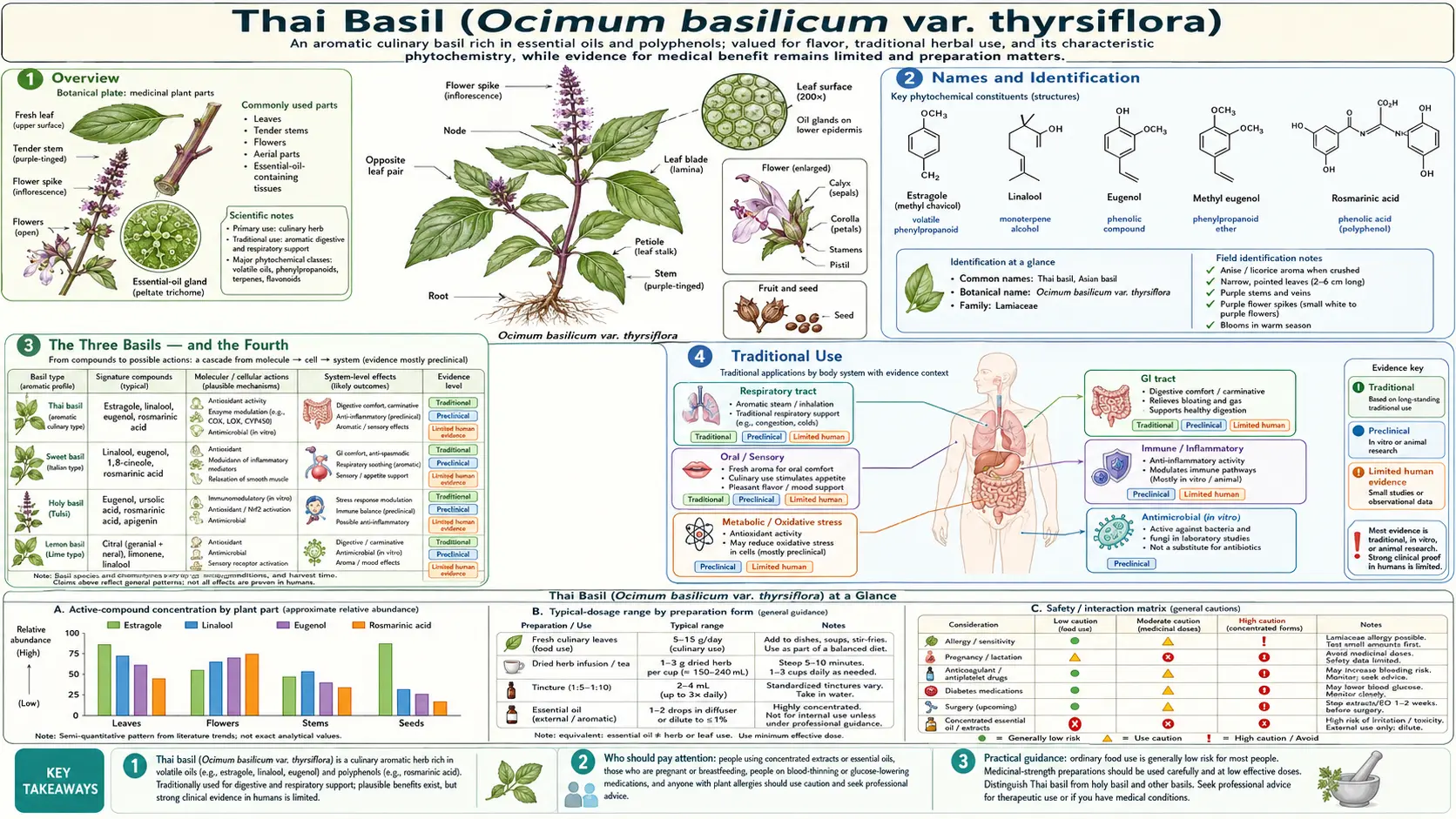
Thai basil is the purple-stemmed, anise-scented basil piled on the herb plate beside a bowl of phở and stirred into Thai green curry at the last second. Botanically it is a variety of ordinary sweet basil, Ocimum basilicum var. thyrsiflora, in the mint family. The liquorice note that makes it distinctive comes mostly from estragole, also called methyl chavicol, alongside linalool.
The main job of this page is to sort out which basil is which, because three different plants get called “Thai basil” or get substituted for one another, and they taste nothing alike. Thai basil (horapha) is not holy basil (kaphrao, tulsi), and neither one is lemon basil (maenglak). Western recipes routinely swap Italian Genovese basil in for all three, which is why so many home-cooked versions of Thai dishes taste almost-but-not-quite right.
The second job is to handle estragole honestly. You will find alarming headlines about it. Estragole is genotoxic and carcinogenic in rodents at high isolated doses, and European regulators have said that exposure to concentrated estragole preparations should be minimised in young children and in pregnancy. But that is a statement about the isolated compound and the essential oil. It is not a statement about eating basil leaves, and there is good published science explaining exactly why the two are different. This page gives you that distinction in full rather than a scare or a shrug.
Table of Contents
- Overview
- Names and Identification
- The Three Basils — and the Fourth
- Traditional Use
- Active Compounds
- Estragole: Reading the Safety Science Properly
- Antimicrobial and Food-Preservation Research
- Antioxidants and Rosmarinic Acid
- What Belongs to Tulsi, Not to Thai Basil
- Culinary Use
- Forms and Preparations
- Dosage
- Cautions and Contraindications
- Key Research Papers
- Connections
- Featured Videos
Overview
Thai basil is an annual (or tender perennial in the tropics) herb in the Lamiaceae, the mint family — square stems, opposite leaves, two-lipped flowers, aromatic oil glands. It grows 30–60 cm tall and is one of the easiest herbs in the world to raise from seed, which is part of why it travelled so successfully with Southeast Asian diaspora communities.
What it looks like. Sturdy purple stems; narrow, pointed, firm leaves 3–7 cm long, darker and less cupped than Italian basil; and dense, upright purple flower spikes that look like little pagodas. The flowers are edible and often left on the bunch at market. If you crush a leaf, the smell is sweet basil with an unmistakable overlay of aniseed or liquorice.
What is used. The leaves and tender flowering tops, almost always fresh. Thai basil dries very badly — the aroma compounds are volatile and the dried herb tastes of dust. Where Mediterranean cooking often uses dried oregano and thyme without complaint, dried Thai basil is essentially not worth buying.
Taxonomically it is one variety of a species that human beings have been selecting for aroma for thousands of years. Ocimum basilicum is a sprawling, promiscuous species with many named varieties and dozens of commercial cultivars, and its essential-oil chemistry varies enormously between them — a point demonstrated repeatedly in the analytical literature (Muráriková and colleagues, 2017; Avetisyan and colleagues, 2017). “Basil” is a very wide word.
Names and Identification
Botanical name: Ocimum basilicum L. var. thyrsiflora (also written var. thyrsiflorum), family Lamiaceae.
- Thai: horapha (โหระพา) — the standard Thai name for this basil
- Vietnamese: húng quế (also rau quế) — the basil on the phở herb plate
- Khmer: chi neang vong; Lao: phak i tou
- Chinese / Taiwanese: jiǔ céng tǎ (九層塔, “nine-layer pagoda”) — a closely related Asian basil, leaning more clove-and-pepper than anise, used in Taiwanese three-cup chicken
- Malay / Indonesian: selasih is often given as the name, but see the caution below
- English: Thai basil, Thai sweet basil, anise basil, liquorice basil
A word about selasih and kemangi. In Malay and Indonesian these names are used loosely across several Ocimum species and most often refer to lemon basil (Ocimum × africanum), not Thai basil. Kemangi in an Indonesian recipe — eaten raw as lalapan, or steamed in pepes — is lemon basil, and the biji selasih that swell into translucent jelly in iced drinks are lemon basil seeds. If an Indonesian or Malaysian recipe calls for kemangi, buying Thai basil will give you the wrong aroma.
Identifying it at the market. Look for the three markers together: purple stems, narrow firm pointed leaves, and a clear anise smell when you rub a leaf. Purple stems alone are not enough — some holy basil cultivars have purple stems too, but their leaves are noticeably hairy, slightly toothed and smell peppery rather than sweet.
The Three Basils — and the Fourth
This is the section worth bookmarking. Four basils turn up in Southeast Asian and Western kitchens, and getting them mixed up is the commonest reason a dish tastes wrong.
1. Thai basil — horapha
Ocimum basilicum var. thyrsiflora. Purple stems, purple flower spikes, narrow firm leaves.
Tastes like: sweet basil with a strong aniseed or liquorice edge; a little peppery; robust. Estragole and linalool dominate its oil.
Where you eat it: Thai green, red and panang curries; stir-fried seafood and clams; Vietnamese phở, bún bò Huế and fresh spring rolls; the Thai-American version of drunken noodles.
Behaviour: the sturdiest of the four. It survives brief cooking and holds up in a hot curry, though the aroma is still best added at the end.
2. Holy basil — kaphrao, tulsi
Ocimum tenuiflorum (older name O. sanctum) — a different species entirely. Leaves slightly hairy with a jagged edge, green or purple depending on the cultivar (Rama and Krishna tulsi respectively), stems often fuzzy.
Tastes like: peppery, clove-like, faintly bitter, almost medicinal when raw. Nothing like anise. Its aroma leans on eugenol.
Where you eat it: pad kraphao — the Thai stir-fry of minced pork or chicken with garlic, chilli and fish sauce, topped with a fried egg. This dish is named after the herb. If a restaurant makes it with Thai basil, it is making something else.
Also: in India this plant is tulsi, a sacred plant grown in courtyards and a major Ayurvedic herb taken as a tea and an adaptogen. Its research literature is entirely separate from Thai basil's — see the section below and the site's Holy Basil page.
Behaviour: raw it is harsh; it needs the heat of a stir-fry, where it turns savoury and fragrant.
3. Lemon basil — maenglak, kemangi
Ocimum × africanum (also seen as O. citriodorum; a hybrid of O. basilicum and O. americanum). Pale green, softer, smaller leaves; green stems.
Tastes like: distinctly lemony, from citral, over a light basil base. Delicate.
Where you eat it: Thai kaeng liang (the peppery vegetable soup), fish and seafood soups, khanom jeen noodle plates; Indonesian kemangi eaten raw as lalapan and in pepes. Its seeds are the ones used in Southeast Asian drinks and desserts.
Behaviour: the most fragile of the three. Added off the heat, right at the end.
4. Genovese or sweet basil — the Western default
Ocimum basilicum, Mediterranean cultivars. Broad, cupped, tender bright-green leaves; green stems.
Tastes like: sweet, softly clove-and-mint, no anise punch. Linalool-forward.
Where you eat it: pesto, caprese, tomato sauce.
As a substitute: it is the least-bad stand-in for Thai basil, but it wilts to nothing in a hot curry and carries none of the liquorice note. If you must substitute, add a small pinch of crushed fennel seed or a shard of star anise to the dish and use the Genovese as a finishing herb. It is not a substitute for holy basil at all — the flavours are not in the same family.
Quick reference
| Name | Species | Aroma | Signature dish |
|---|---|---|---|
| Thai basil (horapha) | O. basilicum var. thyrsiflora | Anise, liquorice | Green curry; phở herb plate |
| Holy basil (kaphrao, tulsi) | O. tenuiflorum | Peppery, clove | Pad kraphao |
| Lemon basil (maenglak, kemangi) | O. × africanum | Lemon, citral | Kaeng liang; Indonesian lalapan |
| Genovese basil | O. basilicum (Mediterranean) | Sweet, mild clove | Pesto |
Traditional Use
Thai basil's own medicinal tradition is modest. It is above all a culinary herb, and where it appears in traditional practice the uses are domestic and digestive.
- Thai household medicine: horapha as a carminative — for wind, bloating and mild indigestion — taken simply by eating it or as an infusion. Also used for coughs and, applied crushed, for insect bites.
- Vietnamese thuốc nam: húng quế among the everyday kitchen herbs eaten in quantity with meals for digestion and “warming.”
- Wider Ocimum basilicum tradition: sweet basil in general has a long record across the Mediterranean, the Middle East, South Asia and Southeast Asia as a digestive, a mild sedative, an insect repellent and a wound herb.
An important boundary. Much of what is written online about “basil’s health benefits” is actually about tulsi (Ocimum tenuiflorum), which has a large Ayurvedic tradition and a real clinical literature. That material does not belong to this plant. Traditional use of Thai basil is what is listed above: a kitchen herb with a digestive reputation.
Active Compounds
Essential oil
Thai basil's oil is dominated by two compounds:
- Estragole (methyl chavicol) — an alkenylbenzene, chemically related to safrole, methyl eugenol and anethole. This is the anise note, and it is the reason the safety section below exists.
- Linalool — the soft, floral, faintly citrus alcohol found in lavender, coriander leaf and many flowers. It rounds the sharpness of estragole.
Also present in varying amounts: 1,8-cineole (eucalyptus-like), eugenol (clove-like), β-caryophyllene, camphor, methyl cinnamate, α-bergamotene and germacrene D.
Chemotype variation is the rule, not the exception. Ocimum basilicum exists as several distinct chemotypes — methyl-chavicol-dominant, linalool-dominant, methyl-eugenol-dominant, methyl-cinnamate-dominant — and the proportions shift with cultivar, climate, harvest stage and drying. Analytical surveys of multiple basil species and cultivars document this range clearly (Muráriková and colleagues, 2017; Avetisyan and colleagues, 2017). Two bunches of “Thai basil” from different growers can differ substantially in their estragole content.
The European Medicines Agency's 2005 review of estragole tabulated its occurrence across aromatic plants and gave sweet basil (Ocimum basilicum) a range of roughly 238–8,780 parts per million in the plant material and 5–85% of the essential oil. The width of those ranges is the point.
Non-volatile constituents
- Rosmarinic acid — the signature polyphenol of the mint family; the main antioxidant in basil leaf.
- Caffeic and chicoric acids, plus a range of flavonoids.
- Nevadensin — a basil flavone that turns out to be unexpectedly important, because it blocks the enzyme step that makes estragole genotoxic. This is covered next.
- Anthocyanins — the pigments responsible for the purple stems and flower spikes.
Estragole: Reading the Safety Science Properly
Estragole (methyl chavicol, 4-allylanisole; CAS 140-67-0) turns up in tarragon, sweet fennel, star anise, anise, marjoram, Thai basil and many other aromatics. It has a genuine toxicological file, and it deserves to be described accurately rather than either buried or sensationalised.
What the animal data show
Estragole is a genotoxic carcinogen in rodents at high isolated doses. Classic structure–activity work in the early 1980s established that estragole and related alkenylbenzenes produce liver tumours in mice, by several routes of administration, in adults and in newborns (Miller and colleagues, 1983). The compound itself is not the culprit — the body makes the culprit. Estragole is hydroxylated to 1′-hydroxyestragole, which a sulfotransferase (SULT) enzyme then converts to a reactive sulfate ester that binds DNA. The EMA's review notes that the resulting DNA adducts are comparable in level and character to those produced by safrole, a structurally related known carcinogen.
Why dose matters more than usual here
The crucial fact is that the activation pathway is non-linear with dose. At low doses, estragole is mostly disposed of by O-demethylation and ends up exhaled as carbon dioxide. As the dose climbs, that route saturates and the 1′-hydroxylation route takes a proportionally larger share. The EMA's summary of the rat data illustrates this precisely: at single oral doses of 0.05 to 50 mg/kg body weight, 52–58% of the dose was excreted as CO₂ and only 1.3–5.4% appeared in urine as 1′-hydroxyestragole. At 500–1,000 mg/kg, CO₂ excretion fell to 28–29% while the 1′-hydroxy metabolite rose to 11.4–13.7%. In two human volunteers given 100 µg per day for six months, urinary 1′-hydroxyestragole amounted to just 0.2–0.4% of the dose.
In other words, the metabolic route that creates the DNA-damaging species barely operates at dietary exposures and takes over only at doses hundreds of times higher.
The matrix effect — the part usually left out
This is the most interesting piece of the science, and it maps directly onto the difference between eating basil and swallowing basil oil.
In 2010, a Dutch group at Wageningen identified nevadensin, a flavone naturally present in basil, as a potent inhibitor of the very SULT enzyme that converts 1′-hydroxyestragole into its DNA-reactive form, and modelled the likely in-vivo consequence (Alhusainy and colleagues, 2010). Follow-up work showed that this matrix modulation applies across several alkenylbenzene-containing herbs and spices (Alhusainy and colleagues, 2012), and a 2013 study provided in-vivo validation in rats: nevadensin inhibited SULT-mediated estragole DNA adduct formation in the liver (Alhusainy and colleagues, 2013). A companion risk assessment applied the same reasoning to basil-containing plant food supplements (van den Berg and colleagues, 2013).
The implication is direct. Basil leaf delivers estragole packaged with its own inhibitor of the activation step. Purified estragole, or a concentrated essential oil in which the volatile fraction has been separated from the non-volatile flavones, does not carry that protection in the same proportion. Testing a pure compound at high dose in a mouse is not a model of eating a herb.
What the regulators actually concluded
The EMA's 2005 public statement is often cited as if it were a warning against basil. It is more specific than that. Its conclusions were:
- Estragole is a naturally occurring genotoxic carcinogen with DNA potency similar to safrole.
- The bioactivation events are minimal at doses in the region of 1–10 mg/kg body weight, which is roughly 100 to 1,000 times the anticipated human exposure.
- Therefore, present exposure from herbal medicinal products — short-term use in adults at recommended dosage — does not pose a significant cancer risk.
- Nevertheless, further work on the low-dose end of the curve is needed, and in the meantime exposure of sensitive groups — young children, pregnant women and breastfeeding women — should be minimised.
- Preparations for topical and external use need further assessment, because skin absorption data are missing.
Elsewhere, the FEMA Expert Panel has treated estragole as generally recognised as safe as a flavouring, and the US Food and Drug Administration permits its food use; the Joint FAO/WHO Expert Committee on Food Additives evaluated it in 1981 without allocating an acceptable daily intake. A detailed FEMA safety assessment of estragole and methyl eugenol was published in 2002 (Smith and colleagues, 2002).
What this means at the dinner table
A generous handful of Thai basil on a bowl of phở is a few grams of fresh leaf, which is mostly water. The estragole in it is measured in fractions of a milligram. That is not the exposure the rodent carcinogenicity studies modelled, and it arrives alongside the flavones that suppress its activation. Eating Thai basil in food is not a meaningful cancer risk, and there is no reason to avoid it.
The exposures worth thinking about are different:
- Basil, tarragon or fennel essential oil taken internally — a concentrated dose of the volatile fraction without the matrix. Don't.
- Estragole-rich supplements and concentrated extracts — unnecessary and unstudied at the doses used.
- Star anise and fennel “teas” given in quantity to infants — a genuinely recognised concern, which is exactly what the EMA's sensitive-group advice is about.
The distinction between a food and a concentrate is the whole story here. It is also a useful template for reading almost any “this herb contains a carcinogen” headline.
Antimicrobial and Food-Preservation Research
Basil essential oil has a large in-vitro antimicrobial literature. Oils from various Ocimum basilicum cultivars inhibit a range of bacteria and fungi in laboratory assays, and there is an active research area exploring basil oil as a natural food preservative, often in nanoemulsions or edible films (Avetisyan and colleagues, 2017).
Two caveats keep this in proportion. First, essentially all of it is in vitro or in food matrices, not in people; concentrated terpene mixtures disrupt microbial membranes readily in a dish, and the effect does not transfer to an infection in a human body. Second, the potency varies with chemotype, so results from one basil oil do not predict another's.
There is no clinical evidence that eating Thai basil treats or prevents any infection. What it can reasonably be said to do is what herbs have always done in hot climates: make food taste good, and contribute a little antimicrobial activity in the dish itself.
Antioxidants and Rosmarinic Acid
Like other members of the mint family, basil is a good source of rosmarinic acid, a caffeic-acid dimer with strong antioxidant activity in laboratory assays, along with caffeic and chicoric acids and assorted flavonoids. Purple-stemmed and purple-leaved varieties additionally carry anthocyanins.
The honest framing is the same one that applies to almost every culinary herb. These compounds are genuinely present and genuinely have antioxidant chemistry. But herbs are eaten in gram quantities, and rosmarinic acid has limited oral bioavailability. No human trial has shown that eating basil changes a clinical outcome. Its contribution to a diet is real but small — part of the general benefit of eating plants, not a targeted intervention.
If you want the nutritional angle, fresh basil is a reasonable per-gram source of vitamin K and provides some vitamin A activity and manganese — but again, the portions are small enough that it is a garnish, not a nutrient source.
What Belongs to Tulsi, Not to Thai Basil
A great deal of health content about “basil” is really about tulsi, Ocimum tenuiflorum, and this needs saying plainly because the substitution is so common.
Tulsi has a substantial Ayurvedic tradition and a real, if uneven, clinical literature. A widely cited overview in the Journal of Ayurveda and Integrative Medicine summarised the plant's traditional and pharmacological profile (Cohen, 2014), and a systematic review in 2017 identified two dozen human studies of tulsi across metabolic, immune, neurocognitive and stress-related outcomes, reporting generally favourable results while noting that the trials were mostly small and heterogeneous (Jamshidi and Cohen, 2017).
None of that is evidence about Thai basil. They are different species with different chemistry — tulsi's oil is eugenol-led, Thai basil's is estragole-led — and no trial has substituted one for the other. If you are interested in the adaptogen and stress research, read the site's Holy Basil page, which is where that evidence belongs. If you are interested in the herb in your green curry, you are in the right place, and the honest answer is that Thai basil has no clinical trial evidence of its own for any health outcome.
That is not a failing of the plant. It is a superb culinary herb. It is simply not a medicine, and it should not be sold as one.
Culinary Use
Thai basil is one of the finishing herbs — added late, often at the table, valued for aroma rather than for the flavour it contributes during cooking.
Thailand
- Gaeng khiao wan (green curry) — a big handful of horapha stirred in as the pot comes off the heat, plus more scattered on top. The anise plays against coconut milk, green chilli and makrut leaf.
- Red curry and panang — the same treatment.
- Pad kee mao (drunken noodles) — wide rice noodles, chilli, garlic and basil. In Thailand this is often made with holy basil; the version served across North America and Europe almost always uses Thai basil, and both are good.
- Stir-fried clams and mussels with roasted chilli paste — basil folded in at the last second, where the steam from the shells carries the aroma up.
- Gaeng ped ped yang (roast duck curry) and Thai eggplant dishes.
- Not pad kraphao. That dish takes holy basil. See above.
Vietnam
- Phở — húng quế is the sturdy purple-stemmed basil on the plate of raw herbs, alongside bean sprouts, lime, chilli and sometimes culantro. You tear it and push it under the surface of the broth so the heat releases the oils. Adding it in the kitchen would waste it.
- Bún bò Huế, bún riêu, bánh xèo — part of the standard herb plate.
- Gỏi cuốn (fresh spring rolls) — a whole leaf rolled inside the rice paper with prawn, pork, noodle and lettuce.
- Bún chả and other noodle bowls — torn through the herbs at the bottom of the bowl.
Elsewhere in the region
- Taiwan and southern China: jiǔ céng tǎ, the “nine-layer pagoda” basil, is essential to three-cup chicken (三杯鸡), thrown in by the fistful at the end so it wilts in the hot sesame-oil, soy and rice-wine glaze. Also with stir-fried clams and in fried squid.
- Cambodia and Laos: in soups and noodle dishes, and as part of the raw-herb plate.
- Indonesia and Malaysia: the raw-basil role is usually filled by kemangi (lemon basil) rather than Thai basil — see the naming note above.
Handling and storage
- Add it last. The aroma compounds are volatile and heat drives them off within a minute or two. Stir into curries off the heat; add to noodles in the final toss; add to soup at the table.
- Tear rather than chop for the herb plate; a knife bruises and blackens the cut edges.
- Do not refrigerate it. Basil is chill-sensitive and suffers cold injury below roughly 10 °C, which turns the leaves black and translucent within a day or two. Stand the bunch in a glass of water on the kitchen counter like cut flowers, loosely tented with a bag, and it will keep for the best part of a week — and often root, so you can plant it.
- Use the stems. The purple stems are fragrant; simmer them in a broth and remove before serving.
- Freezing works, drying does not. Whole leaves frozen in a little oil or blitzed into a paste keep some aroma. Dried Thai basil is not worth the jar.
- Grow it. Thai basil germinates readily from seed, likes heat and full sun, and grows happily in a pot on a windowsill. Pinch out the flower spikes to keep the plant producing leaves — though the flowers themselves are edible and pretty on a plate.
Forms and Preparations
- Fresh bunches — the only form that really matters. Sold in Asian groceries, usually with flower spikes attached.
- Live plants and seed — cheap, easy and the best option if you cook Thai or Vietnamese food regularly.
- Frozen leaves or basil paste — acceptable for cooked dishes, no good for a raw herb plate.
- Dried Thai basil — near worthless. Skip it.
- Basil essential oil — sold for aromatherapy. Note that its composition depends entirely on chemotype; a methyl-chavicol-type oil is estragole-rich, a linalool-type oil is not. Not for internal use.
- Basil seeds — the swelling seeds used in Southeast Asian drinks and desserts are lemon basil (maenglak / selasih) seeds, not Thai basil seeds.
- Basil supplements — where these have any evidence behind them, it is tulsi evidence, and the capsule should say Ocimum tenuiflorum or sanctum on the label. There is no reason to take a Thai basil supplement.
Dosage
No medicinal dose of Thai basil is established, because no human trial has tested it. Culinary quantities are the only meaningful guide:
- In a curry or stir-fry: a large handful — roughly 10–20 g of loose leaves — per dish serving four, added at the end.
- On a phở herb plate: 5–10 sprigs per person, torn in to taste.
- As an infusion: a few sprigs steeped in hot water for 5–10 minutes makes a pleasant anise-scented tea. This is a traditional digestive, not a treatment.
Essential oil: not for internal use at any dose. For topical use, dilute to 1–2% in a carrier oil, patch test first, and avoid entirely in pregnancy, in breastfeeding, and on young children — the EMA has specifically flagged those groups regarding estragole exposure and noted that skin absorption data are lacking.
Cautions and Contraindications
Thai basil as food has an unremarkable safety record. It is eaten daily, in quantity, across Thailand, Vietnam, Cambodia, Laos and Taiwan. The cautions below are almost entirely about concentrated forms.
- Estragole — the concentrate, not the leaf. Estragole is genotoxic and carcinogenic in rodents at high isolated doses, and the European Medicines Agency has advised that exposure be minimised in young children, pregnant women and breastfeeding women. That advice targets concentrated estragole preparations — essential oils, high-dose extracts, and strong star-anise or fennel infusions given repeatedly to infants. It is not advice to avoid basil in cooking, and the same review concluded that ordinary exposure at recommended dosage does not pose a significant cancer risk. See the estragole section above for the full reasoning.
- Basil essential oil should not be swallowed. There is no established internal dose, the concentration of alkenylbenzenes is far above anything in food, and the flavone matrix that suppresses estragole activation in the leaf is not present in the same proportion. Keep essential oils out of reach of children.
- Skin. Basil oil constituents including linalool are recognised fragrance allergens, and oxidised oils are more sensitising than fresh. Dilute, patch test, and store oil sealed and cool.
- Warfarin and vitamin K. Fresh basil is fairly concentrated in vitamin K per unit weight, so very large or wildly variable intakes could in principle nudge an INR. In practice a garnish is a few grams and this is a non-issue — the relevant advice for anyone on warfarin is consistency of green-vegetable intake rather than avoidance of herbs.
- Allergy. Mint-family allergy is uncommon but exists, and oral allergy syndrome (itchy mouth and lips) can occur with raw herbs in people sensitised to related pollens. Stop if you react.
- Pregnancy and breastfeeding. Culinary use is normal and customary throughout Southeast Asia. Basil essential oil, estragole-rich extracts and concentrated supplements should be avoided, per the EMA's advice on sensitive groups.
- Raw herb hygiene. Raw herb plates are exactly that — raw. Wash bunched herbs thoroughly; fresh herbs have been implicated in foodborne outbreaks, and this matters most for people who are pregnant, elderly or immunocompromised.
- Do not treat it as a medicine. Thai basil has no clinical evidence for any health condition. If a product markets Thai basil for blood sugar, stress or immunity, it is borrowing tulsi's research and attaching it to the wrong plant.
Key Research Papers
- Miller EC, Swanson AB, Phillips DH, Fletcher TL, Liem A, Miller JA. Structure-activity studies of the carcinogenicities in the mouse and rat of some naturally occurring and synthetic alkenylbenzene derivatives related to safrole and estragole. Cancer Research. 1983;43(3):1124–1134.
- Smith RL, Adams TB, Doull J, Feron VJ, Goodman JI, Marnett LJ, Portoghese PS, Waddell WJ, Wagner BM, Rogers AE, Caldwell J, Sipes IG. Safety assessment of allylalkoxybenzene derivatives used as flavouring substances — methyl eugenol and estragole. Food and Chemical Toxicology. 2002;40(7):851–870.
- Alhusainy W, Paini A, Punt A, Louisse J, Spenkelink A, Vervoort J, Delatour T, Scholz G, Schilter B, Adams T, van Bladeren PJ, Rietjens IMCM. Identification of nevadensin as an important herb-based constituent inhibiting estragole bioactivation and physiology-based biokinetic modeling of its possible in vivo effect. Toxicology and Applied Pharmacology. 2010;245(2):179–190.
- Alhusainy W, van den Berg SJPL, Paini A, Campana A, Asselman M, Spenkelink A, Punt A, Scholz G, Schilter B, Adams TB, van Bladeren PJ, Rietjens IMCM. Matrix modulation of the bioactivation of estragole by constituents of different alkenylbenzene-containing herbs and spices and physiologically based biokinetic modeling of possible in vivo effects. Toxicological Sciences. 2012;129(1):174–187.
- Alhusainy W, Paini A, van den Berg JHJ, Punt A, Scholz G, Schilter B, van Bladeren PJ, Taylor S, Adams TB, Rietjens IMCM. In vivo validation and physiologically based biokinetic modeling of the inhibition of SULT-mediated estragole DNA adduct formation in the liver of male Sprague-Dawley rats by the basil flavonoid nevadensin. Molecular Nutrition & Food Research. 2013;57(11):1969–1978.
- van den Berg SJPL, Klaus V, Alhusainy W, Rietjens IMCM. Matrix-derived combination effect and risk assessment for estragole from basil-containing plant food supplements. Food and Chemical Toxicology. 2013;62:32–40.
- Muráriková A, Ťažký A, Neugebauerová J, Planková A, Jampílek J, Mučaji P, Mikuš P. Characterization of essential oil composition in different basil species and pot cultures by a GC-MS method. Molecules. 2017;22(7):1221.
- Avetisyan A, Markosian A, Petrosyan M, Sahakyan N, Babayan A, Aloyan S, Trchounian A. Chemical composition and some biological activities of the essential oils from basil Ocimum different cultivars. BMC Complementary and Alternative Medicine. 2017;17(1):60.
- Cohen MM. Tulsi — Ocimum sanctum: a herb for all reasons. Journal of Ayurveda and Integrative Medicine. 2014;5(4):251–259. (Holy basil — a different species.)
- Jamshidi N, Cohen MM. The clinical efficacy and safety of tulsi in humans: a systematic review of the literature. Evidence-Based Complementary and Alternative Medicine. 2017;2017:9217567. (Holy basil — a different species.)
Regulatory Documents
- European Medicines Agency, Committee on Herbal Medicinal Products. Public statement on the use of herbal medicinal products containing estragole (EMEA, 2005) — the source of the dose–response figures, the occurrence table and the sensitive-group advice quoted above.
Live PubMed Searches
- Ocimum basilicum var. thyrsiflora (Thai basil)
- Estragole / methyl chavicol
- Estragole risk assessment in basil
- Nevadensin and sulfotransferase inhibition
- Basil essential oil chemotypes
- Ocimum tenuiflorum (tulsi) clinical trials
- Ocimum × africanum (lemon basil)
- Rosmarinic acid and bioavailability
- Alkenylbenzenes (safrole, methyl eugenol) and food safety
Connections
- All Herbs
- Holy Basil — tulsi, Ocimum tenuiflorum: the peppery basil of pad kraphao and the one with an actual clinical literature.
- Lemongrass — the citral-scented grass that shares almost every dish Thai basil appears in.
- Makrut Lime — the leaf that starts a Thai curry, where basil finishes it.
- Pandan — the sweet aromatic of the same kitchens.
- Peppermint — another Lamiaceae aromatic, and a useful contrast: a culinary mint that does have real clinical trial data.
- Oregano — a mint-family herb whose essential oil raises the same food-versus-concentrate question.
- Marjoram — another estragole-containing aromatic listed in the EMA occurrence table.
- Rosemary — the other great rosmarinic-acid herb.
- Sage — a Lamiaceae relative with its own concentrate-versus-food caution (thujone).
- Galangal — the rhizome in the curry paste basil is stirred into.
- Luteolin — a flavone of the kind basil supplies alongside nevadensin.
- Conditions on this site that reference this page: Helicobacter Pylori · Streptococcus pyogenes (Group A Strep) · Bacteria