Sacred Lotus (Nelumbo nucifera)
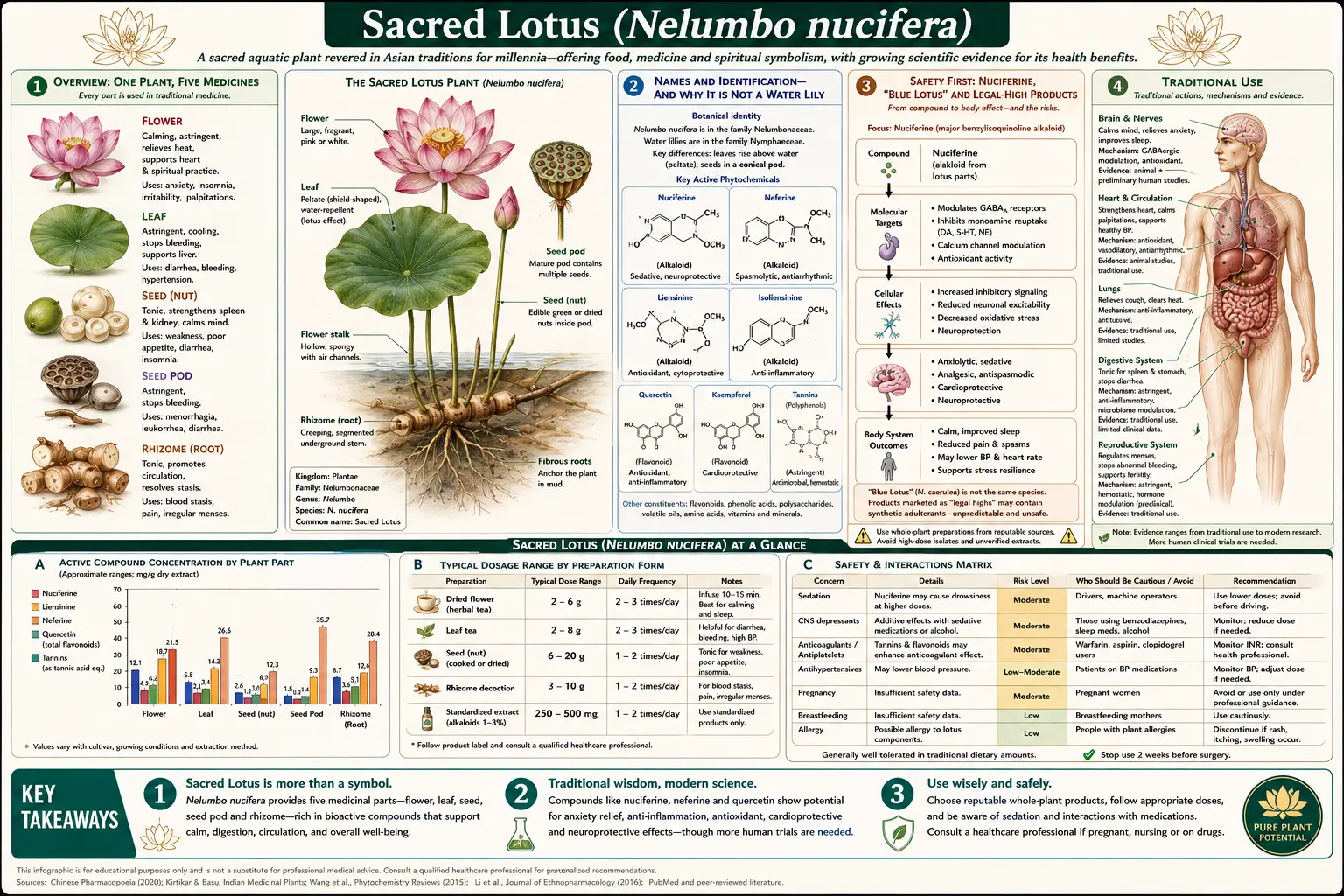
The sacred lotus is one plant that Asian medicine treats as five different medicines. The seed, the bitter green embryo inside the seed, the leaf, the underground rhizome and the stamens all have separate names, separate traditional indications and genuinely different chemistry — which is why herb lists so often break them into unrelated entries. This page keeps them together, because they come from the same plant and their safety questions overlap.
Two things are worth knowing before you read further. First, the sacred lotus is not a water lily. It looks like one, it is sold as one, and most sources say it is one, but Nelumbo sits in its own family, Nelumbonaceae, on a completely different branch of the flowering-plant tree. Second, the lotus leaf contains nuciferine, an alkaloid with real activity at dopamine and serotonin receptors, and nuciferine is a marketed ingredient in "legal high" and vape products — often under the name blue lotus, which is a third plant again. That is the safety story on this page and it is covered early rather than buried.
On efficacy, be prepared for thin evidence. Almost everything published on lotus for blood lipids, blood sugar and sedation is cell-culture or rodent work. There is one reasonable randomized human trial of lotus-leaf extract for body fat, industry-authored, and very little else. Traditional use is long and rich; human proof is short.
Table of Contents
- Overview: One Plant, Five Medicines
- Names and Identification — and Why It Is Not a Water Lily
- Safety First: Nuciferine, "Blue Lotus" and Legal-High Products
- Traditional Use
- Active Compounds
- Lotus Leaf, Body Fat and Blood Lipids
- The Seed Embryo, Sleep and Calm
- Blood Sugar and Metabolic Effects
- Neferine and the Cancer-Cell Literature
- Culinary Use
- The Lotus Effect and the Thousand-Year Seed
- Forms and Preparations
- Dosage
- Cautions and Contraindications
- Key Research Papers
- Connections
- Featured Videos
Overview: One Plant, Five Medicines
Nelumbo nucifera Gaertn. is a large aquatic perennial that roots in the mud of ponds, paddies and slow rivers and holds its leaves and flowers above the water on stiff stalks — a detail that distinguishes it at a glance from the true water lilies, whose leaves float flat on the surface. The leaves are round, up to 60 cm across, and attached in the middle like a parasol, with no notch cut into the rim. The flowers are pink or white and open for three mornings before shedding their petals to leave a flat-topped seed receptacle that looks like a showerhead. That receptacle holds the seeds.
It grows from the Caspian region across India, Sri Lanka, China, Korea, Japan, mainland and island Southeast Asia, and into northern Australia. Almost everywhere it grows, it is farmed. In China alone, tens of thousands of hectares of shallow ponds are managed for lotus, some for rhizome, some for seed, some for both.
Here is what actually reaches a kitchen or a pharmacy, and under which name:
- Seed — lian zi (蓮子). The ivory kernel, sold dried or as a sweet paste. Food first, medicine second: a staple of Chinese soups, congee, mooncake filling and Vietnamese chè sen. In traditional Chinese medicine it is a gentle spleen and heart tonic.
- Seed embryo — lian zi xin (蓮子心). The green sprout at the centre of the seed, removed before eating because it is punishingly bitter. Sold separately as a tea. This part is the richest source of the alkaloid neferine, which is exactly why it is used for different purposes than the seed it came out of.
- Leaf — he ye (荷葉). Dried and cut, brewed as a tea or used to wrap sticky rice for steaming. In modern Chinese practice it is the part reached for in the context of high blood lipids and weight.
- Rhizome — ou or lian ou (藕). The crunchy, hole-riddled underground stem sold as a vegetable across Asia — renkon in Japan, ngó sen or củ sen in Vietnam, kamal kakdi or bhein in India. The joints between segments (ou jie) are a separate traditional item used to stop bleeding.
- Stamen — lian xu (蓮鬚). The dried yellow filaments from the flower, used in Chinese medicine as an astringent.
The practical consequence for a reader buying something: "lotus tea" is not one product. Leaf tea, seed-heart tea and flower tea are chemically distinct, and only the leaf and the seed heart carry meaningful alkaloid loads.
Names and Identification — and Why It Is Not a Water Lily
Binomial: Nelumbo nucifera Gaertn. Family: Nelumbonaceae. The genus contains only two living species: N. nucifera, the pink or white Asian lotus, and N. lutea, the yellow American lotus of the Mississippi basin and Great Lakes.
Local names: Chinese 蓮 / 荷 (lian, he); Japanese 蓮 hasu, rhizome renkon; Korean 연꽃 yeonkkot; Vietnamese sen (flower hoa sen, seed hạt sen, rhizome ngó sen); Thai บัวหลวง bua luang; Malay and Indonesian teratai (a loose word that also covers water lilies — see below) or seroja; Tagalog baino; Hindi and Sanskrit kamal, padma, pundarika.
Now the correction that matters botanically. Water lilies are Nymphaea and its relatives in the family Nymphaeaceae, order Nymphaeales — one of the very earliest branches to split off from the rest of the flowering plants. Nelumbo is not in that family and not in that order. Modern molecular phylogenetics places Nelumbonaceae in the order Proteales, whose other members are the plane trees (Platanus, the London plane on your street) and the proteas of South Africa and Australia. Its nearest living relatives are dry-land trees and shrubs. The resemblance to a water lily is convergent evolution: two unrelated lineages independently solved the problem of being a big-leaved freshwater plant and arrived at similar-looking answers.
You can separate them without a microscope:
- Lotus leaves are held high above the water on stiff stalks and are unbroken circles with the stalk attached at the centre. Water-lily pads float on the surface and have a wedge-shaped notch cut in to the centre.
- Lotus water beads up and rolls off the leaf surface. Water lily pads get wet.
- The lotus seed head — that flat perforated disc — has no equivalent in water lilies.
Three name collisions to watch for when shopping:
- "Blue lotus" is Nymphaea caerulea, an Egyptian water lily — not this plant. It is sold as a smoking blend, vape liquid, tea and tincture for its psychoactive reputation. See the next section.
- "Lotus root" in a Western supermarket is the rhizome of this plant and is a vegetable, not a supplement.
- Jujube seed, "sour date" (suan zao ren) is a different Chinese sleep herb often shelved beside lotus seed heart. They are unrelated plants with different actions.
Safety First: Nuciferine, "Blue Lotus" and Legal-High Products
Nuciferine is the signature aporphine alkaloid of the lotus leaf. For most of the twentieth century it was treated as an inert marker compound. It is not inert.
A 2016 receptor-screening study characterized nuciferine across a broad panel of central-nervous-system targets and found a profile that looks, in the authors' own framing, like an atypical antipsychotic: potent antagonist activity at serotonin 5-HT2A, 5-HT2B and 5-HT2C receptors, partial agonism at 5-HT1A, and agonist activity at dopamine D2 and D5 receptors. In mice it blocked the head-twitch response produced by a hallucinogen and reduced spontaneous movement — both classic antipsychotic-like signals. This is animal and receptor work, not a human trial, and nobody has shown that nuciferine treats anything in a person. But it establishes the important point: this molecule engages the same receptors that prescription psychiatric drugs engage.
That matters commercially because nuciferine has become a selling point. It is listed on the labels of "legal high", "herbal ecstasy", relaxation-blend and vape products, most often attributed to blue lotus (Nymphaea caerulea) — the Egyptian water lily, which contains both nuciferine and apomorphine, a dopamine agonist. A 2023 market survey of blue lotus extracts sold in the United States analysed commercial products and reported wide variation between what the label claimed and what the bottle contained. Blue lotus resin has been documented in electronic-cigarette use. Because the two plants share the word "lotus" and share nuciferine, sacred-lotus leaf products get pulled into the same marketing and the same confusion.
What this means for you, practically:
- A cup of ordinary lotus-leaf tea is a very different exposure from a concentrated nuciferine extract or a vape liquid. Traditional food-and-tea use has a long track record; concentrated novel delivery does not.
- If you take an antipsychotic, an antidepressant, a Parkinson's medication, or any drug acting on dopamine or serotonin, treat concentrated lotus-leaf or nuciferine products as a possible interaction and raise it with your prescriber. This is not a token warning — the receptor overlap is direct.
- Inhaling any plant extract that was never studied for inhalation is its own separate risk, independent of the alkaloid.
- Do not buy a product because "lotus" sounds gentle. The gentle part of the plant is the seed and the rhizome, which are food.
Traditional Use
The lotus is embedded in two of the world's major religions and that is inseparable from its medical reputation. In Buddhism it is the standard image of purity emerging unstained from muddy water — the flower rises clean out of the pond bottom — and buddhas and bodhisattvas are conventionally shown seated on a lotus throne. In Hinduism it is the seat and attribute of Lakshmi, Brahma and Saraswati, and padma is the name of the heart and crown chakras. Being sacred did not make it medicinal, but it did guarantee that it was grown, written about and preserved everywhere it could be grown.
In traditional Chinese medicine the parts diverge sharply:
- Lian zi (seed) is classed as sweet, astringent and neutral, entering the spleen, kidney and heart channels. It is used to strengthen a weak digestion with chronic loose stools, to "calm the spirit" in restlessness and poor sleep, and as an astringent for leakage-type complaints. It appears constantly in medicinal food rather than in strong prescriptions.
- Lian zi xin (seed embryo) is bitter and cold, and is used for a very different picture: agitation, thirst, a red tongue tip and insomnia attributed to "heart fire". Traditional texts also list it for bleeding and for high blood pressure in later practice.
- He ye (leaf) is bitter and neutral, said to clear "summer-heat and damp", raise the clear yang and stop bleeding. In China from the twentieth century onwards it became the standard herb-shop answer to high blood lipids and excess weight, and that is now its main commercial use.
- Ou jie (rhizome node) is the classical hemostatic — nosebleed, blood in the urine, coughing blood.
- Lian xu (stamen) is sweet, astringent and neutral, used to restrain seminal and vaginal discharge.
In Ayurveda, kamala is a cooling pitta-pacifying drug; the flower, stamen and seed are used in preparations for burning sensations, bleeding, and heart and mind complaints. In Vietnamese thuốc nam, lotus-seed heart (tâm sen) is an everyday domestic tea for sleeplessness and is sold in every market. Across Thailand and Cambodia, lotus stamen tea is a common home drink.
None of this is efficacy data. It tells you that a very large number of people used these parts for a very long time without conspicuous harm, and it tells you which effects to go looking for. It does not tell you the effects are there.
Active Compounds
Lotus chemistry splits into two families of alkaloids plus a broad flavonoid load, and — crucially — the two alkaloid families sit in different parts of the plant.
- Aporphine alkaloids — concentrated in the leaf. Nuciferine is the dominant one, alongside N-nornuciferine, roemerine, anonaine, asimilobine and pronuciferine. These are single-ring-system alkaloids with the receptor activity described above. The leaf is the commercial source.
- Bisbenzylisoquinoline alkaloids — concentrated in the seed embryo. Neferine is the best studied, with liensinine and isoliensinine alongside it. Structurally these are two benzylisoquinoline units linked together — bigger, bulkier molecules than nuciferine, with an entirely different pharmacology. They are the reason the bitter green sprout is used for heat, agitation and sleep while the white kernel around it is used as a mild food-grade tonic. It is a genuine chemical basis for a traditional distinction, which is rarer than herbal marketing suggests.
- Flavonoids. Quercetin and its glycosides (notably quercetin-3-O-glucuronide, the major constituent of the leaf extract used in the human trial below), kaempferol glycosides, isoquercitrin, hyperoside, catechin and rutin. The leaf and the flower are the flavonoid-rich parts.
- Rhizome constituents. Starch (this is why lotus root is filling), dietary fibre, vitamin C, potassium, and polyphenols including catechins and gallic-acid derivatives. The rhizome is comparatively alkaloid-poor — it is essentially a vegetable.
- Seed constituents. Starch and protein, with a modest polyphenol content in the seed coat. Lotus-seed protein and starch have their own food-science literature.
Comprehensive chemical profiles of the species have been published repeatedly; the reviews listed at the end catalogue well over a hundred identified compounds.
Lotus Leaf, Body Fat and Blood Lipids
The mechanism claim. Rodent and cell studies report that lotus-leaf extract and isolated nuciferine reduce fat accumulation by several routes: inhibiting pancreatic lipase so less dietary fat is absorbed, activating AMP-activated protein kinase (AMPK, the cell's low-fuel switch) in liver and fat tissue, suppressing the transcription factors that drive fat-cell maturation, and increasing fat oxidation. In high-fat-fed mice and rats, lotus-leaf extract fairly consistently lowers body weight gain, liver fat, triglycerides and LDL cholesterol. That is a coherent story and it is animal evidence.
The human evidence. There is one randomized double-blind trial of reasonable design: 60 overweight adults (BMI 24–28) took an extract of sun-dried lotus leaf, standardized to quercetin-3-glucuronide as the main constituent, for 12 weeks. Whole-body fat fell significantly in both men and women relative to control, and men also showed reduced visceral fat and waist circumference. Two honest caveats: several authors were employees of the food company that makes the extract, and the comparison groups are described as non-intervention controls rather than a matched placebo, which weakens the blinding claim. This is a promising signal, not a settled result, and it has not been independently replicated at the time of writing.
What to take from it. Lotus-leaf tea is not a weight-loss drug. If it does anything in a person, the effect size in the one decent trial was a modest shift in body composition over three months in people who were overweight but not obese. Anyone selling it as a fat-burner is far ahead of the data.
The Seed Embryo, Sleep and Calm
The traditional claim is specific and testable: the bitter green heart of the lotus seed settles agitation and helps sleep. It is drunk as a plain tea across Vietnam and southern China for exactly this.
What the laboratory shows. Neferine and liensinine have sedative and anxiolytic-like effects in rodent behavioural models, and neferine has been shown to have anticonvulsant and neuroprotective effects in a rat chemically-induced seizure model, reducing seizure severity and hippocampal neuron loss. Related work reports effects on GABAergic and glutamatergic signalling and on neuroinflammation. Reviews of lotus alkaloids in neurological models are now numerous.
What is missing. Human trials. I could not identify a properly controlled clinical trial of lotus-seed embryo for insomnia or anxiety. The rodent data are real and reasonably consistent; the leap to "helps you sleep" in a person is unproven. If you drink the tea and it settles you, that is a legitimate personal observation — a warm, bitter, caffeine-free drink at bedtime has its own value — but it is not evidence of a pharmacological sleep effect.
One practical note: the embryo tea is intensely bitter, and traditional practice treats bitter-cold herbs as unsuitable for people who run cold, digest poorly or have loose stools. That is a traditional-framework caution, not a pharmacological one, but it maps onto a real observation that some people get stomach upset from it.
Blood Sugar and Metabolic Effects
Mechanism. Lotus-leaf and lotus-seedpod extracts inhibit α-glucosidase and α-amylase in the test tube — the same enzymes targeted by the drug acarbose — which would slow the breakdown of starch into absorbable glucose. Nuciferine has been reported to improve insulin sensitivity and reduce hepatic fat in rodent models of metabolic syndrome, and lotus-leaf flavonoids show the usual antioxidant and anti-inflammatory activity in cell systems.
Human evidence. Essentially absent for glycaemic outcomes. The body-composition trial above did not establish glucose or HbA1c benefits, and there is no adequately powered randomized trial of lotus for type 2 diabetes or prediabetes. Enzyme inhibition in a cuvette is a hypothesis about what might happen in a gut, not a demonstration that it does.
If you have diabetes and want to drink lotus-leaf tea, the sensible course is to keep taking your medication, tell your clinician, and check your own glucose readings rather than assume a benefit or a risk.
Neferine and the Cancer-Cell Literature
Search PubMed for neferine and a large share of what comes back is oncology: neferine kills cervical carcinoma cells through a pro-oxidant mechanism, inhibits lung cancer cell growth by activating MAPK signalling and arresting the cell cycle, sensitizes multidrug-resistant tumour cells, and induces autophagy in several lines. These are real published findings and they are entirely cell-culture and animal-xenograft work.
This section exists because that literature is routinely quoted online as if lotus seed heart treated cancer. It does not. Killing a cancer cell in a dish is a very low bar — bleach does it — and the concentrations used in these experiments are frequently far above anything achievable by drinking a tea. There is no human trial of neferine in cancer. If you are being treated for cancer, the relevant fact about lotus is the opposite one: concentrated alkaloid extracts have not been tested alongside chemotherapy and could plausibly interfere with it, so tell your oncology team about anything you are taking.
Culinary Use
Lotus is a serious food plant, which is the main reason its safety record is as reassuring as it is.
- Rhizome. Sliced crosswise to show the ring of air canals, it is stir-fried, deep-fried as crisps, braised, pickled in vinegar (Japanese su-renkon), stuffed with glutinous rice and steamed in Chinese Jiangnan cooking, or simmered in pork-rib soup with peanuts. Texture is the point — it stays crunchy through long cooking. In Indian cooking, kamal kakdi is made into kofta and sabzi, and Kashmiri nadru yakhni is a lotus-stem dish in yoghurt gravy.
- Seed. Fresh seeds are eaten raw like a green nut. Dried seeds go into congee, tong sui, Vietnamese chè hạt sen, and are boiled and mashed into the sweet paste at the centre of mooncakes. Candied lotus seeds are a Chinese New Year sweet.
- Leaf. Used as a wrapper: lo mai gai (steamed sticky rice with chicken), Chinese "beggar's chicken", and Vietnamese cơm sen lotus-leaf rice. The leaf perfumes the food with a green, tea-like aroma and is not eaten.
- Stamen and petals. The stamens are dried for tea. Petals are used as a garnish and, in Vietnam, to scent green tea — the celebrated trà sen of Hanoi's West Lake is made by packing tea leaves inside lotus flowers overnight so they absorb the fragrance.
- Embryo. Removed from culinary seeds because of the bitterness; sold separately for tea.
Nutritionally, the rhizome is a starchy vegetable with useful fibre, vitamin C and potassium. The seed is a starch-and-protein food. Neither is a concentrated source of the alkaloids discussed above.
The Lotus Effect and the Thousand-Year Seed
Two things about this plant are extraordinary and both are documented rather than folkloric.
The lotus effect. Rain lands on a lotus leaf and forms near-perfect spheres that roll straight off, collecting dust as they go and leaving the surface clean. This was described in detail by the German botanists Wilhelm Barthlott and Christoph Neinhuis in a 1997 paper in the journal Planta, "Purity of the sacred lotus, or escape from contamination in biological surfaces". Under an electron microscope the leaf is not smooth: it is covered in microscopic bumps, each of which is itself coated in even smaller wax crystals. That two-level roughness means a water droplet rests on air pockets between the bumps, touching only a tiny fraction of the actual surface. Contact angle exceeds 150 degrees, the droplet is almost spherical, and it rolls at the slightest tilt. Dirt particles adhere to the droplet more strongly than to the waxy leaf, so the water carries them away. The mechanism has been directly copied in self-cleaning facade paints, glass coatings and textiles, and "the lotus effect" is now a standard term in materials science. The biological purpose is almost certainly to keep the leaf surface free of fungal spores and to keep the stomata clear.
The ancient seeds. Lotus fruits recovered from a dry lakebed at Xipaozi in Liaoning province, northeastern China, have been germinated after radiocarbon dates in the region of a thousand years and more — the best-authenticated specimens dating to roughly 1,300 years. They did not merely sprout; they grew into normal plants. Research on this "China Antique" lotus has focused on the seed's unusually heat-stable proteins and its repair enzymes as the explanation for the longevity. It is one of the best-documented cases of extreme seed viability in the scientific literature, and it is a reasonable candidate for the oldest directly dated seed ever germinated. The hard, watertight fruit wall does much of the work.
Forms and Preparations
- Loose dried leaf (he ye) — large brittle pieces of green-grey leaf. Brewed as tea, roughly a level tablespoon steeped in just-boiled water for five to ten minutes. Cheap. The most common form for the lipid and weight indications.
- Lotus-leaf extract capsules — usually standardized to total flavonoids or, in the better products, to a named marker such as quercetin-3-glucuronide or nuciferine. Concentration varies enormously between brands. This is the form that carries the alkaloid interaction concerns.
- Seed-heart tea (lian zi xin, tâm sen) — tiny green sprouts, sold loose. Two to five sprouts is enough for a cup; more is unbearably bitter. Often blended with jujube or chrysanthemum to soften it.
- Whole dried seeds — a food. Soaked and cooked. Look for seeds with the embryo already removed if you want them sweet.
- Lotus stamen tea — delicate, floral, very mild. Essentially a beverage.
- Fresh rhizome — sold in Asian groceries, sometimes vacuum-packed. Choose firm segments with unbroken skin; cut surfaces brown quickly.
- Lotus-flower or lotus-scented teas — usually green tea perfumed with lotus, which means you are drinking green tea with its caffeine.
- Nuciferine or "blue lotus" concentrates, vape liquids and smoking blends — a different category entirely. Discussed under Safety and Cautions; not recommended.
Dosage
There is no established evidence-based dose for any lotus preparation for any health outcome. What exists is traditional practice plus the doses used in the few studies.
- Lotus leaf, traditional decoction: Chinese herbal practice typically uses in the region of 3–10 g of dried leaf per day. A home-brewed tea from a tablespoon of cut leaf sits at the low end of that.
- Lotus-leaf extract, trial dose: the 12-week body-composition trial used a proprietary sun-dried leaf extract. Because the extraction ratio and standardization differ between products, a gram figure from that study does not transfer to a supplement on a shelf. Follow the label, and prefer products that state a marker compound and its amount.
- Lotus seed, culinary and traditional: 6–15 g of dried seed per day in soups and congee is ordinary food use.
- Lotus seed embryo: traditional use is small — on the order of 2–3 g per day, and a domestic cup of tea uses far less than that. Its bitterness is self-limiting.
- Rhizome: eat as a vegetable. No dosing question.
Start low. If you are trying lotus-leaf tea, one cup a day for a week tells you whether it suits you before you build a habit around it.
Cautions and Contraindications
The alkaloid issue, restated. Lotus leaf contains nuciferine, which is an agonist at dopamine D2 and D5 receptors and a potent antagonist at serotonin 5-HT2A/2B/2C receptors in laboratory assays, with antipsychotic-like behaviour in mice. Concentrated leaf extracts and isolated nuciferine should therefore be treated as pharmacologically active, not as a herbal tea. Specifically:
- Antipsychotics, antidepressants (especially SSRIs, SNRIs and MAOIs), lithium, triptans, and dopaminergic Parkinson's drugs — plausible interaction with concentrated lotus-leaf or nuciferine products. Discuss before combining.
- Sedatives, benzodiazepines, alcohol, and sleep medication — additive drowsiness is plausible given the rodent sedation data. Do not assume a herbal product cannot add to a sedative.
- "Blue lotus" (Nymphaea caerulea) products, legal-high blends and vape liquids — avoid. Label contents have been shown to be unreliable, inhalation of these extracts is unstudied, and the psychoactive intent is the whole marketing point.
Pregnancy and breastfeeding. Lotus seed and rhizome as food are traditionally regarded as safe and are eaten routinely in pregnancy across Asia. Concentrated leaf extracts, seed-embryo preparations and any alkaloid-standardized product should be avoided — there is no adequate human safety data, and the alkaloids are centrally active. Traditional Chinese texts additionally regard lotus leaf as unsuitable in pregnancy.
Blood pressure and heart medication. Neferine and related alkaloids have effects on cardiac ion channels and blood vessels in animal work, and lotus seed heart is used traditionally for high blood pressure. If you take antihypertensives or antiarrhythmics, treat concentrated products as a possible additive effect and monitor.
Blood-sugar medication. Given the enzyme-inhibition data, monitor glucose if you combine lotus preparations with insulin or oral hypoglycaemics. The risk is theoretical but the monitoring is free.
Digestive effects. Lotus seed is astringent and can be constipating in quantity. Lotus-seed embryo is bitter and cold in traditional terms and commonly causes stomach discomfort in people with sensitive digestion. Lotus leaf is generally well tolerated as tea.
Allergy. Uncommon, but lotus pollen allergy is documented, and occupational contact reactions in lotus growers have been reported. Stop if you develop rash, itching or swelling.
Surgery. Because of the possible sedative and blood-pressure effects, stop concentrated lotus supplements at least two weeks before planned surgery.
Contamination. Lotus is grown in pond mud, and aquatic plants can accumulate heavy metals from sediment. This is a real, documented issue for aquatic vegetables in industrially polluted watersheds. Buy from reputable sources; this argues for regulated food supply chains over unlabelled bulk herb.
Children. Lotus seed and rhizome as food are fine. Alkaloid-containing preparations — leaf extracts and seed-heart tea — have not been studied in children and should not be given.
Key Research Papers
- Paudel KR, Panth N. Phytochemical profile and biological activity of Nelumbo nucifera. Evidence-Based Complementary and Alternative Medicine. 2015;2015:789124.
- Sharma BR, Gautam LN, Adhikari D, et al. A comprehensive review on chemical profiling of Nelumbo nucifera: potential for drug development. Phytotherapy Research. 2017;31(1):3–26.
- Mukherjee PK, Mukherjee D, Maji AK, et al. The sacred lotus (Nelumbo nucifera) — phytochemical and therapeutic profile. Journal of Pharmacy and Pharmacology. 2009;61(4):407–422.
- Chen G, Zhu M, Guo M. Research advances in traditional and modern use of Nelumbo nucifera: phytochemicals, health promoting activities and beyond. Critical Reviews in Food Science and Nutrition. 2019;59(sup1):S189–S209.
- Farrell MS, McCorvy JD, Huang XP, et al. In vitro and in vivo characterization of the alkaloid nuciferine. PLoS One. 2016;11(3):e0150602. The receptor-profiling study behind the safety section above.
- Ren X, Chen H, Wang H, et al. Advances in the pharmacological effects and mechanisms of Nelumbo nucifera Gaertn. extract nuciferine. Journal of Ethnopharmacology. 2024;331:118262.
- Zhao T, Zhu Y, Zhao R, et al. Structure–activity relationship, bioactivities, molecular mechanisms and clinical application of nuciferine on inflammation-related diseases. Pharmacological Research. 2023;193:106820.
- Bharathi Priya L, Huang CY, Hu RM, et al. An updated review on pharmacological properties of neferine — a bisbenzylisoquinoline alkaloid from Nelumbo nucifera. Journal of Food Biochemistry. 2021;45(12):e13986.
- Lin TY, Hung CY, Chiu KM, et al. Neferine, an alkaloid from lotus seed embryos, exerts antiseizure and neuroprotective effects in a kainic acid-induced seizure model in rats. International Journal of Molecular Sciences. 2022;23(8).
- Zhao D, Ma L, Brownlie J, et al. Neuroprotective potential of major alkaloids from Nelumbo nucifera (lotus): mechanisms and therapeutic implications. International Journal of Molecular Sciences. 2025;26(17).
- Ye L, Wang X, Konno T, et al. Fat reducing effects of Nelumbo nucifera leaf extract in overweight patients. Natural Product Research. 2022;36(18):4776–4781. The one randomized human trial discussed above; note the industry authorship.
- Dosoky NS, Shah SA, Dawson JT, et al. Chemical composition, market survey and safety assessment of blue lotus (Nymphaea caerulea Savigny) extracts. Molecules. 2023;28(20).
- Shen-Miller J, Lindner P, Xie Y, et al. Thermal-stable proteins of fruit of long-living sacred lotus Nelumbo nucifera Gaertn var. China Antique. Tropical Plant Biology. 2013;6(2–3).
The lotus-effect paper — Barthlott W, Neinhuis C, "Purity of the sacred lotus, or escape from contamination in biological surfaces", Planta, 1997 — is a botany and materials-science classic rather than a medical one; the topic search below will find it and the large literature it started.
Live PubMed Searches
- Nelumbo nucifera leaf extract and obesity
- Nuciferine receptor pharmacology
- Neferine and the lotus seed embryo
- Liensinine and isoliensinine
- Nelumbo nucifera and blood lipids
- Lotus rhizome nutritional composition
- Blue lotus (Nymphaea caerulea) safety
- The lotus effect and superhydrophobic surfaces
- Ancient lotus seed longevity and germination
- Heavy-metal accumulation in aquatic vegetables
Connections
- All Herbs
- Chrysanthemum — the other great East Asian flower tea, and a frequent blending partner for lotus seed heart.
- Jasmine — another flower used to scent tea rather than to be drunk alone.
- Butterfly Pea — the blue Southeast Asian flower tea, and another plant whose reputation runs ahead of its trial data.
- Conditions on this site that reference this page: Cholesterol Management · Parasites