Saffron
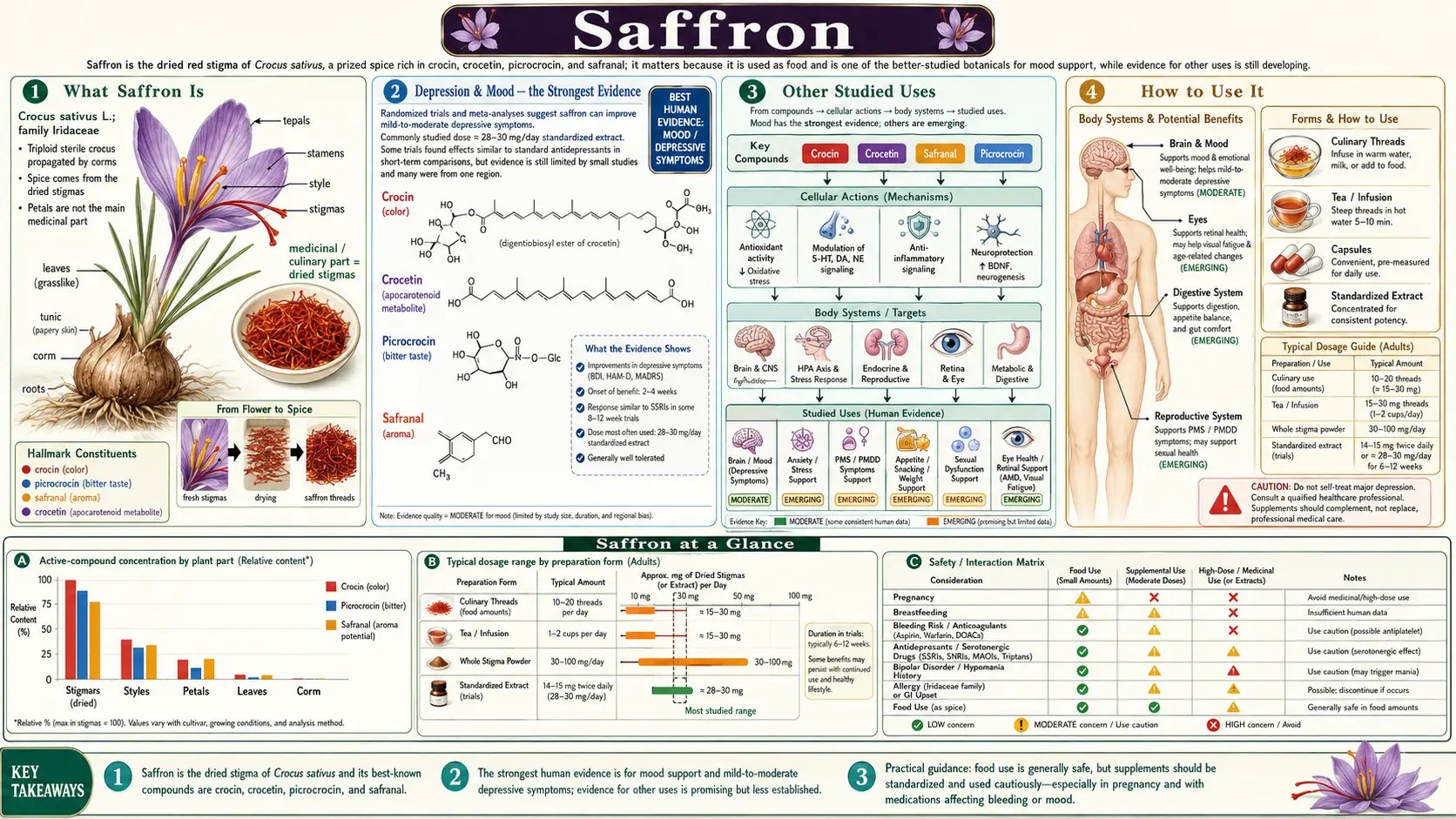
Saffron — the crimson threads harvested from a purple crocus flower — is best known as the world's priciest spice, but it has drawn real scientific attention for one thing in particular: lifting low mood. Among all the herbal options marketed for depression, saffron stands out for having an unusually strong (though still limited) body of human trial evidence behind it, with several randomized controlled trials and meta-analyses pointing in the same direction. This page walks through what saffron is, where the evidence is genuinely solid (mild-to-moderate depression) versus still early (anxiety, PMS, eye health), how it's used, and the safety points that matter — including why it is never a substitute for prescribed treatment of serious depression.
Table of Contents
- What Saffron Is
- Depression & Mood — the Strongest Evidence
- Other Studied Uses
- How to Use It
- Safety & Cautions
- The Bottom Line
- Research Papers
- Connections
- Featured Videos
What Saffron Is
Saffron is the dried red stigmas — the tiny thread-like parts that catch pollen — of the flower Crocus sativus. Each flower produces only three of these threads, and they must be plucked by hand. It takes roughly 150 flowers to yield a single gram of saffron, which is why it is, by weight, the most expensive spice in the world. A little goes a long way: a pinch is enough to color and flavor an entire pot of rice.
Beyond the kitchen, saffron has a long medicinal history. It appears in Persian, Greek, and other traditional medical systems going back thousands of years, where it was used for everything from low spirits to digestive and menstrual complaints. Modern researchers have since identified the plant compounds thought to be responsible for its color, aroma, and biological activity:
- Crocin — the carotenoid pigment that gives saffron (and the food it's cooked in) its deep golden-red color. It's an antioxidant and is studied for effects on mood and the brain.
- Safranal — the compound mainly responsible for saffron's distinctive aroma, also studied for calming and antioxidant effects.
- Crocetin — a smaller carotenoid related to crocin, of interest for the eyes and circulation.
- Picrocrocin — the compound behind saffron's slightly bitter taste.
Most of the clinical research uses a standardized extract — a preparation made to contain a consistent amount of these active compounds — rather than loose threads from a jar, which is worth keeping in mind when comparing the studies to what's on a store shelf.
Depression & Mood — the Strongest Evidence
If saffron has a flagship use, this is it. Several randomized controlled trials (the gold-standard study design, where people are assigned by chance to saffron, placebo, or a comparison drug) have tested standardized saffron extract in adults with mild-to-moderate depression, and the results have been consistently encouraging.
In two early trials from Iran, saffron 30 mg per day worked better than a placebo and performed about as well as standard antidepressants — fluoxetine (Prozac) in one trial and imipramine in another — over roughly six weeks. Later meta-analyses, which pool many trials together, reached a similar conclusion: saffron clearly beat placebo for depressive symptoms, and head-to-head it looked broadly comparable to low-dose antidepressants in the trials available.
That sounds impressive, and it is genuinely better evidence than most herbs can claim. But honesty about the limits matters just as much as the headline:
- The trials are mostly small — often a few dozen people each — so the findings, while consistent, rest on modest numbers.
- Most were conducted in a single country (Iran, often by overlapping research groups). Reviewers have specifically flagged this lack of geographic diversity, along with signs of publication bias, as reasons to stay cautious.
- They were short — typically six to eight weeks — so we know little about saffron's effects over many months.
- They studied mild-to-moderate depression, not severe depression, and used standardized extracts rather than culinary saffron.
The bottom line for mood: saffron is a reasonable option or add-on to consider for milder low mood, not a replacement for prescribed antidepressants and not appropriate as a stand-in for proper care of serious depression. If you are already taking an antidepressant, or if depression is significantly affecting your life, the right move is to talk with your clinician rather than swapping medication for a spice on your own.
Other Studied Uses
Saffron has been explored for several other conditions. The evidence here is thinner than for depression — promising in places, but not yet proven. Treat the following as "worth watching," not "established."
Anxiety
Some of the same trials and meta-analyses that looked at mood also measured anxiety symptoms, and saffron generally came out ahead of placebo. This often travels alongside its mood effect, which makes biological sense, but the dedicated anxiety evidence is still early and smaller than the depression data.
Premenstrual syndrome (PMS)
A randomized, placebo-controlled trial found that saffron 30 mg per day reduced the emotional and physical symptoms of PMS over two menstrual cycles. It's a single, fairly small study, so it's encouraging rather than definitive — but it points in a hopeful direction for cyclical mood and PMS-related symptoms.
Age-related macular degeneration (AMD)
AMD is a common cause of central vision loss with age. A handful of small studies — using around 20 mg of saffron per day — reported measurable short-term improvements in retinal function (how well the light-sensing cells respond) in people with early AMD. This is intriguing and biologically plausible given saffron's antioxidant carotenoids, but the studies are small and short, and saffron is not a proven treatment for AMD. Anyone with AMD should manage it with an eye specialist.
Where the evidence is weak
Saffron is sometimes marketed for weight loss or appetite/snacking control. The evidence for these claims is weak and insufficient, and they should be viewed skeptically. Other uses (memory, sexual function, blood sugar) have early laboratory or small-trial signals but are not established.
How to Use It
In the kitchen: a pinch of saffron threads — steeped briefly in a little warm water, milk, or broth to release the color and flavor — is enough to season a dish for several people. Culinary amounts are about flavor and enjoyment, not a clinical dose, but they're a safe, pleasant way to include it.
As a supplement: the mood, PMS, and anxiety trials most often used about 30 mg per day of a standardized saffron extract (frequently split as 15 mg twice daily); the eye studies used around 20 mg per day. "Standardized" means the product is made to deliver a consistent amount of the active compounds (such as crocin and safranal) in every dose — which is what the studies tested.
Quality and adulteration are a genuine problem. Because saffron is so valuable, it is one of the most adulterated spices in the world — commonly bulked out or faked with dyed corn silk, safflower, marigold petals, or other plant material, and sometimes cut with coloring agents. For both cooking and supplements, this means:
- Buy from a reputable seller, and be wary of saffron priced far below the norm — real saffron is expensive for a reason.
- For supplements, choose a standardized extract from a brand that publishes its sourcing and, ideally, uses third-party testing — so you're getting what the research actually studied.
- Whole threads are harder to fake convincingly than pre-ground powder, which is more easily diluted.
Safety & Cautions
At the amounts used in cooking and at the doses studied in trials (around 30 mg per day), saffron has a good safety record, with side effects in studies generally mild and similar to placebo. That said, "natural" does not mean "harmless at any dose," and a few points deserve real attention:
- Very high doses are toxic. Saffron is safe in normal use, but consuming it in the range of several grams at once (far, far beyond any culinary or supplement amount) can cause serious poisoning. Stick to studied supplement doses and don't assume more is better.
- Pregnancy — avoid medicinal and high doses. Saffron has traditionally been regarded as a uterine stimulant and, at high doses, a possible abortifacient. A pinch in food is a different matter from concentrated supplements, but to be safe, pregnant women should avoid medicinal/high-dose saffron and discuss any supplement use with their clinician.
- Possible interactions with antidepressants. Because saffron appears to affect mood-related brain chemistry, combining it with prescription antidepressants (such as SSRIs) should only be done with a clinician's guidance — both to avoid additive effects and so your treatment is properly monitored.
- Possible interaction with blood thinners. Saffron may have mild blood-thinning/antiplatelet effects, so use caution if you take anticoagulant or antiplatelet medication, or before surgery.
- Allergy. Allergic reactions are uncommon but possible, particularly in people sensitive to related plants.
If you take any prescription medication — especially for mood, or a blood thinner — or are pregnant or breastfeeding, talk with a doctor or pharmacist before using saffron supplements.
The Bottom Line
Among the many herbs promoted for low mood, saffron is one of the few with genuinely respectable human trial evidence behind it. Multiple randomized trials and meta-analyses agree that standardized saffron extract, around 30 mg a day, helps relieve mild-to-moderate depression — in some trials about as well as low-dose prescription antidepressants — and it may also help anxiety and PMS symptoms.
The honest caveats are real: most trials are small, short, and from a single region, so the evidence is encouraging rather than conclusive. Saffron is best thought of as a reasonable add-on or option to consider with a clinician's input for milder low mood — not a cure-all, and never a substitute for proper treatment of serious depression. If you do try it, choose a reputable, standardized product, since saffron is among the most counterfeited spices on the market, and keep your healthcare provider in the loop if you take other medications.
Research Papers
The studies below are the most relevant real, peer-reviewed sources behind this page; each links to the original publication. Saffron's depression evidence is the strongest, but note the recurring caveats the authors themselves raise — small trials, limited geographic diversity, and signs of publication bias.
- Hausenblas HA, Saha D, Dubyak PJ, Anton SD. Saffron (Crocus sativus L.) and major depressive disorder: a meta-analysis of randomized clinical trials. J Integr Med. 2013;11(6):377-383. doi:10.3736/jintegrmed2013056 — Pooled trials show saffron clearly beats placebo for depression and performs similarly to standard antidepressants; authors call for larger, international, longer studies.
- Marx W, Lane M, Rocks T, et al. Effect of saffron supplementation on symptoms of depression and anxiety: a systematic review and meta-analysis. Nutr Rev. 2019;77(8):557-571. doi:10.1093/nutrit/nuz023 — Across 23 studies saffron had positive effects on both depression and anxiety symptoms — but the authors flag publication bias and lack of regional diversity, urging caution.
- Noorbala AA, Akhondzadeh S, Tahmacebi-Pour N, Jamshidi AH. Hydro-alcoholic extract of Crocus sativus L. versus fluoxetine in the treatment of mild to moderate depression: a double-blind, randomized pilot trial. J Ethnopharmacol. 2005;97(2):281-284. doi:10.1016/j.jep.2004.11.004 — Over six weeks, saffron 30 mg/day worked about as well as the antidepressant fluoxetine for mild-to-moderate depression — a small pilot trial.
- Akhondzadeh S, Tahmacebi-Pour N, Noorbala AA, et al. Crocus sativus L. in the treatment of mild to moderate depression: a double-blind, randomized and placebo-controlled trial. Phytother Res. 2005;19(2):148-151. doi:10.1002/ptr.1647 — Saffron 30 mg/day significantly outperformed placebo on a standard depression rating scale, with side effects no different from placebo.
- Agha-Hosseini M, Kashani L, Aleyaseen A, et al. Crocus sativus L. (saffron) in the treatment of premenstrual syndrome: a double-blind, randomised and placebo-controlled trial. BJOG. 2008;115(4):515-519. doi:10.1111/j.1471-0528.2007.01652.x — Saffron 30 mg/day eased PMS symptoms more than placebo over two menstrual cycles — a single, small but well-designed trial.
- Falsini B, Piccardi M, Minnella A, et al. Influence of saffron supplementation on retinal flicker sensitivity in early age-related macular degeneration. Invest Ophthalmol Vis Sci. 2010;51(12):6118-6124. doi:10.1167/iovs.09-4995 — Short-term saffron (~20 mg/day) measurably improved retinal function in early AMD — a small, preliminary study, not proof saffron treats AMD.