Bhringraj / False Daisy (Eclipta prostrata)
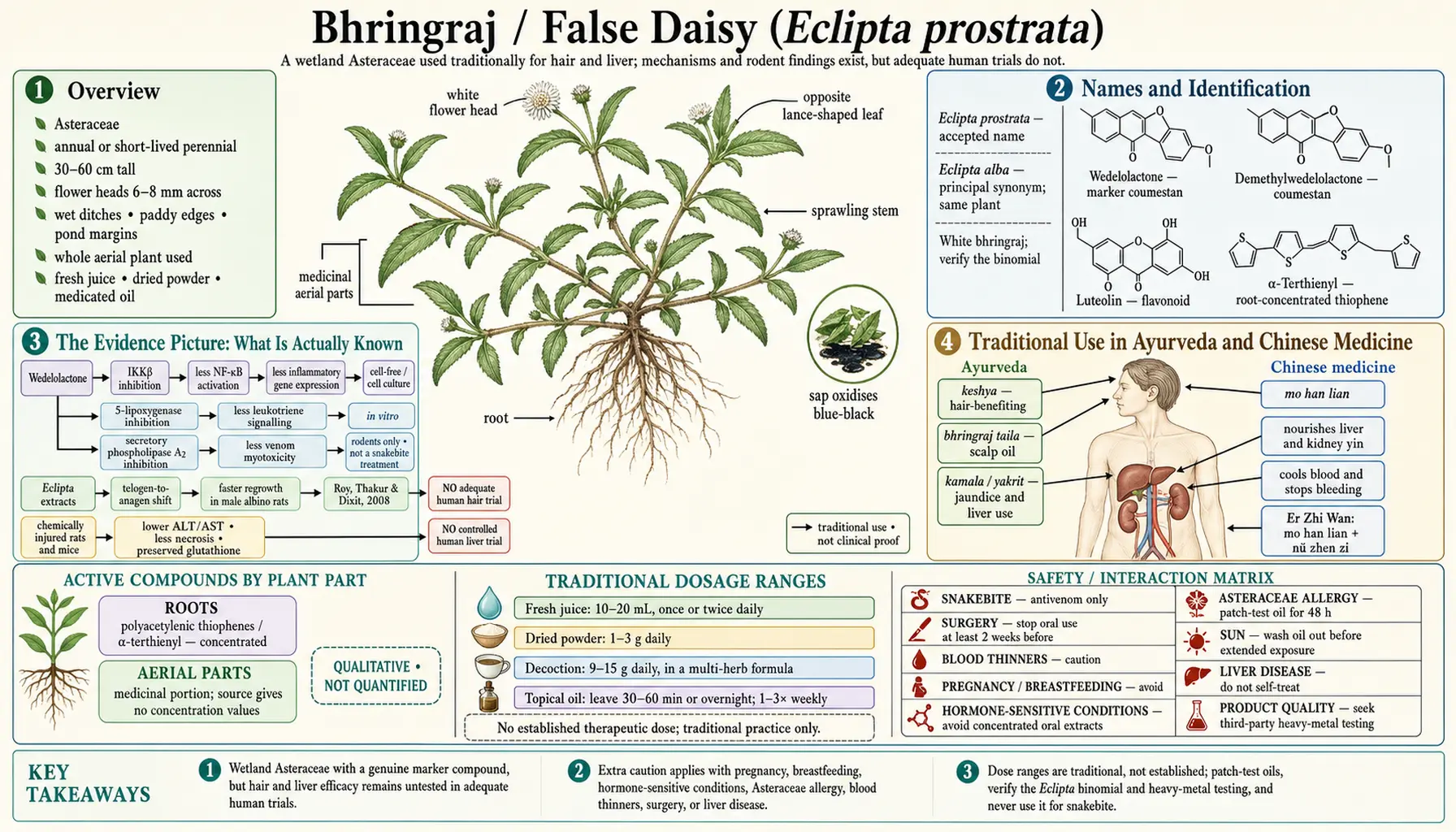
Bhringraj is a small, unremarkable weed of wet ditches and rice-paddy edges that has become one of the best-selling hair products in South Asia. The honest headline is that there is no adequate human trial showing that it grows hair. The hair-growth marketing rests almost entirely on a handful of rodent studies from the 2000s, and although those studies are real and their results are interesting, a rat's dorsal fur is not a human scalp with androgenetic alopecia.
That does not make the plant worthless or fraudulent. It is a genuine part of two independent medical traditions — Ayurveda uses it for hair and liver, Chinese medicine uses the same species under a completely different logic — it has a well-characterised marker compound (wedelolactone) with real, documented biochemistry, and it appears to be low-risk at the doses people actually use. It simply has not been tested in people. This page describes the plant accurately, names what its chemistry actually does, and marks clearly where the evidence stops.
Table of Contents
- Overview
- Names and Identification
- The Evidence Picture: What Is Actually Known
- Traditional Use in Ayurveda and Chinese Medicine
- Active Compounds
- Hair and Scalp: The Central Claim
- Liver Protection
- Bleeding, Blood, and the Yin-Tonic Role
- Wedelolactone and Snake Venom
- Culinary Use
- Forms and Preparations
- Dosage
- Cautions and Contraindications
- Key Research Papers
- Connections
- Featured Videos
Overview
Eclipta prostrata is a low, sprawling annual or short-lived perennial in the daisy family (Asteraceae). It rarely stands more than 30–60 cm tall, has opposite lance-shaped leaves covered in stiff white hairs, and produces small white flower heads about 6–8 mm across — a tiny daisy, which is where the English name false daisy comes from. It looks like nothing. Most people walk past it.
It grows wherever the ground stays wet: paddy-field bunds, irrigation ditches, riverbanks, roadside puddles, and the muddy margins of ponds. It is now pantropical, found across India, Sri Lanka, Bangladesh, Nepal, Myanmar, Thailand, Vietnam, southern China, Indonesia, the Philippines, tropical Africa, Brazil, and the warmer parts of the United States. In most of those places it is classified as a weed.
The part used is the whole aerial plant — stems, leaves and flower heads — harvested when flowering and either used fresh (juiced) or dried. In Chinese practice the dried aerial part is the official drug. In Ayurveda both the fresh juice (svarasa) and the dried powder are used, and the fresh plant is also infused into sesame or coconut oil to make the classical hair oil.
The single most distinctive thing about the plant is what happens when you crush it: the sap oxidises to a deep blue-black within minutes and stains skin, cloth and paper. This is not a metaphor. Children in Vietnam and India use it as ink and as a temporary tattoo dye, and it has been used to blacken hair and to dye leather. Every one of the plant's regional names refers to this in some way, and it is also the origin of the belief that the plant darkens greying hair.
Names and Identification
Binomial: Eclipta prostrata (L.) L.
Family: Asteraceae (Compositae), tribe Heliantheae.
Principal synonym: Eclipta alba (L.) Hassk.
The synonym matters. Eclipta alba is the name used in the overwhelming majority of the Indian pharmacology literature, in Ayurvedic pharmacopoeias, and on almost every product label. Eclipta prostrata is the currently accepted botanical name. They are the same plant. If you are searching the scientific literature and only search one of the two names, you will miss roughly half of it. A third name, Eclipta erecta, appears in older texts and also refers to this species.
Regional names
- Sanskrit: bhringaraja (भृङ्गराज), also kesharaja, markava, angaraka
- Hindi: bhringraj, bhangra, babri
- Tamil: karisalankanni (கரிசலாங்கண்ணி) — the name under which it is best known in the Tamil Siddha tradition
- Bengali: keshuti, kesharaj
- Telugu: guntagalagara; Malayalam: kayyonni; Kannada: garagadasoppu
- Chinese: 墨旱蓮 mo han lian — literally "ink drought-lotus." The drug name in Chinese pharmacopoeial usage is Ecliptae Herba.
- Vietnamese: cỏ mực ("ink grass") or nhọ nồi ("soot from the cooking pot") — both names describe the black stain
- English: false daisy, yerba de tago, trailing eclipta
The white / yellow bhringraj confusion — read this before buying
Classical Ayurvedic texts distinguish three "bhringaraja" plants by flower colour, and they are three different species:
- Shweta (white) bhringaraj = Eclipta prostrata / alba. White flowers. This is the plant this page is about, and the one meant when "bhringraj" is used without qualification.
- Peeta (yellow) bhringaraj = Wedelia calendulacea, now placed as Sphagneticola calendulacea. Yellow flowers, also Asteraceae, also a creeping wetland plant. Sold in India as "peeli bhangra."
- Neela (blue) bhringaraj is inconsistently identified in the literature and is the least reliable of the three.
Product labelled "bhringraj" may legitimately contain either of the first two, and they are not chemically identical — although, confusingly, the marker compound wedelolactone is named after Wedelia and occurs in both genera. If you want Eclipta specifically, look for the binomial on the label rather than the trade name.
A second point of confusion: the genus Eclipta is unrelated to Ecliptic-named ornamentals, and "false daisy" is a name shared with several unrelated small white composites. The binomial is the only reliable identifier.
The Evidence Picture: What Is Actually Known
It is worth being blunt about this near the top of the page, because almost everything written about bhringraj online reverses the order and buries it.
- Hair growth in humans: no adequate trial exists. Not a negative trial — an absent one. There is no published randomised, controlled, adequately powered study of Eclipta prostrata alone for androgenetic alopecia, telogen effluvium, or any other form of hair loss.
- Hair growth in rodents: yes, there are real studies, and they are the source of the entire marketing narrative. Petroleum-ether and ethanol extracts applied to shaved rat and mouse skin have shortened the time to hair regrowth and increased the proportion of follicles in the growth (anagen) phase compared with vehicle. That is a genuine finding in a genuine model. It is also a model in which many things work that do nothing in people.
- Liver protection: rodent only. Consistent, repeated protection against chemically induced liver injury in rats and mice. No controlled human trial.
- Wedelolactone biochemistry: well documented in cell-free and cell-culture systems. This is the strongest part of the evidence base, and it is entirely mechanistic.
- Snake-venom neutralisation: animal models only — see the section below, and please read it before drawing any conclusion from it.
So the honest summary is: an interesting molecule, a plausible mechanism, a large traditional following, and an empty human column.
Traditional Use in Ayurveda and Chinese Medicine
What makes Eclipta unusual is that two large, independent medical traditions adopted the same weed and built entirely different theories around it. Neither tradition borrowed from the other.
Ayurveda: a hair and liver herb
In Ayurveda bhringaraja is classed as keshya — a hair-benefiting drug — and as a rasayana, a rejuvenative. The most familiar preparation is bhringraj taila, a medicated oil made by simmering the fresh plant juice (or a decoction and paste of the herb) with sesame or coconut oil until the water has driven off and the oil has taken up the plant's fat-soluble constituents. This oil is massaged into the scalp, typically left on for an hour or overnight, and washed out. It has been made this way for centuries and it is made this way in factories today.
Bhringaraja is also a jaundice and liver herb in Ayurveda — used for kamala (jaundice) and yakrit (liver) disorders, often as fresh juice with honey or as a component of compound liver formulas. It appears in the classical Ayurvedic compendia and remains in the Ayurvedic Pharmacopoeia of India.
Chinese medicine: a yin tonic and a haemostatic
Under the name mo han lian (墨旱蓮), the same aerial parts are used in Chinese medicine for an unrelated set of indications. It is classified as a herb that nourishes liver and kidney yin and that cools the blood and stops bleeding. In practice that means it is reached for in patterns involving dizziness, tinnitus, blurred vision, lower-back weakness, premature greying, night sweats, and bleeding of "hot" type — blood in the urine or stool, nosebleeds, excessive uterine bleeding.
Its most famous appearance is in Er Zhi Wan (二至丸, "Two Solstices Pill"), a classical two-herb formula pairing mo han lian with nü zhen zi (the fruit of Ligustrum lucidum). The name refers to the two solstices, the traditional harvest times of the two herbs. Er Zhi Wan is still widely prescribed and still commercially manufactured.
Note that the two traditions converge on a couple of points — both associate the plant with hair and with the liver — but the reasoning is entirely different, and the convergence is a curiosity rather than corroboration. Traditional use tells you what people did. It does not tell you whether it worked.
Active Compounds
Coumestans: wedelolactone and demethylwedelolactone
Wedelolactone is the marker compound of Eclipta and by far the best-studied molecule in it. Chemically it is a coumestan — a fused coumarin-benzofuran ring system that sits within the broader isoflavonoid family. Its close relative demethylwedelolactone occurs alongside it, along with their glucosides.
What wedelolactone actually does, in cell-free and cell-culture systems:
- Inhibits IKKβ, the kinase that switches on NF-κB. NF-κB is the master transcriptional switch for inflammatory gene expression, so an IKKβ inhibitor is an anti-inflammatory in the most literal molecular sense. This is a well-replicated in vitro finding.
- Inhibits 5-lipoxygenase, the enzyme that makes leukotrienes — a second, independent anti-inflammatory mechanism.
- Inhibits secretory phospholipase A2, which is the basis of the snake-venom work discussed below.
- Is a coumestan, and coumestans are phytoestrogens as a class. Coumestrol, the archetype, binds oestrogen receptors with meaningful affinity. Wedelolactone's oestrogenic activity is weaker and less characterised, but the structural class is a real reason for caution in hormone-sensitive conditions, and almost nobody mentions it.
Triterpene saponins
Ecliptasaponins and eclalbasaponins (a series designated A through to higher letters) are oleanane-type triterpene glycosides. They are the surfactant fraction — the reason a decoction of the plant foams. Saponins in general are poorly absorbed from the gut, which matters when interpreting oral-dosing studies.
Flavonoids and sterols
Luteolin and luteolin-7-O-glucoside are the principal flavonoids, with apigenin also present. Luteolin is a widely distributed dietary flavone with its own substantial antioxidant and anti-inflammatory literature. The sterol fraction includes stigmasterol and β-sitosterol.
Thiophenes
Like many Asteraceae, Eclipta contains polyacetylenic thiophenes such as α-terthienyl and its derivatives, concentrated in the roots. These are worth knowing about for a specific reason: α-terthienyl is a documented photosensitiser — it generates reactive oxygen species when exposed to near-ultraviolet light. This is a real, well-characterised property of the molecule, and it is a plausible (though unproven) reason to avoid strong sun exposure immediately after applying concentrated plant preparations to skin.
An alkaloid called "ecliptine" is named in older literature but has never been properly characterised, and you should treat mentions of it with scepticism.
Hair and Scalp: The Central Claim
This is why almost everyone arrives at this page, so it deserves a careful answer.
What the rodent studies showed
The pivotal work is a 2008 study by Roy, Thakur and Dixit in Archives of Dermatological Research, which applied Eclipta alba extracts to the shaved backs of male albino rats and measured the time to complete hair regrowth against minoxidil as a positive control. Petroleum-ether and ethanol extracts shortened regrowth time, and follicle counts in the anagen (growth) phase were higher than in vehicle-treated animals. Later rodent and cell-culture work has reported effects on dermal papilla cell proliferation and on growth-factor signalling in follicles.
These are real results. The mechanism proposed — a shift of follicles from the resting telogen phase into anagen — is the same mechanism by which minoxidil works, so it is at least biologically coherent.
Why that is not enough
Rodent hair-growth models are notoriously permissive. Rat dorsal skin cycles its follicles in synchronised waves, so any irritant, any massage, and many inert oils can shift the timing measurably. Human scalp follicles cycle asynchronously and independently, and the dominant driver of common hair loss — androgenetic alopecia — is dihydrotestosterone-mediated follicular miniaturisation, which the standard rat regrowth model does not reproduce at all.
The history of hair-loss research is full of compounds that regrew rat fur and did nothing on human heads. That is precisely why regulators require human trials.
What human data exists
A few small studies have tested multi-herb Ayurvedic hair oils that happen to contain bhringraj among six or ten other ingredients. Those cannot tell you anything about bhringraj specifically — and they generally have no control arm, no blinding, and no standardised outcome measure. There is no adequate human trial of Eclipta prostrata as a single agent for hair growth. If a product page tells you otherwise, ask it for the citation.
What bhringraj oil probably does do
Two things worth saying, because they are honest and they are useful:
- Scalp oil massage is not nothing. Coconut and sesame oils reduce hair-shaft protein loss and reduce mechanical breakage — that is measurable and reasonably well established for coconut oil in particular. Hair that breaks less looks thicker. This is an effect of the carrier oil and the massage, not of the Eclipta.
- The plant genuinely darkens things. The oxidised sap is a real black pigment and it does stain hair. Whether it "reverses greying" biologically — no. It deposits colour, the way henna does, and it washes out.
Liver Protection
Both traditions use the plant for liver complaints, and this is the second-largest preclinical literature.
The mechanism is plausible and reasonably specific. Wedelolactone inhibits IKKβ/NF-κB, and NF-κB activation in Kupffer cells (the liver's resident macrophages) is central to the inflammatory amplification loop that turns a chemical insult into hepatocyte death. Blocking that loop upstream is a rational hepatoprotective strategy, and it is the same general strategy several pharmaceutical programmes have pursued.
The evidence is rodent. Extracts of Eclipta given to rats and mice before or alongside carbon tetrachloride, paracetamol (acetaminophen), or ethanol reduce the rise in serum ALT and AST, reduce histological necrosis, and preserve glutathione. These findings are consistent across multiple independent groups, which counts for something — consistency across labs is a genuine quality signal in preclinical work.
The human column is empty. We could not locate a randomised controlled trial of Eclipta prostrata for any liver condition — not for hepatitis, not for fatty liver disease, not for drug-induced liver injury. Anyone with liver disease should be managed with monitoring and evidence-based treatment; a herb with rodent-only data is not a substitute, and the specific risk of substituting is that liver disease is often silent until it is advanced.
Bleeding, Blood, and the Yin-Tonic Role
The Chinese use of mo han lian to "cool blood and stop bleeding" is the part of the traditional profile with the least Western investigation and, ironically, one of the more interesting chemical rationales.
Coumestans are structurally related to coumarins, and the coumarin skeleton is the parent structure of warfarin — an anticoagulant. But the relationship is not what most people assume. Simple coumarin itself is not an anticoagulant; anticoagulant activity requires the 4-hydroxycoumarin dimer structure found in dicoumarol and warfarin. Wedelolactone is not that. So the traditional haemostatic (bleeding-stopping) use is not contradicted by the chemistry, but neither is it explained by it.
Some laboratory work has reported effects of Eclipta extracts on platelet aggregation and on coagulation parameters, with results pointing in both directions depending on the extract and the assay. This is a genuinely unresolved question, and it is the main reason for the anticoagulant caution in the Cautions section below. When a herb has a traditional bleeding indication and an in vitro literature that disagrees with itself, the right response is caution around surgery and blood thinners, not confidence in either direction.
Wedelolactone and Snake Venom
This is the most striking thing in the Eclipta literature and also the thing most likely to be misread, so it gets its own section.
Eclipta prostrata is used as a folk snakebite remedy not only in India but independently in Brazil, and Brazilian pharmacologists investigated why. They found that wedelolactone neutralises the myotoxic phospholipase A2 enzymes in pit-viper venom — the components that dissolve muscle tissue around a bite. In rodent experiments, wedelolactone (and to a lesser extent the plant's sterols) reduced venom-induced muscle damage and haemorrhage, and extended survival. Work along these lines has been published by Brazilian groups including Mors, Melo and colleagues over several decades.
That is a legitimate and interesting piece of natural-product pharmacology. It is a clue about a molecule.
It is not, under any circumstances, a basis for human use. To be completely explicit:
- The experiments were done in mice and rats, usually with the compound and the venom mixed before injection or given immediately after — conditions that do not resemble a real snakebite.
- Venom phospholipase A2 is only one of many toxic components. Neurotoxins, which kill by paralysing the diaphragm, are unaffected.
- Antivenom is the only treatment for snakebite envenoming. It is time-critical. Any delay spent applying a plant remedy is time during which tissue is being destroyed and, with neurotoxic species, during which the patient is approaching respiratory failure.
Snakebite kills roughly a hundred thousand people a year, most of them agricultural workers in South and Southeast Asia — exactly where this plant grows and exactly where it is used this way. A page that reported the wedelolactone finding without this paragraph would be doing real harm.
Culinary Use
Eclipta prostrata is a marginal food rather than a real vegetable. In parts of India, Southeast Asia and China the young shoots are occasionally cooked as a potherb, and in Vietnam the fresh plant is juiced as a household remedy rather than eaten as food. It is bitter and slightly astringent, and no cuisine treats it as a staple green.
The practical relevance of this is not culinary but toxicological: the fact that people have eaten the plant for a very long time without notable acute problems is weak but genuine reassurance about acute toxicity. It says nothing about the safety of concentrated extracts taken daily for months, which is a different exposure entirely.
Forms and Preparations
- Bhringraj oil (bhringraj taila). The dominant commercial form. The plant is processed into sesame or coconut oil. Quality varies enormously: some products are a genuine medicated oil, others are a base oil with a token amount of extract and added fragrance and colour. A real bhringraj oil is dark green-brown and smells strongly herbal, not perfumed.
- Fresh juice (svarasa). The classical Ayurvedic internal form — the fresh plant is pounded and the juice strained, typically 10–20 mL taken with honey. Only practical where the plant grows.
- Dried herb powder (churna). The whole dried aerial part milled. Used internally and made into scalp pastes with water or buttermilk.
- Decoction. The standard Chinese form for mo han lian — the dried herb simmered in water, usually within a multi-herb formula rather than alone.
- Er Zhi Wan. The classical mo han lian + nü zhen zi pill, widely available as a finished patent formula.
- Standardised extracts. Capsules standardised to wedelolactone content exist but are uncommon; most capsule products are simple dried-herb powder with no marker assay at all.
What to look for on a label
- The binomial — Eclipta prostrata or Eclipta alba — not just "bhringraj," which could legitimately be Wedelia.
- The plant part (aerial parts / whole herb) and whether it is powder or extract, with an extract ratio if extract.
- For oils: the actual carrier oil named, and Eclipta appearing near the top of the ingredient list rather than after the fragrance.
- Third-party heavy-metal testing, for reasons covered in Cautions.
Dosage
There is no established therapeutic dose, because there are no dose-finding human trials. What follows is traditional practice, offered as description rather than recommendation.
- Fresh juice (Ayurveda): commonly 10–20 mL once or twice daily.
- Dried herb powder (Ayurveda): commonly 1–3 g daily, often divided.
- Dried herb in decoction (Chinese practice): commonly 9–15 g daily, essentially always within a multi-herb formula and rarely alone.
- Topical oil: enough to coat the scalp, massaged in, left 30–60 minutes or overnight, then washed out. Usually one to three times a week.
Note how wide the gap is between the Ayurvedic and Chinese oral doses — roughly fivefold. That gap exists because neither number comes from a pharmacokinetic study; they come from two different traditions of practice. Treat both as historical convention.
Cautions and Contraindications
Overall risk profile: topical use appears low-risk for most people. Oral use at traditional doses appears well tolerated in practice, but that judgement rests on usage history, not on safety trials. There is no formal toxicology programme behind this plant.
Do not use it for snakebite
Restating the flag from above because it is the one that can kill someone. Snakebite is a medical emergency and antivenom is the treatment. The wedelolactone research is laboratory work in rodents. Applying or drinking this plant instead of, or before, getting to a hospital wastes the window in which antivenom works.
Bleeding, surgery and anticoagulants
Because Eclipta has a traditional haemostatic indication and an inconsistent in vitro literature on platelets and coagulation, stop oral use at least two weeks before any planned surgery and be cautious if you take warfarin, a direct oral anticoagulant, clopidogrel, or daily aspirin. The interaction is theoretical rather than documented, but the direction of effect is genuinely unknown, which is the worst case for someone on a narrow-therapeutic-index drug.
Hormone-sensitive conditions
Coumestans are a phytoestrogen class. Wedelolactone's oestrogenic potency has not been well quantified, but until it is, people with oestrogen-receptor-positive breast cancer, endometrial cancer, endometriosis, or uterine fibroids should treat concentrated oral extracts as an unknown and avoid them.
Pregnancy and breastfeeding
Avoid. Safety in pregnancy has not been established, some traditional sources associate the plant with menstrual stimulation, and the phytoestrogen question is unresolved. There is no data on transfer into breast milk.
Allergy — it is an Asteraceae plant
The daisy family is a well-known source of contact allergens. People with known sensitivity to ragweed, chrysanthemum, feverfew, chamomile, marigold, arnica, or artichoke are more likely to react to Eclipta, and scalp oils are applied to skin repeatedly over long periods, which is exactly the exposure pattern that produces contact sensitisation. Patch-test a new oil on the inner forearm for 48 hours before putting it on your whole scalp.
Sun exposure after topical use
The plant contains thiophenes including α-terthienyl, which is a documented photosensitiser in the laboratory. Whether this is clinically relevant at the concentrations found in a diluted hair oil is unknown. Sensible precaution: wash the oil out before extended sun exposure rather than wearing it out into the middle of the day.
Staining
Not a medical risk, but real: the plant stains. Expect towels, pillowcases and light-coloured hair to pick up colour.
Heavy metals in imported Ayurvedic products
This is a documented, repeatedly confirmed problem and it is not specific to bhringraj. Surveys of Ayurvedic herbal products sold in the United States and India — most prominently the JAMA studies led by Saper and colleagues in 2004 and 2008 — found that a meaningful fraction contained detectable lead, mercury or arsenic, some at levels that would produce toxicity with regular use. The risk concentrates in rasa shastra preparations, which deliberately contain processed metals, but contamination has been found in plain herbal products too. Buy from manufacturers that publish third-party heavy-metal testing.
Liver disease
Paradoxically, people with existing liver disease should be the most cautious rather than the least. The liver clears most herbal constituents, the plant's hepatoprotective data is rodent-only, and self-treating a serious liver condition with an untested herb delays effective care.
Key Research Papers
A note on the links below. Every link goes to a PubMed search rather than to a numeric identifier. This is deliberate: a mistyped PMID silently sends you to a completely different paper, whereas a search always resolves and lets you confirm the record yourself. Author names, titles and journals are given as plain text so you can verify them independently.
- Roy RK, Thakur M, Dixit VK. Hair growth promoting activity of Eclipta alba in male albino rats. Archives of Dermatological Research. 2008 — find on PubMed. The rodent study that underpins essentially all bhringraj hair marketing.
- Wagner H, Geyer B, Kiso Y, Hikino H, Rao GS. Coumestans as the main active principles of the liver drugs Eclipta alba and Wedelia calendulacea. Planta Medica. 1986 — find on PubMed. The paper that identified wedelolactone as the marker constituent and linked the two "bhringraj" species chemically.
- Mors WB, Nascimento MC, Pereira BM, Pereira NA. Plant natural products active against snake bite — the molecular approach. Phytochemistry. 2000 — find on PubMed. Review of the Brazilian antivenom work, including wedelolactone.
- Melo PA, Ownby CL. Ability of wedelolactone, heparin and para-bromophenacyl bromide to antagonize the myotoxic effects of two crotaline venoms. Toxicon. Find on PubMed. The core rodent myotoxicity experiment.
- Kobori M, Yang Z, Gong D, et al. Wedelolactone suppresses LPS-induced caspase-11 expression by directly inhibiting the IKK complex. Cell Death and Differentiation. Find on PubMed. The mechanistic basis of the NF-κB inhibition claim.
- Saper RB, Kales SN, Paquin J, et al. Heavy metal content of ayurvedic herbal medicine products. JAMA. 2004 — find on PubMed.
- Saper RB, Phillips RS, Sehgal A, et al. Lead, mercury, and arsenic in US- and Indian-manufactured Ayurvedic medicines sold via the Internet. JAMA. 2008 — find on PubMed. Together these two are the reason for the heavy-metal caution above.
- Rehman S, Iqbal Z, Qureshi R, et al. Phytochemistry and pharmacological evaluation of Eclipta alba: a review. Find recent reviews on PubMed. Use a review to get an overview of the constituent list, but note that reviews in this area routinely present rodent findings without flagging the absence of human data.
Live PubMed Searches
- Eclipta prostrata OR Eclipta alba — search both names
- Eclipta hair growth alopecia
- Wedelolactone
- Wedelolactone NF-κB IKK
- Eclipta hepatoprotective
- Ecliptae herba / mo han lian
- Er Zhi Wan (Ligustrum + Eclipta)
- Eclalbasaponins and ecliptasaponins
- Plant phospholipase A2 inhibitors and snakebite
- Asteraceae contact dermatitis
Connections
- All Herbs
- Neem — the other great Ayurvedic skin-and-scalp plant, and one with a considerably larger evidence base
- Amla — the classic partner in Ayurvedic hair formulations; the two are combined far more often than either is used alone
- Ashwagandha — another Ayurvedic rasayana, and a useful contrast: it does have human trial data
- Milk Thistle — the liver herb with the largest human evidence base, for comparison with Eclipta's rodent-only picture
- Turmeric — another NF-κB-modulating Ayurvedic plant with the same bioavailability problem
- Alopecia — what actually causes hair loss, and what actually has evidence for treating it
- Contact Dermatitis — relevant to any repeatedly applied Asteraceae oil
- Non-Alcoholic Fatty Liver Disease — the condition most often self-treated with liver herbs
- Cirrhosis — why silent liver disease is a bad thing to self-treat
- Liver Function Tests — how liver injury is actually measured
- Toxins — background on heavy-metal exposure from supplements
- Conditions on this site that reference this page: Seborrheic Dermatitis · Hypothyroidism