Vietnamese Coriander (Persicaria odorata)
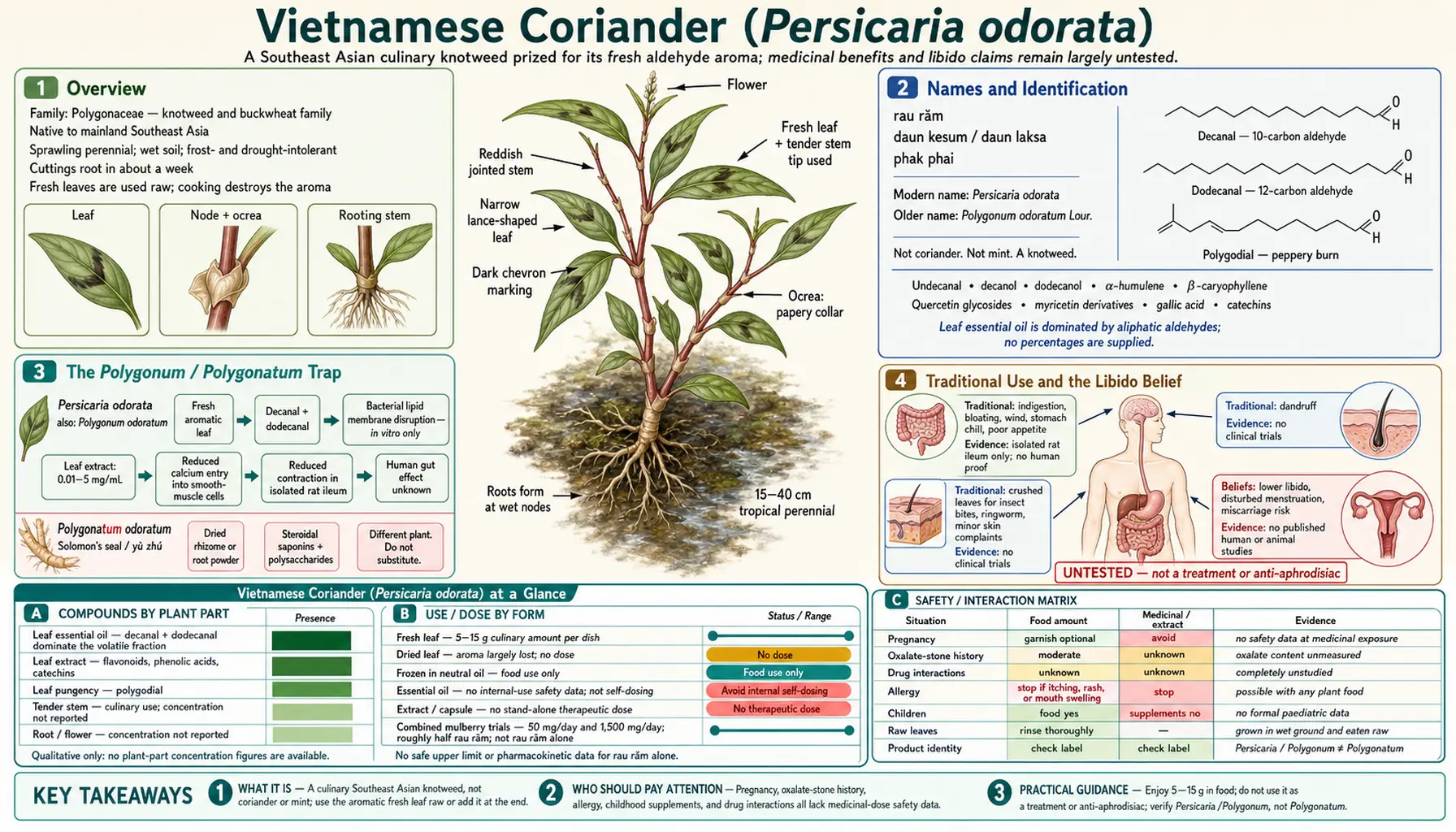
Rau răm is not a coriander. It is a knotweed — a relative of buckwheat, rhubarb and sorrel — and its resemblance to cilantro is a coincidence of chemistry, not of ancestry. It is also indispensable: the herb served with hột vịt lộn, the defining note in Vietnamese chicken salad, and the leaf that makes Malaysian asam laksa taste the way it does.
An honest warning about what follows. This plant has almost no clinical literature of its own. A thorough search of the medical databases turns up a systematic review of cell-line experiments, one study of rat intestinal tissue in an organ bath, a handful of antioxidant and essential-oil screens, several fish-farming and poultry-feed trials, and an ethnobotanical survey. Two small double-blind human trials also exist, but neither tested rau răm on its own — both dosed a combined extract shared with mulberry leaf, which is a narrower finding than it sounds like and is covered in full on the Benefits page. Nothing else on this page should be read as evidence that rau răm treats anything, and the widely repeated Vietnamese belief that it suppresses libido and endangers pregnancy has been neither supported nor refuted by research, because nobody has looked — see the dedicated page on that claim for what a genuinely thorough search does and does not turn up.
Table of Contents
- Overview
- Names and Identification
- The Polygonum / Polygonatum Trap
- Traditional Use and the Libido Belief
- Active Compounds: Why It Smells Like Coriander
- What the Research Actually Shows
- Antimicrobial and Antioxidant Screening
- Effects on the Gut
- Cell Studies and Cancer Claims
- Culinary Use
- Buying, Storing and Growing
- Forms and Preparations
- Dosage
- Cautions and Contraindications
- Key Research Papers
- Connections
- Featured Videos
Overview
Persicaria odorata (Lour.) Soják is a sprawling tropical perennial in the Polygonaceae, the knotweed and buckwheat family. It grows 15–40 cm tall in loose mats, with reddish jointed stems that root wherever a node touches wet soil, and narrow lance-shaped leaves that often carry a dark chevron or V-shaped blotch across the middle. The diagnostic family feature is easy to see once you know it: at each node the stem is sheathed in a papery collar called an ocrea. Sorrel, rhubarb and Japanese knotweed all have it. Coriander and mint do not.
It is native to mainland Southeast Asia and grows wild along canal banks, paddy edges and any patch of ground that stays permanently wet. It is intolerant of frost and of drying out, which is why it is a hot-country crop and a windowsill plant everywhere else.
How it gets to a kitchen is unusual and worth knowing: outside the tropics it essentially never flowers and never sets seed, so every plant in cultivation is a clone propagated from a stem cutting. A cut stem stood in a glass of water grows roots in about a week. That single fact explains why you can buy a bunch of rau răm at a Vietnamese grocery for very little money and, from that same bunch, keep yourself supplied indefinitely.
The part used is the fresh leaf and tender stem tip, almost always raw. Cooking destroys it.
Names and Identification
| Language / region | Name | Notes |
|---|---|---|
| Vietnamese | rau răm | rau = leafy vegetable |
| Malay / Singaporean | daun kesum, daun laksa | "laksa leaf" |
| Thai | ผักไผ่ phak phai | Northern and Isaan cooking |
| Indonesian | daun kesum | Sumatra, Kalimantan |
| Khmer | chi krasang tomhom | — |
| Lao | phak phaeo | — |
| English | Vietnamese coriander, Vietnamese mint, Cambodian mint, hot mint, laksa leaf, rau ram | All four of the first names are botanically wrong |
Every common English name for this plant is misleading. It is not a coriander (Coriandrum sativum, Apiaceae — the carrot and parsley family). It is not a mint (Lamiaceae — square stems, terpene chemistry). "Hot mint" doubles the error while at least capturing the peppery finish. It is a knotweed, Polygonaceae, and its nearest culinary relatives are buckwheat, sorrel and rhubarb.
Botanical synonyms you will meet. The plant was described by the Portuguese missionary-botanist João de Loureiro as Polygonum odoratum Lour., and older literature, seed catalogues and most supplement labelling still use that name. Modern taxonomy splits the huge old genus Polygonum and places it in Persicaria. When searching the literature you have to try both, plus the subspecies name Persicaria odorata subsp. conspicua, or you will miss half of what little exists.
The Polygonum / Polygonatum Trap
This deserves its own section because it is the most consequential confusion attached to this plant, it involves one extra letter, and it appears in supplement listings, herbal databases and occasionally in published papers.
Polygonum odoratum = rau răm, the Southeast Asian culinary knotweed described on this page.
Polygonatum odoratum = angular Solomon's seal, a woodland lily-relative in the Asparagaceae. Its rhizome is the well-known Chinese herb 玉竹 yù zhú, a moistening, yin-nourishing tonic used for dry cough, dry mouth and thirst. It is a completely different plant, from a different continent's worth of tradition, with entirely different chemistry — steroidal saponins and polysaccharides rather than aliphatic aldehydes.
How to tell which one a product means. Read the description, not the Latin. If the label talks about nourishing yin, moistening dryness, dry cough or diabetes, and the product is a dried root or a root powder, it is Solomon's seal — Polygonatum. If it talks about a fresh aromatic leaf, laksa, Vietnamese cooking or a peppery citrus aroma, it is rau răm — Polygonum/Persicaria. Almost every "Polygonum odoratum extract" capsule sold online is in fact Solomon's seal with a misspelt name. That is not a trivial mix-up: you would be buying a tonic root you did not intend to take.
Traditional Use and the Libido Belief
In Vietnamese thuốc nam — the southern folk-medicine tradition — rau răm is classified as warming and drying, and used in the household for indigestion, bloating, wind, stomach chill and poor appetite. Crushed leaves are applied to insect bites, ringworm and minor skin complaints. In Malaysia and Indonesia the same plant appears in traditional preparations for digestion and for dandruff. Thai northern and Isaan cooking treats phak phai as a food first, with a light medicinal reputation for digestion attached.
The libido belief. There is a persistent and specific Vietnamese belief that eating rau răm dampens sexual desire. It is attached to a well-known folk rhyme pairing the herb with hột vịt lộn, and it is commonly said that Buddhist monks ate it deliberately for that reason. A companion belief holds that eating it in quantity weakens the body, that it disturbs menstruation, and that pregnant women should avoid it because it can cause miscarriage — an emmenagogue and abortifacient reputation of exactly the kind attached to many warming, aromatic herbs across many traditions.
What the research says: nothing. Not "the studies were negative" — there are no studies. No published work has examined rau răm and libido, testosterone, sperm parameters, menstruation, uterine activity, or pregnancy outcome in humans or in animals. The belief is old, widespread and sincerely held, and it is entirely untested.
How to act on that. Two things are true at once, and neither cancels the other. Eating rau răm the way Vietnamese cooking has always used it — a small handful of leaves alongside a dish — is a food exposure with centuries of ordinary use behind it. Taking concentrated extracts, or eating large "medicinal" quantities deliberately, is something nobody can vouch for either way. So: if you are pregnant, use it as a garnish if you enjoy it, or leave it out if the traditional caution bothers you — both are reasonable — but do not take rau răm in medicinal quantities or as an extract while pregnant, because there is no safety data at all at that level of exposure. And do not take it as a treatment for anything, including as an intentional anti-aphrodisiac, because the belief is as unsupported in that direction as in any other.
Active Compounds: Why It Smells Like Coriander
The essential oil of the leaf is dominated by aliphatic aldehydes — straight-chain fatty aldehydes rather than the terpenes that carry most herbal aromas. The two largest components reported are typically decanal (a ten-carbon aldehyde) and dodecanal (twelve carbons, also called lauric aldehyde), often together making up the bulk of the volatile fraction. Also reported: undecanal, decanol, dodecanol, and a background of sesquiterpenes including α-humulene and β-caryophyllene.
This is the explanation for the name. The aroma of true coriander leaf is also dominated by C10–C14 aliphatic aldehydes — (E)-2-decenal, decanal, (E)-2-dodecenal. Two completely unrelated plants, in families that diverged tens of millions of years ago, arrived independently at the same class of smell molecule. Your nose cannot tell them apart because, at the receptor level, there is not much to tell apart. It is a clean case of convergent chemistry, and it is why "Vietnamese coriander" is a perfectly good culinary name even though it is a terrible botanical one.
The same aldehyde family is why fish mint smells of fish: it too runs on decanal and dodecanal, plus decanoyl acetaldehyde. Three unrelated Southeast Asian herbs on the same raw-vegetable plate, converging on the same chemistry.
Beyond the volatiles, leaf extracts have been reported to contain flavonoids — quercetin and its glycosides, myricetin derivatives — along with gallic acid and catechins, which is what generates the antioxidant readings described below. The peppery burn at the back of the throat, the reason for the name "hot mint," is not capsaicin and not piperine — a 2006 analytical chemistry study identified it as polygodial, a drimane sesquiterpene dialdehyde and the same pungent compound that gives the related water pepper (Persicaria hydropiper) its bite.
What the Research Actually Shows
It is worth laying out the whole file, because it is short enough to summarise in a paragraph and because seeing its size is more informative than any individual finding.
Searching the biomedical databases for Persicaria odorata and Polygonum odoratum Lour. returns, in total: one systematic review of anticancer activity assembled entirely from cell-line experiments; one study of leaf extract on isolated rat intestine in an organ bath; several phytochemical, antioxidant and essential-oil screening papers; two or three aquaculture studies feeding the powdered herb to farmed fish; three poultry-feed trials; an antiviral screen; an insecticide screen against house-fly larvae; ethnobotanical surveys documenting who eats it and why — and two double-blind, placebo-controlled human trials, neither of which tested rau răm alone. Both used a proprietary congee combining rau răm with mulberry (Morus alba) leaf: one measured bone-turnover markers in menopausal women, one measured memory. What that combined-extract data can and cannot tell you about rau răm specifically — and why it cannot be credited to rau răm alone — is covered in full on the dedicated Benefits page. Outside that one pairing, there is no pharmacokinetic data on rau răm taken by itself — nobody knows what happens to any of its compounds after you swallow them alone — and no formal toxicology.
That is not a criticism of the plant. Vast numbers of safe, useful foods have never been studied, because research money follows patentable molecules and disease burden, not culinary herbs from countries with small research budgets. But it does mean that any website telling you rau răm lowers blood sugar, fights cancer or boosts immunity is extrapolating from a petri dish or from a tilapia.
Antimicrobial and Antioxidant Screening
Mechanism. Long-chain aldehydes like decanal and dodecanal are membrane-active: they dissolve into bacterial lipid membranes and disrupt them. This is a general property of the chemical class rather than anything special about this plant, and it is the same reason many culinary herbs test as antibacterial in a dish. The flavonoids and phenolic acids in the leaf donate electrons to free radicals, which is what an "antioxidant capacity" assay measures.
Evidence: cell-free and in vitro. A 2026 study profiled the phytochemistry of an ethanolic Persicaria odorata leaf extract, measured antioxidant and antibacterial activity in the laboratory, and then fed the extract to farmed black sharkminnow, reporting improved growth and disease resistance. A separate 2025 trial fed Vietnamese coriander powder to Nile tilapia and reported effects on growth, blood counts and immune gene expression. An assessment of indigenous vegetables eaten in Bangladesh included the plant in antioxidant and antibacterial screening.
How to read it. Antioxidant assay numbers do not predict anything in a human body — the assay measures a chemical reaction in a tube, and most dietary polyphenols are poorly absorbed and rapidly metabolised. Fish immunology is genuinely useful to aquaculture and tells you very little about people. Antibacterial activity in a dish means the extract at that concentration killed bacteria at that concentration; it does not mean eating the herb fights an infection. This body of work establishes that rau răm contains reactive plant chemistry, which was never in doubt.
Effects on the Gut
This is the one piece of research that connects a laboratory finding to a traditional use, and it is worth describing precisely because it is the best the plant has.
Mechanism and study. A Thai group at the University of Phayao suspended strips of isolated rat ileum — a segment of small intestine, alive in an organ bath — and measured how they contracted. Vietnamese coriander leaf extract, across a range from 0.01 to 5 mg/mL, reduced contraction induced by potassium chloride. The researchers then probed the mechanism with propranolol (blocking beta-adrenergic receptors), L-NAME (blocking nitric oxide production) and calcium chloride, and found the extract still relaxed the tissue and blunted the calcium-driven contraction — pointing toward interference with calcium entry into the smooth-muscle cell rather than a receptor-mediated pathway.
What it means. Calcium entry is what makes gut smooth muscle squeeze; blocking it is roughly how antispasmodic drugs such as hyoscine work. So the finding is a plausible mechanism for the traditional use of rau răm for cramping, wind and indigestion. It is also rat tissue in a bath, at concentrations applied directly to the muscle. Nothing here tells you whether swallowing the herb produces enough of anything, in the right place, to relax a human gut. It is a reason to run a study, not a reason to take it for cramps.
Cell Studies and Cancer Claims
A 2022 systematic review in Frontiers in Pharmacology gathered the published work on Polygonum odoratum and cancer. This is the paper most often cited online as showing that rau răm "fights cancer," so it is worth stating exactly what it contains: it is a systematic review of studies on cancerous cells — extracts applied to cultured cell lines, with the polyphenol and flavonoid fractions identified as the likely active constituents. The review is a competent summary of preclinical screening. It includes no clinical trials, because none exist.
The gap between "kills cancer cells in a dish" and "treats cancer in a person" is the widest gap in all of pharmacology, and the great majority of compounds that clear the first hurdle fail at every subsequent one. Bleach kills cancer cells in a dish. If you have cancer, rau răm is a herb to enjoy in your food and nothing more; do not let anyone sell it to you as a treatment, and do not substitute it for oncological care.
Culinary Use
This is where rau răm genuinely matters, and it is not a garnish in any of the following dishes — it is a structural ingredient.
Vietnam — hột vịt lộn. The fertilised duck egg is served with a small dish of salt, pepper and lime, and a pile of raw rau răm. This pairing is fixed; you will not be served one without the other. The herb's job is functional as well as symbolic: the sharp aldehyde aroma and the peppery finish cut through an intensely rich, eggy, faintly gamey food, and in the traditional framing a "warming" herb balances a "cooling" one. Eating balut without rau răm is, to a Vietnamese diner, simply eating it wrong.
Vietnam — gỏi gà. Vietnamese chicken salad is shredded poached chicken and finely sliced cabbage and onion, dressed with fish sauce, lime, sugar and chilli, and tossed with a generous quantity of chopped rau răm. Here the herb is the defining flavour of the dish, not an accent — the salad has a name for the leaf in some regions precisely because it is so identified with it. The same treatment applies to squid, prawn and jellyfish salads.
Rau răm also appears with baby clams in Huế's cơm hến, in rice porridge, in bánh cuốn, with grilled and steamed seafood generally, and on the mixed herb plate served with noodle dishes alongside perilla and fish mint.
Malaysia and Singapore — laksa. Daun kesum is the herb that makes asam laksa taste like asam laksa. The Penang version is a sour, funky tamarind-and-mackerel broth, and the shredded kesum goes on top at the last moment together with torch ginger flower (bunga kantan), sliced pineapple, cucumber, red onion and mint. Take the kesum away and the dish loses its spine. It is used in curry laksa too, and its Malay name — daun laksa — records the association.
Thailand, Laos and Cambodia. Phak phai is one of the raw vegetables on the plate beside larb, nam phrik chilli dips and fermented-fish dishes, especially in the north and northeast, and it goes into some Lao soups. Cambodian cooking uses it in salads and in samlor.
The flavour, honestly. The aroma leads with a bright, citrusy, soapy coriander note. Then, a second or two later, a genuine peppery heat builds at the back of the throat — that is the "hot mint" name, and first-time eaters are often surprised by it. It is not chilli heat and it fades quickly. The whole effect is fragile: it is destroyed by more than a few seconds of cooking, which is why the herb is added raw or stirred in off the heat, always at the very end.
Substitutions. There is no real substitute. Cilantro plus a few grinds of black pepper gets the aroma into approximately the right place and misses the throat heat entirely. For laksa, if you cannot find kesum, accept that you are making a different soup rather than pretending otherwise.
Buying, Storing and Growing
Buying. Look in Vietnamese, Thai, Malaysian and Chinese groceries, usually in the refrigerated herb section in bunches held with a rubber band. Good rau răm has firm, unbruised stems and leaves with clear chevron markings; blackened stem ends and slimy lower leaves mean old stock. It should smell strongly when you rub a leaf. It is inexpensive.
Storing. Treat it like cut flowers. Trim the stem ends, stand them in a jar with an inch of water, drape a loose bag over the top and refrigerate. It keeps about a week that way, against two or three days in a sealed bag. Wash only what you are about to use — wet leaves rot fast.
Growing. This is the easiest herb on this site to propagate. Take a few stems from a supermarket bunch, strip the lower leaves, stand them in a glass of water on a bright windowsill, and roots appear within about a week. Pot them into ordinary compost, keep the soil constantly moist — it grows wild in ditches and will not tolerate drying out — and give it warmth and bright indirect light. It will not survive frost, so in temperate climates it is a houseplant or a summer patio pot brought in before the cold. It rarely flowers away from the tropics, so you will never collect seed; you simply take more cuttings.
Forms and Preparations
- Fresh leaf — effectively the only form worth having. Raw, added at the end.
- Dried leaf — largely pointless. The aroma is volatile aldehydes, and drying takes nearly all of it. Dried rau răm smells of hay.
- Frozen — better than dried. Chop and freeze in a little neutral oil in an ice-cube tray; the oil holds the aldehydes. The texture is gone but the aroma partly survives.
- Kesum essential oil — produced on a small scale in Malaysia, valued for its aldehyde content, mostly for flavour and fragrance manufacturing. Not a self-dosing product; no internal-use safety data exists.
- Capsules and extracts — essentially do not exist as genuine products. Anything sold as "Polygonum odoratum extract" is more likely Solomon's seal, Polygonatum odoratum (see the name-trap section above). Check before buying.
Dosage
No therapeutic dose of rau răm alone exists, and no honest source can give you one. The two human trials that exist (see What the Research Actually Shows, above) tested 50 mg/day and 1,500 mg/day of a proprietary extract that was roughly half rau răm and half mulberry leaf — not rau răm by itself — so even the one dose figure in the literature does not really answer "how much rau răm." There is no dose of the herb alone that has been tested against any outcome, no safe upper limit, and no pharmacokinetic data to reason from.
Culinary use is the only defensible guidance: a small handful of fresh leaves — on the order of 5–15 g — chopped into or served alongside a dish, which is what Vietnamese, Malaysian and Thai cooking has always done. Eat it because it makes food better. If a product or a practitioner offers you a milligram figure for rau răm, they have invented it.
Cautions and Contraindications
- Pregnancy. Vietnamese tradition holds firmly that rau răm in quantity is harmful in pregnancy and may cause miscarriage. There is no research supporting or refuting this. The sensible reading: culinary garnish amounts are what the cuisine has always used and are unlikely to be a problem, but there is no basis whatever for medicinal quantities or extracts during pregnancy, and if the traditional caution concerns you, leaving the herb out of a dish costs you nothing. Discuss it with your midwife or obstetrician if you eat it often.
- The libido belief is not a treatment. The claim is untested in both directions. Do not take rau răm expecting it to change sexual function, and do not avoid it in ordinary food amounts on that basis either.
- Oxalate is an open unknown. Several Polygonaceae relatives — sorrel and rhubarb leaves in particular — are high in oxalate, which matters to people who form calcium-oxalate kidney stones. The oxalate content of Persicaria odorata does not appear to have been measured and published. That is not evidence of a problem; it is an absence of information. If you have a history of oxalate stones and eat this herb in quantity, you have no number to work from, and moderation is the only sensible response.
- Drug interactions. Completely unstudied. No interaction has been reported, and none has been looked for.
- Allergy. Possible with any plant food, though not commonly reported for this one. Stop if you develop itching, rash or mouth swelling.
- Wash it properly. Rau răm is grown in permanently wet ground, often at canal and paddy margins, and it is eaten raw. Give it a thorough rinse in several changes of cold water — the same care you would give any raw leafy green.
- Buy the right plant. Do not confuse Polygonum odoratum (this herb) with Polygonatum odoratum (Solomon's seal, the Chinese tonic root yu zhu). One letter separates them and the mix-up is common in online supplement listings.
- Children. Eaten by children throughout Southeast Asia in ordinary food amounts. No formal paediatric data. Food, yes; supplements, no — and there is no supplement worth taking anyway.
Key Research Papers
The literature on this plant is genuinely small. Every entry below is preclinical except the last two, which are human trials of a combined extract shared with mulberry — not rau răm alone; see the note beside each.
- Khuayjarernpanishk T, Sookying S, Duangjai A, et al. Anticancer activities of Polygonum odoratum Lour.: a systematic review. Frontiers in Pharmacology. 2022;13:875016. A systematic review of cell-line experiments. No clinical studies were available to include.
- Duangjai A, Parseatsook K, Sajjapong W, et al. Assessment of Polygonum odoratum Lour. leaf extract on rat's ileum contraction and the mechanisms involved. Journal of Medicinal Food. 2020;23(11):1169–1175. Isolated rat intestine in an organ bath; extract reduced potassium-induced contraction, consistent with interference with calcium entry.
- Sookying S, Panprommin D, Pook-In G, et al. Phytochemical profiling, antioxidant and antibacterial activities of Persicaria odorata ethanolic leaf extract and evaluation of growth performance, disease resistance, and gene expression in Labeo chrysophekadion. Animals (Basel). 2026;16(5):848. In vitro chemistry plus a fish-feeding trial.
- Honghirun A, Thongdon-A R, Aeksiri N, et al. Effect of Vietnamese coriander powder on growth, body composition, hematology, and immune-related gene expression in Nile tilapia. Veterinary Medicine International. 2025;2025:1253764. Aquaculture study.
- Inta A, Panyadee P, Suksathan R, et al. Culinary and medicinal wonders of the wild: an ethnobotanical review of native herbs and spices in Thailand. Heliyon. 2025;11(4):e42470. Documents phak phai among Thai culinary-medicinal plants.
- Roy M, et al. Assessment of antioxidant and antibacterial efficacy of some indigenous vegetables consumed by the Manipuri community in Sylhet, Bangladesh. Heliyon. 2024;10(18):e37750. Screening study including regional knotweed vegetables.
- Starkenmann C, Luca L, Niclass Y, et al. Comparison of volatile constituents of Persicaria odorata (Lour.) Soják (Polygonum odoratum Lour.) and Persicaria hydropiper L. Spach (Polygonum hydropiper L.) Journal of Agricultural and Food Chemistry. 2006;54(8):3067–3071. Identifies polygodial as the pungent compound, shared with water pepper.
- Sungkamanee S, Wattanathorn J, Muchimapura S, Thukham-mee W. Antiosteoporotic effect of combined extract of Morus alba and Polygonum odoratum. Oxidative Medicine and Cellular Longevity. 2014;2014:579305 (corrected 2026, erratum). Ovariectomized-rat precursor to the two human trials below; combined extract, not rau răm alone.
- Wattanathorn J, Somboonporn W, Sungkamanee S, et al. A double-blind placebo-controlled randomized trial evaluating the effect of polyphenol-rich herbal congee on bone turnover markers of the perimenopausal and menopausal women. Oxidative Medicine and Cellular Longevity. 2018;2018:2091872. Human RCT of a combined rau răm + mulberry extract, not rau răm alone. See the Benefits page for what this can and cannot support.
- Wattanathorn J, Somboonporn W, Thukham-Mee W, Sungkamnee S. Memory-enhancing effect of 8-week consumption of the quercetin-enriched culinary herbs-derived functional ingredients: a randomized, double-blind, placebo-controlled clinical trial. Foods. 2022;11(17):2678. Same research group and combined extract, testing memory instead of bone. Also covered on the Benefits page.
Live PubMed Searches
- Persicaria odorata — all literature
- Polygonum odoratum Lour. (the older name)
- Persicaria odorata essential oil composition
- Daun kesum (Malaysian literature)
- Decanal and dodecanal as aroma aldehydes
- Coriander leaf aroma aldehydes — the comparison
- Polygonatum odoratum (Solomon's seal) — the other plant
- Vietnamese culinary herb ethnobotany
- Oxalate content of Polygonaceae vegetables
- Herbal emmenagogue and abortifacient claims — the evidence base
Connections
- All Herbs
- Houttuynia cordata (Fish Mint) — diếp cá, which runs on the same decanal and dodecanal chemistry.
- Perilla (Perilla frutescens) — tía tô, the third herb on the Vietnamese raw plate.
- Vietnamese Balm — kinh giới, its usual companion in gỏi salads.
- Coriander Seeds — true coriander, the plant rau răm is named after but unrelated to.
- Lemongrass — the other backbone aromatic of Vietnamese and Malaysian cooking.
- Ginger — the warming partner in most of the same dishes.
- Turmeric — another Southeast Asian kitchen staple with a much larger research file, for contrast.
- Peppermint — a real mint, which "Vietnamese mint" is not.