Saw Palmetto (Serenoa repens)
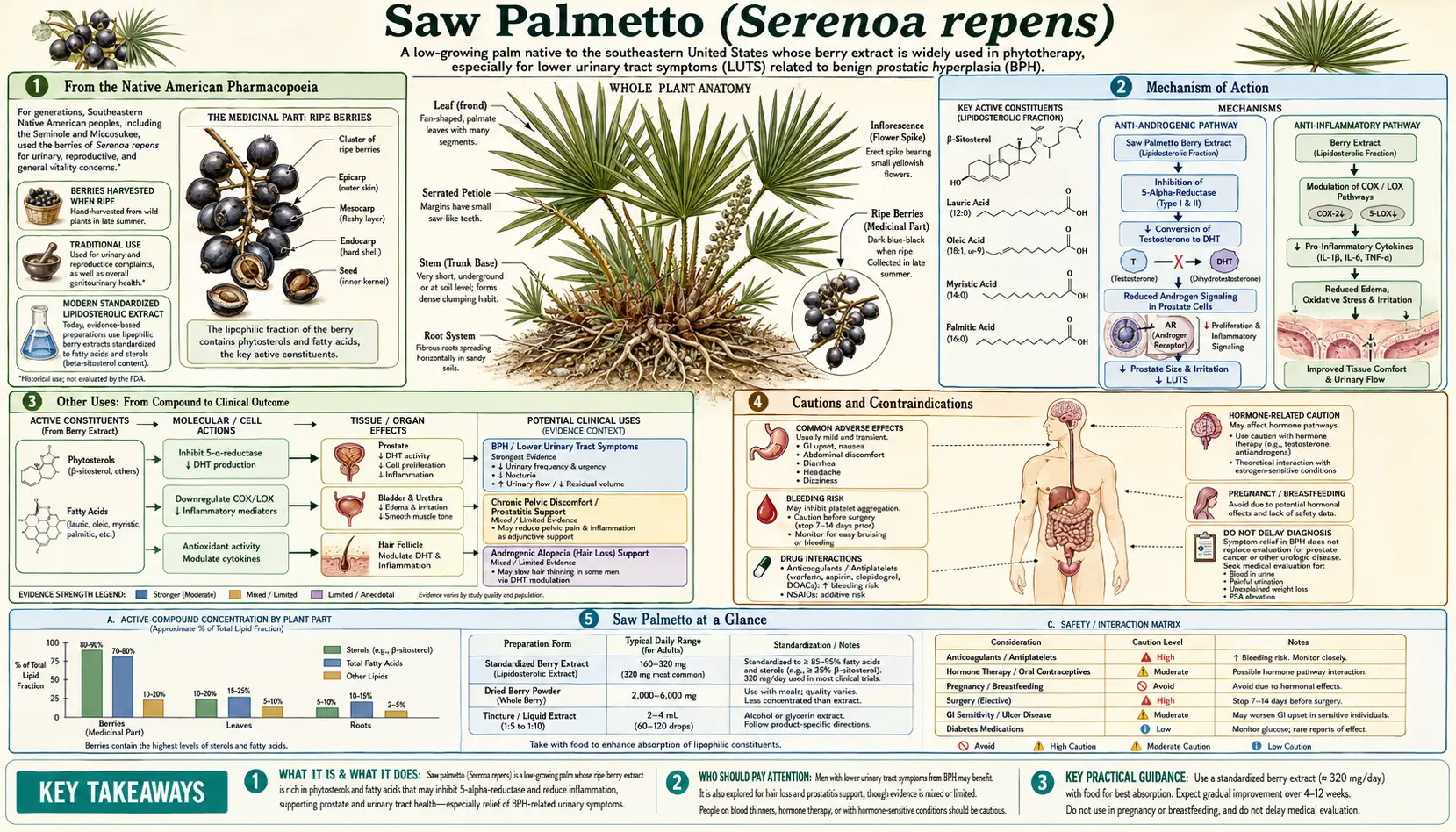
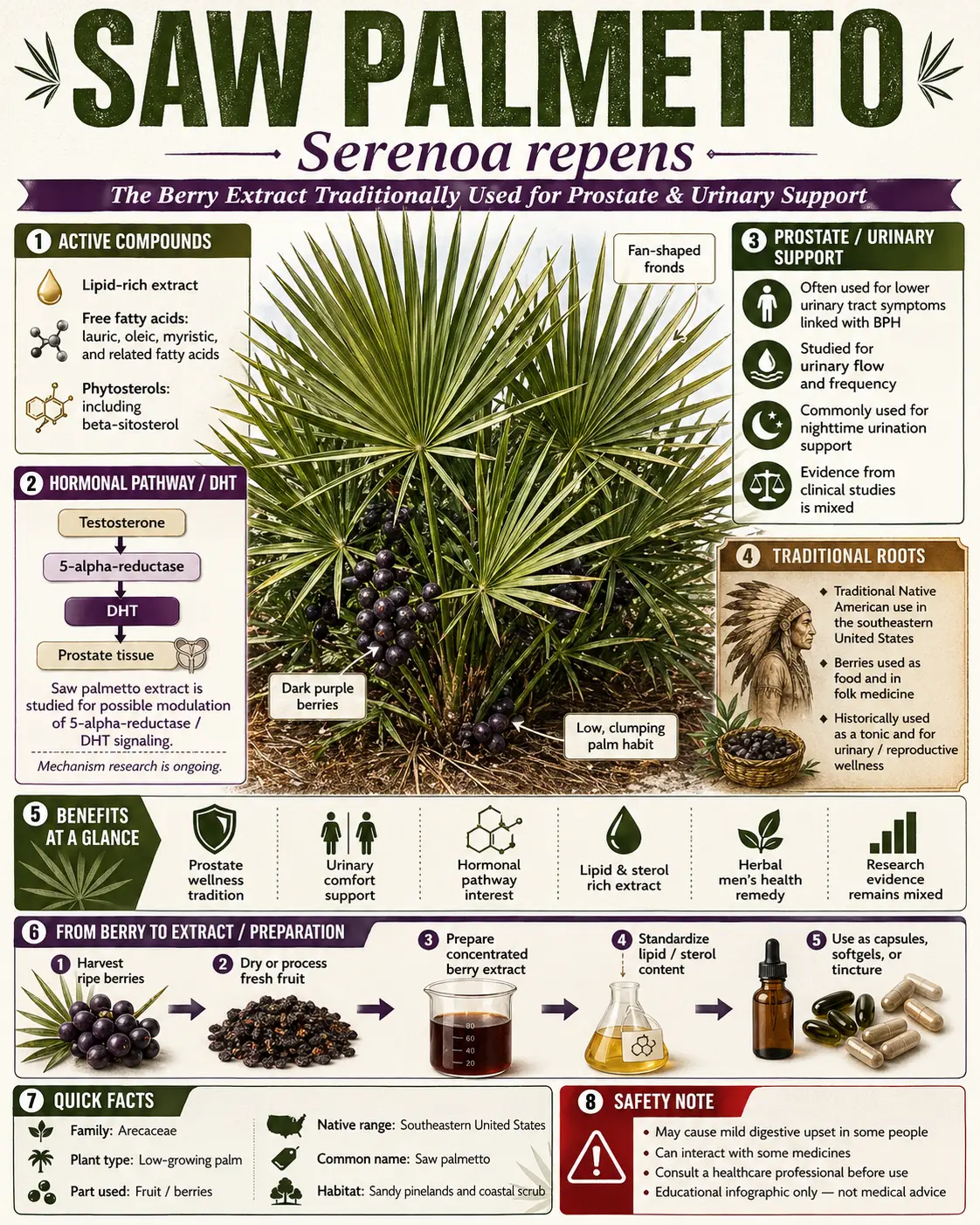
Table of Contents
- From the Native American Pharmacopoeia
- Active Compounds
- Benign Prostatic Hyperplasia
- Mechanism of Action
- Androgenic Alopecia (Hair Loss)
- Other Uses
- Forms and Preparations
- Recommended Dosage
- Cautions and Contraindications
- Featured Videos
From the Native American Pharmacopoeia
Saw palmetto is a small, ground-level palm native to the southeastern coastal United States, whose dark purple-black ripe berries were long used as food and medicine by the indigenous peoples of the region — most enduringly to support the ageing male urinary tract. Carried into print by a Savannah physician in 1879, it became an officially listed American drug, was revived in Europe as the standardized lipidosterolic extract, and is now one of the most studied of all botanical medicines — the fuller story is told in the dedicated History & Traditional Use article.
Active Compounds
Saw palmetto's active fraction is a complex mixture of fatty acids and sterols extracted from the dried, ripe berry by hexane, ethanol, or supercritical CO2:
- Free fatty acids -- predominantly lauric, oleic, myristic, and palmitic acids; the largest fraction of the lipidosterolic extract
- Phytosterols -- including beta-sitosterol, campesterol, stigmasterol, and lupeol
- Polyphenols -- including epicatechin and procyanidins
- Flavonoids -- in the whole berry, with antioxidant activity
Standardization is critical. The lipidosterolic extract (typically 85-95% free fatty acids, 0.2-0.4% sterols) is the form used in clinical trials. Whole-berry powder, dried berry capsules, and aqueous extracts have not been shown to produce equivalent clinical effects and should not be assumed to be interchangeable. Permixon (Pierre Fabre) is the most-studied commercial preparation.
Benign Prostatic Hyperplasia
Saw palmetto's primary clinical application is the treatment of lower urinary tract symptoms associated with benign prostatic hyperplasia (BPH). Multiple randomized controlled trials have shown improvements in:
- International Prostate Symptom Score (IPSS) -- typically reductions of 4-5 points on the 35-point scale
- Maximum urinary flow rate -- modest improvements of 1-3 mL/sec
- Nocturia (nighttime urination)
- Post-void residual urine volume
- Quality-of-life subscales
Effects are smaller than alpha-blockers (tamsulosin, alfuzosin) for symptom relief and smaller than 5-alpha-reductase inhibitors (finasteride, dutasteride) for prostate volume reduction, but saw palmetto has a much better tolerability profile -- particularly avoiding the sexual side effects (erectile dysfunction, decreased libido, retrograde ejaculation) that are common with pharmaceutical agents.
Saw palmetto is therefore most appropriate for men with mild to moderate BPH who prefer to avoid pharmaceutical side effects, or as an adjunct to lifestyle changes (caffeine reduction, evening fluid restriction, weight loss) before considering pharmaceutical therapy.
Mechanism of Action
Saw palmetto's effect on prostate symptoms appears to involve multiple mechanisms:
- 5-alpha-reductase inhibition -- partial inhibition of the enzyme that converts testosterone to dihydrotestosterone (DHT), the more potent androgen that drives prostate growth; effect is weaker than pharmaceutical 5-ARIs
- Anti-inflammatory activity -- reduces inflammatory cytokines (IL-6, IL-8) and inflammatory infiltrate in prostate tissue
- Anti-androgenic activity at the receptor level -- inhibits binding of DHT to androgen receptors in prostate cells
- Smooth muscle relaxation -- mild alpha-1 adrenergic blocking activity, contributing to symptom relief
- Apoptosis of prostate cells -- promotes programmed cell death in hyperplastic prostate tissue at therapeutic concentrations
Importantly, saw palmetto does not significantly affect serum PSA levels (unlike pharmaceutical 5-ARIs which lower PSA by approximately 50%). This is clinically relevant because PSA monitoring for prostate cancer screening remains accurate during saw palmetto use.
Androgenic Alopecia (Hair Loss)
Because saw palmetto inhibits 5-alpha-reductase -- the same enzyme target as pharmaceutical finasteride for male pattern hair loss -- there has been interest in using it for androgenic alopecia. Small clinical trials have shown modest improvements in hair count and patient satisfaction with topical or oral saw palmetto, though effects are smaller than pharmaceutical 5-ARIs.
Saw palmetto for hair loss is most appropriate for men seeking a milder, lower-side-effect alternative to finasteride. Topical preparations may produce local effects with even less systemic exposure.
Other Uses
Beyond the well-validated indications, saw palmetto has been studied for:
- Chronic prostatitis / chronic pelvic pain syndrome -- modest evidence; often combined with stinging nettle and pygeum
- Female androgenic alopecia, polycystic ovary syndrome, and hirsutism -- limited evidence; rationale based on 5-alpha-reductase inhibition
- Sexual function -- mixed and inconsistent evidence; not a reliable libido or ED treatment
Forms and Preparations
- Lipidosterolic extract (LSESr / Permixon) -- the form used in clinical trials; standardized to 85-95% fatty acids; the recommended form
- Standardized softgel capsules -- 320 mg of LSESr in a single softgel; convenient daily dosing
- Whole dried berry capsules -- traditional form; less reliable clinical effect
- Tea -- minimal clinical relevance; the active compounds are lipid-soluble and poorly extracted by water
- Topical preparations for hair loss -- typically 1-2% saw palmetto extract in a topical base
Recommended Dosage
- For BPH symptoms -- 320 mg of LSESr daily, taken with food (improves absorption of fat-soluble extract); single dose or split as 160 mg twice daily
- Onset -- expect 8-12 weeks for meaningful symptomatic improvement; do not abandon the trial too early
- Duration -- safe for indefinite daily use; long-term safety established to at least 3-5 years
- Combination protocols -- often combined with stinging nettle root, pumpkin seed extract, beta-sitosterol, and rye pollen for synergistic prostate support
Cautions and Contraindications
- Always rule out prostate cancer -- BPH symptoms can mimic those of prostate cancer; obtain appropriate PSA and digital rectal examination evaluation before assuming benign disease
- Anticoagulants and antiplatelets -- saw palmetto has mild antiplatelet activity; case reports of increased bleeding with warfarin, aspirin, and clopidogrel
- Surgery -- discontinue at least two weeks before scheduled surgery due to bleeding risk
- Pregnancy and breastfeeding -- not relevant for the typical user, but contraindicated due to anti-androgenic activity that could affect fetal development; do not use
- Hormone-sensitive conditions -- caution in any condition where androgen modulation could be problematic; coordinate with endocrinology
- GI side effects -- mild nausea, abdominal discomfort, or diarrhea in a small percentage of users; usually resolves with food
- Headache, dizziness -- rare; usually mild and self-limited
Research Papers and References
The following PubMed search links provide curated entry points into the published clinical and mechanistic literature on Saw Palmetto (Serenoa repens). Each link opens directly in PubMed at the National Library of Medicine.
- Serenoa repens for benign prostatic hyperplasia — PubMed: Serenoa repens BPH
- Saw palmetto and 5-alpha reductase inhibition — PubMed: saw palmetto 5-alpha reductase
- Saw palmetto IPSS symptom improvement — PubMed: saw palmetto IPSS
- Permixon clinical trials prostate — PubMed: Permixon prostate
- Saw palmetto and androgenic alopecia hair loss — PubMed: saw palmetto alopecia
- Saw palmetto safety and PSA — PubMed: saw palmetto PSA safety
- Saw palmetto polyphenol fatty acid composition — PubMed: saw palmetto fatty acid composition
External Authoritative Resources
- NCCIH — Herbs at a Glance
- MedlinePlus — Herbs and Supplements
- PubMed — All research on Serenoa repens
Connections
- All Herbs
- Saw Palmetto Benefits Deep Dive
- Testosterone Test
- Hormone Panel
- PSA Test
- Alopecia
- Hair Loss
- Benign Prostatic Hyperplasia
- Cancer
- Erectile Dysfunction
- Polycystic Ovary Syndrome
- Zinc
- Low Testosterone and TRT
- Urinary Tract Infections
- Prostate Conditions