Galangal (Alpinia galanga)
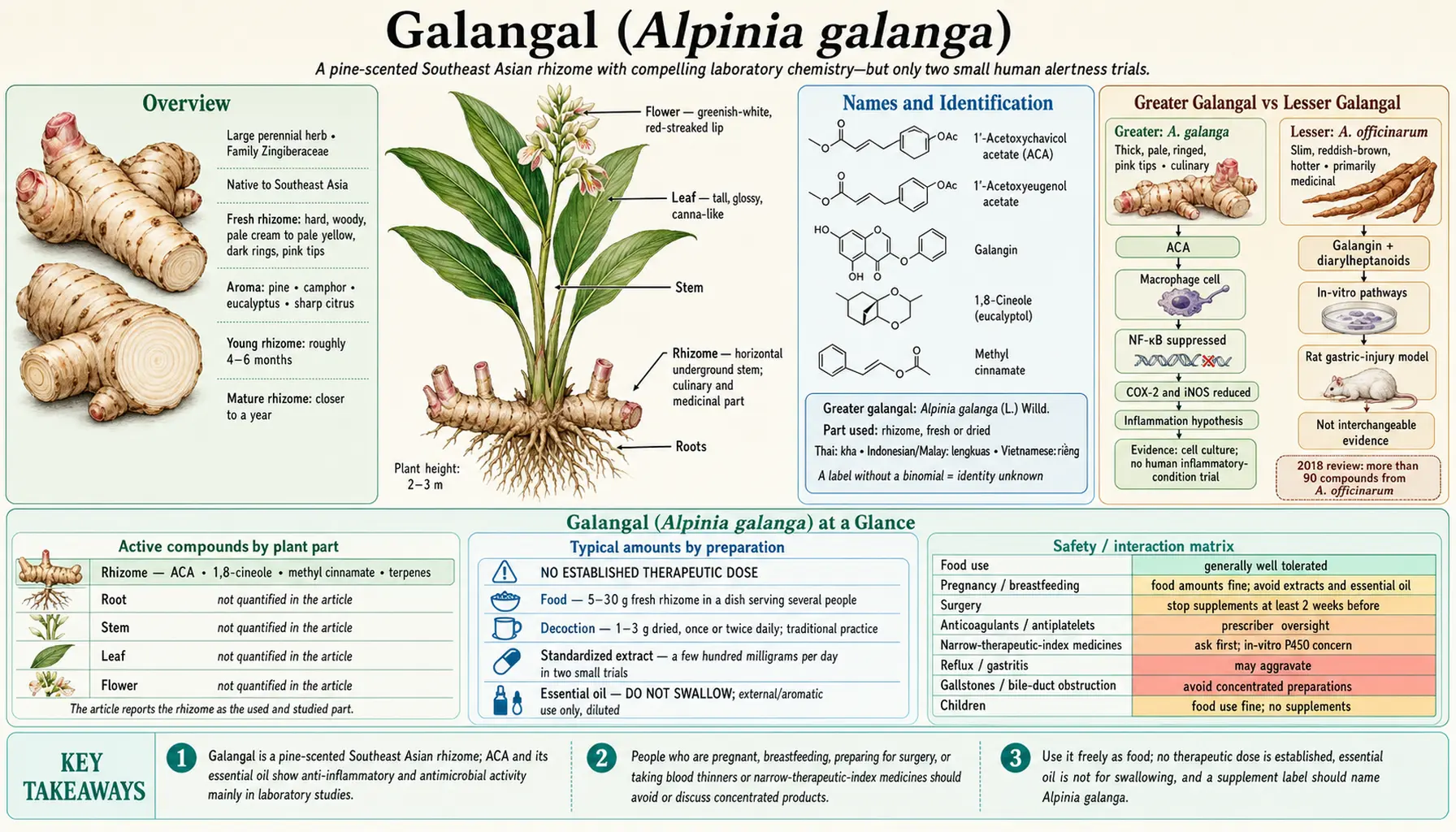
Galangal is the pale, hard, pine-scented rhizome that gives Thai tom kha gai its distinctive perfume and sits at the base of nearly every Southeast Asian curry paste. It is a close cousin of ginger in the family Zingiberaceae, but it is not ginger, it does not taste like ginger, and it cannot be swapped for ginger without changing the dish. The word "galangal" is also genuinely ambiguous: it is used for at least three different plants, sold under overlapping names in the same markets.
On the evidence side, be prepared for a modest page. Galangal has a large and interesting laboratory literature — its signature compound, 1'-acetoxychavicol acetate, is one of the better-characterised natural anti-inflammatory molecules in cell culture — and almost no human trial data. Two small randomised trials on mental alertness are the substance of the clinical record. Everything else here is cell-culture and animal work, and this page labels it as such throughout.
Table of Contents
- Overview
- Names and Identification
- Greater Galangal vs Lesser Galangal
- Telling Galangal from Ginger, Kencur, and Fingerroot
- Traditional Use
- Active Compounds
- Antimicrobial Activity
- Anti-Inflammatory Effects
- Alertness and Attention: The One Human Signal
- Laboratory Cancer Research and What It Does Not Mean
- Culinary Use
- Forms and Preparations
- Dosage
- Cautions and Contraindications
- Key Research Papers
- Connections
- Featured Videos
Overview
Alpinia galanga is a large perennial herb in the ginger family, Zingiberaceae. Above ground it looks like a stand of tall, glossy, canna-like leaves rising two to three metres from the soil, topped in season by a spike of greenish-white flowers with a red-streaked lip. Everything culinary and medicinal happens below ground, in the rhizome — the horizontal, branching underground stem that stores the plant's starch and essential oil.
The plant is native to island and mainland Southeast Asia and is cultivated across Thailand, Indonesia, Malaysia, Vietnam, southern China, and parts of India. It wants what its relatives want: heat, humidity, partial shade, and soil that drains. Rhizomes are lifted at roughly four to six months for the tender young growth prized in Thai kitchens, or left in the ground closer to a year for the harder, more strongly flavoured mature rhizome used for drying.
Fresh galangal is noticeably harder than ginger — woody enough that a dull knife will skid off it — with thin, pale, almost translucent skin marked by fine dark rings, and flesh that runs from creamy white to pale yellow. Cut it and the smell is the giveaway: sharp, resinous, medicinal, closer to pine needles, cardamom, and eucalyptus than to the warm citrus-pepper of ginger. That eucalyptus note is literal chemistry, not metaphor; a substantial fraction of the essential oil is 1,8-cineole, the same molecule that dominates eucalyptus oil.
How it reaches a kitchen depends on where you are. In Bangkok, Jakarta, or Ho Chi Minh City it reaches you as a fresh knob from a wet-market pile, sold alongside lemongrass and kaffir lime leaves as part of the aromatic trio those cuisines are built on. In a Western supermarket it arrives frozen, dried in coin-shaped slices, or ground to a sandy powder — and by the time it is a powder, you are relying entirely on the label to tell you which species you bought. That is where the trouble starts.
Names and Identification
The botanical name for greater galangal is Alpinia galanga (L.) Willd., family Zingiberaceae. The part used is the rhizome, fresh or dried.
Local names matter here more than usual, because they are the only reliable way to know what a recipe means:
- Thai: kha (ข่า) — greater galangal. This is the galangal of tom kha gai, whose name literally announces it: tom (boiled) kha (galangal) gai (chicken).
- Indonesian / Malay: lengkuas (also spelled laos in older Indonesian usage and on some Dutch-influenced labels).
- Vietnamese: riềng.
- Khmer: romdeng. Lao: kha.
- Hindi / Sanskrit-derived Indian usage: kulanjan, bara kulanjan (the "greater" kulanjan).
- Chinese: 大高良姜 da gao liang jiang, "greater gao liang jiang", distinguishing it from the lesser species below.
- English: greater galangal, Thai ginger, Siamese ginger, laos root, blue ginger (an unhelpful name — it is not blue).
A label or recipe that says only "galangal" is ambiguous. It may mean Alpinia galanga, Alpinia officinarum, or Kaempferia galanga. In a Thai or Indonesian recipe, unqualified "galangal" almost always means Alpinia galanga. In a Chinese herbal formula, "galangal" (高良姜) means Alpinia officinarum. On a supplement bottle it means whatever the manufacturer put in, and the only way to know is a binomial printed on the label. If there is no binomial, treat the identity as unknown.
Greater Galangal vs Lesser Galangal
These are two different species with two different jobs, and English collapsed them into one word.
Greater galangal — Alpinia galanga. The large one. Rhizome pale cream to pale yellow, often flushed pink at the growing tips, thick as a thumb or wider, with visible ringed nodes. Flavour piney, camphorous, citrus-sharp. This is the culinary galangal of Southeast Asia and the species behind most of the modern supplement research, including both human alertness trials.
Lesser galangal — Alpinia officinarum Hance. Smaller and thinner — finger-width rather than thumb-width — with reddish-brown skin and denser, darker flesh. It is noticeably hotter and more pungent than greater galangal, closer to a peppery bite. Its home range is southern China, especially Guangdong and Hainan, and it is primarily a medicinal rhizome rather than a kitchen one. In Traditional Chinese Medicine it is 高良姜 gao liang jiang, classified as warming and used for cold-type abdominal pain, vomiting, and poor appetite. The species epithet officinarum is itself the tell: it is the Latin marker for a plant that belonged in the apothecary.
Chemically the two overlap but are not interchangeable. A. officinarum is the richer source of galangin, the flavonol literally named after galangal, and of diarylheptanoids structurally related to the gingerols and curcuminoids of its cousins. A. galanga is the richer source of the phenylpropanoid ester 1'-acetoxychavicol acetate. A 2018 review in the Journal of Ethnopharmacology catalogued more than 90 compounds isolated from A. officinarum alone, and its profile is not the same list you would get from A. galanga.
The practical consequence: a study on "galangal" tells you nothing until you check which species was tested. A supplement making a claim from A. officinarum research while containing A. galanga — or the reverse — is citing evidence about a different plant.
Telling Galangal from Ginger, Kencur, and Fingerroot
Four Zingiberaceae rhizomes turn up in the same Southeast Asian markets, look broadly similar once dried, and are routinely substituted for one another — sometimes by mistake, sometimes because a supplier ran short. Here is how they actually differ.
| Rhizome | Species | Look and feel | Smell and taste | Marker compound |
|---|---|---|---|---|
| Greater galangal | Alpinia galanga | Thick, hard, woody; pale cream skin with dark rings, pink tips | Pine, camphor, eucalyptus, sharp citrus | 1'-acetoxychavicol acetate; 1,8-cineole |
| Lesser galangal | Alpinia officinarum | Slim, finger-width; reddish-brown skin, dense dark flesh | Hot, peppery, more pungent than greater | Galangin; diarylheptanoids |
| Ginger | Zingiber officinale | Knobbly, fibrous, softer; tan papery skin, juicy yellow flesh | Warm, lemony, peppery bite that builds | Gingerols and shogaols |
| Kencur (aromatic ginger) | Kaempferia galanga | Small, rounded, knobby lumps; thin brown skin, white flesh | Intensely aromatic, camphor-medicinal, faintly bitter | Ethyl p-methoxycinnamate |
| Fingerroot (Chinese keys) | Boesenbergia rotunda | Unmistakable cluster of long slender "fingers" from a central knob | Peppery, earthy, mildly bitter, slightly medicinal | Panduratin A; pinostrobin |
The kencur problem is the worst of the four. Kaempferia galanga carries "galanga" in its own binomial and is sold in English-speaking markets as "aromatic ginger", "sand ginger", "resurrection lily" — and, unhelpfully, as a kind of "galangal". It is a genuinely different plant: a different genus, a different smell, a different dominant compound, and a different culinary role. Substituting kencur for galangal in a Thai curry paste will not give you a slightly-off curry paste; it will give you a dish that tastes strongly of camphor. See our separate page on kencur for the full picture.
Ginger substitution deserves a flat answer: no. Recipes that say "if you cannot find galangal, use ginger" are offering a fallback, not an equivalent. Ginger brings gingerols and a warm citrus heat; galangal brings cineole and a resinous, almost antiseptic pine. Both are excellent; they are not the same ingredient. If you can only get one, frozen galangal beats fresh ginger for any dish that names galangal.
Traditional Use
Galangal has a long documented history across several unrelated systems, which is worth reading as history rather than as evidence. Traditional use tells you what people believed and what was available to them. It does not tell you whether the plant works.
In Thai traditional medicine, kha is a warming, wind-dispelling remedy for indigestion, bloating, and flatulence, and it appears in topical compresses for muscle and joint pain — the herbal-ball compress (luk pra kob) used in traditional Thai massage often contains galangal alongside lemongrass, kaffir lime, tamarind leaf, and camphor.
In Indonesian and Malay practice, lengkuas is both kitchen staple and jamu ingredient, used for digestive complaints and applied externally, sliced and rubbed on the skin, for ringworm and other fungal skin conditions — a use that at least has a plausible chemical basis, since galangal extracts are reliably antifungal in the laboratory.
In Traditional Chinese Medicine, it is lesser galangal (A. officinarum) that carries the medicinal reputation, as gao liang jiang, prescribed for cold-pattern epigastric pain and vomiting, usually in combination formulas rather than alone.
In Ayurveda and Unani practice on the Indian subcontinent, kulanjan was used as a digestive and expectorant, and it also travelled: galangal was known in medieval Europe, imported along the spice routes, and appears in the writings of the twelfth-century abbess Hildegard of Bingen, who called it galgant and recommended it for heart pain. European use faded as the spice trade reorganised, and galangal is now largely absent from Western kitchens outside Southeast Asian cooking.
Active Compounds
Galangal's chemistry falls into two groups: a volatile essential oil that carries the smell, and non-volatile phenolics that carry most of the biological activity studied in laboratories.
- 1'-Acetoxychavicol acetate (ACA), also written galangal acetate or 1'S-1'-acetoxychavicol acetate, is the signature compound of A. galanga. It is a phenylpropanoid ester, and it is the molecule most of the modern research is really about. In cell culture it suppresses the NF-κB pathway — the master switch that turns on inflammatory gene expression — and through that route it reduces production of inducible nitric oxide synthase and COX-2. It is also directly antimicrobial and antifungal. ACA is unstable: it degrades on storage and with heat, which is one reason extract potency varies so much between products.
- 1'-Acetoxyeugenol acetate, a close structural relative of ACA, occurs alongside it with broadly similar laboratory activity.
- Galangin is a flavonol (3,5,7-trihydroxyflavone) named for this plant, though it is more abundant in lesser galangal and in bee propolis than in the culinary greater galangal. It is antioxidant, inhibits several cytochrome P450 enzymes in vitro, and has a large in-vitro anticancer literature.
- 1,8-Cineole (eucalyptol) is a major component of the essential oil and is responsible for the eucalyptus-camphor top note. Unlike most compounds on this page, cineole has genuine human trial data — not from galangal, but as an isolated drug in respiratory medicine, where a randomised trial in bronchial asthma reported a steroid-sparing anti-inflammatory effect.
- Methyl cinnamate contributes a sweet, balsamic, strawberry-like facet to the aroma and is one of the compounds used to fingerprint the oil.
- Terpenes: α-pinene, β-pinene, terpinen-4-ol, camphor, and limonene fill out the pine and citrus character.
Essential-oil composition varies widely with geography, harvest age, and whether the rhizome was distilled fresh or dried — which is a real problem for interpreting the literature. Two studies on "Alpinia galanga essential oil" may be studying materially different mixtures.
Antimicrobial Activity
Mechanism. Two things are happening. The essential oil, like most terpene-rich oils, disrupts microbial membranes non-specifically — effective, but not selective, and it works on human cells too at high enough concentration. ACA does something more interesting: alongside direct antibacterial activity, it has been reported to interfere with bacterial plasmids, the small circular DNA elements that carry many antibiotic-resistance genes and move between bacteria.
What the evidence shows. Galangal extracts inhibit a broad range of bacteria and fungi in laboratory assays. Weerakkody and colleagues (2011) found galangal extract inhibited food-borne pathogens and worked synergistically with rosemary and eucalyptus extracts. Latha and colleagues (2009) reported that purified ACA had antiplasmid activity against multi-drug-resistant bacteria. Thai researchers (2024) reported activity against the bacteria implicated in acne alongside cytotoxicity data. In veterinary dermatology research, galangal extract was active against dermatophytes — the fungi responsible for ringworm — which lines up with the traditional Malay topical use.
What it does not show. All of this is in vitro: extracts applied directly to microbes in a dish, at concentrations that have nothing to do with what happens after you eat a curry or swallow a capsule. There is no human trial showing that galangal treats any infection. Nothing in this literature supports using galangal instead of an antibiotic or an antifungal, and if you have a skin infection that is spreading, painful, or not improving, it needs medical treatment.
Anti-Inflammatory Effects
Mechanism. Think of NF-κB as a light switch on the wall of every immune cell. When the cell detects a threat — bacterial lipopolysaccharide, for instance — the switch flips and dozens of inflammatory genes turn on at once: COX-2, inducible nitric oxide synthase, TNF-α, interleukin-6. ACA appears to hold that switch down. In macrophage cell lines it suppresses the induction of COX-2 and iNOS after lipopolysaccharide stimulation, and the effect has been reproduced across several laboratories over more than two decades, beginning with Ohata and colleagues in 1998 and continuing through work published in 2022.
What the evidence shows. This is one of the better-replicated cell-culture findings for any Zingiberaceae compound. Murakami and colleagues placed ACA in a comparative study alongside zerumbone, auraptene, and nobiletin, and found each suppressed lipopolysaccharide-induced COX-2 expression by a somewhat different mechanism. Animal work with related Alpinia extracts supports the anti-inflammatory reading — for example, an A. officinarum ethanol extract reduced indomethacin-induced gastric injury in rats.
What it does not show. There is no randomised controlled trial of galangal for any inflammatory condition in humans — not arthritis, not inflammatory bowel disease, not anything else. The gap between "suppresses COX-2 in a dish" and "reduces joint pain in a person" is enormous, and it has swallowed many promising compounds. Treat this section as a reason for someone to run a trial, not as a reason to take galangal for arthritis.
Alertness and Attention: The One Human Signal
If you want to know what galangal has actually been shown to do in people, this is nearly the whole file.
Srivastava, Mennemeier, and Pimple published a randomised, placebo-controlled crossover study in the Journal of the American College of Nutrition in 2017 testing a standardised Alpinia galanga extract for mental alertness and sustained attention, with and without caffeine. The extract was associated with improved sustained-attention performance, and — the finding that drew commercial interest — it did so without the drop-off that follows caffeine alone. A second randomised placebo-controlled trial by the same lead author, published in 2021, examined the safety and efficacy of the same commercial extract (marketed as EnXtra) in healthy adults.
How much weight this carries. Honestly: some, but not much. These are small trials of one proprietary standardised extract, conducted with industry involvement, measuring cognitive test performance rather than anything a person would notice across a working day. They have not been independently replicated by unaffiliated groups. The finding is worth knowing and worth following, and it is the reason galangal appears in nootropic and pre-workout formulas. It is not established fact, and it does not transfer to eating galangal in food or to a generic "galangal root powder" capsule, neither of which is the tested preparation.
One other human trial deserves mention for what it does not prove. Fedder and colleagues (2014, PLoS One) ran a randomised, double-blind, controlled trial of a combined pomegranate-fruit and galangal-rhizome extract in men and reported an increase in the number of motile sperm. It is a real trial with a real result, but it tested a combination product. There is no way to attribute the effect to galangal rather than to pomegranate, and this single study is not a basis for taking galangal for fertility.
Laboratory Cancer Research and What It Does Not Mean
Searching for galangal and cancer returns hundreds of papers, and it is important to understand what kind of papers they are.
ACA kills cancer cells in culture. It has been shown to repress proliferation and invasion and to trigger apoptosis in endocrine-resistant breast cancer cell lines through HER2 signalling, and similar reports exist across many cell types. Galangin has an equally large in-vitro literature, summarised in a 2021 review in Biomedicine & Pharmacotherapy. Kojima-Yuasa and Matsui-Yuasa's 2020 review in the Journal of Medicinal Food is the best single entry point to the ACA pharmacology.
Every one of these studies is cell-culture or animal work. There are no human cancer trials of galangal, ACA, or galangin. Almost every compound ever tested kills cancer cells in a dish at some concentration — so does bleach — and the overwhelming majority fail when they meet a human body, which absorbs poorly, metabolises fast, and excretes efficiently. ACA in particular is chemically unstable, which makes the pharmacokinetic hurdle higher, not lower.
Nobody should take galangal to treat cancer, and nobody should delay or decline oncology treatment because of this literature. If you are in treatment, tell your oncology team about any supplement you are taking, galangal included — not because it is known to be dangerous, but because interactions with chemotherapy are exactly the kind of thing nobody has studied.
Culinary Use
Galangal is first and foremost a food. In Thai cooking it is one leg of the aromatic tripod — galangal, lemongrass, kaffir lime — that defines the flavour of the cuisine. Sliced into coins, it is simmered in coconut-milk soups (tom kha) and hot-sour broths (tom yum), where it is left in the bowl as an aromatic but not eaten; the mature rhizome is too fibrous to chew comfortably. Pounded, it goes into red, green, and massaman curry pastes.
In Indonesian and Malay cooking, lengkuas is bruised and dropped whole into rendang, opor, soto, and gulai, or ground into the bumbu spice paste that starts most dishes. Vietnamese cooking uses riềng assertively in braised dishes with fermented shrimp or fish sauce, particularly with goat and with catfish.
Practical notes for cooking:
- Slice across the grain into thin coins. Galangal is hard; a sharp knife and patience beat force.
- Young galangal (paler, pinker tips, softer) is milder and can be eaten; mature rhizome is for infusing.
- Freezing works well. Whole rhizomes keep for months in a freezer bag and can be sliced or grated straight from frozen, which is easier than cutting them fresh.
- Dried slices need rehydrating in hot water for 20–30 minutes and are a distant second to fresh or frozen. Powder is a distant third and loses the volatile top notes almost entirely.
- Amounts are generous. A pot of tom kha for four might take 8–12 coins — on the order of 15–30 g of fresh rhizome. This is a food-level quantity, and no evidence suggests it is anything other than safe.
Forms and Preparations
- Fresh rhizome — the standard culinary form. Refrigerated it lasts one to two weeks; wrapped and frozen, several months.
- Frozen whole or sliced — widely sold in Asian groceries and the best year-round option outside Southeast Asia.
- Dried slices — long shelf life, muted flavour; useful for infusions and teas.
- Powder — convenient, weakest, and the form most vulnerable to species substitution because nothing about the powder identifies the plant.
- Essential oil — steam-distilled, high in 1,8-cineole. Not for internal use. Concentrated essential oils are not food and dosing errors are easy to make.
- Standardised extracts in capsules — the supplement form. The one with human data is a specific standardised A. galanga extract sold under a trade name; a bottle labelled only "galangal root 500 mg" is a different product with no trial behind it.
- Traditional decoction — sliced rhizome simmered in water, sometimes with ginger and honey, drunk for digestive complaints. Pleasant, warming, and unstudied.
Dosage
There is no established therapeutic dose of galangal. That sentence is the honest headline, and everything below is context rather than a recommendation.
- Culinary: roughly 5–30 g of fresh rhizome in a dish serving several people. Unlimited by any practical concern; this is how hundreds of millions of people consume it daily.
- Traditional decoction: commonly described as 1–3 g of dried rhizome simmered in water, once or twice a day. These figures come from traditional practice, not from dose-finding studies.
- Standardised extract (alertness research): the published human trials used a specific commercial standardised extract at doses in the range of a few hundred milligrams per day. If you are considering a supplement for this reason, the only defensible approach is to use the extract that was actually tested, at the dose printed on the trial's product, and to recognise that the evidence base is two small trials.
- Essential oil: external and aromatic use only, always diluted in a carrier oil. Do not swallow it.
Because ACA content varies enormously with species, growing region, rhizome age, drying method, and storage time, two galangal capsules with identical labels can differ several-fold in the compound that most of the research is about. Standardisation to a named marker compound, printed on the label, is the only thing that makes a supplement's dose meaningful.
Cautions and Contraindications
Galangal as a food is well tolerated and has been eaten in quantity for centuries across a huge population. Concentrated extracts are a different proposition, and the honest summary is that their safety has barely been studied.
- Pregnancy and breastfeeding: food amounts in cooking are fine. Avoid concentrated extracts and essential oil. There is no human safety data in pregnancy, some Zingiberaceae species have shown reproductive effects in animal studies, and traditional systems variously used Alpinia species as emmenagogues. Absence of evidence is not evidence of safety.
- Surgery: stop galangal supplements at least two weeks before planned surgery. This is a precaution shared with ginger and turmeric — several Zingiberaceae constituents affect platelet function in laboratory work — rather than a documented clinical problem with galangal specifically.
- Anticoagulants and antiplatelet drugs (warfarin, apixaban, rivaroxaban, clopidogrel, aspirin): use extract-strength galangal only with your prescriber's knowledge. The interaction is theoretical, but the consequences of a bleeding interaction are not.
- Drug-metabolising enzymes: galangin inhibits several cytochrome P450 enzymes in vitro. Many prescription drugs are cleared by those enzymes. Nobody has measured whether a galangal supplement raises drug levels in a person, so if you take a narrow-therapeutic-index medication — warfarin, tacrolimus, some antiepileptics, some antiarrhythmics — do not add a concentrated galangal extract without asking.
- Reflux and gastritis: galangal is pungent and warming. Some people with reflux find it aggravating in quantity, even though the traditional use is digestive.
- Gallstones and bile-duct obstruction: as with other carminative rhizomes, avoid concentrated preparations.
- Blood sugar: animal studies suggest hypoglycaemic effects for some Alpinia extracts. If you take insulin or a sulfonylurea and start a galangal supplement, monitor.
- Allergy: uncommon, but cross-reactivity within Zingiberaceae is possible. If ginger, turmeric, or cardamom cause you problems, introduce galangal cautiously.
- Children: food use is fine. Supplements are not appropriate — no paediatric data exists.
- Product identity: because "galangal" covers at least three species, a supplement without a binomial on the label should be considered unidentified plant material. That is a safety issue, not a pedantic one.
Galangal is a spice with an interesting laboratory profile and almost no clinical record. Enjoy it freely in food; treat capsules with the same scepticism you would apply to any supplement whose entire human evidence base is two small trials on a single proprietary extract.
Key Research Papers
- Srivastava S, Mennemeier M, Pimple S. Effect of Alpinia galanga on mental alertness and sustained attention with or without caffeine: a randomized placebo-controlled study. Journal of the American College of Nutrition. 2017;36(8):631–639.
- Srivastava S, Mennemeier M, Chaudhary JA. A randomized placebo controlled clinical trial demonstrating safety and efficacy of EnXtra in healthy adults. Journal of the American College of Nutrition. 2021;40(3):224–236.
- Kojima-Yuasa A, Matsui-Yuasa I. Pharmacological effects of 1'-acetoxychavicol acetate, a major constituent in the rhizomes of Alpinia galanga and Alpinia conchigera. Journal of Medicinal Food. 2020;23(5):465–475.
- Ohata T, Fukuda K, Murakami A, et al. Inhibition by 1'-acetoxychavicol acetate of lipopolysaccharide- and interferon-gamma-induced nitric oxide production through suppression of inducible nitric oxide synthase gene expression in RAW264 cells. Carcinogenesis. 1998;19(6):1007–1012.
- Murakami A, Shigemori T, Ohigashi H. Zingiberaceous and citrus constituents, 1'-acetoxychavicol acetate, zerumbone, auraptene, and nobiletin, suppress lipopolysaccharide-induced cyclooxygenase-2 expression in RAW264.7 murine macrophages through different modes of action. Journal of Nutrition. 2005;135(12 Suppl):2987S–2992S.
- Latha C, Shriram VD, Jahagirdar SS, et al. Antiplasmid activity of 1'-acetoxychavicol acetate from Alpinia galanga against multi-drug resistant bacteria. Journal of Ethnopharmacology. 2009;123(3):522–525.
- Weerakkody NS, Caffin N, Lambert LK, et al. Synergistic antimicrobial activity of galangal (Alpinia galanga), rosemary (Rosmarinus officinalis) and lemon iron bark (Eucalyptus staigerana) extracts. Journal of the Science of Food and Agriculture. 2011;91(3):461–468.
- Pradubyat N, Giannoudis A, Elmetwali T, et al. 1'-Acetoxychavicol acetate from Alpinia galanga represses proliferation and invasion, and induces apoptosis via HER2-signaling in endocrine-resistant breast cancer cells. Planta Medica. 2022;88(2):163–178.
- Abubakar IB, Malami I, Yahaya Y, et al. A review on the ethnomedicinal uses, phytochemistry and pharmacology of Alpinia officinarum Hance. Journal of Ethnopharmacology. 2018;224:45–62.
- Rampogu S, Gajula RG, Lee KW. A comprehensive review on chemotherapeutic potential of galangin. Biomedicine & Pharmacotherapy. 2021;141:111808.
- Gong J, Zhang Z, Zhang X, et al. Effects and possible mechanisms of Alpinia officinarum ethanol extract on indomethacin-induced gastric injury in rats. Pharmaceutical Biology. 2018;56(1):294–301.
- Fedder MD, Jakobsen HB, Giversen I, et al. An extract of pomegranate fruit and galangal rhizome increases the numbers of motile sperm: a prospective, randomised, controlled, double-blinded trial. PLoS One. 2014;9(9):e108532.
Live PubMed Searches
- Alpinia galanga — all research
- Alpinia officinarum (lesser galangal)
- 1'-acetoxychavicol acetate (ACA)
- Galangin
- Alpinia galanga and antimicrobial activity
- Alpinia galanga, cognition, and attention
- Alpinia galanga essential oil composition
- Kaempferia galanga (the other "galangal")
- 1,8-cineole (eucalyptol)
- Zingiberaceae rhizome authentication and substitution
Connections
- All Herbs
- Ginger (Zingiber officinale) — the cousin galangal is most often confused with, and the one with a real clinical evidence base.
- Turmeric (Curcuma longa) — the third great Zingiberaceae rhizome, and a case study in the gap between laboratory promise and human results.
- Kencur (Kaempferia galanga) — the aromatic ginger also sold as a "galangal", and the substitution most likely to ruin a curry.
- Fingerroot (Boesenbergia rotunda) — Chinese keys, the finger-shaped Zingiberaceae rhizome of Thai and Indonesian cooking.
- Conditions on this site that reference this page: Athlete's Foot (Tinea Pedis) · Ringworm (Tinea) · H. pylori (Helicobacter pylori) · Infertility · Male Infertility