Betel Nut (Areca catechu)
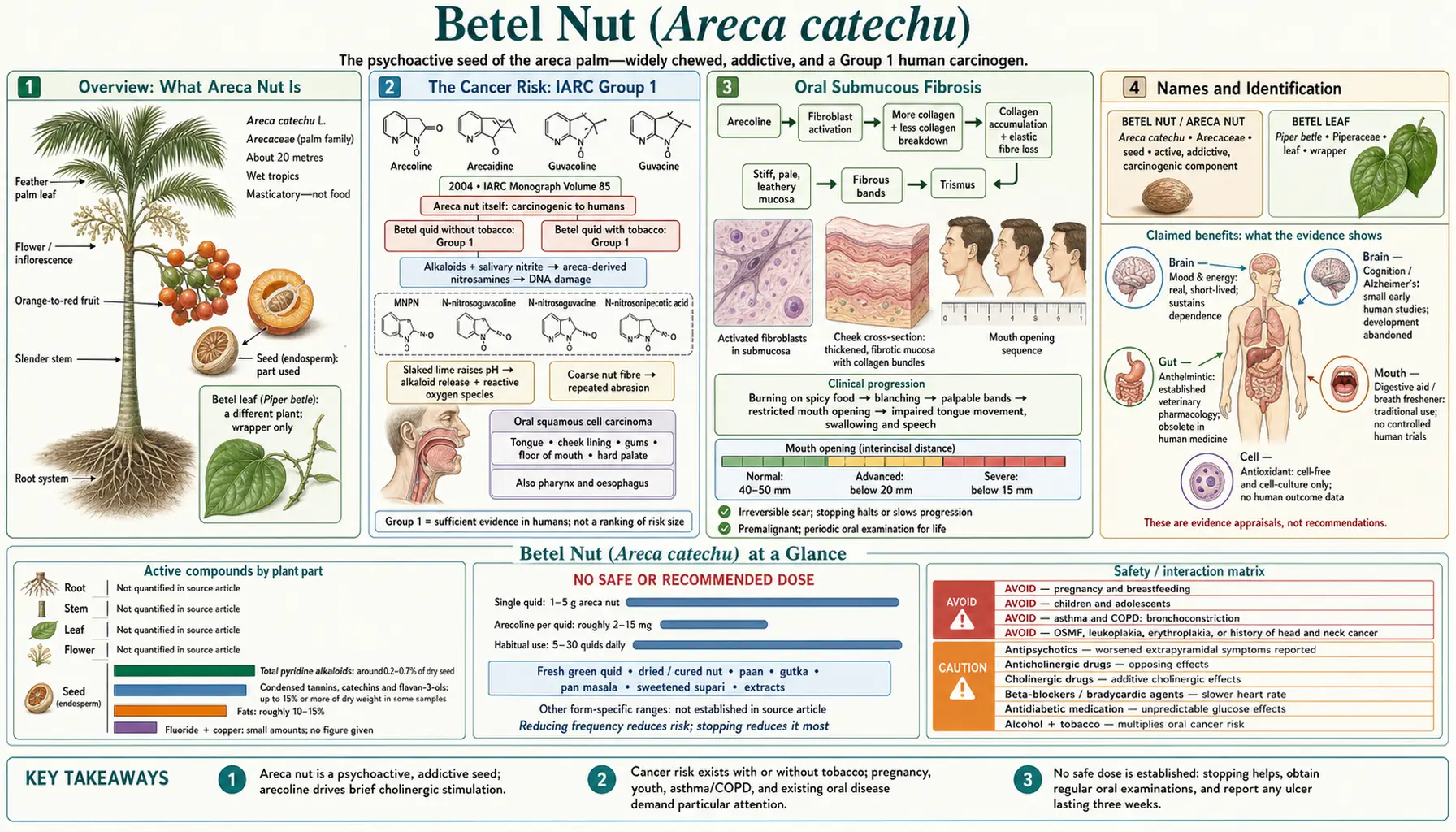
Betel nut is the seed of the areca palm, Areca catechu, and it is chewed regularly by somewhere between 300 and 600 million people — every figure in that range is an estimate, and the higher ones are the most quoted rather than the best established. Even at the low end it is usually placed fourth among the world's most widely used psychoactive substances, after caffeine, alcohol and nicotine. It is also a Group 1 human carcinogen: the International Agency for Research on Cancer concluded in 2004 that areca nut causes cancer in humans both with and without added tobacco. That is the same evidence category as tobacco smoking and asbestos, and it is not a hedge or a preliminary signal.
This page exists because betel nut is normal, social and often ceremonial in the places where it is used, and because that normality does not change the biology. We cover the cultural history honestly, the pharmacology of why the chew feels good, and then the two conditions that dominate the medical picture — oral squamous cell carcinoma and oral submucous fibrosis, a progressive stiffening of the mouth that is itself premalignant and does not reverse. We also cover what quitting looks like, because that is the only intervention with a proven benefit.
Table of Contents
- Overview: What Areca Nut Is
- The Cancer Risk: IARC Group 1
- Oral Submucous Fibrosis
- Names and Identification
- Traditional and Ceremonial Use
- Active Compounds
- Why People Chew It: Arecoline and the Cholinergic Buzz
- Dependence and Withdrawal
- Beyond the Mouth: Heart, Metabolism, Pregnancy
- Claimed Benefits and What the Evidence Shows
- Forms and Preparations
- Dosage: There Is No Established Safe Amount
- Quitting: What Cessation Support Exists
- Oral Cancer Screening: What It Actually Involves
- Cautions and Contraindications
- Key Research Papers
- Conditions It Is Used For
- Connections
- Featured Videos
Overview: What Areca Nut Is
Areca catechu is a slender feather-palm in the family Arecaceae — the same family as coconut and date palm. It grows to about 20 metres, prefers the wet tropics, and is cultivated across South and Southeast Asia, the Pacific Islands and parts of East Africa. India, Bangladesh, Myanmar, Indonesia, Taiwan, Papua New Guinea, Guam and the Solomon Islands are all major consuming regions.
The part used is the seed (the "nut") of the palm's orange-to-red fruit. It is not eaten as food. It is a masticatory: a substance held in the cheek and chewed for its effect, the way coca leaf or smokeless tobacco is used. There is no Culinary Use section on this page because areca nut is not, in any meaningful sense, a food or a spice.
The nut is rarely chewed alone. The standard preparation is the betel quid (also paan, pan masala, sirih pinang, buai, bulath): a sliced or crushed areca seed wrapped in a fresh betel leaf — the leaf of Piper betle, a completely different plant — and smeared with slaked lime (calcium hydroxide). Tobacco is added in much of India, Bangladesh and Pakistan; in Taiwan and parts of Southeast Asia it usually is not. Catechu paste, cardamom, cloves, fennel, sweeteners and colourings are common additions.
Chewing a quid stains the saliva bright red, which is why streets in betel-chewing regions are marked with red spit. Long-term chewers develop permanently red-black stained teeth. Commercially, areca nut also reaches consumers as gutka and pan masala — dry, foil-sachet products that are cheap, heavily marketed, shelf-stable, and easy for children to buy. Several Indian states have banned gutka; enforcement is inconsistent and reformulated products routinely return to the market.
The Cancer Risk: IARC Group 1
In 2004 the International Agency for Research on Cancer — the World Health Organization's cancer agency — published Monograph Volume 85 and reached two separate conclusions that matter enormously:
- Betel quid with tobacco is carcinogenic to humans (Group 1). This was already well known.
- Betel quid without tobacco is also carcinogenic to humans (Group 1), and so is areca nut itself.
That second finding is the one most users have never heard. The common belief across chewing communities — and the marketing position of the tobacco-free product category — is that the danger lives in the tobacco, and that a "clean" quid or a tobacco-free gutka is safe. IARC examined that question directly and concluded it is false. Areca nut on its own causes cancer in humans.
What cancers. The dominant one is oral squamous cell carcinoma — cancer of the tongue, cheek lining (buccal mucosa), gums, floor of the mouth and hard palate. IARC also identified evidence for cancer of the pharynx and oesophagus. In high-prevalence regions, oral cancer is not a rare disease: in parts of India and in Papua New Guinea it is among the most common cancers in men, and the geography of that burden maps closely onto the geography of betel chewing.
Group 1 means what it says. IARC's classification describes the strength of the evidence that something causes cancer, not the size of the risk. Group 1 is the top category: the evidence in humans is considered sufficient. Asbestos, tobacco smoking, benzene, solar radiation and processed meat are all Group 1. The categories do not rank how dangerous each exposure is — but they do rank how settled the question is, and for areca nut the question is settled.
Why it is carcinogenic. Several mechanisms run in parallel, which is part of why the effect is so consistent:
- Areca-derived nitrosamines. The alkaloids in the nut react with nitrite in saliva to form nitrosamines — 3-(methylnitrosamino)propionitrile (MNPN), N-nitrosoguvacoline and related compounds — which are DNA-damaging. This nitrosation happens in the mouth, during chewing, and does not require tobacco.
- Slaked lime raises the pH. Calcium hydroxide makes the quid strongly alkaline, which both accelerates alkaloid release and drives the production of reactive oxygen species that damage DNA in the surrounding mucosa.
- Mechanical and chemical irritation. Coarse nut fibre abrades the cheek lining for hours a day, and the damaged epithelium is repeatedly re-exposed to the chemistry above.
- Arecoline itself is genotoxic in laboratory systems, and drives the fibroblast changes described in the next section.
Risk rises with dose and duration. Frequency of chewing, years of use, and whether the quid is swallowed or held overnight in the cheek all increase risk. Adding tobacco increases it further. Adding alcohol increases it further again — the combination of areca, tobacco and alcohol is multiplicative rather than additive.
Quitting helps, and the size of the benefit has been measured. A 2025 meta-analysis in Cancer Epidemiology, Biomarkers & Prevention examined head and neck cancer risk after stopping smokeless tobacco and betel quid, and found risk declines after cessation. This is the single most useful thing on this page: the damage is not entirely fixed at the moment you stop.
Oral Submucous Fibrosis
Oral submucous fibrosis (OSMF, or OSF) is the condition that betel chewers should understand best, because it arrives long before cancer does and because it is the thing people notice first.
What it is. The connective tissue underneath the lining of the mouth progressively turns to scar. Collagen accumulates, elastic fibres are lost, and the soft, mobile tissue of the cheeks, palate and often the throat becomes stiff, pale and leathery. Arecoline drives fibroblasts to produce more collagen and to break down less of it, so the tissue is being scarred faster than the body can remodel it.
What it feels like, in order.
- Burning on spicy food. Almost always the first sign, and almost always dismissed. The mucosa has become intolerant of chilli and heat.
- Blanching. The inside of the cheek loses its pink and looks marble-white or mottled.
- Palpable bands. Vertical fibrous cords can be felt through the cheek, like taut cables under the skin.
- Trismus — restricted mouth opening. The defining symptom. Normal interincisal opening is about 40–50 mm (roughly three fingers stacked). In advanced OSMF it can fall below 20 mm, and in severe cases below 15 mm.
- Loss of tongue movement, difficulty swallowing, changed speech, and an inability to eat normally.
It is irreversible. This is the hard part. Stopping areca nut halts or slows the progression — which is worth everything — but the scar tissue already laid down does not dissolve. Established trismus does not go back to normal. Treatments (intralesional steroid and hyaluronidase injections, physiotherapy with mouth-opening exercises, surgical release of the bands for severe trismus) improve function to varying degrees; none restore the tissue.
It is premalignant. OSMF is classified as an oral potentially malignant disorder. A 2022 systematic review and meta-analysis in the Journal of Clinical Medicine pooled the published cohorts and estimated the malignant transformation rate; the reported figures across studies generally fall in the low single-digit percentage range, and are higher in populations with heavier and longer exposure. A person with OSMF therefore needs periodic oral examination for life, not just a one-off diagnosis.
It is happening younger. The commercial sachet products (gutka, pan masala) deliver a concentrated dose, are cheap and are widely available to teenagers. Clinics in India and Pakistan have documented OSMF in patients in their teens and early twenties — an age at which the older, hand-rolled-quid pattern of disease was essentially unknown.
Names and Identification
Binomial: Areca catechu L. Family: Arecaceae (palms). Part used: the seed (endosperm) of the fruit.
The single most important naming point on this page: "betel nut" and "betel leaf" are two different plants, and confusing them is common even in published writing.
| Betel nut / areca nut | Betel leaf | |
|---|---|---|
| Species | Areca catechu | Piper betle |
| Family | Arecaceae (palm) | Piperaceae (pepper family) |
| Part | Seed of a palm fruit | Leaf of a climbing vine |
| Role in the quid | The active, addictive, carcinogenic component | The wrapper |
| IARC status | Group 1 carcinogen | Not classified as a Group 1 carcinogen in its own right |
The word "betel" comes from the leaf, via Portuguese betre from Malayalam vettila. Because the nut is habitually wrapped in that leaf, English attached "betel" to the nut as well — which is how a palm seed ended up named after a pepper vine. If a product, a study or a shop sign says "betel", check which plant is meant. The health story is almost entirely about the nut.
Regional names for the nut and the quid:
- Hindi / Urdu: supari (nut); paan (the quid)
- Bengali: supari; paan
- Tamil: pakku; vettrilai paakku
- Sinhala: puwak; bulath vita
- Thai: mak (หมาก); the quid is mak phlu
- Vietnamese: cau (areca); trầu cau for the leaf-and-nut pair
- Malay / Indonesian: pinang; the quid is sirih pinang
- Tagalog: bunga; the chew is nga-nga
- Chinese: binglang (檳榔)
- Tok Pisin (Papua New Guinea): buai
Traditional and Ceremonial Use
Areca chewing is genuinely ancient. Archaeological evidence from Southeast Asia places it thousands of years back, and it is embedded in ritual life across an enormous geographic span. Recording that honestly is worth doing — and it is history, not a medical argument.
In Vietnam, the folk tale of trầu cau explains the origin of areca, betel leaf and lime as a story about brotherly love and marital devotion, and the leaf-and-nut pair remains a formal engagement gift. In Indian weddings, paan and areca are exchanged as part of ceremony and hospitality. In Sri Lanka, a bulath sheaf is offered as a mark of respect to elders and teachers. Across Papua New Guinea and the Solomon Islands, buai is offered in greeting, in negotiation and at funerals. In Ayurveda and in Thai and Malay traditional medicine, areca has been used for intestinal worms, as a digestive, and as a breath freshener — and areca is a genuine anthelmintic in veterinary use, where arecoline is a recognised deworming agent for animals.
None of this is decoration on the page; it is why the habit is so hard to shift. Betel is not experienced as a drug by the people who use it. It is experienced as hospitality, as respect, as what you offer a guest. Public health messaging that treats chewers as reckless fails because it misreads what the quid means.
But traditional use is not evidence of safety, and it never has been. Tobacco was ceremonial too. The ceremonial and the carcinogenic are simply orthogonal facts about the same seed, and the honest position is to hold both at once: this is a meaningful cultural practice, and it causes cancer.
Active Compounds
Alkaloids. The pharmacologically active fraction is a set of pyridine alkaloids, typically totalling around 0.2–0.7% of the dry seed:
- Arecoline — the principal alkaloid and the reason people chew. A muscarinic acetylcholine receptor agonist.
- Arecaidine — formed from arecoline by hydrolysis, especially in the alkaline environment created by slaked lime. It inhibits GABA uptake and is thought to contribute to the mood effect.
- Guvacoline and guvacine — minor alkaloids; guvacine is also a GABA-uptake inhibitor.
A 2019 study in Nicotine & Tobacco Research characterised the cholinergic activity of the areca alkaloids in detail, and confirmed that they act at both muscarinic and, to a lesser and more complex degree, nicotinic acetylcholine receptors — the pharmacological basis for both the stimulation and the dependence.
Polyphenols and tannins. Areca seed is very high in condensed tannins (proanthocyanidins), catechins and flavan-3-ols — up to 15% or more of dry weight in some samples. These are astringent and are responsible for the dry, puckering mouthfeel. In isolation, catechins are antioxidant compounds. That fact is routinely used to market areca extracts as healthful, and it is a genuine measurement being put to a dishonest purpose: the same seed that contains catechins is a Group 1 carcinogen when chewed, and the antioxidant chemistry does not cancel the nitrosamine chemistry.
Areca-derived nitrosamines. Not present in the fresh seed, but generated in the mouth during chewing as the alkaloids meet salivary nitrite: MNPN, N-nitrosoguvacoline, N-nitrosoguvacine, N-nitrosonipecotic acid. These are the compounds IARC evaluated alongside the quid itself.
Other constituents. Fats (roughly 10–15%), polysaccharides, sitosterol, small amounts of fluoride and copper. Copper released during chewing has been proposed as a contributor to fibroblast activation in OSMF.
Why People Chew It: Arecoline and the Cholinergic Buzz
The subjective effect is a mild, quick-onset stimulation: alertness, warmth, a flushed face, a feeling of well-being and sociability, mild euphoria, and suppression of hunger. It comes on within minutes and lasts perhaps an hour. Chewers describe it as somewhere between strong coffee and a cigarette.
Mechanism. Arecoline is a muscarinic acetylcholine receptor agonist — it mimics acetylcholine at M1 through M5 receptors. That single fact explains almost every effect users report:
- Salivation. Muscarinic stimulation of the salivary glands is why chewing produces so much saliva.
- Sweating and facial flushing — muscarinic effects on sweat glands and vasculature.
- Alertness and mild euphoria — central cholinergic activation, with a contribution from arecaidine's effect on GABA uptake.
- Warmth and reduced hunger — commonly reported, and the reason labourers in several countries chew through long shifts.
- Bronchoconstriction — the same muscarinic action that makes arecoline a stimulant makes it hazardous in asthma (see Cautions).
The slaked lime is not incidental. Raising the pH of the quid converts more arecoline to its free base, increasing absorption through the mouth lining. It is the same chemistry that makes freebase forms of other drugs more potent, applied by hand with a smear of lime paste.
A 2002 review in Addiction Biology by Chu covered the neurological pharmacology in detail, and a 2022 review in the same journal revisited betel quid as an addiction with modern receptor data.
Dependence and Withdrawal
Betel nut dependence is real, meets standard substance-dependence criteria, and is often denied — by users, by families and sometimes by clinicians who treat it as a habit rather than an addiction.
Winstock's 2002 analysis in Addiction Biology laid out the abuse liability directly: chewers show tolerance, escalate use, continue despite documented harm, and experience withdrawal. Typical patterns are 5–30 quids a day; heavy users chew almost continuously through waking hours, and some sleep with a quid in the cheek — which prolongs mucosal contact overnight and is associated with worse disease.
Documented withdrawal symptoms on stopping include irritability, anxiety, low mood, poor concentration, insomnia, headache, and intense craving. Onset is within a day and the acute phase typically settles over one to two weeks, though craving in social settings can persist far longer. Users often report that the hardest part is not the pharmacology but the ritual — the offering, the folding of the leaf, the shared moment.
This matters clinically for one specific reason: a person who has been told to stop and cannot is not weak, and telling them harder does not work. Withdrawal is a treatable barrier, and cessation programmes that acknowledge it do better than those that do not.
Beyond the Mouth: Heart, Metabolism, Pregnancy
Cardiovascular and metabolic disease. A 2013 meta-analysis in PLoS One pooled cohort data on betel quid chewing and found associations with metabolic syndrome, cardiovascular disease and all-cause mortality. A large prospective study of Taiwanese men published in the American Journal of Clinical Nutrition in 2008 reported increased cardiovascular and all-cause mortality with betel nut chewing, with a dose–response relationship. Areca use is also associated in multiple cohorts with obesity, type 2 diabetes, metabolic syndrome and hypertension. These are observational findings, with the usual confounding by smoking, alcohol and socioeconomic status — but the dose–response pattern and the plausible mechanism (chronic cholinergic stimulation, plus arecoline's effects on insulin signalling and adipocytes) make them hard to dismiss.
Pregnancy. This is not a theoretical concern. A 2001 study in the Journal of Toxicology and Environmental Health, Part A examined betel quid chewing and birth outcomes among Indigenous women in eastern Taiwan and reported adverse outcomes including lower birth weight. A larger 2008 analysis in Drug and Alcohol Dependence looked at maternal betel quid exposure during pregnancy in the same population and again found associations with adverse birth outcomes, including reduced birth weight and preterm delivery. Areca nut in any form should be avoided in pregnancy, and arecoline crosses the placenta.
Asthma. Arecoline's muscarinic action causes bronchoconstriction. Case reports and small studies describe worsened asthma control in chewers, and areca should be avoided by anyone with asthma or COPD.
Other reported effects: gum recession and periodontal disease; tooth attrition from the abrasive nut; chronic gastritis in swallowers; interactions with antipsychotic medication (see Cautions); and in Taiwan, an association with impaired fasting glucose in chewers who do not smoke.
Claimed Benefits and What the Evidence Shows
We include this section because the claims exist and readers will encounter them — not because any of them justifies chewing.
- Anthelmintic (deworming). This one is real, and it is the strongest traditional claim. Arecoline is an established veterinary anthelmintic, particularly against tapeworm. Human use predates modern drugs. It has been entirely superseded by praziquantel, albendazole and niclosamide, which are safer, better dosed and more effective. Evidence: established veterinary pharmacology; obsolete in human medicine.
- Cognition and Alzheimer's disease. Because arecoline is a muscarinic agonist, it was investigated in the 1980s and 1990s as a cholinergic strategy for Alzheimer's, and small infusion studies reported modest transient effects. The approach was abandoned — arecoline has a very short half-life, a narrow therapeutic window and unacceptable peripheral cholinergic side effects. Evidence: small early human studies; development abandoned. Chewing areca does not treat dementia.
- Antioxidant activity. Areca extracts perform well in test-tube antioxidant assays because of their tannin and catechin content. Evidence: cell-free and cell-culture only. No human outcome data, and irrelevant to the carcinogenicity of chewing.
- Digestive aid and breath freshener. The astringency and the accompanying spices produce a real sensory effect. Evidence: traditional use; no controlled human trials.
- Mood and energy. Genuine, pharmacologically explained, and short-lived — the same category of "benefit" as any stimulant. Evidence: consistent user reports and pharmacology; this is the effect that sustains dependence.
Set against a Group 1 carcinogen classification and an irreversible fibrotic disease of the mouth, none of this constitutes a reason to use areca nut.
Forms and Preparations
- Fresh green quid. Unripe nut sliced fresh, betel leaf, slaked lime. Common in Papua New Guinea, Taiwan, and parts of Southeast Asia.
- Dried / cured nut (supari). Sun-dried, boiled or roasted seed, sold sliced or in chips. The default in South Asia.
- Paan. A hand-folded betel leaf parcel containing areca, lime, catechu paste and variable additions — sweetened (meetha paan) or with tobacco (tambaku paan).
- Gutka. Industrial sachet mixture of crushed areca, tobacco, lime and flavourings. Banned in several Indian states; widely circumvented by selling components separately for the buyer to mix.
- Pan masala. Marketed as the tobacco-free version. It still contains areca nut, and areca nut is the Group 1 carcinogen. "Tobacco-free" is not "safe".
- Sweetened / flavoured supari. Sold as a mouth freshener, often in bright packaging, frequently consumed by children and adolescents who do not consider it a drug at all.
- Areca extracts and supplements. Sold online for "focus", "digestion" or "oral care". These are not regulated for content, the alkaloid dose is unknown, and there is no clinical evidence supporting any of the marketed uses.
Dosage: There Is No Established Safe Amount
There is no recommended dose of areca nut, and this page will not construct one. No health authority defines a safe intake, because the exposure–response relationship for oral cancer and OSMF has no identified threshold below which risk is absent. Risk rises with the number of quids per day, with years of use, and with retention time in the mouth — and it is present at low use, not merely at high use.
For orientation rather than guidance: a single quid typically contains 1–5 g of areca nut, delivering roughly 2–15 mg of arecoline. Habitual users chew 5–30 quids daily. OSMF has been documented in people chewing only a few sachets a day, and in people who had chewed for only a few years.
Acute toxicity. Large amounts of arecoline cause a cholinergic syndrome: profuse salivation, sweating, vomiting, diarrhoea, abdominal cramping, slowed heart rate, bronchospasm, tremor and, in severe overdose, seizures. Poisonings are uncommon but documented, generally in children who ate prepared nut or in people who swallowed a large quantity. Acute severe symptoms after areca ingestion warrant emergency assessment.
The only dose-related advice supported by evidence is downward. Reducing frequency reduces risk; stopping reduces it most.
Quitting: What Cessation Support Exists
Areca cessation is a real and understudied field, but it is not empty, and the tools that exist are worth knowing about.
Behavioural programmes work, and have been trialled properly. The Betel Nut Intervention Trial (BENIT), conducted in Guam and published in 2023 in the International Journal of Environmental Research and Public Health, was a randomised clinical trial of a behavioural cessation intervention for areca nut and betel quid. It is among the few randomised cessation trials in this field and is the reference point for programme design; a companion 2024 paper in BMC Public Health reported the facilitators' experience and practical lessons. The core elements are recognisable from tobacco cessation: setting a quit date, identifying triggers, substitute behaviours, and repeated structured contact.
Practical strategies chewers report as useful:
- Substitution for the oral ritual — fennel seed, cardamom pods, sugar-free gum, roasted chickpeas, sunflower seeds. The hand-to-mouth ritual is a large part of the habit and leaving a hole where it was is the common failure mode.
- Removing the social supply chain — telling the people who offer you quids that you have stopped, so that refusal is not renegotiated every day. In cultures where offering betel is hospitality, this is the hardest and most important step.
- Changing route and routine — avoiding the specific stall, corner or break-time that anchors the habit.
- Expecting withdrawal and planning for it — irritability and craving peak in the first week or two. Knowing this in advance markedly improves the odds of getting through it.
- Treating co-use. If the quid contains tobacco, nicotine dependence must be addressed as well, and standard nicotine replacement therapy or a cessation medication is appropriate. NRT does not treat arecoline dependence, but it removes one of the two drivers.
What to ask a clinician for: an oral examination and documentation of your current mouth opening in millimetres (so change can be tracked), referral to a dental or oral medicine service if any white patch, red patch, ulcer or fibrous band is present, and referral to any local cessation service. In the UK, dental teams are trained to deliver very brief advice on areca; in India, several states run tobacco and areca cessation centres.
Oral Cancer Screening: What It Actually Involves
Screening for oral cancer is quick, painless and mostly visual, and anyone who chews or has chewed should have it regularly — at least annually, and more often if any lesion or OSMF is present.
What the examination involves. A dentist, oral medicine specialist or trained clinician inspects and palpates the whole mouth in good light: lips, buccal mucosa (cheeks pulled out with a mirror), gums, the floor of the mouth, the hard and soft palate, and — critically — the lateral borders of the tongue, which are gently held with gauze and drawn to each side. The lateral tongue and floor of mouth are the highest-risk sites and cannot be seen properly without doing this. The neck is then palpated for enlarged lymph nodes. The whole thing takes about five minutes.
Mouth opening is measured in millimetres between the incisor edges. Falling numbers over time indicate progressing fibrosis.
What they are looking for:
- Leukoplakia — a white patch that cannot be wiped off and has no other explanation.
- Erythroplakia — a red velvety patch. Less common than leukoplakia and carries a considerably higher risk of malignancy.
- Speckled or mixed red-and-white lesions.
- Any ulcer that has not healed in three weeks. This is the classic red flag and it is the one to memorise.
- A lump, a hardened (indurated) area, unexplained bleeding, numbness of the lip or tongue, loose teeth without periodontal cause, or persistent difficulty swallowing.
- Fibrous bands, blanching, restricted opening — the OSMF picture.
What happens next. A suspicious lesion is biopsied — usually a small incisional biopsy under local anaesthetic. Histology is the diagnosis; adjunct devices (toluidine blue, autofluorescence) may be used but do not replace biopsy. Early-stage oral cancer has a substantially better outcome than late-stage disease, and the difference between the two is very often the number of months between noticing something and having it looked at.
Self-examination monthly is worth doing between professional checks: good light, a mirror, clean hands, and a systematic look at every surface listed above. Report anything that has been there three weeks.
Cautions and Contraindications
The overriding caution is the one this whole page is about: areca nut is a Group 1 human carcinogen, with or without tobacco, and it causes an irreversible fibrotic disease of the mouth. There is no preparation, brand, "tobacco-free" formulation or amount that removes this.
Absolute avoidance:
- Pregnancy and breastfeeding. Associated with lower birth weight and adverse birth outcomes; arecoline crosses the placenta and is excreted in milk.
- Children and adolescents. Sweetened supari and flavoured sachets are widely used by children; OSMF is now diagnosed in teenagers.
- Asthma and COPD. Arecoline is a bronchoconstrictor.
- Existing OSMF, leukoplakia, erythroplakia, or any history of head and neck cancer.
Drug and condition interactions:
- Antipsychotics. Case reports describe worsened extrapyramidal symptoms — rigidity, tremor, akathisia — in people taking antipsychotic medication who chew areca. The cholinergic–dopaminergic balance is the plausible mechanism.
- Anticholinergic drugs (oxybutynin, atropine, benztropine, many antihistamines, tricyclic antidepressants) — arecoline is pharmacologically opposed to these and may blunt their effect, or be blunted by them.
- Cholinergic drugs (donepezil, rivastigmine, pyridostigmine, pilocarpine) — additive cholinergic effects; excessive salivation, bradycardia, cramping.
- Beta-blockers and other bradycardic agents — additive slowing of heart rate.
- Antidiabetic medication — areca use is associated with worsened glycaemic control and metabolic syndrome; effects on blood glucose are unpredictable.
- Thyroid disease. Areca chewing has been linked to thyroid dysfunction in some cohorts; the evidence is limited.
- Alcohol and tobacco. Combined use multiplies oral cancer risk rather than adding to it.
Dental consequences that are near-universal in long-term chewers: severe extrinsic staining, tooth wear and attrition from the abrasive nut, gum recession, periodontal disease and tooth loss.
If you chew and are worried: the two actions with proven value are stopping, and getting your mouth examined. Both are available regardless of where you live, and neither requires you to first give up on the culture the habit belongs to.
Key Research Papers
- IARC Working Group on the Evaluation of Carcinogenic Risks to Humans. Betel-quid and areca-nut chewing and some areca-nut derived nitrosamines. IARC Monographs on the Evaluation of Carcinogenic Risks to Humans. 2004;85:1–334. The primary source for the Group 1 classification, including the finding that areca nut without tobacco is carcinogenic.
- Gupta PC, Warnakulasuriya S. Global epidemiology of areca nut usage. Addiction Biology. 2002;7(1):77–83.
- Trivedy CR, Craig G, Warnakulasuriya S. The oral health consequences of chewing areca nut. Addiction Biology. 2002;7(1):115–125.
- Mehrtash H, Duncan K, Parascandola M, et al. Defining a global research and policy agenda for betel quid and areca nut. The Lancet Oncology. 2017;18(12):e767–e775.
- Murthy V, Mylonas P, Carey B, et al. Malignant transformation rate of oral submucous fibrosis: a systematic review and meta-analysis. Journal of Clinical Medicine. 2022;11(7).
- Tang J, Liu J, Zhou Z, et al. Oral submucous fibrosis: pathogenesis and therapeutic approaches. International Journal of Oral Science. 2025;17(1):8.
- Chu NS. Neurological aspects of areca and betel chewing. Addiction Biology. 2002;7(1):111–114.
- Winstock A. Areca nut–abuse liability, dependence and public health. Addiction Biology. 2002;7(1):133–138.
- Horenstein NA, Quadri M, Stokes C, et al. Cracking the betel nut: cholinergic activity of areca alkaloids and related compounds. Nicotine & Tobacco Research. 2019;21(6):805–812.
- Stokes C, Pino JA, Hagan DW, et al. Betel quid: new insights into an ancient addiction. Addiction Biology. 2022;27(5):e13223.
- Yamada T, Hara K, Kadowaki T. Chewing betel quid and the risk of metabolic disease, cardiovascular disease, and all-cause mortality: a meta-analysis. PLoS One. 2013;8(8):e70679.
- Lin WY, Chiu TY, Lee LT, et al. Betel nut chewing is associated with increased risk of cardiovascular disease and all-cause mortality in Taiwanese men. The American Journal of Clinical Nutrition. 2008;87(5):1204–1211.
- Yang MJ, Chung TC, Hsu TY, Ko YC, et al. Betel quid chewing and risk of adverse birth outcomes among aborigines in eastern Taiwan. Journal of Toxicology and Environmental Health, Part A. 2001;64(6):465–472.
- Yang MS, Lee CH, Chang SJ, et al. The effect of maternal betel quid exposure during pregnancy on adverse birth outcomes among aborigines in Taiwan. Drug and Alcohol Dependence. 2008;95(1–2):134–139.
- Herzog TA, Wilkens LR, Badowski G, et al. The Betel Nut Intervention Trial (BENIT) — a randomized clinical trial for areca nut and betel quid cessation: primary outcomes. International Journal of Environmental Research and Public Health. 2023;20(16).
- Shah K, Boffetta P, Seyyedsalehi MS. Reversal of head and neck cancer risk after the cessation of use of smokeless tobacco and betel quid use: meta-analysis. Cancer Epidemiology, Biomarkers & Prevention. 2025;34(5):619–626.
Live PubMed Searches
- Areca nut carcinogenesis
- Oral submucous fibrosis and areca nut
- Betel quid and oral cancer risk
- Arecoline and muscarinic receptors
- Areca nut dependence and withdrawal
- Betel quid cessation interventions
- Areca nut, pregnancy and birth weight
- Gutka and pan masala health effects
- Areca-derived nitrosamines in saliva
- Screening for oral potentially malignant disorders
External Resources
- IARC Monographs Volume 85 — Betel-quid and Areca-nut Chewing
- World Health Organization — South-East Asia Region, tobacco and smokeless tobacco
Conditions Betel Nut Is Used For
Each condition below links to its page. The coloured half of every capsule shows how much human evidence supports this herb for that specific use — traditional use is history, not proof, and is marked as such.
Connections
- All Herbs
- Betel Leaf (Piper betle) — the wrapper, and a different plant entirely
- Oral Cancer
- Head and Neck Cancer
- Esophageal Cancer
- Oncology
- Dentistry and Oral Health
- Psychiatry
- Toxins
- Conditions on this site that reference this page: Gingivitis · Halitosis (Chronic Bad Breath) · Periodontitis (Gum Disease) · Canker Sores (Aphthous Ulcers) · Metabolic Syndrome · Parasites