Tinospora / Guduchi (Tinospora cordifolia)
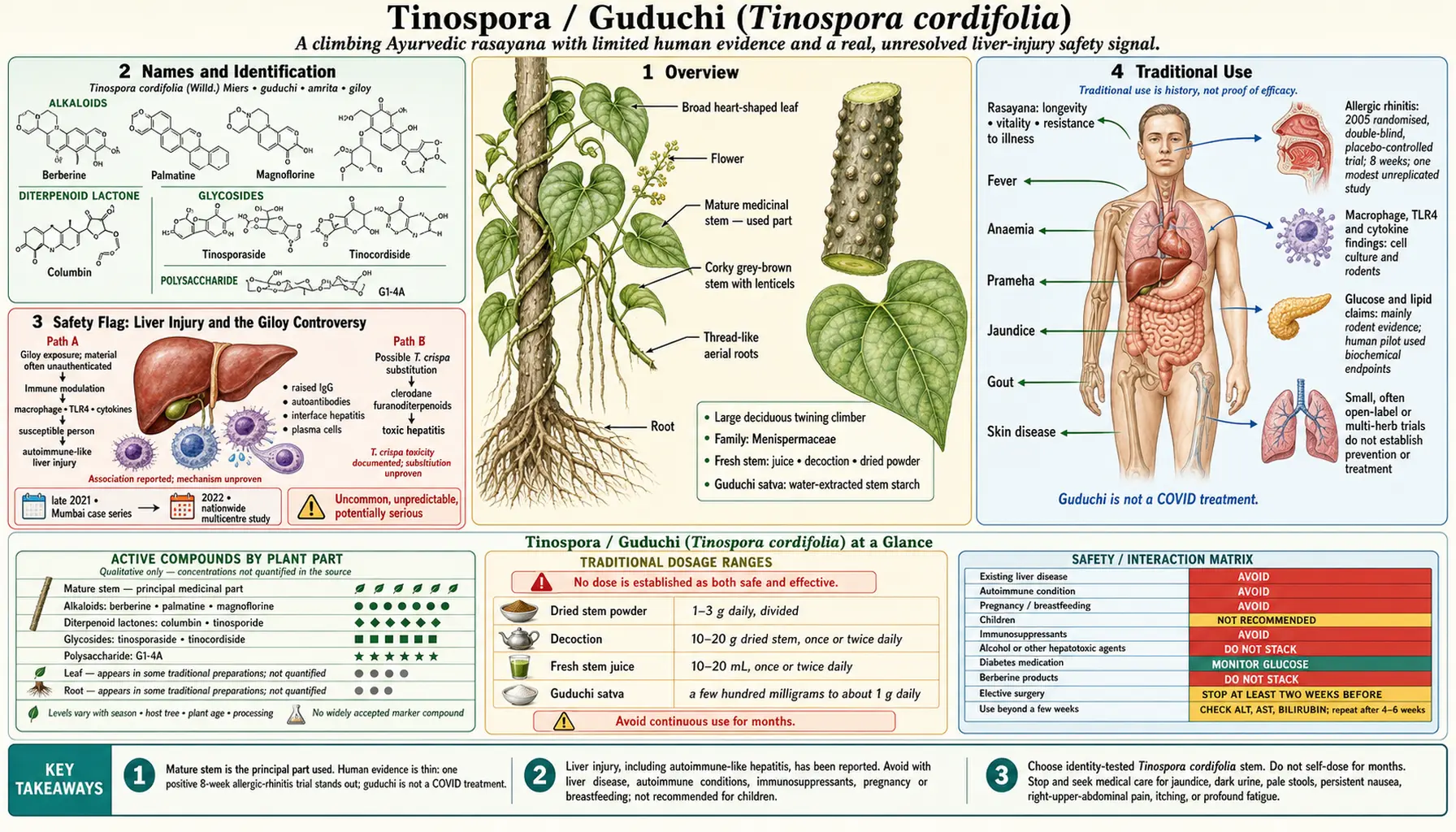
Guduchi — more commonly sold as giloy — is a climbing vine whose Sanskrit epithet is amrita, “the nectar of immortality.” It is one of the most important rasayana or rejuvenative herbs in Ayurveda, and during 2020 and 2021 its consumption in India rose enormously as a supposed immune booster against COVID-19. That surge is also when a serious safety signal appeared: Indian hepatologists published case reports and then a nationwide multicentre series describing acute liver injury, including autoimmune-like hepatitis, in people taking Tinospora cordifolia. The reports provoked a genuine national controversy, and India's Ministry of AYUSH responded that misidentification with the related and separately documented hepatotoxic species Tinospora crispa was a likely explanation. This page reports the whole picture: the cases are real, the species-confusion explanation is plausible but unproven, and either way the conclusion is the same — use authenticated material, do not self-dose casually for months on end. Outside that safety story, the human evidence for guduchi is thin: one decent randomised trial in allergic rhinitis, a great deal of animal immunology, and not much else.
Table of Contents
- Overview
- Names and Identification
- Safety Flag: Liver Injury and the Giloy Controversy
- Traditional Use
- Active Compounds
- Immune Modulation: What Is Actually Known
- The 2020–21 Giloy Boom and the COVID Evidence
- Allergic Rhinitis: The One Real Human Trial
- Blood Sugar and Metabolic Claims
- Forms and Preparations
- Dosage
- Cautions and Contraindications
- Key Research Papers
- Connections
- Featured Videos
Overview
Tinospora cordifolia is a large, deciduous, twining climber in the moonseed family, Menispermaceae. It scrambles up neem, mango and other host trees across India, Sri Lanka, Nepal, Bangladesh and Myanmar, and it is unmistakable once you know it: broad heart-shaped leaves, a corky, warty, greyish-brown stem with lens-shaped protuberances, and long thread-like aerial roots that hang straight down from the canopy like wires.
The part used is the stem, and specifically the mature stem — not the leaf, not the root, though both appear in some traditional preparations. Fresh green stems are cut, cleaned, and either juiced, decocted, or dried and powdered. A traditional water-extracted starch preparation called guduchi satva is made by pounding fresh stems in water and allowing the starch to settle out.
One piece of folklore that matters practically: Ayurvedic tradition holds that guduchi grown on a neem tree is the most potent, on the theory that the vine takes up the host's properties. There is no evidence for this transfer, but it is the reason “neem giloy” commands a price premium, and it is also a reason harvested material is variable.
The plant is remarkably tenacious — a cut segment of stem left on the ground will root and grow. That resilience is part of why it earned the name amrita, and part of why it is cheap and abundant, which in turn is part of why it became the default household immune remedy in India when people were frightened.
Names and Identification
Binomial: Tinospora cordifolia (Willd.) Miers. The basionym is Menispermum cordifolium Willd. — the name Willdenow gave it in the early nineteenth century before Miers transferred it to the genus Tinospora. You will occasionally see the older name in the literature. Some modern taxonomic databases now treat T. cordifolia as conspecific with Tinospora sinensis; that question is not fully settled and does not change anything clinically, but it explains inconsistent naming between sources. Family: Menispermaceae, the moonseed family — a family notable for containing a number of potently bioactive and in some cases frankly toxic plants.
- Sanskrit: guduchi, amrita (“nectar of immortality”), madhuparni
- Hindi: giloy, gurcha; Bengali: gulancha
- Marathi: gulvel; Tamil: seendil; Telugu: tippa teega
- English: heart-leaved moonseed, Indian tinospora, giloy
The identification issue that actually matters — Tinospora crispa. This is the single most important paragraph on the page after the safety flag itself.
- Tinospora cordifolia — guduchi, giloy. Indian subcontinent. Smoother stem with lenticels. The plant this page is about.
- Tinospora crispa — a different species, distributed through Southeast Asia, known as brotowali in Indonesia and Malaysia, boraphet in Thailand, dây ký ninh in Vietnam. Its stem is warty and knobbly rather than merely lenticellate. It is intensely bitter and is used traditionally for fever and malaria. T. crispa is documented to cause hepatitis: a 2018 study identified clerodane furanoditerpenoids as the probable cause of toxic hepatitis induced by T. crispa, following poisoning-centre reports in France.
The two vines look similar enough that untrained collectors confuse them, their ranges overlap, and both are traded as bulk dried stem. Because T. crispa has an established hepatotoxicity mechanism and T. cordifolia did not previously have one, species substitution is a genuinely serious hypothesis for what happened in India — not a face-saving excuse, though it has been used as one. It is also unproven, because the case reports overwhelmingly involved material patients had collected or bought informally, with no botanical authentication of what was actually consumed.
Safety Flag: Liver Injury and the Giloy Controversy
What was reported. In late 2021, a group of hepatologists in Mumbai published a case series in the Journal of Clinical and Experimental Hepatology describing patients who developed liver injury after consuming herbal “immune boosters” during the COVID-19 pandemic. The common exposure was Tinospora cordifolia — giloy. The pattern in several patients had autoimmune-like features: raised immunoglobulin G, autoantibodies, and liver biopsies showing interface hepatitis with plasma cells. Some patients required corticosteroid treatment; the illness was not trivial.
What happened next — the controversy. The paper landed in the middle of a national moment in which giloy was being promoted at the highest levels as a pandemic defence. India's Ministry of AYUSH publicly criticised the study, and the central objection was substantive rather than merely political: the authors had not botanically authenticated the material their patients consumed, and therefore could not exclude that some patients had taken Tinospora crispa, a related species with documented hepatotoxicity, rather than T. cordifolia. The exchange played out in letters and author responses in the journal.
What has been established since — and this is why the story did not simply go away.
- A multicentre nationwide study from India, published in Hepatology Communications in 2022, collected a substantially larger group of patients with giloy-associated liver injury from centres across the country. A single-centre series can be a fluke; a nationwide multicentre series is much harder to dismiss.
- International hepatology commentary took the signal seriously, with an editorial in the same journal that carried the original series debating whether the picture was drug-induced autoimmune-like hepatitis or unmasked de novo autoimmune hepatitis — a real diagnostic question, and not one you argue about over cases nobody believes.
- The Ayurvedic research community engaged with it directly, including a 2023 analysis in the Journal of Ayurveda and Integrative Medicine asking, in its own title, whether a well-known Ayurvedic hepatoprotectant can cause liver damage.
The honest summary, with nothing shaded in either direction:
- The cases are real. Patients developed genuine, sometimes severe liver injury temporally associated with taking giloy, documented at multiple centres in a nationwide series. This is not an anti-Ayurveda invention.
- The species-misidentification explanation is plausible and unproven. T. crispa is genuinely hepatotoxic with an identified compound class behind it, the two species are genuinely confused in trade, and the case series genuinely lacked botanical authentication. It is a real hypothesis. It has not been demonstrated for these patients, and it has not been shown to account for all of them.
- Neither explanation lets a consumer off the hook. If authenticated T. cordifolia can trigger autoimmune-like hepatitis in susceptible people, you should be cautious. If the problem is that the market is contaminated with a hepatotoxic look-alike, you should also be cautious — because you cannot tell the difference by looking at a powder in a jar. Both roads lead to: use botanically authenticated material from a manufacturer that identity-tests, and do not take it open-endedly for months without a reason and without monitoring.
- The risk is not evenly distributed. Enormous numbers of people took giloy in 2020–21 and the reported cases number in the tens to low hundreds. This looks like an idiosyncratic reaction — uncommon, unpredictable, and serious when it happens — rather than a dose-dependent poisoning that will affect everyone.
See Cautions for what this means in practice, including the symptoms that should make you stop immediately.
Traditional Use
Traditional use is history, not evidence of efficacy — but it explains why this plant carries the weight it does.
Guduchi is classified in Ayurveda as a rasayana: a category of rejuvenative substances taken over time to promote longevity, vitality and resistance to illness, rather than to treat a specific complaint. Alongside ashwagandha, it is among the most frequently prescribed rasayana herbs. Its classical indications include jvara (fever, especially chronic or recurrent fever), pandu (anaemia), prameha (a category overlapping with diabetes), jaundice, gout and skin disease. It is a constituent of long-established compound formulations such as guduchyadi kashaya and amritarishta.
It is worth pausing on one irony. Guduchi has classically been regarded as hepatoprotective — a liver-supporting herb, prescribed in jaundice. The modern safety signal concerns exactly the organ the tradition credits it with protecting. That is not proof the tradition was wrong; it is a reminder that traditional attribution and modern pharmacovigilance are measuring different things, and when they disagree, the pharmacovigilance data is the one collected with laboratory tests and biopsies.
The plant is also used in Sri Lankan and Nepali traditional medicine along similar lines, and T. crispa occupies an analogous fever-and-malaria niche in Thai, Malay and Indonesian practice.
Active Compounds
Tinospora cordifolia is chemically busy, which is part of the problem — a great many compounds have been characterised and very few have been connected to a human outcome.
Alkaloids. The stem contains berberine, palmatine, magnoflorine, jatrorrhizine and tembetarine. The presence of berberine is worth noting because berberine is itself a well-studied compound with real metabolic effects and real drug interactions — see Berberine. Guduchi contains it in small and variable amounts, so it is not a berberine source in any practical sense, but the shared chemistry is a reason to be careful about stacking the two.
Diterpenoid lactones. Columbin, tinosporide, tinosporin, jateorine and related furanolactone diterpenes. This is chemically the same broad territory as the clerodane furanoditerpenoids implicated in T. crispa hepatotoxicity, which is precisely why the species question is not a trivial one.
Glycosides. Tinosporaside, tinocordiside, cordifolioside A, syringin and related compounds. Tinocordiside and cordifolioside are frequently named in immunology work.
Polysaccharides. An arabinogalactan-type polysaccharide fraction designated G1-4A is the main target of the immunological research programme on this plant, studied for macrophage activation and Toll-like-receptor signalling. Essentially all of this work is in cell culture and in mice.
Others. Sesquiterpenoids, phenylpropanoid glycosides, sterols including β-sitosterol, and the starch fraction that forms guduchi satva.
A composition caveat that matters. Constituent levels vary markedly with season, host tree, plant age and processing. There is no widely accepted marker compound or standardisation for guduchi products. Two jars of “giloy powder” can differ substantially in chemistry, which limits how much any one study can tell you about the product on your shelf.
Immune Modulation: What Is Actually Known
The mechanism story. Preclinical work describes guduchi as an immunomodulator rather than a stimulant — the claim is that it nudges immune signalling in either direction depending on context. The G1-4A polysaccharide fraction has been reported to activate macrophages, engage Toll-like receptor 4 signalling, and shift cytokine production; other extracts have been reported to increase phagocytic activity, affect natural killer cell function and modulate interleukin production. A published review of the plant's immunomodulatory properties collects this literature.
The level of that evidence: cell culture and rodents. Nearly all of it. There is no body of human trial data showing that taking guduchi reduces the number of infections you get, shortens illness, or improves any clinical immune endpoint. Measuring a cytokine shift in a mouse is a starting point for research, not a demonstration that a person gets sick less often.
Why “immune booster” is the wrong frame anyway. Two reasons, and the second is directly relevant to this plant:
- An immune system turned up indiscriminately is not healthier. Autoimmune disease, allergy and cytokine-driven tissue damage are all consequences of immune activity in the wrong place. “More immune response” is not a goal.
- The autoimmune-like hepatitis reports are a coherent, if unproven, extension of exactly this mechanism. If a substance genuinely modulates immune signalling, then in a susceptible person tipping that signalling towards self-directed attack is a foreseeable failure mode rather than a bizarre coincidence. The immunology claim and the safety signal may be two views of the same property.
The 2020–21 Giloy Boom and the COVID Evidence
Understanding what happened in India during the pandemic explains both the scale of use and the emergence of the safety signal.
Giloy went from a familiar Ayurvedic ingredient to a mass-consumption product almost overnight. It was promoted in official AYUSH advisories on immunity, sold in every pharmacy as juice, tablets and kadha mixes, harvested from garden fences and boiled at home, and taken by a very large number of people daily, for months, at unmeasured doses, with no medical supervision, in the context of real fear. That combination — enormous exposure, prolonged duration, unstandardised material, informal sourcing — is exactly the setting in which an uncommon idiosyncratic reaction becomes visible in clinics.
What the COVID trials showed. Several randomised studies of Ayurvedic regimens containing guduchi were run and published, including a placebo-controlled pilot of an Ayurvedic treatment regimen in COVID-positive patients and a randomised open-label three-armed study of Adhatoda vasica and Tinospora cordifolia extracts in mild COVID-19. A living systematic review and meta-analysis of AYUSH prophylaxis against COVID-19 has attempted to pool this literature.
How to read those results honestly. The trials are mostly small, several are open-label rather than blinded, most tested multi-herb regimens in which guduchi is one component among several, and outcome measures vary. They do not establish that guduchi prevents or treats COVID-19. Meanwhile the disease itself is now managed with vaccines and specific antivirals whose evidence base is of a completely different order. Guduchi is not a COVID treatment, and it was never a substitute for vaccination. The most durable legacy of the giloy boom is, unfortunately, the hepatology literature it generated.
Allergic Rhinitis: The One Real Human Trial
Amid a great deal of preclinical work, guduchi does have one properly conducted human trial worth knowing about.
A randomised, double-blind, placebo-controlled trial published in the Journal of Ethnopharmacology in 2005 tested Tinospora cordifolia extract in patients with allergic rhinitis over eight weeks. The published results reported significant improvement compared with placebo in the cardinal symptoms — sneezing, nasal discharge, nasal obstruction and nasal itching — with associated changes on nasal smear examination.
How much weight to put on it. It is one trial, in a modest number of patients, at a single centre, published two decades ago, and it has not been replicated in a larger independent study. That is not enough to make guduchi a recommended treatment for hay fever. It is, however, a positive result from a properly designed study with a plausible mechanism behind it, and it stands out precisely because so little else in this plant's literature reaches that standard. It also fits the immunomodulation story better than the “booster” framing does: allergic rhinitis is an over-active immune response, and the trial suggested guduchi damped it down.
Blood Sugar and Metabolic Claims
Guduchi is traditionally used in prameha, and modern marketing translates this directly into diabetes claims.
Preclinical: a considerable body of rodent work reports reduced fasting glucose and improved lipid measures with various guduchi extracts, with proposed mechanisms including enhanced insulin secretion and inhibition of carbohydrate-digesting enzymes. Berberine content is sometimes invoked, though the amounts present are small and variable.
Human: sparse. A pilot study using integrated omics analysis examined a guduchi intervention in patients with hypertriglyceridaemia and reported modulation of multiple signalling pathways — interesting mechanistic work in humans, but a pilot with biochemical rather than clinical endpoints. A more recent randomised double-blind placebo-controlled trial tested a combination of Phyllanthus emblica and Tinospora cordifolia in acne, illustrating that human trials do exist but are scattered across unrelated indications rather than concentrated on any one.
The practical position. There is not enough human evidence to use guduchi as a glucose-lowering treatment. If you have diabetes and choose to take it anyway, monitor your blood sugar, because a theoretical additive effect with insulin or sulfonylureas cannot be excluded — and be aware that the liver-injury signal is a real cost to weigh against an unproven benefit. If your interest is metabolic, berberine as a discrete compound has a far better human evidence base than guduchi does.
Forms and Preparations
- Fresh stem juice (giloy juice, swaras) — the most traditional form and the one most heavily consumed during the pandemic. Also the one most likely to come from unauthenticated, informally harvested material.
- Decoction (kwath, kashaya) — dried stem simmered in water. Classical.
- Dried stem powder (churna) — convenient; identity is invisible once powdered.
- Guduchi satva — the settled starch fraction from pounded fresh stems. Traditionally regarded as cooling and gentler.
- Tablets and capsules — widely available. Look for the binomial Tinospora cordifolia and for a stated identity test.
- Standardised extracts — note that with no accepted marker compound, “standardised” on a guduchi label means less than it does for many other herbs.
- Classical polyherbals — amritarishta, guduchyadi kashaya and others. Imported Ayurvedic products carry an additional documented risk of heavy-metal contamination; see Toxins.
What to demand from a supplier. Given everything above, this is not fussiness: the species stated as Tinospora cordifolia in full; confirmation of botanical identity testing; the plant part stated as stem; third-party heavy-metal testing; and a manufacturer you can actually contact. Vine collected off a neighbour's fence is the exposure profile that generated the case reports.
Dosage
No dose of guduchi has been established as both safe and effective by adequate clinical trials. Traditional ranges follow; they are practice, not evidence, and the safety flag on this page argues for the conservative end of any of them.
- Dried stem powder: traditionally 1–3 g daily, in divided doses, usually with warm water or honey.
- Decoction: roughly 10–20 g of dried stem simmered and reduced, taken once or twice daily.
- Fresh stem juice: commonly 10–20 mL once or twice daily in Indian practice.
- Guduchi satva: traditionally a much smaller quantity, in the range of a few hundred milligrams to about 1 g daily.
- Duration — the most important line here. Do not take guduchi continuously for months. The reported liver-injury cases typically followed weeks to months of daily use. Traditional rasayana practice also uses courses with breaks rather than indefinite intake. A course of a few weeks with a clear reason, then a stop, is a far better pattern than open-ended daily dosing.
Cautions and Contraindications
Liver — the flag, restated because it is the point. Case reports and a multicentre nationwide series from India describe acute liver injury, including autoimmune-like hepatitis, associated with Tinospora cordifolia consumption, mostly following weeks to months of daily use during the 2020–21 giloy surge. Whether the cause was T. cordifolia itself or substitution with the hepatotoxic T. crispa is unresolved. What follows from that:
- Do not take guduchi if you have existing liver disease — hepatitis B or C, fatty liver disease, cirrhosis, or a previous episode of drug-induced liver injury.
- Do not take it if you have an autoimmune condition — autoimmune hepatitis obviously, but also lupus, rheumatoid arthritis, autoimmune thyroid disease, multiple sclerosis or inflammatory bowel disease. An immunomodulator with an autoimmune-flavoured safety signal is the wrong thing to add to an autoimmune disease.
- Do not stack it with other hepatotoxic agents, including regular alcohol, high-dose paracetamol/acetaminophen, methotrexate, isoniazid, or multiple concentrated herbal extracts at once.
- If you take it for more than a few weeks, check liver enzymes. A simple ALT, AST and bilirubin panel before starting and after four to six weeks is cheap and would have caught many of the reported cases early.
- Stop immediately and seek medical attention for yellowing of the eyes or skin, dark urine, pale stools, persistent nausea, right-upper-abdominal pain, itching, or new profound fatigue. Take the product with you so the clinician can see what you took.
Immunosuppressant drugs. Anyone on tacrolimus, ciclosporin, azathioprine, mycophenolate or a biologic — including transplant recipients — should avoid guduchi. A herb marketed for immune activation directly opposes the purpose of the medication, and the interaction has not been studied.
Diabetes medication. Possible additive glucose-lowering effect. Monitor if combining.
Berberine-containing products. Guduchi contains berberine among its alkaloids. Berberine has meaningful interactions with drug-metabolising enzymes and transporters. Taking guduchi alongside a berberine supplement, or alongside other Menispermaceae or Berberidaceae herbs, is unnecessary stacking of the same chemistry.
Pregnancy and breastfeeding. Avoid. There is no adequate safety data, the plant is an immune modulator, and the liver signal is unresolved. This is not a hedge; it is the correct answer given what is and is not known.
Children. Not recommended. Guduchi was given widely to children during the pandemic; that was not evidence of safety, and children were represented in liver-injury reporting from India.
Surgery. Stop at least two weeks before elective surgery, given possible glycaemic effects and unknown interactions with anaesthetic drug metabolism.
Species and quality — the one thing you control. Buy only material identified as Tinospora cordifolia by a supplier that performs botanical identity testing. Do not harvest wild vine yourself unless you can identify the species with certainty, and note that the two species are distinguished by stem texture, which is not a reliable field character for a non-botanist.
Key Research Papers
- Nagral A, Adhyaru K, Rudra OS, et al. Herbal immune booster-induced liver injury in the COVID-19 pandemic — a case series. Journal of Clinical and Experimental Hepatology. 2021;11(6):732–738.
- Kulkarni AV, Hanchanale P, Prakash V, et al. Tinospora cordifolia (giloy)-induced liver injury during the COVID-19 pandemic — multicenter nationwide study from India. Hepatology Communications. 2022;6(6):1289–1300.
- Björnsson ES, Navarro VJ, Chalasani N. Liver injury following Tinospora cordifolia consumption: drug-induced AIH, or de novo AIH? Journal of Clinical and Experimental Hepatology. 2022;12(1):6–9.
- Nagral A, Rudra OS, Adhyaru K, et al. Author response to letters on the manuscript “Herbal immune booster-induced liver injury in the COVID-19 pandemic — a case series”. Journal of Clinical and Experimental Hepatology. 2022;12(1):260–262.
- Panneer Selvam K, Payyappallimana U, Ravikumar K, et al. Can Guduchi (Tinospora cordifolia), a well-known ayurvedic hepato-protectant cause liver damage? Journal of Ayurveda and Integrative Medicine. 2023;14(1):100658.
- Cachet X, Langrand J, Riffault-Valois L, et al. Clerodane furanoditerpenoids as the probable cause of toxic hepatitis induced by Tinospora crispa. Scientific Reports. 2018;8(1):13520.
- Badar VA, Thawani VR, Wakode PT, et al. Efficacy of Tinospora cordifolia in allergic rhinitis. Journal of Ethnopharmacology. 2005;96(3):445–449.
- Yates CR, Bruno EJ, Yates MED. Tinospora cordifolia: a review of its immunomodulatory properties. Journal of Dietary Supplements. 2022;19(2):271–285.
- Verma M, Rawat N, Rani R, et al. Adhatoda vasica and Tinospora cordifolia extracts ameliorate clinical and molecular markers in mild COVID-19 patients: a randomized open-label three-armed study. European Journal of Medical Research. 2023;28(1):556.
- Thakar A, Panara K, Goyal M, et al. Ayush [Indian System of Medicines] prophylaxis against COVID-19: a living systematic review and meta-analysis (second update). Journal of Integrative and Complementary Medicine. 2024;30(7):602–619.
- Shirolkar A, Yadav A, Nale A, et al. Integrated omics analysis revealed the Tinospora cordifolia intervention modulated multiple signaling pathways in hypertriglyceridemia patients — a pilot study. Journal of Diabetes and Metabolic Disorders. 2022;21(1):379–397.
Live PubMed Searches
- Tinospora cordifolia — all literature
- Tinospora cordifolia and liver injury
- Tinospora crispa hepatotoxicity
- Guduchi polysaccharides and immunomodulation
- Guduchi / giloy in Ayurvedic research
- Tinospora cordifolia and blood glucose
- Drug-induced autoimmune-like hepatitis from herbals
- Botanical authentication and adulteration of herbal products
- Tinospora alkaloids including berberine
- AYUSH immune boosters during COVID-19 in India
Connections
- All Herbs
- Berberine — one of guduchi's own alkaloids, and a compound with a far stronger human evidence base for metabolic effects.
- Ashwagandha — the other major Ayurvedic rasayana, and another herb with its own reported liver-injury signal worth reading alongside this one.
- Toxins — herb-induced liver injury, species substitution and heavy-metal contamination in herbal products.
- Conditions on this site that reference this page: Autoimmune Hepatitis · Cirrhosis · Nephrology & Hepatology · Rheumatoid Arthritis