Dong Quai (Angelica sinensis)
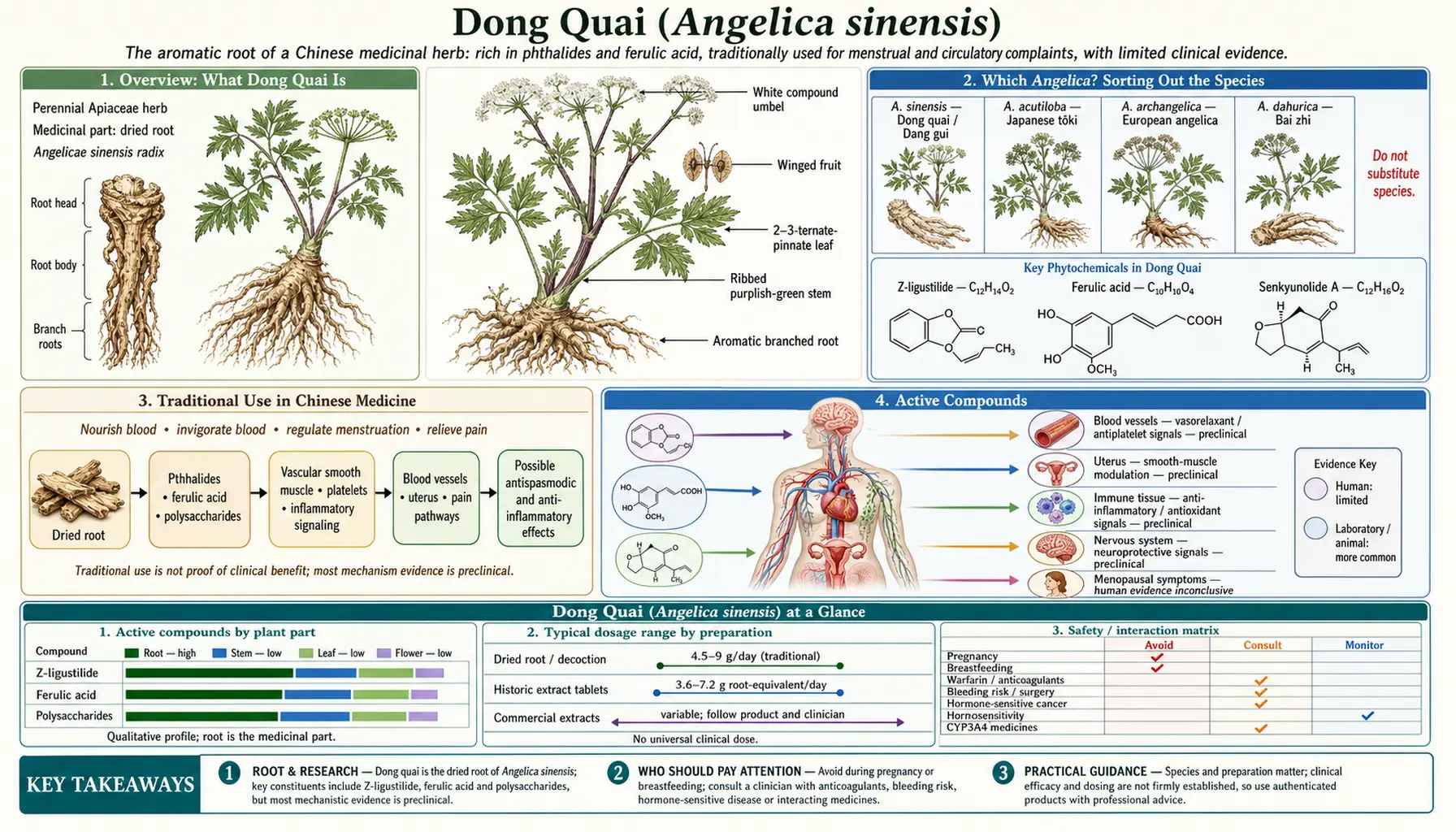
Dong quai is the dried root of Angelica sinensis, a tall umbellifer grown mostly in the cold, high valleys of Gansu province in western China. In Chinese medicine it is called dāng guī (当归) and it is one of the most heavily prescribed single herbs in the entire materia medica — not as a women's remedy, but as a blood tonic given to men and women alike for pallor, fatigue, dry constipation, poor healing, and pain from stagnant circulation.
In the West it is sold as "female ginseng," a name no classical Chinese text ever used, and it is marketed hard for hot flashes — an indication where the best controlled trial of the herb on its own found nothing. This page separates what dong quai has actually been shown to do from what it has been sold as doing, and it flags one genuinely serious interaction: dong quai plus warfarin has caused dangerous bleeding.
Table of Contents
- Overview: What Dong Quai Is
- Which Angelica? Sorting Out the Species
- Traditional Use in Chinese Medicine
- Active Compounds
- Menstrual Pain and Cycle Complaints
- Blood Building, Anemia, and the Iron Myth
- Menopause: What the Trials Actually Found
- Circulation, Platelets, and Blood Vessels
- Other Investigated Uses
- Forms and Preparations
- Quality: What to Look For on a Label
- Recommended Dosage
- Cautions and Contraindications
- Key Research Papers
- Conditions It Is Used For
- Connections
- Featured Videos
Overview: What Dong Quai Is
Angelica sinensis (Oliv.) Diels belongs to the carrot family, Apiaceae — the same family as celery, parsley, fennel, and lovage. If you have ever smelled a bag of dried dong quai, that warm, sweet, unmistakably celery-like aroma is the family resemblance, and it is also your first quality test. The smell comes almost entirely from a single volatile compound, Z-ligustilide, which is fragile. A root that smells of nothing has usually been sitting somewhere warm and bright for a long time.
The plant is a perennial reaching a metre or more, with the flat-topped compound flower head typical of the family. The medicinal part is the root, and only the root. In pharmacopeial language the drug is Radix Angelicae Sinensis — in Chinese dāng guī (当归), in Vietnamese đương quy, in Japanese tōki, although Japanese Kampo practice generally uses a related species rather than this one (see the next section).
Nearly all commercial dong quai comes from a narrow band of high-altitude farmland in Gansu province, with Min County (岷县) roots — sold as mín guī — treated as the benchmark grade. Growing it is fussier than most crops: seedlings are raised for a season, transplanted, and the root lifted in the autumn of its second year. If the plant bolts and flowers before harvest the root turns woody and hollow and is discarded, which is why growers manage seedling size and cold exposure so carefully. After lifting, roots are bundled and dried slowly in smoke sheds over low fires — a method that preserves the volatile oil far better than sun-drying, and gives high-grade dong quai its faint smoky top note.
The parts of the root have separate names
This is unusual, and it matters if you buy whole sliced root. Classical practice divides a single dong quai root into three:
- Dāng guī tóu (当归头) — the "head," the thick crown at the top.
- Dāng guī shēn (当归身) — the "body," the main fleshy taproot. This is the part used to tonify blood, and it is what you want if the goal is nourishing.
- Dāng guī wěi (当归尾) — the "tails," the fine branching rootlets. These are used to move blood and break up stagnation.
Whole root — head, body, and tails together — is quán dāng guī (全当归), and that is what most granule, tincture, and capsule products are made from. The distinction is not mystical: modern analyses of head, body, and tail do find different phthalide and polysaccharide ratios, the tails being proportionally richer in volatile oil. An old empirical rule survived contact with an HPLC machine.
Which Angelica? Sorting Out the Species
"Angelica" on a label tells you almost nothing. Several different plants in this genus are used medicinally, they contain different chemistry, and substitution — sometimes accidental, sometimes not — is a documented problem in the herb trade.
| Species | Common / trade name | What is distinctive |
|---|---|---|
| Angelica sinensis | Dong quai, dāng guī | The subject of this page. Root only. Rich in Z-ligustilide and ferulic acid; comparatively low in furanocoumarins. |
| Angelica archangelica | Garden angelica, European angelica | A completely different plant and a different tradition. Candied stems, and a flavouring in gin and Chartreuse. Much higher furanocoumarin content — this is the angelica that genuinely carries a photosensitivity concern. See Angelica. |
| Angelica dahurica | Bái zhǐ (白芷) | A Chinese herb for headache and sinus congestion, not a blood tonic. Loaded with furanocoumarins such as imperatorin and xanthotoxin. |
| Angelica pubescens | Dú huó (独活) | Used for damp, aching joints and low-back pain. Different indication, different chemistry. |
| Angelica acutiloba | Japanese tōki | The species Japanese Kampo normally uses where a Chinese formula calls for dāng guī. Related but not identical in phthalide profile. |
| Angelica gigas | Korean danggwi | Frequently the plant behind "Korean dong quai." Its main compounds are the pyranocoumarins decursin and decursinol angelate — chemistry quite unlike A. sinensis. Trials on A. gigas do not transfer to dong quai. |
The practical takeaway: if a product says only "Angelica root," "angelica extract," or "Korean dong quai," you do not know what you are taking. A label worth buying names Angelica sinensis and says root.
Traditional Use in Chinese Medicine
Dāng guī is classified as a blood tonic — a warming, moistening, sweet-and-acrid herb said to nourish blood, invigorate its movement, moisten the intestines, and relieve pain. In practice that maps onto a recognizable picture: someone pale, tired, dizzy on standing, with dry skin and dry stools, brittle nails, scanty or painful periods, or slow-healing injuries. Crucially, that picture is not sex-specific, and dāng guī has always been prescribed to men as freely as to women. It appears in classical formulas for trauma, abscesses, sores, chronic constipation in the elderly, and cold painful limbs.
"Female ginseng" is a modern Western marketing label, not a traditional Chinese designation. No classical source calls it that. The name spread through English-language supplement catalogues in the late twentieth century, and it has quietly distorted expectations ever since — it primes buyers to expect a hormonal effect the herb has never convincingly demonstrated, and it hides the indications where the traditional evidence is actually strongest.
Dāng guī is also almost never used alone. It is a formula herb, and four combinations account for a large share of its historical use:
- Sì Wù Tāng (四物汤, "Four Substance Decoction") — dāng guī with rehmannia, white peony, and chuanxiong. The foundational blood-nourishing formula and the base of dozens of gynaecological variants. Recorded in the Song-dynasty imperial formulary.
- Dāng Guī Bǔ Xuè Tāng (当归补血汤) — astragalus and dāng guī in a striking 5:1 ratio by weight, five parts astragalus to one part dāng guī, from Li Dongyuan's writings of 1247. The lopsidedness is the point and has been studied directly; see Astragalus.
- Dāng Guī Sháo Yào Sǎn (当归芍药散) — with white peony and three damp-draining herbs, from Zhang Zhongjing's Han-dynasty Jin Gui Yao Lue. Still widely prescribed in Japan as tōki-shakuyaku-san.
- Shí Quán Dà Bǔ Tāng (十全大补汤, "All-Inclusive Great Tonifying Decoction") — a ten-herb qi-and-blood tonic used for post-illness and post-surgical depletion.
The History page follows the herb from its earliest recorded appearance through to the modern research literature. Traditional use tells you what people looked for and what they believed they saw over a very long period. It is a reason to investigate. It is not evidence of efficacy, and the sections below are careful to keep the two apart.
Active Compounds
Dong quai root is chemically a two-part herb: a volatile oil fraction and a water-soluble polysaccharide fraction. They behave completely differently, they are extracted by different methods, and they are studied for different things — which is one reason a tincture and a decoction are not interchangeable.
The volatile oil: phthalides
Z-ligustilide is the dominant compound and typically makes up a large share — often reported around a third to a half — of the essential oil. It is what you smell. It relaxes smooth muscle in animal tissue preparations, which is the most plausible mechanism behind the herb's traditional use for cramping pain, and it is the compound most often credited with dong quai's activity in laboratory work.
Z-ligustilide is also notoriously unstable. It oxidizes and dimerizes on exposure to air, light, and heat, converting into senkyunolides, ligustilide dimers, and other breakdown products. This has real consequences: a dong quai product's phthalide content falls measurably during ordinary storage, published chemical analyses of "the same" herb often disagree, and a warm shipping container can do more to a bottle of dong quai than most buyers imagine. Related phthalides include butylidenephthalide, senkyunolide A, and n-butylphthalide.
Ferulic acid
Ferulic acid is a simple phenolic acid found throughout the plant kingdom — it is abundant in rice bran and wheat bran — and in dong quai it serves mainly as the quality marker. The Chinese Pharmacopoeia sets a minimum of roughly 0.05% ferulic acid by HPLC for the crude drug, alongside a minimum volatile-oil content. Ferulic acid has genuine antioxidant activity and mild antiplatelet activity in the laboratory, but nobody seriously argues it is the main reason dong quai works; it is measurable, stable, and cheap to assay, which is exactly what a marker compound needs to be. See Ferulic Acid.
Polysaccharides (ASP)
Angelica sinensis polysaccharides — usually abbreviated ASP in the literature — are large sugar polymers that stay behind in the water when you boil the root. This is the fraction studied for effects on blood cell production: in animal and cell models ASP has been reported to stimulate haematopoietic progenitor cells and increase erythropoietin expression. It is also the fraction that a decoction delivers well and an alcohol tincture largely does not. Almost all of the "dong quai builds blood" laboratory literature is really ASP literature.
Coumarins — and how few of them there are
Apiaceae plants are famous for furanocoumarins, and this is where a lot of secondhand writing about dong quai goes wrong. A. sinensis does contain coumarins, but at markedly lower levels than A. archangelica or A. dahurica. The blanket warning that dong quai causes photosensitivity is largely inherited from those other species rather than demonstrated for this one. That does not make the interaction warnings below optional — but it does mean the sun-sensitivity claim deserves an honest "probably overstated" rather than a repetition.
Menstrual Pain and Cycle Complaints
This is dong quai's strongest traditional indication and it is where the mechanism is most coherent, even though the human evidence is still thin.
The mechanism. Period pain is driven largely by prostaglandin-mediated contraction of the uterine muscle and by the reduced blood flow those contractions cause — the uterus is essentially cramping itself into brief ischaemia, which is why the pain feels the way it does. Z-ligustilide and butylidenephthalide relax smooth muscle in isolated tissue preparations, including uterine tissue in animal models, and phthalides have shown mild anti-inflammatory activity on the prostaglandin pathway. An herb that relaxes uterine smooth muscle and modestly dampens prostaglandin signalling is doing, in principle, something close to what a mild antispasmodic plus a weak NSAID would do.
The evidence. Here honesty is required. There is no large, well-designed, placebo-controlled trial of dong quai on its own for dysmenorrhoea. What exists is: a substantial body of animal and isolated-tissue work supporting the smooth-muscle mechanism; a long clinical tradition; and trials of multi-herb formulas containing dong quai, most often Sì Wù Tāng or its variants, several of which have reported reductions in menstrual pain. Formula trials cannot tell you what the dong quai contributed — that is a real methodological limit, not a technicality. Reviews of Chinese herbal medicine for dysmenorrhoea have generally concluded that the trials are promising but small, frequently poorly randomized or poorly blinded, and heterogeneous in what they actually tested.
So: plausible mechanism, favourable but low-quality clinical signal, no clean single-herb trial. That is a fair reason for a person with mild functional period pain to try it, and not a reason to expect it to outperform an NSAID. It is emphatically not a substitute for investigating pain that is severe, worsening, or accompanied by heavy bleeding — endometriosis, adenomyosis, and fibroids all need a diagnosis, not a tonic. The Menstrual Health and Cramps article goes through the specific trials.
Blood Building, Anemia, and the Iron Myth
"Blood tonic" is the closest thing dāng guī has to a job description in Chinese medicine, and it is the claim most often mistranslated into modern terms.
Correct the myth first: dong quai contains a negligible amount of iron. It is a dried root, not an organ meat or a legume. A 10 g daily dose supplies a trivial fraction of the iron an adult needs. If your fatigue is caused by iron-deficiency anaemia — the most common cause worldwide — dong quai will not fix it, and treating iron deficiency with dong quai instead of iron wastes months while ferritin keeps falling. Get the blood work done: a complete blood count plus ferritin, and B12 and folate if the red cells are large rather than small. The related claim that dong quai is a source of vitamin B12 also circulates widely and has no good support; B12 is produced by bacteria, and plants are not a reliable source of it.
What "blood tonic" actually meant. The classical concept is broader than haemoglobin. It bundles together pallor, dizziness, palpitations, dry skin and hair, scanty menses, and poor tissue repair — a picture of under-nourished tissue rather than a lab value. Some of that overlaps with anaemia. Much of it does not.
What the research shows. The interesting laboratory finding is that Angelica sinensis polysaccharides act on blood-cell production. In animal and cell studies ASP has been reported to promote proliferation of haematopoietic progenitor cells, to support recovery of blood counts in irradiated or chemically myelosuppressed animals, and to increase expression of erythropoietin — the kidney hormone that tells marrow to make red cells. Work on Dāng Guī Bǔ Xuè Tāng, the astragalus-heavy formula, has probed the famous 5:1 ratio directly and found that the ratio does change the chemical and biological profile of the decoction, which is a genuinely elegant validation of a 780-year-old prescription.
What has not been shown. None of this establishes that dong quai raises haemoglobin in human beings. The human trials are few, small, mostly of formulas rather than the single herb, and often lack the controls needed to attribute anything. It is honest to say the mechanism is interesting and the human endpoint is unproven. See Blood Building and Anemia for the details.
Menopause: What the Trials Actually Found
This is the indication dong quai is sold for in the West, and it is the indication where the evidence is worst. It deserves a blunt paragraph.
Dong quai on its own does not appear to relieve hot flashes. The reference trial is Hirata and colleagues, published in Fertility and Sterility in 1997. It randomized 71 postmenopausal women to dong quai root or placebo for 24 weeks — a long trial by the standards of the field — and measured hot-flush counts, the vaginal maturation index, and endometrial thickness. It found no significant difference on any of them. That is a negative result on the herb's flagship Western claim, from a properly blinded, placebo-controlled, reasonably long study.
Nothing published since has overturned it for single-herb dong quai. Laboratory work on whether the herb is oestrogenic at all is inconsistent: some assays show weak proliferative effects on breast cancer cell lines, others find no meaningful binding to oestrogen receptors, and the effects that do appear are often not blocked by anti-oestrogens, which argues they are not receptor-mediated at all. The fair summary is that dong quai has not been shown to be meaningfully oestrogenic in humans, and it should not be described as a "natural oestrogen" or a phytoestrogen in the way soy isoflavones are.
The strongest counter-argument, stated fairly. Practitioners of Chinese medicine make a legitimate objection to the Hirata design: dāng guī is never given as a solo herb for this purpose in the tradition it comes from. Testing it alone tests something no classical practitioner would prescribe. And some multi-herb preparations containing dong quai have performed better in small trials — a preliminary study of a dong quai plus chamomile combination reported a meaningful reduction in hot flushes, for instance.
That objection is worth taking seriously as a critique of study design. It is not a reason to conclude that the solo evidence is secretly positive. The solo evidence is negative, the combination trials are small and mostly weakly controlled, and the honest position is that if you buy a bottle of dong quai capsules for hot flashes, you are buying a product whose best trial found no effect. If you want treatments for vasomotor symptoms with real supporting data, that conversation should include Black Cohosh — itself a mixed story — and menopausal hormone therapy, which is far more effective than any botanical. The full trial-by-trial account is in Menopause: Evidence Review.
Circulation, Platelets, and Blood Vessels
Chinese medicine describes dāng guī as both nourishing blood and moving it, and this is the part of the traditional description with the clearest modern correlate — though the correlate is as much a warning as a benefit.
Ferulic acid and several phthalides inhibit platelet aggregation in laboratory assays. Ligustilide relaxes vascular smooth muscle in isolated vessel preparations, producing vasodilation. Extracts have shown effects on nitric oxide signalling and markers of vascular inflammation in animals. In China, oral and injectable Angelica preparations have been used adjunctively in circulatory conditions, with a substantial Chinese-language clinical literature that Western reviewers have generally judged to be of low methodological quality.
Two honest observations. First, the human cardiovascular evidence for dong quai is weak — small studies, surrogate endpoints, no hard outcome data. Nobody should treat it as a cardiovascular medication. Second, and more importantly, the same antiplatelet activity that makes the circulation story interesting is exactly what makes the bleeding interactions real. These are not two separate facts about the herb; they are one fact viewed from two directions. See Circulation and Cardiovascular.
Other Investigated Uses
- Constipation. Traditionally described as moistening the intestines, and used in classical formulas for dry, hard stools in the elderly and postpartum. One of its most consistent traditional uses and one of the least studied — no controlled trials of note.
- Wound healing and sores. Used in topical and internal formulas for abscesses, ulcers, and slow-healing wounds; laboratory work has looked at fibroblast proliferation and angiogenesis. Preliminary, not clinically established.
- Immune modulation. The polysaccharide fraction is immunomodulatory in cell and animal models, much as many plant polysaccharides are. A crowded and unconvincing corner of supplement marketing; treat claims accordingly.
- Pain and inflammation. Phthalides are anti-inflammatory in animal models, consistent with the traditional use for pain. Human data on the single herb are essentially absent.
- Marrow protection during cancer treatment. ASP has been studied in irradiated animals. Self-treating here is a bad idea — anyone in active cancer treatment must clear herbs with their oncology team, both for interaction risk and because antioxidant and immune-modulating agents can interfere with therapy.
Forms and Preparations
| Form | What it delivers | Notes |
|---|---|---|
| Sliced dried root (decoction) | Polysaccharides plus some volatile oil | The traditional form and the only one that delivers a full traditional dose. Simmered 20–30 minutes, usually with other herbs. Long boiling drives off volatile oil, which is why dāng guī is sometimes added later in the simmer. |
| Granules / concentrated powder | Roughly a decoction, reconstituted | Convenient and dose-transparent if the label states the crude-herb equivalent. The standard modern clinic form. |
| Tincture (alcohol extract) | Volatile oil and phthalides; little polysaccharide | Good for the antispasmodic side, poor for the "blood building" side. Not equivalent to a decoction, though it is routinely sold as if it were. |
| Capsules of powdered root | Everything, in a very small amount | The commonest Western form and the weakest. Two 500 mg capsules deliver 1 g of root against a traditional 6–12 g. This alone may explain a lot of disappointing self-experiments. |
| Standardized extract | Usually standardized to ferulic acid | Better than nothing, but ferulic acid is a marker, not the active principle. Standardization here is a quality signal, not a potency guarantee. |
Traditional processing (pao zhi)
Chinese pharmacy modifies dāng guī before use, and the processed forms are distinct items in a dispensary:
- Raw dāng guī — the default; nourishes blood and moistens the intestines.
- Wine-fried dāng guī (酒当归) — stir-fried with rice wine to emphasize the blood-moving, pain-relieving action. Used for menstrual pain and traumatic injury.
- Earth-fried dāng guī (土炒当归) — stir-fried with earth to reduce the laxative effect for people with loose stools.
- Charred dāng guī (当归炭) — carbonized, used traditionally for bleeding.
Quality: What to Look For on a Label
- Binomial and plant part. The label must say Angelica sinensis and root. "Angelica," "angelica extract," or an unqualified "dong quai" is not enough — see the species table above.
- Smell. Whole or sliced root should smell strongly sweet and celery-like. A faint smell means degraded ligustilide, which means old or badly stored product.
- Dose transparency. A good label states grams of crude herb, or the crude-herb equivalent of the extract. "Proprietary blend, 450 mg" tells you nothing.
- Third-party testing. Root crops concentrate soil contaminants; look for heavy-metal and pesticide testing, with a certificate of analysis available on request.
- Storage. Opaque container, cool, sealed, used within a year. Do not keep dong quai in a clear jar on a sunny shelf.
Recommended Dosage
The pharmacopeial and clinical range for the crude dried root in a decoction is 6–12 g per day, usually divided and almost always as part of a multi-herb formula. Some clinical situations use more under supervision.
- Decoction: 6–12 g dried sliced root per day, simmered with the rest of a formula.
- Granules: follow the label's crude-herb equivalent to land in the 6–12 g range.
- Tincture (1:5): commonly 2–5 mL up to three times daily. Understand you are taking the volatile-oil fraction, not a decoction.
- Capsules: typical products supply 500–600 mg per capsule, commonly taken as 1–2 capsules two or three times daily. Even at the top of that range you are well below a traditional decoction dose.
- Timing for menstrual complaints: traditional practice often starts a formula in the week before the period rather than taking it continuously. Many practitioners pause it during heavy flow because of the blood-moving action.
- How long before you judge it: tonic effects, if they come, are described as taking weeks — 4 to 8 weeks is a reasonable trial. Antispasmodic effects on cramps, if any, should be noticeable within a cycle or two. If nothing has changed in two or three months, it is not working for you.
Dong quai is a formula herb by tradition and by design. If you want to use it the way it has actually been used for two millennia, the sensible route is a qualified practitioner prescribing a formula, not a single-herb bottle from a shelf.
Cautions and Contraindications
Warfarin — the single most important item on this page
Do not combine dong quai with warfarin. There are published case reports of a marked rise in INR and prothrombin time, and of bleeding and extensive bruising, in patients who added dong quai to stable warfarin therapy. In the best-known report the anticoagulation measures more than doubled after several weeks of dong quai and normalized after it was stopped. Animal work has found that dong quai alters warfarin's pharmacodynamics — how much anticoagulation you get — without necessarily changing its blood levels, which means the usual reasoning about drug metabolism will not warn you in advance.
The mechanism is probably combined: coumarin constituents plus the antiplatelet activity of ferulic acid and the phthalides. Note that dong quai's coumarins are not themselves warfarin-like anticoagulants in the way spoiled-sweet-clover dicoumarol is; the effect appears to be additive on the clotting system rather than a straightforward chemical mimicry. The reason does not change the advice.
The same caution extends, with less documentation but the same logic, to direct oral anticoagulants (apixaban, rivaroxaban, dabigatran, edoxaban), heparins, clopidogrel and other antiplatelets, and regular aspirin. It also applies to stacking dong quai with other bleeding-risk botanicals — high-dose fish oil, ginkgo, garlic supplements, and high-dose vitamin E.
Surgery and dental procedures
Stop dong quai at least one to two weeks before any planned surgery or invasive dental work, and tell the anaesthetist and surgeon you were taking it. Herbal antiplatelet effects are a recognized perioperative bleeding risk and surgical teams routinely ask about them.
Pregnancy and breastfeeding
Avoid in pregnancy. Dāng guī has a long traditional reputation as a uterine stimulant and appears in formulas historically used to promote menstruation. There is no adequate human safety data. That combination — plausible uterine activity plus no safety studies — is a clear avoid, not a "probably fine." Data in breastfeeding are essentially absent, so the same conservative answer applies.
Photosensitivity — be accurate about this one
You will read everywhere that dong quai causes sun sensitivity. The claim is largely extrapolated from other Angelica species, especially A. archangelica and A. dahurica, which contain far higher furanocoumarin levels. A. sinensis contains comparatively little furanocoumarin, and photosensitivity clearly attributable to it is not well documented. The honest statement is: the risk is probably low and is frequently overstated, but if you are fair-skinned, taking high doses, or already on a photosensitizing drug such as a tetracycline, it is cheap to be careful about sun exposure while you find out.
Hormone-sensitive conditions
Standard supplement labels advise avoiding dong quai in breast, uterine, and ovarian cancer, endometriosis, and uterine fibroids. State the reasoning honestly: the evidence that dong quai is meaningfully oestrogenic is weak and inconsistent, so this warning is precautionary rather than demonstrated. Some cell studies show proliferative effects on hormone-responsive cell lines by mechanisms that appear not to involve the oestrogen receptor at all. Given genuine uncertainty and a serious downside if wrong, caution is reasonable — anyone with an oestrogen-receptor-positive cancer, current or past, should not take dong quai without their oncologist's agreement.
Other cautions
- Heavy menstrual bleeding. The blood-moving action can increase flow. Not a good choice for menorrhagia.
- Diarrhoea or loose stools. Dong quai is a mild laxative — in Chinese terms contraindicated in "spleen deficiency with diarrhoea," in plain terms likely to loosen your stools further.
- Bleeding disorders. Avoid in haemophilia, thrombocytopenia, and any diagnosed clotting disorder.
- Species substitution and contaminants. Both discussed above; quality risks, not theoretical ones.
- Delay of diagnosis. The biggest real-world harm from dong quai is probably not toxicity but months spent tonifying an anaemia, a thyroid problem, or an endometriosis that needed a diagnosis. Fatigue, heavy periods, and severe pelvic pain all warrant investigation.
Key Research Papers
Every entry below has been verified against its PubMed record — author list, title, journal, year, volume, issue and pages all confirmed to match — and the year/volume/pages link opens that exact record.
- Hirata JD, Swiersz LM, Zell B, Small R, Ettinger B. Does dong quai have estrogenic effects in postmenopausal women? A double-blind, placebo-controlled trial. Fertility and Sterility. 1997;68(6):981–986. — The reference negative trial: 71 postmenopausal women randomised to dong quai or placebo for 24 weeks, with no statistically significant difference in endometrial thickness, vaginal maturation index, number of vasomotor flushes, or Kupperman index.
- Hook ILI. Danggui to Angelica sinensis root: are potential benefits to European women lost in translation? A review. Journal of Ethnopharmacology. 2014;152(1):1–13. — Directly examines how the herb's traditional indications were reshaped on the way to the Western market.
- Wei WL, Zeng R, Gu CM, Qu Y, Huang LF. Angelica sinensis in China — a review of botanical profile, ethnopharmacology, phytochemistry and chemical analysis. Journal of Ethnopharmacology. 2016;190:116–141. — The most complete single review of the plant's chemistry and analysis.
- Chao WW, Lin BF. Bioactivities of major constituents isolated from Angelica sinensis (Danggui). Chinese Medicine. 2011;6:29. — Compound-by-compound account of ligustilide, ferulic acid, and the polysaccharides.
- Page RL 2nd, Lawrence JD. Potentiation of warfarin by dong quai. Pharmacotherapy. 1999;19(7):870–876. — The case report behind the most important safety warning on this page: a 46-year-old woman with atrial fibrillation, stable on warfarin, whose prothrombin time and INR more than doubled after four weeks of concurrent dong quai and returned to range a month after she stopped it.
- Lo ACT, Chan K, Yeung JHK, Woo KS. Danggui (Angelica sinensis) affects the pharmacodynamics but not the pharmacokinetics of warfarin in rabbits. European Journal of Drug Metabolism and Pharmacokinetics. 1995;20(1):55–60. — Why drug-level monitoring would not have predicted the interaction.
- Dong TTX, Zhao KJ, Gao QT, et al. Chemical and biological assessment of a Chinese herbal decoction containing Radix Astragali and Radix Angelicae Sinensis: determination of drug ratio in having optimized properties. Journal of Agricultural and Food Chemistry. 2006;54(7):2767–2774. — Puts the classical 5:1 Dang Gui Bu Xue Tang ratio to a laboratory test.
- Liu J, Burdette JE, Xu H, et al. Evaluation of estrogenic activity of plant extracts for the potential treatment of menopausal symptoms. Journal of Agricultural and Food Chemistry. 2001;49(5):2472–2479. — Screened eight menopause botanicals in vitro; dong quai and licorice "showed only weak ER binding and PR and pS2 mRNA induction," while red clover and hops were clearly active. Directly relevant to the weak-oestrogenicity question.
- Kupfersztain C, Rotem C, Fagot R, Kaplan B. The immediate effect of natural plant extract, Angelica sinensis and Matricaria chamomilla (Climex) for the treatment of hot flushes during menopause. A preliminary report. Clinical and Experimental Obstetrics and Gynecology. 2003;30(4):203–206. — 55 postmenopausal women, 12 weeks, placebo-controlled. Small, preliminary, combination product; the fairest example of the "combinations may do better" argument, and weak enough that it should not be oversold.
- Circosta C, De Pasquale R, Palumbo DR, Samperi S, Occhiuto F. Estrogenic activity of standardized extract of Angelica sinensis. Phytotherapy Research. 2006;20(8):665–669. — One of the studies on the other side of the oestrogenicity argument: a standardised ethanol extract did produce oestrogen-like changes in ovariectomised rats. Note that this is an animal study, and that Hirata's human trial found no such effect in women — read alongside Liu 2001.
Live PubMed Searches
- Angelica sinensis — clinical trials
- Dong quai and warfarin interaction
- Z-ligustilide pharmacology
- Angelica sinensis polysaccharide and haematopoiesis
- Dang Gui Bu Xue Tang
- Si Wu Tang and dysmenorrhoea
- Angelica sinensis, menopause, and hot flashes
- Ferulic acid and platelet aggregation
- Angelica sinensis authentication and adulteration
- Chinese herbal medicine for primary dysmenorrhoea — systematic reviews
Conditions Dong Quai Is Used For
Each condition below links to its page. The coloured half of every capsule shows how much human evidence supports this herb for that specific use — traditional use is history, not proof, and is marked as such.
Connections
- All Herbs
- Deep Dives: History and Traditional Use · Dong Quai Benefits · Menstrual Health and Cramps · Blood Building and Anemia · Circulation and Cardiovascular · Menopause: Evidence Review
- Angelica (Angelica archangelica) — the European garden angelica: a different plant, a different tradition, and far more furanocoumarin. Read this if you want to know why the two should never be conflated.
- Astragalus — dong quai's partner in Dang Gui Bu Xue Tang, at five parts astragalus to one part dong quai.
- White Peony — paired with dong quai in Si Wu Tang and Dang Gui Shao Yao San; the classic partner for cramping pain.
- Codonopsis — the qi tonic most often combined with dong quai when both qi and blood are said to be depleted.
- Black Cohosh — the Western botanical with the larger, though still mixed, evidence base for hot flashes.
- Chasteberry — the other herb commonly reached for in cycle complaints, with a different and better-defined mechanism.
- Ferulic Acid — dong quai's pharmacopeial marker compound, in its own right.
- Conditions on this site that reference this page: Non-Hormonal Options · Hot Flashes & Night Sweats