Butterfly Pea (Clitoria ternatea)
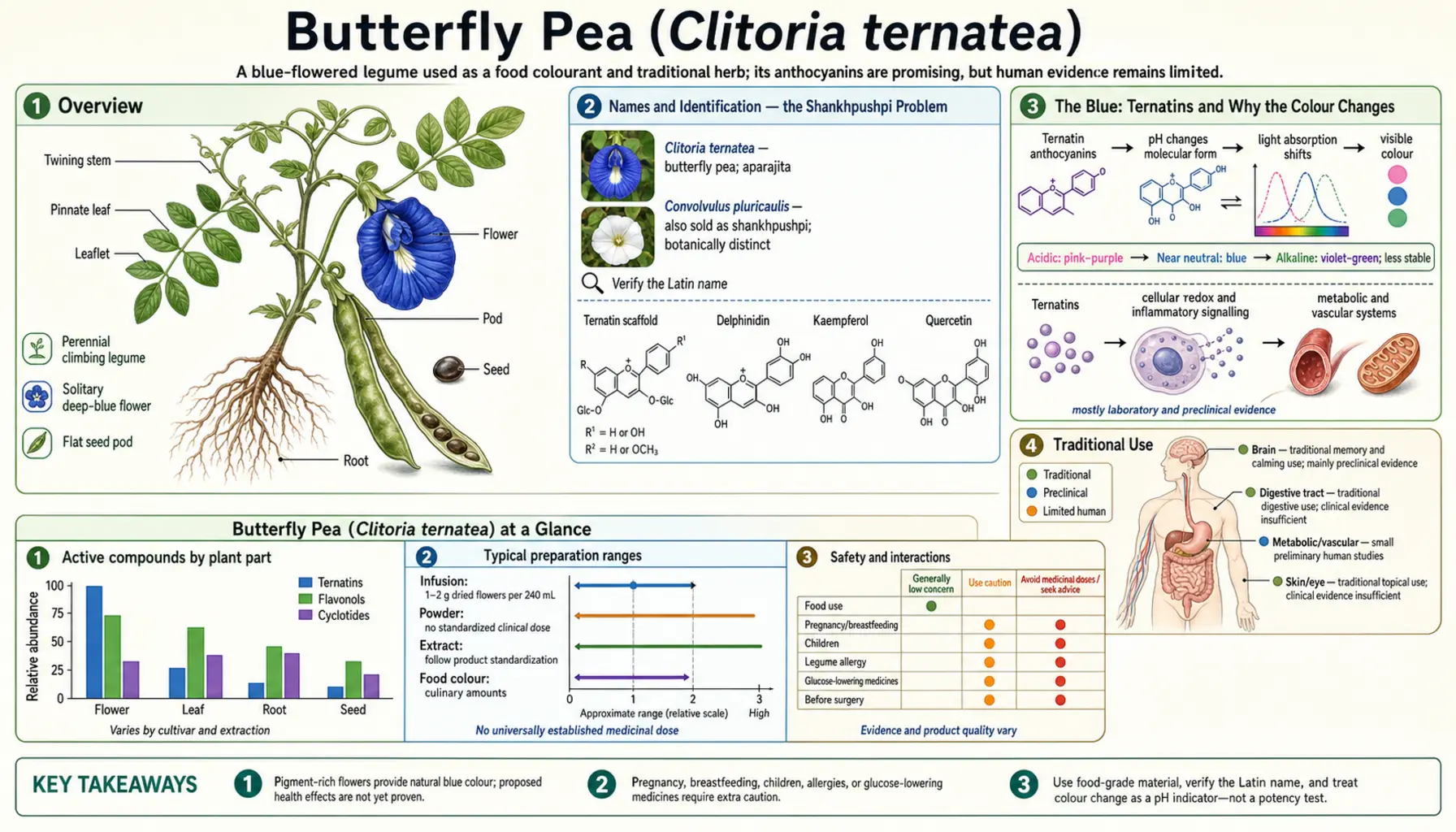
Butterfly pea is the flower behind every colour-changing cocktail and every startlingly blue "unicorn latte" you have seen in the last decade. Steep the dried flowers and you get an ink-blue infusion; squeeze in lemon and it turns violet, then pink, in front of you. That is not a gimmick or a dye — it is real acid–base chemistry happening in your glass, and it is the single biggest reason a Southeast Asian garden vine became a global ingredient.
The plant is a genuine food colouring with centuries of use in Thai and Malay kitchens, and it is a real Ayurvedic herb. What it is not is a proven brain supplement. The human evidence amounts to two small, short Thai trials measuring what happens in the three to six hours after a single drink — not memory studies, not long-term studies, and not in people with any diagnosed condition. The "improves memory" claim you will see on packaging comes from rodent experiments using root extract, which is a different part of the plant from the flowers in your teapot.
Drink it because it is beautiful, caffeine-free and interesting. Read the evidence section before you buy it as a nootropic.
Table of Contents
- Overview
- Names and Identification — the Shankhpushpi Problem
- The Blue: Ternatins and Why the Colour Changes
- Traditional Use
- Active Compounds
- Blood Sugar After a Meal
- Blood Fats and Antioxidant Status
- The Nootropic Claim — What the Data Actually Say
- Culinary Use
- Forms and Preparations
- Dosage — and How Little Is in a Cup
- Cautions and Contraindications
- Key Research Papers
- Connections
- Featured Videos
Overview
Clitoria ternatea L. is a slender perennial climbing vine in the pea family, Fabaceae. It scrambles over fences and trellises to three or four metres, has small compound leaves, and produces solitary flowers roughly five centimetres long. The wild single-petalled form is the deep blue with a white or cream throat that most people picture; there are also double-flowered cultivars, and white and mauve forms. After flowering it sets flat pea pods that are edible when very young.
It is native to tropical Asia — the species epithet ternatea refers to Ternate in the Moluccas, in eastern Indonesia — and is now naturalised or cultivated right across the tropics. Beyond the kitchen it has two other lives: as a nitrogen-fixing cover crop and cattle forage (Australian agriculture has bred cultivars for exactly this), and as the source plant for a commercial bio-insecticide.
The part used for tea and food colouring is the flower, picked and dried. The part used in classical Ayurvedic preparations is more often the root, sometimes the seed or whole plant. This distinction runs through the whole evidence discussion below and is routinely ignored in marketing.
Names and Identification — the Shankhpushpi Problem
Binomial: Clitoria ternatea L. Family: Fabaceae (Leguminosae), subfamily Faboideae. Linnaeus named the genus for the shape of the flower.
Local names:
- Thai: อัญชัน (anchan). Tea is nam dok anchan.
- Malay: bunga telang. Indonesian: bunga telang, kembang telang.
- Vietnamese: hoa đậu biếc ("iridescent-blue pea flower").
- Filipino: pukingan, or "blue ternate".
- Hindi: aparajita; Bengali: aparajita; Tamil: kakkanam; Sanskrit: aparajita, vishnukranta, and — contentiously — shankhpushpi.
- English: butterfly pea, blue pea, Asian pigeonwings, blue ternate, cordofan pea.
The ambiguity worth knowing. Shankhpushpi is not the name of one plant. It is an Ayurvedic drug name — a medhya rasayana, a mind-strengthening rejuvenative — and at least four unrelated species are sold under it in different parts of India:
- Convolvulus pluricaulis (Convolvulaceae) — the most widely accepted botanical source, and the one behind most of the published shankhpushpi research, including a 2022 umbrella review of its use in neurological disorders.
- Clitoria ternatea — this plant, used as shankhpushpi mainly in Bengal and parts of eastern India.
- Evolvulus alsinoides (Convolvulaceae) — dwarf morning glory, used as shankhpushpi in southern India.
- Canscora decussata (Gentianaceae) — used regionally.
The consequence is concrete: a study, a traditional citation or a product claiming "shankhpushpi improves memory" may be about a completely different plant than the one in your teapot. If a butterfly-pea supplement cites shankhpushpi research to justify a cognitive claim, check which species the research used. Very often it is Convolvulus pluricaulis.
One more collision: "blue pea" is also used loosely for other blue-flowered legumes, and Clitoria mariana and Centrosema species look similar. For culinary purposes, buy flowers labelled with the binomial.
The Blue: Ternatins and Why the Colour Changes
This is the most genuinely remarkable thing about the plant, and it is chemistry rather than pharmacology.
The pigments are ternatins — a family of polyacylated anthocyanins built on a delphinidin core. Japanese chemists led by Norio Terahara isolated and named them through the 1990s: ternatins A1–A3, B1–B4, C1–C5 and D1–D3, plus "preternatins" in young flowers. Structurally each is delphinidin 3,3′,5′-triglucoside with side chains on the 3′ and 5′ positions built from alternating glucose and p-coumaric acid units. The largest ternatins carry four coumaroyl groups on each of two side chains.
Why that architecture matters: ordinary anthocyanins are only stably coloured in acid. Raise the pH toward neutral and most of them fade to a dull grey-purple within minutes, which is why blue is such a rare colour in the natural-food-colour industry. The ternatins' long acylated side chains fold back and stack over the flat flavylium core — a phenomenon called intramolecular copigmentation — physically shielding it from attack by water. That is what lets butterfly pea hold a true blue in a near-neutral drink where other anthocyanins would collapse.
The colour change, step by step. Anthocyanins exist as several interconverting chemical forms, and which one dominates depends on pH:
- Strongly acidic (pH about 1–3, i.e. lemon juice): the red flavylium cation dominates — you see pink to magenta.
- Mildly acidic to neutral (pH about 4–7, plain water): the blue quinoidal base dominates — the classic butterfly-pea blue, shading violet in between.
- Alkaline (pH above about 8, e.g. with baking soda): the pigment shifts again toward green and then yellow-brown as the ring structure opens.
So the bartender's trick — pour lemon or lime into a blue infusion and watch it turn purple then pink — is a live acid–base titration you can drink. It is also the reason the plant went global: nothing else in the natural-colour cupboard does that on camera. As a household science demonstration for children it is excellent and completely safe.
Practical corollaries: your blue tea will turn purple if you add lemon, pink-ish if you add a lot; it will stay blue with plain water; it will go murky green in hard alkaline water; and it fades in strong light and heat over time, so store dried flowers in a dark airtight jar.
Traditional Use
In Thailand and Malaysia the primary traditional role is culinary. Anchan and bunga telang are colouring agents, first and foremost, used to turn rice, glutinous-rice cakes and drinks blue. That is a genuinely old use, embedded in festival and everyday cooking, and it is the use with the deepest safety record.
Alongside that sit folk-medical uses across the region: the flower infusion as a cooling drink and mild diuretic, and in Thai traditional practice a topical application of the flower for hair and scalp — the origin of the modern "blue shampoo" market.
In Ayurveda, aparajita / shankhpushpi is classified as a medhya rasayana: a category of drugs said to sharpen intellect, memory and speech. Traditional preparations use the root, seed or whole plant far more than the flower, in ghee-based or milk-based vehicles, and appear in formulations for epilepsy, anxiety, insomnia and children's speech delay. It is also a ritual flower offered to the goddess Durga.
All of this is history, and it is interesting history. It is not proof that any of it works. The Ayurvedic textual tradition also assigns those properties to at least three other species under the same name, which is a fair warning about how much diagnostic weight the name can carry.
Active Compounds
- Ternatins (polyacylated delphinidin anthocyanins) — the blue pigments described above. Also the main antioxidant constituents of the flower.
- Other flavonoids — kaempferol, quercetin and myricetin glycosides are present in the flower and leaf, and contribute to total polyphenol content.
- Phenolic acids — including p-coumaric acid, which also appears bound into the ternatin side chains.
- Cyclotides ("cliotides") — this is the genuinely unusual one. Clitoria ternatea is one of the few legumes known to make cyclotides: small, head-to-tail cyclic peptides knotted by three disulfide bonds, which makes them extraordinarily stable to heat and digestion. They have insecticidal activity, and the plant is the basis of a commercial bio-insecticide. Cyclotides are of real interest as drug scaffolds; they are not the reason anyone drinks the tea, and their behaviour after oral consumption in humans is not established.
- Triterpenoids, tannins and saponins — reported across plant parts in phytochemical surveys.
- Root constituents — the root, used in Ayurveda, contains a different profile including taraxerol and taraxerone. Root extracts are what the rodent nootropic studies used.
Blood Sugar After a Meal
Mechanism. Butterfly-pea flower extract inhibits α-glucosidase and pancreatic α-amylase in the test tube — the starch- and sugar-splitting enzymes in the gut. Slow those down and glucose enters the bloodstream more gradually after a carbohydrate load. This is the same principle behind the diabetes drug acarbose, though nothing here is remotely as potent.
The human trial. This is the best study on the plant. In a randomized crossover trial at Chulalongkorn University in Bangkok, 15 healthy young men (average age 22.5, average BMI 21.6) each drank five different 400 mL beverages on separate occasions: sucrose alone (50 g), butterfly-pea flower extract alone at 1 g and at 2 g, and sucrose plus each dose of extract. Blood was sampled over three hours.
Results. Thirty minutes after drinking, the sucrose-plus-extract combinations produced lower postprandial glucose and insulin than sucrose alone. The extract on its own did not lower fasting glucose — an important safety point, since it means it did not cause hypoglycaemia. Plasma antioxidant capacity rose after the extract by several measures (FRAP, ORAC, TEAC, protein thiol) and malondialdehyde, a marker of fat oxidation damage, fell.
How much weight to give it. Fifteen healthy, slim, young men. One drink. Three hours of measurement. No clinical endpoint — no HbA1c, no weight, no diabetes outcome, no repeat dosing. It is a real, well-conducted acute study and it supports the idea that this flower blunts a sugar spike a little. It does not show that drinking blue tea helps anyone manage diabetes over months, and nobody has tested that.
Blood Fats and Antioxidant Status
The same Thai group ran a companion study in a more relevant population. Sixteen overweight and obese men (average BMI 25.7) ate a high-fat meal on three occasions: alone, with 1 g of flower extract, and with 2 g. Blood was sampled for six hours.
What was found: at the 2 g dose, the rise in serum triglycerides after the fatty meal was reduced, free fatty acids at six hours were lower, and plasma antioxidant status (FRAP and thiol levels) and glutathione peroxidase activity were higher. What was not found: any difference in postprandial glucose between groups, and no change in the inflammatory cytokines interleukin-6, interleukin-1β or TNF-α.
Report that honestly: this is a small acute study with mixed results — positive on fats and antioxidant markers, flatly negative on inflammation and, in this population, on glucose. Sixteen people. One meal. Six hours.
The antioxidant point deserves a caveat of its own. "Raises plasma antioxidant capacity" is a laboratory measurement, not a health outcome. Assays like FRAP and ORAC measure the chemical reducing power of a blood sample; a rise after drinking a polyphenol-rich beverage is expected and has been demonstrated for coffee, tea, cocoa and fruit juice. It has repeatedly failed to translate into disease prevention when tested directly. Treat these results as evidence that the anthocyanins are absorbed and doing something measurable, not as evidence of benefit.
The Nootropic Claim — What the Data Actually Say
Butterfly pea is sold worldwide as a memory and brain herb. Here is the whole evidence base, plainly.
Animal work exists and is not trivial. Rodent studies going back to the early 2000s report that Clitoria ternatea extract improves performance in maze and avoidance learning tasks, increases acetylcholine content in the hippocampus, and inhibits acetylcholinesterase — the same enzyme targeted by donepezil in Alzheimer's disease. A 2020 study in Neurochemistry International characterized the nootropic and anticholinesterase activity of the root extract and proposed it as a candidate for cognitive decline.
Three things constrain what that means for you:
- The part is wrong. Most of this work uses root or whole-plant extract. Your tea is made from flowers. There is no basis for assuming the flower carries the same constituents at the same levels — the flower's distinguishing chemistry is the anthocyanins, which are not what these studies were investigating.
- The dose is wrong. Rodent nootropic studies typically use extract doses in the range of hundreds of milligrams per kilogram of body weight, given daily. Scaled to a person, that is a quantity of concentrated extract, not a cup of infusion.
- There are no human cognitive trials. Not positive ones, not negative ones. As of this writing there is no published randomized controlled trial of butterfly pea for memory, attention, mood or any cognitive outcome in humans. The two human trials that exist measured blood sugar, blood fats and antioxidant markers over a few hours.
The honest summary: the marketing has outrun the data by a wide margin. A plausible traditional use plus rodent data on a different plant part is a reason to run a trial, not a reason to make a claim. If cognition is what you are after, this page cannot tell you butterfly pea will help.
Culinary Use
This is where the plant is genuinely, uncontroversially good at something.
- Nasi kerabu — the blue rice of Kelantan on Malaysia's east coast, served with herbs, salted egg, fish crackers and a spiced coconut mixture. The blue comes from steeping bunga telang and cooking the rice in the coloured water. It is arguably the plant's most famous dish.
- Pulut tai tai / kuih tekan — Peranakan pressed glutinous rice cake, marbled blue and white, served with kaya jam.
- Nyonya kuih generally — the blue swirl in dozens of Straits Chinese steamed cakes.
- Nam dok anchan — the Thai blue flower drink, often with honey and a squeeze of lime, which is exactly when it turns violet. Served iced everywhere in Thailand.
- Trà hoa đậu biếc — the Vietnamese version, plain or with lemongrass.
- Colour-changing cocktails and lattes — the global bar-and-café use, built entirely on the pH trick.
- Young pods and shoots — eaten as a vegetable in parts of Southeast Asia when very young and tender.
As a natural colouring, butterfly pea has a real technical advantage over the alternatives: it is one of very few sources of stable natural blue, and the flavour is close to neutral — faintly grassy, faintly like a mild green tea — so it colours without tasting. That is why food manufacturers keep looking at it.
Forms and Preparations
- Whole dried flowers — the standard form and the best value. Deep indigo-blue when dry; a faded grey-blue means old or light-damaged stock. Store airtight, dark, dry.
- Tea bags and blends — usually blended with lemongrass, pandan or hibiscus. Note that hibiscus is acidic and will pull the colour toward purple in the cup.
- Flower powder / extract powder — concentrated, used by bartenders and bakers. Much stronger by weight; a pinch colours a litre.
- Capsules and supplement extracts — the form the cognitive claims attach to. Standardization is rare; anthocyanin content is often unstated.
- Cosmetic preparations — shampoos and hair oils, drawing on the Thai and Ayurvedic hair tradition. Topical use is not covered by the evidence above.
- Fresh flowers — if you grow the vine, the flowers work fresh; use roughly twice as many as dried.
How to brew. Eight to ten dried flowers in 250 mL of just-boiled water, steeped five minutes, gives a strong blue. It is caffeine-free, so it works in the evening. Add citrus at the table if you want the colour show — add it during steeping and you lose the blue immediately.
Dosage — and How Little Is in a Cup
There is no established therapeutic dose. What we can do is state honestly what the trials used versus what a cup contains.
- Trial doses: both Thai studies used 1 g or 2 g of concentrated flower extract in 400 mL of liquid, taken with a meal. Extract, not flowers — an extract represents the soluble material pulled from a considerably larger mass of dried flower.
- A home-brewed cup: eight to ten dried flowers weigh well under a gram in total, and only part of that dissolves. The anthocyanin dose in a cup of butterfly-pea tea is small — smaller, by any reasonable estimate, than what you get from a handful of blueberries or a glass of blackcurrant juice, both of which are far richer anthocyanin sources by weight.
- Culinary colouring: a tiny quantity, and diluted through a whole dish.
The practical conclusion follows: as a beverage, butterfly pea is best understood as a pleasant, caffeine-free, mildly polyphenol-containing drink — not as a dose of anything. If you want the amount used in the studies, you would need a standardized extract, and at that point you are taking a supplement whose long-term safety has not been studied.
Cautions and Contraindications
The overall picture is reassuring at food levels. Butterfly pea flowers have been eaten and drunk across Southeast Asia for a long time with no pattern of harm, and both human trials reported no adverse events. It is used as a food colouring in several jurisdictions. That is the correct baseline.
The gap is at high doses. Concentrated extracts and supplement capsules have not been tested for chronic use in humans. There are no long-term toxicity studies in people, no data on daily use over months, and no established upper limit. "Traditionally safe as a colouring" does not transfer to "safe as a daily gram-scale extract".
Specific points:
- Blood-sugar medication. The flower extract reduced post-meal glucose and insulin in a trial. It did not cause hypoglycaemia in the fasting state, which is reassuring, but if you take insulin or a sulfonylurea and start using concentrated extract regularly, monitor your readings.
- Pregnancy and breastfeeding. Culinary amounts as a colouring are traditional. Avoid concentrated extracts and supplements — there is no human safety data, and some traditional Indian sources list aparajita preparations among plants used to stimulate the uterus, which is reason enough for caution. Seed and root preparations in particular should be avoided.
- Legume allergy. This is a pea-family plant. If you have a significant legume allergy — peanut, soy, lupin, chickpea — the theoretical cross-reactivity risk is low but not zero. Try a small amount first.
- Seeds and roots are not the tea. Clitoria ternatea seeds have a traditional reputation as a purgative and can cause nausea, vomiting and diarrhoea in quantity. Buy flowers, not "whole plant" material, for beverage use.
- Surgery. Stop concentrated extracts two weeks before planned surgery, on the general principle applying to any supplement with plausible glucose or platelet effects.
- Children. Blue rice and blue drinks are ordinary children's food across Southeast Asia. Supplements are not, and should not be given.
- Do not substitute it for medication. Nothing on this page supports using butterfly pea in place of a diabetes drug, a lipid-lowering drug or a cognitive treatment.
Key Research Papers
- Chusak C, Thilavech T, Henry CJ, Adisakwattana S. Acute effect of Clitoria ternatea flower beverage on glycemic response and antioxidant capacity in healthy subjects: a randomized crossover trial. BMC Complementary and Alternative Medicine. 2018;18(1):6. The 15-man postprandial glucose trial discussed above.
- Thilavech T, Adisakwattana S, Channuwong P, et al. Clitoria ternatea flower extract attenuates postprandial lipemia and increases plasma antioxidant status responses to a high-fat meal challenge in overweight and obese participants. Biology (Basel). 2021;10(10):975. The 16-participant high-fat-meal trial.
- Terahara N, Oda M, Matsui T, et al. Five new anthocyanins, ternatins A3, B4, B3, B2 and D2, from Clitoria ternatea flowers. Journal of Natural Products. 1996;59(2):139–144.
- Terahara N, Toki K, Saito N, et al. Eight new anthocyanins, ternatins C1–C5 and D3 and preternatins A3 and C4 from young Clitoria ternatea flowers. Journal of Natural Products. 1998;61(11):1361–1367. The ternatin structural chemistry behind the colour.
- Oguis GK, Gilding EK, Jackson MA, Craik DJ. Butterfly pea (Clitoria ternatea), a cyclotide-bearing plant with applications in agriculture and medicine. Frontiers in Plant Science. 2019;10:645. The most comprehensive single review of the species.
- Damodaran T, Cheah PS, Murugaiyah V, et al. The nootropic and anticholinesterase activities of Clitoria ternatea Linn. root extract: potential treatment for cognitive decline. Neurochemistry International. 2020;139:104785. Rodent study — and note it used root, not flower.
- Adisakwattana S, Ruengsamran T, Kampa P, Sompong W. In vitro inhibitory effects of plant-based foods and their combinations on intestinal α-glucosidase and pancreatic α-amylase. BMC Complementary and Alternative Medicine. 2012;12:110.
- Sharma R, Singla RK, Banerjee S, et al. Role of shankhpushpi (Convolvulus pluricaulis) in neurological disorders: an umbrella review covering evidence from ethnopharmacology to clinical studies. Neuroscience and Biobehavioral Reviews. 2022;140:104795. On the other shankhpushpi — useful for seeing how the name is used.
Live PubMed Searches
- Clitoria ternatea — everything
- Clitoria ternatea clinical trials
- Ternatin anthocyanin stability
- Polyacylated anthocyanins and intramolecular copigmentation
- Butterfly pea as a natural blue food colourant
- Clitoria ternatea, memory and cognition
- Cliotides and cyclotides
- Clitoria ternatea toxicity and safety
- Shankhpushpi — the species question
- Anthocyanins and postprandial plasma antioxidant capacity
Connections
- All Herbs
- Anthocyanins — the pigment class the ternatins belong to, and the wider evidence on what anthocyanins do in the body.
- Sacred Lotus — another East and Southeast Asian flower with a large traditional reputation and a small trial literature.
- Hibiscus — the other great anthocyanin-red flower tea, and the one with much stronger human blood-pressure evidence.
- Chrysanthemum — a flower tea whose colour chemistry is dull but whose traditional use is better documented.
- Conditions on this site that reference this page: Alopecia · Insulin Resistance · Prediabetes