White Peony Root (Bai Shao)
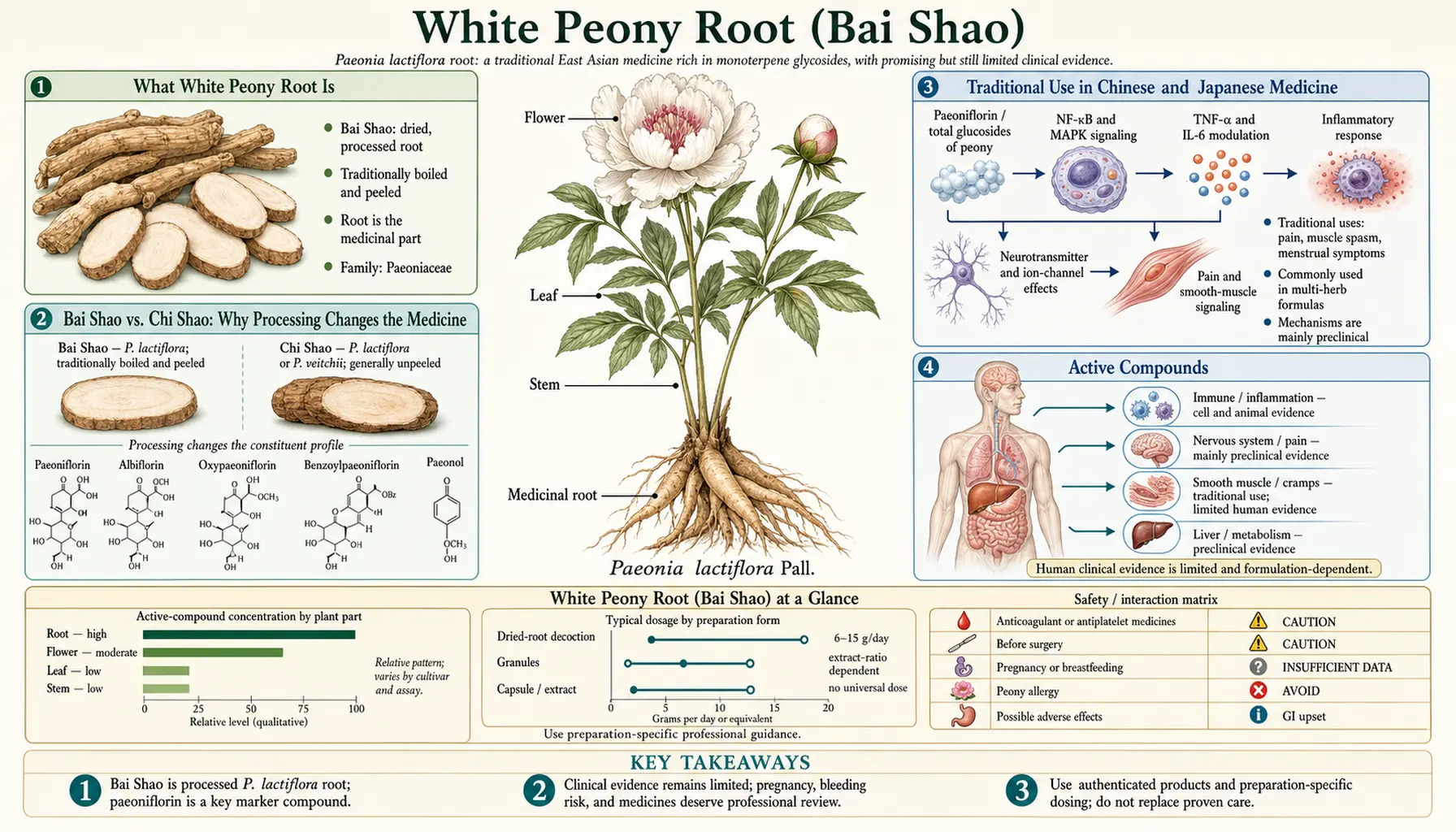
White peony root is the peeled, boiled root of Paeonia lactiflora Pall. — the same garden peony that fills flower beds every June, grown instead for its thick storage roots. In Chinese medicine it is called bai shao (白芯) and it is one of the most-prescribed herbs in the entire pharmacopoeia, appearing in classical formulas for menstrual pain, muscle cramps, abdominal spasm and irritability. It is also the only herb on this site whose standardized extract, Total Glucosides of Paeony (TGP), has been an approved prescription anti-rheumatic drug in China since 1998 — which makes the gap between that drug and the generic "white peony" capsule on a supplement shelf the single most important thing on this page.
Table of Contents
- What White Peony Root Is
- Bai Shao vs. Chi Shao: Why Processing Changes the Medicine
- Traditional Use in Chinese and Japanese Medicine
- Active Compounds
- Total Glucosides of Paeony: The Prescription Drug Made From This Root
- Rheumatoid Arthritis and Autoimmune Disease
- Muscle Cramps and Smooth-Muscle Spasm
- Menstrual Health, PCOS and Hyperandrogenism
- Liver Protection
- Forms and Preparations
- What to Look For on a Label
- Recommended Dosage
- Cautions and Contraindications
- Key Research Papers
- Conditions It Is Used For
- Connections
- Featured Videos
What White Peony Root Is
Paeonia lactiflora Pallas belongs to the family Paeoniaceae — a small family of about three dozen species that sits on its own branch of the flowering-plant tree, unrelated to the buttercups it was once lumped in with. The plant is a herbaceous perennial: it dies back to the ground each winter and regrows from a crown of fat, fleshy roots. Those roots are the medicine. The showy double-flowered peonies sold in nurseries are cultivars of this same species, which is why gardeners are often startled to learn their border plant is a pharmacopoeial drug.
The pharmacopoeial article is called Radix Paeoniae Alba (modern Chinese Pharmacopoeia Latin: Paeoniae Radix Alba). In Chinese it is 白芯 bái sháo — literally "white peony." In Vietnamese traditional medicine it is bạch thược. In Japanese Kampo the same root is shakuyaku.
Commercial bai shao is farmed, not wild-collected. The plants are grown for three to four years so the roots can bulk up, then lifted in summer or autumn. The rootlets and the crown end are trimmed off, the roots are briefly boiled in water, and the thin brown outer bark is scraped away, leaving a smooth, pale, ivory-to-pinkish cylinder that is then sun-dried and sliced crosswise into discs. The order of the two steps varies by producing region — some growers peel first and boil after — but boiling plus peeling is what defines the drug.
Production is concentrated in a handful of Chinese provinces, and the trade still uses regional names that function like appellations. Bo bai shao comes from Bozhou in Anhui province, which is also the site of China's largest herb wholesale market. Hang bai shao comes from the Hangzhou area of Zhejiang and has historically fetched the highest price. Chuan bai shao comes from Sichuan. Shandong is also a significant producer. The differences between them are real but modest — mostly root thickness, density and paeoniflorin content — and no clinical trial has ever compared one region against another.
Bai Shao vs. Chi Shao: Why Processing Changes the Medicine
This is the distinction that trips up nearly everyone who buys peony root, and it is worth getting right before you spend money.
Bai shao (白芯, white peony, Paeoniae Radix Alba) is the cultivated root of Paeonia lactiflora that has been boiled and peeled. Removing the bark strips out a large share of the tannins and leaves a starchy, pale root that is dense in monoterpene glucosides. In Chinese medicine bai shao is classified as a blood tonifier: it "nourishes blood," "softens the liver," "preserves yin" and relieves spasm and cramping pain.
Chi shao (赤芯, red peony, Paeoniae Radix Rubra) is the unpeeled, unboiled root, usually gathered from wild or semi-wild Paeonia lactiflora or from the related Paeonia veitchii Lynch. With the bark left on, it is darker, more astringent and much richer in tannins. Chinese medicine puts it in an entirely different category: chi shao "moves blood," breaks up stasis and clears heat. Traditional practice treats bai shao and chi shao as different drugs with different indications, and the modern chemistry supports the split — analytical comparisons of the two find substantially different profiles of gallotannins, oxypaeoniflorin and related constituents even when the paeoniflorin content overlaps.
A third plant gets confused with both. Paeonia suffruticosa, the tree peony, contributes a completely different drug: mu dan pi (牡丹皮), the root bark of a woody shrub, whose chemical marker is the simple phenol paeonol rather than paeoniflorin. Mu dan pi is not interchangeable with either bai shao or chi shao.
| Drug | Plant and part | Processing | Marker compound | Traditional role |
|---|---|---|---|---|
| Bai shao (white peony) | P. lactiflora, cultivated root | Boiled, outer bark peeled off, sun-dried | Paeoniflorin (≥1.6% by pharmacopoeial standard) | Nourishes blood, softens the liver, relieves spasm |
| Chi shao (red peony) | P. lactiflora (wild) or P. veitchii, root | Unpeeled, not boiled, dried | Paeoniflorin plus much higher tannin load | Moves blood, breaks stasis, clears heat |
| Mu dan pi (tree peony bark) | P. suffruticosa, root bark | Bark stripped from woody root, dried | Paeonol | Clears heat in the blood, cools deficiency fire |
The practical point: the entire body of clinical research described on this page was done on white peony — almost all of it on a standardized extract of white peony. If a product simply says "peony root," you cannot tell which of these three drugs is in the bottle.
Traditional Use in Chinese and Japanese Medicine
Peony root is one of the oldest continuously used herbs in East Asia; the History page covers the full record. In brief: peony ("shao yao") appears in the earliest surviving Chinese materia medica, and the split into separate white and red drugs was formalized in later commentaries and pharmacopoeias. By the Song dynasty the two were listed as distinct medicines, and bai shao had settled into the role it still occupies.
What matters clinically is that bai shao is almost never used alone. It is a formula herb, and the formulas it anchors are among the most-prescribed in Chinese and Japanese practice:
- Shao Yao Gan Cao Tang (芯药甘草汤) — peony and licorice in roughly equal parts. Two herbs, nothing else. Recorded in the Han-dynasty Shang Han Lun for cramping and spasm of the legs and abdomen. In Japan this is Shakuyaku-kanzo-to, one of the most widely dispensed Kampo formulas, and it is the preparation behind most of the muscle-cramp research.
- Si Wu Tang (四物汤) — the "Four Substance Decoction": peony, dong quai, rehmannia and ligusticum. The foundational blood-nourishing formula for menstrual irregularity, standardized in the Song-dynasty imperial formulary.
- Xiao Yao San (逾遥散) — the "Free and Easy Wanderer," combining peony with dong quai, bupleurum, atractylodes, poria, licorice, ginger and mint. Prescribed for the cluster of irritability, premenstrual tension, flank discomfort and digestive upset that Chinese medicine calls "liver qi constraint."
- Gui Zhi Tang (桂枝汤) — cinnamon twig and peony, the archetypal formula of the Shang Han Lun for the early stage of an externally contracted illness.
- Dang Gui Shao Yao San (当归芯药散) — peony with dong quai, ligusticum, poria, atractylodes and alisma. From the Jin Gui Yao Lue; used for lower-abdominal pain in pregnancy and, in modern Japanese practice, for menstrual disorders and cold extremities.
The through-line is unmistakable. Wherever the classical texts describe cramping, spasm, gripping abdominal pain, tight tendons or menstrual pain, peony is in the formula. That is a two-thousand-year observational signal about an antispasmodic, and modern pharmacology has largely borne it out.
Active Compounds
White peony root's chemistry is dominated by a distinctive family of monoterpene glycosides built on a cage-like "pinane" skeleton found almost nowhere else in the plant kingdom.
- Paeoniflorin — the principal constituent and the official quality marker. The Chinese Pharmacopoeia sets a minimum of 1.6% paeoniflorin in dried bai shao. Nearly every pharmacological effect attributed to the root has been tested with purified paeoniflorin at some point.
- Albiflorin — an isomer of paeoniflorin, present at lower levels. It is the constituent most often used analytically to tell bai shao from chi shao, and it has its own literature on anxiety and neuroprotection in animals.
- Oxypaeoniflorin and benzoylpaeoniflorin — related glucosides that vary between the white and red drugs and between growing regions.
- Gallotannins — gallic acid derivatives and related polyphenols. These are concentrated in the root bark, which is exactly why peeling makes bai shao chemically different from chi shao.
- Paeonol — present only in traces in white peony root. It is the dominant marker of tree-peony bark (mu dan pi), so a high paeonol reading in a "white peony" product is a red flag for substitution.
- Sugars, starch and small amounts of benzoic acid — the bulk matrix of the peeled root.
One pharmacological fact shapes everything downstream: paeoniflorin is a sugar-conjugated molecule and is poorly absorbed intact. Oral bioavailability in animal studies runs in the low single-digit percentages. Gut bacteria strip the sugar off, producing smaller metabolites that are absorbed more readily, which means the gut microbiome sits between the dose you swallow and the compound your bloodstream actually sees. That is a plausible part of why standardized, concentrated extracts behave differently from a cup of decoction — and why some of paeoniflorin's most convincing effects in animals show up at doses far higher than a person would ever reach from tea.
Total Glucosides of Paeony: The Prescription Drug Made From This Root
Read this section before you buy anything.
Total Glucosides of Paeony (TGP) is a purified, standardized extract of white peony root, normalized to roughly 40% or more paeoniflorin, with albiflorin, oxypaeoniflorin, benzoylpaeoniflorin and related glucosides making up most of the rest. It is not a food supplement. In China it has been an approved prescription drug since 1998, sold under the brand name Pafulin, and it is registered as a slow-acting, disease-modifying anti-rheumatic agent — the class that also contains methotrexate, sulfasalazine and hydroxychloroquine. The standard dose in trials is 600 mg two to three times daily, giving 1.2 to 1.8 grams per day.
Because it is a registered drug, TGP has been through the machinery that supplements never go through: fixed manufacturing specifications, batch assay for paeoniflorin content, and a large body of randomized controlled trials with published adverse-event tables. Several meta-analyses have pooled that trial evidence for rheumatoid arthritis, systemic lupus erythematosus, Sjögren's syndrome, psoriasis and oral lichen planus.
Now the honest caveats, because the evidence is real but it is not the same as a Western regulatory dossier:
- Almost all of the trials are Chinese, published in Chinese, and conducted in China. Single-country evidence bases are systematically more likely to report positive results than multinational ones, for reasons that include publication practice as well as genuine population differences.
- Trial quality is mostly moderate to low. Reviewers repeatedly flag inadequate description of randomization and allocation concealment, absent or unclear blinding, small sample sizes and short follow-up.
- Most trials test TGP as an add-on, layered on top of methotrexate or leflunomide, not as a standalone therapy. That is how it is used in practice, but it means "TGP works" really means "adding TGP to conventional therapy did better than conventional therapy alone" in those studies.
- No large Western regulatory trial exists. TGP is not approved by the FDA or the EMA and is not sold as a drug outside China.
And the part almost nobody is told: the "white peony root" capsule on a Western supplement shelf is not TGP. It is usually powdered whole root, or a modest 5:1 or 10:1 concentrate, with paeoniflorin content unstated and typically far below 40%. A 500 mg capsule of raw powdered root at the pharmacopoeial minimum of 1.6% paeoniflorin delivers about 8 mg of paeoniflorin. A 600 mg TGP dose at 40% delivers about 240 mg — roughly thirty times as much, three times a day. These are not the same product and the trial results do not transfer. If you read a study on TGP and then buy generic peony capsules expecting the same result, you have bought a different medicine.
Rheumatoid Arthritis and Autoimmune Disease
This is white peony's strongest evidence, and it belongs almost entirely to TGP.
The mechanism, in plain terms. Rheumatoid arthritis is a disease of immune overshoot: T cells and macrophages in the joint lining pour out inflammatory messengers — tumour necrosis factor alpha, interleukin-1 beta, interleukin-6, interleukin-17 — which recruit more immune cells and drive the synovium to erode cartilage and bone. Most modern RA drugs work by blocking one of those messengers outright. Paeoniflorin behaves differently in laboratory models: rather than knocking out a single cytokine, it appears to act as a bidirectional immune regulator, damping the overactive arms of the response (Th1 and Th17 signalling, NF-κB activation, macrophage cytokine output) while leaving, or even supporting, regulatory T-cell function. Think of it less as cutting a wire and more as turning down a thermostat that has been set too high.
That "immunoregulator rather than immunosuppressant" framing is exactly how Chinese rheumatologists describe it, and it explains the clinical positioning: TGP is added to methotrexate or leflunomide rather than replacing them, and it is used partly for something other than joint counts — see below.
What the human evidence shows. Meta-analyses of randomized trials in which TGP was added to methotrexate and/or leflunomide report better disease-activity outcomes than the conventional regimen alone. But the more distinctive and more reproducible finding is on the safety side: TGP appears to reduce the liver-enzyme elevations caused by methotrexate and leflunomide. Methotrexate hepatotoxicity is one of the main reasons patients have to reduce the dose or stop the drug, so an add-on that lets people stay on effective therapy is clinically meaningful even if its own anti-inflammatory contribution is modest. Several trials and at least one meta-analysis have looked specifically at this, and it is the finding a rheumatologist is most likely to find persuasive.
Beyond RA. Systematic reviews have also pooled TGP trials in systemic lupus erythematosus (reporting reduced disease activity and, notably, a steroid-sparing effect), in primary Sjögren's syndrome, in psoriasis as an add-on to conventional therapy, and in oral lichen planus. Each of those literatures carries the same limitations as the RA literature: Chinese-language, moderate quality, mostly add-on designs. Treat them as promising rather than settled.
The deep dive on this topic is Rheumatoid Arthritis and Autoimmunity. Related conditions are collected under Rheumatology.
Muscle Cramps and Smooth-Muscle Spasm
The antispasmodic use is the oldest and, outside China, the most widely practised.
The preparation. Peony is paired one-to-one with licorice root in the two-herb formula Shao Yao Gan Cao Tang — in Japan, Shakuyaku-kanzo-to, product code TJ-68, one of the Kampo formulas covered by Japanese national health insurance. Japanese physicians prescribe it routinely for painful muscle cramps, including the notoriously stubborn cramps that come with liver cirrhosis and with maintenance hemodialysis, and for cramping associated with lumbar spinal stenosis. It is often taken as needed at the onset of cramping rather than on a fixed schedule, because the onset of effect is reported to be fast.
The mechanism. In isolated-tissue and animal work, paeoniflorin relaxes both skeletal and smooth muscle, with effects on calcium handling and on neuromuscular transmission; the licorice component contributes its own antispasmodic activity, and the two are conventionally described as synergistic. Paeoniflorin also has documented analgesic activity in rodent pain models, with adenosine A1 receptor involvement identified in more than one study — a genuinely interesting mechanism, though one demonstrated in animals rather than people.
What the human evidence shows. There are small clinical studies — a preliminary study in hemodialysis patients, a dose-finding study in lumbar spinal stenosis, various Japanese case series — and a 2020 systematic review that gathered them. The honest summary: the studies are small, mostly Japanese, often open-label, and of limited methodological quality, but they point consistently in the same direction. This is a treatment with decades of routine clinical use behind it and a thin formal evidence base, which is a different situation from "unproven and untried" but is not the same as a well-powered randomized trial.
The catch, and it is a serious one. The licorice half of this formula causes pseudoaldosteronism with prolonged use — potassium loss, sodium retention and rising blood pressure. Low potassium itself causes muscle cramps and weakness. So the very formula prescribed for cramps can, taken continuously for weeks or months, produce cramps and weakness through a completely different mechanism. Japanese case reports of severe hypokalemia from Kampo formulas containing licorice are not rare, and pharmacovigilance database studies have quantified the signal. See Cautions — this is the single most important safety issue on this page.
Full detail is in Muscle Cramps and Spasm.
Menstrual Health, PCOS and Hyperandrogenism
Peony is in nearly every classical Chinese formula for menstrual complaints — Si Wu Tang, Xiao Yao San, Dang Gui Shao Yao San. In traditional terms it "nourishes blood" and "relaxes the liver," which maps loosely onto the modern cluster of cramping pain, premenstrual irritability and irregular cycles.
The PCOS claim, and how strong it actually is. Peony-and-licorice is widely marketed for polycystic ovary syndrome on the basis that it lowers testosterone. The origin of that claim is a small body of Japanese research from the late 1980s and early 1990s, the best known being a 1994 study of TJ-68 (Shakuyaku-kanzo-to) in women with polycystic ovarian disease, which reported that serum testosterone fell over several weeks of treatment and that some participants resumed ovulation.
Here is the plain assessment: this evidence is small, old, single-country and preliminary. The studies enrolled very small numbers of women. They were not, for the most part, randomized against placebo. They have not been replicated in a large modern trial, and there is no Western randomized controlled trial of peony-and-licorice in PCOS at all. Proposed mechanisms — inhibition of ovarian androgen synthesis, effects on aromatase activity — come largely from in-vitro work.
That does not make the finding worthless. Lowering androgens is a coherent, measurable endpoint, and the reported effect was in the expected direction. But anyone told that "peony and licorice is proven for PCOS" is being oversold. And the therapy has a specific problem in this population: PCOS strongly overlaps with insulin resistance, metabolic syndrome and elevated blood pressure — and the licorice half of this formula raises blood pressure and depletes potassium with continued use. Long-term daily peony-and-licorice for PCOS is exactly the scenario in which pseudoaldosteronism develops.
For hormonal cycle support with a different evidence profile, compare chasteberry; for menopausal symptoms, black cohosh. Full detail is in Menstrual Health and PCOS.
Liver Protection
Chinese medicine assigns bai shao to the Liver channel and describes it as "softening the liver" — a functional idea about irritability and tension rather than an anatomical one. Modern research has nonetheless found real hepatic activity.
The clinically grounded piece is the one already described under rheumatoid arthritis: TGP given alongside methotrexate and leflunomide is associated with fewer and smaller transaminase elevations than those drugs alone. That is a human finding, measured with ordinary liver-function tests, in people who needed the protection.
The preclinical piece is broader and weaker. In rodents, TGP and paeoniflorin reduce liver injury from carbon tetrachloride and other toxins, and reduce markers of fibrosis in cirrhosis models, with proposed mechanisms including antioxidant activity, suppression of inflammasome signalling and inhibition of stellate-cell activation. This is genuine, reproducible animal work — and it is animal work. It supports a hypothesis; it does not establish that peony treats human liver disease. Nobody should substitute peony root for treatment of hepatitis, fatty liver or cirrhosis on the strength of it.
See Liver Protection for the detailed evidence review.
Forms and Preparations
- Dried sliced root (sheng bai shao) — the raw drug, pale cream discs, decocted in water. This is what a licensed practitioner dispenses in a formula. Traditionally favoured for nourishing liver yin.
- Stir-fried root (chao bai shao) — dry-fried until faintly yellow. Traditionally considered gentler on the digestion and preferred when there is loose stool. Wine-fried (jiu bai shao) and vinegar-fried variants exist for other traditional indications.
- Granulated formula extracts — concentrated decoctions dried to granules, the standard dispensing form in Japan (Kampo) and increasingly in China and the West. Shakuyaku-kanzo-to is normally supplied this way, in 2.5 g sachets.
- Total Glucosides of Paeony (TGP) — the standardized pharmaceutical, typically 300 mg capsules dosed at 600 mg two to three times daily. A prescription drug in China; not marketed as a drug in the United States or Europe.
- Generic "white peony root" supplement capsules — usually powdered root or a modest concentrate. Widely available, cheap, and not equivalent to TGP.
- Tinctures — less common in East Asian practice, more common in Western herbalism. Paeoniflorin is water-soluble, so a high-alcohol tincture is not an obviously superior extraction.
What to Look For on a Label
Because "white peony" on a bottle can mean almost anything, here is what actually distinguishes a product worth buying:
- The botanical name and the part. It should say Paeonia lactiflora, root. If it says only "peony," or names Paeonia suffruticosa, or does not name the part, put it down — those are different drugs.
- "White" or "Alba," explicitly. Paeoniae Radix Alba or "bai shao" tells you it is the peeled, boiled root. "Red peony," "chi shao" or Radix Paeoniae Rubra is a different medicine with a different traditional indication.
- A stated paeoniflorin percentage. This is the whole game. Raw root is around 1.6–3%. A 10:1 concentrate might reach the high single digits. TGP is 40%+. If the label gives no percentage, assume it is low. If it claims to match the RA trials, it must state a paeoniflorin figure in the TGP range — and almost none do.
- Whether licorice is in it. Many "peony" products for cramps or PCOS are actually peony and licorice. That combination has the pseudoaldosteronism risk described below, and you need to know it is there. "Deglycyrrhizinated" licorice (DGL) does not carry that risk — but it also is not what was used in the cramp studies.
- Third-party identity testing. Peony is a species where adulteration and substitution between the three related drugs is a documented problem. A certificate of analysis that identifies the species and assays paeoniflorin is worth paying for.
Recommended Dosage
| Preparation | Typical dose | Notes |
|---|---|---|
| Dried root, decoction (TCM) | 6–15 g per day of dried root | The standard pharmacopoeial range. Simmered in water, almost always within a multi-herb formula rather than alone. |
| Total Glucosides of Paeony (TGP) | 600 mg, two to three times daily (1.2–1.8 g/day) | The dose used across the Chinese RA trials. Prescription drug in China. Onset is slow — trials generally run 12 weeks or longer before judging effect. |
| Shakuyaku-kanzo-to (Kampo granules) | Japanese labelling is around 7.5 g/day of extract granules in two to three divided doses | Frequently used as-needed at cramp onset rather than daily. Because of the licorice content, continuous daily use is where the pseudoaldosteronism risk concentrates. |
| Generic supplement capsules | Manufacturer-dependent, commonly 500–1,000 mg of powdered root | No trial evidence exists at these doses of this material. Do not assume equivalence to TGP. |
Peony is a slow-acting herb in every context it is used. TGP trials in rheumatoid arthritis typically require three months before differences emerge. Nobody should expect a response in a week.
Cautions and Contraindications
Diarrhea and loose stools — the most common adverse effect. Across the TGP trials, gastrointestinal upset is the dominant complaint, and loose stools or diarrhea affect on the order of 10% of users. It is usually mild, often settles with continued use or a dose reduction, and is the main reason people discontinue. Anyone with an already-loose bowel pattern, IBS-D or inflammatory bowel disease should start low.
Licorice-induced pseudoaldosteronism — the serious one. This applies to any peony product that contains licorice, including Shao Yao Gan Cao Tang and Shakuyaku-kanzo-to. Glycyrrhizic acid from licorice is converted to glycyrrhetinic acid, which blocks the kidney enzyme 11β-hydroxysteroid dehydrogenase type 2. That enzyme normally deactivates cortisol before it can reach the mineralocorticoid receptor; blocking it lets cortisol act like aldosterone. The result is sodium and water retention, potassium loss, rising blood pressure, and in severe cases profound hypokalemia with muscle weakness, cardiac arrhythmia or rhabdomyolysis. Documented case reports exist, Japanese pharmacovigilance databases carry a clear signal, and the risk rises with dose and duration. Practical rules:
- Do not take licorice-containing peony formulas continuously for months without supervision.
- Have potassium and blood pressure checked if you use one regularly.
- Avoid entirely if you have hypertension, heart failure, kidney disease, low potassium, or take diuretics, digoxin or corticosteroids.
- Remember that hypokalemia causes cramps — so worsening cramps on a cramp remedy is a warning sign, not a reason to take more.
Interaction with immunosuppressants. TGP is used deliberately alongside methotrexate and leflunomide in China, and the trial data on that combination is reassuring on liver enzymes. But peony's own immune-modulating activity means the combination should be a decision made with your rheumatologist, not added silently. If you take methotrexate, azathioprine, mycophenolate, ciclosporin, a biologic or a JAK inhibitor, tell the prescriber before adding peony in any form.
Anticoagulants and antiplatelets. Peony constituents have shown antiplatelet activity in laboratory work. Clinical bleeding events attributable to white peony are not well documented, but caution is reasonable with warfarin, direct oral anticoagulants, clopidogrel or high-dose aspirin, and around surgery.
Pregnancy and breastfeeding. Safety data are insufficient. Peony appears in classical formulas used during pregnancy, notably Dang Gui Shao Yao San, but traditional use is not a safety study and modern data are lacking. Do not self-prescribe peony in pregnancy or while breastfeeding.
Children. No established pediatric dosing outside supervised traditional practice.
Species substitution. Buying "peony" without a botanical identity risks receiving red peony or tree-peony bark instead, with different actions and different traditional contraindications.
What peony is not. It is not a substitute for disease-modifying therapy in rheumatoid arthritis or lupus, not a treatment for liver disease, and not a fertility drug. The best-supported role for TGP in the published literature is as an adjunct that improves tolerability of conventional therapy — a genuinely useful role, and a narrower one than most marketing suggests.
Key Research Papers
- Mu X, Luan R, Gao Y, et al. The Traditional Applications, Phytochemistry, Pharmacology, Pharmacokinetics, Quality Control and Safety of Paeoniae Radix Alba: A Review. The American Journal of Chinese Medicine. 2024;52(8):2337–2376.
- Ma W, Ren H, Meng X, et al. A review of the ethnopharmacology, phytochemistry, pharmacology, pharmacokinetics and quality control of Paeonia lactiflora Pall. Journal of Ethnopharmacology. 2024;335:118616.
- Parker S, May B, Zhang C, et al. A Pharmacological Review of Bioactive Constituents of Paeonia lactiflora Pallas and Paeonia veitchii Lynch. Phytotherapy Research. 2016;30(9):1445–1473.
- Liu J, Chen L, Fan CR, et al. Qualitative and quantitative analysis of major constituents of Paeoniae Radix Alba and Paeoniae Radix Rubra by HPLC-DAD-Q-TOF-MS/MS. Zhongguo Zhong Yao Za Zhi (China Journal of Chinese Materia Medica). 2015;40(9):1762–1770.
- Liu B, Meng X, Ma Y, et al. Clinical safety of total glucosides of paeony adjuvant therapy for rheumatoid arthritis treatment: a systematic review and meta-analysis. BMC Complementary Medicine and Therapies. 2021;21(1):102.
- Huang Y, Wang H, Chen Z, et al. Efficacy and safety of total glucosides of paeony combined with methotrexate and leflunomide for active rheumatoid arthritis: a meta-analysis. Drug Design, Development and Therapy. 2019;13:1969–1984.
- Xiang N, Li XM, Zhang MJ, et al. Total glucosides of paeony can reduce the hepatotoxicity caused by methotrexate and leflunomide combination treatment of active rheumatoid arthritis. International Immunopharmacology. 2015;28(1):802–807.
- Gong X, Li H, Guo H, et al. Efficacy and safety of total glucosides of paeony in the treatment of systemic lupus erythematosus: A systematic review and meta-analysis. Frontiers in Pharmacology. 2022;13:932874.
- Cui YY, Abdukiyum M, Xu XF, et al. Efficacy and safety of total glucosides of paeony in treating primary Sjögren's syndrome: a propensity-matched study. European Review for Medical and Pharmacological Sciences. 2024;28(10):3523–3531.
- Zheng Q, Jiang W, Sun X, et al. Total glucosides of paeony for the treatment of psoriasis: A systematic review and meta-analysis of randomized controlled trials. Phytomedicine. 2019;62:152940.
- Ota K, Fukui K, Nakamura E, et al. Effect of Shakuyaku-kanzo-to in patients with muscle cramps: A systematic literature review. Journal of General and Family Medicine. 2020;21(3):56–62.
- Hinoshita F, Ogura Y, Suzuki Y, et al. Effect of orally administered Shao-Yao-Gan-Cao-Tang (Shakuyaku-kanzo-to) on muscle cramps in maintenance hemodialysis patients: a preliminary study. The American Journal of Chinese Medicine. 2003;31(3):445–453.
- Takahashi K, Kitao M. Effect of TJ-68 (Shakuyaku-kanzo-to) on polycystic ovarian disease. International Journal of Fertility and Menopausal Studies. 1994;39(2):69–76.
- Arai M, Isono H, Isono M, et al. A Case of Pseudohyperaldosteronism Induced by Yokukansan and Shakuyakukanzoto That Resulted in Severe Hypokalemia. Cureus. 2023;15(4):e38267.
- Li M, Zhu X, Zhang M, et al. The analgesic effect of paeoniflorin: A focused review. Open Life Sciences. 2024;19(1):20220905.
- Zhang J, Fu Y, Yang B, et al. Total glucosides of paeony inhibits liver fibrosis and inflammatory response associated with cirrhosis via the FLI1/NLRP3 axis. American Journal of Translational Research. 2022;14(6):4321–4336.
Live PubMed Searches
- Total glucosides of paeony — rheumatoid arthritis
- Paeoniflorin — immunomodulation
- Paeonia lactiflora — pharmacology
- Paeoniae Radix Alba — quality control and markers
- Shakuyaku-kanzo-to — muscle cramps
- Peony and licorice — hyperandrogenism
- Licorice — pseudoaldosteronism and hypokalemia
- Total glucosides of paeony — Sjögren's syndrome
- Total glucosides of paeony — oral lichen planus
- Paeoniflorin — pharmacokinetics and bioavailability
External Resources
- LiverTox: Clinical and Research Information on Drug-Induced Liver Injury — NIH database covering herbal and dietary supplements.
- NCCIH — Herbs at a Glance — US National Center for Complementary and Integrative Health.
- Plants of the World Online — Paeonia lactiflora Pall. — Kew's accepted-name and distribution record.
Conditions White Peony (Bai Shao) Is Used For
Each condition below links to its page. The coloured half of every capsule shows how much human evidence supports this herb for that specific use — traditional use is history, not proof, and is marked as such.
Connections
- All Herbs
- White Peony Root: History and Traditional Use
- White Peony Root Benefits
- Rheumatoid Arthritis and Autoimmunity
- Menstrual Health and PCOS
- Muscle Cramps and Spasm
- Liver Protection
- Licorice — peony's partner herb, and the source of the pseudoaldosteronism risk
- Dong Quai — co-star with peony in Si Wu Tang and Xiao Yao San
- Codonopsis — qi tonic frequently formulated alongside peony
- Atractylodes — the spleen herb in Xiao Yao San and Dang Gui Shao Yao San
- Chasteberry — a different herbal approach to cycle regulation
- Black Cohosh — for menopausal rather than androgenic complaints
- Rheumatology — rheumatoid arthritis, lupus, Sjögren's and related conditions