Javanese Turmeric / Temulawak (Curcuma zanthorrhiza)
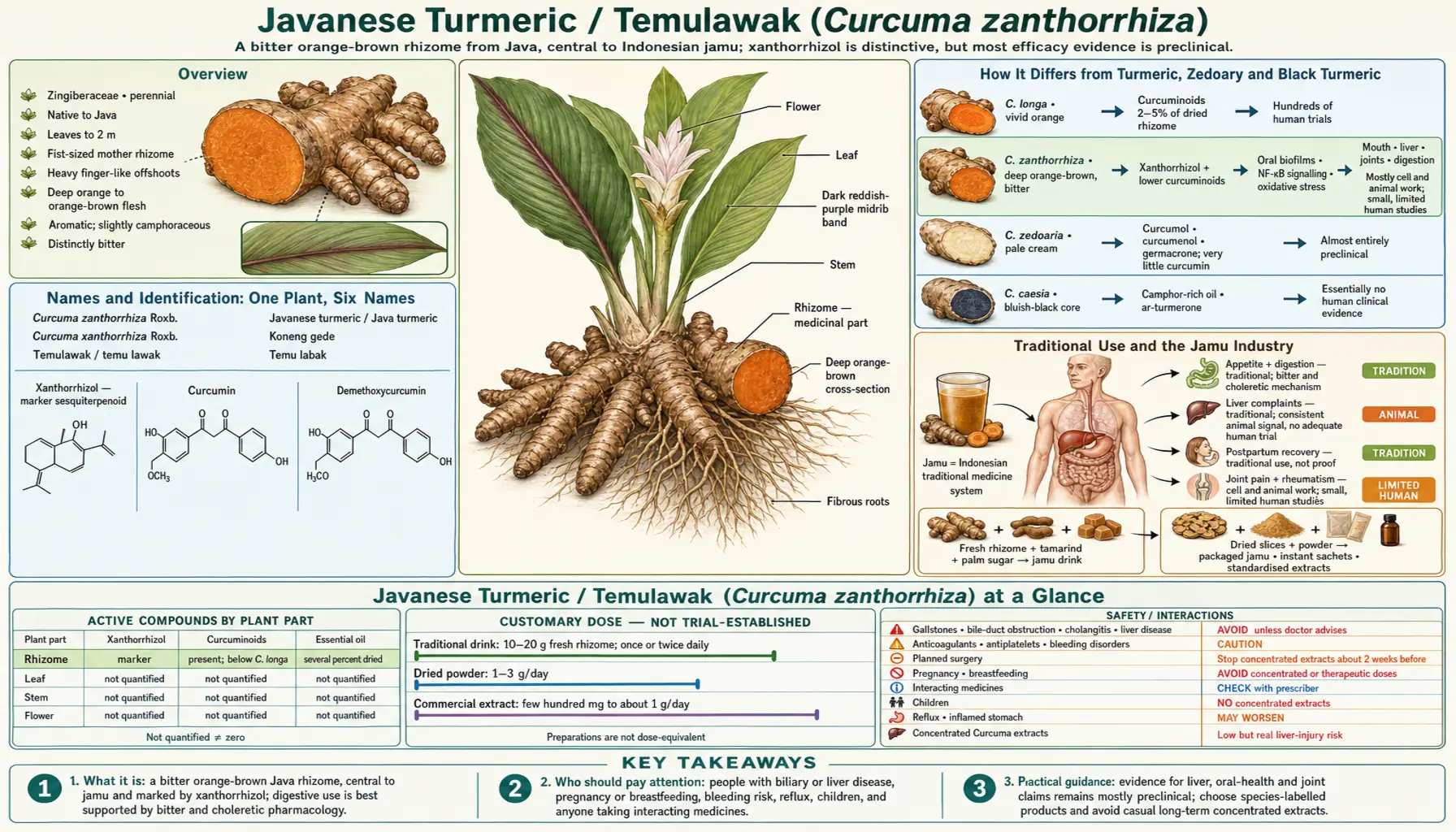
Javanese turmeric, temulawak, Curcuma zanthorrhiza and Curcuma xanthorrhiza are all the same plant. That sentence is where most readers get lost, so it goes first. It is a large orange-fleshed rhizome from Java, distinct from ordinary turmeric (Curcuma longa), notably more bitter, and the single most important medicinal plant in Indonesia — the backbone of the country's jamu industry and the ingredient Indonesian authorities have promoted as the national flagship herb.
Its distinguishing chemistry is xanthorrhizol, a sesquiterpene found in useful quantities in almost no other plant. Its evidence base is a different story: the hepatoprotective and antimicrobial work that everyone cites is overwhelmingly animal and cell-culture research. Human trials exist, but they are small, often unblinded, frequently on combination products, and largely published in local journals. That is enough to make temulawak an interesting candidate. It is not enough to call it proven, and this page will not pretend otherwise.
Table of Contents
- Overview
- Names and Identification: One Plant, Six Names
- How It Differs from Turmeric, Zedoary and Black Turmeric
- Traditional Use and the Jamu Industry
- Regulatory Status in Indonesia
- Active Compounds: Xanthorrhizol and the Curcuminoids
- Liver Support: What the Animal Work Shows
- Digestion, Appetite and Bile Flow
- Antimicrobial and Oral-Health Research
- Anti-Inflammatory and Joint Research
- Culinary Use
- Forms and Preparations
- Dosage
- Cautions and Contraindications
- Key Research Papers
- Connections
- Featured Videos
Overview
Curcuma zanthorrhiza Roxb. is a perennial member of the ginger family, Zingiberaceae, native to Java and now cultivated across the Indonesian archipelago, Malaysia, Thailand, the Philippines and parts of India. It is a big plant — leaves to two metres in good conditions, with a dark reddish-purple band running along the midrib that experienced growers use to spot it in a mixed planting.
The part used is the rhizome, and it is noticeably larger than a turmeric rhizome: the central mother rhizome can be the size of a fist, with heavy finger-like offshoots. Cut open, the flesh is deep orange to orange-brown, a little browner and duller than the vivid orange of C. longa. The aroma is aromatic and slightly camphoraceous, and the taste is distinctly, unmistakably bitter — far more so than turmeric. That bitterness is not a defect; it is the reason the plant is used as a digestive tonic, and Indonesian drink preparations are sweetened with palm sugar and soured with tamarind precisely to make it drinkable.
In Indonesia temulawak is grown both on smallholdings and at commercial scale, and it moves through a real supply chain into a real industry. Fresh rhizomes go to wet markets and to jamu gendong sellers — the traditional vendors who carry bottled herbal drinks — while dried slices and powder feed factory production of packaged jamu, instant drink sachets and standardised extracts. It is one of very few traditional Southeast Asian herbs with that degree of industrial infrastructure behind it.
Names and Identification: One Plant, Six Names
The naming is the single biggest source of confusion, and it is worth being explicit. All of the following refer to the same species:
- Curcuma zanthorrhiza Roxb. — the original spelling published by William Roxburgh.
- Curcuma xanthorrhiza Roxb. — an orthographic variant with an x, extremely common in the research literature and on product labels. Both spellings are in active use and both are correct in practice; a database search that misses one will miss half the papers. The Greek root is xanthos, yellow, plus rhiza, root — “yellow root.”
- Temulawak (also written temu lawak) — the Indonesian name and the one used commercially. Temu is the Malay-Indonesian word for a Curcuma rhizome.
- Javanese turmeric / Java turmeric — the usual English trade names.
- Koneng gede — Sundanese, “big yellow.”
- Temu labak — a regional variant heard in parts of Java and Madura.
You will also see the English name “wild ginger” attached to it in older sources. Avoid that one: in North America “wild ginger” means Asarum canadense, an unrelated plant containing aristolochic acid, which is nephrotoxic and carcinogenic. The two have nothing to do with each other, and confusing them would be dangerous.
Identifying it by eye: temulawak rhizomes are larger and browner-orange than turmeric, with a bitter taste that turmeric does not have. In powder form, colour alone will not distinguish it from C. longa, and the bitterness is the practical cue. If you are buying an extract, the species should be printed on the label; if it is not, you have no way to know what is in it.
How It Differs from Turmeric, Zedoary and Black Turmeric
Four Curcuma species end up on the same shelf under overlapping names. Here is how they actually differ.
| Species | Usual name | Flesh | Signature chemistry | Evidence base |
|---|---|---|---|---|
| C. longa | Turmeric | Vivid orange | Curcuminoids, roughly 2–5% of dried rhizome | The largest by far — hundreds of human trials, mostly of concentrated curcumin extracts |
| C. zanthorrhiza | Temulawak / Javanese turmeric | Deep orange-brown, bitter | Xanthorrhizol, plus curcuminoids at lower levels than C. longa | Substantial animal and in-vitro work; small and limited human studies |
| C. zedoaria | Zedoary / white turmeric | Pale cream, camphoraceous | Sesquiterpenes — curcumol, curcumenol, germacrone; very little curcumin | Almost entirely preclinical |
| C. caesia | Black turmeric | Bluish-black core | Camphor-rich oil, ar-turmerone; highly variable reports | Thin; essentially no human clinical evidence |
The practical points. Temulawak is not a stronger turmeric. It contains fewer curcuminoids than C. longa, so if you are chasing the curcumin literature you should be taking turmeric, not this. What temulawak has that turmeric does not is xanthorrhizol, and the research on temulawak is largely research on that compound. Temulawak is also not zedoary — the two are sometimes conflated in supplement copy because both are “the other turmeric,” but zedoary is pale-fleshed, chemically different, and carries a pregnancy contraindication that temulawak's traditional use does not share in the same form.
Traditional Use and the Jamu Industry
Traditional use is history and cultural practice. It records what generations of people found worth doing; it does not by itself demonstrate that a remedy works.
Jamu is the Indonesian traditional medicine system — a living, everyday practice rather than a museum piece, with roots traceable to the Javanese courts and to manuscripts and temple reliefs from the Majapahit era and earlier. Temulawak is one of its central ingredients. Its classical indications cluster around three areas:
- Appetite and digestion. The most common household use, especially for children who are eating poorly and for adults with bloating, nausea or the general malaise Indonesians call masuk angin. A bitter tonic given before meals to wake up the appetite is a pattern found in almost every traditional medicine on earth.
- Liver complaints. Temulawak has a long reputation for jaundice, hepatitis and “liver weakness.” This is the use that drove most of the modern research programme.
- Postpartum recovery and women's tonics. Temulawak appears in jamu blends given after childbirth and in general strengthening tonics.
Secondary traditional uses include joint pain and rheumatism, fever, skin complaints, and use as a general-purpose tonic. The commonest household preparation is a drink: fresh rhizome sliced and simmered, or dried powder steeped, then combined with asam jawa (tamarind), palm sugar and sometimes pandan leaf. This is sold everywhere in Indonesia, from street vendors to supermarket sachets, and is drunk as a daily beverage rather than as a course of medicine — which is a meaningful difference from how supplements are used in the West.
Regulatory Status in Indonesia
Indonesia has something most countries lack: a formal, tiered regulatory framework for traditional herbal medicines, administered by BPOM, the national food and drug agency. Understanding the tiers tells you exactly how much evidence sits behind any given Indonesian herbal product.
- Jamu — the base tier. Registration rests on empirical traditional use. The product must be safe and must meet quality standards, but no preclinical or clinical efficacy evidence is required. Most temulawak products on the market are in this category. Jamu products carry a distinctive tree-branch logo.
- Obat Herbal Terstandar (OHT) — “standardised herbal medicine.” The raw material must be standardised and characterised, and there must be preclinical (animal and laboratory) evidence supporting the claim. Temulawak-containing products appear at this level.
- Fitofarmaka — the top tier, requiring clinical trial evidence in humans in addition to standardisation and preclinical data. Very few Indonesian herbal products have reached it.
This framework is genuinely useful to a reader, because it makes the evidence gradient explicit in a way that Western supplement regulation does not. A product registered as jamu is telling you, by its own regulatory category, that its claim rests on tradition. That is honest labelling, and it is more information than a typical American supplement bottle provides. It also means that seeing temulawak “approved” or “registered” in Indonesia does not imply that anyone has proved it works — the registration tier is where that information lives.
Indonesian ministries and industry bodies have repeatedly promoted temulawak as the country's iconic or flagship medicinal plant, with national campaigns encouraging domestic consumption and export. That is a policy and economic position, not a scientific finding.
Active Compounds: Xanthorrhizol and the Curcuminoids
Xanthorrhizol is the compound that makes this species chemically distinct. It is a bisabolane-type sesquiterpenoid — a fifteen-carbon terpene with a phenol group attached — and it is found in meaningful quantities in essentially no other commercial plant. It is the reason temulawak is not simply a duller turmeric, and it is the focus of most of the serious research, much of it conducted by Korean groups (notably at Yonsei University) who have worked on it steadily for two decades.
What is actually known about xanthorrhizol comes from laboratory and animal work: antibacterial activity, particularly against oral bacteria such as Streptococcus mutans; antifungal activity against Candida albicans; anti-inflammatory activity through suppression of nitric oxide and inflammatory cytokine production in cell models; and hepatoprotective effects in rodent models of chemical liver injury. Its phenol group is the likely basis of both its antimicrobial and antioxidant behaviour.
The rest of the chemistry:
- Essential oil — several percent of the dried rhizome, dominated by xanthorrhizol together with ar-curcumene, β-curcumene, germacrone, camphor and other sesquiterpenes.
- Curcuminoids — curcumin and demethoxycurcumin are present, typically at levels below those in C. longa. Reported figures vary substantially with cultivar, harvest age and assay method, so no single percentage should be treated as authoritative; the consistent finding across the literature is that temulawak is the lower-curcuminoid species of the two.
- Starch — the bulk of the dried rhizome by weight. Temulawak starch is itself a traditional food, used in porridges and infant foods.
- Bitter principles — the sesquiterpene fraction, which is what your tongue is reacting to and what plausibly drives the digestive effect.
The variability point applies here as it does across the genus: two studies of “Curcuma xanthorrhiza extract” can be studying quite different mixtures depending on cultivar, solvent and extraction method. This is why standardisation matters, and why a product that names its marker compound and its content is worth more than one that does not.
Liver Support: What the Animal Work Shows
The mechanism. The animal literature is reasonably consistent. In standard rodent models of chemically induced liver injury — carbon tetrachloride, paracetamol overdose, galactosamine, and alcohol models — pre-treatment with temulawak extract or with purified xanthorrhizol reduces the rise in serum ALT and AST (the enzymes that leak from damaged liver cells), reduces markers of oxidative stress in liver tissue, and reduces the histological severity of damage seen under the microscope. The proposed mechanism is a combination of direct antioxidant activity, support of the liver's own glutathione system, and suppression of inflammatory signalling.
What kind of evidence that is: animal. These are protective experiments in rodents, where the extract is given before or alongside a known hepatotoxin at doses that scale poorly to a human drinking a cup of temulawak. They are a legitimate reason to investigate the plant. They are not evidence that temulawak treats hepatitis, fatty liver disease, cirrhosis or any human liver condition.
Human evidence. Small studies exist — mostly Indonesian, mostly with a few dozen participants, frequently open-label rather than blinded, and often testing combination products rather than temulawak alone. Typical outcomes are changes in liver enzymes or lipid values over a few weeks. Studies of this size and design cannot separate a real drug effect from regression to the mean, seasonal variation in liver enzymes, or the substantial placebo response seen with subjective outcomes. Several are published in Indonesian-language journals that are not indexed internationally, which makes independent appraisal harder.
The honest position: a plausible mechanism, a consistent animal signal, and no adequately powered, properly blinded human trial establishing benefit for a liver condition. If you have liver disease, temulawak is not a treatment for it, and self-treating liver disease with an unmonitored herbal extract carries a specific irony discussed under Cautions.
Digestion, Appetite and Bile Flow
The mechanism. This is temulawak's most defensible use and its least glamorous. Bitter compounds on the tongue trigger a reflex increase in saliva and gastric secretion and prime the digestive tract for food — the classic action of an aperitif bitter. Separately, Curcuma species are choleretic: they stimulate the liver to produce bile and the gallbladder to release it, which improves fat digestion and can relieve the heavy, over-full feeling after a rich meal. This is well established as a class effect for the genus, and it is the same pharmacology behind artichoke leaf and dandelion root preparations sold in Europe for dyspepsia.
Appetite in children is the classic Indonesian household use, and it is a genuinely common reason parents buy temulawak drinks. Small Indonesian studies have looked at appetite and weight gain in children given temulawak preparations. They are small, generally short, and not the kind of trial that would support a medical claim; parental report of appetite is also one of the most placebo-sensitive outcomes imaginable. As a bitter aperitif for a child who is eating poorly, a sweetened temulawak drink is unlikely to do harm; as a treatment for faltering growth it is not a substitute for finding out why a child is not eating.
What kind of evidence: mechanism plus tradition, with limited human data. The choleretic and bitter effects are real pharmacology and are felt within minutes to hours. That is a fair reason to use temulawak as a digestive tonic. It is not a reason to extend the claim into treating any diagnosed gastrointestinal disease.
Antimicrobial and Oral-Health Research
Xanthorrhizol has been studied more seriously as an antimicrobial than as anything else, and the most interesting work is in the mouth.
Cell culture. Xanthorrhizol shows activity against Streptococcus mutans, the principal bacterium in dental caries, and against Porphyromonas gingivalis and related periodontal organisms. It has also shown activity against Candida albicans, including in biofilm models, and against a range of food-spoilage and pathogenic bacteria. Some of this work reports effects on biofilm formation rather than just on free-floating bacteria, which is the more relevant test for dental plaque.
Why the mouth is the strong case. Most in-vitro antimicrobial findings for plant compounds die on the journey into the body, because you cannot reach the tested concentration in blood or tissue after an oral dose. The mouth is the exception: a mouthwash or toothpaste puts the compound directly onto the target surface at close to the tested concentration. Xanthorrhizol has accordingly been incorporated into oral-care products in Korea and Indonesia, but despite that commercial use, the literature has not caught up to an actual human trial: targeted searches turn up only in-vitro and cell-culture work, including biofilm assays grown from real human saliva in a dish — which is not the same as testing a mouthwash in people (full detail on the Antimicrobial Benefits page). The oral-health case remains the mechanistically strongest of xanthorrhizol's antimicrobial claims for the reason above, but it is untested in a mouth rather than a dish.
What kind of evidence: mostly cell culture, with small human oral-health studies. This is the most promising line of temulawak research and still falls short of showing that it prevents cavities or treats gum disease in practice. It is not a reason to swap out fluoride toothpaste, which has an enormous evidence base behind it.
Systemic antimicrobial claims are a different matter entirely. Taking temulawak by mouth to treat an infection anywhere other than the mouth is not supported. Do not use it in place of antibiotics for a diagnosed bacterial infection.
Anti-Inflammatory and Joint Research
The mechanism. Both xanthorrhizol and the curcuminoids suppress the NF-κB inflammatory signalling pathway in cell models, reducing production of nitric oxide, prostaglandin E2, TNF-α and interleukin-6. In rodent models of induced arthritis and paw oedema, temulawak extracts reduce swelling. This is the same broad mechanistic story told about turmeric, which is unsurprising given the shared chemistry.
Human evidence. There has been Indonesian clinical interest in Curcuma xanthorrhiza extract for knee osteoarthritis, including at least one comparison against a non-steroidal anti-inflammatory drug. These studies are small, and comparison trials of this size are structurally unable to demonstrate equivalence — a trial with a few dozen participants per arm will fail to detect real differences and can be misread as showing that two treatments are the same when it simply lacked the power to tell them apart. Some studies used combination products containing both C. xanthorrhiza and C. longa, which makes it impossible to attribute any effect to temulawak specifically.
What kind of evidence: cell culture and animal, plus small and methodologically limited human studies. If you want a ginger-family herb for joint pain with the strongest human evidence behind it, that is turmeric as a standardised curcumin extract, and even there the effect sizes are modest and the trial quality is uneven. Temulawak is several steps behind it.
Culinary Use
Temulawak sits on the boundary between food and medicine, which is characteristic of Indonesian food culture generally.
- Jamu drinks. The dominant use. Jamu temulawak — the rhizome simmered with tamarind and palm sugar, sometimes with pandan or ginger — is a genuinely popular everyday beverage, not a niche remedy. Instant sachet versions are sold in every Indonesian supermarket.
- Starch and porridge. Temulawak starch is used in porridges and traditional weaning foods, where it is valued as bland and easily digested. The starch carries little of the essential oil.
- Cooking. Small amounts appear in some Javanese dishes as a bitter aromatic, but temulawak is not a general-purpose curry spice the way turmeric is — the bitterness limits it. It is also used as a natural yellow colourant.
- Modern products. Temulawak appears in Indonesian herbal coffees, energy drinks, candies and even beer-style beverages, mostly as a flavour and marketing element.
Forms and Preparations
- Fresh rhizome — the traditional starting point, sliced and simmered for 10–20 minutes to make a drink. Available in Southeast Asian markets and increasingly in Asian grocers elsewhere.
- Dried slices — simmered the same way; the standard form for storage and trade.
- Powder — used in bulk jamu manufacture and sold loose. Cheap, and the form most exposed to substitution with ordinary turmeric.
- Instant drink sachets — convenient, and usually mostly sugar. Check the ingredient list before treating one as a herbal preparation.
- Standardised extracts and capsules — the form used in most research. Good ones state the species, the extract ratio, and a marker content (xanthorrhizol or total curcuminoids).
- Essential oil — used in oral-care and cosmetic products. Not for internal use.
What to look for on a label: the binomial spelled either way (Curcuma zanthorrhiza or xanthorrhiza) rather than just “Javanese turmeric”; the plant part (rhizome); an extract ratio or a standardised marker; country of origin; and a batch or lot number. Indonesian products carry a BPOM registration number, and the registration tier (jamu, OHT or fitofarmaka) tells you what evidence class the product sits in.
Dosage
No dose of temulawak has been established by adequate human trials for any condition. What follows describes what is customarily used, which is a different thing.
- Traditional drink. Roughly 10–20 g of fresh rhizome (or a few grams dried) simmered in water, taken once or twice a day. This is a food-level exposure and is how most Indonesians consume it.
- Dried powder. Traditional preparations commonly use somewhere in the range of 1–3 g per day, often divided.
- Commercial extracts. Capsule products typically supply a few hundred milligrams to about a gram of extract daily. Because extract ratios differ by an order of magnitude between products, these numbers cannot be compared to raw powder or to each other without knowing the ratio.
Three cautions on all of the above. These figures come from tradition and from product labelling, not from dose-finding trials. Extracts concentrate the essential oil and the curcuminoids and are not interchangeable with the rhizome on a milligram basis. And nobody has studied continuous daily use of concentrated extracts over months or years — which is precisely how supplements tend to be taken, and precisely where the liver-injury signal discussed below has emerged for concentrated Curcuma products generally.
Cautions and Contraindications
Gallstones, bile-duct obstruction, cholangitis and liver disease. This is the most concrete contraindication. Temulawak stimulates bile production and gallbladder contraction. If a stone is obstructing a duct, provoking the gallbladder to contract against it is a way to cause biliary colic. The EU/HMPC traditional-use monograph's own contraindication list is broader than gallstones alone: it names obstruction of the bile duct, cholangitis, liver disease, gallstones and any other biliary disease. Avoid with any of these unless a doctor has advised otherwise. This caution applies to the whole genus and to European choleretic herbs generally.
Liver injury — the irony worth taking seriously. Temulawak is marketed for liver support, but concentrated turmeric and Curcuma supplements as a class have been implicated in a growing number of cases of drug-induced liver injury. Reports have come from the United States, Italy, Australia and elsewhere, and cases have been characterised in the US Drug-Induced Liver Injury Network, with a genetic susceptibility marker (HLA-B*35:01) reported in a proportion of cases. Products with enhanced-absorption formulations, including those combined with piperine (black pepper extract), appear over-represented. The absolute risk is low, but it is real, and it is a specific reason not to take high-dose concentrated Curcuma extracts casually or indefinitely. The traditional drink is a much lower exposure than a concentrated capsule. Stop and seek medical advice if you develop jaundice, dark urine, pale stools, itching, unusual fatigue, persistent nausea or right-upper-abdominal pain.
Anticoagulants and antiplatelet drugs. Curcuma constituents can affect platelet function. Caution with warfarin, direct oral anticoagulants, clopidogrel and aspirin, and with any bleeding disorder. Stop concentrated extracts about two weeks before planned surgery and tell the surgical team.
Pregnancy and breastfeeding. Temulawak's traditional role is postpartum rather than during pregnancy, and there is no adequate human safety data for use in pregnancy. Food amounts in cooking are not the concern; concentrated extracts and daily therapeutic doses should be avoided in pregnancy and while breastfeeding.
Drug metabolism. Curcuminoids and related compounds can inhibit cytochrome P450 enzymes and drug transporters, which can raise or lower blood levels of prescribed medicines. Anyone on chemotherapy, immunosuppressants, antiepileptics, antiretrovirals or any narrow-therapeutic-index drug should discuss herbal extracts with their prescriber rather than assume they are inert.
Stomach irritation and reflux. Bitter, bile-stimulating herbs can worsen reflux and can irritate an already inflamed stomach. If temulawak makes heartburn worse, that is a predictable effect, not a detox reaction.
Children. The traditional appetite drink is widely given to children in Indonesia at food-level doses. Concentrated extracts and capsules have no paediatric safety data and should not be used.
Substitution. Powdered temulawak is easy to cut with ordinary turmeric, which is cheaper and looks similar. Buy from sellers who name the species and, ideally, test their material.
Key Research Papers
A note on the links. Where a stable PubMed identifier could not be confirmed at the time of writing, the citation's year links to a PubMed search on the paper's own title rather than to a guessed ID — a wrong identifier sends you to a real but different paper, which is worse than no link. Author, title and journal are given as plain text so every entry can be verified independently.
- Oon SF, Nallappan M, Tee TT, Shohaimi S, Kassim NK, Sazali MF, Cheah YH. Xanthorrhizol: a review of its pharmacological activities and anticancer properties. Cancer Cell International. 2015;15. The most useful single overview of the marker compound and what is claimed for it.
- Hwang JK, Shim JS, Pyun YR. Antibacterial activity of xanthorrhizol from Curcuma xanthorrhiza against oral pathogens. Fitoterapia. 2000;71(3). Foundational work behind the oral-health line of research.
- Rukayadi Y, Hwang JK. In vitro activity of xanthorrhizol against Streptococcus mutans biofilms. Letters in Applied Microbiology. 2006;42(4). Biofilm rather than planktonic bacteria — the more relevant model for dental plaque.
- Rukayadi Y, Yong D, Hwang JK. In vitro anticandidal activity of xanthorrhizol isolated from Curcuma xanthorrhiza Roxb. Journal of Antimicrobial Chemotherapy. 2006;57(6). Antifungal activity in culture.
- Devaraj S, Ismail S, Ramanathan S, Yam MF. Investigation of antioxidant and hepatoprotective activity of standardized Curcuma xanthorrhiza rhizome in carbon tetrachloride-induced hepatic damaged rats. The Scientific World Journal. 2014. Representative of the rodent hepatoprotection literature discussed above — note that it is a protective animal model, not a treatment trial.
- Kim MB, Kim C, Song Y, Hwang JK. Antihyperglycemic and anti-inflammatory effects of standardized Curcuma xanthorrhiza Roxb. extract and its active compound xanthorrhizol in high-fat diet-induced obese mice. Evidence-Based Complementary and Alternative Medicine. 2014. Mouse metabolic work; hypothesis-generating only.
- Kertia N, Asdie AH, Rochmah W, Marsetyawan. Ability of curcuminoid compared to diclofenac sodium in reducing the secretion of cyclo-oxygenase-2 enzyme by synovial fluid's monocytes of patients with osteoarthritis. Acta Medica Indonesiana. 2012;44(2). An Indonesian human study in the osteoarthritis line of work; read it with the sample-size caveats in the section above.
- Halegoua-DeMarzio D, Navarro V, Ahmad J, Avula B, Barnhart H, Barritt AS, Bonkovsky HL, Fontana RJ, Ghabril MS, Hoofnagle JH, Khan IA, Kleiner DE, Phillips E, Stolz A, Vuppalanchi R. Liver injury associated with turmeric — a growing problem: ten cases from the Drug-Induced Liver Injury Network. The American Journal of Medicine. 2023;136(2). Directly relevant to the caution above about concentrated Curcuma supplements.
Live PubMed Searches
These run a fresh search each time, so they stay current. Note that both spellings of the species name are worth searching.
- Curcuma xanthorrhiza — all publications
- Curcuma zanthorrhiza — the alternate spelling
- Xanthorrhizol — all publications
- Temulawak
- Curcuma xanthorrhiza — clinical trials
- Curcuma xanthorrhiza — hepatoprotective studies
- Xanthorrhizol — oral health and mouthwash
- Jamu — Indonesian herbal medicine
- Turmeric supplements — drug-induced liver injury
- Curcuma species — authentication and adulteration
Connections
- All Herbs
- Turmeric (Curcuma longa) — the higher-curcuminoid species with by far the larger human evidence base; the one to reach for if you are following the curcumin research.
- White Turmeric / Zedoary (Curcuma zedoaria) — the pale, camphor-bitter relative, chemically dominated by sesquiterpenes and carrying a pregnancy contraindication.
- Black Turmeric (Curcuma caesia) — the rare bluish-black species, with the thinnest evidence and the worst adulteration problem of the four.