Baheda (Terminalia bellirica)
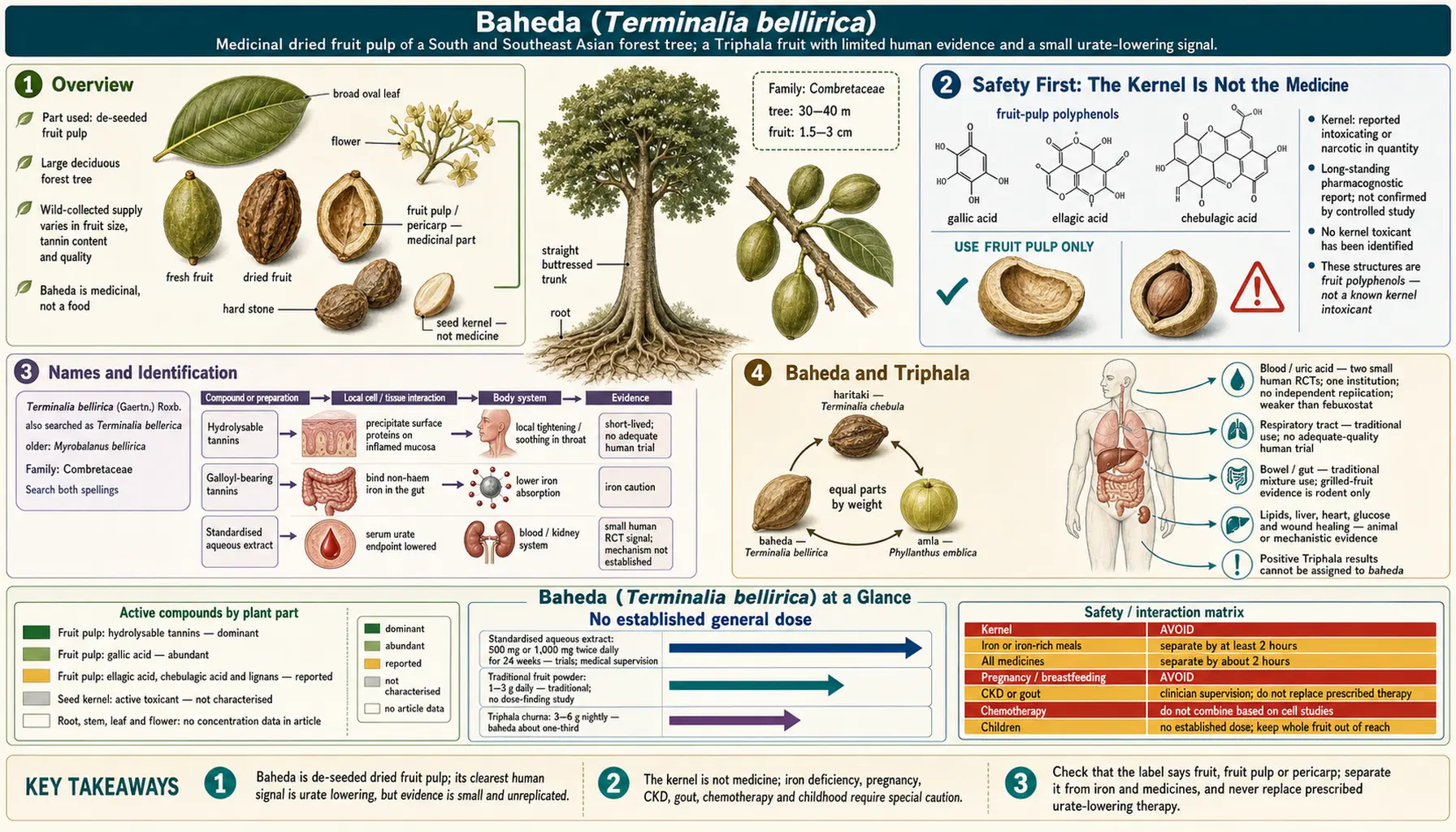
Baheda is the dried fruit of Terminalia bellirica, a large forest tree of South and Southeast Asia, and the second of the three fruits in Triphala — alongside haritaki and amla. Of those three, baheda is plainly the least researched. It has no popular reputation of its own, it is rarely sold as a single herb outside India, and the great majority of what is written about it is either traditional text or laboratory work on rodents and cell lines.
Two things about it deserve stating before anything else. First, the seed kernel inside the fruit is not the medicinal part, and Indian pharmacognostic literature has long reported it as intoxicating or narcotic when eaten in quantity — it is the fleshy pulp that is used. Second, there is a genuine and interesting exception to the “no human data” rule: baheda has been tested in real randomised trials for lowering uric acid, with measurable results. That work is small and comes from a single research group, but it exists, and it is described honestly further down.
Table of Contents
- Overview
- Safety First: The Kernel Is Not the Medicine
- Names and Identification
- Baheda and Triphala
- Traditional Use
- Active Compounds
- Uric Acid: The One Place with Real Human Data
- Cough and Respiratory Use
- Astringency, Diarrhoea and the Grilling Effect
- Lipids, Liver and Metabolic Claims
- Forms and Preparations
- Dosage
- Cautions and Contraindications
- Key Research Papers
- Connections
- Featured Videos
Overview
Terminalia bellirica (Gaertn.) Roxb. is a large deciduous tree in the family Combretaceae — the same family as haritaki, its Triphala partner. It is one of the biggest trees of the Indian deciduous forest, commonly reaching 30–40 metres, with a straight buttressed trunk, a high crown, and broad oval leaves clustered towards the branch ends. It grows across India, Nepal, Sri Lanka, Bangladesh, Myanmar, Thailand, Laos, Vietnam, Malaysia, Indonesia and southern China, generally in lowland and lower-hill forest.
The part used is the fruit pulp. The fruit is a roughly spherical or ovoid drupe, about 1.5–3 cm across, greyish and covered in fine velvety hairs when fresh, drying to a wrinkled brown. Inside is a hard stone containing a single seed — the kernel discussed below, which is not the medicine.
Baheda is not a food. Unlike amla, which is genuinely eaten as a fruit across India, baheda is astringent, unpleasant and used medicinally only. Almost the entire supply is wild-collected from forest trees, which has consequences: fruit size, tannin content and quality vary substantially between sources, and the species is under enough collection pressure that genetic-diversity surveys have been carried out on Indian populations to inform conservation and cultivation planning.
Safety First: The Kernel Is Not the Medicine
Classical and colonial-era Indian pharmacognostic sources — the standard materia medica compilations that most modern herbals quote from — consistently report that the seed kernel of Terminalia bellirica is intoxicating or narcotic when eaten in quantity, producing effects described variously as inebriation, nausea and stupor. The medicinal article of trade is the dried fruit pulp with the stone removed.
Being precise about the status of that claim matters. It is a long-standing and widely repeated ethnobotanical and pharmacognostic report, not a finding confirmed by controlled study. A search of the biomedical literature returns no controlled human or animal investigation of kernel toxicity in this species, and no identified compound has been convincingly established as responsible. So the honest position is: the report is old, consistent across independent sources, and biologically unremarkable — many seed kernels contain compounds absent from the surrounding flesh — but it has never been properly characterised.
The practical rule follows regardless of how strong the evidence is:
- Use the fruit pulp only. Reputable baheda powder is made from de-seeded fruit. If you are buying whole dried fruit and preparing it yourself, discard the stone.
- Do not eat the kernels as a nut, and do not assume that because a seed is edible in some places it is safe in quantity. This applies to children in particular, who are most likely to try one out of curiosity.
- A product that does not specify the plant part is a product to avoid. The label should say fruit, or fruit pulp, or pericarp.
Names and Identification
Binomial: Terminalia bellirica (Gaertn.) Roxb. Family: Combretaceae.
The spelling is a genuine research obstacle. Both Terminalia bellirica and Terminalia bellerica are in wide use in the literature, and a database search on one spelling will silently miss most of the papers filed under the other. Searching PubMed for bellirica alone returns a small fraction of what bellerica returns. If you are looking this plant up, search both spellings. Older sources also use Myrobalanus bellirica.
- English trade name: belleric myrobalan, beleric myrobalan, bastard myrobalan.
- Sanskrit: bibhitaki, vibhitaki.
- Hindi: baheda, bahera, bhaira.
- Tamil: thanri, thanrikkai. Telugu: tandra, thandri. Malayalam: thanni.
- Thai: samo phiphek (สมอพิเภก) — the Thai name derives from the Sanskrit vibhitaki, and sits alongside samo thai for haritaki in Thai traditional medicine.
- Bengali: bahera. Nepali: barro.
“Myrobalan” identifies nothing on its own. All three Triphala fruits carry that English name — chebulic myrobalan is Terminalia chebula, belleric myrobalan is Terminalia bellirica, emblic myrobalan is Phyllanthus emblica — and in European horticulture the word usually refers to Prunus cerasifera, an unrelated plum. Always work from the binomial.
Baheda and Triphala
Triphala — “three fruits” — is the best-known compound medicine in Ayurveda: haritaki (Terminalia chebula), baheda (Terminalia bellirica) and amla (Phyllanthus emblica), classically in equal parts by weight. It is taken chiefly as a nightly bowel and digestive tonic, and it is the reason most people encounter baheda at all.
This creates a specific reading problem for baheda. Nearly every human trial that involves this plant involves it as one-third of a mixture, and a positive Triphala result cannot be assigned to baheda. Both of the two exceptions — the hyperuricaemia trials described below — are notable precisely because they tested a baheda extract on its own.
A 2024 metabolome-profiling study by Hegde and colleagues compared all three fruits directly, mapping which compounds each contributes to the blend. That kind of analytical groundwork is what any serious attempt to separate their individual effects has to start from.
Traditional Use
Ayurveda. Bibhitaki is described as astringent and drying, and its traditional territory is the respiratory tract — cough, hoarseness, sore throat, and what the classical texts frame as excess kapha or congestion. It is also used for the eyes, and as one-third of Triphala for digestion and bowel regularity. Where haritaki is the fruit associated with downward movement and the bowel, bibhitaki is the fruit associated with the chest and throat.
Thai traditional medicine. Samo phiphek appears in the Thai pharmacopoeia in expectorant and antitussive formulas, and in the Thai equivalent of the three-fruit combination.
Tibetan and Unani medicine both include the fruit, largely in compound formulas rather than as a single agent.
Non-medicinal uses are worth mentioning because they explain the plant's economic importance: the tannin-rich fruit has been used in tanning leather and in dyeing, and the timber is used locally. A fruit valued as a tanning agent is, by definition, a fruit with a very high tannin load — which is the same fact that drives the iron caution below.
Traditional use records what people did. It is not evidence that it worked.
Active Compounds
Baheda's chemistry, like haritaki's, is dominated by hydrolysable tannins — galloyl- and ellagitannin-type molecules built around a sugar core.
- Gallic acid — abundant, both free and bound. The single galloyl unit that drives both the astringency and the iron interaction.
- Ellagic acid — released from ellagitannins; one of the most studied plant polyphenols.
- Chebulagic acid — shared with haritaki, and one of the reasons the two Terminalia fruits behave similarly in laboratory assays.
- Termilignan, thannilignan and anolignan B — lignans reported from the fruit. These are the constituents most specific to this species, and they are also the least studied; treat any claim built on them as preliminary.
- Bellericanin — a glycoside named for the species and frequently listed in reviews, though characterisation in the modern literature is thin.
- Others: ellagitannins including belleric acid derivatives, β-sitosterol, gallotannins, and a range of simple phenolics.
Pfundstein and colleagues published a careful 2010 characterisation and quantification of the polyphenols in T. bellirica, T. chebula and T. horrida fruits together with their antioxidant capacities — one of the better analytical references for this species, because it measured the three side by side under identical conditions.
Uric Acid: The One Place with Real Human Data
This is the exception to everything said above about baheda being unstudied in people, and it is worth going through in detail.
Trial one. Usharani and colleagues at Nizam's Institute of Medical Sciences in Hyderabad randomised 110 people with hyperuricaemia into five arms for 24 weeks: T. chebula 500 mg twice daily, T. bellerica 250 mg twice daily, T. bellerica 500 mg twice daily, placebo, and febuxostat 40 mg once daily as an active comparator. All active arms lowered serum uric acid compared with baseline and placebo, starting from week 4. T. bellerica 500 mg twice daily brought mean uric acid from 8.07 to 5.78 mg/dL, roughly twice the reduction seen with T. chebula at the same dose. Febuxostat did considerably better, from 8.53 to 4.28 mg/dL. Levels plateaued after about 16 weeks. The effect looked dose-dependent, and all preparations were reported as well tolerated.
Trial two. Pingali and colleagues, from the same institution, then ran a 24-week dose-response study in 59 people with chronic kidney disease and hyperuricaemia: febuxostat 40 mg daily versus baheda extract at 500 mg or 1,000 mg twice daily. At 24 weeks the mean percentage reduction in serum uric acid was 63.7% for febuxostat, 33.9% for baheda 1,000 mg twice daily, and 19.8% for baheda 500 mg twice daily. Serum creatinine fell in all groups from week 16, and estimated GFR rose.
How to read this honestly. These are real randomised trials with an active comparator, a plausible dose-response, and clinically interpretable endpoints — that is much better than most herbal evidence. But:
- Both come from the same research group at one institution. There is no independent replication anywhere. In herbal medicine that is a serious limitation, not a technicality.
- Both are small — 110 and 59 participants, with 55 completing the second.
- Baheda was consistently and substantially weaker than febuxostat, roughly a third to a half as effective. Anyone with gout or clinically significant hyperuricaemia is being offered a weaker option, not an equivalent one.
- Uric acid is a surrogate. Neither trial measured gout flares, tophi, or kidney outcomes over a meaningful horizon.
- A specific standardised aqueous extract was used. A generic baheda powder is not the same preparation and cannot be assumed to behave the same way.
The reasonable conclusion is that baheda has a genuine and interesting urate-lowering signal that deserves independent replication, and that it is not a substitute for allopurinol or febuxostat in anyone who needs urate lowered.
Cough and Respiratory Use
The traditional use of baheda is overwhelmingly respiratory — cough, hoarseness, throat irritation — and it appears in expectorant formulas across Ayurveda, Thai and Unani practice.
The plausible mechanism is unglamorous and probably correct: astringency. Tannins precipitate surface proteins on inflamed mucous membranes, producing the tightening, soothing sensation that any strong tea or unripe fruit gives, and that a great many traditional throat remedies share. That is a real physical effect, and it is also a local and short-lived one.
Human evidence: none of adequate quality. There is no controlled trial of baheda for cough or any respiratory condition. Formulations containing it have been assessed for allergic rhinitis in safety studies, but those tested multi-herb products and were safety rather than efficacy investigations. If you use baheda for a sore throat, you are using a traditional demulcent-astringent, not a proven treatment.
Astringency, Diarrhoea and the Grilling Effect
One genuinely interesting piece of laboratory work concerns preparation. Pandey and colleagues reported in 2017 that grilling the fruits of Terminalia bellerica enhanced their antidiarrhoeal activity in a rodent model, compared with the raw fruit.
This matters beyond the specific result, because it addresses a long-standing puzzle about the Terminalia fruits: Ayurveda uses them in ways that regulate and loosen the bowel, while Traditional Chinese Medicine uses haritaki as an astringent to stop chronic diarrhoea. If heat processing shifts the balance towards astringency, both traditions can be right about their own preparation. Traditional Indian and Thai practice does often specify roasting or frying the fruit for particular indications.
Evidence level: rodent, single study. It is a good hypothesis, not a finding you should act on. Its main practical use is as a reason to take preparation method seriously when comparing products, and as a reason not to assume a raw powder and a roasted one do the same thing.
A 2023 comparative animal study by Tiwari and colleagues found antispasmodic activity for T. bellerica alongside T. chebula, long pepper, black pepper and ginger — consistent with an effect on gut smooth muscle, again in animals.
Lipids, Liver and Metabolic Claims
You will see baheda marketed for cholesterol, fatty liver and general metabolic health. Essentially all of that rests on animal work.
- Lipids. Rodent studies of Triphala and of Thai polyherbal formulas containing baheda have reported improved lipid profiles in high-fat-diet models. These are rat studies of mixtures. The one well-conducted human trial of a Triphala-containing product for cholesterol — Donato and colleagues, 90 people, three months, placebo-controlled — was negative: no better than placebo on total or LDL cholesterol, BMI or waist circumference, with a hypersensitivity rash in 4.3% of the treated group.
- Liver. A 2024 study reported preventive mechanisms of a Tibetan Triphala preparation against non-alcoholic fatty liver disease. Animal and mechanistic work.
- Heart. Chaudhary and colleagues investigated a protective effect of T. bellirica against drug-induced cardiotoxicity in rats.
- Glucose. Das and colleagues found that foods formulated with all three Triphala herbs inhibited α-amylase, α-glucosidase and DPP-IV and lowered glucose in diabetic rats.
- Wound healing. Singh and colleagues reported wound-healing activity for T. bellerica and gallic acid in diabetic animals.
- Cancer cell lines. Pinmai and colleagues reported that P. emblica and T. bellerica extracts had synergistic growth-inhibitory effects with doxorubicin and cisplatin against hepatocellular carcinoma and lung cancer cells. Cell culture only. Nothing here supports using baheda alongside chemotherapy — and there are real reasons not to, since tannin-rich extracts can interfere with drug absorption and have not been tested for interaction with cytotoxic regimens.
The pattern across all of these is the same: interesting mechanism, no human confirmation. Say that when someone quotes one of these studies at you.
Forms and Preparations
- Whole dried fruit. The traditional article of trade. The stone is removed before use.
- Powder (churna). The commonest form. Should be made from de-seeded fruit pulp.
- Triphala churna. Equal parts baheda, haritaki and amla — the way most people actually consume baheda.
- Standardised aqueous extract. The form used in the hyperuricaemia trials. If you are trying to reproduce that research, note that a generic powder is not the same product, and most commercial capsules are not standardised at all.
- Decoction (kwath). Simmered water extract, strongly astringent, traditional for throat and cough use.
- Roasted or grilled fruit. Traditional for astringent and antidiarrhoeal indications; the rodent evidence above is at least consistent with the practice.
Label checklist: the binomial (either spelling) and the plant part — it must say fruit or fruit pulp, not seed. Country of origin. Any standardisation marker, with a number. Heavy-metal testing, which is worth asking about for any imported Ayurvedic product.
Dosage
There is no established general dose for baheda. Only the hyperuricaemia trials give real numbers, and they apply to one specific standardised extract and one specific indication.
- From the trials: a standardised aqueous T. bellerica extract at 500 mg or 1,000 mg twice daily for 24 weeks, in adults with hyperuricaemia, under medical supervision. The higher dose was roughly half as effective as febuxostat 40 mg.
- Traditional powder: commonly cited in the region of 1–3 g of dried fruit powder daily, though traditional sources vary and no dose-finding study supports any particular figure.
- Triphala churna: commonly 3–6 g at night, of which baheda is roughly one-third.
If you are considering baheda for uric acid, that is a conversation to have with the clinician managing it, not a self-treatment decision — partly because urate needs monitoring by blood test, and partly because the herb is clearly weaker than the drugs it would be replacing.
Cautions and Contraindications
- Use the fruit pulp, never the kernel. The seed kernel is reported in Indian pharmacognostic literature as intoxicating or narcotic in quantity. Uncharacterised, but consistently reported. See the section above.
- Iron absorption. Baheda is heavily tannic — tannic enough to have been used for tanning leather. Galloyl-bearing hydrolysable tannins of this type substantially block absorption of non-haem iron: in human absorption studies, 25 mg of tannic acid in a test meal cut iron uptake by about two-thirds and 100 mg by nearly 90%. Anyone iron-deficient, anaemic, pregnant, menstruating heavily, or vegetarian should treat this as the main caution and separate baheda from iron and from iron-rich meals by at least two hours. Vitamin C partly offsets the effect.
- Separate from all medications by about two hours. Tannins bind drug molecules non-specifically in the gut.
- Pregnancy and breastfeeding: avoid. No human safety data exist. The traditional literature is not a substitute, and the kernel reports argue for extra caution in a plant whose toxicology is poorly characterised.
- Chronic kidney disease. The CKD trial was conducted under nephrology supervision with regular creatinine and eGFR monitoring. Do not self-treat kidney disease with baheda.
- Gout. Baheda does not replace urate-lowering therapy. If you are on allopurinol or febuxostat, do not swap.
- Chemotherapy. Do not combine with cytotoxic drugs on the strength of cell-culture synergy papers. Tannin-rich extracts can interfere with absorption, and no interaction study has been done.
- Children. No established paediatric dosing, and the kernel issue makes whole fruit a particularly poor thing to have within reach.
- Human safety data are thin overall. The hyperuricaemia trials reported good tolerability over 24 weeks in fewer than 200 people combined. That is reassuring but nowhere near enough to characterise uncommon adverse effects.
Key Research Papers
- Usharani P, Nutalapati C, Pokuri VK, Kumar CU, Taduri G. A randomized, double-blind, placebo-, and positive-controlled clinical pilot study to evaluate the efficacy and tolerability of standardized aqueous extracts of Terminalia chebula and Terminalia bellerica in subjects with hyperuricemia. Clinical Pharmacology: Advances and Applications. 2016;8:51–59. Human RCT, n=110.
- Pingali U, Nutalapati C, Koilagundla N, Taduri G. A randomized, double-blind, positive-controlled, prospective, dose-response clinical study to evaluate the efficacy and tolerability of an aqueous extract of Terminalia bellerica in lowering uric acid and creatinine levels in chronic kidney disease subjects with hyperuricemia. BMC Complementary Medicine and Therapies. 2020;20(1):281. Human RCT, n=59.
- Pfundstein B, El Desouky SK, Hull WE, Haubner R, Erben G, Owen RW. Polyphenolic compounds in the fruits of Egyptian medicinal plants (Terminalia bellerica, Terminalia chebula and Terminalia horrida): characterization, quantitation and determination of antioxidant capacities. Phytochemistry. 2010;71(10):1132–1148.
- Hegde SN, K LD, Choudhary M, Menon N, Singh G. A comprehensive metabolome profiling of Terminalia chebula, Terminalia bellerica, and Phyllanthus emblica to explore the medicinal potential of Triphala. Scientific Reports. 2024;14(1):31635.
- Pandey G, Gupta SS, Bhatia A, Sidhu OP, Rawat AK, Rao CV. Grilling enhances antidiarrheal activity of Terminalia bellerica Roxb. fruits. Journal of Ethnopharmacology. 2017;202:63–66. Rodent.
- Tiwari BR, Naseeruddin Inamdar M, Orfali R, Alshehri A, Alghamdi A, Almadani ME, Alshehri S, Imam Rabbani S, Mohammed Basheeruddin Asdaq S. Comparative evaluation of the potential anti-spasmodic activity of Piper longum, Piper nigrum, Terminalia bellerica, Terminalia chebula, and Zingiber officinale in experimental animals. Saudi Pharmaceutical Journal. 2023;31(9):101705. Animal.
- Chaudhary R, Singh R, Verma R, Kumar P, Kumar N, Singh L, Kumar SS. Investigation on protective effect of Terminalia bellirica (Roxb.) against drugs induced cardiotoxicity in wistar albino rats. Journal of Ethnopharmacology. 2020;261:113080. Rodent.
- Singh MP, Gupta A, Sisodia SS. Wound healing activity of Terminalia bellerica Roxb. and gallic acid in experimentally induced diabetic animals. Journal of Complementary and Integrative Medicine. 2019;17(2). Rodent.
- Pinmai K, Chunlaratthanabhorn S, Ngamkitidechakul C, Soonthornchareon N, Hahnvajanawong C. Synergistic growth inhibitory effects of Phyllanthus emblica and Terminalia bellerica extracts with conventional cytotoxic agents: doxorubicin and cisplatin against human hepatocellular carcinoma and lung cancer cells. World Journal of Gastroenterology. 2008;14(10):1491–1497. Cell culture.
- Das A, Naveen J, Sreerama YN, Gnanesh Kumar BS, Baskaran V. Low-glycemic foods with wheat, barley and herbs (Terminalia chebula, Terminalia bellerica and Emblica officinalis) inhibit α-amylase, α-glucosidase and DPP-IV activity in high fat and low dose streptozotocin-induced diabetic rat. Journal of Food Science and Technology. 2022;59(6):2177–2188. Rodent.
- Donato F, Raffetti E, Toninelli G, Festa A, Scarcella C, Castellano M. Guggulu and Triphala for the treatment of hypercholesterolaemia: a placebo-controlled, double-blind, randomised trial. Complementary Medicine Research. 2021;28(3):216–225. Human RCT — negative.
- Umesh Kanna S, Parthiban KT, Senthilraja K, Venkatesan S, Udhaya Nandhini D, Mohan Kumar S, Dhasarathan M, Kumaresan P, Sai MJ, Raveendran M, Geethalakshmi V. Genetic diversity and structure of Terminalia bellerica (Gaertn. Roxb.) population in India as revealed by genetic analysis. Plants. 2024;13(4):470.
- Thallada V, Monika N, Dinesh T, Kusuma G, Ghosh K, Chitra S. The multifaceted benefits of Triphala: uncovering phytochemical and pharmacological properties from antiquity to modern times. Chemistry & Biodiversity. 2026;23(1):e01825. Review.
Live PubMed Searches
- Terminalia bellerica — the spelling with most of the literature
- Terminalia bellirica — the alternate spelling
- Terminalia bellerica and uric acid
- Terminalia bellerica — clinical trials
- Triphala — all literature
- Termilignan and anolignan lignans
- Gallic and ellagic acid in Terminalia species
- Hydrolysable tannins and iron absorption
- Hyperuricaemia — herbal randomised trials
- Terminalia bellerica — toxicity and safety
Connections
- All Herbs
- Haritaki (Terminalia chebula) — the first fruit of Triphala, baheda's closest relative and the far better-studied of the two.
- Amla / Indian Gooseberry (Phyllanthus emblica) — the third fruit of Triphala, from an entirely different plant family.
- Senna — the reference point for what a well-characterised laxative herb looks like, and a useful contrast to the Triphala fruits.
- Vitamin C — partly offsets tannin inhibition of iron absorption.
- Conditions on this site that reference this page: Chronic Cough · Sore Throat