Schisandra (Schisandra chinensis)
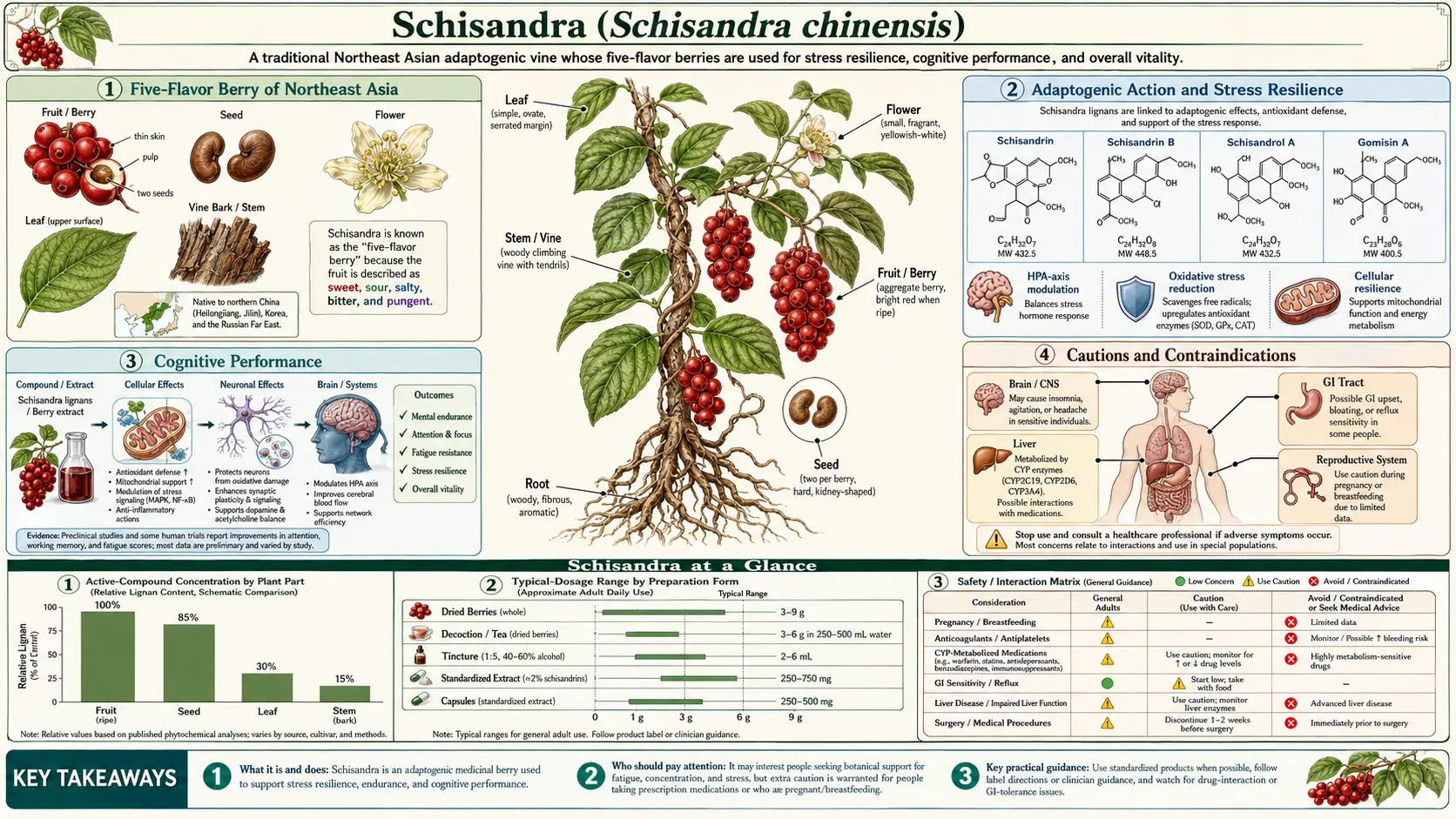
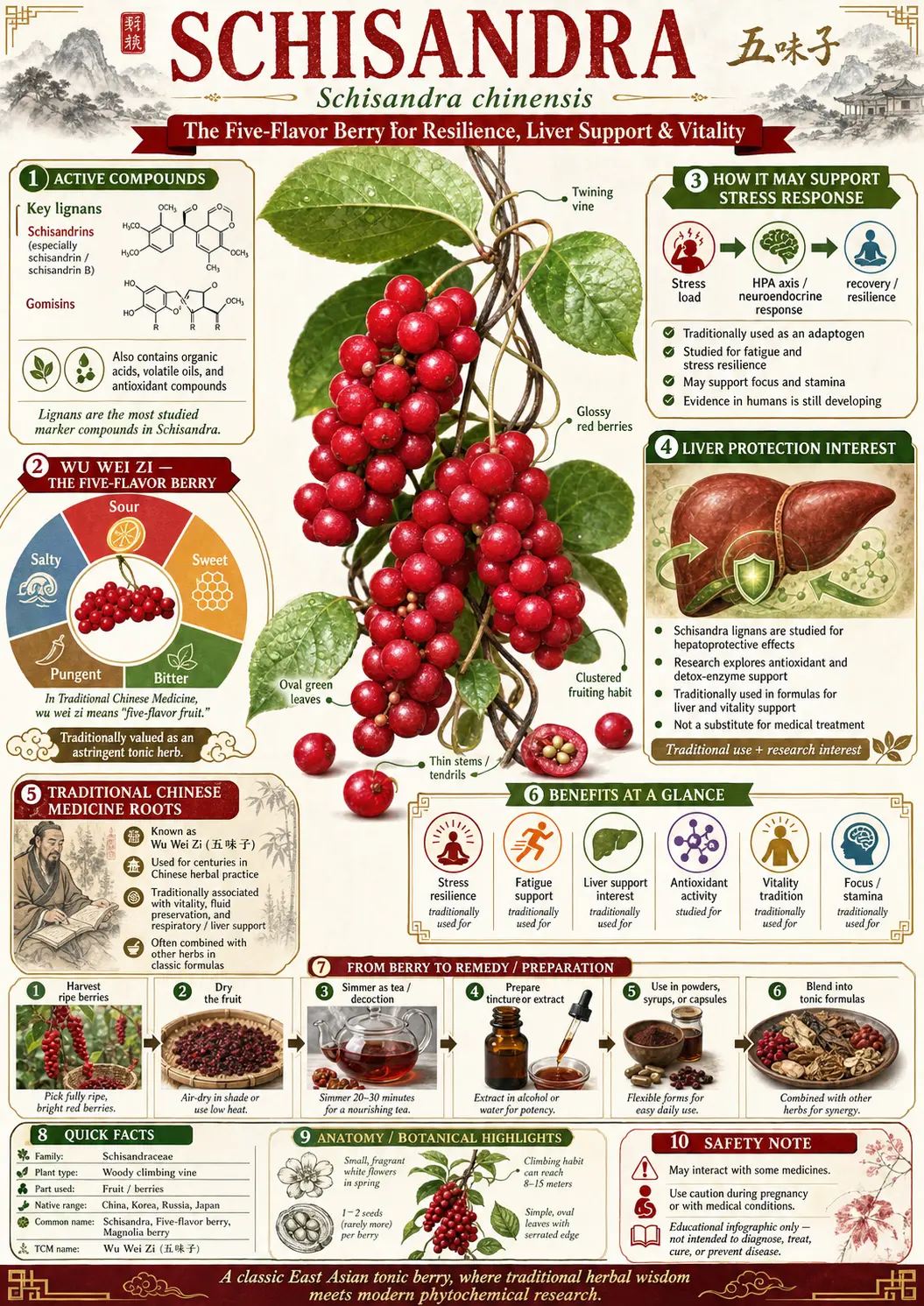
Table of Contents
- Five-Flavor Berry of Northeast Asia
- Active Compounds
- Liver Protection and Function
- Adaptogenic Action and Stress Resilience
- Respiratory and Cough
- Cytochrome P450 and Drug Metabolism
- Cognitive Performance
- Forms and Preparations
- Recommended Dosage
- Cautions and Contraindications
- Featured Videos
Five-Flavor Berry of Northeast Asia
Schisandra (wu wei zi, "five-flavor berry") is a hardy climbing vine native to the forests of northern China, the Russian Far East, Korea, and Japan, whose bright-red berries are said to carry all five classical flavors at once — sweet, sour, bitter, pungent, and salty. First recorded among the "superior" tonic herbs in China's ancient Shen Nong Ben Cao Jing, it later became a stamina aid for hunters in the Russian Far East and, in the twentieth century, a focus of Soviet "adaptogen" research alongside Rhodiola and Eleuthero — the fuller story is told in the dedicated History & Traditional Use article.
Active Compounds
The principal active constituents are schisandra lignans — a unique class of dibenzocyclooctadiene compounds with a complex molecular structure not found in other commonly used herbs:
- Schisandrins (A, B, C) — the most-studied lignans; primary contributors to liver-protective and adaptogenic activity
- Schisantherins — additional liver-protective lignans
- Gomisins — a related family of lignans with overlapping activity
- Sesquiterpenes — minor essential oil components contributing to flavor and mild cardiovascular effects
- Organic acids — citric, malic, tartaric, contributing to the sour flavor and mild expectorant action
Standardized extracts are typically calibrated to schisandrin or total lignan content. Schisandra is unusual in that the seeds contain higher lignan concentrations than the fleshy berry pulp, so high-quality extracts include the whole berry including seeds.
Liver Protection and Function
Schisandra is one of the most thoroughly studied herbs for hepatoprotection. Clinical evidence in chronic hepatitis B and C, drug-induced liver injury, and elevated transaminases includes:
- Significant reductions in elevated ALT and AST in chronic viral hepatitis
- Protection against carbon tetrachloride and acetaminophen liver toxicity in animal models — often used as a model of broad-spectrum hepatoprotection
- Upregulation of glutathione synthesis, the body's master antioxidant in the liver
- Induction of phase I and phase II detoxification enzymes, supporting clearance of hepatotoxic substances
- Anti-fibrotic effects, slowing collagen deposition in the liver
- Modulation of inflammatory cytokines in the liver microenvironment
In integrative hepatology, Schisandra is often combined with milk thistle (silymarin) for synergistic liver support: silymarin protects hepatocytes from oxidative damage, while Schisandra additionally supports liver detoxification capacity and antioxidant defense.
Adaptogenic Action and Stress Resilience
Schisandra is one of the classical Russian-defined adaptogens. Documented effects relevant to stress resilience and physical/mental performance include:
- Improved mental work capacity under fatigue (controlled trials of office workers and students)
- Increased physical endurance in athletes and soldiers
- Faster recovery from physical exertion
- Improved attention, memory, and cognitive performance
- Reduced subjective fatigue and improved mood
- Modulation of the HPA axis with normalization of cortisol response to stress
Schisandra is somewhat more stimulating than ashwagandha but less stimulating than ginseng, making it a good choice for individuals who feel agitated on stronger stimulant adaptogens but find ashwagandha too sedating. It is commonly combined with Rhodiola for additive cognitive and stamina effects.
Respiratory and Cough
Schisandra is one of the classical TCM herbs for chronic dry cough and asthmatic conditions. The astringent, lignan-rich berry tonifies the lungs and consolidates lung qi — in modern terms, it appears to reduce airway hyperreactivity and exhausting unproductive cough. Combination with apricot kernel and other respiratory tonifiers is traditional.
Cytochrome P450 and Drug Metabolism
Schisandra has significant effects on hepatic cytochrome P450 enzymes — a property with both therapeutic and safety implications:
- Induction of CYP3A4 and other phase I enzymes can accelerate the breakdown of many medications, potentially reducing their effectiveness
- Modulation of P-glycoprotein efflux pumps affects drug absorption and distribution
- Schisandra has been studied as an adjuvant to immunosuppressants like tacrolimus and cyclosporine, where it can elevate drug levels and may allow lower pharmaceutical doses; this requires careful pharmacokinetic monitoring
Patients on multiple medications, particularly immunosuppressants, anticoagulants, and chemotherapy, should not start Schisandra without pharmacist or clinician review.
Cognitive Performance
Several controlled trials have shown that Schisandra improves measures of attention, working memory, and mental processing speed, particularly under conditions of fatigue or chronic stress. Combination with Rhodiola and Eleuthero in the standardized adaptogen blend ADAPT-232 has been studied for cognitive performance under stress with positive results.
Forms and Preparations
- Whole dried berries — can be eaten as a snack, brewed as tea, or simmered into syrup; tart, complex flavor with all five classical tastes
- Standardized extracts — typically calibrated to schisandrin (often 2-9%) or total lignan content; the form used in most clinical trials
- Tinctures — 1:5 alcohol extracts; well-suited for the lignan profile
- Combination adaptogen formulas — ADAPT-232, ADAPT-122, and similar Russian-developed blends combining Schisandra with Rhodiola and/or Eleuthero
- Schisandra wine and syrup — traditional Korean and Chinese preparations
Recommended Dosage
- Standardized extract — 100-500 mg twice daily of an extract standardized to 2-9% schisandrin
- Whole dried berries — 1.5-6 g daily, brewed as tea or eaten
- Tincture (1:5) — 2-4 mL twice or three times daily
- Onset — adaptogenic effects build over 2-6 weeks; liver enzyme improvements typically take 8-12 weeks to manifest
- Cycling — traditionally taken for 1-3 months at a time with brief breaks; safe for long-term use overall
Cautions and Contraindications
- Drug interactions via CYP450 — can affect blood levels of many medications including immunosuppressants, anticoagulants, antiretrovirals, certain statins, and chemotherapy; review with pharmacist before starting
- Pregnancy — contraindicated in early and middle pregnancy due to uterine-stimulating activity; traditionally used in TCM at the very end of pregnancy and in labor under skilled supervision; safer to avoid during pregnancy
- Active peptic ulcer or severe GERD — the sour fruit can aggravate these conditions in some users
- Epilepsy — traditional caution; case reports limited but used historically with care in seizure disorders
- Acute infection (early phase) — TCM caution similar to other tonifying herbs; safer to begin after the acute febrile phase
- Mild side effects — heartburn, mild GI upset, decreased appetite, restlessness; usually mild and dose-related
Research Papers and References
The following PubMed search links provide curated entry points into the published clinical and mechanistic literature on Schisandra (Schisandra chinensis). Each link opens directly in PubMed at the National Library of Medicine.
- Schisandra chinensis adaptogen mental performance — PubMed: Schisandra adaptogen mental
- Schisandra and liver function ALT AST hepatitis — PubMed: Schisandra liver ALT
- Schisandrin lignans pharmacology — PubMed: schisandrin lignans
- Schisandra and exercise endurance — PubMed: Schisandra endurance exercise
- Schisandra and cytochrome P450 drug metabolism — PubMed: Schisandra CYP450
- Schisandra in Soviet adaptogen research — PubMed: Schisandra chinensis Soviet
- Schisandra safety review — PubMed: Schisandra safety
External Authoritative Resources
- NCCIH — Herbs at a Glance
- MedlinePlus — Herbs and Supplements
- PubMed — All research on Schisandra chinensis
Connections
- Fluoride Chelation — liver support in the Chinese-medicine approach
- All Herbs
- Schisandra Benefits Deep Dive
- Ashwagandha
- Milk Thistle
- Holy Basil
- Rhodiola Rosea
- He Shou Wu
- Astragalus
- Ginseng
- Fatigue
- Hepatitis
- Hepatitis B
- Detoxification
- Glutathione
- Stress Management
- Depression
- Liver Cleansing
- Dandelion
- Codonopsis (Dang Shen) — the gentle, non-stimulant qi tonic used in place of ginseng
- White Peony Root (Bai Shao) — source of Total Glucosides of Paeony, an approved rheumatoid-arthritis drug in China