Kencur (Kaempferia galanga)
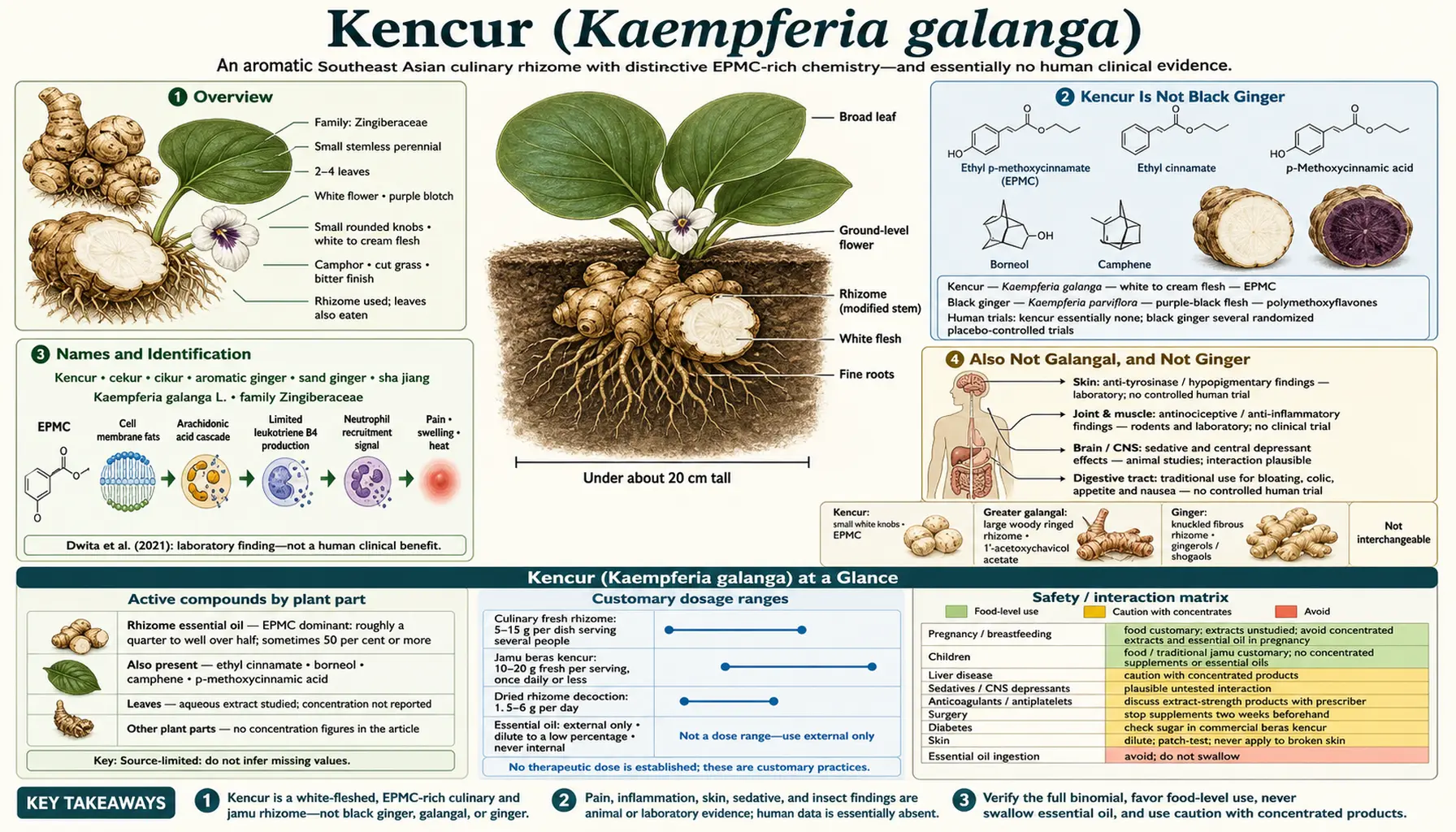
Kencur is a small, white-fleshed, ferociously aromatic rhizome that grows almost flat against the soil, and it is the defining flavour of Indonesian jamu beras kencur — the sweet rice-and-kencur tonic sold from baskets on street corners across Java. Its smell is unmistakable once you know it: camphor and cut grass with a bitter-medicinal edge, quite unlike the pine of galangal or the warm citrus of ginger.
An important warning before anything else: Kaempferia galanga (kencur) is not Kaempferia parviflora (black ginger, Thai krachai dam). They share a genus and nothing else that matters — different species, different rhizome colour, different chemistry, different markets, and radically different evidence. Black ginger has human clinical trials; kencur does not. Products routinely blur the two, and the section below sets out how to tell them apart.
On evidence, be prepared for very little. Kencur's research record is animal and cell-culture work on analgesia, inflammation, and mosquito larvae. Human data is essentially absent. That is a fact about the plant, not a gap in this page.
Table of Contents
- Overview
- Kencur Is Not Black Ginger
- Names and Identification
- Also Not Galangal, and Not Ginger
- Traditional Use and Jamu Beras Kencur
- Active Compounds
- Pain and Inflammation: Animal Evidence
- Topical Use for Aches and Sprains
- Larvicidal and Insect-Repellent Research
- Skin Lightening and Tyrosinase
- Culinary Use
- Forms and Preparations
- Dosage
- Cautions and Contraindications
- Key Research Papers
- Connections
- Featured Videos
Overview
Kaempferia galanga L. is a small stemless perennial in the ginger family, Zingiberaceae. It does not look like its relatives. Instead of a leafy stalk, it produces two to four broad, rounded, dark-green leaves that lie almost flat on the ground like lily pads, with delicate white flowers marked by a purple blotch appearing at ground level between them. The whole plant sits under about 20 cm tall.
The rhizome is a cluster of small, rounded, knobby tubers — each roughly the size of a walnut or smaller — with thin pale-brown skin and crisp, white, almost translucent flesh. It is far smaller and rounder than galangal, has none of fingerroot's slim projections, and lacks the knuckled hand shape of ginger.
The aroma is the identifying feature and it is powerful. Cut a fresh rhizome and you get a wave of camphor with a green, grassy, slightly soapy top note and a bitter finish. The dominant compound responsible is ethyl p-methoxycinnamate, and it is present at high enough levels that dried kencur is sometimes 50 per cent or more of that single molecule by weight of its essential oil.
The plant is native to South and Southeast Asia and is cultivated in Indonesia (especially Java), Malaysia, Thailand, southern China, India, and Bangladesh. It is a smallholder crop: grown in home gardens and small plots, lifted after eight to ten months, and sold fresh in local markets or sliced and sun-dried for the herbal trade. In Java, a large share of the harvest goes into the jamu industry, both the industrial packaged kind and the traditional jamu gendong sold door to door by women carrying bottles in a basket.
Kencur Is Not Black Ginger
This is the single most consequential distinction on the page, and it is worth spelling out in full because the two plants share a genus name and are frequently conflated in supplement marketing.
| Kencur | Black ginger | |
|---|---|---|
| Species | Kaempferia galanga L. | Kaempferia parviflora Wall. ex Baker |
| Flesh colour | White to cream | Deep purple to nearly black |
| Main names | Kencur, cekur, aromatic ginger, sand ginger, sha jiang | Krachai dam, Thai black ginger, Thai ginseng, kaempferia |
| Home market | Indonesia and Malaysia (jamu, cooking) | Thailand and Laos (tonic wine, sports supplements) |
| Signature chemistry | Ethyl p-methoxycinnamate (a phenylpropanoid) | Polymethoxyflavones (a class of flavonoids) |
| Typical use | Culinary spice; jamu tonic; topical for aches | Energy, physical performance, blood flow supplements |
| Human trial evidence | Essentially none | Several randomised placebo-controlled trials |
Why this matters. Kaempferia parviflora has been tested in randomised, double-blind, placebo-controlled human trials — for example on physical fitness in soccer players and adolescent athletes, and in a dedicated safety trial of daily consumption. Whatever you conclude about the size of those effects, the trials exist. Kaempferia galanga has nothing comparable. When a supplement label says only "Kaempferia extract", or leans on the shared trade name "Thai ginseng", it may be borrowing one species' clinical record for the other species' contents.
How to protect yourself. Look for the full binomial on the label. Fresh or sliced, the two are trivially distinguishable — cut a rhizome and look at the colour, because black ginger's purple-black flesh is unmistakable. Powdered, you cannot tell by eye at all, and you are relying entirely on the manufacturer. Our separate page on black ginger covers that plant's own evidence.
Names and Identification
The binomial is Kaempferia galanga L., family Zingiberaceae. The rhizome is the part used; the leaves are also eaten in some regions.
- Indonesian: kencur (older Dutch-era spelling kentjur).
- Malay: cekur.
- Javanese: kencur. Sundanese: cikur.
- Thai: proh hom (เปราะหอม), "fragrant proh".
- Chinese: 沙姜 sha jiang, "sand ginger" — used in Cantonese cooking, especially with poached chicken; also 山柰 shan nai in the herbal trade.
- Vietnamese: dịa liền. Tagalog: dusol.
- Hindi / Bengali: chandramula, chandramulika.
- English: aromatic ginger, sand ginger, resurrection lily, kencur; and — confusingly — sometimes "galangal" or "lesser galangal".
The Latin epithet itself is a trap. Kaempferia galanga carries "galanga" in its own scientific name, which is a fossil of eighteenth-century confusion about which rhizome was which. It is not a galangal in the modern sense: true galangals belong to the genus Alpinia. When an English-language spice reference lists "galangal, three kinds", the third kind is usually this plant.
Also Not Galangal, and Not Ginger
Four rhizomes appear side by side in the same Southeast Asian market stalls, and the differences are easy once you have handled them and impossible once they are ground to powder.
| Rhizome | Species | Shape and size | Aroma | Marker compound |
|---|---|---|---|---|
| Kencur | Kaempferia galanga | Small rounded knobs, walnut-sized, white inside | Camphor, grassy, bitter finish | Ethyl p-methoxycinnamate |
| Greater galangal | Alpinia galanga | Large, hard, woody, ringed, thumb-thick or wider | Pine, eucalyptus, sharp citrus | 1'-acetoxychavicol acetate |
| Ginger | Zingiber officinale | Knuckled hand, fibrous, juicy | Warm, lemony, peppery heat | Gingerols, shogaols |
| Fingerroot | Boesenbergia rotunda | Slim fingers hanging from a round corm, yellow inside | Peppery, earthy, faintly bitter | Panduratin A |
The practical consequence in cooking. Kencur is not a galangal substitute and galangal is not a kencur substitute. Kencur's camphor note is so assertive that using it where a recipe wants galangal produces a dish that tastes strongly medicinal. Going the other way, a beras kencur made with galangal simply is not beras kencur. If you cannot find kencur, leave it out and accept a different drink rather than swapping in a cousin.
The practical consequence in a supplement. Dried, sliced, and especially powdered, all four look like beige chips. The only defence is a binomial on the label from a supplier you have reason to trust. This is not pedantry: the four plants have entirely different chemistry and entirely different (mostly thin) evidence bases.
Traditional Use and Jamu Beras Kencur
Kencur's cultural centre of gravity is Java, and its most famous form is a drink.
Jamu beras kencur — literally "rice kencur jamu" — is made by soaking and grinding raw rice with fresh kencur rhizome, then blending with palm sugar, tamarind, and sometimes ginger, lime, and pandan. The result is a sweet, cloudy, pale-beige drink with a strong camphor-and-caramel character. It is traditionally taken as a general tonic: for appetite, for tiredness, for aching muscles after physical work, and as a strengthening drink for children and for women after childbirth. It is one of the two or three best-known jamu preparations in Indonesia and is sold both by jamu gendong vendors and in bottles in supermarkets.
Beyond the drink, traditional uses across the region include:
- Digestive complaints — bloating, colic, poor appetite, nausea — taken as a decoction or chewed.
- Coughs and colds — kencur with honey or salt, held in the mouth for sore throat and cough. This is a common household remedy in Java and Malaysia.
- Topical application for aches — grated rhizome mixed with rice flour and applied as a poultice to sore muscles, sprains, and swollen joints; also incorporated into traditional massage oils and param body pastes.
- Postpartum care — kencur is part of the warming, drying regimen given to new mothers in Javanese and Malay practice.
- Chinese and Cantonese use — as sha jiang the rhizome is both a kitchen spice and a warming herb for cold-pattern abdominal pain.
All of that is history and ethnobotany. It records what people have found worth doing for a long time, which is genuinely interesting information. It is not evidence that the plant does what the tradition says it does, and none of these indications has been tested in a controlled human trial.
Active Compounds
Kencur has an unusually simple and unusually distinctive chemical profile, dominated by a single molecule.
- Ethyl p-methoxycinnamate (EPMC) is the dominant constituent and a genuine chemical marker for this species. Depending on origin, harvest, and distillation method it can make up anywhere from roughly a quarter to well over half of the essential oil. It is a phenylpropanoid ester, structurally a cousin of the cinnamates in cinnamon. It is what makes kencur smell the way it does, and it is the compound behind most of the plant's studied biological activity. In laboratory work it inhibits inflammatory mediator production, shows analgesic effects in animal models, and is insecticidal. It also crystallises easily, which is why concentrated kencur oil sometimes sets solid at room temperature.
- Ethyl cinnamate occurs alongside EPMC as the second major ester and contributes the sweeter, balsamic part of the aroma.
- Borneol and camphene are the monoterpenes chiefly responsible for the camphor-like character. Borneol has a long history in Asian medicine in its own right and is a component of many traditional topical preparations.
- p-Methoxycinnamic acid, the free acid corresponding to EPMC, is present and is also a metabolite formed when EPMC is broken down in the body.
- Cineole, pentadecane, and various sesquiterpenes fill out the volatile fraction.
- Flavonoids and small amounts of kaempferol-type compounds occur in the non-volatile fraction, but kencur is not primarily a flavonoid plant — a point of contrast with black ginger, whose activity is attributed to polymethoxyflavones.
Because EPMC is fat-soluble and volatile, how you prepare kencur changes what you get. A water decoction extracts relatively little of it; grinding fresh rhizome into a drink with fat or oil present, or using an alcohol extract, extracts far more. Long boiling drives it off. This is one reason traditional preparations and laboratory extracts are not comparable.
Pain and Inflammation: Animal Evidence
Mechanism. EPMC and related kencur constituents appear to act on the arachidonic acid cascade — the biochemical assembly line that converts membrane fats into the prostaglandins and leukotrienes that produce pain, swelling, and heat. Dwita and colleagues (2021) reported that extracts, fractions, and isolated EPMC from Kaempferia galanga limited production of leukotriene B4, a potent chemical signal that recruits neutrophils into inflamed tissue. That is a specific, plausible mechanism rather than a vague antioxidant hand-wave.
What the evidence shows. Sulaiman and colleagues (2008), publishing in the Journal of Natural Medicines, tested an aqueous extract of Kaempferia galanga leaves in standard rodent models and reported both antinociceptive (pain-reducing) and anti-inflammatory effects. This is the kind of study that gives the traditional use a plausible foundation. Related work has found anti-inflammatory and enzyme-inhibitory activity for kencur essential oil, including anticholinesterase and anti-tyrosinase effects reported by Begum and colleagues (2023).
What it does not show. Every one of those studies is in rodents or in cell culture. There is no randomised controlled trial of kencur for pain, arthritis, or any inflammatory condition in humans. Rodent pain models are notorious for producing positive results that do not survive translation — that is one of the best-documented failure patterns in all of pharmacology. If you have persistent joint or muscle pain, kencur is not a substitute for a proper diagnosis and a treatment plan.
Topical Use for Aches and Sprains
The traditional application — grated kencur in a poultice, or kencur-infused massage oil rubbed into a sore back — is the use with the most intuitive support, though "intuitive" is doing a lot of work in that sentence.
Mechanism. Two plausible contributions. First, borneol and camphene are counterirritants: they stimulate cold and warmth receptors in the skin, producing a tingling, cooling sensation that competes with pain signals for attention. This is the same principle behind menthol rubs and camphor balms, and it produces real, if temporary, symptomatic relief. Second, EPMC's anti-inflammatory activity in laboratory models offers a possible local effect, if enough of it penetrates the skin — which nobody has measured properly in humans.
What the evidence shows. Kencur is a component of many traditional Indonesian and Malay topical preparations, and its essential oil has documented anti-inflammatory activity in laboratory assays. Counterirritant relief from camphor-type compounds is a well-established phenomenon in general, though not specifically demonstrated for kencur.
What it does not show. No clinical trial has tested topical kencur for muscle or joint pain. If a kencur rub feels good on a sore shoulder, that is a perfectly reasonable thing to enjoy, and the risk is low. It is not treatment for an injury, and warmth or tingling is not healing.
Larvicidal and Insect-Repellent Research
One of the larger bodies of kencur research has nothing to do with human medicine.
Mechanism. The phenylpropanoids that dominate kencur oil, EPMC especially, are neurotoxic to insects and act as contact and fumigant poisons and as repellents. Plants make compounds like these precisely to discourage being eaten.
What the evidence shows. Choochote and colleagues (1999) reported larvicidal, adulticidal, and repellent effects of Kaempferia galanga against mosquitoes. Kim and colleagues (2008), in Pest Management Science, tested isolated kencur rhizome phenylpropanoids against three mosquito species and found larvicidal activity. Later work has continued to report activity against Aedes aegypti larvae, the dengue vector. Liu and colleagues (2014) documented repellent and insecticidal effects of the essential oil against a stored-product pest.
What it means. This is a genuine and reasonably consistent finding, and it is a legitimate area of applied research into botanical larvicides for water-container mosquito control. It says nothing about whether kencur benefits human health, and it should not be read as a reason to take it internally. It is also, quietly, a reminder that these are bioactive compounds: something potent enough to kill mosquito larvae is not automatically inert in a person at high enough concentration.
Skin Lightening and Tyrosinase
Mechanism. Tyrosinase is the rate-limiting enzyme in melanin production. Inhibit it and pigment production falls. This is the mechanism behind most cosmetic depigmenting agents, and it is the target for a large amount of botanical screening.
What the evidence shows. Ko and colleagues (2014), in Phytotherapy Research, reported hypopigmentary effects of EPMC isolated from Kaempferia galanga. Begum and colleagues (2023) reported anti-tyrosinase activity for EPMC-rich kencur essential oil. Kencur appears in some Southeast Asian cosmetic preparations on this basis.
What it does not show. No controlled human trial has tested kencur or EPMC on human skin pigmentation. Anti-tyrosinase activity in a test tube is a low bar — hundreds of plant extracts clear it — and the leap to a visible effect on skin requires penetration, stability, and a formulation that has been tested. Also worth saying: skin-lightening is a cosmetic aim shaped by cultural pressures, and some commercial lightening products in this market have contained genuinely dangerous ingredients such as mercury and unlabelled steroids. If you are buying a lightening product, that is a bigger safety issue than which botanical is on the front of the jar.
Culinary Use
Kencur is a real food ingredient, used sparingly because it is so strong.
In Indonesian cooking, kencur is essential to pecel and gado-gado peanut sauces, to urap (a dressed vegetable salad with grated coconut), to karedok, and to several sambal preparations. It goes into sayur soups and into some fried-chicken marinades. The young leaves are eaten as a vegetable in parts of Java and Malaysia.
In Malaysian cooking, cekur leaves are shredded into ulam (raw herb salads) and into nasi ulam, and the rhizome flavours certain curries.
In Cantonese cooking, sha jiang is fundamental to the sand-ginger dipping sauce served with poached white-cut chicken — the rhizome minced or powdered, mixed with oil, ginger, spring onion, and salt. It also seasons braised and salt-baked dishes.
Practical notes:
- Use much less than you think. A single small knob — 5 to 10 g — is plenty for a family-sized peanut sauce. Kencur dominates a dish quickly.
- Grate or pound it raw for maximum aroma; prolonged boiling drives off the volatile compounds that make it worth using.
- Powder works for Cantonese sand-ginger dishes and stores well, but loses the green top notes.
- Frozen fresh rhizome is the best option outside Southeast Asia and is common in Indonesian and Chinese groceries.
Forms and Preparations
- Fresh rhizome — the standard culinary form; keeps a week or two refrigerated, months frozen.
- Dried slices — the herbal-trade form, sold as shan nai in Chinese medicine shops; used in decoctions.
- Powder — convenient for Cantonese sand-ginger sauces, and the form most vulnerable to species substitution.
- Jamu beras kencur — the traditional fresh drink, homemade or bottled. Bottled commercial versions are often heavily sweetened; a serving can carry a substantial amount of sugar, which is worth knowing if you have diabetes.
- Kencur oil and massage param — traditional topical preparations for aching muscles.
- Essential oil — steam-distilled, very high in EPMC. Topical and aromatic use only, always diluted. Do not swallow it.
- Capsules and extracts — available but with no dosing research behind them and a real risk of confusion with Kaempferia parviflora.
Dosage
No therapeutic dose of kencur has been established for anything. There is no dose-finding trial, no clinical trial, and no pharmacopoeial dose supported by human data. Numbers below describe customary practice, not evidence-based recommendations.
- Culinary: roughly 5–15 g of fresh rhizome in a dish serving several people. Food-level use has a very long safety record.
- Jamu beras kencur: a traditional serving contains on the order of 10–20 g of fresh rhizome, taken once daily or less. The sugar content of the drink is often the more relevant consideration.
- Dried rhizome decoction: traditional texts describe amounts in the region of 1.5–6 g of dried rhizome per day, in the Chinese herbal tradition, usually within a combination formula rather than alone.
- Essential oil: external use only, diluted to a low percentage in a carrier oil. Never internal.
- Extracts and capsules: there is no evidence-based dose. If you use one, stay at the labelled amount and choose a product that prints Kaempferia galanga on it.
Cautions and Contraindications
Kencur is eaten daily across Indonesia, Malaysia, and southern China, and food-level use appears well tolerated. Concentrated extracts and essential oil are a different matter, and safety data for them is thin to nonexistent.
- Species confusion is the leading safety issue. Kaempferia galanga is not Kaempferia parviflora, and it is not Alpinia galanga either. A product without a binomial should be treated as unidentified plant material, and any claim it makes may belong to a different species entirely.
- Pregnancy: culinary amounts are customary in the region. Avoid concentrated extracts and essential oil. There is no human safety data in pregnancy, and traditional postpartum use is not a clearance for use during pregnancy.
- Breastfeeding: the same caution. Food use is customary; extracts are unstudied.
- Essential oil is not for internal use. Kencur oil is extremely concentrated in EPMC and related compounds. Ingesting essential oils is a recurring cause of poisoning, particularly in children.
- Children: kencur in food and in traditional jamu is common practice in Java. Concentrated supplements and essential oils are not appropriate; there is no paediatric data.
- Liver disease: kencur is metabolised in the liver and its constituents have not been studied in people with impaired liver function. Caution with concentrated products.
- Sedatives and CNS depressants: animal studies have reported sedative and central depressant effects for kencur constituents. If you take benzodiazepines, sleep medication, opioids, or drink significantly, be aware that this interaction has not been tested but is plausible.
- Anticoagulants and antiplatelet drugs: as with other Zingiberaceae, discuss extract-strength products with your prescriber before starting.
- Surgery: stop kencur supplements two weeks beforehand, both for the theoretical bleeding risk and for the possible sedative interaction with anaesthesia.
- Diabetes: commercial beras kencur is frequently high in palm sugar. Check the label.
- Skin sensitivity: topical kencur and its oil can irritate, particularly undiluted. Patch-test on a small area first, and do not apply to broken skin.
- Allergy: uncommon, but cross-reactivity within the ginger family is possible.
The overall picture: kencur is a delicious and historically important spice with a genuinely distinctive chemistry and almost no human evidence. Cook with it freely. Treat any capsule that promises more than flavour with scepticism, and read the binomial before you believe a claim.
Key Research Papers
- Wang SY, Zhao H, Xu HT, et al. Kaempferia galanga L.: progresses in phytochemistry, pharmacology, toxicology and ethnomedicinal uses. Frontiers in Pharmacology. 2021;12:675350. (Review.)
- Kumar A. Phytochemistry, pharmacological activities and uses of traditional medicinal plant Kaempferia galanga L. — an overview. Journal of Ethnopharmacology. 2020;253:112667. (Review.)
- Sulaiman MR, Zakaria ZA, Daud IA, et al. Antinociceptive and anti-inflammatory activities of the aqueous extract of Kaempferia galanga leaves in animal models. Journal of Natural Medicines. 2008;62(2):221–227. (Animal.)
- Dwita LP, Hikmawanti NPE, Yeni, et al. Extract, fractions, and ethyl-p-methoxycinnamate isolate from Kaempferia galanga elicit anti-inflammatory activity by limiting leukotriene B4 (LTB4) production. Journal of Traditional and Complementary Medicine. 2021;11(6):563–569. (Laboratory.)
- Begum T, Gogoi R, Sarma N, et al. Novel ethyl p-methoxy cinnamate rich Kaempferia galanga (L.) essential oil and its pharmacological applications: special emphasis on anticholinesterase, anti-tyrosinase, alpha-amylase inhibitory, and genotoxic efficiencies. PeerJ. 2023;11:e14606. (Laboratory.)
- Ko HJ, Kim HJ, Kim SY, et al. Hypopigmentary effects of ethyl p-methoxycinnamate isolated from Kaempferia galanga. Phytotherapy Research. 2014;28(2):274–279. (Laboratory.)
- Sasaki Y, Norikura T, Matsui-Yuasa I, et al. Kaempferia galanga L. extract and its main component, ethyl p-methoxycinnamate, inhibit the proliferation of Ehrlich ascites tumor cells by suppressing TFAM expression. Heliyon. 2023;9(6):e17588. (Cell culture.)
- Choochote W, Kanjanapothi D, Panthong A, et al. Larvicidal, adulticidal and repellent effects of Kaempferia galanga. Southeast Asian Journal of Tropical Medicine and Public Health. 1999;30(3):470–476. (Entomology.)
- Kim NJ, Byun SG, Cho JE, et al. Larvicidal activity of Kaempferia galanga rhizome phenylpropanoids towards three mosquito species. Pest Management Science. 2008;64(8):857–862. (Entomology.)
- Liu XC, Liang Y, Shi WP, et al. Repellent and insecticidal effects of the essential oil of Kaempferia galanga rhizomes to Liposcelis bostrychophila. Journal of Economic Entomology. 2014;107(4):1706–1712. (Entomology.)
- Promthep K, Eungpinichpong W, Sripanidkulchai B, et al. Effect of Kaempferia parviflora extract on physical fitness of soccer players: a randomized double-blind placebo-controlled trial. Medical Science Monitor Basic Research. 2015;21:100–108. (Human trial — but of the other Kaempferia species, black ginger.)
- Yoshino S, Awa R, Miyake Y, et al. Evaluation of the safety of daily consumption of Kaempferia parviflora extract (KPFORCE): a randomized double-blind placebo-controlled trial. Journal of Medicinal Food. 2019;22(11):1168–1174. (Human trial — again, black ginger, not kencur.)
Live PubMed Searches
- Kaempferia galanga — all research
- Ethyl p-methoxycinnamate (EPMC)
- Kaempferia galanga and inflammation
- Kaempferia galanga essential oil composition
- Kaempferia galanga larvicidal activity
- Kaempferia parviflora (black ginger — the different species)
- Jamu and Indonesian herbal medicine
- Borneol pharmacology
- Zingiberaceae rhizome authentication and substitution
- Plant tyrosinase inhibitors and skin pigmentation
Connections
- All Herbs
- Black Ginger (Kaempferia parviflora) — the same genus, a different species, purple-black flesh, and the human trial data that kencur does not have.
- Galangal (Alpinia galanga) — the true galangal, and the plant whose name kencur borrowed in its own binomial.
- Ginger (Zingiber officinale) — the family's best-studied member, with genuine clinical evidence behind it.
- Fingerroot (Boesenbergia rotunda) — the finger-shaped rhizome of Thai jungle curry and Indonesian jamu.
- Conditions on this site that reference this page: Canker Sores (Aphthous Ulcers) · Sinusitis · H. pylori (Helicobacter pylori) · Peptic Ulcer Disease · Infectious Disease