Soursop Leaf (Annona muricata)
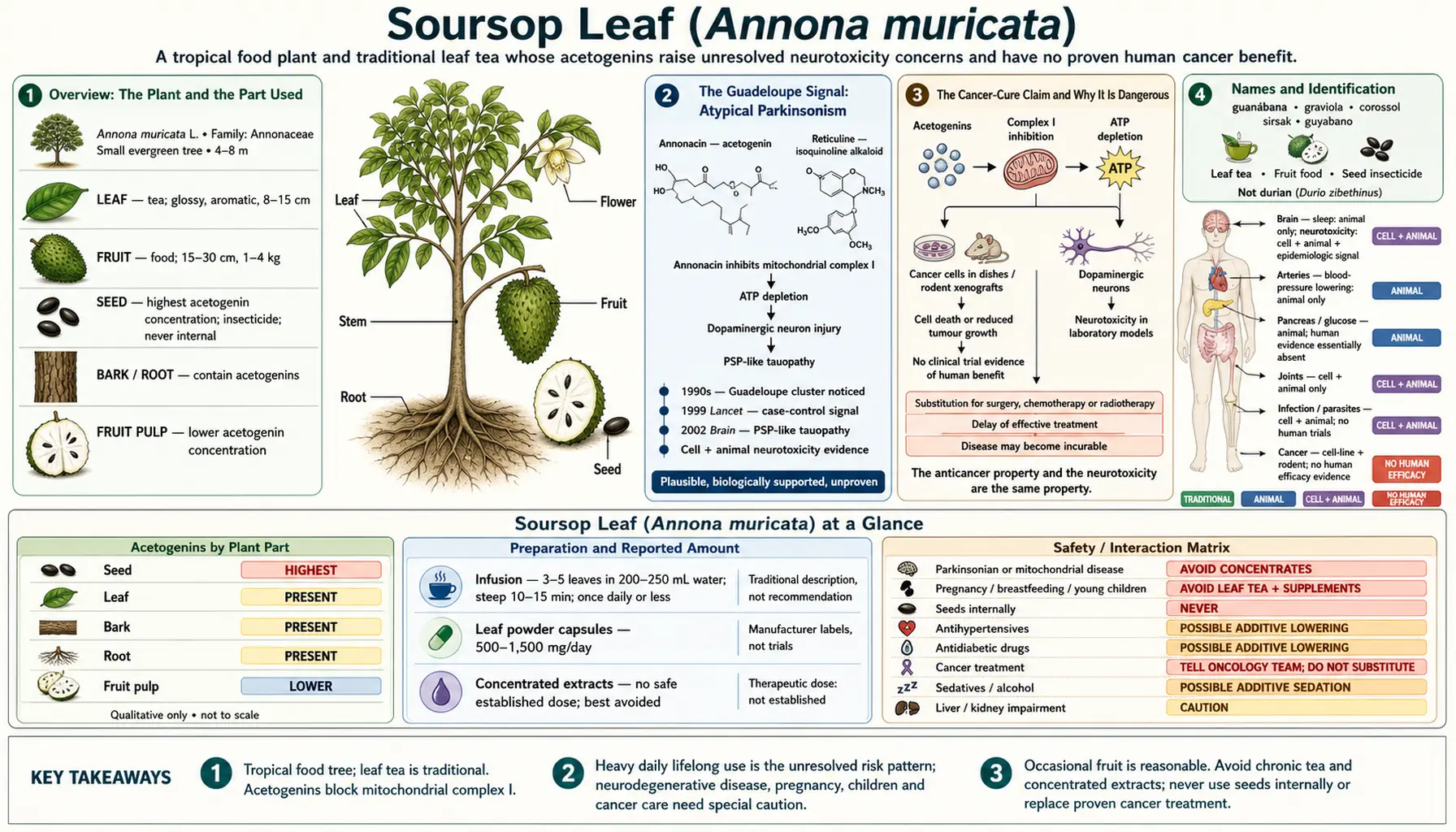
Soursop — Annona muricata, also called guanábana, graviola, corossol, sirsak or guyabano — is a small tropical tree whose spiny green fruit is eaten across the Caribbean, Latin America, West Africa and Southeast Asia, and whose leaves are brewed as a bedtime tea. The fruit is genuinely a food and the tea is genuinely traditional. But this page carries two serious warnings that most soursop pages do not.
The first is neurological. The plant contains annonacin and a family of related compounds called acetogenins, which block complex I of the mitochondrial respiratory chain. Epidemiological work in Guadeloupe found an unusually high local incidence of an atypical parkinsonism resembling progressive supranuclear palsy, and linked it to heavy consumption of Annona muricata fruit and leaf infusions. Causation is not settled and the association remains debated — but annonacin is demonstrably neurotoxic to dopaminergic neurons in laboratory models, and this is a serious unresolved signal rather than a rumour.
The second is commercial. Graviola is one of the most aggressively marketed "natural cancer cures" on the internet. There is no clinical trial evidence that soursop leaf or fruit treats cancer in humans. The entire body of anticancer research is cell-culture and rodent work. The documented harm is not the tea itself — it is people choosing it instead of treatment that works.
Table of Contents
- Overview: The Plant and the Part Used
- The Guadeloupe Signal: Atypical Parkinsonism
- The Cancer-Cure Claim and Why It Is Dangerous
- Names and Identification
- Traditional Use
- Active Compounds
- Sleep and Sedation
- Antiparasitic and Antimicrobial Activity
- Blood Sugar and Blood Pressure
- Anti-inflammatory and Analgesic Claims
- Culinary Use
- Forms and Preparations
- Dosage
- Cautions and Contraindications
- Key Research Papers
- Conditions It Is Used For
- Connections
- Featured Videos
Overview: The Plant and the Part Used
Annona muricata is a small evergreen tree, typically 4–8 metres tall, in the custard-apple family Annonaceae. It is native to tropical America and the Caribbean and was carried by Spanish and Portuguese traders to West Africa, South and Southeast Asia, where it naturalised readily. It needs warmth and humidity, will not tolerate frost, and fruits year-round in the wet tropics.
The fruit is large — commonly 15–30 cm and 1–4 kg — dark green with soft, curved spines, and encloses a white fibrous pulp studded with hard black seeds. The flavour is often described as strawberry-and-pineapple with a creamy, custard texture and a sharp acid edge. It is eaten fresh, blended into juice and ice cream, and sold frozen and canned worldwide.
The leaves are the part this page is mainly about. They are glossy, dark green, 8–15 cm long, and strongly aromatic when crushed. Traditionally they are boiled or steeped — commonly three to five fresh or dried leaves in a cup of hot water — and drunk in the evening. In Indonesia this is daun sirsak; in the Philippines, guyabano leaf tea; in the Caribbean, corossol or soursop tea.
Every part of the plant contains acetogenins — leaves, bark, roots, seeds and, at lower concentration, the fruit pulp. The seeds are the most concentrated and are the traditional insecticide and fish poison across the plant's range. That last fact is a useful anchor: this is a plant whose seed has been used to stun fish, and the same compound class is what is being sold as a wellness tea.
The Guadeloupe Signal: Atypical Parkinsonism
This is the most important section on the page, and it deserves to be told in order, because the story is genuinely complicated and both the alarmist and the dismissive versions of it are wrong.
What was observed
Neurologists on the French Caribbean island of Guadeloupe noticed, through the 1990s, that a strikingly high proportion of their parkinsonian patients did not have ordinary Parkinson's disease. Instead they had an atypical parkinsonism: rigidity and slowness without the classic tremor, early falls, difficulty moving the eyes vertically, cognitive change and prominent problems with balance — a picture closely resembling progressive supranuclear palsy (PSP). Crucially, these patients did not respond to levodopa, the drug that reliably helps true Parkinson's disease. In a referral series, atypical cases outnumbered classic Parkinson's disease, which is the reverse of the pattern seen almost anywhere else in the world.
The case-control study
In 1999, Caparros-Lefebvre and Elbaz published a case-control study in The Lancet examining whether consumption of tropical plants explained the cluster. They found that patients with atypical parkinsonism reported markedly higher lifetime consumption of Annonaceae — specifically soursop fruit, soursop leaf infusions, and related Annona species — than controls. A follow-up paper in Brain in 2002 characterised the syndrome pathologically as a PSP-like tauopathy, and a 2007 Brain paper by Lannuzel and colleagues examined the two clinical phenotypes seen in Guadeloupe and their shared risk factor.
The laboratory evidence
The epidemiology would be far weaker without the biology, and the biology is where this signal gets its weight:
- Annonacin inhibits mitochondrial complex I. This is the same target as rotenone and MPTP — two compounds that reliably produce parkinsonism in animals, and in MPTP's case, in humans. Complex I is the first step of the electron transport chain; blocking it starves the neuron of ATP.
- Annonacin kills dopaminergic neurons in culture. Lannuzel and colleagues showed in Neuroscience in 2003 that annonacin is toxic to mesencephalic dopaminergic neurons specifically by impairing energy metabolism — and that it does so at concentrations far lower than rotenone requires. Cell culture.
- Annonacin causes brain lesions in rats. Champy and colleagues reported in the Journal of Neurochemistry in 2004 that annonacin infused into rats produced nigral and striatal neurodegeneration — the anatomical pattern you would need to see for the hypothesis to hold. Animal.
- Annonacin induces tau pathology. Höllerhage and colleagues reported in Experimental Neurology in 2009 that natural lipophilic complex I inhibitors, annonacin among them, are candidate toxins for sporadic tau pathologies — connecting the compound to the specific pathology found in Guadeloupean patients. Cell and animal.
- The dose is not trivially small. Champy and colleagues quantified acetogenins in Annona muricata in Movement Disorders in 2005 and estimated that a single soursop fruit or a cup of leaf infusion could deliver on the order of a milligram or more of annonacin — and that a lifetime of daily consumption reaches, cumulatively, into the range that produced neurodegeneration in the rat experiments. This calculation is the strongest link between the epidemiology and the toxicology, and it is also the step most open to challenge, since it extrapolates across species and across routes of administration.
What is genuinely uncertain
We are not going to overstate this. The honest summary is that the hypothesis is plausible, biologically supported, and unproven:
- The epidemiology rests on a relatively small number of case-control studies from one island, with retrospective dietary recall — a method vulnerable to recall bias, particularly once a local hypothesis is publicly known.
- Similar clusters of atypical parkinsonism in Guam and in New Caledonia have been attributed to other exposures, and a genetic or environmental contribution specific to Guadeloupe cannot be excluded.
- The rat studies used intravenous infusion of purified annonacin. Oral consumption of a whole fruit is a very different exposure, with different absorption and first-pass metabolism.
- Millions of people in Africa, Asia and Latin America eat soursop regularly without any comparable cluster being reported — although it is also true that PSP-like syndromes are under-diagnosed in most of those settings.
- No prospective cohort study has tested the hypothesis, and it is difficult to see how one ethically could.
What this means in practice
Occasional consumption of soursop fruit is not what the concern is about. The exposure implicated in Guadeloupe was heavy, daily and lifelong — fruit, juice, and leaf infusions used as a daily beverage or as a chronic remedy. The reasonable position, and the one taken by French health authorities who have issued caution over Annona consumption, is:
- Eating soursop fruit occasionally is a normal dietary choice.
- Drinking soursop leaf tea daily, for months or years, is the pattern most closely matched to the exposure of concern, and is not advisable.
- Concentrated graviola supplements — standardised acetogenin extracts, capsules of powdered leaf, tinctures — deliver far more acetogenin than food and have the weakest safety case of all. There is no established safe long-term dose.
- Anyone with an existing neurodegenerative diagnosis, or a family history of parkinsonism, has a clear reason to avoid concentrated preparations entirely.
The Cancer-Cure Claim and Why It Is Dangerous
Search for graviola and you will find it described as "10,000 times stronger than chemotherapy", as a cure suppressed by pharmaceutical companies, and as a treatment for essentially every solid tumour. This is the largest source of harm associated with the plant, and it needs stating without hedging.
There is no clinical trial evidence that Annona muricata treats cancer in humans. Not a positive trial with a caveat; not a small trial needing replication. There is no adequately designed human trial of soursop as a cancer treatment showing benefit. The entire literature is:
- Cell-line work. Acetogenins kill cultured cancer cells, sometimes at low concentrations, and preferentially affect cells with high ATP demand — the mechanistic basis of the "selective for cancer cells" claim. Thousands of substances kill cancer cells in a dish, including bleach. This is a screening result, not a therapy.
- Rodent xenograft work. Some studies report tumour growth reduction in mice implanted with human cancer cells and given leaf extracts. These findings are real, are hypothesis-generating, and historically translate to human benefit only rarely.
- Reviews summarising the above. Moghadamtousi and colleagues published a careful and widely cited review in the International Journal of Molecular Sciences in 2015 that catalogues the isolated acetogenins and their biological activities — and which does not report human efficacy, because there is none to report.
The "10,000 times stronger than chemotherapy" figure traces back to in-vitro potency comparisons of isolated acetogenins against adriamycin in cell assays. It is a laboratory ratio between two compounds in a dish. It says nothing about what happens in a person, where absorption, distribution, metabolism, excretion and toxicity determine everything. It has been recycled through marketing copy for two decades.
The documented harm is substitution. A 2018 paper in Revue des Maladies Respiratoires by Moreau and colleagues examined self-medication with Annona muricata as an anti-cancer agent on Réunion, documenting the practice in a real patient population. The pattern that clinicians describe is consistent: a patient with a curable or treatable cancer delays or declines surgery, chemotherapy or radiotherapy while drinking soursop tea, and returns months later with disease that is no longer curable. Nothing on this page is intended to shame anyone for wanting a gentler option. But the cost of that particular substitution is measured in survival, and it is the reason we lead with it.
If you have cancer and want to use soursop: tell your oncology team. Two concrete reasons, beyond the general principle. First, acetogenins are mitochondrial poisons and may interact with treatments that also stress mitochondria or that rely on oxidative mechanisms. Second, chemotherapy-induced neuropathy and neurotoxicity are already a problem, and adding a neurotoxin is a genuinely bad idea. There is no requirement that you justify yourself — simply tell them what you are taking.
Names and Identification
Binomial: Annona muricata L. Family: Annonaceae. Parts used: leaf (tea), fruit (food), seed (insecticide — not for internal use).
Regional names:
- Spanish: guanábana
- Portuguese (Brazil): graviola
- French / Creole: corossol
- Indonesian / Malay: sirsak, durian belanda ("Dutch durian")
- Tagalog: guyabano
- Thai: thurian thet (ทุเรียนเทศ)
- Vietnamese: mãng câu xiêm
- Hindi: lakshman phal
- Swahili: mstafeli
Confusable relatives. Several Annona species look and taste similar and are sold interchangeably in markets. All of them contain acetogenins, so the safety discussion above applies across the genus:
- Annona squamosa — sugar apple, sweetsop, custard apple, sitaphal, srikaya. Round, knobbly, sweeter.
- Annona reticulata — bullock's heart, custard apple.
- Annona cherimola — cherimoya. The Guadeloupe studies included several Annona species, not soursop alone.
- Annona montana — mountain soursop; sometimes substituted for A. muricata and reported to contain higher acetogenin levels.
"Custard apple" is ambiguous and is applied in different countries to A. reticulata, A. squamosa and occasionally A. cherimola. If a supplement label says "custard apple" or simply "Annona", assume it contains acetogenins.
Not to be confused with: durian (Durio zibethinus), despite the Malay name "Dutch durian" — a completely unrelated plant.
Traditional Use
Soursop leaf is used across an enormous geographic range, and the traditional indications are remarkably consistent from continent to continent:
- Caribbean and Latin America. Corossol or guanábana leaf tea as an evening sedative and for "nerves", for fever, and for high blood pressure. The crushed leaf is applied to skin infections and boils.
- West Africa (Nigeria, Ghana, Cameroon). Leaf decoctions for fever, malaria, hypertension, diabetes and parasites; the plant is one of the most frequently cited in West African ethnobotanical surveys.
- Indonesia and Malaysia (Jamu). Daun sirsak boiled into a tea for gout, uric acid, back pain, high blood pressure, and — heavily, in recent decades — for cancer. The modern cancer usage in Jamu is largely a product of internet-era marketing rather than deep tradition.
- Philippines. Guyabano leaf tea for sleep, cough and hypertension.
- Vietnam and Thailand. Leaf and unripe fruit in folk preparations for digestive complaints and fever.
- India. Leaf poultices for skin conditions and inflammation; unripe fruit for dysentery.
- Seeds, everywhere. Powdered and used as an insecticide, a head-lice treatment and a fish poison. This is the one traditional use that is uncontroversially explained by the chemistry.
Traditional use tells us that this plant is bioactive and that people have found it worth using. It does not tell us that any of these uses works, and it does not tell us that daily long-term use is safe — a distinction that matters more than usual here, given the neurotoxicology.
Active Compounds
Annonaceous acetogenins — the defining and most consequential class. Over 200 have been isolated from Annona muricata. Chemically they are long-chain fatty acid derivatives with tetrahydrofuran rings and a terminal lactone. The principal ones include annonacin, annomuricin, muricatocin, annomutacin, murisolin, bullatacin and squamocin.
Their pharmacology is unusually well characterised for a plant compound: they are potent inhibitors of mitochondrial complex I (NADH:ubiquinone oxidoreductase). In a cancer cell this depletes ATP and triggers apoptosis, which is why they screen so well in oncology assays. In a dopaminergic neuron — a cell type with exceptionally high energy demand and a long unmyelinated axon — the same action is the mechanism of the neurotoxicity described above. The anticancer property and the neurotoxicity are the same property. You cannot have one without the other, and any marketing that offers the first while omitting the second is describing half a molecule.
Acetogenins are lipophilic, which means they cross the blood–brain barrier and accumulate in fatty tissue. That is precisely why chronic exposure is more concerning than acute exposure.
Isoquinoline alkaloids — reticuline, coreximine, anonaine, asimilobine. These are present in the leaf and fruit and have been shown to affect dopaminergic signalling in laboratory systems. They are a second, less-discussed candidate contributor to the neurological signal.
Phenolics and flavonoids — quercetin and kaempferol glycosides, gallic and chlorogenic acids, catechins. These account for the leaf's antioxidant activity in laboratory assays. They are also present in a great many ordinary plants and are not a reason to choose soursop specifically.
Essential oil — β-caryophyllene, δ-cadinene, epi-α-cadinol and related sesquiterpenes give the crushed leaf its aroma.
Fruit nutrition. The pulp is a reasonable source of vitamin C (roughly 20 mg per 100 g), potassium, magnesium and dietary fibre, with about 66 kcal per 100 g. Nutritionally it is a perfectly good tropical fruit.
Sleep and Sedation
The claim: soursop leaf tea in the evening for sleep and anxiety — the most consistent traditional use worldwide.
Mechanism: rodent studies of Annona muricata leaf extract have reported sedative and anxiolytic-type behaviour, with effects attributed to the alkaloid fraction and to modulation of GABAergic and serotonergic signalling. Related Annona species have shown similar effects in animal models.
Human evidence: none of adequate quality. There are no published randomised controlled trials of soursop leaf for insomnia or anxiety. The consistency of the traditional use across four continents is interesting, and a mild sedative effect would be entirely plausible given the alkaloid content — but "plausible and widely believed" is not the same as demonstrated, and this is exactly the use that produces the daily, long-term exposure pattern of greatest concern. Evidence: animal only.
Antiparasitic and Antimicrobial Activity
The claim: leaf and seed preparations for malaria, intestinal worms, lice and skin infections.
Mechanism: acetogenins are broadly toxic to organisms that depend on mitochondrial respiration — which is why the seeds work as an insecticide and a fish poison. That is not a subtle mechanism; it is metabolic poisoning, and it does not distinguish sharply between a parasite's mitochondria and yours.
Evidence: laboratory studies report activity against Plasmodium species, Leishmania, Trypanosoma, various helminths and a range of bacteria including Staphylococcus aureus. Topical seed preparations for head lice have long ethnobotanical support and a clear mechanistic rationale. Evidence: cell-culture and animal for the internal uses; traditional plus mechanism for the topical insecticidal use. There are no human trials for malaria or for systemic parasitic infection, and soursop should never be used in place of antimalarial or antiparasitic medication — malaria in particular kills quickly and has excellent, cheap, proven treatment.
Blood Sugar and Blood Pressure
The claim: soursop leaf tea for type 2 diabetes and hypertension — a very common use in West Africa, Indonesia and the Caribbean.
Blood sugar. Rodent studies in streptozotocin-induced diabetic rats have reported reduced fasting glucose with Annona muricata leaf extract, with proposed mechanisms including pancreatic beta-cell protection and inhibition of intestinal alpha-glucosidase. Evidence: animal. Human trial evidence is essentially absent. The practical risk is real in the other direction: someone who substitutes leaf tea for metformin or insulin, or who adds it without monitoring, can end up with uncontrolled hyperglycaemia or, less commonly, an unexpected drop in glucose.
Blood pressure. Animal studies report modest blood-pressure lowering, attributed to peripheral vasodilation rather than to heart-rate or contractility effects. Evidence: animal. Again, no adequate human trials. Anyone on antihypertensive medication who adds a daily leaf infusion should be aware of the possibility of additive lowering.
Anti-inflammatory and Analgesic Claims
The claim: leaf preparations for gout, arthritis, back pain and general inflammation — particularly prominent in Indonesian Jamu practice.
Mechanism and evidence: leaf extracts reduce inflammatory markers and pain behaviour in standard rodent models (carrageenan paw oedema, acetic acid writhing), with the effect attributed to the flavonoid and alkaloid fractions. Some in-vitro work reports inhibition of xanthine oxidase, the enzyme targeted by allopurinol, which would fit the traditional gout use. Evidence: cell-culture and animal only. No human trials. For gout specifically, the medications that lower urate have decades of outcome data behind them, and untreated gout damages joints permanently.
Culinary Use
The fruit is a genuine and popular food, and this page is not an argument against eating it. Ripe soursop is scooped from the skin, the black seeds discarded, and the pulp eaten fresh or blended.
- Juice and batidos. Champola de guanábana in Cuba and Puerto Rico — pulp blended with milk, ice and sugar. Jus corossol across the French Caribbean.
- Ice cream and sorbet. The pulp's acidity and creaminess make it one of the best tropical fruits for frozen desserts; commercially widespread in Latin America and Southeast Asia.
- Es sirsak in Indonesia — pulp with ice, condensed milk and syrup.
- Candies, jams, nectar and canned pulp are exported worldwide.
The seeds are never eaten. They are hard, black and easily separated, and they carry the highest acetogenin concentration in the plant. Discard them; never crush them into a smoothie or blend the fruit whole.
The leaves are not a culinary ingredient. They are used only as an infusion, and that infusion is a remedy rather than a beverage — which is the distinction this whole page turns on.
Forms and Preparations
- Fresh leaf infusion. The traditional form: 3–5 leaves torn and steeped or simmered in a cup of water for 10–15 minutes. Bitter, grassy, faintly aromatic.
- Dried leaf tea, loose or bagged. Widely sold; acetogenin content varies enormously between products and is essentially never stated.
- Leaf powder capsules. Concentrated relative to tea. No standardisation.
- Standardised graviola extracts. Sometimes sold with an acetogenin percentage on the label. These are the highest-exposure products available and carry the weakest safety case of any form.
- Tinctures and liquid extracts. Alcohol extraction favours the lipophilic acetogenins, so these are relatively enriched in the compounds of concern.
- Fruit pulp, juice, frozen and canned — food products; the lowest-acetogenin form of the plant.
- Seed preparations. Traditional topical insecticide and lice treatment. Never for internal use.
What to look for on a label: the binomial (Annona muricata, not just "graviola" or "custard apple"), the plant part, and the country of origin. What you will almost never find, and what actually matters, is the acetogenin content. Absence of that number is the norm, which is itself a reason to treat concentrated products cautiously.
Dosage
There is no established therapeutic dose of soursop leaf, because there are no human efficacy trials to derive one from. There is also no established safe upper limit, and given the neurotoxicology that gap is not a formality.
Traditional practice, offered as description rather than recommendation, is roughly 3–5 leaves steeped in 200–250 ml of water, once daily or less. Commercial capsules commonly suggest 500–1,500 mg of leaf powder per day; these figures come from manufacturers, not from trials.
The practical guidance this page will give is about duration rather than amount:
- Do not drink soursop leaf tea daily on an open-ended basis. Chronic daily use is the exposure pattern implicated in Guadeloupe.
- If you use it at all, use it occasionally — and treat multi-month daily courses as something to avoid rather than something to titrate.
- Concentrated extracts and standardised acetogenin products have no safe established dose and are best avoided entirely.
- Fruit is a different question. Eating soursop as fruit, as part of a varied diet, is a reasonable thing to do. The concern scales with concentration and with years.
Cautions and Contraindications
Neurotoxicity is the headline caution. Annonacin and related acetogenins inhibit mitochondrial complex I, are neurotoxic to dopaminergic neurons in laboratory models, and are the basis of an epidemiological link between heavy Annona consumption and atypical parkinsonism in Guadeloupe. The link is not proven. It is also not dismissible, and no other food plant in common use carries a comparable signal.
Do not use concentrated preparations if you have:
- Parkinson's disease, progressive supranuclear palsy, multiple system atrophy or any other parkinsonian syndrome.
- A family history of parkinsonism or another neurodegenerative disorder.
- Any mitochondrial disease. Adding a complex I inhibitor to an already impaired respiratory chain is a clear hazard.
Avoid entirely:
- Pregnancy and breastfeeding. Acetogenins are lipophilic and cross biological membranes readily; some Annona preparations have traditional uterine-stimulant reputations. There is no safety data. Avoid leaf tea and all supplements.
- Infants and young children. The developing nervous system is the worst possible place to test a mitochondrial toxin.
- Soursop seeds, internally, in any amount.
Drug and condition interactions:
- Levodopa and other dopaminergic drugs. Theoretical antagonism at the level of the dopaminergic neuron. Avoid.
- Antihypertensives. Possible additive blood-pressure lowering.
- Antidiabetic drugs (metformin, sulfonylureas, insulin). Possible additive glucose lowering; also note that metformin itself has effects at complex I, so the combination is doubly unattractive.
- Chemotherapy and radiotherapy. Tell your oncology team. Potential for interaction and for additive neurotoxicity on top of chemotherapy-induced neuropathy.
- Liver and kidney impairment. Clearance of acetogenins in humans is not characterised; caution is appropriate.
- Sedatives, benzodiazepines and alcohol. Possible additive sedation given the traditional sleep use.
Reported adverse effects from ordinary use are mostly gastrointestinal — nausea and vomiting, particularly on an empty stomach. Movement-disorder effects would not be expected to appear acutely; the concern is cumulative and is precisely the kind of harm that is invisible at the individual level until it is not.
And once more, because it is the harm that is actually documented: soursop is not a cancer treatment. If you have cancer, take the treatment that has evidence behind it. You can eat the fruit.
Key Research Papers
- Caparros-Lefebvre D, Elbaz A. Possible relation of atypical parkinsonism in the French West Indies with consumption of tropical plants: a case-control study. Caribbean Parkinsonism Study Group. The Lancet. 1999;354(9175):281–286. The original epidemiological signal.
- Caparros-Lefebvre D, Sergeant N, Lees A, et al. Guadeloupean parkinsonism: a cluster of progressive supranuclear palsy-like tauopathy. Brain. 2002;125(Pt 4):801–811.
- Lannuzel A, Michel PP, Höglinger GU, et al. The mitochondrial complex I inhibitor annonacin is toxic to mesencephalic dopaminergic neurons by impairment of energy metabolism. Neuroscience. 2003;121(2):287–296. Cell culture.
- Champy P, Höglinger GU, Féger J, et al. Annonacin, a lipophilic inhibitor of mitochondrial complex I, induces nigral and striatal neurodegeneration in rats. Journal of Neurochemistry. 2004;88(1):63–69. Animal.
- Champy P, Melot A, Guérineau Eng V, et al. Quantification of acetogenins in Annona muricata linked to atypical parkinsonism in Guadeloupe. Movement Disorders. 2005;20(12):1629–1633. The dose-estimate paper.
- Lannuzel A, Höglinger GU, Verhaeghe S, et al. Atypical parkinsonism in Guadeloupe: a common risk factor for two closely related phenotypes? Brain. 2007;130(Pt 3):816–827.
- Höllerhage M, Matusch A, Champy P, et al. Natural lipophilic inhibitors of mitochondrial complex I are candidate toxins for sporadic neurodegenerative tau pathologies. Experimental Neurology. 2009;220(1):133–142.
- Moghadamtousi SZ, Fadaeinasab M, Nikzad S, et al. Annona muricata (Annonaceae): a review of its traditional uses, isolated acetogenins and biological activities. International Journal of Molecular Sciences. 2015;16(7):15625–15658. The standard phytochemical review — and note that it reports no human efficacy data.
- Moreau D, Huchot E, Gazaille V, et al. Self-medication with Annona muricata L. (corossol) as an anti-cancer agent in Réunion. Revue des Maladies Respiratoires. 2018;35(9):948–955. Article in French. Documents the substitution behaviour in a real patient population.
Live PubMed Searches
- Annonacin neurotoxicity
- Annonaceae and atypical parkinsonism
- Guadeloupean parkinsonism and tauopathy
- Annona muricata acetogenins
- Annona muricata and cancer research
- Graviola and soursop toxicity
- Mitochondrial complex I inhibitors and dopaminergic neurons
- Annona muricata and blood glucose
- Annona muricata antiparasitic activity
- Delayed conventional cancer treatment and survival
Conditions Soursop Leaf Is Used For
Each condition below links to its page. The coloured half of every capsule shows how much human evidence supports this herb for that specific use — traditional use is history, not proof, and is marked as such.
Connections
- All Herbs
- Progressive Supranuclear Palsy — the syndrome the Guadeloupe cluster resembles
- Parkinson's Disease
- Multiple System Atrophy
- Neurology
- Cancer
- Oncology
- Toxins
- Conditions on this site that reference this page: Breast Cancer · Psychiatry