Elephant's Foot (Elephantopus scaber)
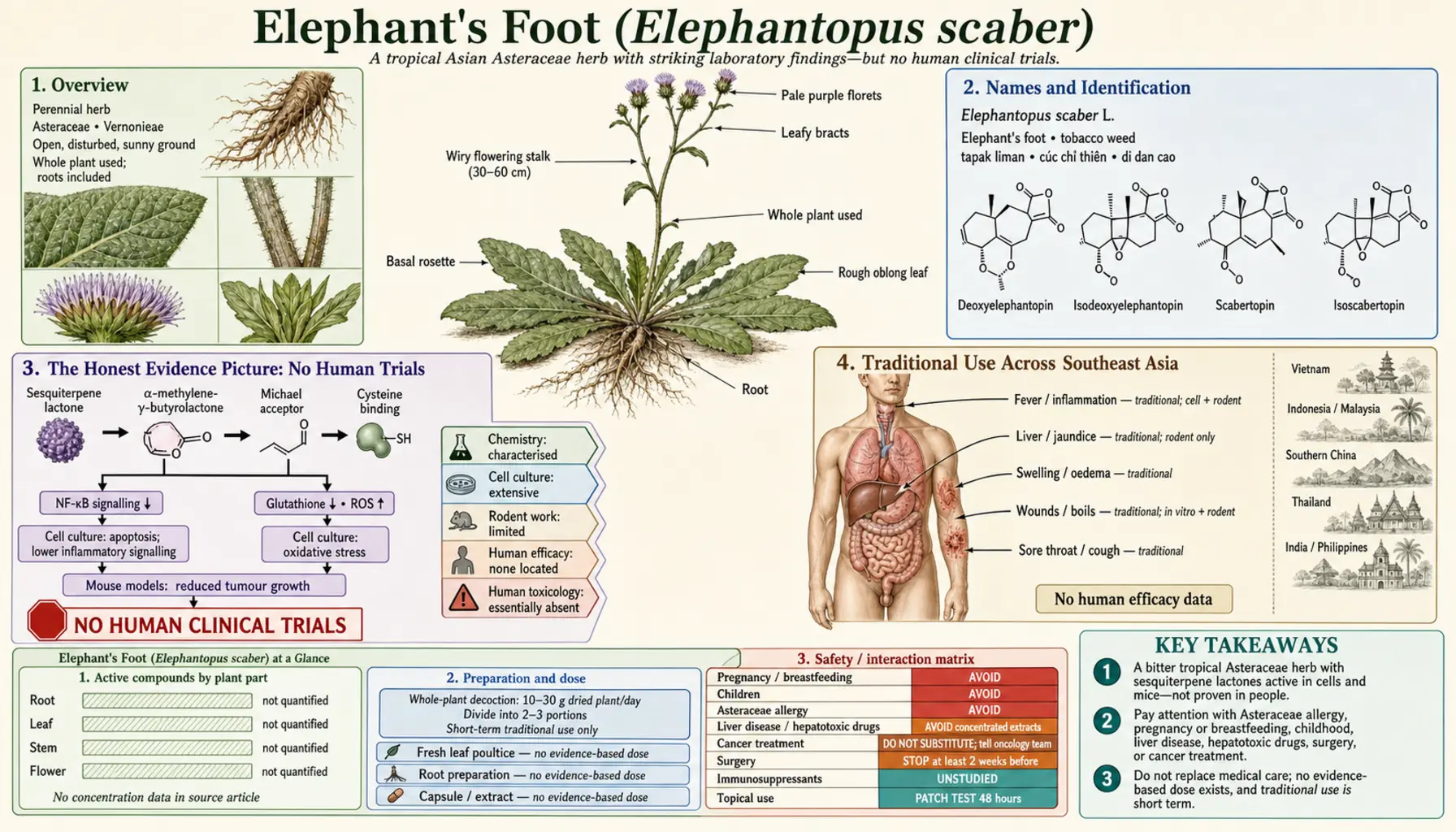
Elephant's foot is a flat rosette weed of roadsides and open ground across Vietnam, Indonesia, Malaysia, southern China, India and the Philippines, where it has been used for centuries against fever, liver complaints, boils and wounds. Over the last two decades it has attracted serious laboratory attention for a very specific reason: one of its constituents, deoxyelephantopin, kills cancer cells in culture at low concentrations and shrinks tumours in mice. That literature is substantial and it is real.
It is also entirely in vitro and rodent. No human clinical trial of this plant or of deoxyelephantopin exists. We could not locate human clinical evidence for any indication — not cancer, not fever, not liver disease. That gap is the single most important thing on this page, because the cell-line results are striking enough that they are already being sold as though they meant something clinically, and they do not yet.
There is a second warning that belongs at the top rather than buried at the bottom. The molecules responsible for the interesting activity are sesquiterpene lactones, and sesquiterpene lactones are one of the best-documented classes of plant contact allergen in dermatology. This is an Asteraceae plant, so anyone sensitised to ragweed, chrysanthemum, feverfew or arnica should expect cross-reactivity. The chemistry that makes it interesting is the same chemistry that makes it allergenic — those are not two separate facts.
Table of Contents
- Overview
- Names and Identification
- The Honest Evidence Picture: No Human Trials
- Traditional Use Across Southeast Asia
- Active Compounds: The Sesquiterpene Lactones
- Deoxyelephantopin and the Cancer Literature
- Fever, Inflammation and the NF-κB Story
- Liver Claims
- Wounds and Skin Use
- Why This Plant Is a Contact Allergen
- Forms and Preparations
- Dosage
- Cautions and Contraindications
- Key Research Papers
- Connections
- Featured Videos
Overview
Elephantopus scaber is a perennial herb of the daisy family (Asteraceae), tribe Vernonieae — the same tribe as the ironweeds and as Vernonia amygdalina, the African bitter leaf. Its growth form is distinctive and is the reason for its name: a flat basal rosette of large, rough, oblong leaves pressed down against the ground, from which a wiry, sparsely leafed flowering stalk rises 30–60 cm. The genus name is from Greek elephas (elephant) and pous (foot); the species epithet scaber means "rough," and the leaves genuinely are — sandpapery to the touch, which is a reliable field character.
The flowers are small and easy to miss: pale purple to lavender florets gathered into heads that are themselves clustered into a compound head, each subtended by a set of leafy bracts. The plant flowers over a long season and self-seeds readily.
It grows in open, disturbed, sunny ground — roadsides, grazed grassland, plantation edges, waste plots, riverside banks — and is common enough throughout tropical Asia to be treated as a weed. Its range extends across India, Sri Lanka, Bangladesh, Myanmar, Thailand, Vietnam, Cambodia, Laos, southern China, Taiwan, Malaysia, Indonesia and the Philippines, and it has spread as a pantropical weed into Africa and the Americas.
The whole plant is used, roots included, most often as a decoction of the dried aerial parts and root. In several traditions the fresh leaf is pounded and applied directly to boils and wounds. It is intensely bitter — the Chinese name means "earth gall," gall being the reference point for bitterness — which is why it is a medicine and not a vegetable.
Names and Identification
Binomial: Elephantopus scaber L.
Family: Asteraceae (Compositae), tribe Vernonieae
English: prickly-leaved elephant's foot, elephant's foot, tobacco weed
Regional names
- Vietnamese: cúc chỉ thiên ("the chrysanthemum that points at heaven," from the upright flowering stalk rising out of the flat rosette); also cây thổi lửa
- Indonesian and Malay: tapak liman — "elephant's footprint," the same image as the Latin. This is the name under which it appears in Indonesian jamu.
- Chinese: 地膽草 di dan cao ("earth gall herb"), also 苦地膽 ku di dan ("bitter earth gall")
- Thai: โด่ไม่รู้ล้ม do mai ru lom — "stands up and never knows how to fall," a reference to the resilient rosette. In Thailand it is sold widely as a male tonic largely on the strength of that name.
- Tamil: aanaichuvadi ("elephant's footprint"); Hindi: gobhi, gojihva
- Philippines: dila-dila, tabag
Name confusions — three of them, and they matter
1. "Elephant's foot" is several completely different plants. The English name is shared with Dioscorea elephantipes, a South African caudiciform vine grown as an ornamental succulent, and with Amorphophallus paeoniifolius, the elephant foot yam — a large aroid corm eaten as a staple vegetable across India and Southeast Asia. Neither has anything to do with this plant. Searching the English name will bring back all three.
2. Sibling species are used interchangeably. Elephantopus mollis (soft elephant's foot, with white flowers) and Elephantopus tomentosus occupy the same habitats, are used in the same traditions, and are commonly harvested and sold under the same local names. Pseudelephantopus spicatus is a further lookalike from a closely related genus. Their chemistry overlaps but is not identical, and material sold as E. scaber may be any of them. Wild-collected herb from a market is not a controlled identity.
3. The Vietnamese name places it among the chrysanthemums, which is botanically accurate at family level and misleading at species level. Cúc covers many Asteraceae; the plant is not a chrysanthemum in the sense of the tea flower (Chrysanthemum morifolium), and their uses and chemistry differ substantially.
The Honest Evidence Picture: No Human Trials
Stated plainly, since the rest of the page depends on it:
- Human clinical evidence: none located. No randomised controlled trial, and no controlled trial of any design, for cancer, fever, liver disease, wound healing, or sexual function. This is not a case of trials that failed. It is a case of trials that have not been done.
- Cell-culture (in vitro) work: extensive, and genuinely interesting. Deoxyelephantopin and isodeoxyelephantopin are cytotoxic to a wide range of cancer cell lines at low micromolar concentrations, with a reasonably well-worked-out mechanism.
- Rodent work: real, and limited. Mouse tumour models — including mammary carcinoma allografts — have shown reduced tumour growth with deoxyelephantopin. Rodent anti-inflammatory, antipyretic and hepatoprotective screens also exist.
- Chemistry: well characterised. The sesquiterpene lactone constituents have been isolated, named and structurally determined. This is solid work.
- Human toxicology: essentially absent. There is no dose-ranging safety data in people, which is a serious gap for a plant whose active compounds are reactive electrophiles.
The gap between "kills cancer cells in a dish" and "helps a person with cancer" is enormous and it is where the overwhelming majority of candidate compounds die. Roughly nineteen out of twenty drugs that enter human trials at all — already having survived years of preclinical filtering — never reach approval, and oncology has the worst attrition of any field. A compound that has never entered a human trial is at a far earlier point than that.
Traditional Use Across Southeast Asia
What is notable about elephant's foot is how consistent its traditional indications are across traditions that developed independently. Four themes recur nearly everywhere it grows: fever, liver, swelling/oedema, and topical use on wounds and boils.
Vietnam — thuốc nam
In Vietnamese folk medicine (thuốc nam, "southern medicine," as distinct from imported Chinese practice), cúc chỉ thiên is a cooling and clearing herb. The whole plant is decocted for fevers, for jaundice and liver complaints, for oedema, and for sore throat and coughs. The fresh plant is pounded into a poultice for boils, abscesses and infected wounds.
Indonesia and Malaysia — jamu
As tapak liman, the plant is a recognised jamu ingredient, used for fevers, as a general tonic and "cleanser," for wounds, and in postpartum recovery formulations. It is sold in Indonesian markets as dried whole plant and appears in packaged jamu preparations.
Southern China
Under the name di dan cao, it belongs to the class of herbs that "clear heat and resolve toxicity" — the traditional category covering acute infections and inflammatory conditions. Its recorded indications include sore throat, tonsillitis, fever, acute hepatitis, oedema, dysentery, and topical use on snakebite and boils. It is a folk and regional herb rather than one of the central Chinese materia medica items.
Thailand
Under the evocative name do mai ru lom, the root in particular is marketed as a male tonic and general strengthener, and this is now its most visible commercial use in Thailand. Note that this indication is the one with the least mechanistic or experimental support of any on this page.
India and the Philippines
In Indian folk practice the leaf paste is applied to eczema, ulcers and wounds, and decoctions are used for fever and dysuria. In the Philippines the plant appears in traditional practice for similar febrile and topical indications.
The consistency across these traditions is worth something as a signal that the plant does something — it is at least the kind of plant that gets noticed. It is not evidence of efficacy for any specific condition.
Active Compounds: The Sesquiterpene Lactones
The pharmacologically interesting fraction of this plant is a family of germacranolide sesquiterpene lactones. The named ones are:
- Deoxyelephantopin — the flagship compound and the subject of most of the research literature.
- Isodeoxyelephantopin — an isomer, studied nearly as heavily, with a similar activity profile.
- Scabertopin and isoscabertopin — named for the species epithet.
- Elephantopin, molephantin and molephantinin — further members of the series, some first characterised in E. mollis.
Alongside these the plant contains ordinary and less remarkable constituents: lupeol, epifriedelinol and stigmasterol (triterpenes and sterols), luteolin-7-glucoside and other flavonoid glycosides, and caffeoylquinic acids of the chlorogenic acid family. These contribute general antioxidant activity and are found in hundreds of other plants.
The one chemical fact that explains everything else on this page
Sesquiterpene lactones of this type carry an α-methylene-γ-butyrolactone group. In plain terms, that is a strained, electron-poor double bond sitting next to a carbonyl, and it behaves as a Michael acceptor — it reacts irreversibly with soft nucleophiles. The most abundant soft nucleophile in any cell is the thiol group of cysteine, present in glutathione and in the active or regulatory sites of a great many proteins.
So these molecules covalently modify cysteine residues. That single property accounts for:
- The anticancer activity. Alkylating the critical cysteine of IKKβ or of the NF-κB p65 subunit shuts down NF-κB signalling, on which many tumour cells depend for survival. Depleting glutathione at the same time raises oxidative stress. Cancer cells, which typically run with less spare redox capacity than normal cells, are hit harder — and that differential is the therapeutic hypothesis.
- The anti-inflammatory activity. The same NF-κB shutdown, in immune cells.
- The contact allergy. A small reactive molecule that covalently binds skin proteins is the textbook definition of a hapten — and haptens are what the immune system learns to attack. This is exactly why sesquiterpene lactones are standard patch-test allergens.
- The reason to be cautious about high oral doses. Glutathione is the body's principal detoxification reserve, particularly in the liver. Compounds that consume it are not automatically safe just because they are plant-derived.
One mechanism, four consequences. Any page that presents the anticancer activity without the allergy and glutathione consequences has understood only a quarter of the chemistry.
Deoxyelephantopin and the Cancer Literature
This is the largest body of research on the plant and the one most in need of careful framing.
What has actually been shown
In cell culture: deoxyelephantopin and isodeoxyelephantopin inhibit growth and induce apoptosis in a broad range of human cancer cell lines — nasopharyngeal carcinoma, breast (including the triple-negative MDA-MB-231 line), cervical, hepatocellular, lung, colorectal and leukaemia lines — at low micromolar concentrations. Reported mechanisms include NF-κB inhibition, generation of reactive oxygen species, mitochondrial apoptosis with cytochrome c release and caspase activation, endoplasmic reticulum stress, cell-cycle arrest, autophagy modulation, and Nrf2 pathway activation. Some studies report sensitisation of resistant lines to conventional chemotherapy agents.
In mice: deoxyelephantopin has reduced tumour growth in mouse models, including the TS/A mammary carcinoma allograft in BALB/c mice, with reported effects on tumour volume and on metastasis. Reports generally describe the compound as tolerated at the doses used.
This is a coherent, multi-laboratory preclinical package. It is a reasonable basis for a medicinal-chemistry programme.
What has not been shown, and why the gap is not a formality
- No human trial exists. Not phase III, not phase II, not phase I. There is no human safety data, no pharmacokinetics, no dose.
- Michael acceptors are notoriously difficult to develop as drugs, for a reason that follows directly from their mechanism: a molecule that reacts with any accessible cysteine hits many proteins, not just the intended one. Selectivity is the central problem, and cell-culture assays are exactly the setting in which that problem is least visible.
- The concentrations used in cell culture are not concentrations you can reach by drinking a decoction. An in vitro result at 5 µM tells you nothing about what a cup of bitter tea does to a tumour, because the compound must first be present in the plant in sufficient quantity, survive the gut, be absorbed, escape first-pass metabolism, and reach the tumour at that concentration. None of those steps has been measured for deoxyelephantopin in humans.
- Whole plant is not purified compound. Almost all the cancer work uses isolated deoxyelephantopin. Traditional preparations are dilute mixtures of hundreds of constituents.
Please read this if you or someone you love has cancer
This is where the honest version of this page matters most. Do not substitute this plant, or any preparation of it, for cancer treatment. The reasons are concrete rather than defensive:
- Studies of patients who use alternative therapies in place of conventional cancer treatment have consistently found substantially worse survival, and that finding holds after adjusting for cancer type and stage. Refusal or delay of standard treatment is itself the mechanism of harm.
- Cancer treatment is time-sensitive in a way most illnesses are not. Time spent on an untested herb is time during which a curable stage can become an incurable one.
- There is a real interaction risk. A compound that depletes glutathione, generates reactive oxygen species and modulates NF-κB and Nrf2 could plausibly interfere with chemotherapy or radiotherapy — in either direction. Nrf2 activation in particular is associated with chemoresistance in tumour cells. Nobody has studied it, which means nobody can tell you it is safe alongside treatment.
If you are in treatment and want to take a herbal product, tell your oncology team. They cannot advise on what they do not know about.
Fever, Inflammation and the NF-κB Story
The traditional fever and inflammation indications have the most coherent mechanistic story on this page, and it is the same one as above: NF-κB is the master transcription factor for inflammatory gene expression, and sesquiterpene lactones inhibit it covalently. Blocking NF-κB reduces the transcription of TNF-α, interleukin-1β, interleukin-6, COX-2 and inducible nitric oxide synthase — which is, in effect, the entire acute inflammatory programme.
The evidence level: cell culture (usually LPS-stimulated macrophage lines, where extracts and isolated lactones reduce nitric oxide and cytokine output) and rodent models (carrageenan paw oedema, and yeast- or LPS-induced fever). No human data.
It is worth noticing that this same mechanism is shared by feverfew's parthenolide, and that feverfew — which does have human migraine trial data, of mixed quality — is a useful reference point for how modest the clinical translation of a potent in vitro NF-κB inhibitor can turn out to be.
The practical point about fever specifically: fever in an adult that is high, persistent beyond a few days, or accompanied by confusion, stiff neck, breathlessness, rash or severe pain needs medical assessment. In the regions where this plant grows, the differential includes dengue, malaria, typhoid, leptospirosis and melioidosis — several of which are treatable and several of which are lethal if missed.
Liver Claims
Traditional use for jaundice and hepatitis is consistent across Vietnamese, Chinese and Indonesian practice, and rodent hepatoprotection studies exist — the standard carbon tetrachloride and paracetamol models, with reduced transaminase elevation and reduced histological damage. Lupeol and the flavonoid fraction, rather than the sesquiterpene lactones, are the usual proposed contributors.
No human data exists. And here there is a specific reason for caution that runs opposite to the traditional claim: the liver is where glutathione conjugation happens, and Michael-acceptor compounds consume glutathione. Concentrated extracts of a sesquiterpene-lactone-rich plant are therefore a theoretical hepatic burden, not obviously a hepatic benefit, and this has not been studied at all in humans.
Anyone with existing liver disease, or taking a drug with known hepatotoxicity, has the strongest reason to avoid concentrated preparations — which is the reverse of what the traditional indication would suggest.
Wounds and Skin Use
Pounded fresh leaf applied to boils, abscesses and infected wounds is one of the most widespread uses of this plant, and there is a coherent rationale: sesquiterpene lactones have documented antibacterial activity in vitro, and reducing local inflammation is plausibly useful on an inflamed lesion. Rodent wound-healing models have reported faster closure with plant extract.
Two counterweights, both important:
- Repeated skin application is the exposure route most likely to sensitise you. Contact allergy to sesquiterpene lactones develops with repeated exposure and, once established, is permanent and cross-reactive across the entire daisy family — which would then include chamomile, arnica, calendula, feverfew, artichoke, lettuce, chicory and ragweed pollen. Trading a boil for lifelong Compositae sensitivity is a bad exchange.
- Poultices of unwashed wild plant on an open wound carry an infection risk of their own, including tetanus and soil organisms. A spreading, red, hot or painful lesion, or one with fever, needs antibiotics rather than leaves.
Why This Plant Is a Contact Allergen
This deserves its own section because it is the best-established human-relevant fact about the chemistry of this plant — the one thing in this entire page with a solid clinical literature behind it.
Sesquiterpene lactone contact allergy is a recognised, well-characterised dermatological entity. "Sesquiterpene lactone mix" is a standard screening allergen in patch-test series worldwide, and Compositae dermatitis is a familiar diagnosis in occupational and general dermatology. The mechanism is exactly the reactivity described earlier: the α-methylene-γ-butyrolactone binds skin proteins covalently, creating a hapten-protein complex the immune system learns to recognise.
Three features make this clinically significant:
- It cross-reacts across the family. Sensitisation to one Asteraceae species commonly means reaction to many. This is why Compositae dermatitis is often diagnosed by pattern rather than by a single exposure history.
- It can be airborne. Airborne contact dermatitis from Compositae plants is well described — typically affecting the face, eyelids, neck and forearms, in a distribution that can be mistaken for photodermatitis. In India, Parthenium dermatitis from Parthenium hysterophorus (congress grass) is a large-scale public-health problem affecting substantial numbers of agricultural and outdoor workers, and it is the same chemistry.
- It is permanent. Once sensitised, you remain sensitised. There is no desensitisation protocol.
Practical advice: if you have known ragweed, chrysanthemum, feverfew, chamomile, arnica or marigold sensitivity, avoid topical preparations of this plant. If you use it topically at all, patch-test a small area for 48 hours first, and stop at the first sign of itching, redness or small blisters — which typically appear one to three days after exposure rather than immediately.
Forms and Preparations
- Whole-plant decoction. The dominant traditional form throughout its range — dried whole plant including roots, simmered in water. Very bitter.
- Fresh leaf poultice. Leaves pounded and applied to boils, wounds and swellings.
- Dried whole plant. Sold in Asian herb markets loose, usually wild-collected.
- Jamu preparations. In Indonesia, as one ingredient among several in packaged or freshly prepared jamu.
- Root preparations. Thai do mai ru lom tonics, frequently in alcohol or as capsules.
- Capsules and extracts. Increasingly sold online, generally with no marker standardisation, no deoxyelephantopin assay, and frequently with cancer claims that are unsupported and in many jurisdictions illegal.
What to look for on a label
- The binomial — and be aware that E. mollis and E. tomentosus are traded under the same names.
- The plant part, and whether it is powder or extract with a ratio.
- Treat any cancer claim as a reason to distrust the vendor entirely. A seller willing to make that claim about an untested plant is not a seller whose identity, purity or dose statements you should rely on.
Dosage
No established or evidence-based dose exists. There has been no human dose-finding study, no pharmacokinetic study, and no human toxicology study. Anyone quoting a precise therapeutic dose in milligrams of deoxyelephantopin is extrapolating from mouse experiments, which is not a valid way to set a human dose.
Traditional practice, for description only: decoctions are typically made from roughly 10–30 g of dried whole plant per day, simmered and divided into two or three portions, and generally taken short-term for an acute complaint rather than continuously.
Two observations about that traditional pattern that are worth taking seriously. First, it is short-term acute use — days, for a fever or a boil — not the daily long-term supplementation that capsule products imply. Second, a dilute water decoction of whole plant delivers a far smaller and far more diluted dose of sesquiterpene lactones than a concentrated ethanolic extract in a capsule. The traditional safety record, such as it is, belongs to the traditional preparation and does not transfer to the modern one.
Cautions and Contraindications
Do not use it to treat cancer
Restating the central warning. The entire deoxyelephantopin oncology literature is in vitro and rodent. There is no human trial. Substituting an untested plant for cancer treatment is associated with materially worse survival, and there is a plausible, unstudied risk of interference with chemotherapy and radiotherapy through the plant's effects on glutathione, reactive oxygen species and the Nrf2 pathway. If you are in treatment, tell your oncology team about anything you take.
Asteraceae allergy and cross-reactivity
Anyone sensitised to ragweed, chrysanthemum, feverfew, chamomile, arnica, calendula, artichoke, lettuce or dandelion should assume cross-reactivity and avoid this plant, particularly topically. Sesquiterpene lactone sensitisation is permanent. Patch-test before any repeated skin use.
Pregnancy and breastfeeding
Avoid entirely. Sesquiterpene lactones are cytotoxic to dividing cells, several plants in this class have traditional emmenagogue and abortifacient reputations, and there is no reproductive toxicology data. Do not use this plant while pregnant, attempting to conceive, or breastfeeding.
Liver disease and hepatotoxic drugs
Concentrated extracts consume glutathione, which is the liver's principal detoxification reserve. Avoid if you have liver disease, drink heavily, or take drugs with known hepatotoxicity — and note that this is the opposite of what the traditional liver indication would suggest.
Children
Avoid. There is no paediatric safety data, children have proportionally less glutathione reserve, and febrile illness in a child needs a diagnosis.
Surgery and immunosuppressants
Stop at least two weeks before planned surgery. Because the plant's constituents modulate NF-κB and inflammatory signalling, treat combination with immunosuppressant drugs as an unstudied interaction.
Species identity and provenance
Wild-collected material may be E. mollis, E. tomentosus or a Pseudelephantopus. It is also usually collected from roadsides and disturbed ground, which carries the usual risks: vehicle-related metal deposition, herbicide residue, and contamination from animals.
Fever is a symptom, not a diagnosis
In the regions where this plant is used, a fever may be dengue, malaria, typhoid, leptospirosis, melioidosis or tuberculosis. Several are lethal untreated and several are readily treatable. A bitter decoction that suppresses the fever without touching the cause is a dangerous thing to rely on.
Key Research Papers
A note on the links. Every link goes to a PubMed search rather than a numeric identifier. A mistyped PMID silently sends you to a different paper; a search always resolves and lets you confirm the record yourself. Author names, titles and journals are plain text so you can verify them independently.
- Deoxyelephantopin from Elephantopus scaber — antitumour activity and mechanism. Find on PubMed. The core of the oncology literature. Read the methods sections: note that they are cell lines and mice.
- Isodeoxyelephantopin and NF-κB signalling. Find on PubMed. The mechanistic basis of both the anticancer and the anti-inflammatory claims.
- Deoxyelephantopin in mouse mammary carcinoma (TS/A) models. Find on PubMed. The in vivo rodent work.
- Sesquiterpene lactones: chemistry and mechanism of NF-κB inhibition by cysteine alkylation. Find on PubMed. Explains the single chemical property underlying everything on this page.
- Sesquiterpene lactone contact allergy and Compositae dermatitis. Find on PubMed. The best-supported human-relevant fact about this plant class.
- Parthenium dermatitis in India — airborne Compositae contact dermatitis. Find on PubMed. The scale of the sesquiterpene lactone allergy problem in South Asia.
- Johnson SB, Park HS, Gross CP, Yu JB. Use of alternative medicine for cancer and its impact on survival. Journal of the National Cancer Institute. 2018 — find on PubMed. Also see the companion paper by the same group on refusal of conventional treatment among complementary-medicine users.
- Phytochemistry and ethnopharmacology of Elephantopus scaber — reviews. Find on PubMed. Useful for the constituent list; note that these reviews generally do not flag the absence of human data.
Live PubMed Searches
- Elephantopus scaber
- Deoxyelephantopin
- Isodeoxyelephantopin
- Scabertopin
- Elephantopus scaber clinical trial — check this yourself; it is the emptiest search on the page
- Elephantopus scaber hepatoprotective
- Sesquiterpene lactone contact dermatitis
- Nrf2 and chemoresistance — background to the chemotherapy interaction concern
- Tapak liman and jamu
- Alternative medicine, treatment refusal and cancer survival
Connections
- All Herbs
- Andrographis — the Southeast Asian bitter fever herb that does have human trial data; the single most useful comparison on this page
- Chrysanthemum — the other Asteraceae "cooling" herb of Chinese practice, and a cross-reactivity concern for anyone sensitised
- Feverfew — parthenolide is the same chemistry, and feverfew shows how modest the clinical translation of a potent NF-κB inhibitor can be
- Turmeric — another plant with a huge in vitro anticancer literature and a much harder clinical story
- Neem — a comparable traditional fever-and-skin plant from South Asia
- Contact Dermatitis — how sesquiterpene lactone allergy is diagnosed and patch-tested
- Dermatology — the wider skin-condition index
- Pain and Allergy — background on allergic sensitisation
- Oncology — what cancer treatment actually involves, and why substitution is dangerous
- Immunology — NF-κB and the inflammatory response
- Kidney and Liver Conditions — relevant to the traditional liver indication and the glutathione caution
- Conditions on this site that reference this page: Alcoholic Hepatitis · Cirrhosis