Perilla (Perilla frutescens)
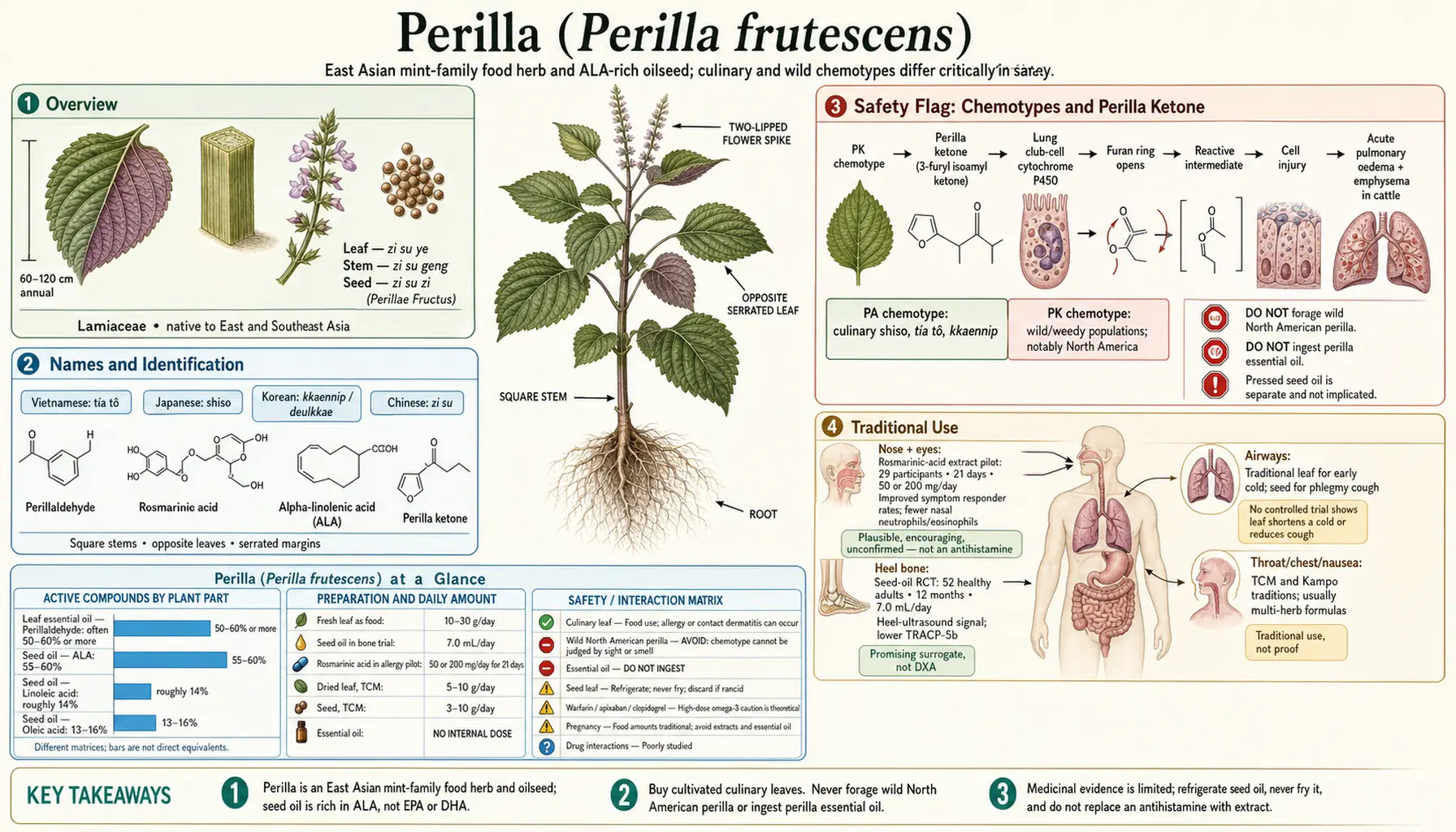
The purple-backed tía tô torn into Vietnamese noodle soup, the green shiso leaf under a slice of sashimi, and the broad kkaennip a Korean diner wraps around grilled pork are all the same species: Perilla frutescens, a member of the mint family. It is one of the most heavily eaten fresh herbs in East Asia and one of the least understood outside it.
Two facts make this page worth reading carefully. The first is genuinely useful: perilla seed oil is among the richest plant sources of alpha-linolenic acid on earth, typically 55–60% of its fatty acids — usually edging out flaxseed. The second is a real safety distinction. Some strains of this same species produce perilla ketone, a potent lung toxin that kills cattle in American pastures every summer. The leaves sold in Asian groceries are not that chemotype — but the distinction is real, it is why you should never forage "wild purple mint" in North America and treat it as shiso, and almost nothing written for a Western audience explains it. Human evidence for perilla leaf as a medicine, meanwhile, is thin: a handful of small allergy trials and a couple of modest supplement studies of the seed oil.
Table of Contents
- Overview
- Names and Identification
- Safety Flag: Chemotypes and Perilla Ketone
- Traditional Use
- Active Compounds
- Perilla Seed Oil and Alpha-Linolenic Acid
- Allergy and Rhinitis: The Human Trials
- Bone and Brain: Two Small Oil Trials
- Colds, Cough, and the Kampo Uses
- Culinary Use
- Forms and Preparations
- Dosage
- Cautions and Contraindications
- Key Research Papers
- Connections
- Featured Videos
Overview
Perilla frutescens (L.) Britton is an annual in the Lamiaceae — the mint family, and it looks it: square stems, opposite leaves in pairs, small two-lipped flowers in slim spikes. It grows fast and tall for a herb, 60 to 120 cm in a season, with broad serrated leaves that may be green, deep purple-red, or green on top and purple beneath depending on the variety.
It is native to East and Southeast Asia and has been cultivated for well over a thousand years in China, Japan, Korea, Vietnam and the northeastern Indian hills. Two quite different crops come from it. In Japan, Vietnam and China it is grown as a leaf herb, picked young and used raw. In Korea and parts of northern India it is also grown as an oilseed — deulkkae, whose seeds are pressed for cooking oil or ground into soups. The leaf crop and the seed crop are usually different cultivars of the same species.
Perilla has also naturalised across much of the eastern and midwestern United States, where it is a common weed of fencerows, woodland edges and pastures under the names "beefsteak plant" and "purple mint." That naturalised American population is the source of the toxicity problem described below; it is not the same material as the cultivated food crop.
Names and Identification
| Language / region | Name | What it refers to |
|---|---|---|
| Vietnamese | tía tô | Leaf, green above and purple beneath |
| Japanese | しそ shiso; 青じそ aojiso; 赤じそ akajiso | Green shiso and red shiso, both var. crispa |
| Japanese (parts) | mejiso, hojiso, egoma | Sprouts, flower spikes, and the oilseed form |
| Korean | 깻잎 kkaennip; 들깨 deulkkae | The broad flat leaf; the oilseed |
| Chinese | 紫蘇 zǐ sū; 紫蘇葉 zǐ sū yè; 紫蘇子 zǐ sū zǐ | The plant; the leaf drug; the seed drug (Perillae Fructus) |
| English | perilla, shiso, beefsteak plant, purple mint, wild coleus | — |
The sesame trap. Korean kkaennip is routinely translated as "sesame leaf" on restaurant menus and grocery packaging in the West. It is not sesame. Sesame is Sesamum indicum, a completely unrelated plant in the Pedaliaceae, and its leaves are not eaten. The confusion comes from Korean usage: chamkkae ("true kkae") is sesame, deulkkae ("wild kkae") is perilla, and kkaennip is literally "kkae leaf." If you are avoiding sesame for an allergy, a packet of Korean "sesame leaves" is perilla and poses no sesame risk — but if you are buying "perilla oil" expecting the nutty toasted flavour of sesame oil, you will get something quite different.
The ornamental trap. Deep-purple perilla is sold in Western garden centres as a bedding plant, sometimes labelled "beefsteak plant" and sometimes confused with coleus, which it superficially resembles. Ornamental nursery stock is grown as a decorative and may carry pesticides not permitted on food crops; do not eat it.
Distinguishing the culinary types. Japanese green shiso has strongly crinkled, saw-toothed leaves and a bright, unmistakable aroma with notes of cumin, cinnamon and citrus. Red shiso has the same crinkle but is purple through and through, with a duller aroma — its job is colour and pickling. Vietnamese tía tô is typically green on the upper surface and purple underneath, less crinkled, and noticeably more anise-like. Korean kkaennip leaves are much larger, flatter, rounder and softer, with a milder, greener flavour; they are built to be a wrapper. They are not interchangeable in cooking.
Safety Flag: Chemotypes and Perilla Ketone
This is the single most important thing on this page, and it is very poorly known outside veterinary medicine.
Perilla frutescens is a textbook chemotype species. Its essential-oil composition is controlled by a small number of genes and falls into discrete, sharply different types — plants that look almost identical can produce completely different dominant compounds. Botanists name the chemotypes after the compound that dominates:
| Chemotype | Dominant compound | Where it is found |
|---|---|---|
| PA | Perillaldehyde | The culinary type — shiso, tía tô, kkaennip |
| PK | Perilla ketone | Wild and weedy populations, notably in North America |
| EK / IK | Egomaketone, isoegomaketone | Wild and some oilseed lines |
| PP | Phenylpropanoids (myristicin, elemicin) | Scattered wild populations |
| C / PL | Citral, piperitenone | Minor, mostly wild |
What perilla ketone does. Perilla ketone is a substituted furan — chemically, 3-furyl isoamyl ketone. Furans are generally harmless until an enzyme opens the ring. In the lung, the club cells lining the small airways are unusually rich in cytochrome P450 monooxygenases, and those enzymes convert perilla ketone into a highly reactive intermediate that attacks the surrounding cells. The lung, in other words, poisons itself in the act of processing the compound. The result in cattle is acute pulmonary oedema and emphysema — a syndrome sometimes called "perilla mint toxicosis," and one of the recognised causes of acute bovine pulmonary emphysema.
The chemistry was pinned down in 1977, when a group publishing in Science isolated perilla ketone from the mint plant and identified it as a potent lung toxin. Follow-up work in the 1980s established which species are susceptible and produced in-vivo evidence that the lung monooxygenase system is required for the damage, and field reports documented cattle deaths in Tennessee and neighbouring states.
The pattern on American farms is consistent and seasonal: perilla grows in shady fencerows and around barns; in late summer, when pasture is short and the plants are flowering and seeding, cattle browse it; and the animals are found dead or in severe respiratory distress within a day or two. It is a real and recurring agricultural problem, not a laboratory curiosity.
What this means for you, plainly:
- The perilla you buy in an Asian grocery is not the toxic chemotype. Culinary shiso, tía tô and kkaennip are perillaldehyde types, selected over centuries for flavour. Millions of people eat them daily. There is no evidence of lung toxicity from the food crop.
- Do not forage wild perilla in North America and use it as shiso. Naturalised American populations are exactly the ones most likely to be ketone types, and you cannot tell by looking or, reliably, by smell.
- Do not self-dose perilla essential oil. Essential oil is the concentrated volatile fraction, which is precisely where the chemotype difference lives. Commercial perilla essential oil is sold for aromatherapy and is not standardised for internal use.
- Perilla seed oil is a separate product and is not implicated. Pressed seed oil is a fatty oil — triglycerides — not the volatile essential oil. Perilla ketone is not a meaningful component of cold-pressed culinary seed oil.
Traditional Use
Chinese medicine has used perilla for a very long time and splits it into three separate drugs. Zi su ye (the leaf) is classified as acrid and warm, used for the earliest stage of a wind-cold common cold — the stage of chills, stuffy nose and no sweating — and classically for seafood and crab poisoning, which is the traditional rationale behind serving shiso with raw fish. Zi su geng (the stem) is used to settle nausea in pregnancy and to move stagnant qi in the chest. Zi su zi (the seed, formally Perillae Fructus) is used quite differently — to "descend qi," loosen phlegm and quiet a wheezy cough, and it appears in the classical formula San Zi Yang Qin Tang.
Japanese Kampo inherited these uses. Perilla leaf (so-yo) is a component of hange-koboku-to, a formula prescribed for the sensation of a lump in the throat with no physical cause — the symptom Western medicine calls globus — and for anxiety-linked chest tightness. It also appears in koso-san, a gentle cold formula.
In Vietnam, tía tô is the household cold remedy: leaves torn into hot rice porridge (cháo tía tô) with ginger and spring onion, eaten to raise a sweat at the first sign of chills. In Korea, perilla is food first, but perilla seed powder is folk-credited with easing coughs and, in older practice, with helping a mother's milk supply.
None of this is proof of anything. It is a record of what people did, and it is a useful guide to where a researcher might look — nothing more.
Active Compounds
Perillaldehyde — the defining aroma compound of culinary perilla, often 50–60% or more of the leaf essential oil. It is the smell of shiso. It also has a curious derivative: perillartine (the oxime of perillaldehyde), which is roughly two thousand times sweeter than sucrose and has been used as a sweetener in Japan.
Rosmarinic acid — the main water-soluble polyphenol of the leaf, and the compound behind most of perilla's tested anti-allergic activity. It is not unique to perilla: rosemary, lemon balm, sage and Vietnamese balm all contain it, sometimes in higher amounts. Any claim about "perilla's" anti-allergy effect is really a claim about rosmarinic acid.
Luteolin, apigenin and their glycosides — flavones with the usual in-vitro anti-inflammatory profile.
Anthocyanins, chiefly shisonin (a malonylshisonin-type cyanidin glycoside) — the red pigment of akajiso. Like all anthocyanins it is pH-sensitive: dull purple in neutral conditions, brilliant magenta-red in acid. That reaction is not chemistry trivia; it is exactly why salted red shiso packed with sour ume plums produces the electric red of umeboshi, and why shiso juice turns vivid the moment you add citric acid or lemon.
Alpha-linolenic acid (ALA) — the dominant fatty acid of the seed, discussed in its own section below.
Perilla ketone, egomaketone, isoegomaketone — the furanoketones of the non-culinary chemotypes. See the safety section.
Perilla Seed Oil and Alpha-Linolenic Acid
This is the most solid, most checkable nutritional fact about the plant.
Perilla seed oil typically contains 55–60% alpha-linolenic acid (ALA, an 18-carbon omega-3 fatty acid), with roughly 14% linoleic acid and 13–16% oleic acid. For comparison, flaxseed oil — the plant omega-3 everyone has heard of — usually runs about 50–58% ALA. Perilla generally edges it out, and the two are the richest widely available plant sources by a wide margin. Rapeseed oil is around 9%, soybean oil around 7%, walnut oil around 10%.
The honest caveat, and it matters. ALA is not EPA or DHA, the long-chain omega-3s that most of the cardiovascular and brain research is actually about. Your body can elongate ALA into EPA and DHA, but the conversion is poor: commonly cited figures are around 5–8% of ALA reaching EPA and well under 1% reaching DHA, with the rate lower in men than in women. So perilla oil is an excellent way to raise your ALA intake, and a poor way to raise your DHA. If you eat no fish and want DHA, an algal oil is a direct source; perilla oil is not a substitute. What perilla oil is good for is displacing omega-6-heavy seed oils and improving the overall balance of the fats you eat — and, in the trials below, measurably raising the ALA content of your own cell membranes.
Practical handling. With three double bonds on most of its fatty acids, perilla oil oxidises fast. It goes rancid at room temperature in weeks, it must never be used for frying, and it should be bought in small dark bottles, kept refrigerated once opened, and used within a couple of months. Rancid oil is not neutral — it delivers oxidised lipids you do not want. Korean deulgireum (toasted perilla seed oil) is a finishing oil, drizzled over vegetables at the end, and that is the right way to use it.
Allergy and Rhinitis: The Human Trials
Mechanism. Rosmarinic acid suppresses allergic antibody responses and dampens the recruitment of neutrophils and eosinophils in animal models of allergic inflammation. That is the rationale for testing it in hay fever.
The human trial. One randomised, double-blind, placebo-controlled study tested a rosmarinic-acid-enriched perilla extract in adults with mild seasonal allergic rhinoconjunctivitis, over 21 days. Participants received 200 mg of rosmarinic acid, 50 mg, or placebo. Compared with placebo, the extract significantly increased responder rates for itchy nose, watery eyes, itchy eyes and total symptom score, and significantly reduced neutrophil and eosinophil counts in nasal lavage fluid. No adverse events were reported and routine blood tests were normal.
Now the size. The three groups were ten, nine and ten people. Twenty-nine participants in total, for three weeks, in mild disease. That is a pilot study. The reduction in nasal inflammatory cells is genuinely interesting because it is an objective measurement rather than a diary score, and it points at a real mechanism. But a positive result in twenty-nine people has not been replicated at a size that would change practice, and it is now two decades old. The honest position is: plausible, encouraging, unconfirmed. Perilla extract is not an antihistamine and should not replace one.
Bone and Brain: Two Small Oil Trials
Two Japanese randomised trials of perilla seed oil are worth reporting accurately, because they are the strongest human data the plant has and they are still modest.
Bone. A 12-month randomised, double-blind, placebo-controlled trial gave 52 healthy Japanese adults (mean age 54) either 7.0 mL of perilla seed oil or 7.0 mL of olive oil daily. After a year, the perilla group showed a significant increase in calcaneal (heel-bone) ultrasound density expressed as percentage of the young adult mean, and a significant fall in serum TRACP-5b, a marker of bone resorption. Bone alkaline phosphatase, a marker of bone formation, did not change — so the mechanism, if real, is slowed breakdown rather than increased building. Red-cell membrane ALA rose and an antioxidant-balance ratio improved, confirming the oil was actually absorbed.
What to make of it: 52 people, one site, and heel ultrasound is a screening surrogate, not the DXA hip-and-spine scan that defines osteoporosis. A twelve-month duration is respectable. Call it a promising signal that needs a bigger trial with real bone-density endpoints and fracture follow-up.
Cognition. A second trial combined perilla seed oil with nobiletin-rich ponkan citrus powder in healthy elderly Japanese adults and reported improved cognitive scores. The design flaw is obvious and unavoidable: it was a combination product, so nothing can be attributed to the perilla oil on its own. It cannot support a claim that perilla oil improves memory.
Colds, Cough, and the Kampo Uses
What is claimed. Perilla leaf for the first day of a cold; perilla seed for a phlegmy cough; hange-koboku-to for the lump-in-the-throat sensation.
What is known. Perillaldehyde has antibacterial and antifungal activity in culture, and perilla extracts show anti-inflammatory effects on airway cells in the laboratory. Kampo formulas containing perilla have been studied in Japan for globus sensation and for functional dyspepsia, but almost always as whole multi-herb formulas, often without placebo control, and usually in small numbers. No controlled trial shows that perilla leaf shortens a cold or reduces cough.
The sashimi question. The traditional claim that shiso protects against food poisoning from raw fish is charming and partly grounded — perillaldehyde does inhibit bacterial growth in a dish. But the amount of leaf on a sashimi plate, in contact with the fish for a few minutes, is nowhere near enough to sterilise anything. The green leaf under your sashimi is a flavour element and a garnish. Do not treat it as a food-safety measure.
Culinary Use
Perilla is a major food across four cuisines that each use it completely differently. This is where the plant genuinely earns its place.
Japan — shiso, two colours, four forms. Aojiso (green shiso) is the aromatic one. It is shredded fine over sashimi and cold noodles, wrapped whole around fish or chicken before grilling, folded into rice balls, laid over umeboshi in a maki roll, and — best of all — battered on one side only and deep-fried as tempura, so the leaf shows green through a lace of batter. It has an affinity for cold soba dipping sauce and for tomato, which is why it turns up in Japanese-Italian cooking. Akajiso (red shiso) is a colouring and preserving agent: massaged with salt and packed with ume plums, it turns umeboshi their characteristic red; dried and ground with salt it becomes yukari furikake; and simmered with sugar and citric acid it makes shiso juice, the electric-magenta summer drink whose colour change on adding acid delights every child who watches it. Two more forms garnish sashimi plates: mejiso, the tiny sprouts, and hojiso, the flower spikes, which are stripped into soy sauce with the back of a chopstick.
Korea — kkaennip as wrapper and pickle. The broad soft leaf is a ssam wrapper: a piece of grilled pork belly, a smear of ssamjang, a sliver of raw garlic, folded up and eaten in one bite. It is also the basis of kkaennip jangajji — leaves stacked in a jar with soy sauce, garlic, chilli flakes and sesame, then peeled off one at a time over rice, a side dish that is genuinely addictive. Battered and pan-fried as kkaennip jeon, sometimes stuffed with seasoned pork, it becomes a main dish. Separately, the ground seed (deulkkae garu) is a Korean pantry staple: stirred into gamjatang pork-bone stew, folded into blanched vegetable namul, and used to make deulkkae kalguksu, a pale, nutty, almost creamy noodle soup that contains no dairy at all.
Vietnam — tía tô on the herb plate. It is one of the standard rau thơm served raw alongside noodle soups and grilled meats — with bún riêu, bún bò Huế, bún chả, and rolled into fresh spring rolls next to fish mint and Vietnamese balm. Its anise-menthol edge is more assertive than Japanese shiso, and it holds up against strong fermented dipping sauces. It is also torn into hot rice congee as the household cold remedy, and eaten with snails and with bò lá lốt.
China. Zi su leaves are cooked with crab, clams and freshwater fish, both for flavour and on the traditional reasoning that a warm herb balances a cold food. Fried perilla leaf appears in Hunan and Guizhou cooking.
Buying, storing, growing. Fresh perilla wilts fast. Buy leaves that are stiff and unblemished, stand the stems in a glass of water like a bouquet, bag them loosely and refrigerate; three or four days is realistic. Korean kkaennip is usually sold in stacked plastic packs and keeps a little longer. Perilla is one of the easiest herbs to grow from seed in a warm summer — sow shallowly, it needs light to germinate — and it self-seeds enthusiastically, which is exactly how it became an American weed. Grow it in a pot if that worries you.
Substitutions. There is no true substitute for shiso. A mixture of Thai basil, mint and a little tarragon gets you into the right neighbourhood for aroma. Nothing substitutes for kkaennip as a wrapper except a large butter-lettuce leaf, which brings no flavour at all. Red and green shiso are not interchangeable: red is for colour and pickling, green is for aroma.
Forms and Preparations
- Fresh leaf — the primary culinary form. Green shiso, red shiso, Vietnamese tía tô and Korean kkaennip are distinct products.
- Salted red shiso — sold in vacuum packs for pickling; also the ground yukari seasoning.
- Dried leaf and leaf tea — much of the aroma is lost; the rosmarinic acid survives.
- Perilla seed (deulkkae) and ground seed powder — a Korean staple ingredient, sold whole or ground. Ground seed goes rancid quickly; buy small and refrigerate.
- Perilla seed oil — two versions. Cold-pressed (pale, mild, for dressings and supplements) and toasted (Korean deulgireum, dark and nutty, a finishing oil). Neither is for frying.
- Perilla leaf extract capsules — usually standardised to rosmarinic acid; this is the form used in the allergy trial.
- Perilla essential oil — the concentrated volatile fraction, sold for aromatherapy. Not for internal use — this is where the chemotype issue lives.
- Kampo and TCM formulas — hange-koboku-to, koso-san, San Zi Yang Qin Tang, prescribed as whole formulas.
Dosage
- Fresh leaf as food: no limit worth naming. Korean and Japanese diners eat 10–30 g a day without concern.
- Perilla seed oil: the 12-month bone trial used 7.0 mL per day. General ALA guidance is easier to work from — most dietary bodies suggest roughly 1.1 g/day of ALA for women and 1.6 g/day for men, and a single teaspoon (about 5 mL) of perilla oil supplies roughly 2.5–3 g, comfortably above either figure.
- Rosmarinic acid extract: the allergy trial used 50 mg or 200 mg of rosmarinic acid per day for 21 days. Both doses beat placebo in that small study.
- Dried leaf in decoction (TCM): zi su ye is commonly prescribed at roughly 5–10 g per day and zi su zi (seed) at roughly 3–10 g, always as part of a formula. These are traditional prescribing ranges, not doses validated against a diagnosis.
- Perilla essential oil: no internal dose. Do not take it.
Cautions and Contraindications
- Do not forage wild perilla in North America. Naturalised "purple mint" and "beefsteak plant" populations may be perilla-ketone chemotypes. The compound is a documented lung toxin in livestock and there is no reason to test it on yourself. Buy the food crop.
- Do not ingest perilla essential oil. Same reason, concentrated. Aromatherapy oils are not standardised for chemotype and are not food.
- Perillaldehyde is a contact sensitiser. It belongs to the family of fragrance aldehydes that cause allergic contact dermatitis, and hand dermatitis has been described in people who handle large quantities of the fresh leaf. If your hands react to a bunch of shiso, wear gloves.
- Perilla itself can be an allergen. Allergic reactions to perilla leaf and seed have been reported, mostly from countries where it is eaten daily and in quantity. It is not a common allergen in the West, but it is not a non-allergen either.
- Rancid oil is a real risk. Perilla seed oil oxidises faster than almost any other culinary oil. Buy small bottles, refrigerate after opening, discard anything that smells of paint or old fish, and never fry with it.
- Bleeding risk is theoretical rather than demonstrated. Omega-3 fats have mild antiplatelet effects, and the standard advice is to mention any high-dose omega-3 supplement to a surgeon or to a clinician managing warfarin, apixaban or clopidogrel. That said, ALA has a much weaker antiplatelet effect than the EPA and DHA in fish oil, and clinically significant bleeding attributable to culinary perilla oil has not been demonstrated.
- The ALA and prostate cancer question. An older body of observational research suggested a weak association between high ALA intake and prostate cancer risk. Later and larger analyses have been inconsistent, and the association is not considered established. It is worth knowing about if you are taking high-dose ALA supplements long term and have a strong family history; it is not a reason to avoid perilla as a food.
- Pregnancy and breastfeeding. Perilla leaf in food amounts is traditional across East Asia, including in Chinese formulas specifically used for pregnancy nausea. Concentrated extracts and essential oil have no safety data in pregnancy and should be avoided.
- Drug interactions. Poorly studied. No clinically important interaction has been established for perilla leaf; the omega-3 note above is the practical one.
Key Research Papers
- Takano H, Osakabe N, Sanbongi C, et al. Extract of Perilla frutescens enriched for rosmarinic acid, a polyphenolic phytochemical, inhibits seasonal allergic rhinoconjunctivitis in humans. Experimental Biology and Medicine (Maywood). 2004;229(3):247–254. Randomised, double-blind, placebo-controlled — but only 29 participants over 21 days.
- Wilson BJ, Garst JE, Linnabary RD, et al. Perilla ketone: a potent lung toxin from the mint plant, Perilla frutescens Britton. Science. 1977;197(4303):573–574. The original identification of the toxic constituent.
- Garst JE, Wilson WC, Kristensen NC, et al. Species susceptibility to the pulmonary toxicity of 3-furyl isoamyl ketone (perilla ketone): in vivo support for involvement of the lung monooxygenase system. Journal of Animal Science. 1985;60(1):248–257.
- Kerr LA, Johnson BJ, Burrows GE. Intoxication of cattle by Perilla frutescens (purple mint). Veterinary and Human Toxicology. 1986;28(5):412–416.
- Matsuzaki K, Hossain S, Wakatsuki H, et al. Perilla seed oil improves bone health by inhibiting bone resorption in healthy Japanese adults: a 12-month, randomized, double-blind, placebo-controlled trial. Phytotherapy Research. 2023;37(6):2230–2241. 52 adults, 7 mL/day; heel ultrasound surrogate rather than DXA.
- Hashimoto M, Matsuzaki K, Maruyama K, et al. Perilla seed oil in combination with nobiletin-rich ponkan powder enhances cognitive function in healthy elderly Japanese individuals. Food & Function. 2022;13(5):2768–2781. Combination product — the oil's own contribution cannot be separated.
- Guan L, Zhu L, Zhang X, et al. Perilla seed oil and protein: composition, health benefits, and potential applications in functional foods. Molecules. 2024;29(22):5258.
- Liu S, Jin X, Shang Y, et al. A comprehensive review of the botany, ethnopharmacology, phytochemistry, pharmacology, toxicity and quality control of Perillae Fructus. Journal of Ethnopharmacology. 2023;304:116022. The seed drug, zi su zi.
- Ahmed HM. Ethnomedicinal, phytochemical and pharmacological investigations of Perilla frutescens (L.) Britt. Molecules. 2018;24(1):102.
Live PubMed Searches
- Perilla frutescens — all literature
- Perilla ketone and pulmonary toxicity
- Perilla chemotypes and essential oil
- Perilla seed oil and alpha-linolenic acid
- Rosmarinic acid and allergic rhinitis
- ALA conversion to EPA and DHA in humans
- Perillaldehyde
- Hange-koboku-to (Kampo formula)
- Perilla allergy and anaphylaxis reports
- Acute bovine pulmonary emphysema and perilla
Connections
- All Herbs
- Houttuynia cordata (Fish Mint) — diếp cá, perilla's constant partner on the Vietnamese raw-herb plate.
- Vietnamese Balm — kinh giới, another Lamiaceae herb rich in rosmarinic acid.
- Vietnamese Coriander (Persicaria odorata) — rau răm, the third of the essential Vietnamese fresh herbs.
- Flaxseed — the plant omega-3 perilla oil is measured against.
- Chia Seeds — another concentrated plant ALA source.
- Walnuts — the everyday whole-food ALA source.
- Salmon — the direct EPA and DHA source that ALA cannot replace.
- Lemon Balm — the best-known rosmarinic acid herb.
- Peppermint — a fellow Lamiaceae, for comparison of mint-family chemistry.
- Conditions on this site that reference this page: Functional Dyspepsia · H. pylori (Helicobacter pylori) · Allergic Rhinitis (Hay Fever) · Allergies