Long Pepper (Piper longum)
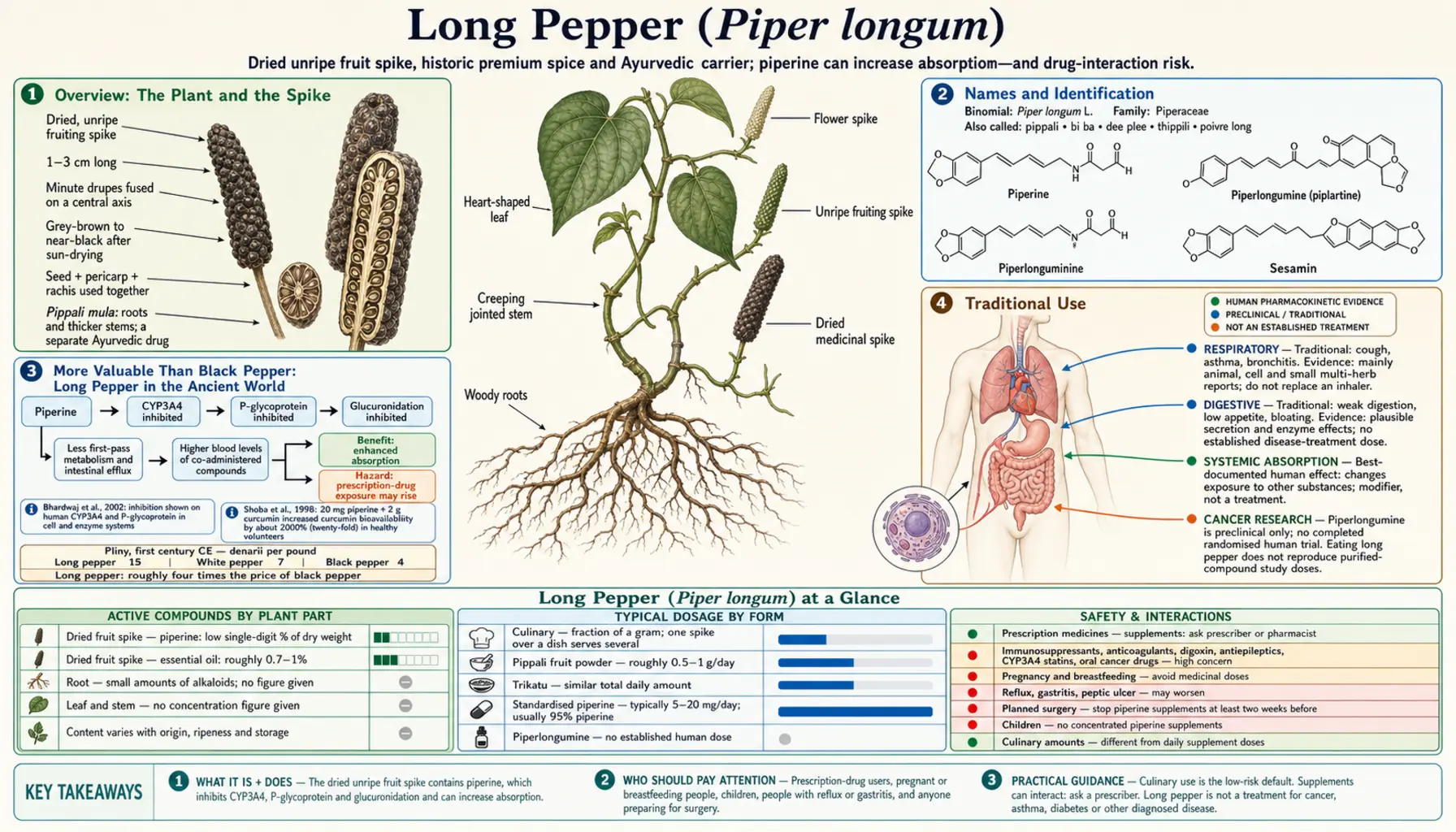
Long pepper is the dried, unripe fruiting spike of Piper longum, a small climbing vine native to South and Southeast Asia. It does not look like a peppercorn at all — it is a slender grey-brown cone, one to three centimetres long, made of dozens of tiny fruits fused into a single spike, and you grate or grind the whole thing. It tastes like black pepper crossed with something sweeter and more resinous, with a slow heat that arrives late and lingers.
Two things make it worth a page. Historically, it was the pepper Rome paid most for — more valuable than black pepper, and the plant whose Sanskrit name, pippalī, is the ancestor of the English word "pepper" itself. Pharmacologically, it is the key member of the Ayurvedic formula Trikatu and is used as a yogavahi, a carrier that makes other substances work better. That last claim is unusual among traditional herbal claims in being demonstrably true — and it is also the herb's main hazard. Piperine inhibits CYP3A4 and P-glycoprotein, so it genuinely raises blood levels of co-administered drugs and nutrients. If you take prescription medication, that is a drug interaction, not a benefit.
Table of Contents
- Overview: The Plant and the Spike
- Names and Identification
- More Valuable Than Black Pepper: Long Pepper in the Ancient World
- Traditional Use
- Active Compounds
- Bioavailability Enhancement: The Best-Documented Effect
- The Same Effect Is a Drug-Interaction Hazard
- Piperlongumine and Cancer Research
- Digestive and Respiratory Uses
- Anti-Inflammatory and Metabolic Effects
- Culinary Use
- Forms and Preparations
- Dosage
- Cautions and Contraindications
- Key Research Papers
- Connections
- Featured Videos
Overview: The Plant and the Spike
Piper longum L. is a slender aromatic climber in the family Piperaceae, the pepper family, alongside black pepper (Piper nigrum), betel leaf (Piper betle) and kava (Piper methysticum). It grows as a creeping, jointed vine with woody roots, heart-shaped leaves and a preference for the humid understory. It is native to the Indian subcontinent — the Western Ghats, the northeastern states, Nepal — and is also found and cultivated across Southeast Asia.
The part used is not a berry. Where black pepper gives you individual round drupes that dry into peppercorns, Piper longum packs its fruits onto an erect spike. Dozens of minute drupes fuse along a central axis into a hard, cylindrical catkin that tapers slightly toward the tip and is covered in a fine, regular pattern of bumps. Harvested unripe and sun-dried, it turns from green to a dull greyish-brown or near-black and becomes extremely hard. It keeps for years.
Because the whole spike is used, long pepper delivers seed, pericarp and rachis together, which is part of why its flavour is broader than black pepper's. Cooks either grate it on a microplane, grind it in a spice mill (a mortar struggles — the spikes are tough and want to skitter), or drop a whole spike into a braise and fish it out later.
The roots and thicker stems are a separate drug in Ayurveda, called pippali mula or granthika, used for different indications from the fruit. If you buy "pippali" you almost always get the dried fruit spikes; pippali mula is sold separately by Ayurvedic suppliers.
Names and Identification
Binomial: Piper longum L. Family: Piperaceae.
- Sanskrit / Hindi: pippali (पिप्पली), pipli, pipal
- Vietnamese: tiêu lốt, tất bạt
- Chinese: bi ba (荄萄)
- Thai: dee plee (ดีปลี)
- Tamil: thippili
- Bengali: pipul
- Malay / Indonesian: cabai jawa (usually the related Piper retrofractum — see below)
- Arabic: dar filfil
- French: poivre long
The word "pepper" comes from this plant
The Sanskrit pippalī passed into Greek as peperi, into Latin as piper, and from there into every Germanic and Romance language — English "pepper," German Pfeffer, French poivre, Spanish pimienta. In other words, the generic word we now apply to black pepper, to bell peppers and to chillies started life as the name of this spice. Long pepper reached the Mediterranean first and lent its name to everything pungent that came after it.
Look-alikes and label confusion
Piper retrofractum — Javanese or Balinese long pepper, cabai jawa, is a different species with a similar spike. It is widely sold as "long pepper," especially in Indonesian and Thai markets, and appears in Indonesian jamu formulas. Its spikes are typically longer and more slender than P. longum's and taper more sharply. Chemically it is similar — also piperine-bearing — but it is not the same plant, and research on one does not automatically apply to the other.
Not to be confused with: pink peppercorns (Schinus, not a pepper at all), cubeb pepper (Piper cubeba, which has a stalked round fruit — "tailed pepper"), Sichuan pepper (Zanthoxylum, a citrus relative producing tingling numbness, no piperine), and grains of paradise (Aframomum melegueta, a ginger relative). All of these have historically been sold under overlapping "pepper" names.
More Valuable Than Black Pepper: Long Pepper in the Ancient World
Modern cooks treat long pepper as an obscure specialty. For most of recorded European history it was the opposite: the premium pepper, the expensive one, the one worth adulterating.
Long pepper reached the Mediterranean world early, carried overland and by sea from India, and it was familiar in Greece well before black pepper became common. Theophrastus in the fourth century BCE distinguished two kinds of pepper, one round and one long. Long pepper appears in the Roman medical literature too — Dioscorides describes it, and it turns up in Roman cookery, including in the recipes collected under the name of Apicius.
The clearest evidence of its status is a price list. Pliny the Elder, writing in the first century CE in his Natural History, gives the going rates: long pepper at fifteen denarii a pound, white pepper at seven, black pepper at four. Long pepper was, by Pliny's account, roughly four times the price of black. He was not impressed by any of it — he grumbled that pepper had nothing to recommend it but its bite, and that Romans were pouring silver into India for the privilege. He also noted that long pepper was easily and routinely adulterated, which is exactly what you expect for the most expensive item in a category.
Long pepper stayed in the European kitchen through the medieval period. It appears in medieval spice lists and cookbooks, in spiced wines, and in the elaborate spice blends of late-medieval cookery. It also stayed in European pharmacy, where it was a warming, digestive drug and a component of compound remedies.
Then it faded — and the reason is economic, not culinary. Two things happened. First, black pepper supply expanded enormously as Portuguese and then Dutch shipping took direct control of the sea route to the Malabar Coast and the Indonesian archipelago, and the price of black pepper fell. Second, after 1492, chillies (Capsicum) arrived from the Americas and spread across Africa and Asia with astonishing speed, offering heat that could be grown locally and cheaply anywhere warm. Long pepper, harder to grow, more expensive, and no longer distinctive, simply lost its niche. It never disappeared — it stayed continuously in Indian, Nepali, Indonesian and North African cooking, and in Ayurveda and Unani medicine, where it never stopped being important — but it vanished from the European table for several centuries.
It is back now, in a small way. Long pepper has become a favourite of Nordic and modern-European chefs, and it turns up in high-end spice shops, in craft gin botanical bills, and in a slow revival of historical cooking. If you have never tasted it, the closest description is: black pepper with the volume turned down and a long, sweet, slightly cocoa-and-cardamom warmth turned up behind it.
Traditional Use
Ayurveda. Pippali is one of the most heavily used single drugs in the Ayurvedic materia medica. It is classed as pungent in taste, heating in potency, and — unusually — sweet in post-digestive effect, which is why it is considered less drying than black pepper. It is a principal drug for kapha conditions: cough, asthma, bronchitis, hoarseness, chronic congestion. It is also used for weak digestion, loss of appetite, bloating, worms, enlarged spleen and liver conditions, and as a general rasayana or rejuvenative.
Trikatu. The single most common context for pippali is Trikatu, "the three pungents" — long pepper, black pepper and dried ginger, classically in equal parts. Trikatu is added to enormous numbers of Ayurvedic compound formulas, and its stated purpose is not primarily to treat anything itself but to kindle digestive fire (agni), clear ama, and improve the action of the other ingredients. That last function has a name: yogavahi — a substance that carries and enhances what it is combined with.
Pippali vardhamana. A distinctive traditional protocol involves taking a slowly escalating and then de-escalating daily number of pippali fruits over several weeks — a graded dose regimen used as a rejuvenative and for chronic respiratory and digestive conditions. It is worth knowing that classical Ayurveda itself treats long pepper as something to be dosed carefully and cyclically rather than taken indefinitely at a fixed dose.
Traditional Chinese Medicine. As bi ba (荄萄), long pepper fruit is a warm, pungent drug used to warm the middle burner and disperse cold: cold-type abdominal pain, vomiting, watery diarrhoea, and toothache from cold. It is also applied topically for toothache in some traditional preparations.
Unani and Southeast Asia. Dar filfil is a warming digestive and respiratory drug in Unani medicine. In Indonesia, cabai jawa (generally P. retrofractum) is a standard jamu ingredient, used in tonics for fatigue, aching muscles and low appetite.
All of this is ethnobotany. It tells you what long pepper has been used for over two millennia. It does not tell you that it works for any of it.
Active Compounds
- Piperine — the same alkaloid that makes black pepper pungent, and the compound behind the bioavailability effect. Chemically it is an amide of piperic acid and piperidine. Content in dried long pepper fruit is generally a low single-digit percentage of dry weight and varies with origin, ripeness and storage; black pepper is usually somewhat richer in it.
- Piperlongumine (piplartine) — the compound that makes Piper longum chemically distinct from black pepper. An amide alkaloid with a reactive electrophilic centre, it has become a heavily studied laboratory anticancer lead. It is not present in Piper nigrum in meaningful amounts.
- Related amide alkaloids — piperlonguminine, pipernonaline, piperettine, guineensine, retrofractamide and others. This family is what a "standardised long pepper extract" is generally standardised against, usually as total piperine.
- Lignans — sesamin and related compounds occur in Piper species.
- Essential oil — roughly 0.7–1% of the dried spike, containing caryophyllene, pentadecane, bisaborene and other terpenes, responsible for the aroma rather than the heat.
- Steroids and other minor constituents — including sitosterol and small amounts of alkaloids in the root.
Comprehensive phytochemical reviews of the species have been published by Yadav and colleagues in the Journal of Ethnopharmacology in 2020 and by Biswas and colleagues in Phytotherapy Research in 2022; both are good entry points to the primary literature.
Bioavailability Enhancement: The Best-Documented Effect
Most traditional claims about herbs do not survive contact with pharmacology. This one does.
The mechanism. When you swallow a drug or a plant compound, three systems decide how much of it reaches your bloodstream. Enzymes in the gut wall and liver — principally cytochrome P450 3A4 (CYP3A4) — chemically modify it. A pump in the intestinal lining called P-glycoprotein (P-gp) actively throws absorbed molecules back into the gut. And conjugating enzymes, especially the UDP-glucuronosyltransferases, tag molecules with sugar groups so the body can excrete them. Together these constitute first-pass metabolism, and for many compounds they destroy the great majority of an oral dose before it ever circulates.
Piperine interferes with all three. Bhardwaj and colleagues showed in The Journal of Pharmacology and Experimental Therapeutics in 2002 that piperine inhibits human P-glycoprotein and CYP3A4 — work done in cell and enzyme systems, but directly on the human proteins. Piperine also inhibits glucuronidation in the gut wall. The practical result is that a compound taken alongside piperine is metabolised less on its way in, and more of it survives to reach the blood.
Think of it as a bouncer problem. Your gut wall employs bouncers whose job is to turn most arrivals away. Piperine distracts the bouncers. Everything in the queue — helpful and unhelpful alike — gets in more easily.
Human evidence. The landmark study is Shoba and colleagues, published in Planta Medica in 1998. In healthy human volunteers, 20 mg of piperine given with 2 g of curcumin increased curcumin bioavailability by about 2000% — a twenty-fold increase — compared with curcumin alone. Curcumin on its own is notoriously badly absorbed, which is exactly why the pairing is now standard: read the label of almost any turmeric supplement and you will find piperine (often as the branded extract BioPerine) listed alongside it. Anand and colleagues' 2007 review in Molecular Pharmaceutics laid out the curcumin bioavailability problem in detail and why piperine helps. Heidari and colleagues reviewed the accumulated preclinical and clinical curcumin-piperine literature in Phytotherapy Research in 2023.
Beyond curcumin, small human pharmacokinetic studies have reported piperine raising plasma levels of phenytoin, carbamazepine, propranolol and theophylline. Indian researchers have developed rifampicin formulations that add piperine on precisely this principle — the goal being to achieve therapeutic blood levels of the tuberculosis drug from a lower dose.
The honest framing. Long pepper's most reliable pharmacological property is that it changes how much of something else gets into you. It is a modifier, not a treatment. Every claim in the next few sections should be read against the possibility that observed effects come partly from this mechanism rather than from long pepper doing anything directly.
The Same Effect Is a Drug-Interaction Hazard
This section is the most clinically important thing on the page.
An enhancer that raises blood levels of what you take with it does not distinguish between a poorly absorbed nutrient you want more of and a prescription drug whose dose was carefully chosen. CYP3A4 is involved in the metabolism of a very large share of prescription medicines — commonly cited estimates put it at roughly half. P-glycoprotein handles many others. Inhibiting both at once is how grapefruit juice earned its warnings, and piperine works on the same machinery.
Categories of drug where this matters most — because a modest rise in blood level can cause real harm:
- Immunosuppressants — tacrolimus, cyclosporine, sirolimus. Narrow therapeutic index, CYP3A4 and P-gp substrates. This is a transplant-graft-and-kidney-damage-level concern.
- Anticoagulants — direct oral anticoagulants such as rivaroxaban and apixaban are CYP3A4 and P-gp substrates; raised levels mean bleeding risk.
- Digoxin — a classic P-glycoprotein substrate with a famously narrow margin between therapeutic and toxic.
- Antiepileptics — phenytoin and carbamazepine, where human studies have specifically shown piperine raising levels.
- Statins — simvastatin, lovastatin and atorvastatin are CYP3A4 substrates; higher levels raise the risk of muscle injury.
- Some antiarrhythmics, calcium channel blockers and benzodiazepines — all common CYP3A4 substrates.
- Oral chemotherapy agents and targeted cancer drugs — many are CYP3A4 and P-gp substrates with narrow windows. Do not add piperine-containing supplements during cancer treatment without asking the oncology team.
- Thyroid medication, and generally anything where you have been titrated to a stable dose over months.
What this means in practice. Culinary use — long pepper ground over food, a spike in a braise — involves small amounts and is not the concern here. The concern is supplements: standardised piperine extracts, Trikatu capsules, and the piperine added to turmeric and other formulas, taken daily at doses far above what cooking supplies. If you take any prescription medication, tell your prescriber or pharmacist that you are taking a piperine-containing supplement, and give them the actual milligram figure from the label. Reviews of herb-drug interactions by Zhou and colleagues in Drug Metabolism Reviews (2004) and Hu and colleagues in Drugs (2005) place piperine in the broader context of plant compounds that modulate these systems.
Timing helps but does not solve it. Separating a piperine supplement from a medication by several hours reduces overlap in the gut, but CYP3A4 inhibition is not purely a gut-lumen phenomenon and the effect is not fully avoided by spacing. Separation is a sensible precaution, not a licence.
Piperlongumine and Cancer Research
Mechanism. Piperlongumine (also called piplartine) is chemically reactive — it contains an electrophilic centre that reacts with the thiol groups on cysteine residues in proteins. Among its targets are enzymes that manage cellular glutathione and oxidative stress. Cancer cells typically already run at higher baseline oxidative stress than normal cells and depend more heavily on these defence systems, so a compound that knocks out the defence can, in principle, kill the cancer cell while leaving the normal cell relatively intact.
The landmark paper. Raj and colleagues published in Nature in 2011 a screen that identified piperlongumine as a small molecule that selectively kills cancer cells by targeting the stress response to reactive oxygen species. That paper is why piperlongumine went from an obscure plant amide to one of the more heavily worked-on natural-product leads of the past fifteen years. Since then it has been studied against a long list of cancer cell lines and in mouse xenograft models, and medicinal chemists have made large numbers of synthetic analogues — Piska and colleagues reviewed that synthetic effort in the European Journal of Medicinal Chemistry in 2018, and Duarte and colleagues reviewed the antitumour literature in Pharmaceuticals in 2023.
What has not happened. Piperlongumine is not a cancer treatment. There is no completed randomised trial in humans showing that it treats any cancer. Fifteen years after the Nature paper it remains a preclinical lead compound, which is the normal fate of the overwhelming majority of such compounds. Also — and this matters — the concentrations used in these studies are pharmacological doses of purified compound delivered to cells or injected into mice. Eating long pepper does not produce them. Nobody has shown that dietary or supplemental long pepper achieves meaningful piperlongumine levels in human tissue.
If you or someone you love has cancer, long pepper is not a treatment option, and any product marketed on the strength of the piperlongumine literature is overselling a laboratory finding. Worse, as the interaction section above explains, piperine-containing supplements can raise blood levels of oral chemotherapy drugs. The realistic role of this research is as a starting point for drug development.
Digestive and Respiratory Uses
Mechanism. Piperine stimulates salivary and gastric secretion, and there is animal evidence that it increases the activity of pancreatic and intestinal digestive enzymes and shortens intestinal transit time. It also has a mild thermogenic effect. For the respiratory claims, the mechanisms proposed are anti-inflammatory and bronchodilatory activity in animal models, plus the plain physical effect of a pungent aromatic on mucus and on the cough reflex.
Human evidence: thin, but not zero. The most concrete human study is old and narrow. Agarwal and colleagues, publishing in the Journal of Ethnopharmacology in 1994, reported on the management of giardiasis with Pippali rasayana, an immunomodulatory herbal preparation based on long pepper. It is a small study of a compound preparation, not a modern trial of standardised long pepper, and it should be read as a signal rather than a demonstration.
For asthma and chronic cough — long pepper's flagship traditional indication — there is animal and cell work suggesting anti-asthmatic activity, and a handful of small Ayurvedic clinical reports of multi-herb formulas, but nothing that constitutes credible evidence in the modern sense. Long pepper should not replace an inhaler. Asthma is a condition where undertreatment kills people, and the traditional reputation of a warming spice is not a reason to reduce controller medication.
Practical read. Long pepper as a culinary digestive — a pinch after a heavy meal, the traditional use in Trikatu — is a reasonable, low-risk thing to try, and the mechanism is plausible. Framing it as a treatment for a diagnosed digestive or respiratory disease is not supported.
Anti-Inflammatory and Metabolic Effects
Mechanism. Piperine suppresses NF-κB signalling and reduces production of inflammatory cytokines in cell models, and reduces markers of inflammation in animal models of arthritis and colitis. On the metabolic side, animal studies report effects on lipid profiles, on adipocyte differentiation, and on glucose handling, and piperine has a modest thermogenic effect.
Evidence level. Overwhelmingly animal and cell culture for long pepper specifically. There is a much larger human literature on curcumin plus piperine — several trials of the combination in inflammatory and metabolic conditions have reported improvements in inflammatory markers and lipids — but those trials test curcumin with piperine as an absorption aid. They tell you little about long pepper as a therapy in its own right, and they are usually small, short and heterogeneous. Heidari and colleagues' 2023 review is the honest place to see both the promise and the methodological limits of that literature.
Reviews of the anticancer and anti-inflammatory pharmacology of the genus — Turrini and colleagues on Piper nigrum and piperine in Toxins (2020), Wang and colleagues on anticancer principles from medicinal Piper plants (2014) — are useful maps of what has been looked at.
Bottom line: mechanistically interesting, clinically unproven for long pepper on its own.
Culinary Use
Long pepper is a genuinely good spice and the easiest way to meet it.
Flavour. Heat comparable to black pepper but slower and rounder, arriving a beat late and staying longer. Behind the heat there is sweetness and a resinous, faintly cocoa-and-nutmeg warmth. Some people get cardamom or cinnamon notes. It is less sharp and less "green" than freshly cracked black pepper.
Where it is traditionally used:
- India and Nepal — in pickles, in some regional masalas, in Ayurvedic preparations, and in dishes from the Himalayan foothills and the Northeast.
- Indonesia — cabai jawa in jamu tonics and in some Javanese dishes.
- North Africa — long pepper is a classic component of ras el hanout, the elaborate Moroccan blend.
- Southeast Asia — scattered use in Thai and Vietnamese traditional preparations more often than in everyday cooking.
- Modern Europe — a favourite of Nordic and contemporary chefs, in game and beef dishes, in fruit desserts (it is very good with pears, figs and stone fruit), in chocolate, and as a gin botanical.
How to use it. Grate a spike on a microplane directly over finished food, the way you would nutmeg. Grind spikes in an electric spice mill for a blend. Or drop one or two whole spikes into a stew, curry, braise or mulled wine and remove them before serving. Toast lightly in a dry pan first if you want the aroma to open up. Because the heat builds slowly, taste and wait a minute before adding more — it is easy to overshoot.
Forms and Preparations
- Whole dried spikes. The best form for cooking and the most stable in storage. Sold by spice merchants and Indian and Southeast Asian groceries. Should be firm, dry, uniformly grey-brown, and aromatic when scratched.
- Ground long pepper. Convenient, loses aroma fast. Buy small quantities.
- Pippali powder (Ayurvedic). Sold by weight by Ayurvedic suppliers, traditionally taken with honey, ghee or warm water.
- Trikatu. The equal-parts blend with black pepper and dried ginger, in powder, tablet or capsule form. Note that this concentrates piperine from two sources.
- Standardised piperine extracts. Usually 95% piperine, often branded, typically dosed at 5–20 mg. These are the products with real interaction potential — a 20 mg piperine capsule delivers far more piperine than any plausible meal.
- Piperlongumine. Sold as a research chemical and, increasingly, as a supplement. There is no human dosing data and no safety data for chronic use. This site does not recommend it.
- Pippali mula (root). A distinct Ayurvedic drug with its own indications; do not assume it is interchangeable with the fruit.
Dosage
Culinary use: a fraction of a gram — one grated spike over a dish serves several people. No upper limit worth stating; your palate will stop you first.
Traditional Ayurvedic dosing of pippali fruit powder is commonly given in classical and contemporary texts as roughly 0.5 to 1 gram per day, taken with honey or warm water, generally with food. Trikatu is used at similar total daily amounts. Traditional practice emphasises short courses or graded regimens rather than indefinite daily use — the pippali vardhamana protocol escalates and then reduces the dose over weeks.
Standardised piperine supplements: typically 5–20 mg per day, and the 20 mg figure comes from the Shoba curcumin study rather than from any dose-finding work on piperine itself. More is not better; the enhancement effect plateaus and the interaction risk does not.
What has no established dose: long pepper for asthma, for cancer, for metabolic disease, or for any specific medical indication. No dose-ranging trials exist. Anyone quoting you a therapeutic milligram figure for those uses is extrapolating.
Cautions and Contraindications
1. Drug interactions are the headline risk. See the dedicated section above. Piperine inhibits CYP3A4, P-glycoprotein and intestinal glucuronidation, and can raise blood levels of many prescription drugs. Anyone on immunosuppressants, anticoagulants, digoxin, antiepileptics, statins, oral cancer drugs, or any narrow-therapeutic-index medication should not take piperine or Trikatu supplements without talking to their prescriber first. Culinary amounts are a different matter from daily supplement doses.
2. Pregnancy. Avoid medicinal doses. Long pepper is traditionally regarded as heating and is generally avoided in pregnancy in Ayurveda; there is animal literature raising concerns about high-dose piperine and reproductive outcomes, and there is no human safety data. Culinary amounts in food are not a realistic concern; supplements should be avoided.
3. Breastfeeding. No safety data for medicinal doses. Avoid supplements.
4. Gastro-oesophageal reflux, gastritis and peptic ulcer. Long pepper stimulates gastric secretion and is a pungent irritant. It commonly worsens reflux and can aggravate gastritis. If a spicy meal reliably triggers your symptoms, so will this.
5. Haemorrhoids and inflammatory bowel conditions. Traditionally avoided in these, and the reasoning — a hot, irritant spice on inflamed mucosa — is sound.
6. Bleeding risk. Beyond the anticoagulant interaction, high-dose piperine has shown antiplatelet effects in laboratory work. Stop piperine supplements at least two weeks before planned surgery, and tell your surgical and anaesthetic team.
7. Children. Culinary use is fine. Concentrated piperine supplements should not be given to children — there is no dosing or safety data, and children's medications are dosed tightly.
8. Allergy. Uncommon, but Piper allergy exists. Stop if you develop rash, itching or swelling.
9. Quality and adulteration. Long pepper has been adulterated since Pliny complained about it. Buy whole spikes from a reputable spice merchant rather than pre-ground powder of unknown origin, and be aware that Piper retrofractum is frequently sold as Piper longum. For supplements, look for third-party testing and a stated piperine content.
10. What long pepper is not. It is not a treatment for cancer, asthma, diabetes, or any diagnosed disease. It is a spice with one well-documented pharmacological property — enhancing the absorption of other things — and a large, entirely preclinical literature suggesting other possibilities.
Key Research Papers
- Shoba G, Joy D, Joseph T, et al. Influence of piperine on the pharmacokinetics of curcumin in animals and human volunteers. Planta Medica. 1998;64(4):353–356.
- Bhardwaj RK, Glaeser H, Becquemont L, et al. Piperine, a major constituent of black pepper, inhibits human P-glycoprotein and CYP3A4. The Journal of Pharmacology and Experimental Therapeutics. 2002;302(2):645–650.
- Raj L, Ide T, Gurkar AU, et al. Selective killing of cancer cells by a small molecule targeting the stress response to ROS. Nature. 2011;475(7355):231–234.
- Yadav V, Krishnan A, Vohora D. A systematic review on Piper longum L.: bridging traditional knowledge and pharmacological evidence for future translational research. Journal of Ethnopharmacology. 2020;247:112255.
- Biswas P, Ghorai M, Mishra T, et al. Piper longum L.: a comprehensive review on traditional uses, phytochemistry, pharmacology, and health-promoting activities. Phytotherapy Research. 2022;36(12):4425–4476.
- Heidari H, Bagherniya M, Majeed M, et al. Curcumin-piperine co-supplementation and human health: a comprehensive review of preclinical and clinical studies. Phytotherapy Research. 2023;37(4):1462–1487.
- Anand P, Kunnumakkara AB, Newman RA, Aggarwal BB. Bioavailability of curcumin: problems and promises. Molecular Pharmaceutics. 2007;4(6):807–818.
- Piska K, Gunia-Krzyżak A, Koczurkiewicz P, et al. Piperlongumine (piplartine) as a lead compound for anticancer agents — synthesis and properties of analogues: a mini-review. European Journal of Medicinal Chemistry. 2018;156:13–20.
- Duarte ABS, Gomes RC, Nunes VRV, et al. The antitumor activity of piplartine: a review. Pharmaceuticals. 2023;16(9):1246.
- Zhou S, Lim LY, Chowbay B. Herbal modulation of P-glycoprotein. Drug Metabolism Reviews. 2004;36(1):57–104.
- Hu Z, Yang X, Ho PC, et al. Herb-drug interactions: a literature review. Drugs. 2005;65(9):1239–1282.
- Agarwal AK, Singh M, Gupta N, et al. Management of giardiasis by an immuno-modulatory herbal drug Pippali rasayana. Journal of Ethnopharmacology. 1994;44(3):143–146.
- Turrini E, Sestili P, Fimognari C. Overview of the anticancer potential of the "king of spices" Piper nigrum and its main constituent piperine. Toxins. 2020;12(12):747.
Live PubMed Searches
- Piper longum pharmacology
- Piperine as a bioavailability enhancer
- Piperine and CYP3A4 inhibition
- Piperine and P-glycoprotein
- Piperlongumine and cancer
- Trikatu in Ayurveda
- Curcumin plus piperine clinical trials
- Piper retrofractum (Javanese long pepper)
- Piperine drug-interaction pharmacokinetics
- Piper longum in respiratory conditions
Connections
- All Herbs
- Black Pepper — Piper nigrum, the other piperine source and long pepper's partner in Trikatu.
- Ginger — the third of the three pungents in Trikatu.
- Turmeric — the herb whose absorption problem piperine is most famously used to solve.