Black Turmeric (Curcuma caesia)
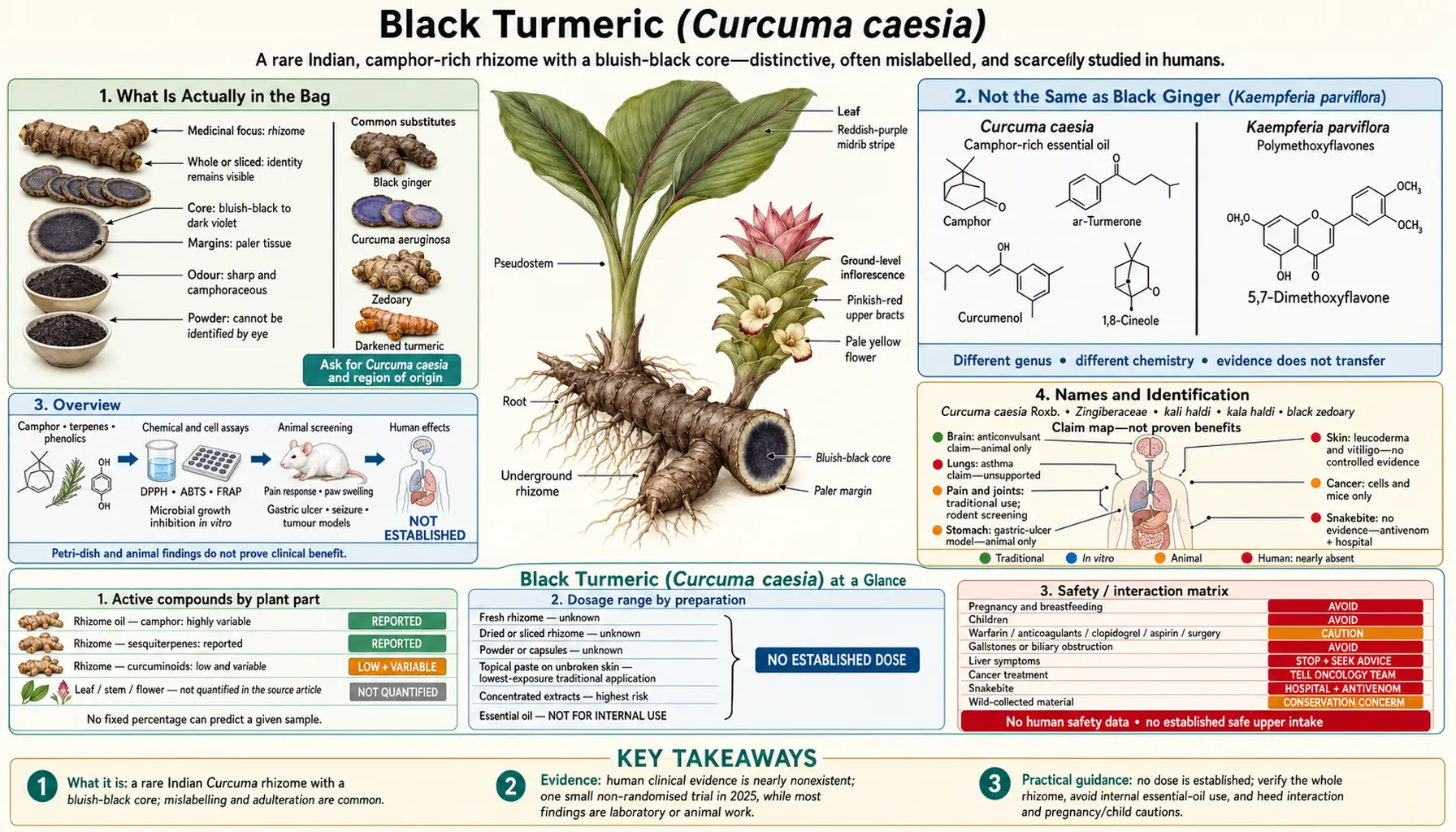
Black turmeric is Curcuma caesia Roxb., a ginger-family rhizome from India whose cut surface shows a striking bluish-black core. In Hindi it is kali haldi. It is genuinely unusual, genuinely rare, and genuinely surrounded by more folklore than any other plant in the genus.
⚠ Human clinical evidence for Curcuma caesia is nearly nonexistent. As of 2026 there is exactly one published human trial — a small, non-randomised 2025 comparison against ordinary turmeric for oral submucous fibrosis, with an unreported placebo arm and a honey-vehicle confound (full picture on the Anti-Inflammatory Benefits page). No dosing research exists at all. Everything else published about it is Indian phytochemical screening, test-tube antioxidant and antimicrobial assays, and rodent pain and inflammation models. The folk claims made for it — for cancer, epilepsy, asthma, leucoderma, and most alarmingly for snakebite — are extensive and are not supported by any of that work.
⚠ And there is a second, more immediate problem: what you buy is very often not this plant. Much of the “black turmeric” on the market is Kaempferia parviflora — black ginger, a different genus from Thailand — or one of several other Curcuma species, or ordinary turmeric that has been coloured. C. caesia is rare, largely wild-collected, and reported as threatened in parts of its Indian range, which makes cheap and plentiful “black turmeric” a contradiction in terms. On this page, adulteration is treated as the norm rather than the exception, because that is what the evidence supports.
Table of Contents
- What Is Actually in the Bag
- Not the Same as Black Ginger (Kaempferia parviflora)
- Overview
- Names and Identification
- Conservation: A Rare, Wild-Collected Rhizome
- Traditional and Folk Use
- Active Compounds
- Antioxidant and Antimicrobial Laboratory Work
- Analgesic and Anti-Inflammatory Animal Studies
- Claims That Are Not Supported
- Forms and Preparations
- Dosage
- Cautions and Contraindications
- Key Research Papers
- Connections
- Featured Videos
What Is Actually in the Bag
This section leads the page because for black turmeric it matters more than pharmacology. If the material is not Curcuma caesia, nothing else on this page applies to it.
The economics explain the problem entirely. C. caesia is not a plantation crop at any meaningful scale. It is collected from the wild and from small tribal cultivations in central and northeastern India, its populations are under pressure, and it carries an inflated price driven partly by ritual and superstition rather than by medicinal demand. Meanwhile the market wants a cheap, dark, exotic-sounding powder in unlimited quantities. Those two facts cannot both be satisfied honestly.
What gets sold as black turmeric instead, in rough order of frequency:
- Kaempferia parviflora — Thai black ginger. A different genus with completely different chemistry, cultivated at commercial scale, and legitimately marketed under its own “black ginger” name. Sold as black turmeric it is a straightforward mislabelling. See the next section.
- Curcuma aeruginosa — the Indonesian temu hitam, literally “black temu,” which has a purplish-blue tinge in the flesh and is a plausible visual substitute. It is a different species from C. caesia.
- Curcuma zedoaria — zedoary. In Vietnamese it is literally called nghệ đen, “black turmeric,” so this substitution can even be made in good faith by a seller working in a different language.
- Ordinary turmeric, darkened. Cheap turmeric powder blended with activated charcoal, burnt material or dye. Visually convincing in powder form and chemically nothing like the real thing.
- Miscellaneous dark rhizomes of no fixed identity.
How to reduce your risk, if you have decided to buy it anyway. Buy the whole fresh or dried rhizome, never powder — powder discards the only visual evidence you have. The genuine article is bluish-black to dark violet in the core, with paler tissue toward the edges, and it has a sharp camphoraceous smell. It should not smell like ordinary turmeric. Ask the seller for the binomial in writing; a seller who cannot produce “Curcuma caesia” and a region of origin is not sourcing it deliberately. Prefer sellers who publish identity testing. And treat an unusually cheap price as diagnostic: a genuinely scarce wild-collected rhizome does not undercut turmeric.
Not the Same as Black Ginger (Kaempferia parviflora)
These two plants share a marketing category and nothing else. The confusion is worth untangling carefully, because black ginger has a far larger and more credible research literature, and readers who have read about black ginger and then buy “black turmeric” are not getting what they read about — or, just as often, readers buy “black turmeric” and receive black ginger without being told.
| Curcuma caesia | Kaempferia parviflora | |
|---|---|---|
| Genus | Curcuma | Kaempferia — a different genus |
| Usual English name | Black turmeric | Black ginger; also Thai ginseng |
| Local name | Kali haldi (Hindi) | Krachai dam (Thai) |
| Home range | Central and northeastern India | Northern Thailand, Laos, Myanmar |
| Flesh colour | Bluish-black core | Deep purple to blackish throughout |
| Signature chemistry | Camphor-rich essential oil, sesquiterpenes | Polymethoxyflavones — 5,7-dimethoxyflavone and relatives |
| Supply | Wild-collected, scarce, threatened in places | Commercially cultivated at scale |
| Human evidence | One small non-randomised trial (2025) | Several small human trials, mainly on exercise performance and blood flow |
The chemistry line is the important one. Black ginger's methoxyflavones are a genuinely distinctive class of compounds and have been investigated for effects on blood flow and physical performance, with a modest but real human trial literature behind them. Curcuma caesia contains nothing comparable. Anything you have read about phosphodiesterase inhibition, erectile function, exercise capacity or “Thai ginseng” belongs to Kaempferia parviflora and cannot be transferred to Curcuma caesia. If those are the effects you are after, buy the plant that was actually studied, under its own name.
Overview
Curcuma caesia Roxb. is a perennial herb of the Zingiberaceae, growing from an underground rhizome and dying back to it in the dry season. The leaves are broad and paddle-shaped, up to about a metre, with a dark reddish-purple stripe along the midrib. The inflorescence rises separately at ground level, with greenish bracts topped by pinkish-red upper bracts and pale yellow flowers with a reddish margin.
The rhizome is what everything is about. Cut it and the interior is a dark bluish-black to violet-black at the core — a colour genuinely unlike anything else in the genus — fading toward pale margins. The smell is sharply camphoraceous, and the taste is bitter, pungent and cooling in the way a strongly camphorous plant is.
Its native range is central and northeastern India — Madhya Pradesh, Chhattisgarh, Odisha, West Bengal, and the northeastern states including Assam, Meghalaya, Manipur and Nagaland — extending into parts of Nepal and Bangladesh. It grows in moist deciduous forest and forest margins, and it has never been a large-scale commercial crop. Where it is cultivated, it is usually on a small scale by tribal and smallholder growers, often as a kitchen-garden plant.
Names and Identification
- Binomial: Curcuma caesia Roxb., Zingiberaceae. The species epithet caesia is Latin for bluish-grey, describing the rhizome.
- Hindi: kali haldi (“black turmeric”); also written kala haldi.
- Bengali and Odia: kala haldi / kala haladi.
- Assamese: kola halodhi.
- Manipuri: yaingang amuba — yaingang is turmeric, amuba is black.
- English: black turmeric, black zedoary.
The names that cause trouble are all the ones from outside India:
- Vietnamese nghệ đen translates as “black turmeric” but means Curcuma zedoaria.
- Indonesian temu hitam translates as “black temu” and means Curcuma aeruginosa.
- English-language supplement marketing uses “black turmeric” for Kaempferia parviflora.
Four plants, one English phrase. When you see “black turmeric” anywhere, the useful question is never what the label says but which binomial the seller will commit to.
Identifying the real thing: whole rhizome, bluish-black to violet core with paler margins, strongly camphoraceous smell, bitter taste. Powder cannot be identified by eye. Laboratory identification uses DNA barcoding or chromatographic fingerprinting of the essential oil; a supplier that has done either will usually say so.
Conservation: A Rare, Wild-Collected Rhizome
Curcuma caesia is repeatedly described in the Indian botanical and conservation literature as rare, declining or threatened across parts of its range, particularly in central India. The pressures named are the familiar ones: destructive harvesting of a plant whose useful part is the whole underground organ, habitat loss and forest conversion, slow vegetative propagation, and a high market price that rewards collection. Much of the published Indian work on the species is explicitly framed as conservation or micropropagation research — tissue-culture protocols to produce planting material without stripping wild populations.
Two clarifications, because conservation claims are often loosely made. The species is not listed on CITES, so its international trade is not restricted by that treaty. And the designations that do exist are regional — state red lists and national agency assessments in India — rather than a single authoritative global status. So “endangered” is accurate as a description of local situations reported in the literature, and would be an overstatement if presented as a formal global classification.
What follows from this for a reader is practical rather than abstract. A wild-collected, slow-growing, locally threatened rhizome with no human evidence behind it is a poor thing to consume casually. If you have a specific reason to use it, source cultivated material and ask where it was grown. If you do not, the ethical and the evidential arguments point the same way, which is unusual and worth noticing.
Traditional and Folk Use
Traditional use is history and ethnography. It records what people did and believed; it is not evidence of efficacy, and for this species the gap between the breadth of the claims and the depth of the evidence is exceptionally wide.
Documented ethnomedicinal uses, mostly from northeastern and central India, include the rhizome paste applied to bruises, sprains and wounds; decoctions or powder taken for indigestion, stomach pain and worms; preparations for coughs, asthma and other respiratory complaints; use for fever; use for joint and muscle pain; use in skin conditions including leucoderma; and use for menstrual complaints. Several of these overlap with what is claimed for other Curcuma species and are consistent with a bitter, aromatic, camphor-rich rhizome.
Snakebite and scorpion sting appear repeatedly in ethnobotanical surveys of this plant, usually as a paste applied to the bite. This is recorded here because it is a real part of the ethnographic record, and flagged immediately because relying on it can kill someone. See Claims That Are Not Supported.
Ritual and magical use. This is a large part of the story and is usually left out of supplement copy. In parts of India the black rhizome is regarded as auspicious or magically protective, and is bought as a talisman for wealth and protection rather than as a medicine. Prices in that market bear no relation to any pharmacological value. This ritual demand is a significant driver of both the plant's high price and the adulteration described above — the buyer of a talisman is not going to send it for analysis.
Active Compounds
The published phytochemistry of C. caesia is thin and inconsistent, and the inconsistency is itself informative.
The compounds reported across essential-oil analyses include:
- Camphor — frequently reported as a major or dominant constituent of the rhizome oil, sometimes at very high proportions. This is the source of the characteristic smell, and it is also the main reason the plant needs a real safety section.
- ar-Turmerone and related turmerones — sesquiterpenes shared with other Curcuma species.
- Curcumenol — a guaiane sesquiterpene also prominent in zedoary.
- ar-Curcumene and β-curcumene — bisabolane and related sesquiterpenes.
- 1,8-Cineole, borneol, bornyl acetate — monoterpenes contributing to the cooling, camphoraceous character.
- Germacrone, elemene-type sesquiterpenes — reported variably.
- Curcuminoids — present but generally at low and variable levels. Black turmeric is not a meaningful source of curcumin.
- Starch — the bulk of the dried rhizome.
The variability is the finding. Published analyses of C. caesia rhizome oil disagree sharply with one another about which compounds dominate and in what proportion — camphor is reported as anywhere from a minor component to the overwhelming majority. Some of that is genuine chemotypic and geographic variation, which is real and well documented across the genus. Some of it is almost certainly misidentified plant material, which brings the discussion straight back to the adulteration problem. The practical consequence is that you cannot predict what is in a given sample, which is a serious obstacle to using it safely, let alone to studying it.
Antioxidant and Antimicrobial Laboratory Work
The largest body of published work on C. caesia consists of in-vitro screening assays, mostly from Indian university laboratories.
Antioxidant assays. Extracts of the rhizome scavenge DPPH and ABTS radicals, reduce ferric iron in FRAP assays, and show total phenolic and flavonoid content in the expected range for an aromatic rhizome. These results are reported as positive in essentially every study that looks.
Antimicrobial assays. Extracts and essential oil inhibit growth of common laboratory test organisms — Staphylococcus aureus, Escherichia coli, Bacillus species, Pseudomonas, and fungi including Candida albicans — in disc-diffusion and broth-dilution tests.
What kind of evidence this is: cell-free and cell-culture, and weaker than it looks. Two cautions apply to almost the entire genre. First, a DPPH assay measures a chemical reaction in a cuvette. Virtually every plant extract containing phenolic compounds is positive, and the result predicts nothing about antioxidant activity in human tissue, where absorption, metabolism and the body's own enzymatic antioxidant systems dominate. Second, concentrated aromatic essential oils are antimicrobial in a Petri dish almost by definition — terpenes dissolve microbial membranes — at concentrations that no oral dose will produce in your bloodstream. These studies are cheap to run and easy to publish, and their abundance is a fact about research economics rather than about the plant.
Nothing in this literature has been followed into a human study.
Analgesic and Anti-Inflammatory Animal Studies
A smaller set of rodent studies has reported effects that would be interesting if replicated: reduced pain responses in hot-plate and tail-flick tests, reduced paw swelling in carrageenan-induced oedema models, protection in models of gastric ulceration, anticonvulsant activity in chemically induced seizure models, and smooth-muscle relaxant effects on isolated tissue preparations. Some antitumour work in tumour-bearing mice has also been published.
What kind of evidence this is: animal, and preliminary even by animal-study standards. These experiments are typically single studies from single laboratories, using crude extracts of uncertain composition, with small group sizes and without independent replication. A carrageenan-injected rat paw is a screening assay, not arthritis. A hot-plate latency is not human pain. And when the tested material's chemistry varies as much between samples as C. caesia's does, a positive result in one laboratory may not even be reproducible with a different batch of the same species.
One observation worth making plainly: a lot of what looks like “research on black turmeric” is not indexed in PubMed at all, appearing instead in regional and low-visibility journals. That is not a slight on Indian science — excellent work on medicinal plants is published in India — but it does mean much of this literature has not passed through the peer-review and indexing filters that Western readers implicitly assume when they see a citation. For a reader trying to judge how much is known about this plant, the thinness of the internationally indexed literature is itself one of the most useful facts available.
Claims That Are Not Supported
Black turmeric attracts more unsupported claims than almost any other herb in this section of the site. The following are made routinely and are not supported by evidence.
⚠ Snakebite and scorpion sting. This is the dangerous one. Some ethnobotanical surveys record the rhizome paste being applied to snakebites. There is no evidence that it neutralises venom, and no plant preparation should ever be used in place of antivenom. Venomous snakebite is a medical emergency in which delay kills. If someone is bitten: keep them still and calm, immobilise the limb, remove rings and tight clothing, and get to a hospital as fast as possible. Do not cut, suck, apply a tourniquet, or apply any herbal paste in the belief that it buys you time.
Cancer. The existence of mouse tumour experiments and cell-line cytotoxicity screens does not make black turmeric a cancer treatment. There are no human studies. Using it in place of oncology treatment would be dangerous, and using it alongside treatment without telling the oncology team risks interactions with drug metabolism.
Epilepsy and asthma. Anticonvulsant and bronchodilator effects have been reported in animal models. Both conditions can kill when treatment fails, and neither should be managed with an unstudied herb.
Leucoderma and vitiligo. A traditional use with no controlled evidence.
“It's stronger turmeric.” It is not. It has less curcumin than Curcuma longa, and the turmeric research does not transfer to it.
“It works like black ginger.” It does not. See the comparison above.
Is it a food? Barely. Unlike turmeric and unlike temulawak, C. caesia is not a general culinary spice. It appears occasionally in pickles and in some tribal cooking in northeastern India, in small amounts, and that is the extent of it. There is no established dietary tradition that would give a reassuring baseline for how much a person can safely eat.
Forms and Preparations
- Fresh rhizome — the only form in which you can see what you are buying. Found in some Indian regional markets; rarely exported.
- Dried whole or sliced rhizome — still shows the dark core; the best compromise between verifiability and availability.
- Powder — the dominant retail form and the least verifiable. Colour is easy to fake and the powder cannot be identified by eye.
- Capsules and extracts — sold online with widely varying and usually unsubstantiated claims. Most do not state a species, an extract ratio or any marker compound.
- Paste — the traditional topical preparation, fresh rhizome ground with water and applied to bruises or swellings.
- Essential oil — steam-distilled. Not for internal use, and given its camphor content this is not a nominal warning.
- Talismanic whole rhizomes — sold at high prices for ritual rather than medicinal purposes. This is a real and substantial part of the market and explains a great deal about its pricing.
Dosage
There is no established dose of Curcuma caesia for any purpose. None. No human dose-finding study, no clinical trial, no pharmacopoeial monograph in the sense that zedoary has one in the Chinese Pharmacopoeia. Any specific figure you find online — “500 mg twice daily,” “one teaspoon in warm milk” — has been invented by a seller or copied from another plant.
Traditional use gives no reliable numbers either, because it is preparation-specific and orally transmitted: a pinch of powder, a small piece of fresh rhizome, a paste applied topically. None of that was measured, and none of it was recorded in a form that transfers.
Two things follow. First, the honest answer to “how much should I take?” is that nobody knows, and the camphor content means the answer is not automatically “more is fine.” Second, because sample chemistry varies so widely, even a dose that was safe in one batch tells you little about the next. If you use it at all, topical use of a paste on unbroken skin is the lowest-exposure traditional application, and internal use of concentrated extracts is the highest-risk one.
Cautions and Contraindications
⚠ No human safety data exists. That is the governing fact. There are no toxicology studies in people, no pharmacovigilance data, and no established safe upper intake. Absence of reported harm from a plant almost nobody has studied is not evidence of safety.
Camphor. The essential oil of C. caesia is frequently reported as camphor-rich, sometimes very much so. Camphor is neurotoxic in overdose — it causes agitation, vomiting and seizures, and camphor ingestion is a recognised paediatric poisoning emergency. This is a specific, mechanistic reason to avoid concentrated preparations and to keep the essential oil away from children entirely, and never to take it internally.
Never rely on it for snakebite. Restated because it is the only claim on this page that could kill someone within the hour. Antivenom and a hospital, immediately.
Pregnancy and breastfeeding. Avoid. Several Curcuma species carry traditional emmenagogue contraindications in pregnancy, there is no data for this one, and camphor crosses the placenta. There is no acceptable risk-benefit case for using an unstudied herb in pregnancy.
Children. Avoid, for the camphor reason above.
Bleeding and anticoagulants. Curcuma constituents can affect platelet function. Caution with warfarin, direct oral anticoagulants, clopidogrel and aspirin; stop before surgery and tell the surgical team.
Gallstones and biliary obstruction. Bile-stimulating effects are a class feature of the genus. Avoid with known gallstones or duct obstruction.
Liver. Concentrated Curcuma supplements as a class have been implicated in rare cases of drug-induced liver injury. Stop and seek advice if you develop jaundice, dark urine, pale stools, itching or persistent nausea.
Cancer treatment. Tell your oncology team about anything herbal you are taking. Curcuma constituents can affect drug-metabolising enzymes and transporters and can move a chemotherapy drug's blood levels in either direction.
Adulteration is a safety issue, not just a value one. If the material is misidentified, none of the cautions above necessarily apply, and different ones may. An unidentified rhizome is an unknown pharmacology.
Conservation. Wild-collected material from a locally threatened species is worth declining on its own terms.
Key Research Papers
Two notes before the list. First, where a stable PubMed identifier could not be confirmed at the time of writing, the citation's year links to a PubMed search on the paper's own title rather than to a guessed ID — a wrong identifier sends you to a real but different paper, which is worse than no link. Author, title and journal are given in plain text so each can be verified independently. Second, and specific to this species: the list is short because the literature is short. Only one human clinical study exists at all — covered on the Anti-Inflammatory Benefits page rather than duplicated here — and a good deal of the remaining published work on C. caesia sits in journals not indexed by PubMed. That is not a gap in this page; it is the single most important fact about the evidence base.
- Karmakar I, Dolai N, Suresh Kumar RB, Kar B, Roy SN, Haldar PK. Antitumor activity and antioxidant property of Curcuma caesia against Ehrlich's ascites carcinoma bearing mice. Pharmaceutical Biology. 2013;51(6). A rodent tumour model — hypothesis-generating, and frequently misrepresented online as evidence that black turmeric treats cancer.
- Karmakar I, Haldar PK, and colleagues (Jadavpur University) — a series of papers on isolated constituents of Curcuma caesia and their effects on cultured carcinoma cells. Browse this group's indexed output. Cell-level follow-up to the mouse work above; the same interpretive limits apply.
- Karmakar I, Saha P, Sarkar N, Bhattacharya S, Haldar PK. Neuropharmacological assessment of Curcuma caesia rhizome in experimental animal models. Oriental Pharmacy and Experimental Medicine. 2011. The origin of the anticonvulsant and sedative claims — rodent behavioural models only.
- Paw M, Begum T, Gogoi R, Pandey SK, Lal M. Chemical composition of Curcuma caesia Roxb. essential oil and its antimicrobial and antioxidant activity. Composition and in-vitro activity — PubMed search. Representative of the essential-oil characterisation literature; compare its reported camphor content against other analyses to see the variability described above.
- Angel GR, Vimala B, Nambisan B. Antioxidant and anti-inflammatory activities of proteins isolated from eight Curcuma species. In-vitro comparison across the genus — PubMed search. Useful because it places C. caesia alongside its relatives under one method.
- Antimicrobial and antifungal screening of Curcuma caesia rhizome extracts — a scattered set of Indian screening papers rather than one landmark study. Browse the indexed screening literature. Presented as a search rather than a single citation precisely because there is no single study of record here — which is itself the point.
- Behera KK, Sahoo S, Prusti A. Regeneration of plantlet of black turmeric (Curcuma caesia Roxb.) through in vitro culture. Micropropagation and conservation — PubMed search. The conservation-driven tissue-culture literature described in the Conservation section.
- Halegoua-DeMarzio D, Navarro V, Ahmad J, et al. Liver injury associated with turmeric — a growing problem: ten cases from the Drug-Induced Liver Injury Network. The American Journal of Medicine. 2023;136(2). Not about C. caesia, but the basis for the genus-level liver caution above.
Live PubMed Searches
These run a fresh search on each click. Running the first one is itself instructive: the total volume of indexed literature on this species is small.
- Curcuma caesia — all publications
- Curcuma caesia — clinical trials (expect very few or none)
- Curcuma caesia essential oil composition
- Kaempferia parviflora — the black ginger literature, for contrast
- Curcuma aeruginosa — the Indonesian temu hitam
- Curcuma species — authentication and DNA barcoding
- Herbal supplement adulteration and substitution
- Camphor toxicity and ingestion
- Snakebite — traditional plant remedies and the evidence
- Ethnobotany of Zingiberaceae in northeast India
Connections
- All Herbs
- Turmeric (Curcuma longa) — the ordinary orange species, and the only member of the genus with a large human evidence base. Black turmeric is not a stronger version of it.
- Black Ginger (Kaempferia parviflora) — a different genus sold under the same “black turmeric” label, with polymethoxyflavone chemistry and its own small human trial literature. If you read about black ginger, this is the plant you want.
- White Turmeric / Zedoary (Curcuma zedoaria) — the pale, camphor-bitter relative. Note that Vietnamese nghệ đen, literally “black turmeric,” means zedoary, not C. caesia.
- Javanese Turmeric / Temulawak (Curcuma zanthorrhiza) — Indonesia's flagship medicinal Curcuma, defined by xanthorrhizol and backed by a real, if limited, research programme.
- Conditions on this site that reference this page: Periodontitis (Gum Disease) · Tuberculosis (TB) · Oncology · Dementia · Rheumatoid Arthritis