Bael (Aegle marmelos)
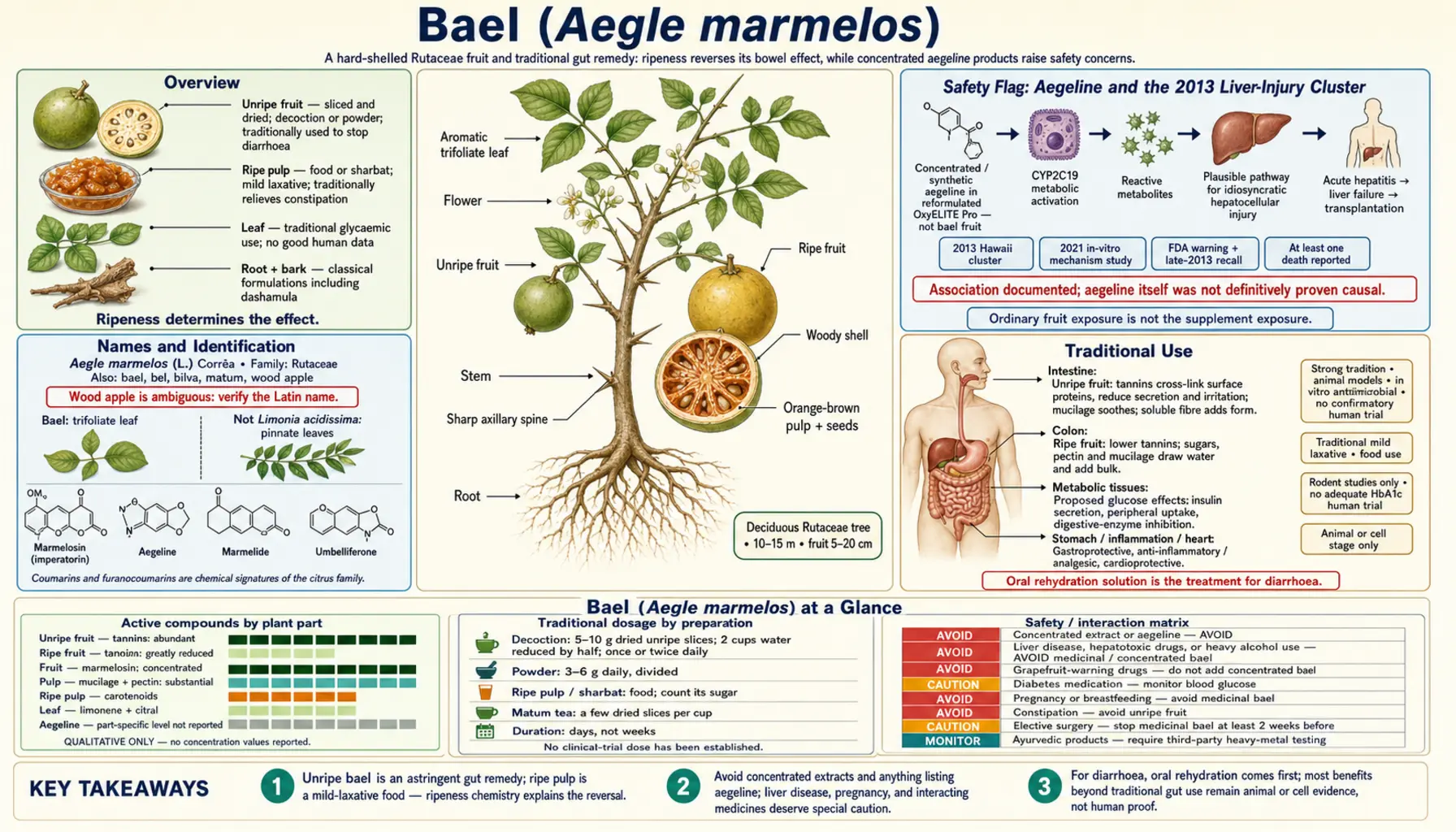
Bael is a hard-shelled fruit from a thorny tree sacred to Shiva, and across the Indian subcontinent it has one dominant medicinal identity: it is a gut remedy. The unripe fruit is used to stop diarrhoea and dysentery; the ripe fruit is used, in the opposite direction, to relieve constipation. That inversion is real and has a straightforward explanation in the fruit's chemistry. A safety point belongs at the top of this page: bael contains an alkaloid called aegeline, and a concentrated, synthetic aegeline preparation used in a reformulated weight-loss supplement was at the centre of a cluster of severe acute liver injury in Hawaii in 2013, including cases requiring liver transplantation. That was a supplement ingredient, not the fruit, and the distinction matters — but so does knowing about it. Beyond the gut, most of bael's health claims rest on animal and cell studies, not human trials.
Table of Contents
- Overview
- Names and Identification
- Safety Flag: Aegeline and the 2013 Liver-Injury Cluster
- Traditional Use
- Active Compounds
- The Ripe/Unripe Inversion Explained
- Diarrhoea and Dysentery: The Core Use
- Blood Sugar: Animal Work, Not Human Proof
- Other Investigated Effects
- Culinary Use
- Forms and Preparations
- Dosage
- Cautions and Contraindications
- Key Research Papers
- Connections
- Featured Videos
Overview
Aegle marmelos is a medium-sized deciduous tree of the citrus family, Rutaceae, growing to 10–15 metres with sharp axillary spines and aromatic trifoliate leaves. Crush a leaf and it smells unmistakably citrus — the family resemblance to lime and orange is obvious even though the fruit looks nothing like them.
The fruit is the reason people grow it. It is round to oval, 5–20 cm across, and encased in a woody shell so hard you cannot cut it with a kitchen knife — the standard method is to crack it with a hammer or throw it against a stone. Hence one of its English names, wood apple. Inside is an aromatic, sticky, orange-brown pulp packed with mucilage and seeds, with a flavour somewhere between marmalade, tamarind and roasted date.
The part used depends entirely on ripeness, and this is the single most important thing to understand about bael:
- Unripe (green, hard) fruit — the medicinal form. Sliced and sun-dried, then decocted or powdered. Used to stop diarrhoea.
- Ripe fruit — the food form. Pulped into the summer drink bael sharbat. Used to relieve constipation and as a cooling drink.
The tree is native to the Indian subcontinent and grows across India, Nepal, Bangladesh, Sri Lanka, Myanmar and Thailand, tolerating poor soil, drought and a wide temperature range. It is sacred in Hinduism: the trifoliate leaf, or bilva patra, is offered to Shiva, its three leaflets read as his three eyes or his trident. That religious status is why bael trees stand in temple courtyards across India and why the tree is rarely felled — a piece of cultural practice that has quietly conserved the species.
Names and Identification
Binomial: Aegle marmelos (L.) Corrêa. Family: Rutaceae — the citrus family. Genus: Aegle, named for one of the Hesperides of Greek myth, guardians of a garden of golden fruit.
- Sanskrit: bilva, shriphala (“fruit of prosperity”)
- Hindi: bael, bel; Bengali: bel
- Thai: matum (มะตูม)
- Tamil: vilvam; Telugu: maredu; Marathi: bel
- Sinhala: beli; Nepali: bel
- English: bael, bael fruit, Bengal quince, stone apple, wood apple, golden apple
Name ambiguity — this one causes real confusion. The English name “wood apple” is shared between two different trees, and they are not interchangeable:
- Aegle marmelos — bael. Rutaceae. Smooth greenish-yellow shell, aromatic orange pulp, sweet and marmalade-like when ripe. This page.
- Limonia acidissima (also written Feronia limonia) — often called wood apple or elephant apple, Hindi kaitha. Also Rutaceae, but a different genus. Rough grey shell, brown sour pulp, distinctly acidic.
Recipes, folk remedies and even some supplement listings mix these up. If a source says “wood apple” without a Latin name, you cannot tell which plant is meant. The reliable identifier for bael is the binomial Aegle marmelos plus the trifoliate leaf; Limonia has pinnate leaves with several pairs of leaflets. Separately, “golden apple” is also used in the Caribbean for Spondias dulcis, an entirely unrelated tree.
Safety Flag: Aegeline and the 2013 Liver-Injury Cluster
This section exists because it is the one piece of information about bael that could actually harm someone if they did not have it, and it is rarely mentioned on herbal websites.
What happened. In 2013, physicians in Hawaii identified a cluster of patients presenting with acute hepatitis with no viral or other obvious cause. The common thread was a dietary supplement: a reformulated version of OxyELITE Pro, a weight-loss and “fat-burner” product. Cases were severe — the published reports describe acute hepatocellular injury including patients who progressed to acute liver failure, some requiring liver transplantation, and at least one death. The US Food and Drug Administration issued warnings and the manufacturer recalled the product in late 2013. Subsequent case series through the US Drug-Induced Liver Injury Network found further cases beyond Hawaii.
Where bael comes in. The reformulated product had replaced its previous stimulant ingredient with, among other things, aegeline — an alkaloid amide originally isolated from Aegle marmelos. Aegeline was the novel ingredient in the reformulation, and that is why it drew attention.
What is and is not established — read this carefully.
- The liver injury cluster is real and well documented in the peer-reviewed literature. That is not in dispute.
- Aegeline itself was never definitively proven to be the cause. The product contained multiple ingredients, the investigations could not isolate a single culprit with certainty, and analytical work on retained product samples left open questions. Aegeline is the leading suspect because it was the new ingredient, not because a mechanism was demonstrated at the time.
- Later laboratory work has given the suspicion a plausible mechanism: a 2021 study reported that aegeline undergoes metabolic activation mediated by CYP2C19, generating reactive metabolites — the general pathway by which many drugs cause idiosyncratic liver injury. That is in-vitro evidence for a mechanism, not evidence that it caused those specific cases.
- The exposure was not bael fruit. The supplement contained a concentrated preparation, understood to be synthetically produced aegeline, at doses that bear no relationship to eating bael pulp or drinking bael sharbat. There is no comparable signal from ordinary dietary or traditional use of the fruit, which has been eaten across South Asia for millennia.
What to do with this. Eating ripe bael or drinking bael sharbat is not the situation the Hawaii cluster describes. But concentrated bael extracts and any product listing “aegeline” on the label deserve a hard no, particularly for anyone with existing liver disease, anyone taking other hepatotoxic drugs, or anyone who drinks heavily. This is also a general lesson worth carrying: a compound isolated from a food and concentrated hundreds of times over is a drug, and it should be judged as a drug. The safety record of the fruit does not transfer to the extract. That principle is revisited in Cautions.
Traditional Use
Traditional use is history rather than evidence, but bael's history is unusually specific — it is not a cure-all herb, it is a gut herb, and it has been one for a very long time.
In Ayurveda, bilva appears in the classical materia medica as a principal remedy for atisara (diarrhoea) and grahani (a category covering chronic diarrhoeal and malabsorptive conditions). The unripe fruit, bilva kacha, is the form specified for these; the ripe fruit is described as a mild laxative and a nourishing, cooling food. Ayurveda's texts are explicit that the two forms do opposite things, which is a fairly sophisticated observation for a pre-modern system.
In Siddha and in Sri Lankan traditional medicine the pattern is the same. In Thai traditional medicine, matum is prepared as a roasted-fruit tea, drunk both as a digestive and simply as a pleasant beverage — dried matum slices are sold in every Thai market. Across rural India, unripe bael powder remains a first-line household remedy for a child with loose stools.
The leaves have their own separate traditional life: chewed for diabetes, used in eye washes, and offered at temple. The root and bark appear in classical compound formulations such as dashamula. But the fruit is the part with a coherent, testable claim.
Active Compounds
Marmelosin (imperatorin). The most-cited constituent of bael, a furanocoumarin concentrated in the fruit. It is often named as the plant's “active principle,” though what it actually does in a person is not established. Being a furanocoumarin is clinically relevant for a different reason — see Cautions on drug metabolism and photosensitivity.
Aegeline. An alkaloid amide, and the compound with the most consequential safety history. Discussed in full above.
Marmelide and related coumarins. Bael contains a large family of coumarins and furanocoumarins — marmelide, marmin, marmesin, umbelliferone, psoralen derivatives — typical of the Rutaceae. Coumarins are the family's chemical signature.
Tannins. Abundant in the unripe fruit and greatly reduced as it ripens. This is the mechanistic heart of the antidiarrhoeal use, and the reason ripe and unripe fruit behave differently.
Mucilage and pectin. The sticky character of bael pulp comes from a substantial mucilage and pectin content. Mucilage is a soothing, film-forming soluble fibre; pectin is a gelling soluble fibre. Both are relevant to the gut in ways described below.
Other constituents. Alkaloids such as aegelenine and skimmianine; the flavonoid rutin; carotenoids in the ripe pulp; a good complement of riboflavin and vitamin C; and essential-oil components in the leaf including limonene and citral, which is where the citrus smell comes from.
The Ripe/Unripe Inversion Explained
Traditional systems that use bael insist that the unripe fruit binds the bowel and the ripe fruit loosens it. It sounds like folk contradiction. It is not — it follows from what happens chemically as the fruit ripens.
Unripe fruit: high tannin, astringent. Tannins are polyphenols that bind and precipitate proteins. Applied to inflamed intestinal mucosa, tannins cross-link surface proteins and form a temporary protective coating — the astringent effect you feel as puckering dryness when you bite an unripe persimmon. In the gut this reduces secretion and irritation, and is thought to slow transit. The same astringent principle underlies traditional antidiarrhoeal use of other tannin-rich plants worldwide, from blackberry root to oak bark. Alongside the tannins, mucilage forms a soothing layer over the mucosa.
Ripe fruit: tannins broken down, sugars and fibre dominant. Ripening degrades a large share of the tannins — that is why an unripe fruit is mouth-puckering and a ripe one is sweet and pleasant. What remains is pulp rich in sugars, pectin and mucilage. That combination behaves like any soluble-fibre-plus-sugar food: it draws water into the lumen, adds bulk, and provides a mild osmotic push. Hence the mild laxative use.
So the same fruit really does do opposite things at two stages of ripeness, because ripening removes the astringent constituents and leaves the bulk-forming ones. It is a rare case where a traditional distinction survives translation into chemistry cleanly. It also means that if you buy “bael powder” without knowing which fruit stage it came from, you genuinely do not know what you have bought.
Diarrhoea and Dysentery: The Core Use
Mechanism. As above: tannin-mediated astringency reducing mucosal secretion and irritation, plus mucilage forming a physical soothing layer, plus soluble fibre adding form to loose stool. Laboratory work has additionally reported antimicrobial activity of bael extracts against enteric bacteria including Shigella, Salmonella and Escherichia coli strains, which would be relevant to infectious dysentery if it translated in vivo.
Level of evidence — stated plainly. The antidiarrhoeal effect of Aegle marmelos extracts has been demonstrated repeatedly in animal models — castor-oil-induced diarrhoea in rodents, intestinal transit assays, and related designs — and the antimicrobial work is in vitro. Published reviews of the plant consistently describe this as its best-supported pharmacological activity. What is missing is good human trial data: there is no large randomised controlled trial of standardised unripe bael preparation for acute diarrhoea with hard endpoints such as stool frequency or duration of illness. So the honest description is: strong traditional use, coherent mechanism, consistent animal data, no confirmatory human trial.
What that means practically. For an ordinary mild bout of loose stools in an otherwise healthy adult, unripe bael preparation is a low-risk traditional option. It is not a substitute for the things that actually save lives in diarrhoeal illness, and this needs to be unambiguous: oral rehydration solution is the treatment for diarrhoea. Dehydration is what harms and kills, particularly in children, and no astringent herb addresses it. Bloody diarrhoea, high fever, diarrhoea lasting more than a couple of days, diarrhoea in an infant or an elderly person, or diarrhoea after antibiotics all need medical assessment, not fruit powder.
Blood Sugar: Animal Work, Not Human Proof
Bael leaf and fruit are widely promoted for diabetes, and this is where the gap between claim and evidence is widest.
What exists. A substantial body of rodent studies reports that aqueous and alcoholic extracts of Aegle marmelos fruit and leaf lower fasting blood glucose, improve insulin measures and improve lipid profiles in diabetic model rats. Proposed mechanisms include enhanced insulin secretion, improved peripheral glucose uptake and inhibition of carbohydrate-digesting enzymes. Reviews of the plant's pharmacology summarise this literature at length.
What does not exist. Adequately powered, randomised, placebo-controlled human trials with HbA1c endpoints. Some small human observations exist in the Indian integrative literature, but nothing that would support a clinical recommendation.
The practical reading. If you have diabetes, treat bael as a food and not as therapy. Do not reduce or stop prescribed medication on the strength of animal data. And note the double-edged detail: ripe bael pulp and bael sharbat are high in sugar. Traditional sharbat is sweetened further with jaggery or sugar. A drink promoted as a diabetes remedy that is itself a sugar load deserves scepticism. If you do use bael alongside glucose-lowering medication, monitor, because an additive effect — while unproven — cannot be excluded.
Other Investigated Effects
Several further activities appear in the literature. All of them, without exception, are at the cell-culture or animal stage.
- Anti-inflammatory and analgesic: reported in standard rodent models. Animal only.
- Gastroprotective: extracts reduce ulcer formation in induced-ulcer rodent models, plausibly via the mucilage and antioxidant constituents. Animal only.
- Antioxidant: strong performance in chemical assays, as expected from the polyphenol content. Chemistry, not outcome.
- Radioprotective: a distinctive line of Indian research reports that bael extracts protect mice from radiation-induced damage. Interesting, entirely preclinical.
- Antimicrobial and antifungal: in-vitro activity against a range of organisms.
- Cardioprotective and lipid-lowering: rodent data.
None of this justifies taking a concentrated bael supplement, and the aegeline story is a specific reason not to.
Culinary Use
Ripe bael is a genuine food across South and Southeast Asia, and this is the safest way to encounter the plant.
- Bael sharbat — the signature preparation. Crack a ripe fruit, scoop the pulp, mash it with water, strain out seeds and fibre, sweeten, chill. Drunk across northern India through the hot season as a cooling drink and a folk digestive. It tastes like a mild, resinous marmalade.
- Bael murabba — unripe or half-ripe fruit slices preserved in sugar syrup, an Indian confection with a long shelf life.
- Matum tea — in Thailand, dried sliced bael is roasted and steeped as a fragrant amber tea, sold everywhere and drunk as a beverage rather than a medicine.
- Jam, toffee, powder — ripe pulp is processed into preserves and into a spray-dried powder used in beverages.
- Leaves — used ritually rather than culinarily, though the young leaves are occasionally eaten.
Forms and Preparations
- Dried unripe fruit slices — the traditional medicinal form. Simmered as a decoction, roughly 5–10 g of dried slices in 2 cups of water reduced by half.
- Unripe fruit powder (bilva churna) — convenient, but the manufacturer's ripeness choice is invisible to you. Buy only where the label specifies unripe fruit.
- Ripe pulp / sharbat — food. Fresh or bottled.
- Roasted slices for tea (matum) — food. Very low risk.
- Leaf juice or powder — traditional for glycaemic use; no good human data.
- Standardised or concentrated extracts, and anything specifying aegeline — avoid. This is the category with the safety problem, and it offers no demonstrated human benefit to offset it.
- Classical compound formulations — bael appears in Ayurvedic polyherbals such as bilvadi preparations and dashamula. These carry the usual concerns about Ayurvedic products: variable composition and a well-documented history of heavy-metal contamination in some imported products. Buy only from manufacturers who publish third-party heavy-metal testing.
Dosage
No dose of bael has been established by clinical trial for any condition. No pharmacopoeial standard exists that is backed by human efficacy data. The figures below reflect traditional practice only.
- Unripe fruit decoction (traditional, for loose stools): about 5–10 g dried slices simmered in water, taken once or twice daily for a short period.
- Unripe fruit powder: traditional texts describe roughly 3–6 g daily in divided doses.
- Ripe pulp / sharbat: a food. One glass is one glass. Count its sugar.
- Matum tea: a few dried slices per cup. No meaningful limit.
- Duration: short-term only, days rather than weeks. There is no safety data for long-term use of concentrated preparations, and the aegeline question makes open-ended use of concentrates unwise.
Cautions and Contraindications
Liver — the leading concern. Restating the flag above, because it is the reason this page exists in the form it does: aegeline-containing supplements were central to a documented cluster of severe acute liver injury in Hawaii in 2013, with cases severe enough to require liver transplantation and at least one reported death, prompting an FDA warning and a product recall. Causation for aegeline specifically remains unproven and the exposure was a concentrated, synthetic preparation rather than the fruit. Even so:
- Do not use concentrated bael extracts or any product listing aegeline. The risk is uncertain; the benefit is unestablished. That is a bad trade at any level of risk.
- People with existing liver disease — hepatitis B or C, fatty liver, cirrhosis — should avoid medicinal bael preparations entirely and stick to food amounts if anything.
- Anyone taking other potentially hepatotoxic agents, including high-dose paracetamol/acetaminophen, methotrexate, isoniazid or amiodarone, should not add concentrated herbal extracts.
- If you take any herbal supplement and develop jaundice, dark urine, pale stools, right-upper-abdominal pain, unexplained nausea or profound fatigue, stop it and seek medical attention, and take the bottle with you.
Furanocoumarins and drug metabolism. Bael is a Rutaceae plant containing marmelosin (imperatorin) and related furanocoumarins — the same chemical class responsible for the grapefruit-juice effect on the CYP3A4 enzyme. Whether bael produces a clinically meaningful version of that interaction has not been established in humans, but the chemistry warrants caution. If you take a drug with an explicit grapefruit warning — certain statins, some calcium-channel blockers, ciclosporin, tacrolimus, some benzodiazepines and several antiarrhythmics — do not add concentrated bael. Furanocoumarins can also cause photosensitivity on skin contact.
Diabetes medication. Animal data suggest a glucose-lowering effect. Combined with insulin or a sulfonylurea, an additive effect is theoretically possible. Monitor blood glucose if you use bael regularly.
Constipation. The astringent unripe fruit is the wrong choice if you tend towards constipation — it will make it worse. Use the ripe fruit for that purpose, or a different remedy.
Pregnancy and breastfeeding. Avoid medicinal bael in pregnancy. Some traditional sources describe the fruit and other parts of the plant as having effects on the uterus, and animal reports of antifertility activity for various parts of the plant exist. The data are poor, which is precisely the problem: there is not enough information to call it safe. Ripe fruit as an occasional food is a different matter and is eaten in pregnancy across India, but concentrated preparations are not recommended. The same reasoning applies while breastfeeding.
Children. Bael powder is a common household remedy for childhood diarrhoea in South Asia. The most important point stands regardless: children with diarrhoea need oral rehydration solution and zinc, and any child with bloody stool, high fever, persistent vomiting, drowsiness or signs of dehydration needs medical care immediately, not a herbal decoction.
Contamination. Imported Ayurvedic preparations have a documented record of contamination with lead, mercury and arsenic in a proportion of products tested. Buy only from suppliers with published third-party heavy-metal testing. See Toxins for background on heavy-metal exposure.
Surgery. Discontinue medicinal bael preparations at least two weeks before elective surgery, given the possible glycaemic effect and the unknowns around drug metabolism.
Key Research Papers
- Roytman MM, Pörzgen P, Lee CL, et al. Outbreak of severe hepatitis linked to weight-loss supplement OxyELITE Pro. American Journal of Gastroenterology. 2014;109(8):1296–1298.
- Johnston DI, Chang A, Viray M, et al. Hepatotoxicity associated with the dietary supplement OxyELITE Pro — Hawaii, 2013. Drug Testing and Analysis. 2016;8(3–4):319–327.
- Heidemann LA, Navarro VJ, Ahmad J, et al. Severe acute hepatocellular injury attributed to OxyELITE Pro: a case series. Digestive Diseases and Sciences. 2016;61(9):2741–2748.
- Tian M, Zhou S, Li W, et al. Metabolic activation of aegeline mediated by CYP2C19. Xenobiotica. 2021;51(11):1217–1228.
- Sharma N, Radha, Kumar M, et al. Aegle marmelos (L.) Corrêa: an underutilized fruit with high nutraceutical values — a review. International Journal of Molecular Sciences. 2022;23(18).
- Venthodika A, Chhikara N, Mann S, et al. Bioactive compounds of Aegle marmelos L., medicinal values and its food applications: a critical review. Phytotherapy Research. 2021;35(4):1887–1907.
- Manandhar B, Paudel KR, Sharma B, Karki R. Phytochemical profile and pharmacological activity of Aegle marmelos Linn. Journal of Integrative Medicine. 2018;16(3):153–163.
- Monika S, Thirumal M, Kumar PR. Phytochemical and biological review of Aegle marmelos Linn. Future Science OA. 2023;9(3):FSO849.
- Thakur M, Kaur T, Sobti RC, et al. Exploring pharmacological potential of Aegle marmelos: integrating traditional knowledge with modern physiology and molecular biology. Physiology and Molecular Biology of Plants. 2025;31(4):521–543.
- Mudi SR, Akhter M, Biswas SK, et al. Effect of aqueous extract of Aegle marmelos fruit and leaf on glycemic, insulinemic and lipidemic status of type 2 diabetic model rats. Journal of Complementary and Integrative Medicine. 2017;14(2).
Live PubMed Searches
- Aegle marmelos — all literature
- Bael and diarrhoea
- Aegeline — all literature
- OxyELITE Pro and liver injury
- Marmelosin / imperatorin
- Bael and blood glucose
- Bael antimicrobial activity
- Herb-induced liver injury from supplements
- Furanocoumarins and CYP3A4 interactions
- Heavy-metal contamination in Ayurvedic products
Connections
- All Herbs
- Gastroenterology — diarrhoea, dysentery and the digestive conditions bael has traditionally been used for.
- Toxins — herb-induced liver injury, supplement adulteration and heavy-metal contamination.
- Food — ripe bael as sharbat and preserve, and the sugar load that comes with it.
- Conditions on this site that reference this page: Escherichia coli · Type 1 Diabetes · Irritable Bowel Syndrome · Giardia