Willow Bark (Salix alba)
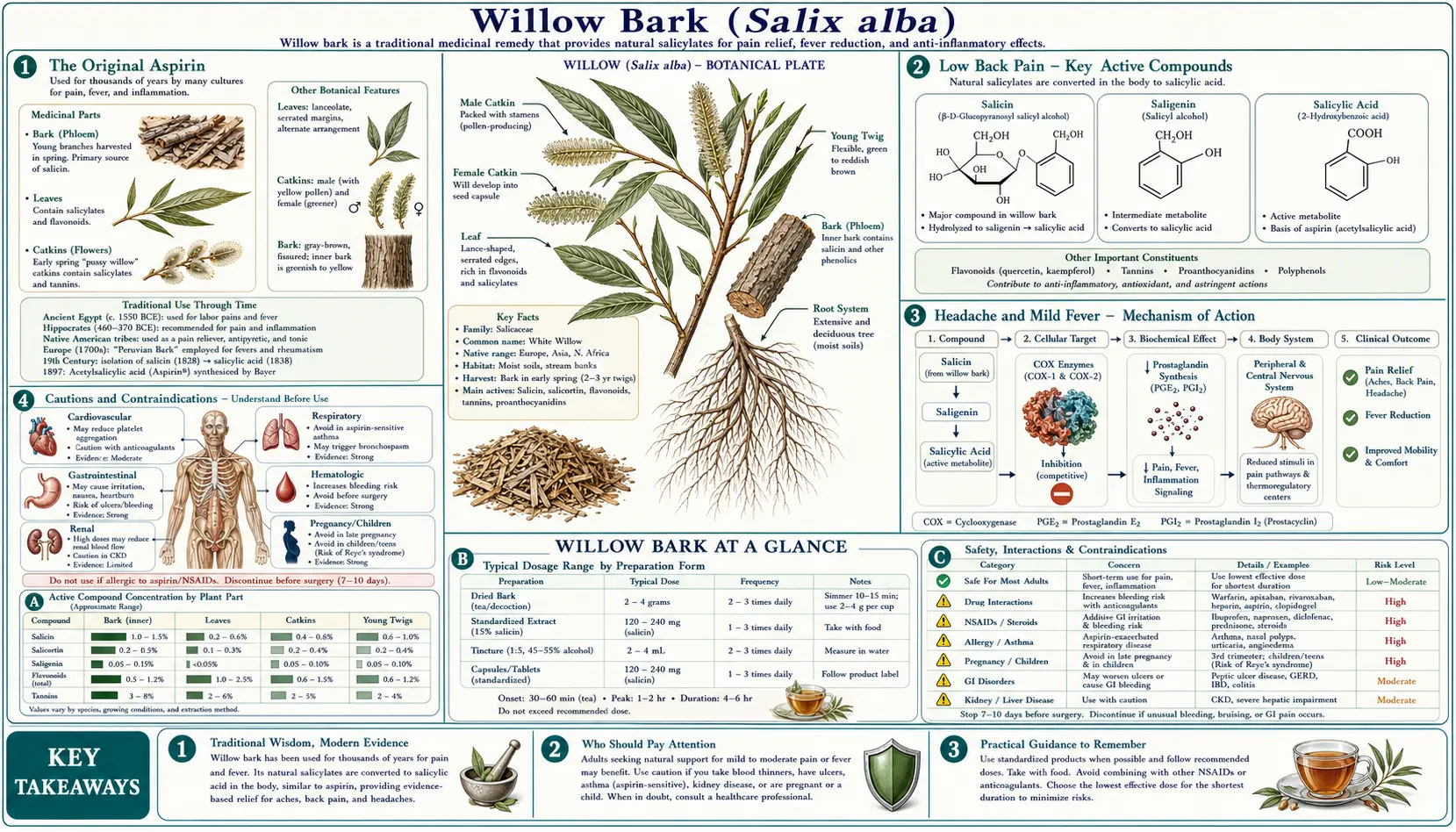
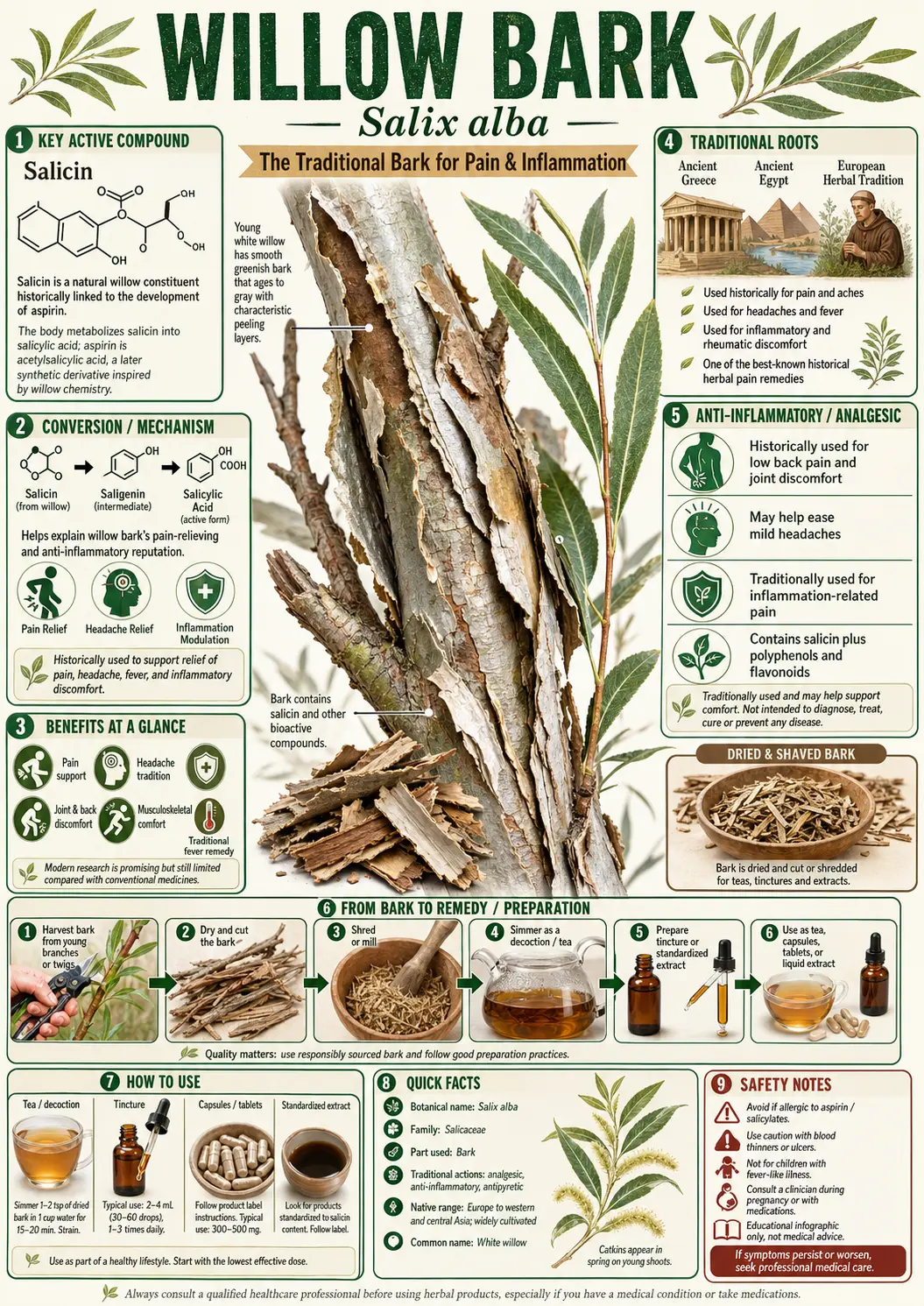
Table of Contents
- The Original Aspirin
- Active Compounds
- Mechanism of Action
- Low Back Pain
- Osteoarthritis
- Headache and Mild Fever
- Forms and Preparations
- Recommended Dosage
- Cautions and Contraindications
- Featured Videos
The Original Aspirin
Willow bark is the prototype natural pain reliever and the historical predecessor of aspirin. The medicinal use of willow goes back at least 3,500 years — the Ebers Papyrus of ancient Egypt (c. 1550 BCE) recommends willow leaves for inflammation and pain. Hippocrates prescribed willow bark and leaves for fever and women in labor in the 5th century BCE. The Cherokee, Iroquois, and other Native American peoples chewed the inner bark for headache, muscle pain, and fever.
In 1763, English clergyman Edward Stone published a clinical report describing successful treatment of fever in 50 patients with willow bark, marking the beginning of systematic scientific investigation. In 1828, a German pharmacist isolated the active glycoside, naming it salicin after the Latin Salix. By 1899, Bayer was marketing acetylsalicylic acid — a synthetic, chemically modified version with improved tolerability — under the trade name Aspirin.
Modern willow bark preparations occupy a clinical niche distinct from aspirin: they retain the analgesic and anti-inflammatory benefits of the salicylate parent compounds while being generally better tolerated than aspirin, with less gastrointestinal irritation and a different antiplatelet profile. They are commonly used in integrative pain management for musculoskeletal conditions where chronic NSAID use is not desired.
Active Compounds
- Salicin — the principal active glycoside; metabolized in the gut and liver to salicylic acid (the same compound that aspirin is hydrolyzed to in the body)
- Salicortin and tremulacin — additional salicin-related glycosides found in many willow species
- Polyphenols and flavonoids — including catechins and proanthocyanidins, contributing additional anti-inflammatory and antioxidant activity
- Tannins — astringent compounds that contribute to mild GI tract effects
Standardized extracts are typically calibrated to salicin content. Therapeutic dosing usually delivers 120-240 mg of salicin daily, which produces salicylic acid blood levels well below those achieved by therapeutic aspirin — but with effective analgesia for many users due to the synergistic activity of the whole-plant phytochemistry.
Mechanism of Action
Salicin is hydrolyzed in the gut to saligenin, then oxidized in the liver to salicylic acid — the same downstream active compound produced by aspirin metabolism. Salicylic acid is a non-selective inhibitor of cyclooxygenase enzymes (COX-1 and COX-2), reducing prostaglandin synthesis and thereby producing analgesic, antipyretic, and anti-inflammatory effects.
Key pharmacological differences from aspirin:
- Reduced GI irritation — because salicin is a glycoside that is converted to salicylic acid only after intestinal absorption, the gastric mucosa is not exposed to free salicylate; this reduces the GI bleeding and ulceration risk that limits aspirin use
- Different antiplatelet profile — willow bark does not produce the same irreversible platelet inhibition that aspirin does, because aspirin's antiplatelet effect comes from acetylation of COX-1 by the acetyl group, which is not present in salicin
- Slower onset, longer duration — the conversion to salicylic acid produces a more gradual rise in plasma levels and a smoother analgesic curve
- Synergistic polyphenols — the additional flavonoids and tannins contribute to anti-inflammatory effect beyond what salicin alone produces
Low Back Pain
The strongest clinical evidence for willow bark is in chronic low back pain. Multiple randomized controlled trials have shown that 240 mg of salicin daily produces significant analgesia for low back pain comparable to or modestly less than that of standard NSAIDs (e.g., rofecoxib in the now-historical comparison trials). A meta-analysis estimated a number needed to treat (NNT) of approximately 5 for clinically meaningful pain reduction.
Effects build over 1-4 weeks of consistent use, more slowly than acute NSAID dosing but with better long-term tolerability. Willow bark is appropriate for chronic mechanical back pain in adults seeking to avoid daily NSAID use, with appropriate medical evaluation to rule out red-flag conditions.
Osteoarthritis
Several controlled trials have evaluated willow bark for osteoarthritis of the hip and knee, with generally positive findings. Pain and stiffness scores improve significantly over 2-6 weeks of treatment, with effect sizes smaller than full-dose pharmaceutical NSAIDs but adequate for many patients with mild to moderate OA.
Willow bark fits naturally into integrative protocols for osteoarthritis alongside turmeric, boswellia, glucosamine sulfate, and weight-bearing exercise. The combination of low-grade analgesia from multiple botanical sources can reduce or eliminate the need for daily NSAID use in many patients.
Headache and Mild Fever
Willow bark has classical use for tension headache and mild fever. While modern clinical trials specifically for headache are limited, the mechanism (cyclooxygenase inhibition by salicylic acid) is identical to that of aspirin, which is well established for tension headache. A typical therapeutic dose of 120-240 mg of salicin produces approximately the same analgesic effect as a low-to-moderate dose of aspirin.
For migraine specifically, willow bark may serve as an abortive treatment, though it has not been extensively studied for this indication. Combination with magnesium, riboflavin, and feverfew represents a reasonable integrative approach for migraine prevention.
Forms and Preparations
- Standardized extract — typically standardized to 15% or 25% salicin; the form used in clinical trials
- Whole bark capsules and tablets — ground inner bark; less precise dosing
- Tincture (1:5) — 4-6 mL three times daily for therapeutic doses
- Tea / decoction — 2-3 g of dried bark simmered in water for 10-15 minutes; bitter and astringent flavor
- Combination products — often combined with turmeric, boswellia, ginger, or devil's claw for synergistic anti-inflammatory action
Recommended Dosage
- Standardized extract — enough to deliver 120-240 mg of salicin daily (the dose used in low back pain trials); typically one capsule once or twice daily of a 15-25% salicin extract
- Whole bark — 6-12 g of dried bark daily, divided in two or three doses
- Tincture (1:5) — 4-6 mL three times daily
- Onset — some pain relief is felt acutely (1-2 hours after dosing) but maximum benefit develops over 2-4 weeks of consistent use
- Duration — safe for daily use over months; periodic breaks are reasonable but not strictly required
Cautions and Contraindications
- Aspirin / salicylate allergy — contraindicated; cross-reactivity with salicylates
- Children with viral illness (Reye syndrome) — avoid willow bark in children with fever, particularly during influenza or chickenpox; the same Reye syndrome warning that applies to aspirin applies to other salicylates including willow
- Anticoagulants and antiplatelets — additive bleeding risk with warfarin, clopidogrel, dabigatran, apixaban; theoretical risk smaller than aspirin but still meaningful
- NSAIDs — avoid concurrent NSAID use; both inhibit cyclooxygenase and combination increases GI and renal risk
- Active peptic ulcer or GI bleeding — contraindicated
- Severe asthma — aspirin-exacerbated respiratory disease (AERD) means cross-reactivity with salicylates; avoid
- Pregnancy and breastfeeding — avoid; salicylates can affect fetal ductus arteriosus closure when taken in late pregnancy and bleeding around delivery
- Surgery — discontinue at least one week before scheduled surgery
- Renal disease — caution; salicylates can impair renal function
- Mild side effects — nausea, mild GI upset, headache, rash; less common than with aspirin
Research Papers and References
The following PubMed search links provide curated entry points into the published clinical and mechanistic literature on Willow Bark (Salix alba). Each link opens directly in PubMed at the National Library of Medicine.
- Salix alba salicin for low back pain — PubMed: willow salicin low back pain
- Willow bark for osteoarthritis — PubMed: willow bark osteoarthritis
- Salicin metabolism and pharmacokinetics — PubMed: salicin metabolism pharmacokinetics
- Willow bark anti-inflammatory mechanism — PubMed: willow bark anti-inflammatory
- Willow bark headache and migraine — PubMed: willow bark headache
- Willow bark safety GI bleeding — PubMed: willow bark safety bleeding
- Willow bark versus aspirin clinical comparison — PubMed: willow bark aspirin
External Authoritative Resources
Connections
- All Herbs
- Pain Management — willow bark's place among evidence-graded options
- Willow Bark Benefits Deep Dive
- Turmeric
- Ginger
- Peppermint
- Chronic Pain
- Arthritis
- Aspirin
- Glycine & Aspirin Metabolism
- Glycine
- Headache
- Migraine
- Magnesium
- Joint Pain
- Gout
- Chronic Low Back Pain
- Influenza
- Health Benefits
- Tart Cherry
- John Vane — the Nobel laureate who explained how willow bark's descendant, aspirin, actually works