Dandelion (Taraxacum officinale)
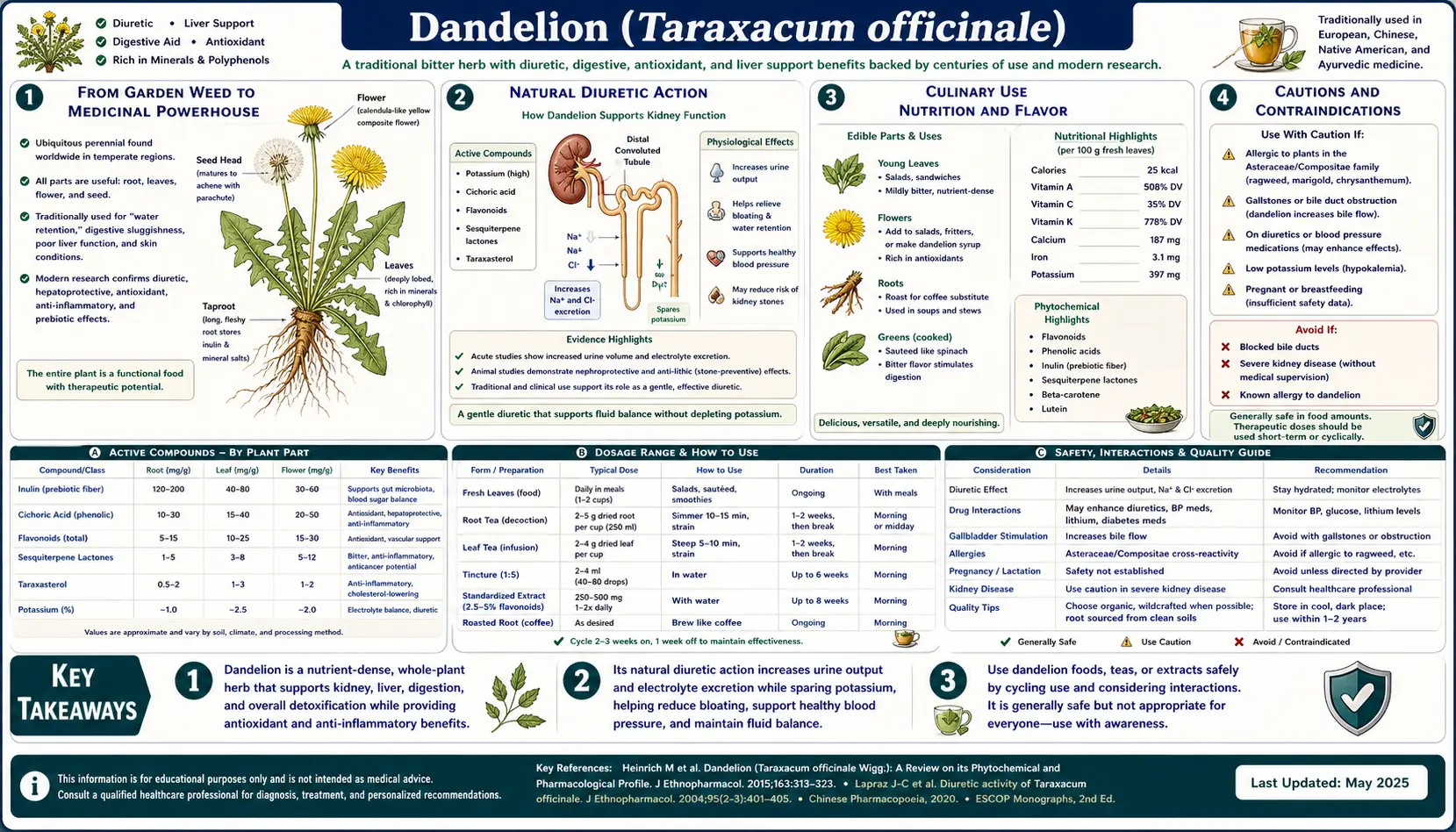
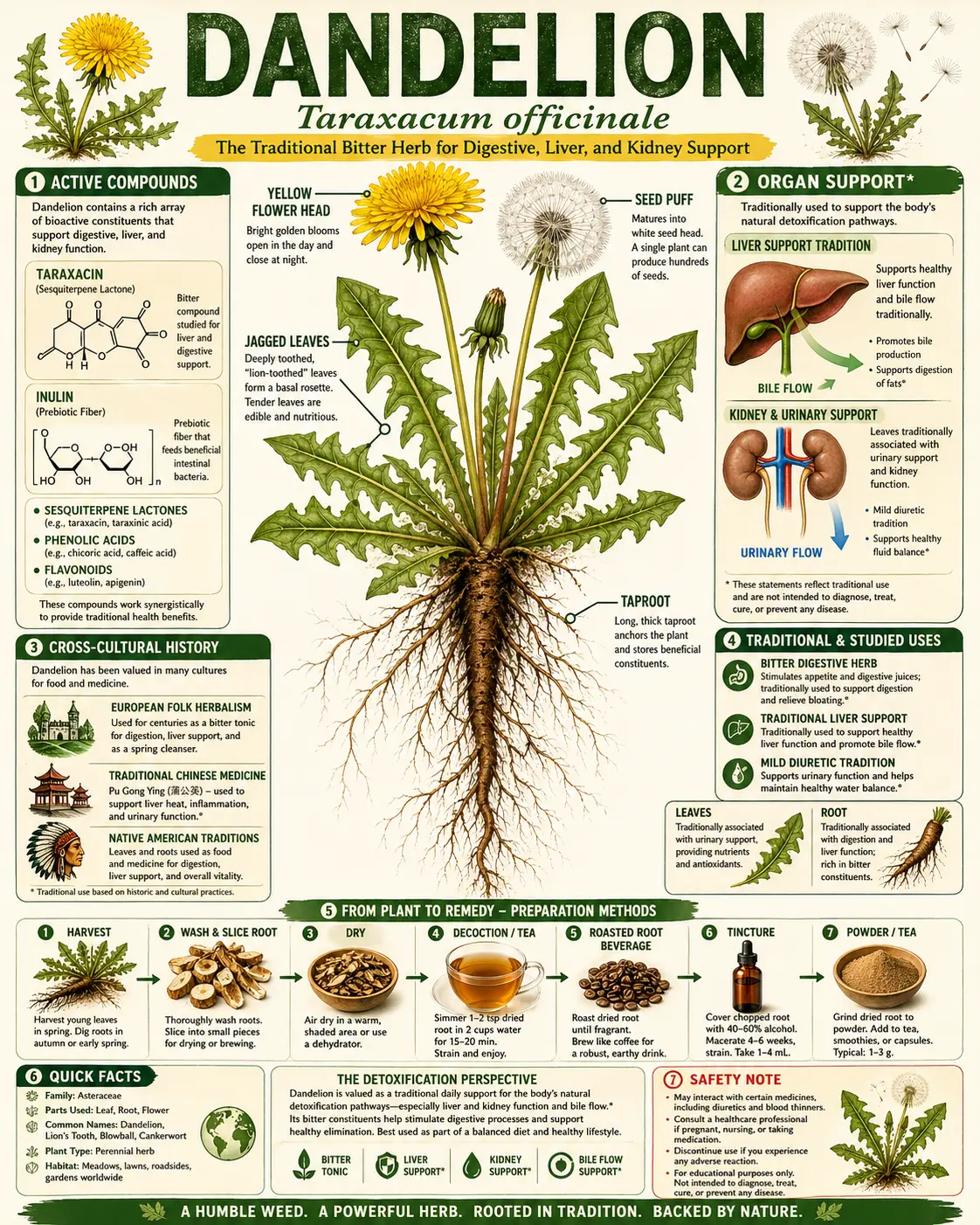
Table of Contents
- From Garden Weed to Medicinal Powerhouse
- Active Compounds
- Liver and Bile Flow Support
- Natural Diuretic Action
- Digestive Bitter Action
- Blood Sugar and Metabolic Support
- Culinary Use
- Forms and Preparations
- Recommended Dosage
- Cautions and Contraindications
- Featured Videos
From Garden Weed to Medicinal Powerhouse
Dandelion's name comes from the French dent de lion ("lion's tooth"), for the toothed leaves, while its botanical name Taraxacum officinale — the bitter herb of the apothecaries — records a medicinal career stretching back at least a thousand years. Persian and Arab physicians, the Chinese materia medica, medieval Welsh and English herbalists, and later North American practitioners all valued it for the liver and bile, for digestion, and as a diuretic. — the fuller story is told in the dedicated History & Traditional Use article.
Active Compounds
Dandelion is rich in vitamins and minerals, including substantial amounts of vitamin A (as beta-carotene), vitamin K, vitamin C, calcium, iron, magnesium, and potassium. The leaves contain more potassium than nearly any other commonly consumed vegetable, which is therapeutically relevant given the diuretic activity of the plant.
Bioactive constituents include:
- Sesquiterpene lactones — including taraxacin, taraxacerin, and lactucin — responsible for the bitter taste and digestive bitter action
- Triterpenes — including taraxasterol, taraxerol, and lupeol, with anti-inflammatory and hepatoprotective activity
- Phenolic acids and flavonoids — chicoric acid, chlorogenic acid, luteolin, and apigenin, with antioxidant and anti-inflammatory effects
- Inulin and other fructans — soluble prebiotic fibers concentrated in the root, supporting the growth of beneficial gut bacteria
- Coumarins — mild anticoagulant and anti-inflammatory activity
Liver and Bile Flow Support
Dandelion root is a classical bitter herb and cholagogue — a substance that promotes bile flow from the liver and gallbladder. By stimulating bile secretion and gallbladder contraction, it supports fat digestion, the elimination of fat-soluble toxins via bile, and the natural turnover of cholesterol.
Hepatoprotective activity has been demonstrated in animal studies showing reduced liver enzyme elevation following exposure to chemical toxins, alcohol, or paracetamol. Mechanistically, dandelion's polyphenols protect hepatocytes from oxidative stress, support glutathione recycling, and modulate phase II detoxification enzyme expression.
In integrative practice, dandelion root is commonly combined with milk thistle (silymarin) for synergistic liver support: milk thistle protects hepatocytes from oxidative damage while dandelion enhances bile flow and supports the elimination of conjugated metabolites. This combination is foundational in integrative protocols for hepatic steatosis (fatty liver), chronic mild liver enzyme elevation, and supportive care during medication-related liver stress.
Natural Diuretic Action
The leaves of dandelion are one of the few herbal diuretics with both traditional support and credible modern evidence. The folk name "pissenlit" (French) and the British colloquial "piss-a-bed" both reference this prominent action.
What distinguishes dandelion leaf from pharmaceutical diuretics is its high natural potassium content. Pharmaceutical loop and thiazide diuretics deplete potassium, often requiring potassium supplementation or potassium-sparing combinations. Dandelion leaf delivers substantial dietary potassium along with its diuretic action, partially offsetting the urinary potassium loss.
Clinical use is appropriate for:
- Mild fluid retention and bloating, particularly cyclical premenstrual edema
- Mild hypertension (modest effect; not a substitute for established antihypertensive therapy)
- Adjunctive support in heart failure under cardiology supervision
- Acute uncomplicated cystitis or bladder irritation, often combined with cranberry and uva ursi
Digestive Bitter Action
Dandelion is one of the classical digestive bitters. Bitterness on the tongue triggers a vagal reflex that stimulates secretion of saliva, gastric acid, pancreatic enzymes, and bile — the entire upstream cascade of digestion. This makes dandelion (especially as a tincture or fresh leaf in salad) useful for sluggish digestion, postprandial bloating, mild constipation, and the kind of low appetite that often accompanies depression, recovery from illness, or chronic stress.
The traditional European practice of taking a small bitter aperitif before meals — now largely lost in modern American food culture — has a real digestive physiological basis. Dandelion fits this pattern as a bitter food: a few leaves of fresh dandelion in salad, or a few drops of dandelion tincture in water, taken 10-20 minutes before a meal, support the natural digestive cascade.
Blood Sugar and Metabolic Support
Modern animal and small human studies suggest that dandelion may modestly improve glucose tolerance and insulin sensitivity. The inulin content of the root acts as a prebiotic fiber that selectively feeds beneficial gut bacteria, particularly bifidobacteria, which contribute to short-chain fatty acid production and improved metabolic markers.
Effects on blood sugar are gentler than berberine or bitter melon and are not sufficient as monotherapy for type 2 diabetes, but dandelion fits well into broader metabolic protocols and as a daily liver-supporting beverage.
Culinary Use
Dandelion is a complete edible plant — root, leaf, flower, and stem all have culinary applications. Wild-foraged plants from clean, unsprayed areas are tender and richly flavored.
- Young leaves — spring leaves (before the plant flowers) are mildly bitter and excellent in salad, sauteed with garlic and olive oil, or wilted into soups
- Mature leaves — more bitter; can be blanched briefly to mellow the flavor before use
- Flowers — battered and fried, or fermented into dandelion wine; a few fresh petals add color to salads
- Roots — roasted and ground as a coffee substitute (chicory-like flavor); rich source of inulin
- Stems — the milky latex contains lactucarium, a mild sedative; not commonly consumed
Forms and Preparations
- Dandelion root tea — 1-2 teaspoons of dried, roasted root simmered in water for 10-15 minutes; rich, slightly bitter, coffee-like
- Dandelion leaf tea — 1-2 teaspoons of dried leaf in hot water; primarily diuretic action
- Tinctures — separate root and leaf preparations; 1:5 in alcohol for the root, 1:3 in alcohol for the leaf
- Capsules — 500-1500 mg of dried root or leaf two to three times daily
- Standardized extracts — usually standardized to inulin (root) or chlorogenic acid content
- Roasted root coffee substitute — whole-food daily preparation suitable for indefinite use
Recommended Dosage
- Dried root tea — 2-8 g per day, divided in two or three cups
- Dried leaf tea — 4-10 g per day for diuretic effect
- Tincture — 2-5 mL three times daily
- Capsules of standardized extract — 500-1500 mg daily depending on indication
- Fresh leaves in food — a daily handful of young dandelion greens contributes meaningfully to mineral intake and provides ongoing bitter stimulation
Cautions and Contraindications
- Bile duct obstruction — contraindicated in patients with gallstones causing biliary obstruction or known bile duct blockage; the cholagogue effect could precipitate biliary colic
- Severe gallbladder disease — use only under medical supervision in patients with active cholecystitis
- Allergy — members of the Asteraceae (daisy) family, including ragweed, can trigger cross-reactive allergies; sensitive individuals should test with a small dose first
- Drug interactions — diuretic effect may potentiate prescription diuretics and cause additive potassium changes; the high potassium content can be a concern in patients on potassium-sparing diuretics or ACE inhibitors with reduced kidney function
- Lithium — diuretic effect can affect lithium clearance
- Foraging caution — avoid plants from lawns treated with herbicides, roadsides, or industrial sites; dandelions concentrate metals from contaminated soil
- Oxalate content — moderate oxalate; individuals with calcium oxalate kidney stones should not consume large amounts
Research Papers and References
The following PubMed search links provide curated entry points into the published clinical and mechanistic literature on Dandelion (Taraxacum officinale). Each link opens directly in PubMed at the National Library of Medicine.
- Dandelion liver and hepatoprotection — PubMed: Taraxacum liver hepatoprotection
- Dandelion as a diuretic — PubMed: Taraxacum diuretic
- Dandelion and bile flow / cholagogue — PubMed: Taraxacum bile cholagogue
- Dandelion for blood sugar regulation — PubMed: Taraxacum glucose diabetes
- Taraxacum and inulin prebiotic effect — PubMed: Taraxacum inulin prebiotic
- Dandelion polyphenols and antioxidant activity — PubMed: Taraxacum polyphenols antioxidant
- Dandelion safety and oxalate content — PubMed: Taraxacum safety oxalate
External Authoritative Resources
- NCCIH — Herbs at a Glance
- MedlinePlus — Herbs and Supplements
- PubMed — All research on Taraxacum officinale
Connections
- Fluoride Chelation — the flushing herb in fluoride protocols
- All Herbs
- Dandelion Benefits Deep Dive
- Milk Thistle
- Detoxification
- Turmeric
- Comprehensive Metabolic Panel
- Chanca Piedra
- Ginger
- Schisandra
- Potassium
- Blood Sugar Control
- Kidney Function
- Glutathione
- Liver Disease
- Edema
- Bloating
- Vitamin C
- Berberine
- Liver Cleansing
- Detox Protocols
- Nhan Tran (Adenosma caeruleum) — Vietnam's everyday liver tea, and the species confusion surrounding it