Rosemary (Salvia rosmarinus)
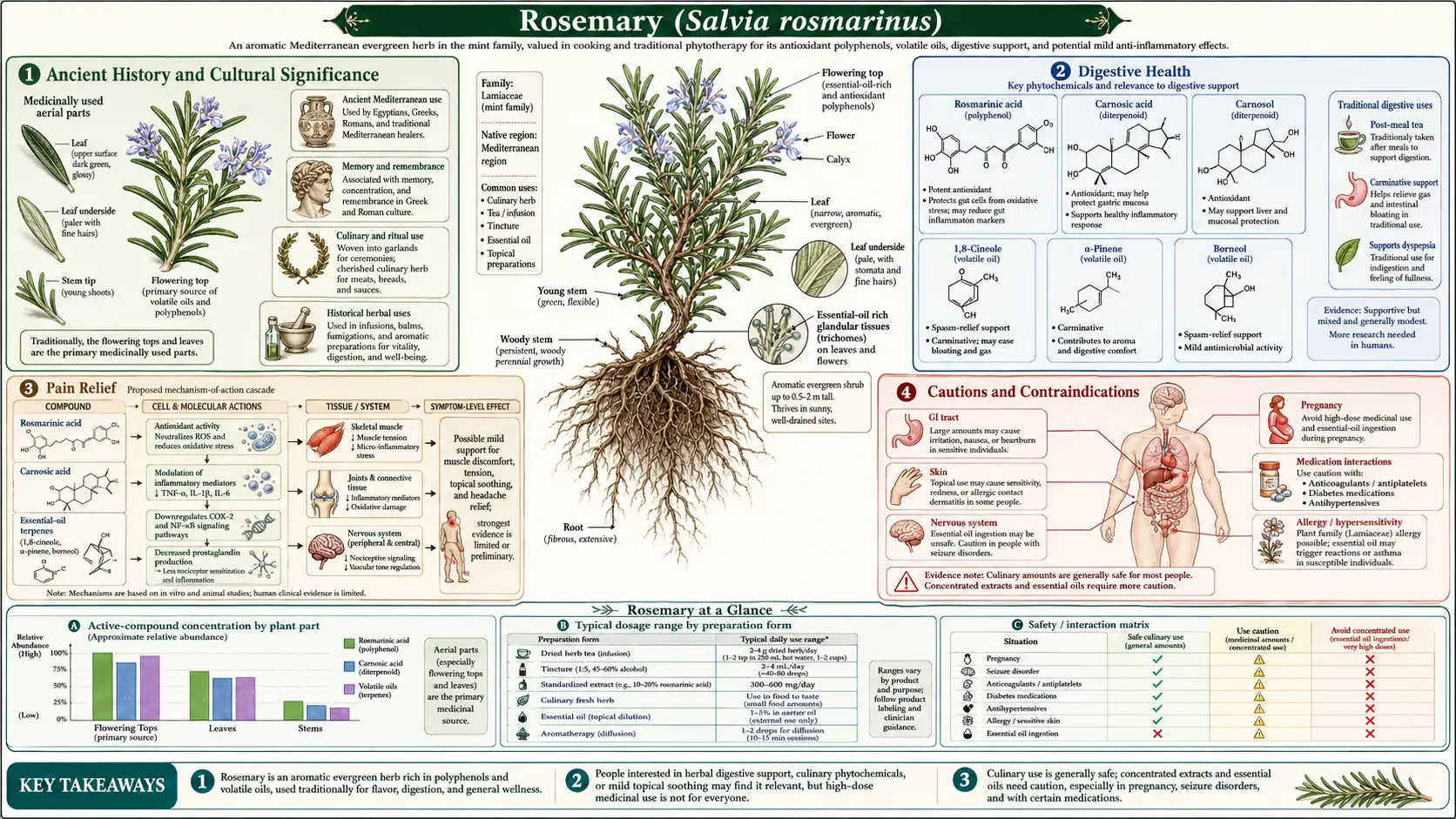
Table of Contents
- Ancient History and Cultural Significance
- Active Compounds
- Cognitive Enhancement and Memory
- Neuroprotection
- Antioxidant Properties
- Anti-Inflammatory Effects
- Digestive Health
- Liver Support and Detoxification
- Cardiovascular Health
- Immune Support
- Respiratory Health
- Pain Relief
- Hair Growth and Scalp Health
- Cancer Research
- Mood and Stress Relief
- Forms and Preparations
- Recommended Dosage
- Cautions and Contraindications
- Featured Videos
Ancient History and Cultural Significance
Rosemary has been valued for over two thousand years — described by Dioscorides and Pliny, burned in sickrooms to “purify” the air, and carried at both weddings and funerals as a token of memory and faithfulness. Its reputation as the “herb of remembrance,” immortalised by Shakespeare's “rosemary, that's for remembrance,” and the legend of the rosemary-based Hungary Water are part of a long and colourful tradition — the fuller story is told in the dedicated History & Traditional Use article.
Active Compounds
Rosemary contains an extraordinarily rich profile of bioactive compounds that work synergistically to produce its wide-ranging therapeutic effects.
- Carnosic acid: The most abundant diterpene in rosemary, a powerful lipid-soluble antioxidant that crosses the blood-brain barrier and protects neurons from oxidative damage. It is activated by free radicals themselves, making it uniquely efficient.
- Rosmarinic acid: A polyphenolic compound with potent anti-inflammatory, antiviral, and antioxidant properties. It inhibits complement activation and prostaglandin synthesis.
- Camphor: A bicyclic monoterpene ketone responsible for much of rosemary's distinctive aroma. It provides analgesic, anti-inflammatory, and decongestant effects when applied topically or inhaled.
- 1,8-Cineole (eucalyptol): A monoterpenoid that acts as a powerful expectorant and bronchodilator. It also enhances cognitive performance through inhalation by increasing cerebral blood flow.
- Carnosol: A phenolic diterpene with significant anticancer, anti-inflammatory, and antioxidant activity.
- Ursolic acid: A pentacyclic triterpenoid with anti-inflammatory, anticancer, and muscle-preserving properties.
- Additional compounds: Luteolin, apigenin, diosmin, hesperidin, caffeic acid, and betulinic acid contribute further therapeutic value.
Cognitive Enhancement and Memory
The ancient connection between rosemary and remembrance has been remarkably validated by modern scientific research. Shakespeare's famous line "rosemary, that's for remembrance" in Hamlet reflects a folk tradition now supported by clinical evidence.
Aroma inhalation studies have demonstrated that simply smelling rosemary essential oil can significantly improve memory performance. Research published in Therapeutic Advances in Psychopharmacology found that exposure to rosemary aroma enhanced both the speed and accuracy of cognitive tasks. Participants in rosemary-scented rooms scored significantly higher on prospective memory tests, which involve remembering to perform actions at specific times in the future.
The key mechanism involves 1,8-cineole, which is absorbed into the bloodstream through nasal mucosa and crosses the blood-brain barrier. Blood levels of 1,8-cineole correlate directly with improved cognitive performance. Carnosic acid further supports cognition by protecting neurons from oxidative stress and promoting the production of nerve growth factor (NGF), which is essential for the maintenance and growth of brain cells.
Rosemary also inhibits acetylcholinesterase, the enzyme that breaks down acetylcholine, a neurotransmitter critical for learning and memory. By preserving acetylcholine levels, rosemary supports the same neurochemical pathway targeted by several pharmaceutical drugs for cognitive decline.
Neuroprotection
Research into rosemary's neuroprotective properties has yielded promising results for neurodegenerative conditions, particularly Alzheimer's disease and Parkinson's disease.
Carnosic acid protects brain cells through a unique mechanism. It remains inactive until triggered by oxidative stress, at which point it converts to carnosol, which then neutralizes free radicals. This "pathological activation" means the compound works precisely where and when it is most needed, minimizing unnecessary biochemical interference in healthy tissue.
In Alzheimer's research, rosemary compounds have been shown to inhibit the aggregation of beta-amyloid plaques, reduce tau protein hyperphosphorylation, and decrease neuroinflammation, all of which are central features of the disease. Carnosic acid also upregulates the production of glutathione, the brain's primary endogenous antioxidant.
For Parkinson's disease, rosemary extracts have demonstrated protective effects on dopaminergic neurons in preclinical models. Carnosol and carnosic acid reduce the neuroinflammation driven by activated microglia, and rosmarinic acid has been shown to prevent the toxic aggregation of alpha-synuclein, a protein implicated in Parkinson's pathology.
Antioxidant Properties
Rosemary is one of the most powerful antioxidant herbs known to science. Its antioxidant capacity is so significant that carnosic acid is widely used as a natural food preservative in the commercial food industry, approved for this purpose in both the European Union and the United States. It effectively prevents lipid oxidation and rancidity in oils, meats, and processed foods without synthetic additives.
The antioxidant activity of rosemary operates through multiple mechanisms simultaneously. Carnosic acid and carnosol directly scavenge reactive oxygen species, including superoxide radicals, hydroxyl radicals, and peroxyl radicals. Rosmarinic acid chelates transition metal ions such as iron and copper that would otherwise catalyze the formation of free radicals.
Additionally, rosemary compounds activate the Nrf2 pathway, which upregulates the body's own antioxidant defense enzymes, including superoxide dismutase, catalase, and glutathione peroxidase. This dual action of directly neutralizing free radicals while simultaneously strengthening the body's endogenous antioxidant defenses makes rosemary exceptionally effective at combating oxidative stress.
Anti-Inflammatory Effects
Chronic low-grade inflammation underlies many modern diseases, and rosemary addresses this through multiple anti-inflammatory pathways.
- COX-2 inhibition: Rosmarinic acid and carnosol inhibit cyclooxygenase-2, the enzyme responsible for producing inflammatory prostaglandins, through a mechanism similar to non-steroidal anti-inflammatory drugs but without gastric side effects.
- NF-kB suppression: Carnosic acid blocks the activation of nuclear factor kappa-B, a master transcription factor that drives the expression of inflammatory cytokines, adhesion molecules, and other mediators of chronic inflammation.
- Lipoxygenase inhibition: Rosemary compounds inhibit 5-lipoxygenase, reducing the production of leukotrienes that contribute to allergic inflammation and asthma.
- Cytokine modulation: Rosemary extracts reduce levels of pro-inflammatory cytokines including TNF-alpha, IL-1beta, and IL-6, while supporting anti-inflammatory cytokines such as IL-10.
These combined anti-inflammatory effects make rosemary beneficial for conditions ranging from arthritis and inflammatory bowel disease to chronic pain syndromes and metabolic inflammation.
Digestive Health
Rosemary has been used as a digestive tonic for centuries, and its effectiveness is well supported by pharmacological research. In European herbal medicine, rosemary is classified as a cholagogue and choleretic, meaning it both stimulates the release of stored bile from the gallbladder and increases bile production in the liver.
This bile-stimulating action is particularly valuable for the digestion of dietary fats and the absorption of fat-soluble vitamins (A, D, E, and K). Individuals suffering from sluggish digestion, post-meal heaviness, bloating, and flatulence often experience significant relief with rosemary tea or extract taken before or with meals.
Rosemary also exerts antispasmodic effects on smooth muscle in the gastrointestinal tract, easing cramping and discomfort associated with indigestion and irritable bowel syndrome. Its carminative properties help expel trapped gas, while its antimicrobial compounds support a healthy gut microbiome by selectively inhibiting pathogenic bacteria without disrupting beneficial species.
Liver Support and Detoxification
The liver is the body's primary organ of detoxification, and rosemary provides comprehensive hepatoprotective support. Carnosic acid and carnosol have been shown in multiple studies to protect liver cells from damage caused by toxins, alcohol, pharmaceutical drugs, and environmental pollutants.
Rosemary enhances both Phase I and Phase II liver detoxification pathways. It induces cytochrome P450 enzymes that oxidize and prepare toxins for elimination, while simultaneously upregulating Phase II conjugation enzymes, particularly glutathione S-transferase, which binds activated toxins to glutathione for safe excretion.
Research has demonstrated that rosemary extract can significantly reduce elevated liver enzymes (ALT and AST) in animal models of liver injury. It also inhibits liver fibrosis by reducing the activation of hepatic stellate cells, which are responsible for the excessive collagen deposition that characterizes cirrhosis. For individuals exposed to environmental toxins or taking medications that burden the liver, rosemary serves as a gentle yet effective supportive herb.
Cardiovascular Health
Rosemary contributes to cardiovascular wellness through several complementary mechanisms. It improves peripheral circulation, making it particularly beneficial for individuals with cold extremities, Raynaud's phenomenon, or poor blood flow to the brain.
- Blood pressure regulation: Rosemary has a normalizing effect on blood pressure. Its diuretic properties can help reduce fluid retention, while its vasodilatory compounds improve blood vessel tone and elasticity.
- Endothelial protection: Rosmarinic acid protects the endothelial lining of blood vessels from oxidative damage and inflammation, reducing the risk of atherosclerotic plaque formation.
- Lipid profile improvement: Rosemary extracts have been shown to reduce LDL cholesterol oxidation, a critical step in the development of atherosclerosis, while modestly improving overall lipid profiles.
- Anti-platelet activity: Certain rosemary compounds reduce excessive platelet aggregation, lowering the risk of abnormal blood clot formation without the bleeding risks associated with pharmaceutical anticoagulants.
Immune Support
Rosemary provides broad-spectrum antimicrobial activity alongside immune-modulating effects. Its essential oil demonstrates significant antibacterial activity against numerous pathogenic organisms, including Staphylococcus aureus, Escherichia coli, Bacillus subtilis, and Candida albicans.
The antimicrobial mechanisms include disruption of bacterial cell membranes, inhibition of biofilm formation, and interference with bacterial quorum sensing. These properties make rosemary valuable not only as an internal immune support but also as a topical antiseptic and a natural food safety agent.
Beyond direct antimicrobial effects, rosemary modulates immune function by enhancing natural killer cell activity, supporting macrophage function, and promoting balanced T-helper cell responses. Its antioxidant compounds protect immune cells from the oxidative damage they sustain during the respiratory burst used to destroy pathogens.
Respiratory Health
Rosemary is a traditional remedy for respiratory ailments, and its high content of 1,8-cineole (eucalyptol) and camphor makes it an effective decongestant and expectorant. Inhaling steam infused with rosemary essential oil or fresh rosemary sprigs helps open congested airways, loosen thick mucus, and ease breathing.
1,8-Cineole has been shown in clinical trials to reduce the frequency and severity of exacerbations in chronic obstructive pulmonary disease (COPD) and to improve lung function in patients with asthma. It works by reducing airway inflammation, relaxing bronchial smooth muscle, and thinning mucus secretions for easier clearance.
Rosemary's antimicrobial compounds also help combat respiratory infections. Its anti-inflammatory properties reduce the swelling and irritation of inflamed nasal passages, sinuses, and bronchial tubes, providing symptomatic relief from colds, flu, sinusitis, and allergic rhinitis.
Pain Relief
Topical application of rosemary essential oil (properly diluted in a carrier oil) is a well-established remedy for muscle pain, joint stiffness, and arthritis. The analgesic effects are mediated primarily by camphor and 1,8-cineole, which stimulate thermoreceptors in the skin, creating a warming sensation that eases pain perception.
Rosemary essential oil massage has been shown in clinical studies to significantly reduce pain intensity in patients with rheumatoid arthritis, osteoarthritis, and chronic myofascial pain. The anti-inflammatory compounds absorbed through the skin reduce local inflammation at the site of application.
For tension headaches and migraines, applying diluted rosemary oil to the temples and forehead can provide relief. The combination of analgesic, anti-inflammatory, and circulatory-enhancing properties makes rosemary a versatile topical pain remedy that can reduce dependence on over-the-counter analgesics for chronic musculoskeletal conditions.
Hair Growth and Scalp Health
One of the most exciting areas of rosemary research involves its effects on hair growth. A landmark clinical trial published in SKINmed Journal (2015) compared rosemary essential oil to 2% minoxidil (the active ingredient in Rogaine) over a six-month period in patients with androgenetic alopecia (pattern hair loss). The results showed that rosemary oil was equally effective as minoxidil in promoting hair regrowth, with significantly fewer side effects such as scalp itching.
Rosemary promotes hair growth through multiple mechanisms:
- Improved scalp circulation: Rosemary increases blood flow to hair follicles, delivering more oxygen and nutrients to support active growth.
- DHT inhibition: Carnosic acid inhibits 5-alpha reductase, the enzyme that converts testosterone to dihydrotestosterone (DHT), the hormone primarily responsible for androgenetic hair loss.
- Anti-inflammatory action: By reducing scalp inflammation, rosemary creates a healthier environment for hair follicle function.
- Antimicrobial effects: Rosemary combats dandruff-causing fungi and bacteria, promoting a clean and healthy scalp.
For hair applications, 3-5 drops of rosemary essential oil can be added to a tablespoon of carrier oil (such as jojoba or coconut oil) and massaged into the scalp several times per week.
Cancer Research
Rosemary compounds, particularly carnosol, carnosic acid, and ursolic acid, have shown promising anticancer properties in preclinical research. These compounds affect multiple stages of cancer development, including initiation, promotion, and progression.
Carnosol has demonstrated the ability to induce apoptosis (programmed cell death) in cancer cells while sparing healthy cells. It has shown activity against breast, prostate, colon, lung, and skin cancer cell lines in laboratory studies. Key mechanisms include:
- Inhibition of NF-kB signaling, which many cancers hijack to resist apoptosis
- Suppression of angiogenesis (new blood vessel formation that tumors require for growth)
- Enhancement of detoxification enzymes that neutralize carcinogenic compounds
- Modulation of estrogen metabolism, potentially reducing estrogen-driven cancer risk
- Inhibition of matrix metalloproteinases that cancer cells use to invade surrounding tissues
While these preclinical findings are promising, human clinical trials are still needed. Rosemary should be viewed as a supportive dietary herb rather than a cancer treatment.
Mood and Stress Relief
Rosemary aroma has measurable effects on mood and stress physiology. Research has shown that inhaling rosemary essential oil reduces salivary cortisol levels, the primary stress hormone. Lower cortisol is associated with reduced anxiety, improved immune function, and decreased risk of stress-related chronic diseases.
In aromatherapy studies, rosemary inhalation has been shown to simultaneously reduce anxiety while increasing alertness, a unique combination that distinguishes it from sedating herbs. Participants exposed to rosemary aroma report feeling more content, less drowsy, and more energized.
This dual action of calming stress while enhancing mental clarity makes rosemary particularly valuable for students, professionals, and anyone facing cognitively demanding tasks under pressure. The simple practice of keeping a rosemary plant on a desk or diffusing rosemary essential oil during work can meaningfully improve both productivity and emotional well-being.
Forms and Preparations
- Fresh herb: Used in cooking, teas, and steam inhalations. Fresh rosemary retains the full spectrum of volatile oils and is excellent for culinary use and simple infusions.
- Dried herb: Convenient for teas and cooking. Drying concentrates certain compounds while reducing volatile oil content. Store in a cool, dark place for up to one year.
- Rosemary tea: Steep 1-2 teaspoons of fresh or dried rosemary in hot water (not boiling) for 5-10 minutes. Strain and drink up to three times daily.
- Essential oil: Highly concentrated; must always be diluted before topical use. Used in aromatherapy, massage blends, hair treatments, and steam inhalations. Never ingest essential oil.
- Standardized extract: Capsules or liquid extracts standardized to carnosic acid content (typically 10-20%) provide consistent therapeutic doses for specific health goals.
- Tincture: Alcohol-based extraction preserves both water-soluble and fat-soluble compounds. Taken in small doses (1-4 ml) diluted in water.
Recommended Dosage
- Dried herb tea: 2-4 grams steeped in 150 ml hot water, 2-3 times daily
- Standardized extract: 200-400 mg standardized to 6-20% carnosic acid, 1-2 times daily
- Tincture (1:5): 2-4 ml, three times daily
- Essential oil (topical): 2-5 drops diluted in 1 tablespoon carrier oil; never apply undiluted
- Essential oil (aromatherapy): 3-5 drops in a diffuser, or inhale from the bottle for 1-3 minutes
- Fresh herb in cooking: Use liberally as a culinary seasoning for daily low-dose benefit
Start with lower doses and increase gradually. Therapeutic effects often become more apparent with consistent daily use over 2-4 weeks.
Cautions and Contraindications
- Seizure disorders: High doses of rosemary, particularly camphor-rich preparations, may lower the seizure threshold. Individuals with epilepsy or a history of seizures should use rosemary only in normal culinary amounts and avoid concentrated extracts and essential oils.
- Pregnancy: Rosemary is safe in culinary quantities during pregnancy. However, therapeutic doses (concentrated extracts, large amounts of tea, or essential oil) should be avoided, as they may stimulate uterine contractions.
- Blood pressure medications: Rosemary may interact with antihypertensive medications, ACE inhibitors, and diuretics. Individuals taking blood pressure medication should consult their healthcare provider before using rosemary in therapeutic doses.
- Anticoagulant medications: Due to its mild antiplatelet effects, rosemary in therapeutic doses may enhance the effects of blood-thinning medications such as warfarin.
- Essential oil safety: Rosemary essential oil must always be diluted in a carrier oil before topical application (maximum 2-3% concentration for general use). Never ingest essential oil. Keep away from the eyes and mucous membranes.
- Iron absorption: Very large doses of rosmarinic acid may reduce non-heme iron absorption. Those with iron-deficiency anemia should separate rosemary supplementation from iron-rich meals.
- Allergic reactions: Though rare, individuals allergic to other Lamiaceae family plants (mint, basil, sage) may experience cross-reactivity with rosemary.
Research Papers and References
The following are topic-level PubMed search links covering the main evidence streams for Rosemary (Salvia rosmarinus / Rosmarinus officinalis). Each link resolves to a curated PubMed query so that the most current randomized trials, meta-analyses, and mechanistic studies can be reviewed directly from the National Library of Medicine.
- Rosemary aroma and cognitive performance. — PubMed: rosemary memory cognition aromatherapy
- Carnosic acid and rosmarinic acid: pharmacology. — PubMed: rosemary carnosic acid rosmarinic acid
- Rosemary in neurodegeneration and Alzheimer models. — PubMed: rosemary Alzheimer neuroprotection
- Antioxidant pharmacology of Rosmarinus officinalis. — PubMed: rosemary antioxidant
- Rosemary oil in androgenetic alopecia. — PubMed: rosemary hair growth alopecia
- Anti-inflammatory effects of rosemary extracts. — PubMed: rosemary anti-inflammatory
- Antimicrobial activity of rosemary essential oil. — PubMed: rosemary antimicrobial
- Rosemary and glycemic control. — PubMed: rosemary blood glucose diabetes
- Rosemary and anxiety/stress outcomes. — PubMed: rosemary anxiety stress
- Preclinical antitumor activity of rosemary constituents. — PubMed: rosemary cancer apoptosis
- Hepatoprotective effects of rosemary. — PubMed: rosemary hepatoprotective
- Rosemary, camphor, and seizure safety signals. — PubMed: rosemary safety seizures camphor
External Authoritative Resources
- NCCIH — Herbs at a Glance
- MedlinePlus — Herbs and Supplements
- PubMed — All research on Salvia rosmarinus / Rosmarinus officinalis
Connections
- All Herbs
- Rosemary Benefits Deep Dive
- Thyme
- Sage
- Oregano
- Alzheimer's Disease
- Lemon Balm
- Bacopa Monnieri
- Cancer
- Glutathione
- Anxiety
- Oxidative Stress
- Arthritis
- Alopecia
- Hair Loss
- Parkinson's Disease
- Staphylococcus Aureus
- Eucalyptus
- Escherichia Coli
- BHA