Atractylodes (Bai Zhu)
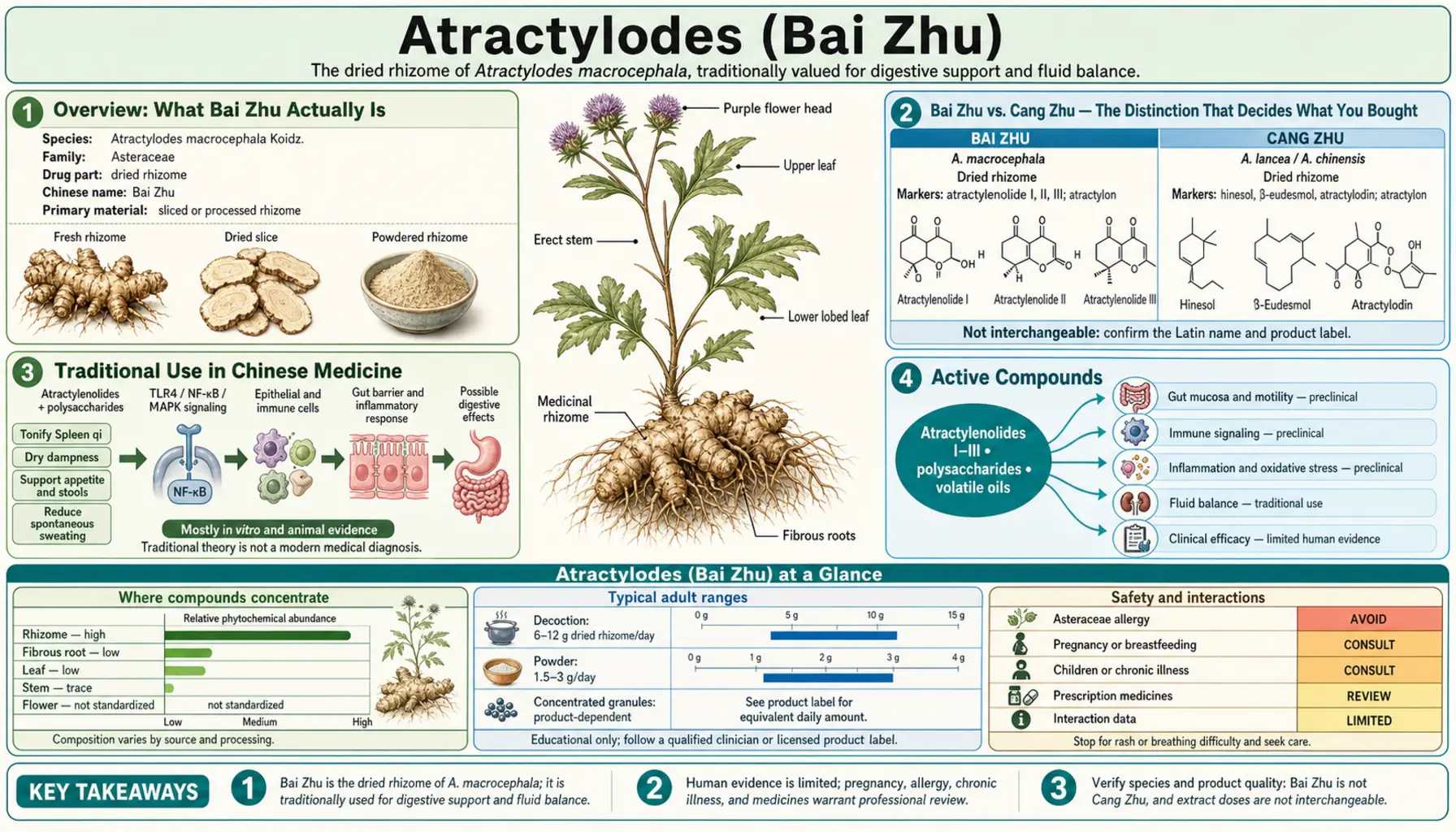
Atractylodes, known in Chinese medicine as bai zhu (白术, "white atractylodes"), is the dried rhizome of Atractylodes macrocephala Koidz., a perennial in the daisy family. For roughly two thousand years it has been the single most-used digestive tonic in Chinese herbal practice — it appears in more classical formulas than almost any other root — and it is still one of the highest-volume herbs grown in China today.
It is also a herb where the gap between reputation and human evidence is unusually wide. Almost everything published about bai zhu is laboratory work: isolated cells, mice, rats, or farmed poultry. Nearly all of the human data comes from multi-herb formulas in which bai zhu is one of four to twelve ingredients, which means no one can say which ingredient did what. This page tells you what the plant is, what is actually in it, what the research does and does not show, and how to tell whether the bottle you bought contains this herb at all.
Table of Contents
- Overview: What Bai Zhu Actually Is
- Bai Zhu vs. Cang Zhu — The Distinction That Decides What You Bought
- Traditional Use in Chinese Medicine
- Active Compounds
- Digestion and "Spleen Qi"
- Fluid Balance, Dampness and Edema
- Immune Signalling and Inflammation
- The Gut Barrier and the Microbiome
- Atractylenolide I in Cancer Laboratories — Read This Carefully
- Processing: Raw, Dry-Fried, Bran-Fried and Charred
- Forms and Preparations
- Recommended Dosage
- Cautions and Contraindications
- Key Research Papers
- Conditions It Is Used For
- Connections
- Featured Videos
Overview: What Bai Zhu Actually Is
Atractylodes macrocephala Koidz. is a herbaceous perennial in the Asteraceae — the same botanical family as daisies, sunflowers, chrysanthemum, chamomile, marigold and ragweed. It grows about knee- to waist-high, with deeply divided leaves and a thistle-like flower head. The species name macrocephala means "large-headed" and refers to that flower head, which is noticeably bigger than those of its close relatives.
The part used in medicine is not the leaf or the flower. It is the rhizome — the knobby, horizontal underground stem, which in pharmacy Latin is Rhizoma Atractylodis Macrocephalae (you will also see it written Atractylodis Macrocephalae Rhizoma, which is the same thing in the newer word order). A rhizome is not a root; it is a stem that happens to grow sideways underground, and it stores the starch and volatile oils the plant will need to push out new growth in spring. That storage function is why it is worth harvesting.
Commercial bai zhu is a cultivated crop, not a wild-harvested herb. Plants are grown for two to three years before the rhizome is lifted, usually in late autumn or early winter after the tops have died back and the rhizome is at its heaviest. Younger rhizomes are smaller and, in the traditional grading system, considered weaker. Zhejiang Province is the historic centre of the trade, and rhizomes from the Yuqian area of Zhejiang — sold as "Yu Zhu" — have long been treated as the premium grade. Anhui, Hunan, Hubei and Jiangxi also produce large volumes. The idea that a herb from one specific region is superior has its own name in Chinese pharmacy, daodi (道地), and bai zhu is one of the classic examples; whether the chemistry actually differs enough to matter to a patient is a separate and much less settled question.
An honest framing of the evidence, stated once here and repeated where it matters below: there is a large and growing body of research on this herb, and it is overwhelmingly preclinical. Cell-culture and rodent studies tell you a compound can do something in a dish or in a mouse. They do not tell you it does anything useful in a person at a dose a person would take. Where human trials exist, they almost always test a whole formula — Shen Ling Bai Zhu San, Si Jun Zi Tang, Bu Zhong Yi Qi Tang — and a positive result in a twelve-herb decoction cannot be assigned to any one of the twelve herbs. When you read this page, hold onto that distinction. It is the difference between "interesting" and "proven."
Bai Zhu vs. Cang Zhu — The Distinction That Decides What You Bought
This is the single most practical thing on this page. There are two completely different medicinal herbs sold in English under the bare word "Atractylodes," and Western supplement labels very often do not say which one is inside.
- Bai zhu (白术, "white atractylodes") is Atractylodes macrocephala. It is the tonifying one — used to strengthen digestion, build what Chinese medicine calls spleen qi, and gently dry excess fluid.
- Cang zhu (苍术, "grey" or "black atractylodes") is Atractylodes lancea or Atractylodes chinensis. It is far more aromatic, far more strongly drying, and it is not a tonic. It is used to "dry dampness" and to open up a heavy, sodden, congested feeling — a job closer to clearing than to building.
Traditional practitioners do not treat these as interchangeable. Giving a strongly drying herb to someone who is already depleted and dry is, in the classical framework, exactly backwards. The two rhizomes even look different: bai zhu is pale, dense and starchy with a faintly sweet aroma, while cang zhu is darker, more fibrous and pungently aromatic — the smell is the giveaway.
| Bai Zhu (白术) | Cang Zhu (苍术) | |
|---|---|---|
| Species | Atractylodes macrocephala Koidz. | Atractylodes lancea or A. chinensis |
| English trade name | White atractylodes | Grey / black / "cang" atractylodes |
| Pharmacy Latin | Rhizoma Atractylodis Macrocephalae | Rhizoma Atractylodis |
| Traditional action | Tonifies (builds); mildly dries | Dries and disperses; does not tonify |
| Aroma | Faint, slightly sweet, earthy | Strong, pungent, camphor-like |
| Marker compounds | Atractylenolides I–III, atractylon | Atractylodin, β-eudesmol, hinesol |
| Japanese Kampo name | Byakujutsu | Sojutsu |
How to check what you actually bought. Turn the bottle over and look for the binomial. If the label says Atractylodes macrocephala, you have bai zhu. If it says Atractylodes lancea, A. chinensis, or simply "Atractylodis Rhizoma," you have cang zhu. If it says only "Atractylodes root" or "Atractylodes 500 mg" with no species and no part, you do not know what you have, and you should email the company and ask — a manufacturer that cannot tell you the species is telling you something about its supply chain. One more note: the label should say rhizome, not root. "Atractylodes root" is a common and sloppy shorthand, and while it usually still means the rhizome, it is a small signal about how carefully the product was documented.
Traditional Use in Chinese Medicine
In the traditional framework, bai zhu is the premier spleen-qi tonic. The "spleen" of Chinese medicine is not the organ a surgeon removes; it is a functional description of the body's ability to extract nourishment from food and turn it into usable energy and tissue, and to keep fluids moving rather than pooling. When that function is described as weak, the classical picture is loose stools, poor appetite, bloating after eating, heavy tired limbs, and a pale swollen tongue with tooth-marks along the edges.
Four traditional functions are attributed to bai zhu:
- Tonifies the spleen and augments qi — the digestive-strengthening role above.
- Dries dampness and promotes urination — used where fluid is felt to be accumulating: puffiness, heaviness, loose watery stool.
- Stabilizes the exterior and stops sweating — specifically for spontaneous daytime sweating in someone who feels weak and catches every cold going around.
- Calms a restless fetus — a classical obstetric indication, discussed with its evidence gap in Cautions below.
It rarely appears alone. The formulas that made it famous include Si Jun Zi Tang (Four Gentlemen Decoction — bai zhu with ginseng or codonopsis, poria and licorice), Shen Ling Bai Zhu San, Bu Zhong Yi Qi Tang, Yu Ping Feng San (Jade Windscreen, with astragalus), and Ling Gui Zhu Gan Tang. The full story of those formulas, their source texts and their dates is on the History and Traditional Use page.
Traditional use is a reason to investigate a plant. It is not evidence that the plant works. Two thousand years of consistent use tells you the herb is unlikely to be acutely poisonous at customary doses, and that it produced effects noticeable enough to keep prescribing — which could be a real pharmacological action, or an accurate observation of a self-limiting condition, or both. Sorting those apart is what trials are for, and for this herb on its own, those trials have mostly not been done.
Active Compounds
Bai Zhu's chemistry splits into two very different fractions that behave differently, extract differently, and are studied by different research communities. Understanding the split explains a lot about the forms on the shelf.
The volatile oil: sesquiterpenes and sesquiterpene lactones
The aromatic fraction contains atractylenolide I, II and III — sesquiterpene lactones — plus atractylon and β-eudesmol. A sesquiterpene is a 15-carbon plant compound; a lactone is a ring closed by an ester bond. The class as a whole is common in the daisy family and includes some famously bioactive molecules elsewhere (parthenolide in feverfew, artemisinin's relatives in wormwood). Sesquiterpene lactones are also the chemical class most often responsible for Asteraceae contact allergy, which is why the allergy caution further down is not merely theoretical hand-waving.
Atractylenolide I is by far the most-studied single molecule in this herb. Most of that attention comes from immunology and oncology laboratories, where it has been repeatedly shown to alter macrophage signalling in cell culture. Atractylenolide III shows up more often in gastroprotection and anti-inflammatory work. All of this is in vitro and animal work — no atractylenolide has an established human pharmacokinetic profile at herbal doses that would let anyone predict what a 9 g decoction does to blood levels.
The polysaccharides
The other fraction is a group of large sugar polymers, abbreviated in the literature as AMP (Atractylodes macrocephala polysaccharide) or PAMK (polysaccharide of Atractylodes macrocephala Koidz.). These are the compounds behind most of the immune and intestinal-barrier research, and a striking amount of that work is in poultry and pigs, because Chinese agricultural science has studied this herb as a feed additive for gut health in livestock. That is legitimate science, and it is also not a human trial.
Why the split matters to you
Volatile oils and polysaccharides do not come out of the plant the same way. Polysaccharides are water-soluble and survive boiling — a traditional decoction extracts them well. Volatile oils partly boil off; the longer and harder you simmer, the more aroma you lose, which is measurable as a drop in essential-oil content. An alcohol tincture does the reverse: it captures the aromatic terpenes well and the large polysaccharides poorly. So a tincture and a decoction of the same rhizome are genuinely different preparations, and no one has run a head-to-head human trial telling you which is better for anything. This is also, as the Processing section explains, the pharmacological reason the traditional frying methods exist.
Digestion and "Spleen Qi"
This is the herb's central claim and the one with the most research behind it — though "most" is doing heavy lifting in a field where almost nothing is a human single-herb trial.
The mechanism, as far as animal work describes it. Rodent studies report several converging effects: modulation of gastrointestinal motility (with the direction of effect depending on the model and whether the gut is over- or under-active at baseline), protection of the stomach lining against chemically induced damage, and reduced inflammatory signalling in gut tissue. Atractylenolide III in particular has been studied for gastroprotection against ethanol-induced gastric injury in animals. Think of the motility findings as a thermostat rather than an accelerator: in models where transit is abnormally slow it appears to speed things, and in models of over-fast transit it appears to slow them. That "normalizing" pattern is exactly what a traditional tonic is supposed to do — and it is also exactly the kind of result that is easy to over-read, because a compound that looks bidirectional across different animal models may simply be behaving inconsistently.
The human evidence. Bai zhu-containing formulas — most often Shen Ling Bai Zhu San and Si Jun Zi Tang — have been tested in Chinese clinical trials for functional dyspepsia, chronic diarrhea, irritable-bowel-type symptoms and post-chemotherapy digestive complaints. Some of those trials report benefit. Three things limit what you can conclude from them: many are small, many were not blinded or placebo-controlled, and every single one tests a combination. If Shen Ling Bai Zhu San helps someone's diarrhea, that result belongs to the formula, not to bai zhu. There is no adequately powered, placebo-controlled human trial of bai zhu alone for any digestive condition.
What this means practically. It is reasonable to say bai zhu is a traditional digestive tonic with plausible mechanisms and supportive animal data. It is not reasonable to say it treats IBS, cures dyspepsia, or fixes a diagnosed condition. If your digestion has changed and stayed changed — persistent diarrhea, blood, unexplained weight loss, new pain, symptoms after age 50 — that needs investigating, not an over-the-counter tonic. Deeper coverage of the mechanism and formula literature is on the Digestion and Spleen Qi page.
Fluid Balance, Dampness and Edema
"Dampness" in Chinese medicine describes a cluster of sensations rather than a lab value: heaviness in the limbs, a foggy head, puffy fingers or ankles, loose stool, a thick coating on the tongue. Bai zhu is one of the standard herbs for it, and in the classical system raw (unfried) bai zhu is the form chosen when moving fluid is the priority.
The mechanism, as far as it goes. Rodent studies report increased urine output with atractylodes extracts, and the herb's diuretic reputation is old and consistent across sources. Some animal work also points at effects on aquaporin water-channel expression in kidney tissue. That is a genuinely interesting lead, and it is a lead — not a demonstrated clinical mechanism in humans.
The honest limit. There is no human trial showing that bai zhu reduces edema as a measured clinical outcome. This matters more than usual, because edema is a symptom of things that kill people. Swelling in both legs can be heart failure. Swelling with foamy urine can be kidney disease. Abdominal swelling can be liver disease. Sudden swelling in one leg can be a blood clot, which is a same-day emergency. Treating any of those with a mild herbal diuretic instead of getting a diagnosis is genuinely dangerous — not because the herb is toxic, but because the delay is.
There is also a pharmacological caution: if you already take a prescription diuretic (furosemide, hydrochlorothiazide, spironolactone), adding a herb with diuretic activity is a theoretical additive effect on fluid and electrolyte loss. No one has quantified it in humans. "Theoretical" here means unstudied, not disproven — and low potassium is exactly the kind of problem that produces cramps, palpitations and weakness before anyone thinks to check. The fuller discussion is on the Fluid Balance and Edema page.
Immune Signalling and Inflammation
Two separate research streams sit under this heading, and they use different parts of the plant's chemistry.
Atractylenolide I and macrophages. Macrophages are the immune system's front-line scavenger cells; when they encounter bacterial debris such as lipopolysaccharide (LPS), they switch on an inflammatory program through the TLR4 receptor and the NF-κB signalling pathway, pumping out messengers like TNF-α, IL-1β, IL-6 and nitric oxide. A consistent body of cell-culture work reports that atractylenolide I damps this response — less TNF-α, less nitric oxide, reduced NF-κB activation. Atractylenolide III has shown similar effects in comparable models. This is a coherent, repeatedly reproduced in vitro finding.
Polysaccharides and immune modulation. The AMP/PAMK fraction has been studied in mice and in poultry, where it is reported to support antibody responses, spleen and thymus tissue measures, and immune-cell activity, particularly in animals stressed by heat, toxin exposure or nutritional challenge. Again: interesting, coherent, and entirely non-human.
The gap. There are no human trials measuring inflammatory markers, infection rates, or immune outcomes with bai zhu as a single herb. That includes the traditional "stabilizes the exterior, prevents catching colds" indication — Yu Ping Feng San (which contains bai zhu, astragalus and siler) has been studied in humans for respiratory infection prevention with mixed and generally low-quality results, and once more, the formula is not the herb.
A note on the phrase "immune boosting," which you will see on labels: it is not a real pharmacological category. An immune system that is turned up indiscriminately is autoimmunity. What the laboratory data actually describe is modulation — some inflammatory signals down, some adaptive responses up, in models. If you have an autoimmune condition or take immunosuppressants after a transplant, that ambiguity is a reason for caution, not reassurance, because nobody can tell you which direction the net effect goes in your body. See Immune and Inflammation for the detail.
The Gut Barrier and the Microbiome
The lining of your intestine is one cell thick. Those cells are stitched together by protein complexes called tight junctions — occludin, claudins, and the scaffolding protein ZO-1 — that decide what crosses from the gut into the bloodstream. Damage that stitching and larger molecules cross that should not, provoking immune activation. This is the real biology sitting underneath the popular term "leaky gut."
What the research shows. PAMK and related polysaccharide fractions have been reported, in rodent and poultry studies, to raise expression of ZO-1 and occludin, reduce markers of intestinal permeability, protect the gut lining against stressors, and shift gut bacterial populations — often toward more short-chain-fatty-acid-producing species. Short-chain fatty acids, especially butyrate, are the primary fuel for colon lining cells, so a shift in that direction is biologically sensible.
What the research does not show. It does not show that bai zhu treats intestinal permeability in humans, because that study has not been done. It is worth being precise here: "leaky gut syndrome" is not a recognised clinical diagnosis, there is no validated test that a consumer can order to establish they have it, and increased intestinal permeability is better understood as something that accompanies conditions like coeliac disease, inflammatory bowel disease, and severe infection than as a free-standing illness that supplements repair. An animal study showing improved tight-junction protein expression in a stressed mouse is a mechanistic hypothesis. It is several long steps from a human outcome.
Microbiome findings carry a similar caveat: the composition of a mouse's gut flora, on mouse chow, is not a model of yours. More detail on the barrier and microbiome literature is on the Gut Barrier and Microbiome page.
Atractylenolide I in Cancer Laboratories — Read This Carefully
If you search this herb online you will hit a wall of papers with words like "inhibits proliferation," "induces apoptosis," and "suppresses tumor growth" in the titles. That literature is real, and it is being seriously misrepresented by some sellers. Here is what it actually is.
Atractylenolide I is a favourite compound in cell-line and xenograft research. Papers report that it slows growth or triggers programmed cell death in cultured cancer cells, and that it alters the behaviour of tumour-associated macrophages — the immune cells that tumours recruit and reprogram to protect themselves. There is also a body of work on cancer cachexia, the severe muscle-and-fat wasting that accompanies advanced cancer, in animal models.
None of this is clinical benefit, and it should not be presented as any. Three specific reasons, worth understanding once so you can apply them to any herb:
- Concentration. Cells in a dish are bathed in a chosen concentration of a purified compound. Nobody has shown that swallowing a decoction of the whole rhizome produces anything approaching that concentration at a tumour site in a person.
- The base rate. An enormous number of natural compounds kill cancer cells in a dish. So does bleach. Selectivity — killing the tumour and not the patient, at an achievable dose — is the entire difficulty of oncology, and cell-culture papers rarely address it.
- Attrition. The overwhelming majority of compounds that look promising in mouse tumour models fail in human trials. That is the ordinary, expected outcome, not a conspiracy.
If you are being treated for cancer, there is a further and more urgent point. Herbs are not inert with respect to chemotherapy. Some alter drug-metabolising enzymes; some have antioxidant effects that are theoretically at odds with treatments that work by oxidative damage; and none of this has been mapped for bai zhu. Tell your oncology team about anything you are taking, including "just a tea." That is not a formality — drug interactions with herbal products are a real and documented category of harm, and the team can only work around what it knows about.
Processing: Raw, Dry-Fried, Bran-Fried and Charred
Chinese pharmacy has a discipline of its own for preparing raw plant material, called paozhi (炮制). For bai zhu it is not decorative — the processing genuinely changes the chemistry, and the traditional indications track the chemical change in a way that is unusually easy to justify.
The key fact: heating drives off volatile oil. The aromatic sesquiterpene fraction is the part that traditional theory associates with moving and drying; the starchy, polysaccharide-rich body of the rhizome is what remains and is associated with building and nourishing. So the more you fry it, the less "moving" and the more "tonifying" it becomes — which is exactly what the classical texts say, arrived at by taste and observation centuries before anyone could measure essential-oil content.
| Preparation | Method | Traditional use | Chemical direction |
|---|---|---|---|
| Raw (生白术 sheng bai zhu) | Sliced and dried only | Strongest for draining dampness and promoting urination; also the form often chosen for constipation from weak transit | Highest volatile-oil content |
| Dry-fried (炒白术 chao bai zhu) | Stir-fried in a dry wok until lightly coloured | Milder; more tonifying to digestion; the general-purpose form | Volatile oil reduced |
| Bran-fried (麸炒白术 fu chao bai zhu) | Fried with wheat bran | Gentlest on the stomach; strengthens digestion with least drying | Volatile oil reduced; bran said to buffer harshness |
| Charred (焦白术 jiao bai zhu) | Fried until the surface is scorched | Traditionally for diarrhea; the most astringent, least draining form | Volatile oil largely driven off |
A related traditional form is earth-fried bai zhu (土炒白术), stir-fried with a prepared ochre-coloured earth, also used for loose stools. Two honest caveats: first, no clinical trial has compared these preparations head to head in humans, so the differentiation is traditional pharmacology supported by chemistry, not proven clinical differentiation. Second, almost no Western retail product tells you which one it is. A capsule labelled "Atractylodes 500 mg" gives you no way to know whether it is raw or fried, and a practitioner-supplied herb usually will specify because it was ordered that way.
Forms and Preparations
Sliced dried rhizome for decoction. The traditional and best-documented form. Pale discs, sometimes visibly fried at the edges. Simmered in water, usually as part of a formula, for 20–40 minutes. This extracts the polysaccharides well and some of the volatile oil poorly, as discussed above. It is also the cheapest form by a wide margin — bai zhu is a bulk agricultural crop, not a rare herb, and it should not be expensive.
Granules / concentrated extract powder. A decoction spray-dried onto a carrier (usually starch or dextrin) so it dissolves in hot water. Convenient, and the standard modern format in practitioner clinics across East Asia. Watch the ratio claim: "5:1" means five parts raw herb produced one part granule by the manufacturer's process, and there is no enforced standard behind that number in most markets.
Capsules of raw powdered rhizome. The whole ground herb in a capsule. Honest and simple, but the dose is the limiting factor: a traditional daily dose of 6–12 g would be roughly 12 to 24 capsules of 500 mg. Products offering "1 capsule daily" are delivering a small fraction of the traditional dose, which may or may not matter, because nobody has established a minimum effective human dose.
Tincture. Alcohol extraction favours the aromatic terpene fraction and largely leaves the polysaccharides behind. Since a good share of the immune and gut-barrier research is on polysaccharides, a tincture is not simply a liquid version of a decoction — it is a chemically different product with different research behind it.
Standardized extracts. Uncommon for this herb. If you find one standardized to a stated percentage of atractylenolides, that at least tells you a lab measured something. It does not tell you the amount is clinically meaningful, because no clinically meaningful amount has been established.
Multi-herb formulas. The most historically faithful way to take bai zhu, and the way essentially all of the human data was generated. If you are drawn to this herb for digestion, the traditional answer is not bai zhu alone — it is a formula built around it. That is a conversation with a qualified practitioner, who will also want to know every medication you take.
Recommended Dosage
Traditional decoction dose: 6–12 g of dried rhizome per day, simmered as part of a formula. This is the range given in standard Chinese materia medica references and matches the pharmacopeial range. Higher doses appear in the classical literature for specific purposes — notably larger amounts of raw bai zhu used for constipation — but those are practitioner decisions, not self-care instructions.
The honest statement about dosing: there is no clinical-trial-established dose for bai zhu as a single herb for any condition, because those trials have not been run. The 6–12 g figure is inherited from traditional practice and codified by pharmacopeia. It is a reasonable, long-tested customary range. It is not a dose that was derived from measuring an outcome in a randomized trial.
Practical notes if you use it anyway:
- Start at the low end. 6 g of a mild tonic is a sensible place to begin, and there is no evidence that more is better.
- Take it with or near food. It is a digestive herb; this is also how it is used traditionally.
- Give it weeks, not days. Tonic herbs in the traditional framework are not fast-acting. If nothing has changed after four to six weeks, it is not going to.
- For granules, follow the manufacturer's stated raw-herb equivalence, and do not stack a granule product on top of a capsule product on top of a tincture — that is how people end up taking an unknown total dose.
- Store it properly. The volatile-oil fraction degrades with heat, light and time. Keep it sealed, cool and dark, and do not expect a bag that has been open in a warm kitchen for two years to be the same herb it was.
Cautions and Contraindications
Bai zhu has a long record of use at customary doses and is not considered a high-risk herb. That is not the same as "safe for everyone," and there are several genuine gaps worth naming plainly.
Pregnancy — the gap you should know about. Classical Chinese medicine uses bai zhu to "calm a restless fetus" (an tai), and it appears in traditional pregnancy formulas. It would be easy to report that tradition and stop. Here is the part that matters: there is no reliable modern human safety data for bai zhu in pregnancy. No controlled studies of pregnancy outcomes, no teratogenicity data adequate to make a recommendation, no established safe dose. A long history of traditional use is reassuring in a weak, indirect way — it suggests obvious acute harm would probably have been noticed — but it is not a safety study, and historical populations were not monitored for the outcomes modern obstetrics cares about. If you are pregnant, trying to conceive, or breastfeeding, this is a decision to make with your obstetric provider, not on the strength of a classical indication.
Daisy-family allergy. Atractylodes is an Asteraceae. If you react to ragweed, chrysanthemum, chamomile, marigold, echinacea, feverfew or arnica, cross-reactivity is possible. Sesquiterpene lactones — the compound class that includes the atractylenolides — are the classic Asteraceae contact allergens, so this caution has a chemical basis rather than being family-name superstition. Reactions can be skin rash, itching, or in rare cases something more serious. If you are in that group, start very small or avoid it.
Diuretics. Theoretical additive effect with prescription diuretics on fluid and electrolyte loss, as described in the Fluid Balance section. Unquantified in humans. If you take one and want to use this herb, tell the prescriber.
Unmapped drug interactions. The effect of bai zhu on the liver enzymes that metabolise most medications (the cytochrome P450 family) has not been adequately characterised in humans. That means interactions are unknown, not absent. Be especially careful if you take a narrow-margin drug where small changes in blood level matter — warfarin, lithium, anti-seizure medication, transplant immunosuppressants, digoxin.
Autoimmune disease and immunosuppression. Given the immune-modulating laboratory data, and the fact that nobody can predict its net direction in a human, caution is warranted if you have an autoimmune condition or take immunosuppressive drugs.
The traditional contraindication. Classical sources caution against bai zhu in patterns of "yin deficiency with heat" — dryness, night sweats, thirst, a red peeled tongue — because a warming, drying herb is the wrong direction for someone already dry. Whatever you make of the framework, the practical translation is sensible: if you are already dry, constipated from dryness, or running hot, this is not your herb.
Quality and adulteration. Two issues are worth knowing about in the Chinese herb trade. The first is species substitution — cang zhu sold as bai zhu, discussed at length above. The second is sulfur fumigation, a bleaching and preservation practice applied to some herbal materials, including atractylodes rhizome, which has been shown in published analytical work to alter the chemistry of the treated herb and leave sulfite residues. Reputable suppliers test for it; a suspiciously uniform, very pale, faintly sour-smelling product is a reason for suspicion. Buy from suppliers who will show you a certificate of analysis.
Storage. The essential-oil fraction degrades with prolonged storage and heat. Buy modest quantities, keep them sealed and cool, and replace them annually.
When to see a clinician instead. Persistent diarrhea or constipation, blood in the stool, unexplained weight loss, new abdominal pain, swelling in one leg, swelling with breathlessness, or any digestive change that begins after age 50. These need a diagnosis. A tonic herb is not a substitute for finding out what is wrong.
Key Research Papers
The first three entries are specific papers, each verified against its PubMed record — author list, title, journal, year, volume and pages all confirmed — with the year/volume/pages linking to that record. The rest name a body of literature rather than one paper, so they open a PubMed search instead: that is deliberate, because a search cannot silently point at the wrong study. Note how much of this list is preclinical — that is not a gap in our reading, it is the shape of the field.
- The standard review of the herb. Zhu B, Zhang QL, Hua JW, Cheng WL, Qin LP. The traditional uses, phytochemistry, and pharmacology of Atractylodes macrocephala Koidz.: a review. Journal of Ethnopharmacology. 2018;226:143–167. The single best starting point — it catalogues the constituents, the traditional indications and the pharmacological literature in one place, and it is honest about how little of that literature is clinical.
- Atractylenolides and macrophage inflammation. Li CQ, He LC, Jin JQ. Atractylenolide I and atractylenolide III inhibit lipopolysaccharide-induced TNF-α and NO production in macrophages. Phytotherapy Research. 2007;21(4):347–353. One of the anchor papers for the anti-inflammatory mechanism, and the source of the widely quoted finding that atractylenolide I is the more potent of the two. Peritoneal macrophages only — no animal or human endpoint.
- Gastroprotection by atractylenolide III. Wang KT, Chen LG, Wu CH, Chang CC, Wang CC. Gastroprotective activity of atractylenolide III from Atractylodes ovata on ethanol-induced gastric ulcer in vitro and in vivo. Journal of Pharmacy and Pharmacology. 2010;62(3):381–388. Cultured rat gastric mucosal cells plus a rat ulcer model; atractylenolide III at 10 mg/kg reduced ethanol-induced ulceration, apparently by suppressing MMP-2 and MMP-9. Published under the name Atractylodes ovata — a genuinely ambiguous older name, and worth a warning rather than a shrug. NCBI Taxonomy resolves A. ovata to A. lancea, which is cang zhu, not bai zhu, yet several papers published under it report bai-zhu marker compounds and Korean work has used it for A. japonica. So the name alone does not tell you which root was studied. The practical rule for this and any older Atractylodes paper: identify the herb from the marker compounds the authors measured, never from the binomial on the title page.
- Atractylenolide I and macrophage reprogramming in tumour models. A substantial cluster of papers on atractylenolide I, tumour-associated macrophages and immune signalling. Browse this literature on PubMed. Entirely preclinical — cell lines and mouse xenografts. No clinical benefit has been demonstrated.
- PAMK polysaccharide and intestinal barrier function. Rodent and poultry studies of Atractylodes macrocephala polysaccharide on tight-junction proteins and gut integrity. Browse this literature on PubMed. Non-human throughout.
- Polysaccharide immune modulation. Studies of AMP/PAMK on immune-organ measures, antibody response and immune-cell activity in animal models. Browse this literature on PubMed.
- Gastrointestinal motility effects. Animal work on atractylodes extracts and gastric emptying, intestinal transit and smooth-muscle activity. Browse this literature on PubMed.
- Diuretic activity and aquaporins. Rodent studies of atractylodes on urine output and renal water-channel expression. Browse this literature on PubMed. No human edema trial exists.
- Processing chemistry (paozhi). Analytical work comparing raw, dry-fried and bran-fried bai zhu, including changes in volatile-oil and atractylenolide content. Browse this literature on PubMed.
- Sulfur fumigation and herb quality. Analytical chemistry on how sulfur-fumigation of atractylodes rhizome changes its constituents. Browse this literature on PubMed.
Live PubMed Searches
- Atractylodes macrocephala — everything
- Atractylenolide — all three compounds
- Bai zhu in traditional Chinese medicine
- Atractylodes lancea (cang zhu) — the other species
- Shen Ling Bai Zhu San — clinical formula studies
- Si Jun Zi Tang (Four Gentlemen Decoction)
- Yu Ping Feng San and respiratory infection
- Bu Zhong Yi Qi Tang
- Atractylodes macrocephala and gut microbiota
- Sesquiterpene lactones and Asteraceae allergy
Conditions Atractylodes (Bai Zhu) Is Used For
Each condition below links to its page. The coloured half of every capsule shows how much human evidence supports this herb for that specific use — traditional use is history, not proof, and is marked as such.
Connections
- All Herbs
- Atractylodes Benefits — hub
- Atractylodes: History and Traditional Use
- Digestion and Spleen Qi
- Fluid Balance and Edema
- Immune and Inflammation
- Gut Barrier and Microbiome
- Codonopsis (Dang Shen) — the ginseng substitute in Four Gentlemen
- Poria (Fu Ling) — the classic damp-draining partner
- Licorice — the fourth "gentleman" and formula harmonizer
- Astragalus — paired with bai zhu in Jade Windscreen
- White Peony — frequent formula partner
- Ginger — the other great warming digestive herb
- SIBO — when digestive symptoms need a diagnosis, not a tonic