Ginseng (Panax ginseng)
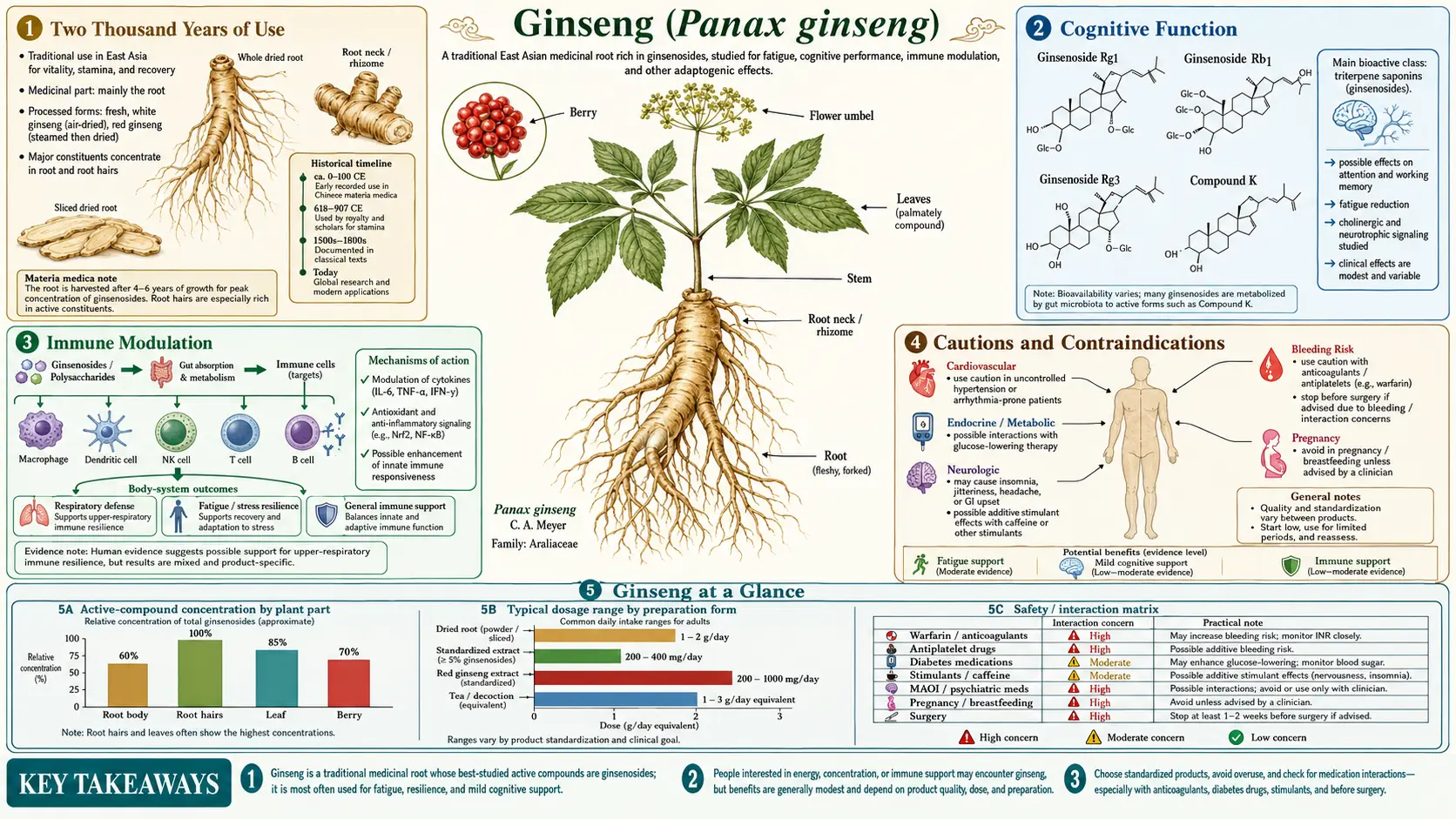
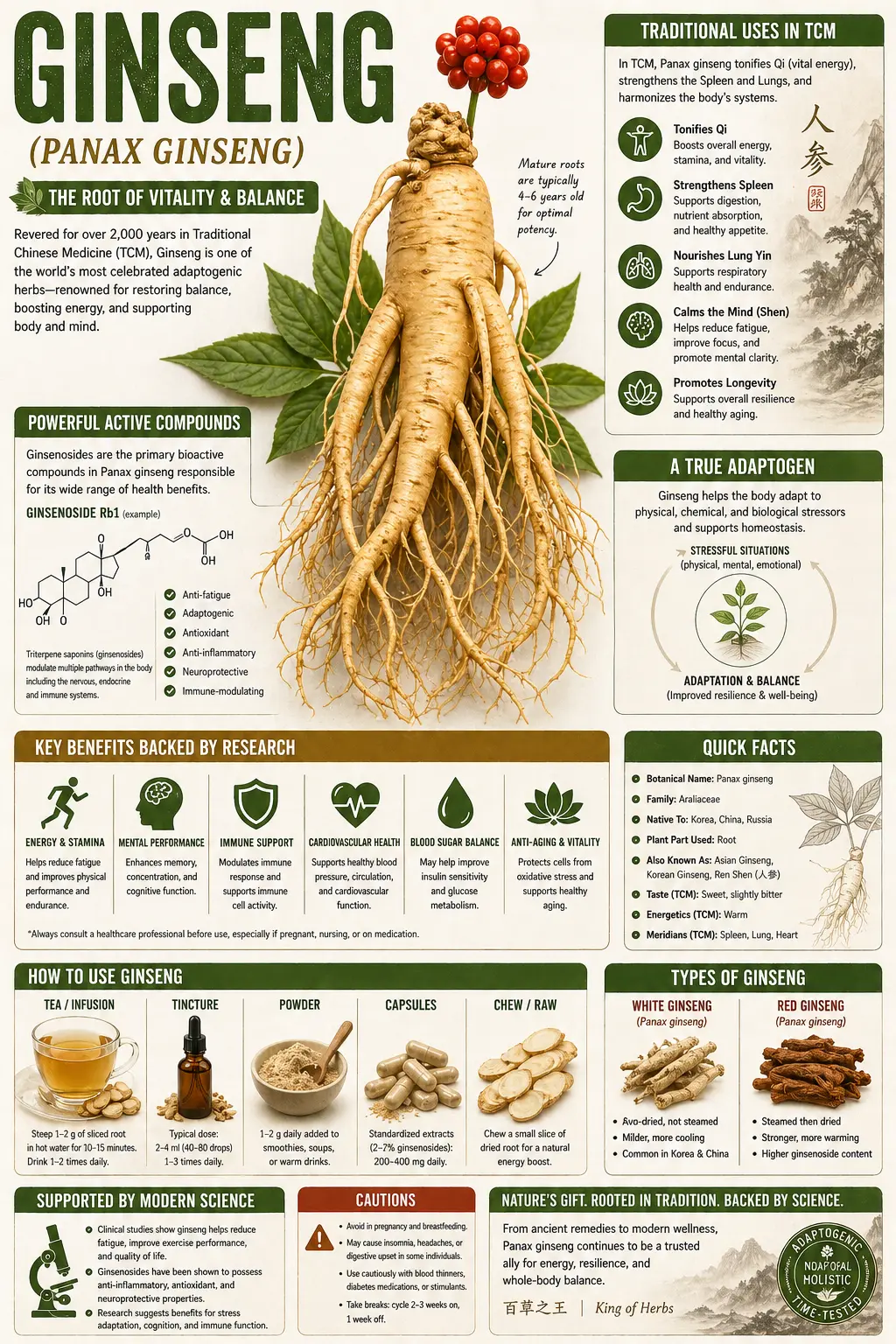
Table of Contents
- Two Thousand Years of Use
- Ginsenosides
- Energy and Fatigue
- Cognitive Function
- Sexual Function and Erectile Dysfunction
- Blood Sugar Regulation
- Immune Modulation
- Forms and Preparations
- Recommended Dosage
- Cautions and Contraindications
- Featured Videos
Two Thousand Years of Use
Ginseng (renshen, "man root") has been one of the most prized tonics in East Asian medicine for roughly two millennia, valued for its slow-growing, human-shaped root and first recorded in the Han-era Chinese classic Shennong Bencao Jing. Its American cousin (Panax quinquefolius) was identified near Montreal in 1716 with the help of the Iroquois and soon became a major export to China, while chemists in the 1960s finally isolated the ginsenosides behind its reputation. — the fuller story is told in the dedicated History & Traditional Use article.
Ginsenosides
The principal active compounds in ginseng are ginsenosides (also called panaxosides), a family of triterpene saponins. More than 50 distinct ginsenosides have been identified, often labeled with letters and numbers (Rb1, Rb2, Rc, Rd, Re, Rf, Rg1, Rg3, Rh1, Rh2, etc.). The total ginsenoside content varies with species, age of root, growing conditions, and processing method.
Asian ginseng is richer in protopanaxadiol-type ginsenosides (Rb1, Rb2, Rc, Rd) -- generally considered more stimulating and warming. American ginseng is richer in protopanaxatriol-type ginsenosides (Re, Rg1) -- typically considered more cooling and calming.
Red ginseng is produced by steaming and drying fresh ginseng root, which converts certain ginsenosides into more pharmacologically active forms (Rg3, Rg5, Rh1, Rh2). Red ginseng is generally considered more potent and more "heating" than the white (unsteamed) form.
Energy and Fatigue
Ginseng is one of the most thoroughly studied herbs for fatigue. Multiple controlled trials have shown reductions in self-reported fatigue, improvements in physical and mental performance, and faster recovery from physical exertion. Effects are particularly pronounced in individuals with chronic fatigue, post-viral exhaustion, cancer-related fatigue, and the kind of stress-induced depletion common in modern life.
Mechanistically, ginseng modulates the hypothalamic-pituitary-adrenal axis (similar to other adaptogens), supports mitochondrial function, increases nitric oxide-mediated blood flow, and modulates dopaminergic neurotransmission. The effect is energizing without the spike-and-crash pattern of caffeine.
Cancer-related fatigue has emerged as one of the most well-validated indications. Two large randomized trials, one led by Mayo Clinic, found that 1,000-2,000 mg of standardized American ginseng daily significantly reduced fatigue in cancer survivors with no concerning safety signal.
Cognitive Function
Ginseng supports multiple aspects of cognitive performance. Documented effects in clinical trials include:
- Improved working memory and short-term recall
- Faster mental arithmetic and reaction time
- Reduced subjective mental fatigue under sustained cognitive load
- Improved sustained attention
- Mild improvements in mood and well-being scores
These effects appear to be partially mediated by improved cerebral blood flow, increased acetylcholine activity, and modulation of glutamatergic and dopaminergic pathways. Combined ginseng + ginkgo biloba preparations have been studied for additional cognitive benefit and represent a popular nootropic combination.
Sexual Function and Erectile Dysfunction
Korean red ginseng has the strongest botanical evidence for erectile dysfunction outside of pharmaceutical PDE5 inhibitors (sildenafil, tadalafil). A meta-analysis of randomized controlled trials concluded that red ginseng produces statistically significant improvements in International Index of Erectile Function (IIEF) scores compared with placebo, with typical doses of 600-1,000 mg three times daily.
The proposed mechanism involves enhanced nitric oxide synthesis in cavernosal tissue (the same final pathway as PDE5 inhibitors, but reached differently), as well as improvements in stress response, energy, and overall well-being that contribute to sexual function. Effects are gentler and slower-acting than pharmaceutical drugs but are appropriate for men seeking a daily-use approach without prescription medication, or as an adjunct to standard therapy.
Ginseng has also been studied for female sexual dysfunction, with smaller but generally positive findings on arousal, lubrication, and overall sexual satisfaction.
Blood Sugar Regulation
Both Asian and American ginseng have demonstrated mild glucose-lowering effects in clinical trials. American ginseng has been particularly well studied for postprandial glucose control, with consumption of 3 g of root before a meal reducing the post-meal glucose spike by approximately 20%.
Effects on HbA1c in long-term trials are modest (approximately 0.2-0.4 percentage points reduction) but consistent. Ginseng is therefore not a primary therapy for type 2 diabetes but fits well into broader metabolic support protocols, particularly for patients also seeking energy and cognitive benefits.
Immune Modulation
Ginseng modulates immune function through effects on natural killer cells, macrophages, T-cell subsets, and cytokine production. A standardized North American ginseng extract (Cold-FX) has been evaluated in clinical trials for prevention of upper respiratory infections in adults, with reductions in cold and flu frequency, severity, and duration.
These effects make ginseng a reasonable choice for individuals prone to recurrent respiratory infections, whether viral or bacterial. Combination with astragalus produces complementary effects: astragalus for sustained baseline immune support, ginseng for energy and adaptogenic resilience.
Forms and Preparations
- Korean red ginseng -- steamed and dried; the most concentrated and warming form; preferred for fatigue, low libido, and cold-deficient presentations
- Asian white ginseng -- dried without steaming; gentler and somewhat less stimulating
- American ginseng -- considered cooler and more calming; preferred for those with anxiety or heat signs along with fatigue, and the form most studied for cancer-related fatigue
- Standardized extracts -- often standardized to total ginsenoside content (typically 4-7%); the form used in most clinical trials
- Whole sliced root -- traditional preparation, simmered as a decoction or chewed slowly
- Tinctures -- 1:5 alcohol extracts; convenient but less concentrated than capsules
Recommended Dosage
- Standardized extract (4-7% ginsenosides) -- 200-400 mg daily for general support; up to 1,000 mg daily for therapeutic doses
- Whole root powder -- 1-3 g daily; up to 9 g for short-term therapeutic use
- Korean red ginseng for ED -- 600-1,000 mg three times daily, total 1.8-3 g daily
- Cycling -- traditional practice is to use ginseng for 2-3 weeks then break for one week; some clinicians recommend continuous use during periods of high demand
- Timing -- best taken in the morning or early afternoon; the stimulating effect can interfere with sleep if taken in the evening
Cautions and Contraindications
- Hypertension and stimulant sensitivity -- Asian (red and white) ginseng can be too stimulating for those with anxiety, hypertension, or insomnia; American ginseng or a lower dose is often better tolerated
- Anticoagulants and antiplatelets -- ginseng has mild antiplatelet activity that can compound the effects of warfarin, aspirin, and clopidogrel; case reports describe reduced INR with warfarin
- Diabetes medications -- glucose-lowering effect can compound that of insulin and oral hypoglycemics; monitor blood sugar
- Estrogen-sensitive conditions -- some ginsenosides have weak estrogenic activity; women with hormone-sensitive cancers should use only under oncology guidance
- Pregnancy and breastfeeding -- avoid; insufficient safety data; some traditions specifically caution against ginseng in pregnancy
- Acute infection -- avoid during the early febrile phase of an acute infection
- Mild side effects -- insomnia, headache, mild GI upset, nervousness; usually dose-related
Research Papers and References
The following PubMed search links provide curated entry points into the published clinical and mechanistic literature on Ginseng (Panax ginseng). Each link opens directly in PubMed at the National Library of Medicine.
- Panax ginseng for fatigue and energy — PubMed: Panax ginseng fatigue
- Ginseng cognitive function and memory — PubMed: ginseng cognition memory
- Ginseng erectile dysfunction and male fertility — PubMed: ginseng erectile dysfunction
- Ginsenosides pharmacology and mechanism — PubMed: ginsenosides pharmacology
- Ginseng glycemic control type 2 diabetes — PubMed: ginseng glycemic diabetes
- Korean red ginseng cardiovascular effects — PubMed: Korean red ginseng cardiovascular
- Ginseng immune function and influenza — PubMed: ginseng immune influenza
- Ginseng safety adverse effects review — PubMed: ginseng safety review
External Authoritative Resources
- NCCIH — Herbs at a Glance
- MedlinePlus — Herbs and Supplements
- PubMed — All research on Panax ginseng
Connections
- All Herbs
- Ginseng Benefits Deep Dive
- Astragalus
- Ashwagandha
- Stress Management
- Holy Basil
- Rhodiola Rosea
- Maca
- He Shou Wu
- Schisandra
- Fatigue
- Erectile Dysfunction
- Cancer
- Anxiety
- Hypertension
- Diabetes
- Ginkgo Biloba
- Andrographis
- Codonopsis (Dang Shen) — the gentle, non-stimulant qi tonic used in place of ginseng