Sida cordifolia (Bala)
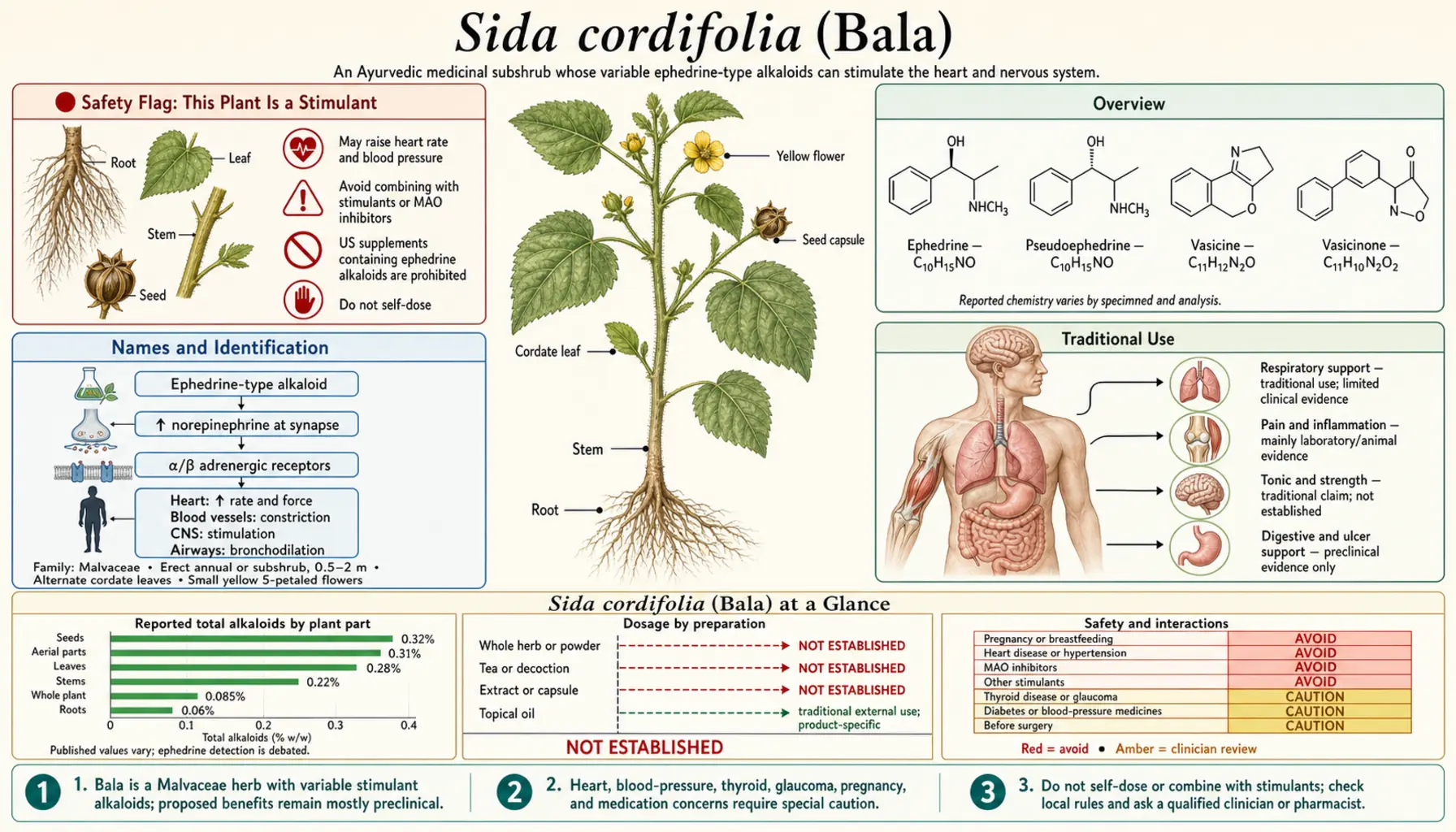
🔴 Read this first. Sida cordifolia — country mallow, known in Ayurveda as bala — contains ephedrine and pseudoephedrine, the same stimulant alkaloids that made ephedra (ma huang) one of the most dangerous supplements ever sold in the United States. This is not a gentle tonic herb. It raises blood pressure and heart rate, and ephedrine-type alkaloids have been linked to hypertension, arrhythmia, stroke and heart attack, including in young people with no prior heart disease.
The plant does have a real and long history in Ayurveda, where the root is used in compound formulas and medicated oils at modest doses — a very different exposure from a concentrated capsule sold for "energy" or fat-burning. That distinction runs through this whole page, and it matters. After the US FDA banned ephedrine-alkaloid supplements in 2004, Sida cordifolia turned up in weight-loss and pre-workout products as a legal-looking way to keep selling the same stimulant.
Human evidence for benefit is essentially absent. There are no good clinical trials of Sida cordifolia for any condition. What exists is traditional use, animal work, and a large, well-documented body of harm data about the alkaloids it contains. We have written this page accordingly.
Table of Contents
- 🔴 Safety Flag: This Plant Is a Stimulant
- Overview
- Names and Identification
- Traditional Use
- Active Compounds
- Cardiovascular Risk: What the Ephedra Record Shows
- Weight Loss and "Energy" Claims
- Anti-Inflammatory and Pain Research
- Respiratory Effects
- The "Rejuvenative" and Strength Claims
- Regulation, Labels and Sport
- Forms and Preparations
- Dosage
- Cautions and Contraindications
- Key Research Papers
- Conditions It Is Used For
- Connections
- Featured Videos
🔴 Safety Flag: This Plant Is a Stimulant
Sida cordifolia is not chemically similar to ephedra. It contains the same drugs. Alkaloid analyses going back to the 1970s have repeatedly found ephedrine and pseudoephedrine (also written ψ-ephedrine) in the plant, alongside a mix of minor alkaloids. Ephedrine is a prescription-grade sympathomimetic: it is used in operating theatres to raise blood pressure during anaesthesia. Pseudoephedrine is the decongestant sold behind the pharmacy counter, restricted in many countries because it is a precursor for illicit methamphetamine.
What that means in practice:
- It raises blood pressure and heart rate. That is not a side effect, it is the mechanism. Ephedrine releases noradrenaline from nerve terminals and directly stimulates adrenergic receptors, so the heart beats faster and harder and blood vessels constrict.
- The risk is not dose-predictable from the label. Alkaloid content in Sida cordifolia varies with plant part, growing region, harvest time and extraction method. Most published analyses put total alkaloids well under one percent of dry weight, but a concentrated extract can multiply that, and supplement labels almost never state an alkaloid figure at all. You cannot tell from the bottle how much stimulant you are about to swallow.
- Serious events have happened at ordinary doses in healthy people. The ephedra case series that triggered regulatory action included strokes, heart attacks, seizures and deaths in people in their twenties and thirties.
- "Ephedra-free" on a label does not mean stimulant-free. A product can be free of Ephedra sinica and still deliver ephedrine, because the ephedrine came from a different plant. That is exactly the loophole Sida cordifolia was used to fill.
If you have high blood pressure, any heart rhythm problem, coronary disease, a history of stroke, an overactive thyroid, an anxiety disorder or a seizure disorder — or if you are pregnant, breastfeeding, or taking an MAO inhibitor — do not take Sida cordifolia in any concentrated form. The Cautions section goes through this in detail.
Overview
Sida cordifolia L. is a small, softly hairy perennial shrub in the mallow family (Malvaceae) — the same family as okra, hibiscus and cotton. It grows knee-to-waist high, with heart-shaped leaves (that is what cordifolia means), small pale-yellow to cream flowers, and a ring of segmented seed capsules that catch on clothing and animal hair. It is a classic disturbed-ground plant: roadsides, field margins, overgrazed pasture, waste land.
It is native to India and tropical Asia and has spread as a weed through Africa, Australia, the Pacific, the Caribbean and the Americas. In parts of northern Australia and Brazil it is an aggressive invasive rather than a garden plant. If you see it growing wild in Florida or Queensland, that is a naturalised weed, not a cultivated crop.
The part used matters. In classical Ayurveda the root is the drug — usually as a decoction, a milk decoction, or infused into sesame oil for external massage. In the modern supplement trade, the aerial parts and seed are often used instead, because that is where much of the alkaloid sits. Two products both labelled "Sida cordifolia" can therefore behave completely differently: one is a mild demulcent root decoction, the other is a stimulant extract.
How it reaches you depends entirely on which supply chain you are in. Through Ayurvedic pharmacies, it arrives as root powder or as a named classical formula (Bala taila, Balarishta, Ksheerabala). Through the international supplement trade, it arrives as a standardised or unstandardised extract inside a multi-ingredient "thermogenic" or "pre-workout" blend, frequently stacked with caffeine.
Names and Identification
Binomial: Sida cordifolia L. Family: Malvaceae.
- Sanskrit: bala (बला) — literally "strength". Also vatyalaka, kharayashtika.
- Hindi: bariyar, khareti. Bengali: berela.
- Tamil: kurunthotti. Malayalam: kurunthotti — the name most Keralan Ayurvedic pharmacies use.
- English trade names: country mallow, heart-leaf sida, flannel weed, bala.
- Portuguese (Brazil): malva-branca — the name under which several of the pharmacology papers were published.
The bala group: four different plants, one name
This is the identification trap on this herb. Classical Ayurveda recognises a set of four related "bala" drugs, the bala chatushtaya, and regional practice disagrees about which species fills each slot:
- Bala — Sida cordifolia
- Atibala — usually Abutilon indicum
- Mahabala — usually Sida rhombifolia
- Nagabala — variously Grewia hirsuta, Sida veronicifolia or Sida spinosa depending on tradition
These species look similar, grow together, and are collected together. Analytical chemists have specifically developed methods to tell four Sida species and Abutilon indicum apart in traded material precisely because substitution is routine. Their alkaloid profiles are not the same, so "bala" bought in one place can be pharmacologically different from "bala" bought in another. If a supplier cannot tell you the species and the plant part, they do not know what is in the bag.
How routine, quantified. A DNA-barcoding study of raw-drug market samples sold as Sida cordifolia (Vassou and colleagues, 2015) found that none of them genuinely were — 0% match to the labelled species. The single most common substitute, Sida acuta, carries roughly six times more ephedrine than S. cordifolia itself. This is not a symmetric "could be more, could be less" risk (full detail on the Weight Loss Benefits page): the empirical finding points toward buying more stimulant than the label implies, not less.
Separately, "country mallow" is used in some markets for Abutilon species and for Malva species. It is a common name, not an identification.
Traditional Use
Bala is a genuine classical dravya (medicinal substance), not a modern invention. It appears in the major Ayurvedic compendia and is classed as balya (strength-giving) and vatahara (pacifying the vata humour, the principle associated with movement, the nervous system and the joints). Traditional indications cluster in three areas: musculoskeletal and neurological complaints, respiratory complaints, and general debility or convalescence.
The characteristic classical preparations tell you a lot about historical exposure:
- Bala taila and Ksheerabala taila — sesame oil processed with bala root (and, for ksheerabala, milk). These are external preparations used for massage in joint pain, muscle wasting, neuropathy and paralysis, and in panchakarma therapies. Skin, not stomach.
- Balarishta — a fermented decoction taken by the spoonful.
- Ksheerapaka — root simmered in milk, an old convalescent preparation.
- Compound formulas such as Dhanwantharam taila, where bala is one plant among many.
Two honest observations. First, traditional use is history, not evidence of efficacy — a plant can be used for two thousand years and still not work. Second, and more usefully, the traditional exposure route is genuinely different from a modern extract capsule. A few grams of root simmered in milk, or an oil rubbed on a knee, is not the same pharmacological event as 500 mg of concentrated aerial-part extract taken with 200 mg of caffeine before a workout. Ayurvedic practice also treats bala as something given inside a formula by a practitioner, not as a stimulant taken by the handful. That does not make the classical form risk-free, but it does explain how a plant with a long safety-tolerant tradition became a supplement safety problem.
Active Compounds
Alkaloids (the part that matters for safety):
- Ephedrine — a mixed-acting sympathomimetic. It directly stimulates α- and β-adrenergic receptors and displaces noradrenaline out of nerve terminals, which is why its cardiovascular effect is larger and longer than its receptor affinity alone suggests. PubChem entry.
- Pseudoephedrine — a stereoisomer of ephedrine, more selective for decongestion, less potent on the heart, but still a stimulant. PubChem entry.
- Vasicine, vasicinone and vasicinol — quinazoline alkaloids also found in Adhatoda vasica (Malabar nut), where they underpin that plant's use as a bronchodilator and expectorant. Vasicine is a uterine stimulant in animal work, which is one reason bala is not a pregnancy herb.
- Hypaphorine and betaine — minor nitrogenous constituents.
Non-alkaloid constituents: mucilage (the mallow-family slipperiness that gives the root its soothing, demulcent quality), flavonoids and phenolics, sterols including β-sitosterol, and small amounts of fatty acids in the seed. The mucilage is very likely responsible for the mild throat-and-gut-soothing effect traditional users describe — and it is the one part of the plant with essentially no safety concern.
The concentration problem. Published figures for total alkaloid content are low — typically a fraction of one percent of dry weight — and they scatter widely between studies, plant parts and regions. That scatter is the hazard. A crude root powder may deliver a trivial ephedrine dose; a 20:1 aerial-part extract may deliver a pharmacologically active one; and nothing on a typical label distinguishes them.
Cardiovascular Risk: What the Ephedra Record Shows
Mechanism. Ephedrine increases cardiac output and peripheral vascular resistance simultaneously. Systolic blood pressure rises, heart rate rises, and myocardial oxygen demand rises with it. In a healthy 25-year-old heart that is usually tolerated. In a coronary artery with a soft plaque, in an electrically unstable atrium, in a small aneurysm or an arteriovenous malformation, it is a provocation.
Human evidence — and here the human evidence is unusually strong, because it is harm data.
- Case series (human). Haller and Benowitz reviewed 140 adverse-event reports submitted to the FDA involving supplements containing ephedra alkaloids. They judged 31 percent of the events to be definitely or probably related to the supplement and another 31 percent possibly related. The events included hypertension, palpitations, tachycardia, stroke and seizure, and there were deaths — in people who were mostly young and mostly healthy before they started. New England Journal of Medicine, 2000.
- Meta-analysis (human). The RAND team led by Shekelle pooled the trial and safety literature for JAMA in 2003 and found that ephedra and ephedrine were associated with a two- to three-fold increase in the odds of psychiatric symptoms, autonomic symptoms, upper gastrointestinal symptoms and heart palpitations. That is a pooled estimate across controlled trials, not anecdote.
- Stroke (human). Chen and colleagues reported ischaemic strokes following use of over-the-counter ephedra products; Cantu and colleagues documented strokes associated with sympathomimetics in cough and cold preparations. These are case reports and case series — they establish that it happens, not how often.
- Stacking with caffeine (human, controlled). Haller, Jacob and Benowitz gave healthy volunteers ephedra with guarana (a caffeine source) and measured the haemodynamic response directly. Combining the two produced greater increases in heart rate and blood pressure than either alone. Almost every commercial "thermogenic" product stacks stimulants this way.
What this does and does not prove about Sida cordifolia specifically. Nobody has run a controlled cardiovascular safety trial on Sida cordifolia extract. The inference is chemical: the plant contains ephedrine, ephedrine does these things, therefore an extract that delivers ephedrine carries the same class of risk in proportion to how much it delivers. That is a reasonable inference — it is how pharmacology works — but it also means the honest statement is "unknown and unmeasured dose of a drug with known serious risks", which is arguably worse than a known dose.
Weight Loss and "Energy" Claims
Mechanism. Ephedrine increases resting energy expenditure modestly and suppresses appetite. Both effects are real. This is why ephedrine-caffeine combinations were genuinely popular: they worked, in the narrow sense that people lost some weight.
Human evidence. The 2003 JAMA meta-analysis is the definitive read. Pooling the controlled trials, ephedrine or ephedra promoted weight loss of roughly 0.9 kg per month more than placebo, over trial durations of no more than about six months. No trial ran long enough to say anything about weight a year or two later, and none measured whether the weight stayed off.
Put that number next to the harm number. Slightly under a kilogram a month, for at most half a year, in exchange for a two- to three-fold increase in palpitations and autonomic symptoms and a signal for stroke and cardiac events. That trade-off is why the FDA acted. It is also the honest answer to "does it work?" — yes, a little, and that is not the same as "you should take it".
There is no published clinical trial of Sida cordifolia itself for weight loss. Products containing it are sold on the ephedrine literature by implication, without having done the work.
Anti-Inflammatory and Pain Research
Mechanism (proposed). The non-alkaloid fraction — flavonoids, sterols, mucilage — is credited with anti-inflammatory activity, and this is the pharmacology most often cited to justify bala's classical use in joint and muscle complaints.
Evidence level: animal only. Franzotti and colleagues, working in Brazil where the plant is called malva-branca, tested an aqueous extract in the standard rodent models — carrageenan-induced paw oedema for inflammation, and writhing and hot-plate tests for analgesia — and reported activity in both, with low acute toxicity at the doses used (Journal of Ethnopharmacology, 2000). Momin and colleagues reported analgesic, anti-inflammatory and antidiarrhoeal activity from an ethanol extract of the roots in similar rodent models (Asian Pacific Journal of Tropical Biomedicine, 2014).
What this means for you: very little, yet. Rodent paw-oedema activity is a screening result. It identifies plants worth studying; it does not tell you whether a human with osteoarthritis will feel better. There are no human trials. Anyone selling you Sida cordifolia for arthritis is selling you a rat study.
Respiratory Effects
Mechanism. This one is straightforward and real. Ephedrine is a bronchodilator — it was used clinically for asthma for decades before selective β2-agonists like salbutamol replaced it. Pseudoephedrine is a nasal decongestant. Vasicine, the quinazoline alkaloid bala shares with Adhatoda vasica, has bronchodilator and expectorant activity in animal work. So a plant containing all three plausibly does open airways, and that is very likely why traditional systems used it for cough, wheeze and breathlessness.
Human evidence: none for the plant. There is no controlled trial of Sida cordifolia in asthma or any other respiratory condition.
And this is the worst possible reason to take it. Ephedrine was abandoned for asthma because its cardiovascular effects were unacceptable compared with inhaled drugs that go to the lung and largely stay there. Substituting an unmeasured oral stimulant for a modern inhaler, in a condition where undertreatment kills people, is a genuinely dangerous swap. If you have asthma, this plant is not an alternative to your controller inhaler.
The "Rejuvenative" and Strength Claims
Bala's Sanskrit name means "strength", and it is classed among the strengthening and rasayana (rejuvenative) drugs. In modern marketing this becomes "supports vitality", "adaptogen", "for stamina and recovery".
The mechanistic problem with that framing. An adaptogen, in the sense the word is normally used for herbs like Ashwagandha, is supposed to reduce the stress response and normalise cortisol and sympathetic tone. Ephedrine does the opposite: it is a sympathomimetic, it pushes the stress axis, and the felt "energy" is adrenergic drive, not restoration. Whatever bala is, it is not an adaptogen in that sense, and grouping it with ashwagandha on a shelf is misleading. If you want the calming, sleep-supporting, cortisol-modulating profile, ashwagandha is the herb with the human trials; bala is not a substitute for it.
Evidence level. The strength and rejuvenation claims rest on classical texts and on rodent studies of vague endpoints. There is no human trial of Sida cordifolia for strength, stamina, recovery or fatigue. The subjective "it works, I can feel it" that users report is, in a stimulant-containing plant, exactly what you would expect from the stimulant — and stimulant effect is not the same as restoration.
Regulation, Labels and Sport
The 2004 US rule
On 11 February 2004 the FDA published a final rule declaring dietary supplements containing ephedrine alkaloids adulterated, because they present an unreasonable risk of illness or injury. It took effect that April, and it was upheld on appeal. You can read the rule itself in the Federal Register. Note what it bans: ephedrine alkaloids, not one species. The rule is written around the chemistry, and the agency's discussion of botanical sources of ephedrine alkaloids includes Sida cordifolia alongside Ephedra species. Read the primary document rather than a supplement seller's summary of it.
Despite that, Sida cordifolia continued to appear in products, in part because enforcement is complaint-driven and in part because a botanical ingredient name is not automatically recognised as an ephedrine source by a buyer, a retailer, or an algorithm scanning an ingredient list. The NIH National Center for Complementary and Integrative Health page on ephedra is a plain-language summary of why the ban happened.
Elsewhere
Ephedrine-containing botanicals are restricted or prohibited in several other markets, including Canada, Australia and a number of European countries; the details differ by jurisdiction and change over time. Ephedrine itself is also a controlled precursor chemical in many countries because of its role in methamphetamine synthesis, which adds a second, entirely separate legal layer to bulk plant material.
Athletes: this can end a career
Ephedrine is on the World Anti-Doping Agency Prohibited List as a specified stimulant, banned in competition above a urinary threshold of 10 µg/mL. Methylephedrine carries the same threshold. Pseudoephedrine is prohibited in competition above 150 µg/mL. A "natural botanical" ingredient does not exempt you: doping control measures the molecule, not the plant it came from, and strict liability means the athlete is responsible for what is in their sample regardless of intent. Check the current WADA Prohibited List before taking any product containing Sida cordifolia, bala, country mallow, or an unspecified "proprietary energy blend".
Forms and Preparations
- Root powder (churna). The classical internal form. Lowest-alkaloid, most traditional, usually taken with warm milk or water, often inside a compound formula.
- Decoction (kwatha) and milk decoction (ksheerapaka). Root simmered in water or milk. Also traditional; water extracts alkaloids less efficiently than alcohol, but not zero.
- Medicated oils (Bala taila, Ksheerabala taila, Dhanwantharam taila). External use. Applied for massage. Systemic absorption through intact skin is limited, and these are the preparations with the longest safety-tolerant record.
- Balarishta. A self-generated-alcohol fermented preparation, taken in small measured doses.
- Standardised or unstandardised extract capsules. This is the risky form — the one that concentrates alkaloids, is usually made from aerial parts, and often sits in a multi-stimulant blend. Extract ratios (5:1, 10:1, 20:1) tell you the plant material was concentrated but not how much alkaloid ended up in the capsule.
- Multi-ingredient "thermogenic", "fat burner", "pre-workout" and "energy" blends. Frequently combined with caffeine, synephrine (bitter orange), yohimbine or higenamine — a stack that compounds cardiovascular load. Proprietary blends hide the per-ingredient amount.
What to look for on a label: the species and the plant part, an extract ratio and a solvent, and any statement of alkaloid content. If the label says only "Sida cordifolia extract 400 mg" inside a proprietary blend, the manufacturer either does not know or is not saying how much ephedrine you are getting. Treat that as a reason not to buy it.
Dosage
There is no established safe dose of Sida cordifolia extract, and this page is not going to invent one. No dose-ranging study exists. No human safety trial exists. The variable that actually matters — delivered ephedrine and pseudoephedrine per capsule — is not disclosed on commercial products.
For completeness, the figures circulating in the Ayurvedic and practitioner literature for the traditional root preparations are roughly 3–6 g of root powder per day, or 50–100 mL of decoction, given inside a compound formula. Treat those as historical dosing conventions, not as safety findings — they were arrived at by clinical tradition, not by toxicology, and they apply to crude root, not to a concentrated extract.
Practical position:
- If you are considering a concentrated Sida cordifolia extract, a fat burner or an energy blend containing it — don't. The benefit is a fraction of a kilogram a month at best, and the risk is cardiovascular.
- If you are working with a qualified Ayurvedic practitioner using classical root preparations, that is a genuinely different exposure, but it still requires that the practitioner knows your blood pressure, your heart history, your thyroid status and your full medication list.
- External medicated oils are the lowest-risk form by a wide margin.
- Nobody should be self-dosing this plant from an unlabelled bulk powder.
Cautions and Contraindications
🔴 Do not use concentrated Sida cordifolia if any of the following apply:
- Pregnancy or breastfeeding. Ephedrine crosses the placenta and is transferred in breast milk; vasicine is a uterine stimulant in animal studies. There is no safe-use data. Avoid entirely.
- High blood pressure, treated or untreated.
- Any arrhythmia, including atrial fibrillation — see arrhythmia and atrial fibrillation.
- Coronary artery disease, angina, or previous heart attack — see heart attack.
- Previous stroke, TIA, known aneurysm or vascular malformation — see stroke.
- Hyperthyroidism or phaeochromocytoma.
- Narrow-angle glaucoma.
- Benign prostatic hyperplasia or urinary retention — sympathomimetics worsen outflow obstruction.
- Anxiety disorder, panic disorder, insomnia, bipolar disorder — stimulants reliably aggravate all of these.
- Seizure disorder.
- Children and adolescents.
- Competitive athletes subject to doping control — see above.
Drug interactions
- MAO inhibitors (phenelzine, tranylcypromine, isocarboxazid; also selegiline and rasagiline used in Parkinson's disease, and the antibiotic linezolid, which is a weak MAOI). This combination can cause a hypertensive crisis. It is the single most dangerous interaction on this list.
- Other stimulants — caffeine, synephrine (bitter orange), yohimbine, higenamine, ADHD medications, decongestants. Effects add, and controlled human data confirm that stimulant stacking raises blood pressure and heart rate more than either component alone.
- Beta-blockers — blocking β receptors while an α-agonist is on board can leave unopposed vasoconstriction and a paradoxical rise in blood pressure.
- Blood-pressure medication of any class — the herb works directly against the drug.
- General anaesthesia. Ephedrine-containing products sensitise the heart to anaesthetic agents and can provoke intraoperative arrhythmia and blood-pressure swings. Stop at least two weeks before surgery and tell the anaesthetist you were taking it.
- Digoxin, theophylline, thyroid hormone — additive cardiac and stimulant effects.
- Diabetes medication — sympathomimetics raise blood glucose and can blunt the warning symptoms of hypoglycaemia.
- Ergot alkaloids and triptans — additive vasoconstriction.
Warning signs to act on
Stop immediately and seek urgent care for chest pain or pressure, a racing or irregular heartbeat that will not settle, severe headache (especially sudden and severe), one-sided weakness, facial droop, difficulty speaking, visual loss, seizure, or fainting. These are cardiac and stroke symptoms and they are the specific harms documented with ephedrine-type alkaloids.
Also worth knowing
- Species substitution is not just common, it may be the norm: a DNA-barcoding study of market samples found 0% genuine Sida cordifolia, with the most common substitute (Sida acuta) carrying roughly six times more ephedrine — so the realistic expectation is more alkaloid than the label implies, not less.
- Heavy-metal contamination has been documented in a minority of imported Ayurvedic products generally, particularly rasa shastra mineral preparations. Buy from suppliers who publish batch testing.
- Bulk plant material containing ephedrine may have legal implications in jurisdictions that control ephedrine as a precursor chemical.
Key Research Papers
- Haller CA, Benowitz NL. Adverse cardiovascular and central nervous system events associated with dietary supplements containing ephedra alkaloids. New England Journal of Medicine. 2000;343(25):1833–1838. — PubMed PMID: 11117974
- Shekelle PG, Hardy ML, Morton SC, et al. Efficacy and safety of ephedra and ephedrine for weight loss and athletic performance: a meta-analysis. JAMA. 2003;289(12):1537–1545. — PubMed PMID: 12672771
- Andraws R, Chawla P, Brown DL. Cardiovascular effects of ephedra alkaloids: a comprehensive review. Progress in Cardiovascular Diseases. 2005;47(4):217–225. — PubMed PMID: 15991150
- Chen C, Biller J, Willing SJ, et al. Ischemic stroke after using over the counter products containing ephedra. Journal of the Neurological Sciences. 2004;217(1):55–60. — PubMed PMID: 14675610
- Cantu C, Arauz A, Murillo-Bonilla LM, et al. Stroke associated with sympathomimetics contained in over-the-counter cough and cold drugs. Stroke. 2003;34(7):1667–1672. — PubMed PMID: 12791938
- Haller CA, Jacob P, Benowitz NL. Short-term metabolic and hemodynamic effects of ephedra and guarana combinations. Clinical Pharmacology & Therapeutics. 2005;77(6):560–571. — PubMed PMID: 15961987
- Rothman RB, Vu N, Partilla JS, et al. In vitro characterization of ephedrine-related stereoisomers at biogenic amine transporters and the receptorome reveals selective actions as norepinephrine transporter substrates. Journal of Pharmacology and Experimental Therapeutics. 2003;307(1):138–145. — PubMed PMID: 12954796
- Marchei E, Pellegrini M, Pacifici R, et al. A rapid and simple procedure for the determination of ephedrine alkaloids in dietary supplements by gas chromatography–mass spectrometry. Journal of Pharmaceutical and Biomedical Analysis. 2006;41(5):1633–1641. — PubMed PMID: 16580167
- Franzotti EM, Santos CV, Rodrigues HM, et al. Anti-inflammatory, analgesic activity and acute toxicity of Sida cordifolia L. (Malva-branca). Journal of Ethnopharmacology. 2000;72(1–2):273–277. — PubMed PMID: 10967481
- Momin MA, Bellah SF, Rahman SM, et al. Phytopharmacological evaluation of ethanol extract of Sida cordifolia L. roots. Asian Pacific Journal of Tropical Biomedicine. 2014;4(1):18–24. — PubMed PMID: 24144125
- Kumar S, Kumar S, Vishnoi VK, et al. Sida cordifolia L.: ethnobotany, phytochemistry, phytonanotechnology and commercial application. Current Pharmaceutical Biotechnology. 2024;25(7):838–859. — PubMed PMID: 37861013
- Rahate SP, Singh M, Verma AK, et al. Densitometric method for assessment of six specialized metabolites in four Sida sp. and its congener Abutilon indicum: targeted metabolomics, greenness assessment and chemometrics analysis. Journal of Pharmaceutical and Biomedical Analysis. 2024;240:115945. — PubMed PMID: 38181556
PubMed Topic Searches
- PubMed: Sida cordifolia + ephedrine
- PubMed: Sida cordifolia pharmacology
- PubMed: Sida cordifolia toxicity
- PubMed: Ephedrine alkaloids in dietary supplements — adverse events
- PubMed: Ephedra and cardiovascular risk
- PubMed: Ephedrine and stroke — case reports
- PubMed: Ephedrine + MAOI hypertensive crisis
- PubMed: Bala (Ayurveda) and Sida cordifolia
- PubMed: Sida species adulteration and authentication
- PubMed: Weight-loss stimulant supplements — cardiovascular adverse events
Conditions Sida cordifolia Is Used For
Each condition below links to its page. The coloured half of every capsule shows how much human evidence supports this herb for that specific use — traditional use is history, not proof, and is marked as such.
Connections
- All Herbs
- Ashwagandha — the genuinely calming, cortisol-modulating Ayurvedic tonic that bala is often shelved beside but does not resemble.
- Cardiology — the conditions this plant's alkaloids can provoke.
- Hypertension — the most common reason someone should not take this herb.
- Stroke — the harm most consistently reported with ephedrine-type supplements.
- Heart Attack — myocardial infarction has been reported in young users of stimulant supplements.
- Arrhythmia — sympathomimetics are a recognised trigger.
- Atrial Fibrillation — a specific contraindication for stimulant herbs.
- Toxins — how we cover substances whose risk outweighs their benefit.
- Licorice — another traditional herb with a real, dose-dependent blood-pressure problem.
- Ginseng — a stimulating tonic herb with a very different and far better-characterised safety profile.
- Lab Tests — blood pressure, thyroid function and an ECG are the checks that matter before any stimulant herb.