Coleus forskohlii (Forskolin)
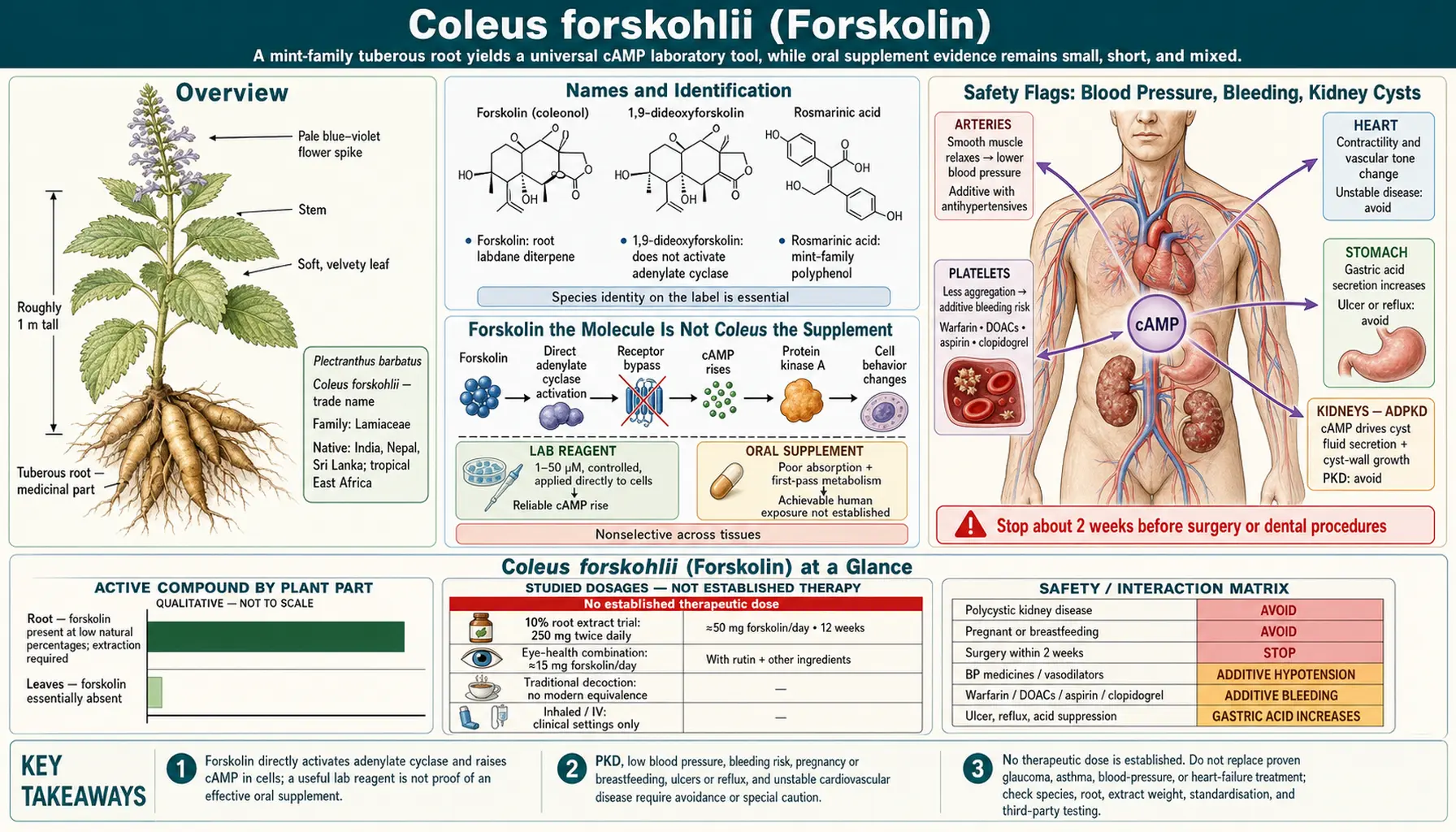
Plectranthus barbatus — still sold everywhere under its older name Coleus forskohlii — is a mint-family plant from India and East Africa whose thick, aromatic tuberous root yields forskolin, one of the most widely used chemical tools in all of cell biology. Forskolin genuinely and directly switches on an enzyme called adenylate cyclase, which is why it appears in thousands of laboratory papers. That is not the same thing as being an effective supplement you swallow, and the gap between those two statements is the single most important thing on this page: the human trial evidence is small, short, few in number and mixed, and it does not establish forskolin as a weight-loss agent or a glaucoma treatment.
Because forskolin raises cAMP in essentially every cell type it touches, it carries real, mechanistically predictable safety issues rather than vague theoretical ones. It relaxes blood vessels and lowers blood pressure, it inhibits platelet aggregation, and it should be stopped about two weeks before surgery. It is flagged as something to avoid in polycystic kidney disease, because cAMP is precisely the signal that drives cyst fluid secretion and cyst growth in that disease. It also increases stomach acid. Those cautions lead this page, and we return to them in detail below.
Table of Contents
- Overview
- Names and Identification
- Forskolin the Molecule Is Not Coleus the Supplement
- Safety Flags: Blood Pressure, Bleeding, Kidney Cysts
- Traditional Use
- Active Compounds
- Body Composition and Weight Loss
- Intraocular Pressure and Glaucoma
- Asthma and Bronchodilation
- Heart Muscle and Blood Vessels
- Culinary Use
- Forms and Preparations
- Dosage
- Cautions and Contraindications
- Key Research Papers
- Connections
- Featured Videos
Overview
Plectranthus barbatus is a perennial member of the Lamiaceae — the mint family, which also gives us basil, oregano, rosemary and sage. It grows to roughly a metre tall, with soft, slightly velvety leaves and pale blue to violet flower spikes that look unmistakably mint-like once you know the family. It is native to the dry, sub-tropical hill country of India, Nepal and Sri Lanka, and to tropical East Africa — Ethiopia, Kenya, Tanzania and Uganda — and it has been carried far beyond that range as a garden and hedge plant.
The part used is the root. Unlike most of its aromatic mint-family relatives, where the leaf is the prize, this plant's value is underground: a cluster of finger-thick, golden-brown, strongly aromatic tubers. When you buy a forskolin supplement you are buying an extract of those tubers, not of the leaves.
Commercial cultivation is concentrated in western and southern India — Gujarat, Maharashtra, Karnataka and Tamil Nadu — where the plant is grown as a contract crop for the extract industry. Roots are lifted at the end of the season, dried, solvent-extracted and concentrated to a stated forskolin percentage, almost always 10%; what that number does and does not tell you is covered under Forms and Preparations. There is also a second, much smaller path from field to table: in parts of Gujarat and Rajasthan the fresh root is eaten as a pickled condiment rather than as a medicine, which makes this one of the few plants on this site that is simultaneously a laboratory reagent, a supplement ingredient and a regional food. See Culinary Use.
Names and Identification
The naming here is genuinely messy, and the mess matters because several different plants share the same common names.
- Currently accepted binomial: Plectranthus barbatus Andrews. A 2019 taxonomic revision of the group moved many Plectranthus species back into the genus Coleus, so contemporary botanical databases may list the plant as Coleus barbatus. Both names refer to the same plant.
- Synonyms in circulation: Coleus forskohlii (Willd.) Briq., Coleus barbatus (Andrews) Benth. The supplement trade has settled almost universally on Coleus forskohlii, which is why that is the name on the bottle even though botanists have moved on.
- Family: Lamiaceae (mint family).
- Epithet: forskohlii honours Pehr Forsskål, the eighteenth-century Swedish-Finnish naturalist of the Danish expedition to Arabia. The plant is not named after the molecule; the molecule, forskolin, was named after the plant.
Regional names: in English, Indian coleus. In Hindi and Marathi, makandi and mainmul. In Gujarati, garmar. In Sanskrit and Ayurvedic texts, pashanabhedi (also written pashanbhed), which translates roughly as stone-breaker — a name given to plants used for urinary stones.
Where the names collide
Three ambiguities are worth carrying with you:
- Pashanabhedi is not a unique name. It has been applied across Indian medicine to several unrelated stone-breaking plants, and the name is most commonly assigned to Bergenia ligulata (a saxifrage), not to this plant. So when a marketing page tells you that classical Ayurvedic texts describe "this herb," some of those textual references may belong to an entirely different species. The identification of Plectranthus barbatus as the botanical source behind particular classical descriptions was made relatively late, and the historical record is not as clean as advertising implies.
- In Brazil the same plant is called boldo. The leaves of Plectranthus barbatus are brewed as a digestive tea under the names falso boldo or boldo brasileiro — but true boldo is Peumus boldus, a completely unrelated Chilean tree with a different chemistry and a different safety profile. Two different plants, one common name, on two continents.
- Do not confuse it with Plectranthus amboinicus, the fleshy, oregano-scented culinary plant sold as Cuban oregano, Indian borage or Mexican mint. Same genus, different species, different use, and it contains no meaningful forskolin.
The practical consequence: species identity on a label is not optional here. A product that says only "coleus" is not adequately identified.
Forskolin the Molecule Is Not Coleus the Supplement
What forskolin actually does — and this part is not in dispute
Most hormones and neurotransmitters do not enter a cell. They dock at a receptor on the outside, and the cell converts that docking into an internal signal. One of the most important internal signals is cyclic AMP (cAMP), manufactured by a membrane enzyme called adenylate cyclase (also spelled adenylyl cyclase). Adrenaline, glucagon, TSH, prostacyclin and many other messengers all end up pulling the same lever: switch on adenylate cyclase, cAMP rises, an enzyme called protein kinase A wakes up, and the cell changes what it is doing.
Forskolin skips the receptor entirely and activates adenylate cyclase directly, binding the enzyme itself at the seam between its two catalytic halves. This is genuine, well-characterised, textbook pharmacology, first described by Seamon and Daly at the US National Institutes of Health in 1981.
Because of that, forskolin became a standard laboratory reagent. A cell biologist who wants to know what happens when cAMP rises does not have to hunt for the right hormone for that cell type — add forskolin to the dish and cAMP goes up, reliably and reproducibly, in almost any cell. That universality is exactly why forskolin appears in thousands of papers.
Why a great lab tool can still be a poor supplement
Readers see "directly activates adenylate cyclase" and reasonably conclude "therefore it does something in me." That inference does not hold, for four separate reasons that stack on top of each other.
- Getting there is the problem. Forskolin is a fat-soluble diterpene that dissolves poorly in water. Its oral bioavailability is poor, and published human pharmacokinetic data are remarkably thin for a compound this famous — we do not have a good public picture of what blood concentration a capsule actually produces, or for how long.
- A dish is not a person. In cell culture, forskolin is typically used at one to fifty micromolar, applied directly to naked cells in a controlled buffer with nothing in the way. A swallowed capsule has to survive the stomach, cross the gut wall, run the gauntlet of first-pass liver metabolism, and then distribute through several litres of blood and body fat before any of it reaches a target tissue. There is no defined conversion between "the concentration that worked in a dish" and "the dose you should swallow."
- Universality is a liability, not a feature. The property that makes forskolin useful in a lab — it works in every cell type, bypassing whatever receptors that cell happens to have — is precisely what you would not want in a medicine. A drug is supposed to be selective; forskolin is the opposite by design. If enough reached your bloodstream to do something useful to your fat cells, it would simultaneously be raising cAMP in your blood vessels, platelets, parietal cells, thyroid follicles and heart. That is the source of every item in Cautions: not exotic side effects, but the same mechanism arriving in the wrong tissue.
- The human trials are small, short, few and mixed. Not "emerging," not "promising" — genuinely small. The best-known body-composition studies enrolled around 30 and around 23 people for twelve weeks. That is a pilot-sized evidence base, and it is what the entire retail category rests on.
The following table summarises how far apart the laboratory story and the clinical story really are.
| Question | Forskolin as a lab reagent | Forskolin as an oral supplement |
|---|---|---|
| Does it raise cAMP? | Yes — reliably, in nearly any cell type | Unknown at achievable oral doses; poorly documented in humans |
| How is it delivered? | Dissolved in solvent, applied straight to cells | Swallowed; poor absorption; first-pass metabolism |
| Typical exposure | Micromolar, controlled, direct | Not established in the public literature |
| Selectivity | Deliberately none — that is the point | Still none — which is now a safety problem |
| Evidence base | Thousands of mechanistic papers | A handful of small, short, mixed human trials |
One more detail that makes the point elegantly: the plant also contains 1,9-dideoxyforskolin, a near-identical molecule that does not activate adenylate cyclase. Researchers use it as a negative control precisely to prove which effects are cAMP-driven and which are not. So even within the root, small structural differences completely change the pharmacology — another reason that "it contains forskolin" tells you much less than it sounds like it does.
Safety Flags: Blood Pressure, Bleeding, Kidney Cysts
These are not boilerplate. Each one follows directly from the cAMP mechanism, which is what makes them credible.
It lowers blood pressure
In vascular smooth muscle — the ring of muscle wrapped around your arteries — rising cAMP activates protein kinase A, which relaxes the muscle. Relaxed arteries are wider arteries, and wider arteries mean lower pressure. This is the same broad pathway that several genuine vasodilator drugs exploit. If you take antihypertensive medication, forskolin can add to it, and the result is additive hypotension: light-headedness on standing, fatigue, and in the worst case a fall. Anyone already managing low blood pressure or orthostatic symptoms should be similarly cautious.
It inhibits platelet aggregation
cAMP is the master brake inside a platelet — it is the signal your own blood vessel lining uses, via prostacyclin, to keep platelets from clumping where they should not. Raising platelet cAMP therefore makes platelets less sticky. In practice that means additive bleeding risk with anticoagulants and antiplatelet drugs: warfarin, clopidogrel, aspirin, and the direct oral anticoagulants. It also means forskolin belongs on the list of supplements to stop about two weeks before any surgery, dental extraction or procedure, which is the standard advice for supplements with antiplatelet activity.
It is flagged as contraindicated in polycystic kidney disease
This warning is often listed without explanation, which makes it sound arbitrary. It is not. In autosomal dominant polycystic kidney disease (ADPKD), cAMP is the central driver of the disease process. Inside the epithelium lining a cyst, elevated cAMP does two harmful things at once: it drives chloride-and-fluid secretion into the cyst cavity, so the cyst fills, and it switches those cells into a proliferative mode, so the cyst wall grows. The clinical proof of that mechanism runs in the opposite direction: the approved drug that slows ADPKD progression, tolvaptan, works by blocking the vasopressin V2 receptor in order to lower cAMP in exactly those cells.
Meanwhile, in the laboratory, forskolin is one of the standard agents used to induce cyst formation and fluid secretion in ADPKD models. A compound whose day job is making kidney cysts grow in a dish has no business being taken by someone whose kidneys are already full of them. If you have PKD, this is a hard no.
Traditional Use
In Ayurvedic and Indian folk practice the root of this plant has been used for several broad indications:
- Heart and circulatory complaints — chest discomfort and what would now loosely be grouped as cardiac weakness.
- Respiratory complaints — cough, wheezing and conditions we would today call asthma.
- Digestive and abdominal problems — poor appetite, colic, abdominal fullness and worms.
- Urinary stones — as a pashanabhedi or stone-breaking herb, given to help pass or prevent calculi.
- Topical and general use — as an aromatic bitter and for skin complaints.
Two honest caveats. First, traditional use is history, not evidence of efficacy. It tells us that generations of practitioners found the plant worth using; it does not tell us whether it worked, and none of the four indications above has been demonstrated in a modern controlled trial of the whole root.
Second, and specific to this plant: the textual record is less clean than it is usually presented. As noted under Names and Identification, pashanabhedi is a shared name, most often assigned to Bergenia ligulata. The botanical identification of Plectranthus barbatus as the source behind certain classical descriptions came relatively late, well after the plant's chemistry had already attracted pharmaceutical interest. When a supplement label says "used for thousands of years in Ayurveda," treat that as a marketing claim with a genuine but tangled historical core, not as a documented lineage.
Active Compounds
- Forskolin (originally named coleonol). A labdane diterpene isolated from the tuberous root, and the reason the plant is commercially interesting. It was identified in the 1970s during a systematic screening programme by Indian researchers at the Central Drug Research Institute in Lucknow, and its unique ability to activate adenylate cyclase directly was characterised in the early 1980s. It is present in the root at low percentages — which is why extraction and concentration are necessary — and is essentially absent from the leaves.
- Related labdane diterpenes. The root contains a family of structurally similar compounds, including 1,9-dideoxyforskolin and various coleonols and deacetyl derivatives. 1,9-dideoxyforskolin is instructive: it does not activate adenylate cyclase, but it does interfere with glucose transport, which is why it serves as the standard negative control in forskolin experiments. Small structural change, entirely different pharmacology.
- Rosmarinic acid. A polyphenol found throughout the mint family, with antioxidant and anti-inflammatory activity in laboratory systems. It is a real constituent, but it is not distinctive to this plant — rosemary, lemon balm and perilla all contain more of it, and no human outcome has been attributed to the rosmarinic acid content of coleus specifically.
- Root essential oil. The characteristic camphoraceous, slightly medicinal aroma of the fresh tuber comes from a volatile oil containing monoterpenes and sesquiterpenes. It is what makes the pickled root taste the way it does. Composition varies substantially with geography and harvest.
Body Composition and Weight Loss
Proposed mechanism. Inside a fat cell, cAMP activates protein kinase A, which activates hormone-sensitive lipase — the enzyme that breaks stored triglyceride back down into free fatty acids for release. This is the same pathway adrenaline uses. So the reasoning goes: forskolin raises cAMP, cAMP triggers lipolysis, therefore forskolin should mobilise fat. In isolated fat cells, forskolin does exactly that. This is a cell-culture finding.
What happened in people. Two twelve-week randomised trials, both published in 2005, form the entire foundation of forskolin's weight-loss reputation.
- Overweight and obese men (Godard and colleagues, Obesity Research, 2005). Thirty men took either a coleus extract standardised to 10% forskolin, 250 mg twice daily — about 50 mg of forskolin per day — or placebo, for twelve weeks. The forskolin group showed a favourable shift in composition: lower body-fat percentage and fat mass, higher lean body mass, and higher serum free testosterone compared with placebo. But body weight itself did not meaningfully change. This is a composition study, not a weight-loss study, and it was a human trial of thirty men.
- Mildly overweight women (Henderson and colleagues, Journal of the International Society of Sports Nutrition, 2005). Twenty-three women, the same dose, the same twelve weeks. The result was essentially negative for fat loss: the extract did not promote loss of fat, though the authors reported it appeared to blunt weight gain relative to placebo. No clinically significant adverse effects were observed. Again human, and even smaller.
Later work has not rescued the claim. A 2015 Australian randomised trial in around thirty overweight and obese adults following a reduced-calorie diet reported no meaningful between-group difference in weight or fat loss over twelve weeks, with a few secondary metabolic measures moving in the extract's favour.
The honest summary: one small positive composition trial in men, one small largely negative trial in women, and a later small trial that found nothing on the primary outcome. Different sexes, different results, tiny samples, three months at most, and no replication at scale. Forskolin is not established as a weight-loss agent, and any product marketed on that basis is running far ahead of its data. If you are seeking fat loss, the effect size you should expect from this supplement — on the current evidence — is approximately zero on the scale.
Intraocular Pressure and Glaucoma
Proposed mechanism. The ciliary body inside the eye secretes aqueous humour, and that secretion is under beta-adrenergic, cAMP-linked control — which is exactly why beta-blocker eye drops such as timolol lower eye pressure. Forskolin, applied to the eye, was shown in early work to lower intraocular pressure by reducing aqueous inflow rather than by improving outflow. That much is real pharmacology.
What has been studied in people. The interesting early work was topical: in the early 1980s, forskolin applied as eye drops was reported to lower intraocular pressure in rabbits, monkeys and human volunteers. Note the route — drops on the eye, not a capsule.
Most of the modern human work comes from a relatively small number of Italian ophthalmology groups and studies oral combination supplements — forskolin together with rutin, and in some formulations B vitamins, homotaurine, carnosine or folic acid — given to patients with primary open-angle glaucoma who were already on maximum tolerated pressure-lowering drops. These studies generally report a modest additional drop in intraocular pressure. They are also small, short, often unblinded or single-centre, frequently test a multi-ingredient product so no effect can be assigned to forskolin alone, and have not been replicated by independent groups at scale.
The honest summary: a plausible mechanism plus a small, geographically clustered body of add-on data using combination products. This is not a standard of care anywhere, and it is not a reason to alter or delay proven glaucoma treatment — glaucoma damages the optic nerve silently and irreversibly, and the pressure-lowering drops and procedures that prevent that damage are among the better-evidenced interventions in medicine.
And explicitly: do not put a supplement in your eye. Forskolin eye drops are not an approved, quality-controlled glaucoma therapy in most countries. Oral capsules are manufactured to oral standards — not sterile, not pH-balanced, not preservative-controlled. Improvising eye drops from a supplement risks corneal injury and infection.
Asthma and Bronchodilation
Proposed mechanism. Airway smooth muscle relaxes when cAMP rises inside it — this is precisely how salbutamol and every other beta-2 agonist inhaler works. Forskolin reaches the same endpoint from a different direction, by activating adenylate cyclase directly instead of through the beta-2 receptor. In theory that is interesting, because it should not depend on receptors that have become desensitised.
What has been studied. A 1993 clinical pharmacology study compared inhaled dry-powder forskolin (as colforsin) with inhaled fenoterol in asthma and found measurable bronchodilation. A later small single-blinded trial from Mexico compared oral forskolin with sodium cromoglycate for preventing asthma attacks in a few dozen patients and reported comparable attack rates. Both are human studies, and both are small; the second was single-blinded, which is a weak design for a symptom-based outcome.
The honest summary — and note the route. The clearest bronchodilator signal came from inhaling forskolin as a dry powder delivered straight to the airway, which is an entirely different exposure from swallowing a capsule. No forskolin inhaler is available anywhere as an approved product. Nothing here justifies substituting a coleus supplement for a rescue inhaler or a controller medication, and doing so in asthma can be fatal. If you have asthma, keep your inhalers.
Heart Muscle and Blood Vessels
Proposed mechanism. In heart muscle, cAMP increases the force of contraction — the property called positive inotropy — by increasing calcium entry and handling. In blood vessels, the same rise in cAMP relaxes smooth muscle and widens the vessel. So forskolin should, in principle, make the heart squeeze harder while reducing the resistance it is squeezing against. That combination is genuinely attractive in acute heart failure.
What has been studied. This is the one indication where forskolin chemistry actually reached the clinic — and it is worth looking closely at how. Human studies of forskolin's cardiac effects were done by intravenous infusion, under continuous monitoring in hospital, in patients with cardiomyopathy or heart failure, and showed real haemodynamic changes. Separately, a chemically modified, water-soluble derivative — colforsin daropate — was developed and approved in Japan as an intravenous drug for acute heart failure.
The honest summary. The story is often retold as "forskolin is a heart medicine." What is true is narrower and more instructive: a redesigned, water-soluble relative of forskolin, given by IV drip under monitoring, is a heart medicine in one country. The reason the molecule had to be redesigned at all is the same reason the capsule is doubtful — the natural compound does not dissolve or absorb well enough to be given any other way. Nothing about that programme validates an oral capsule, and people with unstable cardiovascular disease, arrhythmias or heart failure should not be self-experimenting with a compound that alters cardiac contractility and vascular tone.
Culinary Use
There is a genuine, if regional, food use. In parts of Gujarat and Rajasthan, the fresh tuberous root of garmar is cleaned, sliced and made into a pickle (achaar) — salted and spiced with mustard, chilli, turmeric and oil, and eaten in small quantities alongside a meal as a pungent condiment. The fresh root is aromatic, slightly bitter and camphoraceous, which is why it is treated as a strong-flavoured accent rather than a vegetable eaten in bulk. It has also been eaten as a fresh relish.
This is worth knowing for two reasons. It confirms that the root is not intrinsically toxic in ordinary food amounts, and it establishes a baseline of everyday consumption in a region. But it does not transfer to supplements. A pickled condiment made from raw root is a completely different exposure from a solvent extract concentrated to 10% forskolin and taken twice a day for months. A traditional food history is reassurance about the food, not about the concentrate.
Separately, as noted above, the leaves of this species are brewed as a bitter digestive tea in Brazil under the name falso boldo. That is a leaf preparation of the same plant, unrelated to the root extract sold as forskolin, and should not be confused with true boldo (Peumus boldus).
Forms and Preparations
- Standardised root extract (the dominant form). Capsules or tablets of a solvent extract of the tuber, standardised to a stated forskolin content — nearly always 10%. A branded 10% extract has been the material used in most of the published trials, which is one of the few genuinely useful things about the category: at least the retail product resembles what was studied.
- Higher-percentage extracts (20%, 40%, 95%). Sold as "more potent." They have not been tested in the human trials described above, and a higher concentration is not evidence of a better product — it changes the dose without changing what we know about it.
- Raw powdered root. Uncommon in the West. Forskolin is present in the root at low percentage, so an unconcentrated powder delivers far less than any trial dose.
- Combination eye-health formulas. Oral products pairing forskolin with rutin and other ingredients, as used in the Italian glaucoma studies.
- Traditional decoction of the root. The Ayurvedic preparation. There is no reliable way to translate a decoction into a forskolin dose.
- Forskolin eye drops. Investigational only. Not an approved therapy in most countries. Do not improvise these.
What "10% forskolin" tells you — and what it does not
What it tells you: that one tenth of the extract powder, by weight, is forskolin. So a 250 mg capsule of a 10% extract contains about 25 mg of forskolin. Multiply the capsule weight by the percentage — that arithmetic is the only thing the number gives you for free, and many labels bury it.
What it does not tell you:
- What the other 90% is. Other diterpenes, plant matter, carriers, excipients — the label is silent.
- Whether the plant was the right plant. Standardisation to a marker compound is a chemistry test, not a botanical identity test.
- Whether the forskolin came from the root at all. Because forskolin is a defined molecule that can be purchased in bulk, a "10% extract" figure can in principle be met by adding purified compound to a weaker extract. Reputable manufacturers do not do this; the specification alone cannot rule it out.
- Whether any of it is absorbed. This is the big one. Percentage in a capsule says nothing whatsoever about concentration in your blood, and as discussed above, forskolin's oral absorption is poor.
Practical label check: a defined botanical species (Plectranthus barbatus, or Coleus forskohlii), root as the plant part, the extract weight per capsule and the standardisation percentage, and third-party testing for identity, heavy metals and microbial contamination.
Dosage
There is no established therapeutic dose of forskolin for any condition. What exists is a set of doses used in a handful of small studies, which is not the same thing.
- The body-composition trial dose: 250 mg of a 10% standardised extract, twice daily — about 50 mg of forskolin per day — for 12 weeks. This is the most commonly copied regimen on retail labels, and it is copied from studies with roughly 23 to 30 participants apiece and mixed results.
- The eye-health combination studies: lower daily forskolin amounts, on the order of 15 mg per day, always alongside rutin and other ingredients, taken as a manufactured combination product rather than as forskolin alone.
- Traditional root decoctions: no meaningful modern dose equivalence exists.
- Inhaled and intravenous routes: studied only in clinical settings under monitoring. These are not doses anyone should attempt to reproduce.
Duration. The published human trials generally ran for about 12 weeks. There is no long-term safety data. Taking a compound that raises cAMP everywhere in the body, continuously, for years, has simply not been studied, and given that cAMP signalling touches proliferation, secretion, contractility and platelet function, "no data" here should be read as a real gap rather than as reassurance.
If you and your clinician decide to try it anyway: start at the low end, take it with food, know your baseline blood pressure and check it, and set a stop date rather than drifting into indefinite use.
Cautions and Contraindications
Every item below traces back to the same root cause: forskolin raises cAMP in whatever tissue it reaches, and it cannot pick which tissue that is.
Do not take it if
- You have polycystic kidney disease. cAMP drives cyst fluid secretion and cyst-lining cell proliferation in ADPKD; forskolin is used experimentally to induce those changes, and the approved drug for the disease works by lowering cAMP. This is the clearest contraindication on the page.
- You are pregnant or breastfeeding. There is no adequate human safety data, and traditional sources have regarded the root as inadvisable in pregnancy. A compound with vasodilator and smooth-muscle effects, with no pregnancy data, is not one to experiment with.
- You have an active stomach or duodenal ulcer, or ongoing reflux disease. Acid secretion by the stomach's parietal cells runs through histamine H2 receptors into adenylate cyclase and cAMP — that is the pathway H2 blockers interrupt. Forskolin pushes it the other way and increases gastric acid secretion, which is directly counterproductive here and can work against acid-suppressing therapy.
- You have unstable cardiovascular disease, a tachyarrhythmia, or heart failure that is not under control. Forskolin alters cardiac contractility and vascular tone. Those effects were studied by IV infusion under monitoring for good reason.
- You are having surgery within two weeks. Stop it. Antiplatelet activity plus a blood-pressure-lowering effect is a poor combination on an operating table.
- You have low blood pressure or significant orthostatic symptoms.
Drug interactions
| Drug class | Interaction | Why |
|---|---|---|
| Antihypertensives — beta-blockers, calcium-channel blockers, ACE inhibitors, ARBs, diuretics, nitrates | Additive blood-pressure lowering | cAMP relaxes vascular smooth muscle |
| Anticoagulants — warfarin, direct oral anticoagulants | Additive bleeding risk | cAMP suppresses platelet activation |
| Antiplatelet drugs — aspirin, clopidogrel | Additive bleeding risk | Same pathway these drugs already target |
| Other antiplatelet supplements — fish oil, ginkgo, garlic, high-dose vitamin E | Additive bleeding risk | Stacked effects on the same brake |
| H2 blockers and proton-pump inhibitors | May work against them | Forskolin increases gastric acid secretion |
| Vasodilators and PDE inhibitors (including erectile-dysfunction drugs) | Possible additive hypotension | Convergent cyclic-nucleotide signalling |
| Thyroid medication | Theoretical interference | The TSH receptor signals through adenylate cyclase and cAMP in thyroid cells |
Reported side effects
In the small oral trials, tolerability was generally reported as acceptable, with loose stools and increased bowel activity the most commonly noted complaints. Effects seen with other routes reflect the mechanism arriving faster: flushing, a fast heartbeat and low blood pressure with intravenous administration, and cough or throat irritation with inhalation. Dizziness or light-headedness from blood-pressure lowering is the symptom to watch for orally.
The bottom line
Do not put a supplement in your eye. Do not replace an asthma inhaler, a glaucoma drop, a blood-pressure medication or a heart-failure regimen with a capsule. And if you take a blood thinner, an antiplatelet drug or a blood-pressure medication, tell your prescriber before you start this — the interaction here is mechanistic and predictable, not hypothetical.
Key Research Papers
Each citation below gives the authors, title, journal and year as accurate plain text. The link is a PubMed topic search built from the authors and distinctive title words rather than a numeric identifier, so it can never resolve to the wrong paper.
- Seamon KB, Padgett W, Daly JW. Forskolin: unique diterpene activator of adenylate cyclase in membranes and in intact cells. Proceedings of the National Academy of Sciences of the USA. 1981;78(6):3363–3367. The paper that established direct activation of adenylate cyclase and made forskolin a universal laboratory reagent.
- Godard MP, Johnson BA, Richmond SR. Body composition and hormonal adaptations associated with forskolin consumption in overweight and obese men. Obesity Research. 2005;13(8):1335–1343. Thirty men, 12 weeks, 250 mg of 10% extract twice daily: favourable composition shift, no meaningful weight loss.
- Henderson S, Magu B, Rasmussen C, et al. Effects of Coleus forskohlii supplementation on body composition and hematological profiles in mildly overweight women. Journal of the International Society of Sports Nutrition. 2005;2(2):54–62. Twenty-three women, same dose and duration: no promotion of fat loss.
- Loftus HL, Astell KJ, Mathai ML, Su XQ. Coleus forskohlii extract supplementation in conjunction with a hypocaloric diet reduces the risk factors of metabolic syndrome in overweight and obese subjects: a randomized controlled trial. Nutrients. 2015;7(11):9508–9522.
- Caprioli J, Sears M. Forskolin lowers intraocular pressure in rabbits, monkeys, and man. The Lancet. 1983;1(8331):958–960. The early topical eye-drop work — note the route.
- Caprioli J, Sears M, Bausher L, Gregory D, Mead A. Forskolin lowers intraocular pressure by reducing aqueous inflow. Investigative Ophthalmology and Visual Science. 1984;25(3):268–277.
- Vetrugno M, Uva MG, Russo V, et al. Oral administration of forskolin and rutin contributes to intraocular pressure control in primary open angle glaucoma patients under maximum tolerated medical therapy. Journal of Ocular Pharmacology and Therapeutics. 2012;28(6):536–541.
- Bauer K, Dietersdorfer F, Sertl K, Kaik B, Kaik G. Pharmacodynamic effects of inhaled dry powder formulations of fenoterol and colforsin in asthma. Clinical Pharmacology and Therapeutics. 1993;53(1):76–83. Bronchodilation from inhaled forskolin, not from a capsule.
- González-Sánchez R, Trujillo X, Trujillo-Hernández B, et al. Forskolin versus sodium cromoglycate for prevention of asthma attacks: a single-blinded clinical trial. Journal of International Medical Research. 2006;34(2):200–207.
- Kamenetsky M, Middelhaufe S, Bank EM, Levin LR, Buck J, Steegborn C. Molecular details of cAMP generation in mammalian cells: a tale of two systems. Journal of Molecular Biology. 2006;362(4):623–639.
Live PubMed Searches
- forskolin + adenylate cyclase
- coleus forskohlii + body composition + randomized
- forskolin + intraocular pressure
- forskolin + bioavailability
- coleus forskohlii + safety
- forskolin + platelet aggregation
- forskolin + cAMP + polycystic kidney disease
- plectranthus barbatus + phytochemistry
- colforsin daropate + heart failure
- forskolin + gastric acid secretion
Connections
- All Herbs
- Cardiology — blood pressure, heart failure and antiplatelet therapy, the areas where forskolin's cAMP effects matter most.
- Ophthalmology — glaucoma and intraocular pressure, where forskolin has been studied as an add-on and where proven treatment should never be delayed.
- Conditions on this site that reference this page: Heart Failure · Hypothyroidism · Peptic Ulcer Disease · Glaucoma