Amla / Indian Gooseberry (Phyllanthus emblica)
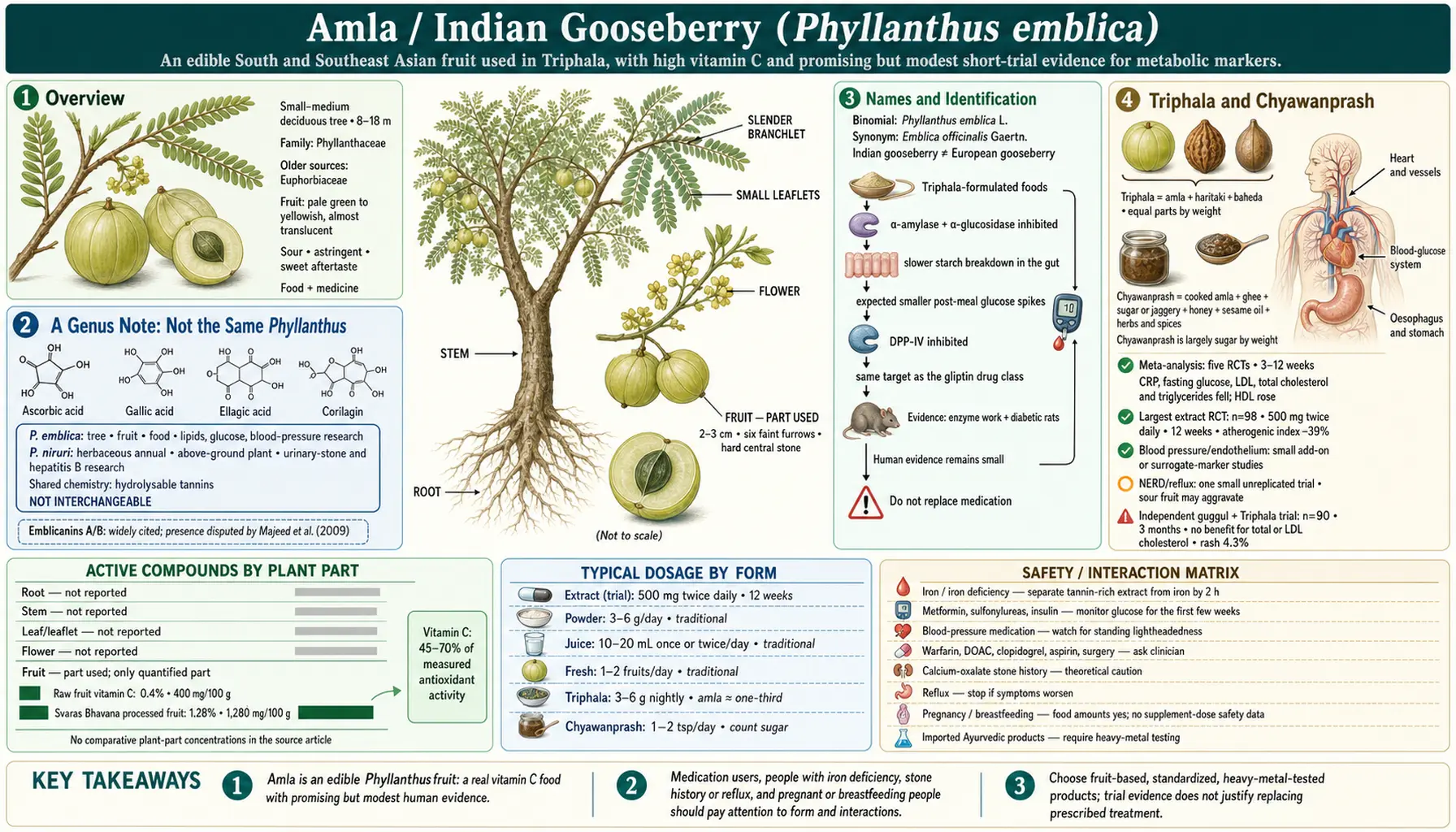
Amla is the fruit of Phyllanthus emblica, a small tree grown across South and Southeast Asia, and the third of the three fruits in Triphala — alongside haritaki and baheda. It is also the base of chyawanprash, the sweet herbal jam eaten across India, and unlike its two Triphala partners it is a real food: sour, astringent, and genuinely eaten fresh, pickled and candied.
Amla has the best human evidence of the three fruits — a handful of small randomised trials on cholesterol, blood sugar and blood pressure, and one meta-analysis pooling five of them. It also carries the site's most-repeated piece of nutrition folklore, the claim that it is an extraordinary vitamin C source. That claim is partly true and partly an artefact of how vitamin C used to be measured, and this page tries to explain the difference rather than repeat the marketing. There is also a naming trap worth knowing about: amla is a Phyllanthus, the same genus as chanca piedra, and the two plants have almost nothing in common.
Table of Contents
- Overview
- A Genus Note: Not the Same Phyllanthus
- Names and Identification
- Triphala and Chyawanprash
- Traditional Use
- The Vitamin C Question, Honestly
- Active Compounds
- Cholesterol and Triglycerides
- Blood Sugar
- Blood Pressure and Endothelial Function
- Reflux and Digestion
- Culinary Use
- Forms and Preparations
- Dosage
- Cautions and Contraindications
- Key Research Papers
- Connections
- Featured Videos
Overview
Phyllanthus emblica L. — still very widely published under its synonym Emblica officinalis Gaertn. — is a small to medium deciduous tree, typically 8–18 metres, with feathery-looking foliage. The “leaves” that give it that look are actually rows of small leaflets along slender branchlets, a characteristic Phyllanthus arrangement. It grows across India, Nepal, Sri Lanka, Bangladesh, Myanmar, Thailand, Laos, Vietnam, Malaysia, Indonesia and southern China, both wild and widely cultivated.
The part used is the fruit — a pale green to yellowish, almost translucent globe about 2–3 cm across, with six faint vertical furrows and a hard central stone. It is crisp, extremely sour, markedly astringent, and leaves a sweet aftertaste in the mouth — which is why the Chinese name for it, yu gan zi, means roughly “the fruit that leaves sweetness behind”.
Botanical placement has moved. Amla was long assigned to the Euphorbiaceae, and many older papers — including some cited on this page — still say so. Under modern classification the genus Phyllanthus sits in the family Phyllanthaceae. Nothing about the plant changed; the family boundary did.
Amla is a substantial commercial crop, particularly in Uttar Pradesh, and is grown in orchards rather than only wild-collected. That is a meaningful difference from baheda: cultivated named varieties exist, quality is more consistent, and the fruit reaches markets fresh in season rather than only as a dried powder.
A Genus Note: Not the Same Phyllanthus
This site also carries a page on chanca piedra, Phyllanthus niruri — the “stonebreaker” used in South American and Ayurvedic traditions for kidney stones and liver complaints. Amla and chanca piedra are in the same genus and are used for entirely different things. The shared genus name causes real confusion, including in supplement labelling, so it is worth being explicit:
- Phyllanthus emblica (amla) is a tree. The part used is a fruit the size of a small plum. It is a food as well as a medicine, and the modern research is about lipids, glucose and blood pressure.
- Phyllanthus niruri (chanca piedra) is a small herbaceous annual, essentially a weed, growing to knee height. The part used is the whole above-ground plant. It is not a food, and the research on it is about urinary stones and hepatitis B.
- A third species, Phyllanthus amarus, is so routinely sold and published as P. niruri that a good deal of the literature on one is really about the other. That confusion belongs to the chanca piedra side of the genus, not to amla.
What they do share is chemistry class — the genus is rich in hydrolysable tannins, including corilagin and related galloyl compounds — and a general reputation for liver protection. Srirama and colleagues compared the hepatoprotective activity of several Indian Phyllanthus species head to head in 2012, which is the right way to answer a genus-level question. But do not let the shared genus name make you treat the two as interchangeable. They are not.
Names and Identification
Binomial: Phyllanthus emblica L. Synonym: Emblica officinalis Gaertn. Family: Phyllanthaceae (older sources: Euphorbiaceae).
- English: Indian gooseberry, emblic myrobalan. It is not related to the European gooseberry (Ribes uva-crispa) — that name is purely descriptive.
- Sanskrit: amalaki, dhatri. Hindi: amla, aonla, ambla.
- Tamil / Kannada: nellikai. Malayalam: nelli. Telugu: usiri. Bengali: amloki.
- Sinhala: nelli. Nepali: amala.
- Thai: makham pom (มะขามป้อม).
- Chinese: 余甘子, yú gān zǐ.
- Tibetan: skyu ru ra.
Two naming traps. First, “myrobalan”: all three Triphala fruits carry it in English — chebulic (T. chebula), belleric (T. bellirica) and emblic (P. emblica) — and in European horticulture the word usually means a completely unrelated plum, Prunus cerasifera. Second, the database problem: a search for Emblica officinalis and a search for Phyllanthus emblica return overlapping but different sets of papers, because journals have not standardised. Search both.
Triphala and Chyawanprash
Triphala — “three fruits” — combines amla with haritaki and baheda, classically in equal parts by weight, and is the most widely used compound preparation in Ayurveda. Amla is the odd one out chemically: the other two are Terminalia species in the Combretaceae, while amla belongs to a different family entirely, and it is the only one of the three that contributes meaningful ascorbic acid.
Chyawanprash is the other reason amla is everywhere. It is a thick, dark, sweet-sour herbal jam built on a base of cooked amla fruit, combined with ghee, sugar or jaggery, honey, sesame oil and a long list of other herbs and spices, eaten by the spoonful as a daily tonic. It is genuinely popular — not a niche supplement — and it is worth one practical note: a chyawanprash is largely sugar by weight. Anyone taking it daily “for immunity” while managing diabetes should count it as a sweet, because it is one. An early Indian trial by Manjunatha and colleagues compared chyawanprash with plain vitamin C on glucose tolerance and lipoproteins, which is exactly the question that framing raises.
Traditional Use
Ayurveda. Amalaki is one of the most prominent rasayana or rejuvenative herbs, described as cooling, and used for digestion, for the eyes, for hair, for what would now be called general vitality, and as one-third of Triphala. It is classically associated with pitta — heat — and is the traditional counterweight to acidity and burning.
Traditional Chinese Medicine. Yu gan zi is used for cough, sore throat and dry mouth.
Thai and Tibetan medicine both include the fruit; in Tibetan medicine skyu ru ra is one of the “three fruits” formula that parallels Triphala.
Cosmetic use is a genuine tradition rather than a modern invention: amla-infused hair oil is used across India for hair conditioning and darkening, and amla powder appears in traditional hair washes. A 2024 randomised trial by an Iranian group tested an oral amla product in female androgenetic alopecia — a small modern echo of a very old use.
Traditional use is history. It tells you where to look; it does not tell you what works.
The Vitamin C Question, Honestly
Amla's reputation rests on vitamin C more than on anything else, and the figures you will see quoted range absurdly widely — anywhere from about 250 to 900 mg per 100 g of fresh fruit, sometimes higher. That spread is not just cultivar variation. A large part of it comes from the difficulty of measuring ascorbic acid in a fruit this tannin-rich. Here is the honest version.
Why the old numbers are unreliable
Classical vitamin C assays — the dye-titration and colorimetric methods used for most of the twentieth century — do not detect ascorbic acid specifically. They detect reducing capacity: the ability of a sample to donate electrons to a coloured reagent. Ascorbic acid does that very well. So do polyphenols and hydrolysable tannins, which amla is loaded with. Run such an assay on amla juice and a substantial part of what you read as “vitamin C” is actually tannin. That is the single most important thing to understand about amla's reputation, and it explains most of the eye-catching older figures.
What careful measurement found
Scartezzini and colleagues at the University of Bologna set out in 2006 to settle this with a specific HPLC method and diode-array detection, and also measured how much of the antioxidant activity vitamin C actually accounted for. Their findings:
- The raw fruit contained ascorbic acid at 0.4% by weight — about 400 mg per 100 g.
- Fruit processed by the traditional Ayurvedic Svaras Bhavana method (repeatedly treating the herb with its own juice) contained 1.28% — about 1,280 mg per 100 g, along with higher antioxidant activity.
- Vitamin C accounted for roughly 45–70% of the antioxidant activity — a large share, but by no means all of it.
So the headline claim survives, with a haircut. Four hundred milligrams per 100 g is a genuinely remarkable figure — roughly seven times an orange, and one of the highest of any edible fruit. Amla is a real vitamin C food. It is just not the thousand-milligram-plus fruit that the older reducing-capacity numbers implied, unless it has been through a traditional concentrating process.
The emblicanin story, and the paper that challenged it
The standard explanation for the rest of amla's antioxidant activity, repeated in almost every supplement description, is a set of low-molecular-weight hydrolysable tannins named emblicanin A and emblicanin B, together with punigluconin and pedunculagin — collectively the “tannoid principles” of amla. Animal work has been published on this fraction; Justin Thenmozhi and colleagues, for instance, reported that amla tannoids reduced markers of neuronal damage in an aluminium-exposure rodent model.
But that story is not settled, and honesty requires saying so. Majeed and colleagues published an analytical paper in 2009 pointedly titled “Ascorbic acid and tannins from Emblica officinalis Gaertn. Fruits — a revisit”, in which they reported that they found no evidence for the presence of emblicanins A and B in the extract they analysed, and separately argued that the widely quoted high ascorbic acid content is questionable because of previously unidentified mucic acid gallates that co-elute with ascorbic acid in the older chromatographic methods. In other words: even HPLC can be fooled if you have not identified everything that comes off the column at the same time.
Where that leaves you. Two claims about amla are widely repeated and only one of them is solid:
- Amla is a high-vitamin-C fruit. Well supported, with the best specific measurement around 400 mg per 100 g of fresh fruit — excellent, but roughly a third to half of the most-quoted figures.
- Amla's antioxidant power comes from emblicanins A and B. Widely repeated, plausible, and directly challenged by at least one careful analytical study that could not find them. Treat it as unsettled.
One further practical point. Amla's vitamin C is often described as unusually stable to drying and heat compared with other fruits, and the explanation usually offered is that the surrounding tannins protect ascorbate from oxidation. That is a reasonable hypothesis and it is consistent with the traditional practice of using dried amla, but it is worth treating as an explanation rather than an established fact — and Scartezzini's data showing that processing raised the measured ascorbic acid content is at least consistent with it. If you want ascorbic acid specifically and reliably, see Vitamin C.
Active Compounds
- Ascorbic acid (vitamin C) — genuinely abundant; see above for why the number is contested.
- Hydrolysable tannins: the emblicanin A and B, punigluconin and pedunculagin group — widely cited as the “tannoid principles”, with their presence disputed by at least one analytical study.
- Gallic acid and ellagic acid — abundant, and shared with the two Terminalia fruits of Triphala.
- Corilagin — a galloyl-glucose tannin found throughout the genus Phyllanthus, and one of the chemical threads linking amla to chanca piedra.
- Mucic acid gallates — identified by Majeed and colleagues as compounds that co-elute with ascorbic acid and can inflate apparent vitamin C measurements.
- Chebulagic and chebulinic acids — also reported, again shared with the Terminalia fruits.
- Flavonoids including quercetin and kaempferol derivatives, plus a range of simple phenolic acids.
Hegde and colleagues published a comprehensive comparative metabolome profile of all three Triphala fruits in 2024, which is the most useful single reference for anyone wanting to see what amla contributes to the blend that the Terminalia fruits do not.
Cholesterol and Triglycerides
This is amla's strongest human evidence, and it is genuinely better than most herbal evidence — while still being modest.
The meta-analysis. Setayesh and colleagues pooled the randomised trials of amla supplementation available to December 2022 and found significant reductions in C-reactive protein, fasting blood glucose, LDL cholesterol, total cholesterol and triglycerides, with an increase in HDL cholesterol. The honest framing of that result is in the numbers behind it: only five randomised trials qualified, participants averaged 40–58 years with a mean BMI around 25.5, and interventions ran from three to twelve weeks. Five short trials is a signal worth taking seriously and a long way from settled.
The largest single trial. Upadya and colleagues randomised 98 people with dyslipidaemia to 500 mg of a standardised amla extract twice daily or matching placebo for 12 weeks. Total cholesterol, triglycerides, LDL and VLDL cholesterol were all significantly lower than placebo, and the atherogenic index of plasma fell by 39%. Coenzyme Q10 did not fall — the authors' point being that statins reduce it and amla did not.
The caveats that belong with it. Ninety-eight people for twelve weeks measures blood markers, not heart attacks. The trial was registered retrospectively. The extract was a specific commercial preparation, not generic amla powder. And crucially, the one large, independent, European placebo-controlled trial of a Triphala-containing product for cholesterol was negative: Donato and colleagues found a guggul-plus-Triphala preparation no better than placebo on total or LDL cholesterol over three months in 90 people, with a hypersensitivity rash in 4.3% of the treated group. Different product, different combination — but a useful reminder of how often positive early results in this field fail to replicate outside the country of origin.
Blood Sugar
The meta-analysis above found a significant reduction in fasting blood glucose across the pooled trials, and the Upadya dyslipidaemia trial reported a general downward trend in fasting glucose — though with only eight participants in the pre-diabetic or diabetic range, the authors were explicit that this needed confirming in a larger study.
Mechanistically there is supporting laboratory work: Das and colleagues found that foods formulated with all three Triphala herbs inhibited α-amylase, α-glucosidase and DPP-IV and lowered glucose in diabetic rats. Inhibiting those first two enzymes slows starch breakdown in the gut and would be expected to blunt post-meal glucose spikes — the same mechanism as the drug acarbose. DPP-IV inhibition is the mechanism of the gliptin drug class.
Evidence level: a handful of small human trials, plus rodent and enzyme work. The signal is real enough to matter as an interaction warning: if you take amla alongside metformin, sulfonylureas or insulin, monitor glucose more closely for the first few weeks. It is not enough to justify replacing anything.
Blood Pressure and Endothelial Function
Shanmugarajan and colleagues ran a randomised, double-blind, placebo-controlled trial of a Phyllanthus emblica extract as an add-on therapy in people already being treated for essential hypertension, reporting antihypertensive and other effects. Usharani and colleagues in Hyderabad had earlier tested a standardised aqueous amla extract in people with metabolic syndrome, looking at endothelial dysfunction, oxidative stress, systemic inflammation and lipids.
Two things to notice. First, both are add-on or surrogate-marker studies in small samples — endothelial function measures are informative but they are not blood pressure control, let alone stroke prevention. Second, and worth saying out loud: a striking proportion of the entire amla and Triphala clinical literature comes from a small number of Indian centres, with the Hyderabad group appearing repeatedly across amla and baheda trials alike. That is not an accusation of anything; it is a straightforward reason to want independent replication before treating any of these findings as established.
Reflux and Digestion
Karkon Varnosfaderani and colleagues in Tehran ran a double-blind, randomised, placebo-controlled trial of an amla tablet in non-erosive reflux disease — heartburn and regurgitation without visible damage to the oesophagus on endoscopy. This is an interesting choice of indication, because it lines up with amla's classical Ayurvedic role as a cooling remedy for acidity, and because NERD responds poorly to standard acid suppression, leaving a genuine treatment gap.
It is one small trial from one centre, and it has not been replicated. Note also the apparent tension worth flagging for readers: amla is intensely sour, and some people with reflux find sour foods provoke symptoms even when a preparation of the same fruit is being studied as a treatment. Individual response varies; if it makes your heartburn worse, that is information, not a failure to persist.
Amla's role in Triphala as a bowel and digestive tonic is described on the haritaki page, since haritaki carries most of that action.
Culinary Use
Unlike its two Triphala partners, amla is a real food eaten by real people who are not thinking about medicine at all.
- Fresh, with salt and chilli. The commonest way it is eaten in India and Thailand — sliced or whole, dipped in salt. Intensely sour and astringent up front, with a distinctive sweet finish once you drink water afterwards.
- Pickle (achar). Preserved in oil, salt, mustard and spices — a staple across north India.
- Murabba. Whole fruits candied in heavy sugar syrup, sometimes with cardamom or saffron. The traditional way of making amla palatable and storable.
- Juice. Widely sold, usually diluted; often blended with other juices because it is too sour alone.
- Dried and powdered. Used in cooking as a souring agent, and as the basis of Triphala.
- Chyawanprash. The cooked-amla herbal jam described above.
- Thailand: makham pom is eaten fresh with salt, preserved as a sweet, and used in herbal drinks.
Eating the fresh fruit is a meaningfully different exposure from taking a standardised extract capsule — different dose, different matrix, more vitamin C, more fibre, and none of the standardisation. Both are legitimate; they are just not the same thing, and trial results from one do not transfer to the other.
Forms and Preparations
- Fresh fruit. Seasonal — broadly autumn to winter in India. The only form that reliably delivers the vitamin C content discussed above.
- Dried fruit and powder (churna). The most widely traded form. Keeps well; buy in small quantities as powder oxidises.
- Juice. Check whether it is diluted and whether sugar has been added, which it very often has.
- Standardised extract. The form used in the clinical trials — typically 500 mg capsules taken twice daily. If you are trying to reproduce the trial evidence, this is the form that was tested, and a product should say what it is standardised to.
- Triphala churna. Equal parts amla, haritaki and baheda.
- Chyawanprash. Traditional jam; count the sugar.
- Hair oil. Amla infused in coconut or sesame oil. Topical, traditional, and outside the scope of any of the trials above.
Label checklist: the binomial (Phyllanthus emblica or Emblica officinalis — both are the same plant), the plant part (fruit), a standardisation marker with a number if it is an extract, and heavy-metal testing, which is worth asking about for any imported Ayurvedic product.
Dosage
Amla is unusual among herbs on this site in that some of the dosing comes from actual trials rather than only tradition.
- Standardised extract, from the trials: 500 mg twice daily for 12 weeks was the regimen in the dyslipidaemia trial, and similar doses appear in the metabolic-syndrome and hypertension add-on studies.
- Dried fruit powder, traditional: commonly 3–6 g daily, often taken with water or honey. No dose-finding study supports a particular figure.
- Juice, traditional: commonly 10–20 mL diluted in water, once or twice daily.
- Fresh fruit: one to two fruits daily is the usual traditional practice where the fruit is available.
- Triphala churna: commonly 3–6 g at night, of which amla is roughly one-third.
- Chyawanprash: commonly one to two teaspoons daily. Remember what most of that weight is.
Cautions and Contraindications
- Iron absorption — a genuine complication in this fruit. Amla's galloyl tannins inhibit non-haem iron absorption, as in the two Terminalia fruits. But amla also contains substantial ascorbic acid, which enhances non-haem iron absorption, so the net effect within the whole fresh fruit is not predictable from either fact alone and has not been measured directly. For a tannin-rich extract with little vitamin C, assume the inhibitory effect dominates and separate it from iron by two hours. Anyone with iron deficiency should raise this specifically.
- Blood-sugar-lowering medication. Plausible additive effect based on the pooled trial data. Monitor more closely for the first few weeks on metformin, sulfonylureas or insulin.
- Blood pressure medication. Amla was tested as an add-on to existing antihypertensives, so an additive effect is exactly what was intended. Watch for lightheadedness on standing.
- Bleeding risk. Antiplatelet activity has been reported for amla preparations. Data are limited, but the sensible course is to mention amla to your clinician if you take warfarin, a DOAC, clopidogrel or regular aspirin, and to stop it before planned surgery on the same schedule you would stop other supplements.
- Kidney stones. Two mechanism-based reasons for caution in anyone who forms calcium-oxalate stones: high vitamin C intake increases urinary oxalate excretion, and amla itself contains oxalate. This is theoretical rather than demonstrated for amla specifically, but it is worth raising if you have a stone history — and it is a nice irony given that the other Phyllanthus on this site, chanca piedra, is used for stones.
- Reflux and acidity. Studied as a treatment for non-erosive reflux disease, but the fruit is very sour and some people find it aggravating. Judge by your own response.
- Pregnancy and breastfeeding. Amla is a food eaten in normal amounts throughout pregnancy in South Asia; that is different from taking a concentrated extract. No safety data exist for supplement doses in pregnancy, so food amounts yes, concentrated supplements no.
- Chyawanprash and diabetes. Mostly sugar by weight. Anyone managing blood glucose should treat a daily spoonful as the sweet it is.
- Separate extracts from medication by about two hours, on general tannin-binding grounds.
- Product quality. Heavy-metal contamination of imported Ayurvedic products has been documented repeatedly. Buy from suppliers who test and will show you the results.
Key Research Papers
- Scartezzini P, Antognoni F, Raggi MA, Poli F, Sabbioni C. Vitamin C content and antioxidant activity of the fruit and of the Ayurvedic preparation of Emblica officinalis Gaertn. Journal of Ethnopharmacology. 2006;104(1–2):113–118. The specific HPLC measurement: 0.4% ascorbic acid raw, 1.28% processed.
- Majeed M, Bhat B, Jadhav AN, Srivastava JS, Nagabhushanam K. Ascorbic acid and tannins from Emblica officinalis Gaertn. fruits — a revisit. Journal of Agricultural and Food Chemistry. 2009;57(1):220–225. Found no evidence of emblicanins A and B; identified co-eluting mucic acid gallates.
- Setayesh L, Haghighat N, Rasaei N, Rezaei M, Casazza K, Nadery M, Yamrali I, Zamani M, Asbaghi O. The impact of Emblica officinalis (Amla) on lipid profile, glucose, and C-reactive protein: a systematic review and meta-analysis of randomized controlled trials. Diabetes & Metabolic Syndrome. 2023;17(3):102729. Five RCTs pooled.
- Upadya H, Prabhu S, Prasad A, Subramanian D, Gupta S, Goel A. A randomized, double blind, placebo controlled, multicenter clinical trial to assess the efficacy and safety of Emblica officinalis extract in patients with dyslipidemia. BMC Complementary and Alternative Medicine. 2019;19(1):27. Human RCT, n=98, 12 weeks.
- Shanmugarajan D, Girish C, Harivenkatesh N, Chanaveerappa B, Prasanna Lakshmi NC. Antihypertensive and pleiotropic effects of Phyllanthus emblica extract as an add-on therapy in patients with essential hypertension — a randomized double-blind placebo-controlled trial. Phytotherapy Research. 2021;35(6):3275–3285. Human RCT.
- Usharani P, Merugu PL, Nutalapati C. Evaluation of the effects of a standardized aqueous extract of Phyllanthus emblica fruits on endothelial dysfunction, oxidative stress, systemic inflammation and lipid profile in subjects with metabolic syndrome: a randomised, double blind, placebo controlled clinical study. BMC Complementary and Alternative Medicine. 2019;19(1):97. Human RCT.
- Karkon Varnosfaderani S, Hashem-Dabaghian F, Amin G, Bozorgi M, Heydarirad G, Nazem E, Nasiri Toosi M, Mosavat SH. Efficacy and safety of Amla (Phyllanthus emblica L.) in non-erosive reflux disease: a double-blind, randomized, placebo-controlled clinical trial. Journal of Integrative Medicine. 2018;16(2):126–131. Human RCT.
- Manjunatha S, Jaryal AK, Bijlani RL, Sachdeva U, Gupta SK. Effect of Chyawanprash and vitamin C on glucose tolerance and lipoprotein profile. Indian Journal of Physiology and Pharmacology. 2001;45(1):71–79. Human trial.
- Hegde SN, K LD, Choudhary M, Menon N, Singh G. A comprehensive metabolome profiling of Terminalia chebula, Terminalia bellerica, and Phyllanthus emblica to explore the medicinal potential of Triphala. Scientific Reports. 2024;14(1):31635.
- Justin Thenmozhi A, Dhivyabharathi M, Manivasagam T, Essa MM. Tannoid principles of Emblica officinalis attenuated aluminum chloride induced apoptosis by suppressing oxidative stress and tau pathology via Akt/GSK-3β signaling pathway. Journal of Ethnopharmacology. 2016;194:20–29. Rodent.
- Srirama R, Deepak HB, Senthilkumar U, Ravikanth G, Gurumurthy BR, Shivanna MB, Chandrasekaran CV, Agarwal A, Shaanker RU. Hepatoprotective activity of Indian Phyllanthus. Pharmaceutical Biology. 2012;50(8):948–953. Comparative study across the genus.
- Yadav SS, Singh MK, Singh PK, Kumar V. Traditional knowledge to clinical trials: a review on therapeutic actions of Emblica officinalis. Biomedicine & Pharmacotherapy. 2017;93:1292–1302. Review.
- Donato F, Raffetti E, Toninelli G, Festa A, Scarcella C, Castellano M. Guggulu and Triphala for the treatment of hypercholesterolaemia: a placebo-controlled, double-blind, randomised trial. Complementary Medicine Research. 2021;28(3):216–225. Human RCT — negative.
- Pinmai K, Chunlaratthanabhorn S, Ngamkitidechakul C, Soonthornchareon N, Hahnvajanawong C. Synergistic growth inhibitory effects of Phyllanthus emblica and Terminalia bellerica extracts with conventional cytotoxic agents: doxorubicin and cisplatin against human hepatocellular carcinoma and lung cancer cells. World Journal of Gastroenterology. 2008;14(10):1491–1497. Cell culture.
Live PubMed Searches
- Phyllanthus emblica — all literature
- Emblica officinalis — the synonym, a different result set
- Amla — randomised controlled trials
- Amla and ascorbic acid measurement
- Emblicanin A and B
- Chyawanprash
- Triphala — all literature
- Phyllanthus niruri — the other Phyllanthus
- Vitamin C, oxalate and kidney stones
- Phyllanthus emblica — safety and toxicity
Connections
- Fluoride Chelation — the traditional vitamin C source in the fluorosis protocol
- All Herbs
- Haritaki (Terminalia chebula) — the first fruit of Triphala, and the one that carries most of the bowel-regulating action.
- Baheda (Terminalia bellirica) — the second fruit of Triphala, and the least researched of the three.
- Chanca Piedra (Phyllanthus niruri) — the same genus, a completely different plant and a completely different use. Worth reading alongside this page.
- Vitamin C — the nutrient amla is famous for, and the place to go for what ascorbic acid actually does.