Crepe Ginger (Cheilocostus speciosus)
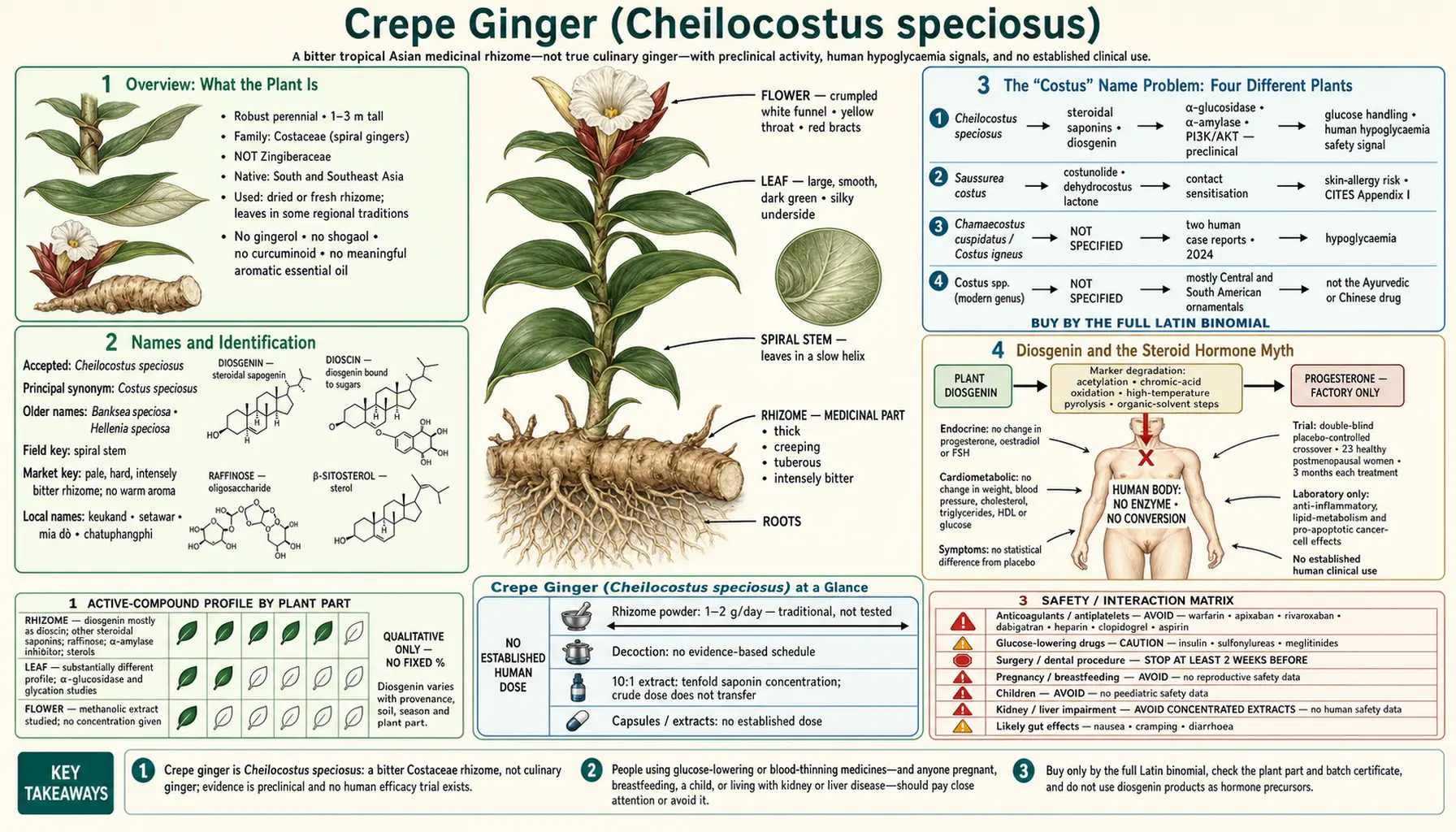
Crepe ginger (Cheilocostus speciosus, long known as Costus speciosus) is a tall tropical herb from India and Southeast Asia whose leafy stem twists round itself in a slow spiral as it grows — the feature that gives its family, the Costaceae, its common name of “spiral gingers.” It looks like a ginger, is sold as a ginger, and is not one. The Costaceae split off from the true ginger family, Zingiberaceae, long ago, and crepe ginger has none of the aromatic oils that make ginger, turmeric or galangal worth cooking with. The rhizome is bitter and medicinal, not culinary.
Two things about this plant need saying before anything else. First, the name “costus” is attached to at least four unrelated plants in the herb trade, and buyers routinely receive the wrong one — including a CITES-protected Himalayan root and an Indian “insulin plant” with documented case reports of hypoglycaemia. Sorting that out is the most useful thing this page does. Second, crepe ginger contains diosgenin, a steroidal sapogenin that really was the industrial starting material for the first synthetic steroid hormones — but eating a diosgenin-rich plant does not make hormones in your body. That conversion is a multi-step factory process, not a metabolic one. The myth that it happens inside you has sold an enormous quantity of yam and costus products, and it is simply false. Beyond that, the honest evidence position is thin: there is real animal and cell-culture work on inflammation, real hospital-survey evidence in humans on blood sugar (see below — a safety signal, not proof of a safe treatment), and no controlled human efficacy trial of any kind.
Table of Contents
- Overview: What the Plant Is
- Names and Identification
- The “Costus” Name Problem: Four Different Plants
- Diosgenin and the Steroid Hormone Myth
- Traditional Use in Ayurveda and Jamu
- Active Compounds
- Blood Sugar: What the Animal Work Shows
- Inflammation and Immune Effects
- Antimicrobial and Antiviral Screening
- Is Crepe Ginger a Kitchen Spice?
- Forms and Preparations
- Dosage
- Cautions and Contraindications
- Key Research Papers
- Connections
- Featured Videos
Overview: What the Plant Is
Cheilocostus speciosus is a robust perennial herb growing one to three metres tall from a thick, creeping, tuberous rhizome. The stem is the identifying feature: it does not stand straight but spirals, so the leaves come off in a slow helix rather than in opposite pairs or neat ranks. The leaves themselves are large, smooth and dark green above with a silky underside. The flower is spectacular and gives the plant its English name — a crumpled, papery white funnel with a yellow throat, opening one at a time from a cone of overlapping red bracts. “Crepe” refers to the crinkled tissue-paper texture of the petal.
The plant is native across South and Southeast Asia — India, Sri Lanka, Nepal, Bangladesh, Myanmar, Thailand, Indochina, peninsular Malaysia and the Indonesian islands — and grows in damp forest edges, along streams and in disturbed ground at low to moderate elevation. It is also widely planted as an ornamental in the tropics and subtropics, and has naturalised in Hawaii, the Caribbean and parts of tropical America. If you have seen a “spiral ginger” in a botanical garden, this is very likely it.
The part used is the rhizome, dug up, sliced and dried. In Ayurvedic practice the fresh rhizome is also used, and in some regional traditions the leaves are used separately. The rhizome is intensely bitter — a saponin bitterness, soapy rather than sharp — and this alone tells you it belongs in the medicine cabinet rather than the spice rack.
Family matters here. Until the 1980s the Costaceae were often folded into the Zingiberaceae, and older books call this plant a ginger without qualification. Modern classification places Costaceae as a separate family within the order Zingiberales. The practical difference for anyone using the plant is chemical: the true ginger family is defined by aromatic essential oils in specialised oil cells (gingerol, curcumin, cineole, and so on), and the Costaceae largely lack them. Crepe ginger’s chemistry is dominated instead by steroidal saponins. Same order, different toolkit.
Names and Identification
Accepted botanical name: Cheilocostus speciosus (J. Koenig) C. Specht.
Principal synonym: Costus speciosus (J. Koenig) Sm. — this is still the name used in almost the entire research literature. If you search PubMed for “Cheilocostus” you will find a few dozen papers; search “Costus speciosus” and you will find several hundred. They are the same plant. Older sources may also use Banksea speciosa or Hellenia speciosa.
Family: Costaceae (the spiral gingers) — not Zingiberaceae.
Local names:
- Keukand, kebu or keu (Hindi and Bengali) — the names under which the rhizome is sold in North Indian herb markets.
- Setawar (Malay).
- Mía dò (Vietnamese) — literally “red sugarcane,” describing the reddish, jointed, cane-like stem.
- Chatuphangphi (Thai).
- Crepe ginger, spiral ginger, wild ginger, cane reed (English).
How to tell it apart in the field or the market: the spiral stem is diagnostic and no true ginger does it. The dried rhizome slices are pale, hard and strongly bitter, without the warm aroma of Zingiber or the ochre stain of turmeric. If a “ginger” smells of nothing and tastes bitter and soapy, you are probably holding a Costaceae.
The “Costus” Name Problem: Four Different Plants
This is the section to read before you buy anything labelled “costus.” The word is attached to at least four distinct plants across the Ayurvedic, Chinese, Indian and international herb trades, and substitution is routine rather than exceptional.
1. Crepe ginger — Cheilocostus speciosus (Costaceae)
The subject of this page. A tropical Asian spiral ginger. Rhizome contains diosgenin. Used in Ayurveda and in Indonesian jamu. Not endangered, not restricted, not aromatic.
2. Kuth / Indian costus — Saussurea costus (Asteraceae)
This is the one most likely to be sold to you by mistake, and it is a completely different plant. Saussurea costus (synonym Saussurea lappa) is a Himalayan member of the daisy family, native to Kashmir and the high Western Himalaya. Its root is kuth in Kashmiri, mu xiang (木香) in Chinese medicine, and kushtha in Sanskrit — and it is the “costus root” of the perfumery trade.
Three reasons the mix-up matters:
- Different chemistry entirely. The active constituents of Saussurea costus are sesquiterpene lactones — costunolide and dehydrocostus lactone — not steroidal saponins. Sesquiterpene lactones are a well-known class of contact allergens; costus root oil is a documented skin sensitiser and its use in fragrance is restricted for exactly that reason.
- It is CITES-protected. Saussurea costus is one of the very small number of plant species listed in CITES Appendix I, the strictest category, which effectively prohibits international commercial trade in wild-collected material. You can check the current listing in the CITES species checklist. Buying “wildcrafted Himalayan costus root” online is, at best, legally fraught.
- Adulteration is documented in the peer-reviewed literature. Analytical chemists have built dedicated authenticity-screening methods for Saussurea costus root precisely because the market material is unreliable, and DNA barcoding work on the genus exists for the same reason.
3. The “insulin plant” — Chamaecostus cuspidatus / Costus igneus (Costaceae)
A small orange-flowered spiral ginger from Brazil, now grown all over South India as a houseplant and hedge, where its leaves are chewed daily for diabetes under the name insulin plant or fiery costus. It is in the same family as crepe ginger but a different genus, and analytical work has been published specifically to tell the two apart chemically.
This one has real human safety signals. An Indian hospital published two case reports in 2024 of patients developing hypoglycaemia attributed to Costus igneus, noting that it may be harmful in excess or in combination with other glucose-lowering agents. If you are diabetic, on insulin or on a sulfonylurea, and someone hands you an “insulin plant” leaf, that is a plant with a documented capacity to drop blood sugar in people — not a harmless salad green.
4. Costus proper — the neotropical spiral gingers
The genus Costus in its modern, narrowed sense contains mostly Central and South American species. When taxonomists moved C. speciosus to Cheilocostus, they were separating the Asian plants from this American core. Ornamental nurseries sell many of them; none is the Ayurvedic or Chinese drug.
What to do about it
Insist on a Latin binomial on the label — genus and species. “Costus” on its own is not an identification. If a product claims Ayurvedic kushtha or Chinese mu xiang, it should say Saussurea costus and should come with legitimate cultivated provenance. If it claims crepe ginger or keukand, it should say Cheilocostus or Costus speciosus. If it claims “insulin plant,” it should say Chamaecostus cuspidatus or Costus igneus — and you should treat it as a blood-sugar-active agent.
Diosgenin and the Steroid Hormone Myth
This section exists because the claim it corrects is persistent, commercially profitable and consequential — particularly for women considering “natural progesterone” products.
The history is real, and it is genuinely remarkable
Diosgenin is a steroidal sapogenin: a molecule whose four-ring core is the same carbon skeleton found in cholesterol, progesterone, testosterone and cortisol, with a distinctive spiroketal cap on one end. In plants it normally exists bound to sugars, as the saponin dioscin; the sugars are stripped off during processing to leave diosgenin.
In the late 1930s and 1940s, the American chemist Russell Marker worked out a chemical route from diosgenin to progesterone — the sequence still known as the Marker degradation. He then went looking for a cheap plant source, found it in wild Mexican yams (Dioscorea species, locally called cabeza de negro and barbasco), and in 1944 co-founded the Mexico City company Syntex to exploit it. The price of progesterone collapsed by orders of magnitude. Cortisone, previously extracted in vanishing quantities from ox bile, became manufacturable. And in 1951 a Syntex team — Carl Djerassi, Luis Miramontes and George Rosenkranz — synthesised norethindrone, the first orally active progestin, which became the progestin component of the first oral contraceptives. A Mexican yam really did make the birth control pill possible.
The myth is where that history gets misapplied
Because diosgenin can be converted into hormones, an entire product category — wild yam creams, “natural progesterone” supplements, DHEA-precursor capsules, and diosgenin-containing herbs including crepe ginger — has been sold on the implication that your body will do the conversion.
It will not. The Marker degradation is an industrial chemical process. It requires acetylation, oxidation with chromic acid, controlled pyrolysis at high temperature, and further steps in organic solvent. There is no human enzyme that performs any part of it. Human steroidogenesis starts from cholesterol, not from plant sapogenins, and the enzymes involved (the cytochrome P450 side-chain cleavage system and its downstream partners) do not recognise diosgenin as a substrate. Swallowing diosgenin or rubbing it on your skin no more produces progesterone than swallowing sand produces glass.
The human trial that tested it
(Human, randomised, negative.) Komesaroff and colleagues ran a double-blind, placebo-controlled crossover study of a wild yam cream in 23 healthy postmenopausal women with troublesome symptoms. Each woman used active cream and matching placebo for three months in random order, with blood and saliva sampled at baseline, three and six months.
The result was flat. After three months there was no change in weight, blood pressure, total cholesterol, triglycerides, HDL, FSH, glucose, oestradiol, or serum or salivary progesterone. Symptom scores showed small movements with both active cream and placebo and no statistical difference between them. There were also no side effects. The authors’ conclusion was that topical wild yam appears free of side effects and appears to have little effect on menopausal symptoms.
That trial is now over two decades old and has never been overturned. It measured the exact thing the marketing claims — circulating and salivary progesterone after real-world use of a diosgenin product — and found nothing.
What diosgenin does do
None of the above means diosgenin is inert. It is a genuinely interesting molecule with real activity in laboratory systems: anti-inflammatory effects, effects on lipid metabolism, and pro-apoptotic effects on cancer cell lines, including work using diosgenin isolated specifically from Costus speciosus. Those are cell-culture and animal findings. They have nothing to do with hormone production, and they have not been translated into human trials. The correct position is: diosgenin is a plausible research compound with no established human clinical use, and it is definitively not a hormone precursor in the body.
Traditional Use in Ayurveda and Jamu
Ayurveda. The rhizome of Cheilocostus speciosus is a classical bitter drug. It appears in Ayurvedic practice for fever, for skin eruptions and rashes, for worms, for cough and asthma, and as a bitter tonic and digestive stimulant — the general profile of a tikta (bitter) drug used to clear heat and dampness. It is often confused in the literature with kushtha (Saussurea costus), which has its own quite separate classical indications, and reading older translations requires care about which plant a text means.
Indonesian jamu. The rhizome (setawar) is used in Javanese and Malay herbal practice as a component of tonics and, topically, for skin complaints.
Nepal and the eastern Himalaya. The plant is recorded in modern ethnobotanical surveys as part of the wild medicinal flora used by hill communities — documented, for example, in a 2020 Journal of Ethnopharmacology survey of three ethnic groups in Makawanpur district, central Nepal.
How much weight to give this. The traditional record for crepe ginger is real and geographically wide, but it is also mostly recorded by twentieth-century compilers rather than by ancient text, and much of it is confounded by the naming problem described above. Traditional use tells you people found the plant available and bitter, and that bitter drugs had a settled role in these systems. It does not tell you the plant treats fever, and no controlled study has ever tested whether it does.
Active Compounds
- Diosgenin — the headline constituent, present in the rhizome mostly as its glycoside dioscin. Reported concentrations vary a great deal with provenance, soil, season and plant part; a 2021 Indian study specifically mapped how diosgenin content in Costus speciosus shifts across soil types in the Indo-Gangetic plains, which is a polite way of saying that no two batches are the same. Any product claiming a precise diosgenin percentage without a certificate of analysis for that batch is guessing.
- Other steroidal saponins — a family of related glycosides accompanying dioscin, responsible for the rhizome’s bitterness and its foaming behaviour in water.
- Raffinose — an oligosaccharide isolated from the plant and studied for effects on lipid synthesis and insulin signalling in laboratory models.
- A proteinaceous α-amylase inhibitor — a protein isolated and characterised from the rhizome in 2018, of fungal origin associated with the plant, which slows starch digestion in vitro.
- Polyphenols and flavonoids — multiple phenolic acids detected by HPLC across aqueous, ethanolic and methanolic extracts.
- Sterols including β-sitosterol, plus assorted triterpenes.
Comparative metabolic profiling using NMR, GC-MS and UPLC/ESI-MS/MS has been done on both leaves and rhizomes, and the two organs differ substantially — another reason to care which part a product contains. Note what is absent: there is no gingerol, no shogaol, no curcuminoid, no meaningful aromatic essential oil. Whatever crepe ginger does, it does not do it the way ginger and turmeric do.
Blood Sugar: What the Animal Work Shows
Antidiabetic activity is the most-studied claim for this plant, and the work is entirely preclinical.
Diabetic rats (animal). An Egyptian and Saudi group gave ethanolic root extract of Costus speciosus to streptozotocin-induced diabetic rats and reported lowered blood glucose along with changes in the expression of genes governing insulin synthesis and glucose catabolic enzymes. Streptozotocin destroys pancreatic beta cells chemically; it is a standard model but a crude one, and results in it translate to human type 2 diabetes inconsistently at best.
Enzyme inhibition (in vitro). A Sri Lankan group tested Costus speciosus leaf extracts against α-glucosidase, the intestinal enzyme that releases glucose from dietary carbohydrate, and also against protein glycation, reporting inhibition of both. α-Glucosidase inhibition is a real drug mechanism — acarbose works this way — but demonstrating it in a test tube says nothing about whether enough active compound survives digestion and reaches the gut wall at a meaningful concentration.
Separately, a proteinaceous α-amylase inhibitor was isolated from the rhizome, and raffinose from the plant was reported to attenuate lipid synthesis through PPAR and SREBP-1c signalling and to improve insulin sensitivity via the PI3K/AKT pathway in laboratory models.
The honest bottom line. There are several independent, plausible mechanisms by which crepe ginger constituents could affect glucose handling, demonstrated in cells and rodents by different groups in different countries. There is no controlled efficacy trial — but there is real human evidence of a different kind: three independent Sri Lankan hospital surveys spanning 2014–2025 found people who eat this plant developing hypoglycaemia at rates their doctors documented, one association statistically significant (P = 0.01) and specifically named to this species, not its more famous “insulin plant” cousin (full picture on the Blood Sugar Benefits page). That is evidence the plant does something real to blood glucose in people, not just in rats — and it is a safety warning, not grounds for using it as a treatment. No dose-finding study and no controlled outcome trial exist, and until one does there is no basis for using this plant to manage blood sugar; if anything, the survey data argues for caution rather than self-treatment. If you have diabetes, the treatments with proven outcome data are the ones to rely on; see Type 2 Diabetes.
Inflammation and Immune Effects
Psoriasis model (animal). A 2025 Indian study reported that Costus speciosus extract acted as an immunomodulator in an imiquimod-type psoriasis model in BALB/c mice, with effects attributed to the NF-κB pathway. NF-κB is the master inflammatory transcription factor, and a very large number of plant extracts have been reported to suppress it in animal models; the finding is unremarkable in kind rather than distinctive.
Liver injury (animal). A 2025 study from a Bangladeshi group found that a methanolic extract of crepe ginger flower reduced markers of oxidative stress and hepatic injury in an animal model. Note the plant part — flower, not rhizome. Findings on one organ of a plant do not transfer to another.
Cancer cell lines (in vitro). Diosgenin isolated from Costus speciosus has been reported to inhibit cell proliferation and trigger apoptosis in cultured cancer cells. Nearly every plant sterol and saponin does something to a cancer cell line at a high enough concentration; these results are a starting point for chemistry, not a claim about treatment.
None of this has been tested in humans. Anti-inflammatory activity in a mouse is a hypothesis about a person.
Antimicrobial and Antiviral Screening
Bacteria (in vitro). Rhizome extracts of Cheilocostus speciosus have been screened against antibiotic-resistant bacterial isolates and shown measurable inhibition in culture. Saponin-rich plant extracts frequently do this — saponins are surface-active and disrupt membranes — and it rarely survives translation into a systemic infection model, because the concentrations that kill bacteria in a dish are not concentrations you can safely achieve in blood.
Influenza (in vitro and animal). A 2023 study in Viruses reported that an aqueous leaf extract suppressed influenza A H1N1 activity in cell culture and in an animal model. This is a better-designed piece of work than most screening papers because it includes an in vivo arm, but it remains preclinical, on the leaf rather than the rhizome, and unreplicated.
Is Crepe Ginger a Kitchen Spice?
No — and this is worth stating clearly, because the name misleads.
True culinary gingers (Zingiberaceae) earn their place in cooking through volatile aromatic oils held in specialised secretory cells: gingerol and shogaol in ginger, turmerone and curcumin in turmeric, cineole and galangol in galangal, the terpene mix in cardamom. Costaceae rhizomes largely lack this apparatus. Crepe ginger rhizome is bitter, mucilaginous and aromatically flat. Nobody in India, Indonesia or Vietnam cooks with it as a spice.
Young shoots and stems of the plant are reported eaten as a sour vegetable in some parts of its range, but this is local subsistence use rather than a culinary tradition, and it is not the same material as the medicinal rhizome. Do not substitute crepe ginger for ginger in a recipe, and be sceptical of any product that markets it as a culinary ginger. If you want ginger’s effects, use ginger.
Forms and Preparations
- Dried rhizome slices or powder. The traditional form, sold in Indian and Southeast Asian herb markets under local names. Decocted in water, or taken as powder in the Ayurvedic manner.
- Fresh rhizome juice or paste. Used in classical Ayurvedic practice and in some folk preparations, sometimes applied topically for skin complaints.
- Capsules and extracts sold internationally, usually labelled “Costus speciosus” and frequently standardised to a stated diosgenin content.
- Diosgenin as an isolated compound, sold as a raw material and as a supplement ingredient. Note that isolated diosgenin from any source — yam, fenugreek, costus — carries the same misleading hormone-precursor marketing, and the same absence of human evidence.
What to check on a label: the full binomial, the plant part (rhizome, leaf or flower — the research differs sharply between them), country of origin, and a batch-specific certificate of analysis if a diosgenin percentage is claimed. Given the naming chaos described above, a product that says only “Costus” or “Costus root” should be treated as unidentified.
Dosage
There is no established human dose for crepe ginger. That is the accurate answer, and it is worth saying plainly rather than manufacturing a number.
No regulator anywhere — not the EMA, not the US FDA, not the Indian Ministry of AYUSH in the form of a modern clinical dose — has established an evidence-based dosing schedule for Cheilocostus speciosus, because there are no controlled human trials from which to derive one. Traditional Ayurvedic texts and modern compilations give rhizome powder doses in the range of a gram or two daily, but these are transmitted practice, not tested amounts, and they refer to a bitter decoction rather than to a concentrated extract.
The extract problem. A 10:1 extract concentrates the saponins tenfold. Traditional dose ranges derived from decocted crude rhizome are not transferable to capsules of concentrated extract, and treating them as though they are is how people get into trouble with plants that have a long, apparently safe folk record.
If you are considering this herb, the honest framing is that you would be self-experimenting with a plant that has strong laboratory activity, documented anticoagulant effects in animals, and real-world human evidence of a hypoglycaemic effect strong enough to land people in hospital. That is a reasonable thing to decide to do with your eyes open; it is not a reasonable thing to do casually.
Cautions and Contraindications
Bleeding risk
A 2025 study found that aqueous, ethanolic and methanolic extracts of Costus speciosus prolonged thrombin time, activated partial thromboplastin time and prothrombin time in vitro, and confirmed the effect in rats given methanolic extract at 200 and 400 mg/kg daily for two weeks. The authors framed this positively, as a potential natural anticoagulant. Read as a safety signal, it means the opposite: do not combine this herb with warfarin, apixaban, rivaroxaban, dabigatran, heparin, clopidogrel or aspirin, and stop it at least two weeks before any planned surgery, dental extraction or procedure. Anyone with a bleeding disorder or low platelets should avoid it.
Blood sugar — and the “insulin plant” confusion
Crepe ginger itself has real human evidence of a glucose-lowering effect — not a treatment trial, but three independent Sri Lankan hospital surveys (2014–2025) linking it to documented hypoglycaemia in real-world users, one statistically significant (P = 0.01) and specific to this species (details on the Blood Sugar Benefits page). Its family member Chamaecostus cuspidatus (Costus igneus, the “insulin plant”) separately has its own published human case reports of hypoglycaemia. Because the two are sold under overlapping names and both carry real human hypoglycaemia signals, anyone using insulin, a sulfonylurea (glibenclamide, gliclazide, glipizide) or a meglitinide should treat any “costus” product as potentially glucose-lowering: monitor closely, and be alert to sweating, shakiness, confusion or palpitations.
Saponin effects on the gut
Steroidal saponins are surface-active detergent-like molecules. At meaningful doses they irritate the gastrointestinal lining and can cause nausea, cramping and diarrhoea, and they are haemolytic to red cells in vitro. This is the standard reason that saponin-rich plants are taken as dilute decoctions rather than concentrated extracts, and it is why gut upset is the most likely adverse effect you would actually encounter.
Pregnancy and breastfeeding
Avoid. There are no reproductive safety data of any kind, and a steroidal-saponin-rich bitter rhizome with no toxicology file is not something to experiment with during pregnancy or lactation. This is a “no data” position rather than a demonstrated harm, but the correct default with no data in pregnancy is avoidance.
Children
No paediatric safety data. Not appropriate for children.
Kidney and liver disease
No human safety data exist, and no formal repeat-dose toxicology has been published for crepe ginger. It is worth noting that a related diosgenin-bearing plant, Dioscorea villosa (wild yam), was found to induce chronic kidney injury via pro-fibrotic pathways in a 2008 rodent study — a reminder that “plants containing diosgenin” are not automatically benign. Anyone with existing kidney or liver impairment should avoid unstudied concentrated herbal extracts generally, and this one specifically.
Identity
The most likely harm from a “costus” purchase is not toxicity but getting a different plant than the one you researched. If you receive Saussurea costus instead, you have a sesquiterpene-lactone-rich root with real contact-allergy potential and a CITES Appendix I listing behind it. Buy on the binomial or do not buy.
Serious illness
Nothing on this page supports using crepe ginger in place of treatment for diabetes, infection, liver disease or cancer. The evidence is animal and cell-culture throughout.
Key Research Papers
Every citation below has been checked against the PubMed record.
- Komesaroff PA, Black CV, Cable V, Sudhir K. Effects of wild yam extract on menopausal symptoms, lipids and sex hormones in healthy menopausal women. Climacteric. 2001;4(2):144–150. The randomised, placebo-controlled crossover trial that measured serum and salivary progesterone after real-world diosgenin use and found no change.
- Kaki AR, Savino K. Costus igneus, ‘the insulin plant’ causing hypoglycaemia: two case reports. Tropical Doctor. 2024;54(1):72–73.
- Gheraibia S, Belattar N, Hassan ME, El-Nekeety AA, El-Sawy ER, Abdel-Wahhab MA. Molecular docking of polyphenol compounds and exploring the anticoagulant activity of Costus speciosus extracts in vitro and in vivo. Toxicology Reports. 2025;14:101961.
- Ali HA, Almaghrabi OA, Afifi ME. Molecular mechanisms of anti-hyperglycemic effects of Costus speciosus extract in streptozotocin-induced diabetic rats. Saudi Medical Journal. 2014;35(12):1501–1506.
- Perera HK, Premadasa WK, Poongunran J. α-Glucosidase and glycation inhibitory effects of Costus speciosus leaves. BMC Complementary and Alternative Medicine. 2016;16:2.
- Muthukumaran P, Thiyagarajan G, Arun Babu R, Lakshmi BS. Raffinose from Costus speciosus attenuates lipid synthesis through modulation of PPARs/SREBP1c and improves insulin sensitivity through PI3K/AKT. Chemico-Biological Interactions. 2018;284:80–89.
- Balasubramanian A, Bhattacharjee M, Sakthivel M, et al. Isolation, purification and characterization of proteinaceous fungal α-amylase inhibitor from rhizome of Cheilocostus speciosus (J. Koenig) C.D. Specht. International Journal of Biological Macromolecules. 2018;111:39–51.
- Kumar A, Maurya AK, Chand G, Agnihotri VK. Comparative metabolic profiling of Costus speciosus leaves and rhizomes using NMR, GC-MS and UPLC/ESI-MS/MS. Natural Product Research. 2018;32(7):826–833.
- Rawat P, Kumar M, Srivastava A, et al. Influence of soil variation on diosgenin content profile in Costus speciosus from Indo-Gangetic plains. Chemistry & Biodiversity. 2021;18(6):e2000977.
- Shukla V, Bajpai V, Singh P, et al. Identification and quantification of phytochemicals of Chamaecostus cuspidatus and Cheilocostus speciosus by LC-MS techniques and their in-vitro anti-adipogenic screening. Natural Product Research. 2023;37(14):2461–2465. Directly addresses telling the “insulin plant” and crepe ginger apart chemically.
- Mügge FLB, Morlock GE. Planar bioluminescent cytotoxicity assay via genetically modified adherent human reporter cell lines, applied to authenticity screening of Saussurea costus root. Journal of Chromatography A. 2022;1683:463522.
- Selim S, Al Jaouni S. Anticancer and apoptotic effects on cell proliferation of diosgenin isolated from Costus speciosus (Koen.) Sm. BMC Complementary and Alternative Medicine. 2015;15:301.
- Wojcikowski K, Wohlmuth H, Johnson DW, Rolfe M, Gobe G. Dioscorea villosa (wild yam) induces chronic kidney injury via pro-fibrotic pathways. Food and Chemical Toxicology. 2008;46(9):3122–3131.
- Joshi N, Ghorbani A, Siwakoti M, Kehlenbeck K. Utilization pattern and indigenous knowledge of wild medicinal plants among three ethnic groups in Makawanpur district, central Nepal. Journal of Ethnopharmacology. 2020;262:113219.
Live PubMed Searches
These run a fresh search each time and stay current as new work appears.
- Costus speciosus — the main literature
- Cheilocostus speciosus (the accepted name)
- Diosgenin — all published work
- Diosgenin and progesterone (the conversion question)
- Saussurea costus (kuth / mu xiang — the other “costus”)
- Costus igneus / Chamaecostus cuspidatus (the “insulin plant”)
- Costus speciosus and diabetes
- Costunolide and dehydrocostus lactone (Saussurea chemistry)
- Costaceae — the spiral ginger family
- Wild yam and menopause
Connections
- All Herbs
- Ginger — the true ginger, Zingiberaceae, with the aromatic oils crepe ginger lacks and a far better evidence base.
- Turmeric — the other major Zingiberaceae medicinal, for comparison of what a real ginger-family chemistry looks like.
- Fenugreek — another major dietary source of diosgenin, and subject to exactly the same hormone-precursor myth.
- Type 2 Diabetes — the condition this plant is most often marketed for, and what actually has outcome evidence behind it.
- Conditions on this site that reference this page: MRSA Antibiotic Resistance · Fungal Infections · Psoriasis · Ringworm (Tinea) · Oncology · Menopause · Rheumatoid Arthritis · Male Infertility