Betel Leaf (Piper betle)
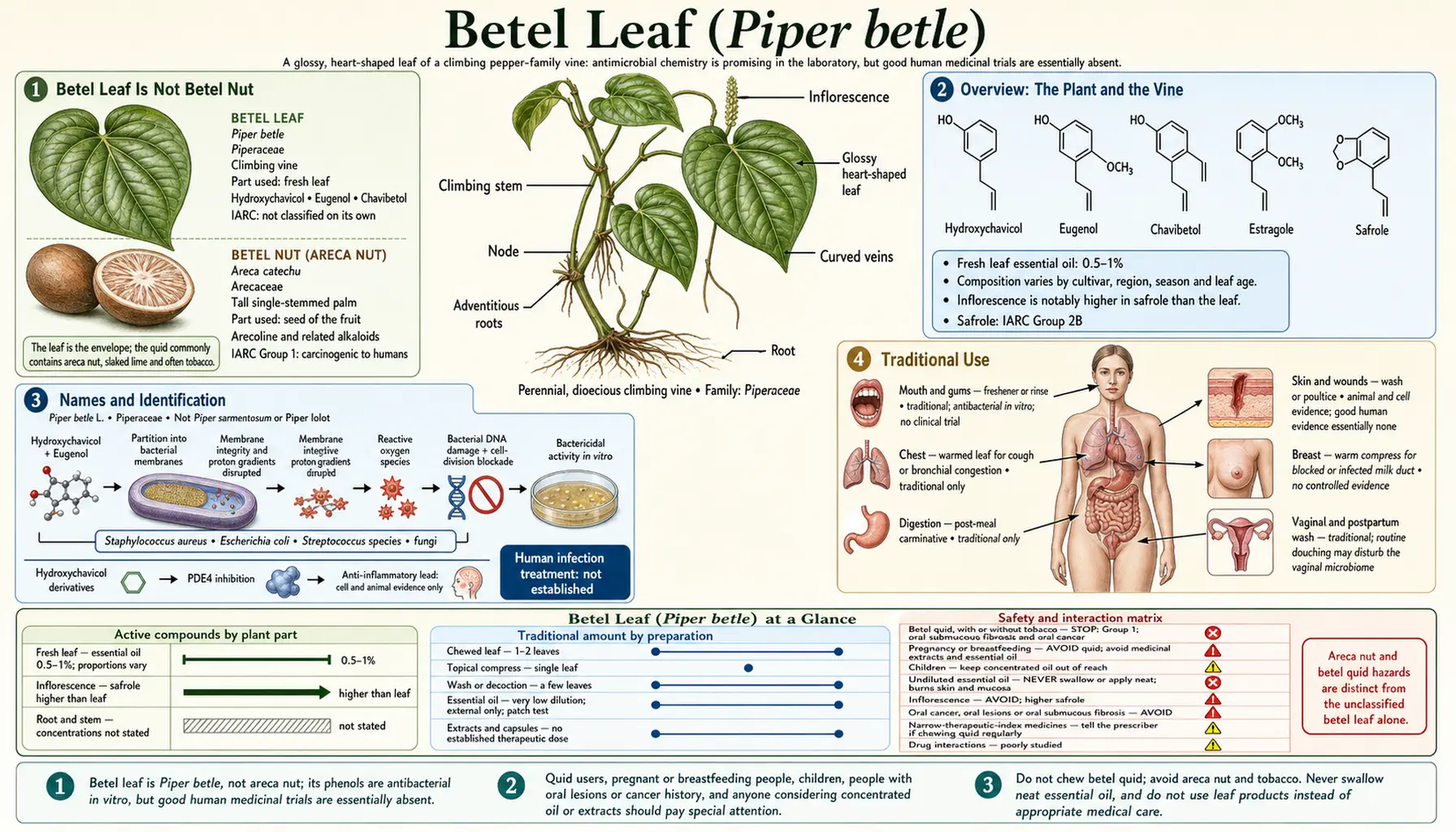
Betel leaf is the glossy, heart-shaped leaf of Piper betle, a climbing vine in the pepper family and a close relative of both black pepper and kava. Across South and Southeast Asia it is a wrapper, a mouth freshener, a folk wound dressing and a ritual offering, and it is chewed daily by tens of millions of people. The single most important thing to understand about it is that betel leaf is not betel nut. The leaf and the nut come from two unrelated plants; the Group 1 carcinogen classification that makes headlines belongs to the nut, not the leaf — but because the two are almost always chewed together in one quid, that distinction protects almost nobody in practice.
The leaf's own chemistry is genuinely interesting. Its essential oil is rich in hydroxychavicol, eugenol and chavibetol, and it kills bacteria reliably in a petri dish. But almost the entire medicinal literature on betel leaf is cell-culture and animal work. There are essentially no good human trials of betel leaf as a medicine, and this page will not pretend otherwise.
Table of Contents
- Betel Leaf Is Not Betel Nut
- Overview: The Plant and the Vine
- Names and Identification
- Traditional Use
- Active Compounds
- Antimicrobial Activity
- Wound Healing and Skin Use
- Antioxidant and Anti-Inflammatory Effects
- The Oral Health Paradox
- Culinary and Ritual Use
- Forms and Preparations
- Dosage
- Cautions and Contraindications
- Key Research Papers
- Connections
- Featured Videos
Betel Leaf Is Not Betel Nut
These are two different plants that share a name in English because they are eaten together.
| Betel leaf | Betel nut (areca nut) | |
|---|---|---|
| Species | Piper betle | Areca catechu |
| Family | Piperaceae (pepper family) | Arecaceae (palm family) |
| Growth form | Climbing vine | Tall single-stemmed palm |
| Part used | Fresh leaf | Seed of the fruit |
| Key compounds | Hydroxychavicol, eugenol, chavibetol | Arecoline and related alkaloids; polyphenols; tannins |
| IARC status | Not classified on its own | Group 1 — carcinogenic to humans |
In 2004 the International Agency for Research on Cancer evaluated betel-quid and areca-nut chewing and placed three things in Group 1, carcinogenic to humans: areca nut itself, betel quid with tobacco, and betel quid without tobacco. A later re-evaluation reaffirmed those conclusions. Piper betle leaf on its own has never been given a Group 1 classification — the carcinogenicity verdict attaches to the nut and to the quid it goes into.
Here is why that distinction is technically true and practically dangerous. A betel quid is a small parcel: a betel leaf smeared with slaked lime (calcium hydroxide) and folded around slices of areca nut, very often with tobacco, sometimes with catechu, gambier, cardamom, cloves or sweeteners. The leaf is the envelope. Almost nobody chews the leaf alone. So in the real world, being a "betel leaf user" and being an "areca nut user" are the same population, and the cancer risk they carry comes overwhelmingly from the nut, from the alkaline lime that drives formation of areca-derived nitrosamines in the mouth, and from tobacco when it is added.
The evidence that the quid itself is the hazard is strong and does not depend on tobacco. A meta-analysis by Gupta and Johnson of studies from South Asia and the Pacific found that betel quid without tobacco was still associated with a substantially increased incidence of oral cancer. A case-control study in Kerala led by Jacob and colleagues found betel quid without tobacco was a risk factor for oral precancerous lesions. Warnakulasuriya and Chen's 2022 review of human studies concluded that the human evidence implicating areca nut in oral cancer is now solid.
So the honest summary is this. If someone tells you "the leaf is fine, it's the nut that causes cancer," they are describing the toxicology correctly and the behaviour incorrectly. The exposure that matters is the quid, and the quid is what causes oral submucous fibrosis and oral squamous cell carcinoma. If you are trying to reduce harm, the target is the areca nut and the tobacco — and quitting the quid entirely is the only intervention with a good evidence base behind it. See the Betel Nut page for the full picture on the nut.
Overview: The Plant and the Vine
Piper betle L. is a perennial, dioecious climbing vine in the family Piperaceae — the same family and the same genus as black pepper (Piper nigrum), kava (Piper methysticum) and long pepper (Piper longum). It climbs by adventitious roots along the nodes and is grown up living support trees or on bamboo trellises. The leaves are alternate, glossy, distinctly heart-shaped at the base, with prominent curved veins, and they are aromatic when torn — a warm, peppery, slightly clove-like smell that comes from the phenolic essential oil.
The vine is native to the Malesian region and is now cultivated all across South and Southeast Asia: India, Bangladesh, Sri Lanka, Myanmar, Thailand, Vietnam, Malaysia, Indonesia, the Philippines, and parts of southern China, East Africa and the Pacific. Cultivation is intensive and labour-heavy. In West Bengal and Bangladesh the vines are grown in dense shaded enclosures — a boroj or betel garden — that keep humidity high and light diffuse. Leaves are picked by hand, sorted by size and tenderness, tied into bundles, and moved fast, because a betel leaf is a perishable fresh vegetable and loses value within days.
That perishability is why betel leaf occupies an unusual economic niche. It is not a dried spice traded across oceans like its cousin black pepper; it is a fresh crop with a short chain from grower to street vendor. In Indian and Bangladeshi cities the paan stall is a fixture of daily life, and the leaf reaches the customer within a day or two of being cut. Where the diaspora has carried the habit — the UK, the Gulf states, North America — the leaves arrive by air freight, which is one reason imported paan is expensive.
Different cultivars are genuinely different products. In India, magahi, banarasi, kapoori and meetha leaves are distinguished by pungency, thickness and sweetness, and command different prices. Chemotype varies with cultivar, region, season and leaf age, which is one reason published essential-oil analyses of Piper betle disagree with each other so often. When a study reports "betel leaf oil contains X percent hydroxychavicol," that number applies to the specific leaves that were extracted, not to betel leaf in general.
Names and Identification
Binomial: Piper betle L. Family: Piperaceae.
Regional names:
- Vietnamese: lá trầu, trầu không
- Malay / Indonesian: sirih (the quid is menyirih)
- Hindi / Urdu: paan, paan ka patta
- Thai: phlu (พลู)
- Bengali: paan
- Tamil: vettrilai
- Tagalog / Filipino: ikmo, buyo
- Sinhala: bulath
- Chinese: ju jiang (蒂酱)
Two name confusions worth knowing
1. Betel leaf vs. betel nut. Covered in full above. In English, "betel" alone is ambiguous and often means the nut. In most Asian languages the two have entirely separate names — sirih (leaf) and pinang (nut) in Malay, trầu and cau in Vietnamese — and the confusion is largely an English-language artefact.
2. Betel leaf vs. "wild betel leaf." This one trips up cooks constantly. The leaf used to wrap the Thai one-bite snack miang kham is cha phlu (Piper sarmentosum), not phlu (Piper betle). The leaf in the Vietnamese dish bò nướng lá lốt — grilled beef rolled in fragrant leaves — is lá lốt (Piper lolot, closely allied to P. sarmentosum), not betel leaf either. English menus and English-language recipe sites routinely translate both as "betel leaf," and packets in Asian groceries are often labelled "wild betel leaf" or "betel leaf" interchangeably. Practical distinctions: Piper sarmentosum and P. lolot leaves are thinner, softer, matte, mild and grassy; Piper betle leaves are thicker, waxy, glossier, and sharply pungent — you cannot eat a whole one comfortably. If a recipe asks you to eat several leaves at once, it means the mild Piper sarmentosum type.
3. Betel leaf vs. paan masala and gutka. "Paan" in casual English can mean the folded leaf parcel or it can mean commercially packaged paan masala and gutka — dry, sachet-sold mixtures of areca nut, catechu, lime and flavourings, usually with tobacco in the case of gutka, and with no leaf at all. These products carry the areca risk in a convenient, heavily marketed, cheap form, and several Indian states have banned gutka outright. If the product comes in a shiny sachet, there is no leaf in it.
Traditional Use
Betel leaf is one of the most culturally embedded plants in Asia, and its uses run from medicine to ceremony to courtship. Traditional use is history and ethnography — it tells you what people believed and did, not what works.
Ayurveda and Siddha. Betel leaf (tambula) is described as pungent, warming and carminative. It was used for digestion after meals, for cough and bronchial congestion (often warmed and applied to the chest), as a mouth freshener, and as a poultice on boils and swellings. Betel-leaf juice with honey was a household cough preparation.
Vietnamese thuốc nam. Betel leaves were crushed or infused for washing wounds and skin infections, for insect bites, and as a rinse for sore gums. A warm leaf compress was a common home treatment for a blocked or infected milk duct in nursing mothers — a use still widespread and still without controlled evidence.
Jamu and Malay tradition. Sirih is a foundational Jamu ingredient. Infusions of the leaf are used as a wash for vaginal hygiene and postpartum care, as a mouth rinse, and for eye irrigation, and packaged sirih feminine washes are sold across Indonesia and Malaysia today. Modern gynaecological advice cautions against routine vaginal douching of any kind, because it disturbs the vaginal microbiome.
Ceremony. Across South and Southeast Asia the betel leaf is a ritual object. In Vietnam, trầu cau — betel leaf and areca nut — is the traditional wedding offering, carrying a folk tale about fidelity and kinship; a Vietnamese wedding still includes a tray of it. In India, the leaf appears in puja offerings and in wedding and welcome rituals. In Malay and Indonesian custom, a formal presentation of sirih opens negotiation and marks respect. This ceremonial role is one reason public health campaigns against the quid meet resistance: they run against something that is not simply a habit but a marker of hospitality and identity.
Active Compounds
Betel leaf's pharmacology is dominated by simple phenylpropanoid phenols in the essential oil. The oil is typically 0.5–1% of the fresh leaf, and its composition varies widely with cultivar and region.
- Hydroxychavicol — a catechol (4-allylpyrocatechol), the compound most associated with betel leaf's antibacterial and antioxidant activity in the laboratory. Being a catechol, it oxidises easily and generates reactive oxygen species; that pro-oxidant behaviour is central to both its antimicrobial effect and its capacity to damage DNA at higher concentrations.
- Eugenol — the same phenol that dominates clove oil. Antiseptic, mildly anaesthetic, and responsible for much of the leaf's warm clove-like aroma.
- Chavibetol (betel phenol) and chavibetol acetate — isomers of eugenol, characteristic of Piper betle oil.
- Estragole (methyl chavicol) and safrole — present in variable, chemotype-dependent amounts. Both are naturally occurring but not benign: safrole is a rodent hepatocarcinogen and is classified by IARC as possibly carcinogenic to humans (Group 2B). Piper betle inflorescence, chewed with the quid in parts of Taiwan, is notably higher in safrole than the leaf.
- Terpenes — caryophyllene, cadinene, and others, contributing aroma.
- Other constituents — tannins, small amounts of flavonoids and carotenoids, calcium, and a modest amount of ascorbic acid.
Note what is not in the leaf: arecoline. That alkaloid, responsible for the mild stimulant buzz that quid chewers describe and for much of the nut's toxicity, comes entirely from the areca nut.
Antimicrobial Activity
Mechanism. Hydroxychavicol and eugenol are lipophilic phenols. They partition into bacterial membranes, disrupt membrane integrity and proton gradients, and generate reactive oxygen species inside the cell. Singh and colleagues, publishing in Free Radical Biology and Medicine in 2018, worked out a more specific mechanism: hydroxychavicol causes bacterial DNA damage and blocks cell division, in part by interfering with the division machinery. That is a plausible, well-characterised way for a small phenol to be bactericidal.
What the evidence shows. This is one of the few areas where betel leaf's reputation and the laboratory data actually line up — in vitro. Betel leaf extracts and essential oil inhibit a wide range of organisms in dish assays, including Staphylococcus aureus (including methicillin-resistant isolates), Escherichia coli, Streptococcus species, and various fungi. Raikwar and colleagues reported activity against MRSA clinical isolates in 2025. Ngamsurach and Praipipat quantified activity against S. aureus and E. coli using disc diffusion and batch experiments. Kulnanan and colleagues found antibacterial, antibiofilm and anti-adhesion effects against avian pathogenic E. coli. There is also applied food-science work: Basak and Guha modelled betel leaf essential oil suppressing Penicillium expansum growth on culture media, aimed at food preservation.
What the evidence does not show. All of this is cell-culture and applied microbiology, not clinical medicine. "Kills bacteria in a dish" is a low bar — vinegar, alcohol, cinnamon oil and tea tree oil all clear it. What is missing is any decent human trial showing that a betel leaf preparation cures an infection, shortens a course of illness, or matches a standard antiseptic. There is no evidence that chewing or drinking betel leaf produces antibacterial concentrations anywhere in the body other than transiently in the mouth. Treat betel leaf as a promising source of antimicrobial chemistry, not as an antibiotic.
Wound Healing and Skin Use
Mechanism. Two things plausibly help a wound here: local antisepsis from the phenols, and tannins, which are astringent and precipitate surface proteins to form a protective layer. Some laboratory work also suggests betel leaf extracts influence fibroblast behaviour and collagen deposition.
Human evidence: essentially none of good quality. Animal evidence: Keat and colleagues reported accelerated wound healing in experimentally diabetic rats treated with betel extract. Cell-culture evidence: Chế and colleagues, in Heliyon in 2021, studied betel leaf extract on umbilical cord-derived cells with a view to cutaneous wound treatment. Lien and colleagues, in Burns & Trauma in 2015, examined which leaf phytochemicals influence wound healing.
Rather more of the recent literature is materials science than herbal medicine: several groups have built wound dressings that carry betel leaf extract — chitosan/polyvinyl alcohol films, collagen scaffolds with chitosan microspheres. Those studies test an engineered dressing, not the folk practice of slapping a warmed leaf on a wound.
Practical read. A clean betel leaf is a reasonable improvised covering in a setting with no sterile dressing, and its phenols probably do some local good. It is not a substitute for washing a wound with clean water, for a proper dressing, or for antibiotics when a wound is infected. Do not use betel preparations on deep, dirty, or animal-bite wounds, on burns beyond very superficial, or on anything showing spreading redness, streaking or fever — those need medical care.
Antioxidant and Anti-Inflammatory Effects
Mechanism. Catechols like hydroxychavicol donate hydrogen atoms readily and quench free radicals efficiently in chemical assays, which is why betel leaf scores well on ORAC, DPPH and similar tests. More interestingly, Ou and colleagues reported in Bioorganic Chemistry in 2025 that hydroxychavicol derivatives from Piper betle act as phosphodiesterase-4 (PDE4) inhibitors with anti-inflammatory effects. PDE4 is a real drug target — roflumilast and apremilast work on it — so this is a mechanistically credible lead rather than a generic "antioxidant" claim.
Evidence level: cell culture and animal only. Chuljerm and colleagues found protective effects against oxidative stress in human nasal epithelial cells, and there are numerous rodent studies of betel extract on markers of oxidative stress. None of this has been tested in a human trial of any clinical outcome.
An important caveat about "antioxidant." Catechols are redox-active in both directions. The same chemistry that lets hydroxychavicol mop up radicals in a test tube lets it generate reactive oxygen species and damage DNA at higher concentrations — that is precisely the mechanism by which it kills bacteria. Do not assume that because a betel extract is "antioxidant" on an assay, a concentrated supplement of it is safe to swallow daily. It has not been studied that way.
The Oral Health Paradox
Betel leaf is a traditional mouth freshener and folk remedy for sore gums, and its chemistry gives that some plausibility: eugenol is used in dentistry, and the leaf oil inhibits several oral bacteria in vitro. Some research groups have explored betel-derived compounds for anti-plaque and anti-Streptococcus mutans applications.
Set against that, the oral cavity is exactly where quid chewing does its damage. Chewing a lime-smeared leaf around areca nut produces, over years, the clinical picture that dentists in South Asia see constantly:
- Oral submucous fibrosis — a progressive, largely irreversible stiffening of the lining of the mouth, driven principally by areca nut. Patients gradually lose the ability to open the mouth wide. It is a recognised premalignant condition.
- Oral leukoplakia and other potentially malignant lesions.
- Oral squamous cell carcinoma — among the most common cancers in men in parts of India, Taiwan and Papua New Guinea, and quid chewing is the dominant driver.
- Betel chewer's mucosa, deep red-brown staining of the teeth and gums, and gingival recession at the site where the quid is habitually parked.
Cirillo and colleagues published a scoping review in 2022 asking directly whether some quid mixtures are less harmful than others, and the pattern that emerges from that literature is that areca nut is the necessary ingredient, tobacco multiplies the risk, and the leaf is not where the danger lives. Lin and colleagues reviewed how cytochrome P450 enzymes metabolise betel-quid-derived compounds, work aimed at understanding why some chewers develop cancer and others do not.
The honest bottom line for oral health: a betel leaf mouth rinse is an unstudied folk practice with a plausible mechanism and no clinical trial behind it. Chewing the quid is a well-documented cause of oral cancer. If you want the mouth-freshening effect, chew fennel or cardamom.
Culinary and Ritual Use
Betel leaf is not really a culinary herb in the way basil or mint are. It is too pungent, too fibrous and too astringent to eat in quantity. Its food-adjacent roles are narrow:
- The quid wrapper. Its principal use, and the one this page has spent most of its length warning about.
- Sweet paan. Meetha paan is a tobacco-free, areca-free version filled with gulkand (rose petal preserve), fennel, coconut, dates, candied fruit and syrups, served as a dessert or digestive after a meal in Indian restaurants. This is the version with the least risk attached, though "areca-free" is worth verifying rather than assuming — many paan stalls add supari by default.
- Infusions. Betel leaf is occasionally brewed as a tea in Indonesia and Malaysia.
- Flavouring. Small amounts appear in a handful of regional dishes and drinks.
What betel leaf is not used for: the leaf-wrapped bites people most often associate with the name. Miang kham in Thailand uses cha phlu (Piper sarmentosum). Bò nướng lá lốt in Vietnam uses lá lốt (Piper lolot). Both of those are mild leaves you can eat by the handful. If a recipe calls for "betel leaves" and expects you to eat five of them wrapped around grilled beef, buy the wild betel leaf / lá lốt / cha phlu at the Asian grocery, not true Piper betle.
The ceremonial role is the other half of the story. In Vietnam, the betel-and-areca tray at a wedding is a required element of the engagement ceremony. In India, betel leaves accompany offerings in temple ritual, and giving paan to a departing guest is a courtesy. In Malay and Indonesian custom, presenting sirih in a decorated container opens a formal exchange. None of this is medicinal, and all of it matters for understanding why the habit is so hard to displace.
Forms and Preparations
- Fresh leaf. The traditional form for everything. Sold in bundles at South and Southeast Asian markets and at Indian and Vietnamese groceries in the West. Keep wrapped in a damp cloth in the refrigerator; they last a few days at most.
- Betel leaf essential oil. A concentrated phenolic oil, sold for aromatherapy and as an antimicrobial ingredient. Like clove oil, it is a mucous-membrane irritant and must never be swallowed neat or applied undiluted to skin.
- Aqueous or alcoholic extracts. Used in research, in some cosmetic and antiseptic products, and in Southeast Asian feminine-hygiene washes.
- Dried leaf powder and capsules. Sold online as a supplement. There is no dosing evidence, no standardisation, and no safety data for chronic use of concentrated leaf. This site does not recommend them.
- Betel-leaf mouth rinses and toothpastes. Marketed in India and Southeast Asia. Plausible, unproven.
- Betel-leaf inflorescence. Chewed with the quid in Taiwan. Higher in safrole than the leaf; avoid.
Dosage
There is no established therapeutic dose of betel leaf for any condition. No dose-ranging study, no standardised extract with a defined hydroxychavicol content, no pharmacokinetic data in humans. Any number a supplement label gives you was chosen by the manufacturer, not derived from evidence.
What can be said about traditional practice:
- Traditional culinary and post-meal use is one to two leaves, chewed and spat or swallowed — a fraction of a gram of leaf.
- Traditional topical use is a single leaf, warmed and applied, or a decoction of a few leaves in water used as a wash.
- Essential oil should be diluted to a very low percentage in a carrier oil if used on skin at all, patch-tested first, and never taken internally.
- Concentrated extracts and capsules: no dose can be recommended. The pro-oxidant chemistry that makes hydroxychavicol interesting is a reason for caution about daily concentrated intake, not a reason for confidence.
Cautions and Contraindications
1. The quid is the hazard, and the leaf is how it gets into the mouth. Chewing betel quid — with or without tobacco — causes oral submucous fibrosis and oral cancer, and is classified Group 1 carcinogenic to humans. Areca nut also carries cardiovascular, metabolic and dependence risks. If you chew, the intervention with real evidence behind it is stopping. Dentists and oral-medicine clinics in high-prevalence countries run cessation programmes; several countries and Indian states have banned gutka and paan masala outright. Regular oral screening is worthwhile for anyone with a long chewing history, because oral submucous fibrosis and leukoplakia are visible long before cancer is.
2. Pregnancy and breastfeeding. Avoid betel quid entirely — areca chewing in pregnancy has been associated with lower birth weight and adverse outcomes. For betel leaf alone, there is no safety data on medicinal or concentrated use in pregnancy; culinary amounts of the leaf are traditional in many cultures, but concentrated extracts and essential oil should be avoided. Eugenol- and safrole-containing oils are not appropriate in pregnancy.
3. Safrole and estragole. Some Piper betle chemotypes, and particularly the inflorescence, contain safrole, a rodent liver carcinogen classified IARC Group 2B. This is an argument against chronic high-dose consumption of concentrated leaf extract or essential oil, and against chewing the inflorescence.
4. Essential oil toxicity. Betel leaf oil is a phenol-rich essential oil in the same class as clove oil. Neat application burns skin and mucosa. Ingestion of concentrated phenolic oils can cause severe irritation and, in children, serious poisoning. Keep it out of reach of children.
5. Allergy and contact dermatitis. Occupational contact dermatitis is documented in betel-leaf handlers. Eugenol is a recognised contact allergen.
6. Drug interactions. Poorly studied. Two areas warrant care. Betel-quid constituents interact with cytochrome P450 enzymes, so anyone on narrow-therapeutic-index medication who chews regularly should mention it to a prescriber. And arecoline from the nut is a cholinergic agonist — a real concern for people with asthma, or on anticholinergic or cholinergic drugs. That risk belongs to the nut, not the leaf, but again, in practice they arrive together.
7. Who should avoid it. Anyone with a history of oral cancer or a potentially malignant oral lesion; anyone with oral submucous fibrosis; pregnant and breastfeeding women; children; and anyone tempted to take concentrated betel leaf extract as a daily supplement on the strength of petri-dish antimicrobial data.
8. See a clinician promptly if you chew and notice a white or red patch in the mouth that does not resolve in two weeks, a mouth ulcer lasting more than three weeks, a lump in the cheek or neck, burning on eating spicy food, or a progressive inability to open your mouth as wide as you used to. These are the early signs, and they are treatable when caught early.
Key Research Papers
- Gupta B, Johnson NW. Systematic review and meta-analysis of association of smokeless tobacco and of betel quid without tobacco with incidence of oral cancer in South Asia and the Pacific. PLoS One. 2014;9(11):e113385.
- Warnakulasuriya S, Chen THH. Areca nut and oral cancer: evidence from studies conducted in humans. Journal of Dental Research. 2022;101(10):1139–1146.
- Jacob BJ, Straif K, Thomas G, et al. Betel quid without tobacco as a risk factor for oral precancers. Oral Oncology. 2004;40(7):697–704.
- Cirillo N, Duong PH, Er WT, et al. Are there betel quid mixtures less harmful than others? A scoping review of the association between different betel quid ingredients and the risk of oral submucous fibrosis. Biomolecules. 2022;12(5):664.
- Jeng JH, Chang MC, Hahn LJ. Role of areca nut in betel quid-associated chemical carcinogenesis: current awareness and future perspectives. Oral Oncology. 2001;37(6):477–492.
- Biswas P, Anand U, Saha SC, et al. Betelvine (Piper betle L.): a comprehensive insight into its ethnopharmacology, phytochemistry, and pharmacological, biomedical and therapeutic attributes. Journal of Cellular and Molecular Medicine. 2022;26(11):3083–3119.
- Singh D, Narayanamoorthy S, Gamre S, et al. Hydroxychavicol, a key ingredient of Piper betle, induces bacterial cell death by DNA damage and inhibition of cell division. Free Radical Biology and Medicine. 2018;120:62–71.
- Ou J, Zhong F, Huang P, et al. Hydroxychavicol derivatives from Piper betle Linn. as natural PDE4 inhibitors with anti-inflammatory effects. Bioorganic Chemistry. 2025;157:108294.
- Raikwar G, Mohan S, Dahiya P, et al. Chemical composition, antibacterial and antioxidant activities of Piper betle and Anethum graveolens essential oils against methicillin-resistant Staphylococcus aureus clinical isolates. Brazilian Journal of Microbiology. 2025;56(2):1017–1031.
- Ngamsurach P, Praipipat P. Antibacterial activities against Staphylococcus aureus and Escherichia coli of extracted Piper betle leaf materials by disc diffusion assay and batch experiments. RSC Advances. 2022;12(40):26435–26454.
- Lien LT, Tho NT, Ha DM, et al. Influence of phytochemicals in Piper betle Linn leaf extract on wound healing. Burns & Trauma. 2015;3:23.
- Lin CY, Pan TS, Ting CC, et al. Cytochrome P450 metabolism of betel quid-derived compounds: implications for the development of prevention strategies for oral and pharyngeal cancers. The Scientific World Journal. 2013;2013:618032.
Live PubMed Searches
- Piper betle leaf pharmacology
- Hydroxychavicol
- Betel quid and oral submucous fibrosis
- Areca nut and oral cancer
- Piper betle essential oil antibacterial
- Piper betle wound healing
- Betel quid cessation interventions
- Piper sarmentosum (wild betel leaf)
- Safrole carcinogenicity
- Piper betle antioxidant and anti-inflammatory
Connections
- All Herbs
- Betel Nut — the areca palm seed that carries the carcinogenic risk in the quid.
- Black Pepper — Piper nigrum, the best-known member of the same genus.
- Kava — Piper methysticum, another Piper used as a social and ceremonial plant.
- Conditions on this site that reference this page: Helicobacter Pylori · Pseudomonas aeruginosa · Streptococcus pyogenes (Group A Strep) · Gingivitis · Halitosis (Chronic Bad Breath) · Periodontitis (Gum Disease) · Dentistry & Oral Health · Athlete's Foot (Tinea Pedis)