Tongkat Ali (Eurycoma longifolia)
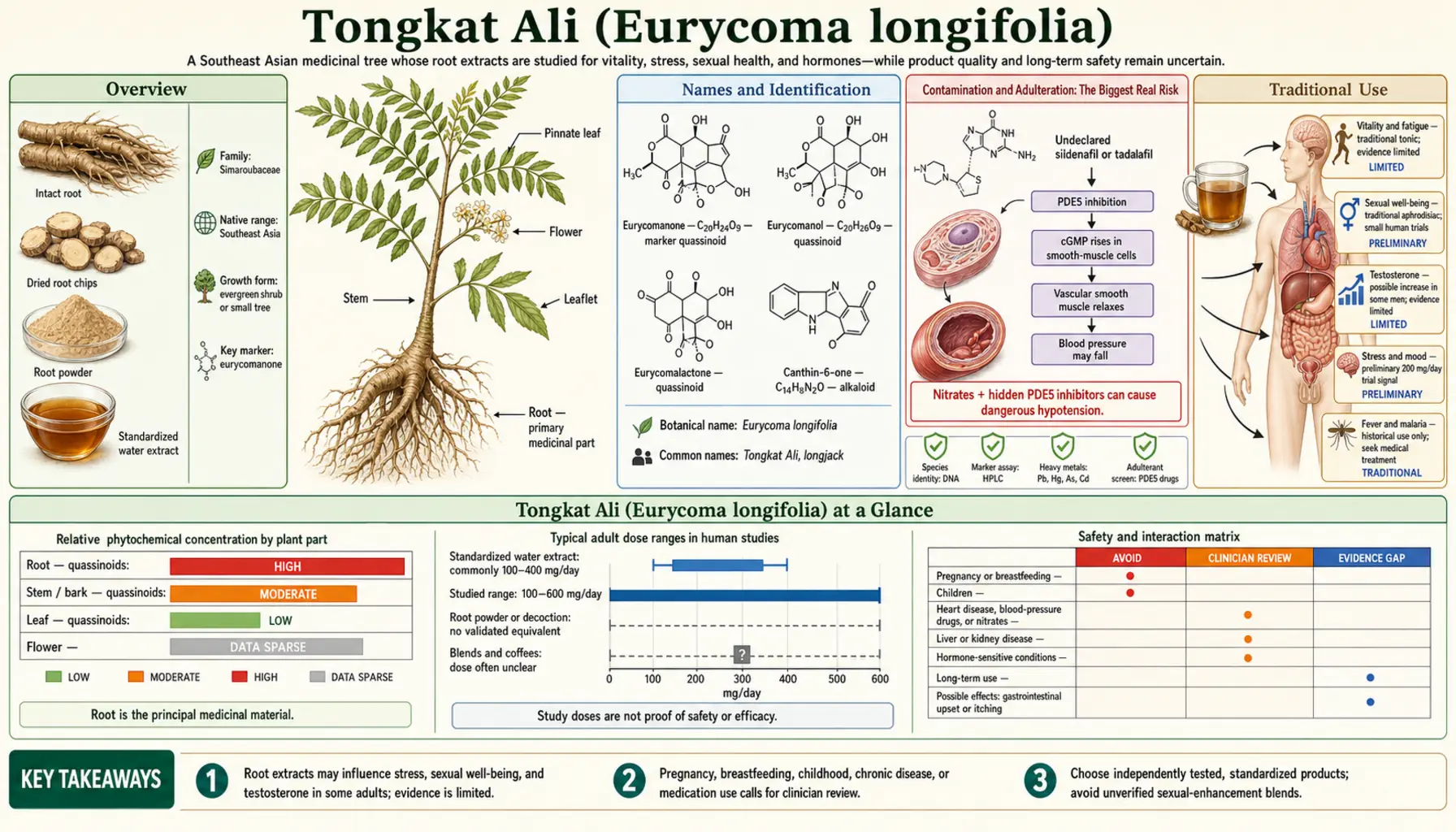
Tongkat ali is the bitter taproot of Eurycoma longifolia, a slender understory tree of the Malaysian and Indonesian rainforest, and it is probably the best-known traditional medicine to come out of Malaysia. It is sold worldwide for testosterone, libido, male fertility and stress, and unlike most herbs in that market it does have real randomised human trials behind it — but they are small, short, use different extracts at different doses, and several were funded by companies that sell the ingredient. The honest summary is that something may be there and it is not yet pinned down.
Two practical warnings belong at the very top, because they matter more to most buyers than any question about efficacy. First, Malaysian tongkat ali products have repeatedly been found contaminated with mercury and lead at levels above permitted limits. Second, this is one of the herbal categories where deliberate adulteration with actual pharmaceuticals — sildenafil analogues and related compounds — is a documented problem. What is inside a tongkat ali capsule is a genuine open question, and it is a bigger risk than the plant itself.
Table of Contents
- Overview
- Names and Identification
- Contamination and Adulteration: The Biggest Real Risk
- Traditional Use
- Active Compounds
- Testosterone in Ageing Men
- Male Fertility and Semen Quality
- Stress, Mood and Cortisol
- Strength, Body Composition and Athletes
- Forms and Preparations
- Dosage
- Cautions and Contraindications
- Key Research Papers
- Connections
- Featured Videos
Overview
Eurycoma longifolia Jack is a small, slow-growing tree in the family Simaroubaceae — the quassia family, a group defined chemically by intensely bitter compounds. It grows in the sandy, acid, well-drained soils of lowland rainforest in Peninsular Malaysia, Borneo, Sumatra, southern Thailand, Vietnam, Laos and Cambodia, usually as a spindly understory plant three to ten metres tall with a single unbranched stem and a crown of long compound leaves. It looks unremarkable. What people want is underground.
The medicinal part is the taproot: a long, straight, pale root that plunges almost vertically into the soil. The Malay name — tongkat Ali, "Ali's walking stick" — most likely describes that root's shape, although a folk reading connecting it to male vigour has followed the plant into every marketing brochure ever written about it. The root is harvested by digging the whole tree out, which kills it, and a root worth harvesting takes roughly four years and more usually eight to ten to reach useful size. That single fact explains most of what has gone wrong with the supply chain: wild harvest pressure has been heavy for decades, good roots are expensive, and expensive raw material attracts substitution and dilution. Malaysia has invested substantially in cultivating the plant on plantations and in developing standardised extracts precisely to get out of that trap.
The traditional preparation is a water decoction — thin slices of root boiled for a long time and drunk, or sold as a bundle of root chips with instructions to boil them. The taste is famously, memorably bitter, in the same league as gentian or quinine. In Malaysia the root also reaches people as an ingredient in instant coffee sachets and canned drinks, which is a modern retail format rather than a traditional one, and, as discussed below, historically one of the formats most likely to be adulterated.
Names and Identification
Binomial: Eurycoma longifolia Jack. Family: Simaroubaceae.
- Malay: tongkat ali; also penawar pahit ("bitter antidote") and bedara pahit.
- Indonesian: pasak bumi — "stake of the earth", again describing the root.
- Vietnamese: cây bá bệnh — literally "the hundred-diseases tree", the traditional Vietnamese name for a general-purpose tonic, and also mật nhân.
- Thai: plaa lai phueak and other regional names; the plant is used in southern Thai practice but is far more central to Malay medicine.
- English trade name: longjack — a market coinage, not a traditional name.
- Chinese: 東革阿里 (dōng gé ā lǐ), a phonetic transliteration of the Malay.
The name is shared with at least one entirely different plant, and this matters. In the Malaysian market, "tongkat ali" is sold in colour grades:
- Tongkat ali putih / kuning ("white" or "yellow") is the real Eurycoma longifolia — the plant every clinical trial has studied.
- Tongkat ali hitam ("black") is generally Polyalthia bullata, a member of the soursop family Annonaceae. It is a different genus, a different family, a different chemistry, and it has essentially no clinical literature of its own. It is nevertheless sold under the same name, at a premium, on the folk belief that black is stronger. The 2006 mercury-contamination survey that found the worst readings was specifically a survey of tongkat ali hitam preparations.
- Tongkat ali merah ("red") is a third market grade whose botanical identity is inconsistent between vendors.
If a product does not print the binomial Eurycoma longifolia on the label, you do not know which plant you have bought. That is not a pedantic point — it is the difference between a substance with several randomised trials and a substance with none.
Contamination and Adulteration: The Biggest Real Risk
Most herb pages put safety at the bottom. For tongkat ali it has to come near the top, because the documented problems are with the products rather than with the plant, and they are not hypothetical.
Heavy metals. Ang Hooi Hoon and colleagues at Universiti Sains Malaysia ran a long series of surveys of Malaysian herbal preparations through the 2000s. In one study of tongkat ali preparations bought on the Malaysian market, samples were analysed for mercury by cold-vapour atomic absorption spectrophotometry and a substantial proportion exceeded the Malaysian regulatory limit for mercury in traditional medicines. A second survey, focused on tongkat ali hitam preparations, found the same problem. The same research group published parallel findings for lead and arsenic across the broader Malaysian herbal market. Heavy metals do not come from the plant's own metabolism; they come from contaminated soil, from processing equipment, from adulterants deliberately added as fillers or colourants, and from traditional formulations that historically included mineral ingredients. The practical consequence is that a tongkat ali product should be one you can see a third-party heavy-metal certificate of analysis for. Not a general "quality tested" claim on the bottle — an actual lot-specific report showing lead, mercury, arsenic and cadmium in parts per million.
Pharmaceutical adulteration. Products sold for sexual performance are, across every regulatory jurisdiction that has looked, the herbal category most often spiked with real drugs. Said and colleagues published a screening method specifically because sildenafil analogues were turning up in Eurycoma longifolia products — that is, products marketed as a natural alternative to erectile-dysfunction medication were in some cases simply erectile-dysfunction medication in a capsule with a leaf on the label. The analogues used are often modified versions of sildenafil or tadalafil that evade routine screening but retain the pharmacology, including the pharmacology that can drop blood pressure dangerously in someone taking nitrates for angina. A man who avoids his cardiologist's prescription because he prefers "something natural", and then takes an adulterated capsule, has combined the worst of both worlds.
Neither of these is an argument that the herb is dangerous. They are an argument that the supply chain is the risk, and that sourcing deserves more of your attention than dosing does.
Traditional Use
In Malay traditional medicine tongkat ali was a broad tonic rather than a narrow sexual remedy. Root decoctions were given for fever — including as a malaria remedy across the region — and for dysentery, jaundice, aches, ulcers, boils, wounds, high blood pressure and general fatigue and post-illness weakness. The penawar pahit name, "bitter antidote", reflects a use as an all-purpose counteragent to poisons and unwellness. In Indonesian jamu practice pasak bumi occupies the same broad tonic position, and in Vietnamese thuốc nam the name cây bá bệnh literally advertises the same generality.
Use as a male aphrodisiac and postpartum tonic is real and long-standing, but it is one strand of a much wider traditional profile, and the modern global framing of tongkat ali as essentially a testosterone product is a marketing narrowing rather than a faithful reading of the tradition. The antimalarial use, interestingly, is the one with the clearest chemical rationale: the quassinoids in the root have measurable activity against Plasmodium falciparum in laboratory assays. That is not a recommendation — malaria is a medical emergency treated with artemisinin combination therapy — but it is a reminder that traditional users were not simply guessing.
Traditional use tells us where to look. It is history, not evidence of effect.
Active Compounds
The root contains several structurally distinct groups of compounds, and the arguments about which one matters are not settled.
- Quassinoids — the degraded triterpene lactones that give the Simaroubaceae family its name and its taste. Eurycomanone is the principal one and is the marker compound used to standardise commercial extracts; related molecules include eurycomanol, eurycomalactone and the longilactones. Quassinoids are the bitter principles, and they are pharmacologically active in their own right: in cell culture they show antimalarial and cytotoxic activity. That cytotoxicity is worth naming plainly — this is not an inert plant sugar, it is a class of compound that kills cells in a dish at high enough concentration.
- Eurypeptides — small peptides isolated from hot-water extracts of the root. Because the traditional preparation is a water decoction and most of the clinical trials use standardised water extracts, the peptide fraction is the one most often credited with the hormonal effects. The mechanistic case for this is suggestive rather than proven.
- Canthin-6-one alkaloids — a family of indole alkaloids, including 9-methoxycanthin-6-one, associated in laboratory work with antimicrobial and cytotoxic activity.
- Other constituents — β-carboline alkaloids, tirucallane-type triterpenes, squalene derivatives and various phenolics, all present in smaller quantities.
What standardisation means on a label. Most reputable products state a eurycomanone percentage, commonly somewhere around one to two percent, or state a water-extract ratio such as 100:1 or 200:1. Neither number tells you as much as it appears to. A ratio describes how much raw root went in, not how much of anything active came out, and different manufacturers calculate ratios differently. A eurycomanone percentage is more meaningful, but eurycomanone may not be the constituent responsible for the hormonal effects at all — if the eurypeptide hypothesis is right, a highly concentrated eurycomanone extract could in principle be further from the tested preparations than a plain water extract. This is exactly why "tongkat ali" as a category is so hard to reason about: the trials tested specific extracts, and the retail shelf sells dozens of different ones under one name.
Testosterone in Ageing Men
Proposed mechanism. Three ideas circulate. The first is that the extract raises free testosterone by loosening the grip of sex hormone-binding globulin, which normally holds most circulating testosterone in an inactive form — the analogy usually offered is releasing money from a locked account rather than earning more of it. The second is that it supports steroidogenesis directly in the Leydig cells of the testis. The third is that it lowers cortisol, and since cortisol and testosterone tend to move in opposite directions under stress, lowering one lifts the other. None of these has been demonstrated convincingly in humans. They are hypotheses that fit the observations, and more than one of them may be partly right.
Human evidence. This is the most-studied claim and it is worth being precise about what exists.
A 2022 systematic review and meta-analysis by Leisegang and colleagues pooled the available clinical trials and concluded that Eurycoma longifolia supplementation increased serum total testosterone in men. That is the strongest single statement anyone can currently make in the herb's favour, and it is a real one. But a meta-analysis inherits the weaknesses of its inputs, and the inputs here are a small number of trials that differ in extract, dose, duration and — crucially — in the men studied. Pooling a trial in hypogonadal 60-year-olds with a trial in healthy 25-year-olds produces an average that describes neither.
Chinnappan and colleagues ran a randomised, double-blind, placebo-controlled multicentre trial of a standardised aqueous root extract in ageing men, reporting effects on testosterone and quality-of-life measures. Tambi and colleagues had earlier reported that a standardised water-soluble extract raised testosterone in men with late-onset hypogonadism — one of the most-cited results in the whole literature, and also a small one that is routinely cited far beyond what its size supports. Leitão and colleagues ran what is, at six months, the longest and one of the more rigorous trials: a double-blind, placebo-controlled randomised study of tongkat ali combined with concurrent exercise training in ageing men with androgen deficiency. Testing a supplement on top of an intervention as powerful as structured resistance training is a demanding design, and readers should treat it as the most informative single trial to look up.
Against that, Chan and colleagues examined reproductive hormone regulation in young males — an important counterweight, because the positive literature is concentrated in older, stressed or hypogonadal men. A compound that helps a struggling system may do very little in a healthy one, and the burden of proof for the twenty-five-year-old buying it at a gym is different from the burden for the sixty-year-old with a documented low reading.
What weighs against all of it. No individual trial is large; several enrolled fewer than a hundred people and many ran four to twelve weeks. Several of the positive trials tested one patented standardised water extract (marketed as Physta) with the support of the company that manufactures it. That is disclosed openly in the papers rather than hidden, and industry funding does not make a result false — but it is a reason to want independent replication before treating the effect as established. And a change in a blood testosterone number is not the same as a change in how someone feels or functions; the trials that measured symptoms and quality of life alongside hormones are the ones worth reading closely.
Male Fertility and Semen Quality
Proposed mechanism. Whatever supports testosterone production in the testis would also be expected to support spermatogenesis, and several of the root's constituents show antioxidant activity in laboratory assays — relevant because oxidative damage to sperm DNA is one recognised contributor to idiopathic male infertility.
Human evidence. Tambi and Imran reported improvements in semen parameters in men with idiopathic infertility taking a standardised extract. It is a genuinely interesting result and it is the main basis for the fertility claim. It is also a single small study, and semen parameters are notoriously variable within the same man from month to month — sperm concentration can swing widely with a fever, a hot bath, a stressful quarter at work, or simply the interval since the last ejaculation. That variability is exactly why uncontrolled improvements in semen numbers are weak evidence, and it is why this result needs replication in a larger placebo-controlled trial before it should change anyone's plans.
Most of the remaining fertility literature is in rats. Rodent studies consistently report increases in sperm count and testosterone with Eurycoma extracts, which is why the hypothesis is taken seriously, but rodent reproductive physiology is not a reliable guide to human outcomes and the doses used are frequently far higher than anything a person takes.
The practical framing. Male-factor infertility is diagnosable. A semen analysis costs relatively little and is available through any fertility clinic and most primary-care referrals. If conception is the goal, the sequence that helps is: get the analysis, get a hormone panel, look for the treatable causes — varicocele, thyroid disease, medication effects, obesity, heavy alcohol use, anabolic steroid history — and treat those. A herb with one small supporting study is a reasonable thing to add to that process if you want to. It is a poor substitute for it, and the months spent finding out are months that matter when age is a factor.
Stress, Mood and Cortisol
Proposed mechanism. Tongkat ali is often described as an adaptogen, meaning a substance claimed to buffer the body's stress response rather than stimulate or sedate it. The specific proposal here is modulation of the hypothalamic–pituitary–adrenal axis, with a resulting fall in cortisol.
Human evidence. Talbott and colleagues gave a standardised extract to moderately stressed adults for four weeks and reported reductions in salivary cortisol alongside improvements in mood scores — the tension, anger and confusion subscales of a standard mood inventory. This trial is small and short, but its design is a sensible one: it recruited people who were actually stressed, rather than healthy volunteers with nothing to improve, and it measured a hormone and a symptom together. George and colleagues later ran a randomised placebo-controlled trial of a water extract combined with multivitamins, again looking at quality of life, mood and stress. That combination design is a real limitation — when a product contains a herb and a multivitamin and the result is positive, the herb has not been isolated.
Interest in this application has since widened beyond men: a registered randomised trial protocol has been published for a standardised water extract in perimenopausal and postmenopausal women, which is a notable direction of travel for a herb with such a strongly male marketing identity.
Overall the stress evidence is thinner than the testosterone evidence but points the same way, and the two claims are not independent — if the cortisol effect is real, it may be the mechanism behind the hormone effect rather than a separate benefit.
Strength, Body Composition and Athletes
Proposed mechanism. If testosterone rises, muscle protein synthesis and training adaptation should follow. This is the reasoning behind tongkat ali's presence in a large share of the sports-supplement market.
Human evidence. Chen and colleagues combined Eurycoma longifolia supplementation with resistance training and measured isokinetic muscular strength and power. Kreipke and colleagues tested a multi-ingredient performance supplement containing tongkat ali among other components over four weeks, looking at strength, body composition and anabolic hormones — and multi-ingredient trials, whatever they find, cannot tell you which ingredient did it. The Leitão six-month trial discussed above also sits in this space, because it paired the herb with structured training.
The honest read. The training itself is doing the overwhelming majority of the work in every one of these studies. There is no human trial showing that tongkat ali produces meaningful strength or lean-mass gains on its own, and the effect sizes involved — even taking the hormone findings at face value — are nowhere near what an actual anabolic steroid does. Anyone whose mental model is "natural steroid" has the wrong model.
Athletes subject to drug testing have an additional problem. Tongkat ali itself is not a prohibited substance, but the sexual-performance and testosterone-booster shelf is one of the most heavily adulterated in the supplement industry, and an athlete who tests positive because of an undeclared steroid or steroid precursor in a capsule bears the consequence regardless of intent. Competing athletes should use only products certified under a third-party sport programme, or use none.
Forms and Preparations
- Root chips for decoction — the traditional form, sold as bundles of dried, sliced taproot. Simmered in water for anything from twenty minutes to several hours and drunk as a bitter tea, often re-boiled two or three times. This is closest to what tradition actually used and the water-extraction chemistry matches what most trials tested. It is also the form in which you can at least see that you have bought woody root rather than powder of unknown origin.
- Standardised water extracts in capsules — the form used in essentially all the randomised trials, typically labelled with a eurycomanone percentage or an extract ratio. If you intend to take tongkat ali because of the clinical evidence, this is the form the clinical evidence is about.
- Unstandardised root powder in capsules — cheap, common, and a black box. Nothing on the label constrains what is inside.
- Instant coffee and canned drink sachets — enormously popular across Malaysia, Singapore and Indonesia. Convenient, pleasant, and historically the format most associated with pharmaceutical adulteration, because sweetened coffee masks both the bitterness of the root and the taste of anything else added.
- Tinctures and liquid extracts — less common, and alcohol extraction pulls a different constituent profile than water, so a tincture is not chemically interchangeable with the tested preparations.
Reading a label, in order of importance: the binomial Eurycoma longifolia (not just "tongkat ali"); a lot-specific third-party certificate of analysis covering heavy metals; a stated standardisation; and a country of manufacture with a functioning regulator. A product that satisfies all four costs more. It is the one part of this decision where paying more genuinely buys something.
Dosage
There is no established therapeutic dose, no official monograph dose, and no dose–response study adequate to define one. What follows is a description of what the trials used, not a recommendation.
- Standardised water extract: the clinical trials cluster in the range of roughly 200 to 400 mg per day of a standardised aqueous extract, taken once daily, usually in the morning. Some trials used 200 mg; some used 300 or 400 mg. Doses above this range have not been shown to do more, and there is no evidence that more is better.
- Traditional decoction: a handful of root chips — commonly cited as somewhere in the region of 10 to 20 grams of dried root — simmered in water. Traditional dosing is imprecise by nature and the extraction efficiency of a home decoction is unknown.
- Duration in trials: most ran four to twelve weeks; the longest ran six months. Nothing is known about taking it for years.
- Cycling: the widespread advice to cycle five days on, two days off, or five weeks on and a break, has no evidence behind it in either direction. It is a supplement-industry convention, not a finding.
If you take it, take it for a defined period — eight to twelve weeks — with a way of measuring whether anything happened. For a testosterone indication, that means a baseline blood panel and a repeat panel, ordered by a clinician who knows you are taking it. Taking a hormone-active herb indefinitely without measuring anything is how people spend years and hundreds of dollars on a product that was never doing anything for them.
Cautions and Contraindications
Product contamination is the leading risk. Mercury and lead above regulatory limits have been documented repeatedly in Malaysian tongkat ali preparations, and sildenafil analogues have been documented in Eurycoma products. Both facts should govern how you buy far more than how you dose. Do not buy tongkat ali from an unbranded market stall, an anonymous online seller, or any source that cannot produce a lot-specific heavy-metal analysis. Coffee and drink sachets deserve particular scepticism.
Hormone-sensitive conditions. Anyone with prostate cancer, a history of prostate cancer, benign prostatic hyperplasia with significant symptoms, or a raised PSA should not take a supplement marketed for raising testosterone without their urologist's involvement. The same caution applies to men on testosterone replacement therapy — adding an unmeasured hormone-active herb to a monitored hormone protocol makes the monitoring meaningless. Because oestrogenic and anti-oestrogenic activities have both been reported for Eurycoma constituents in laboratory work, women with hormone-sensitive breast or uterine conditions should also avoid it.
Immunosuppressant therapy. Laboratory work reports immunostimulant activity for several Eurycoma constituents. Anyone taking immunosuppressive medication — after a transplant, or for an autoimmune disease — should avoid the herb, on the general principle that a substance which may push the immune system in the opposite direction to the prescription is not worth the uncertainty.
Pregnancy and breastfeeding. Avoid. Quassinoids are biologically active compounds with reported effects on reproductive tissue in animal studies, safety in human pregnancy is entirely unstudied, and the contamination risk described above is unacceptable in pregnancy on its own.
Children and adolescents. Avoid. There is no safety data, and a herb marketed for raising testosterone has no business anywhere near a developing endocrine system.
Drug interactions. Formal human interaction studies are lacking. Reasonable caution applies to: anticoagulants and antiplatelet drugs (some constituents affect platelet function in laboratory assays); antidiabetic drugs, since blood-glucose-lowering effects have been reported in animals and additive effects could cause hypoglycaemia; antihypertensives, for the same additive reason; and propranolol, for which reduced absorption has been reported. Any product adulterated with a sildenafil analogue would interact catastrophically with nitrates — nitroglycerin, isosorbide — which is a further reason to treat sourcing as a safety issue rather than a quality preference.
Liver and kidney disease. Toxicity studies in animals, including an oral toxicity study of a tongkat ali-infused coffee, have generally not shown liver or kidney damage at ordinary doses, and a Malaysian safety assessment of a combined Eurycoma and Labisia pumila formulation reached a similar conclusion. That is reassuring as far as it goes. It does not cover long-term human use, and anyone with existing liver or kidney impairment should not take an unnecessary supplement whose clearance pathways are not characterised.
Reported side effects. In the trials, adverse events were generally mild and comparable to placebo: insomnia and restlessness (which is why it is usually taken in the morning), irritability, and gastrointestinal upset. Some users report an increase in body odour. The bitterness itself is enough to stop some people.
Key Research Papers
- Leisegang K, Finelli R, Sikka SC, et al. Eurycoma longifolia (Jack) improves serum total testosterone in men: a systematic review and meta-analysis of clinical trials. Medicina (Kaunas). 2022;58(8).
- Leitão AE, Vieira MCS, Pelegrini A, et al. A 6-month, double-blind, placebo-controlled, randomized trial to evaluate the effect of Eurycoma longifolia (Tongkat Ali) and concurrent training on erectile function and testosterone levels in androgen deficiency of aging males (ADAM). Maturitas. 2021;145:78–85.
- Chinnappan SM, George A, Pandey P, et al. Effect of Eurycoma longifolia standardised aqueous root extract–Physta on testosterone levels and quality of life in ageing male subjects: a randomised, double-blind, placebo-controlled multicentre study. Food and Nutrition Research. 2021;65.
- Chan KQ, Stewart C, Chester N, et al. The effect of Eurycoma longifolia on the regulation of reproductive hormones in young males. Andrologia. 2021;53(4):e14001.
- Tambi MI, Imran MK, Henkel RR. Standardised water-soluble extract of Eurycoma longifolia, Tongkat ali, as testosterone booster for managing men with late-onset hypogonadism? Andrologia. 2012;44 Suppl 1:226–230.
- Tambi MI, Imran MK. Eurycoma longifolia Jack in managing idiopathic male infertility. Asian Journal of Andrology. 2010;12(3):376–380.
- Talbott SM, Talbott JA, George A, et al. Effect of Tongkat Ali on stress hormones and psychological mood state in moderately stressed subjects. Journal of the International Society of Sports Nutrition. 2013;10(1):28.
- George A, Udani J, Abidin NZ, et al. Efficacy and safety of Eurycoma longifolia (Physta) water extract plus multivitamins on quality of life, mood and stress: a randomized placebo-controlled and parallel study. Food and Nutrition Research. 2018;62.
- Ang HH, Lee EL, Cheang HS. Determination of mercury by cold vapor atomic absorption spectrophotometer in Tongkat Ali preparations obtained in Malaysia. International Journal of Toxicology. 2004;23(1):65–71.
- Ang HH, Lee KL. Contamination of mercury in tongkat Ali hitam herbal preparations. Food and Chemical Toxicology. 2006;44(8):1245–1250.
- Said MM, Gibbons S, Moffat AC, et al. Rapid detection of sildenafil analogue in Eurycoma longifolia products using a new two-tier procedure of the near infrared (NIR) spectra database. Food Chemistry. 2014;158:296–301.
- Rehman SU, Choe K, Yoo HH. Review on a traditional herbal medicine, Eurycoma longifolia Jack (Tongkat Ali): its traditional uses, chemistry, evidence-based pharmacology and toxicology. Molecules. 2016;21(3):331.
- Bhat R, Karim AA. Tongkat Ali (Eurycoma longifolia Jack): a review on its ethnobotany and pharmacological importance. Fitoterapia. 2010;81(7):669–679.
- Ahmad N, Teh BP, Halim SZ, et al. Eurycoma longifolia-infused coffee — an oral toxicity study. Nutrients. 2020;12(10).
- Teh BP, Ahmad N, Ibnu Rasid EN, et al. Herbal-based formulation containing Eurycoma longifolia and Labisia pumila aqueous extracts: safe for consumption? Pharmaceuticals (Basel). 2021;14(2).
Live PubMed Searches
- Eurycoma longifolia — randomised controlled trials
- Eurycoma longifolia and testosterone
- Eurycomanone — pharmacology
- Tongkat ali — lead and arsenic contamination
- Herbal supplement adulteration with sildenafil analogues
- Eurycoma longifolia — male infertility and semen quality
- Eurycoma longifolia — toxicity studies
- Eurycoma longifolia — antimalarial activity
- Polyalthia bullata — "black tongkat ali"
- Eurycoma longifolia — exercise performance
Connections
- All Herbs
- Kacip Fatimah (Labisia pumila) — Malaysia's women's-health counterpart, frequently formulated alongside tongkat ali and studied in the same Malaysian research programmes.
- Ginseng — the other great root tonic of the region, with a far larger and better-replicated clinical literature.
- Ashwagandha — the Ayurvedic adaptogen with overlapping cortisol and testosterone claims and, on the whole, stronger trial evidence for the stress indication.
- Maca — the Andean root marketed for libido, notable because its human trials suggest a libido effect without a hormone change.
- Tribulus — the other major "testosterone booster" herb, and a useful comparison: its human evidence for raising testosterone is largely negative.