Stevia (Stevia rebaudiana)
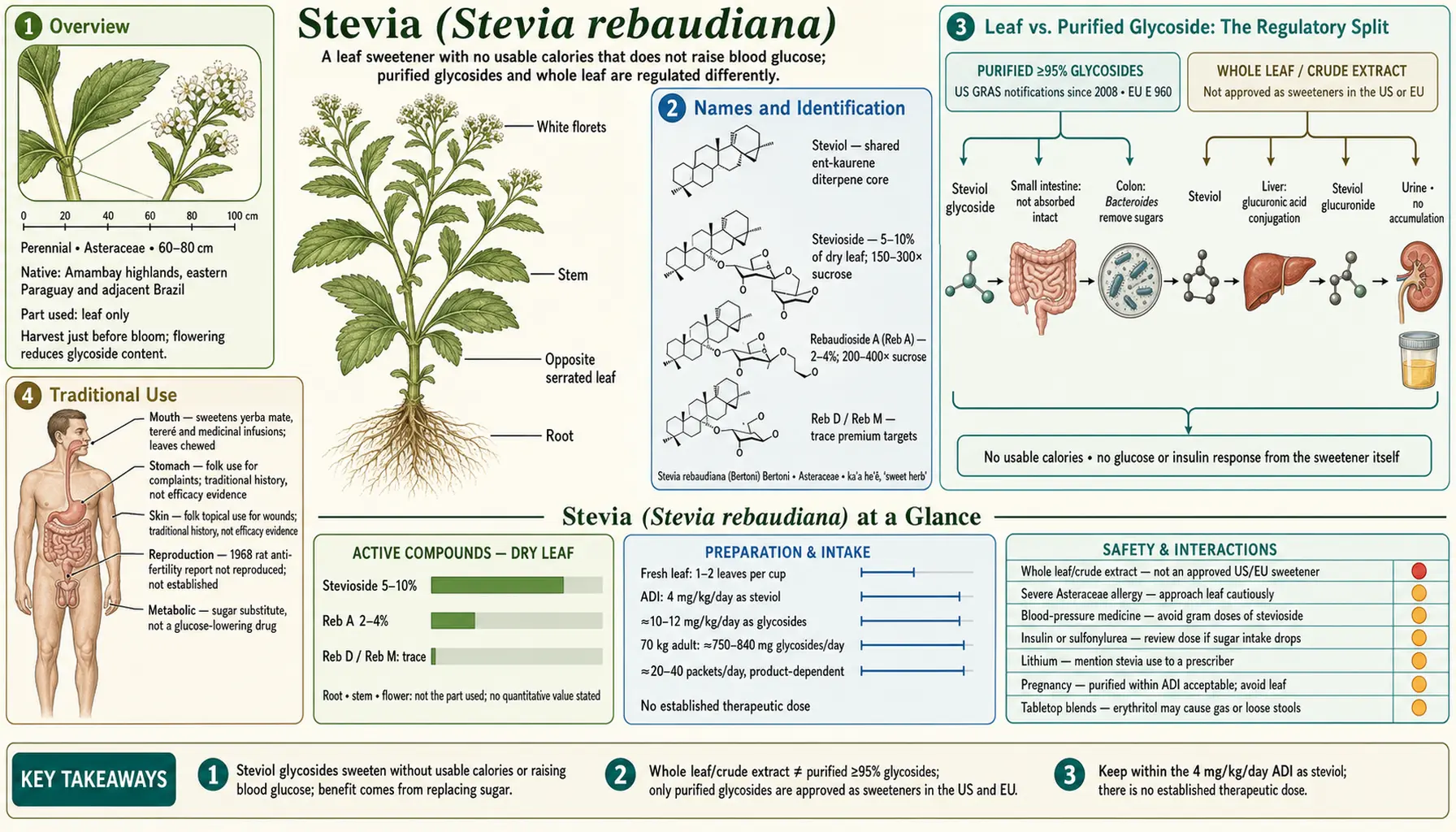
Stevia is a small shrub from the Paraguay–Brazil borderlands whose leaves are 200 to 350 times sweeter than sugar, contain no usable calories, and do not raise blood glucose. The Guaraní have used it for centuries as ka'a he'ê, sweet herb; it is now a global commodity crop grown mainly in China and Southeast Asia, and the sweetener in tens of thousands of products.
The single most useful fact on this page is a regulatory one, and it surprises almost everyone: purified steviol glycosides and stevia leaf are not the same regulatory object. Purified steviol glycosides at 95% or higher are approved as sweeteners in the United States, the European Union and most of the world. Whole stevia leaf and crude leaf extracts are not approved as sweeteners in either the US or the EU. A packet of Reb A and a bag of dried stevia leaf tea are legally, and to a lesser degree scientifically, different things.
Table of Contents
- Overview
- Names and Identification
- Leaf vs. Purified Glycoside: The Regulatory Split
- Traditional Use
- Active Compounds: The Steviol Glycosides
- Why Products Taste So Different
- How the Body Handles Stevia
- Blood Glucose and Insulin
- Blood Pressure
- The Gut Microbiome Question
- Appetite, Weight and Sweetness Compensation
- Culinary Use
- Forms and Preparations
- Dosage and the Acceptable Daily Intake
- Cautions and Contraindications
- Key Research Papers
- Connections
- Featured Videos
Overview
Stevia rebaudiana (Bertoni) Bertoni is a perennial member of Asteraceae, the daisy and sunflower family — relatives include chrysanthemum, marigold, ragweed, artichoke, chamomile and lettuce. It grows to about 60–80 cm, with small opposite serrated leaves and inconspicuous white florets. It is native to a narrow area in the Amambay highlands of eastern Paraguay and adjacent Brazil, where it grows on the margins of marshland in acidic, sandy soils.
The part used is the leaf, and only the leaf. The sweetness lives in the leaf tissue, concentrated as the plant approaches flowering; commercial growers harvest just before bloom, because flowering reduces glycoside content.
Cultivation has moved almost entirely away from the plant's homeland. China is by a wide margin the largest producer of stevia leaf and of extracted steviol glycosides, with substantial additional production in Paraguay, Brazil, Argentina, India, Vietnam, Indonesia and Kenya. In Vietnam the plant is grown as cỏ ngọt, in Thailand as หญ้าหวาน — both meaning, straightforwardly, "sweet grass".
Industrial processing is closer to tea manufacture than to chemistry: dried leaves are extracted with hot water, the extract is clarified, passed through resins, decolourised, concentrated and crystallised, and the target glycoside is separated by repeated crystallisation from ethanol or methanol. Newer high-value glycosides such as rebaudioside M are increasingly made by bioconversion — enzymes or engineered yeast adding sugar units to a cheaper starting glycoside — because they occur in the leaf at well under 1%.
Names and Identification
- Binomial: Stevia rebaudiana (Bertoni) Bertoni. Family Asteraceae.
- Guaraní: ka'a he'ê — "sweet herb". Sometimes written kaa he-he.
- Spanish / Portuguese: hierba dulce, yerba dulce, erva-doce (note: erva-doce in Portuguese more often means fennel or anise, a real source of confusion).
- Vietnamese: cỏ ngọt.
- Thai: หญ้าหวาน (ya wan).
- Chinese: 甜叶菊 (tián yè jú), "sweet leaf chrysanthemum".
- Japanese: ステビア.
The species was described by the Swiss-born Paraguayan botanist Moisés Santiago Bertoni around the turn of the twentieth century, which is why his name appears twice in the authority. The sweet principle, stevioside, was isolated by the French chemists Bridel and Lavieille in 1931. Japan commercialised stevia sweeteners in the 1970s, decades before Western regulators accepted them, and Japanese consumption of stevia in soft drinks and pickles is the longest continuous record of large-scale human use.
One name ambiguity worth flagging: the genus Stevia contains more than 200 species and nearly all of them are not sweet. Only S. rebaudiana, and to a much lesser degree S. phlebophylla, produce the sweet glycosides. "Stevia" on a label always means S. rebaudiana.
Leaf vs. Purified Glycoside: The Regulatory Split
This section is the practical heart of the page.
Purified steviol glycosides — approved. In the United States, high-purity steviol glycosides (conventionally defined as not less than 95% total steviol glycosides on a dry basis) have been the subject of successful GRAS — Generally Recognized As Safe — notifications since 2008, and the FDA has not objected to their use as general-purpose sweeteners. In the European Union they are authorised as the food additive E 960. Similar approvals exist in Japan, Australia and New Zealand, Canada, Brazil, China and most other major markets.
Whole leaf and crude extract — not approved. The FDA has explicitly stated that whole stevia leaf and crude stevia extracts are not GRAS and have no approved food-additive use in the United States, and it maintains an import alert covering them. The European Union's authorisation likewise covers purified steviol glycosides, not leaf material. The reason is not that the leaf is known to be dangerous — it is that the leaf contains hundreds of other compounds that have never been characterised or tested for chronic safety, so the toxicological package that supported approval simply does not apply to it.
Where the leaf still legally appears: in the United States, dried stevia leaf is sold as a dietary supplement and as a herbal tea, which is a different regulatory pathway with a far lower evidence bar than food-additive approval. That is why you can buy a bag of stevia leaf tea in the same country where stevia leaf is not an approved sweetener. It is not a loophole so much as two separate frameworks that happen to touch the same plant.
What this means for you. If you grow stevia in the garden and drop a leaf into tea, you are consuming something for which there is centuries of traditional use and essentially no modern safety dossier. If you use a Reb A packet, you are consuming a single purified compound with a large toxicological file and an internationally agreed intake limit behind it. Both may be fine. They are not the same decision, and no product label will explain the difference to you.
Traditional Use
The Guaraní of Paraguay and Brazil have used ka'a he'ê for centuries, chiefly to sweeten yerba mate and the cold mate drink tereré, and to sweeten bitter medicinal infusions — a use that makes the plant a delivery vehicle as much as a medicine. Leaves were also chewed directly.
Secondary traditional uses recorded in Paraguay and neighbouring regions include applications for stomach complaints, as a general tonic, and topically for wounds. In parts of South America the leaf has a folk reputation as a contraceptive, which traces to a 1968 Paraguayan report of anti-fertility effects in rats; that finding was not reproduced in later, better-controlled animal studies, and it should not be treated as established.
Stevia has no place in traditional Chinese medicine, Ayurveda, Thai medicine or Indonesian jamu — it is a New World plant that arrived in Asia as a twentieth-century crop. Where it appears in Vietnamese and Thai herbal practice today, that is a recent adoption, generally as a sugar substitute for people with diabetes rather than as a traditional drug.
Traditional use here is history, not evidence. What it does provide is a long record of people consuming leaf material without obvious harm, which is useful context but is not the same as a safety evaluation.
Active Compounds: The Steviol Glycosides
All of stevia's sweetness comes from a family of compounds called steviol glycosides. Every one of them is built the same way: a shared core called steviol — a diterpene of the ent-kaurene type — decorated with different arrangements of glucose and rhamnose sugar units. Change the sugars and you change the sweetness intensity, the onset, the lingering and the bitterness, while the core stays identical. That shared core is why regulators express the intake limit "as steviol" rather than per compound.
The main players, by abundance in the leaf:
- Stevioside — usually the most abundant, commonly 5–10% of dry leaf weight. Roughly 150–300 times as sweet as sucrose. Carries a distinct bitter, liquorice-like aftertaste.
- Rebaudioside A (Reb A) — typically 2–4% of dry leaf. Around 200–400 times as sweet. Noticeably cleaner and less bitter than stevioside. This is the compound that made stevia commercially viable in the West and it is what is in most tabletop packets.
- Rebaudiosides C, D, F, M, N, O; dulcoside A; rubusoside; steviolbioside — minor components. Reb M and Reb D are the current premium targets: they taste closest to sugar with the least bitterness and the least lingering, but occur at trace levels in the leaf, so they are made by enzymatic bioconversion from more abundant glycosides.
The leaf also contains flavonoids, chlorogenic acid derivatives, sterols, minerals and a small amount of essential oil — the compounds behind the leaf's "green" flavour, and the uncharacterised fraction that keeps whole leaf out of the approved-sweetener category.
Why Products Taste So Different
Two stevia products can taste so unalike that people conclude one of them is fake. The explanation is the glycoside mix.
Sweet taste is detected by a single receptor, T1R2/T1R3. Bitterness is detected by a family of about 25 receptors called TAS2Rs. Steviol glycosides bind the sweet receptor — and some of them also bind bitter receptors, notably TAS2R4 and TAS2R14. Stevioside activates these bitter receptors more strongly than Reb A does. That is the whole story of stevia's aftertaste: it is not an impurity, it is the molecule doing two things at once.
Practical consequences:
- A product labelled "stevia extract" with no further detail may be a stevioside-heavy extract and taste markedly liquorice-bitter.
- A product labelled "Reb A 97%" or "rebaudioside A" will taste cleaner.
- Products using Reb M or Reb D, often marketed as "next generation" or "bioconverted", are closer still to sugar.
- Sensitivity to the bitterness varies genetically between individuals, the way it does for coriander or grapefruit. Someone telling you stevia tastes fine is not necessarily tasting what you taste.
- Steviol glycosides have a slower onset and a longer tail than sucrose regardless of purity. That timing mismatch is why blends with erythritol or with small amounts of sugar or allulose often taste better than stevia alone — the bulk sweetener covers the front of the curve.
How the Body Handles Stevia
Getting this right explains everything else on the page.
Steviol glycosides are not absorbed intact. Human digestive enzymes cannot cleave the particular sugar linkages involved, and the molecules are too large and too polar to cross the small-intestinal wall efficiently. So they travel the length of the small intestine essentially untouched and arrive in the colon.
In the colon, gut bacteria — chiefly Bacteroides species — hydrolyse off the sugar units, releasing the shared core, steviol. Steviol is small and lipophilic; it is absorbed across the colonic wall, travels to the liver, and is conjugated with glucuronic acid to steviol glucuronide. In humans that conjugate is excreted almost entirely in the urine. There is no accumulation.
Three things follow directly:
- No calories. The sugar units released in the colon are a trivial quantity — the amounts consumed are milligrams, because the sweetener is hundreds of times sweeter than sugar. There is no meaningful energy yield.
- No glucose or insulin response. Nothing sugar-like is absorbed in the small intestine, so there is no rise in blood glucose and no insulin release from the sweetener itself. This is a metabolic fact, not a marketing claim, and it is why stevia is usable by people with diabetes.
- The gut microbiota are a necessary intermediate. Stevia's metabolism requires colonic bacteria. That is the mechanistic reason the microbiome question in a later section is a real question rather than a manufactured one.
Interestingly, humans and rats differ in the final step — rats excrete steviol largely unconjugated in bile and faeces, humans excrete steviol glucuronide in urine. That difference matters when reading older rodent toxicology.
Blood Glucose and Insulin
Mechanism: as above — nothing glycaemic is absorbed.
Human evidence. The controlled trials are consistent and, for once, boring in a good way. Steviol glycosides at sweetener-relevant and above-sweetener doses do not meaningfully change blood glucose, insulin, or HbA1c:
- Barriocanal and colleagues (2008) gave 250 mg of steviosides three times daily for three months to people with type 1 diabetes, type 2 diabetes and to normotensive controls, and found no significant change in glucose control or blood pressure.
- Maki and colleagues (2008) gave 1,000 mg/day of rebaudioside A for 16 weeks to adults with type 2 diabetes and found no significant change in HbA1c, fasting glucose, insulin or lipids compared with placebo.
- Anton and colleagues (2010) used a stevia preload before a meal in a small crossover study and reported lower postprandial glucose and insulin than after a sucrose preload, without participants eating more later to compensate — a study about substituting for sugar rather than about stevia doing something itself.
The one interesting outlier. Gregersen and colleagues (2004) gave 1 g of stevioside with a test meal to 12 people with type 2 diabetes and reported roughly an 18% reduction in the incremental glucose area under the curve, along with a higher insulinogenic index. That is a real result but a small one — twelve participants, a single dose far above ordinary sweetener use — and it has not been consistently replicated. Some cell and animal work suggests stevioside may have direct effects on pancreatic beta-cell insulin secretion; whether that happens in people at real-world intakes is unresolved and, on the balance of the human trials, unlikely to be large.
Bottom line: stevia does not raise blood glucose, and it does not lower it either. It is a sugar substitute, not a glucose-lowering agent. The benefit for someone with diabetes is entirely in what it replaces.
Blood Pressure
Mechanism. Stevioside has been reported in animal and cell work to act on calcium influx through voltage-gated calcium channels in vascular smooth muscle — broadly the mechanism of the calcium channel blocker class of blood-pressure drugs. Plausible; the question is whether it happens in people.
Human evidence — genuinely mixed, and mostly old.
- Two long trials from Taiwan and China in the 2000s (Chan and colleagues, 2000; Hsieh and colleagues, 2003) gave stevioside at 250–500 mg three times daily for one to two years to people with hypertension and reported clinically meaningful falls in systolic and diastolic blood pressure.
- Later trials found nothing. Ferri and colleagues (2006) in Brazil found no significant blood-pressure effect in people with mild hypertension. Barriocanal (2008) and Maki (2008), noted above, both measured blood pressure and both found no effect.
How to read this. Two points matter. First, the positive trials used pharmacological doses — 750 to 1,500 mg of stevioside a day, far more than anyone gets from sweetening drinks, and delivered as a drug rather than as a table sweetener. Second, the positive results came from a single region and were not reproduced by independent groups elsewhere. Systematic reviews of this literature have generally concluded that the evidence is insufficient to recommend stevia for blood pressure.
Do not use stevia to treat high blood pressure. Nothing here supports that, and the failure to replicate is more informative than the original positive findings.
The Gut Microbiome Question
This is the open research question about stevia, and it deserves to be described as open rather than settled in either direction.
The concern is structural: because steviol glycosides reach the colon intact and are metabolised there, the gut bacteria are not incidental bystanders. Whether that interaction changes the microbial community in a way that matters is unresolved.
What is known:
- Cell and in-vitro work has reported that steviol glycosides can interfere with bacterial quorum sensing — the chemical signalling bacteria use to coordinate behaviour — at concentrations achievable in the gut. This is a hypothesis-generating finding, not a demonstrated human effect.
- The most relevant human trial is Suez and colleagues (2022) in Cell, which gave healthy adults saccharin, sucralose, aspartame or stevia at doses below the ADI for two weeks. All four sweeteners altered the composition and function of the gut microbiome and of the oral microbiome. However, only saccharin and sucralose significantly impaired glycaemic responses; stevia and aspartame did not. Faecal transplants from responders into germ-free mice transferred the glycaemic effects — strong evidence that the microbiome was causally involved for the sweeteners where an effect was seen.
- Other short human studies have generally found no dramatic shift in microbial diversity from stevia at ordinary intakes.
Honest summary: stevia measurably changes the gut microbiome, at least in the short term, and we do not currently know whether that matters for health. In the one good head-to-head human trial, stevia was among the sweeteners that did not impair glucose tolerance. That is reassuring but not conclusive, and long-term data do not exist. Anyone who tells you stevia definitely damages the microbiome, or that it definitely does not, is going beyond the evidence.
Appetite, Weight and Sweetness Compensation
The theory that non-nutritive sweeteners make people eat more — by uncoupling sweet taste from calories and thereby confusing appetite regulation — has been argued for decades and is still not settled.
What the human data show for stevia specifically: short trials of stevia preloads have generally not found compensatory overeating; participants given stevia instead of sugar did not make up the missing calories later in the day. Broader systematic reviews of non-nutritive sweeteners find modest weight reductions when they genuinely displace sugar in the diet, and no effect when they are simply added on top.
The World Health Organization issued a conditional recommendation in 2023 against using non-sugar sweeteners for weight control, on the grounds that long-term observational data do not show benefit and hint at possible harm. That guidance covers the whole class, is based on low-certainty evidence, and explicitly acknowledges the difficulty of separating cause from effect in observational studies — people who are already gaining weight tend to switch to diet products. It is a real caution and it is not a finding that stevia causes weight gain.
The practical framing: stevia's value is as a substitution. Replacing a sugared drink with a stevia-sweetened one removes real calories and real glycaemic load. Adding stevia to an unchanged diet does nothing.
Culinary Use
Stevia is used as a food in three quite different ways.
- Fresh or dried leaf — a few leaves in a pot of tea, or in yerba mate and tereré as the Guaraní do. This gives sweetness plus a green, faintly liquorice, faintly bitter flavour that many people find pleasant in tea and unpleasant in anything else. This use falls under the leaf/supplement framework described above, not the approved-sweetener one.
- Liquid or powdered extract — for beverages, yoghurt, coffee.
- Blended tabletop sweetener — the packets, which are overwhelmingly a bulking agent (erythritol, dextrose, maltodextrin or inulin) with a small percentage of steviol glycosides. Read the ingredient list; a packet of "stevia" is usually more than 95% something else.
Behaviour in cooking. Steviol glycosides are heat-stable to about 200 °C and stable across the pH range of most foods, which distinguishes them sharply from aspartame, which breaks down when heated. They therefore work in baking, in simmered sauces and in acidic drinks.
What they cannot do is anything sugar does besides being sweet. Sugar provides bulk, browns in the Maillard reaction, caramelises, holds moisture, tenderises, depresses freezing point in ice cream and feeds yeast in bread. Steviol glycosides do none of that. This is why a straight stevia-for-sugar swap in baking produces flat, pale, dry results, and why practical recipes replace most of the sugar's bulk with something else — allulose, erythritol, apple purée, yoghurt — and use stevia only for the sweetness.
Forms and Preparations
- Fresh leaves. One or two leaves per cup of tea. Easy to grow in a pot; the plant is a tender perennial and dies at frost.
- Dried leaf and leaf tea. Green, herbal, bitter-sweet. Sold as a supplement or herbal tea, not as an approved sweetener in the US or EU.
- Green leaf powder. Ground whole leaf; roughly 10–15 times as sweet as sugar, so it is used by the spoonful rather than the grain. Same regulatory position as leaf.
- Purified extract powder and liquid drops. The approved form. Look for a stated purity ("≥95% steviol glycosides") and a stated principal glycoside (Reb A, Reb M, Reb D).
- Tabletop blends. Packets and spoonable products. The bulking agent determines most of what you taste, and most of the digestive tolerance — erythritol-heavy blends can cause gas and loose stools at higher intakes, which is the erythritol's doing, not stevia's.
- In manufactured foods: listed as steviol glycosides, rebaudioside A, stevia leaf extract, or in the EU as E 960 (with subcodes such as E 960a for the leaf-derived material and E 960c for enzymatically produced glycosides).
Dosage and the Acceptable Daily Intake
The JECFA acceptable daily intake is 4 mg per kilogram of body weight per day, expressed as steviol. The Joint FAO/WHO Expert Committee on Food Additives set this figure, and the European Food Safety Authority independently arrived at the same number. "Expressed as steviol" is the key phrase — because every steviol glycoside yields the same core, the limit is stated for the core so that one number covers all of them.
Converting to something usable:
- Steviol glycosides are heavier than steviol alone, so 4 mg/kg of steviol corresponds to roughly 10–12 mg/kg of steviol glycosides, depending on which glycoside is involved.
- For a 70 kg (154 lb) adult, the ADI is about 280 mg of steviol per day, which is on the order of 750–840 mg of steviol glycosides.
- In everyday terms that is roughly 20 to 40 tabletop packets a day, depending on how much glycoside each packet actually contains. Regulatory intake surveys in Europe and the US consistently find that even high consumers stay below the ADI.
An ADI is not a danger threshold. It is the amount considered safe to consume every day across a lifetime, derived by taking the highest dose showing no adverse effect in animal studies and dividing by a safety factor of 100. Exceeding it on one day is not an event.
There is no established therapeutic dose of stevia for any medical condition. The blood-pressure trials used 750–1,500 mg of stevioside daily, which is above the ADI when expressed as steviol, and their results did not replicate. Do not treat those numbers as a dosing recommendation.
Cautions and Contraindications
Purified steviol glycosides have a good safety record. They have been used at scale in Japan since the 1970s and worldwide since 2008, and the major regulators have reviewed them repeatedly and reaffirmed the same ADI. Most of what follows concerns edge cases and the leaf.
- Whole leaf and crude extract are not approved as sweeteners in the US or EU. Not because of demonstrated harm but because the uncharacterised remainder of the leaf has never been evaluated. If you use leaf, understand you are outside the evidence base that supports the packets.
- Asteraceae allergy. Stevia is in the same family as ragweed, chrysanthemum, marigold and daisy. Cross-reactivity is theoretically possible, particularly with leaf material, but documented allergic reactions to purified steviol glycosides are rare; EFSA's review found no meaningful allergenicity signal for the purified compounds. People with severe Asteraceae allergy should still approach leaf preparations cautiously.
- Blood-pressure medication. At sweetener doses there is no evidence of interaction. At the gram-level doses used in the older hypertension trials, an additive effect with antihypertensive drugs — particularly calcium channel blockers, given the proposed mechanism — is plausible. Do not take gram doses of stevioside alongside blood-pressure medication.
- Diabetes medication. Purified steviol glycosides do not lower blood glucose, so they do not add hypoglycaemia risk. If you switch from sugar to stevia in significant quantities, however, your total carbohydrate intake drops, and someone on insulin or a sulfonylurea may need their dose reviewed. That is a real, if indirect, consideration.
- Lithium. Stevia has been claimed to have a mild diuretic effect, which would in theory raise lithium levels. The evidence for a diuretic effect at ordinary intakes is weak, but the interaction is worth mentioning to a prescriber.
- Pregnancy and breastfeeding. Purified steviol glycosides within the ADI are considered acceptable by JECFA and EFSA, and there is no evidence of harm. Whole leaf has not been evaluated in pregnancy, and given the historical (unreplicated) rodent anti-fertility report, leaf preparations are best avoided.
- Children. The ADI is per kilogram of body weight, so a child's limit is proportionately smaller — for a 20 kg child, about 80 mg of steviol a day. Children who consume many stevia-sweetened drinks can approach the ADI more readily than adults.
- The bulking agent, not the stevia. Digestive upset from tabletop stevia products is usually erythritol, which is a sugar alcohol and osmotically active. Erythritol has itself come under scrutiny following 2023 work associating higher blood levels with cardiovascular events; that research concerns erythritol, is observational plus mechanistic rather than a trial, and is not a finding about stevia. If it concerns you, choose a stevia product blended with something else or use liquid drops.
- Older safety questions, now resolved. Steviol showed weak mutagenicity in one bacterial test system with metabolic activation; extensive follow-up in whole animals did not find genotoxicity, and the regulators concluded the compound is not genotoxic. The 1968 Paraguayan rat fertility report was not reproduced. Neither is a live concern for purified glycosides.
Key Research Papers
Identifiers below are given as PubMed topic searches rather than as individual record numbers, so that a link cannot resolve to the wrong paper. Author, year and journal are stated only where we are confident of them.
- Suez J and colleagues. Personalized microbiome-driven effects of non-nutritive sweeteners on human glucose tolerance. Cell, 2022. Randomised human trial of saccharin, sucralose, aspartame and stevia; all four altered the gut and oral microbiome, but only saccharin and sucralose impaired glycaemic responses. Find on PubMed.
- Maki KC and colleagues. Chronic consumption of rebaudioside A and glycemic control in adults with type 2 diabetes mellitus. Food and Chemical Toxicology, 2008. 16-week randomised placebo-controlled trial at 1,000 mg/day; no significant change in HbA1c, glucose, insulin or lipids. Find on PubMed.
- Barriocanal LA and colleagues. Apparent lack of pharmacological effect of steviol glycosides used as sweeteners in humans. Regulatory Toxicology and Pharmacology, 2008. Three-month study in type 1 and type 2 diabetes and in controls; no effect on glucose control or blood pressure. Find on PubMed.
- Gregersen S and colleagues. Antihyperglycemic effects of stevioside in type 2 diabetic subjects. Metabolism, 2004. Small crossover study; 1 g stevioside with a test meal reduced the incremental glucose area under the curve by about 18%. The main positive outlier in the glucose literature. Find on PubMed.
- Chan P and colleagues. A double-blind placebo-controlled study of the effectiveness and tolerability of oral stevioside in human hypertension. British Journal of Clinical Pharmacology, 2000. One of the two long positive blood-pressure trials, at 250 mg three times daily. Find on PubMed.
- Anton SD and colleagues. Effects of stevia, aspartame and sucrose on food intake, satiety, and postprandial glucose and insulin levels. Appetite, 2010. Preload study finding lower postprandial glucose and insulin after stevia than after sucrose, without later compensatory eating. Find on PubMed.
- Reviews of the absorption, distribution, metabolism and excretion of steviol glycosides, describing colonic bacterial hydrolysis to steviol, hepatic glucuronidation and urinary excretion. Find on PubMed.
- Receptor-level work on why steviol glycosides taste bitter, identifying activation of the bitter taste receptors TAS2R4 and TAS2R14 alongside the sweet receptor. Find on PubMed.
Live PubMed Searches
- Stevia rebaudiana — all literature
- Steviol glycosides — safety and acceptable daily intake
- Stevioside and blood pressure — randomised trials
- Stevia and glycaemic response — controlled trials
- Non-nutritive sweeteners and the gut microbiome
- Rebaudioside M and enzymatic bioconversion
- Non-sugar sweeteners and body weight — systematic reviews
- Steviol — genotoxicity assessments
- Erythritol (the usual bulking agent) and cardiovascular risk
- Whole stevia leaf and crude extract — toxicology
Connections
- All Herbs
- Licorice — the other great plant sweetener, and the useful contrast: glycyrrhizin is also a glycoside, also intensely sweet, and unlike steviol glycosides it has serious dose-dependent effects on blood pressure and potassium. Stevia's liquorice-like aftertaste is a coincidence of taste receptors, not of chemistry.
- Endocrinology — diabetes, insulin resistance and metabolic conditions, the context in which most people encounter stevia.
- Food — the food index, for the broader question of what a sweetener is replacing.
- Conditions on this site that reference this page: Atherosclerosis · Cardiovascular Disease · Insulin Resistance · Metabolic Syndrome · Prediabetes · Type 1 Diabetes · Type 2 Diabetes