Black Cohosh (Actaea racemosa)
Interactive Visualization Menopause — run the hormones down and set off a hot flash Empty the ovarian follicle pool and watch estradiol swing, then flatten, while FSH climbs — then trigger a hot flash and see the narrowed thermoneutral zone behind it. Launch →
Table of Contents
- Native American and European Use
- Mechanism of Action
- Menopausal Symptom Relief
- Menstrual and Premenstrual Concerns
- Polycystic Ovary Syndrome and Fertility
- Forms and Preparations
- Recommended Dosage
- Cautions and Contraindications
- Conditions It Is Used For
- Featured Videos
Native American and European Use
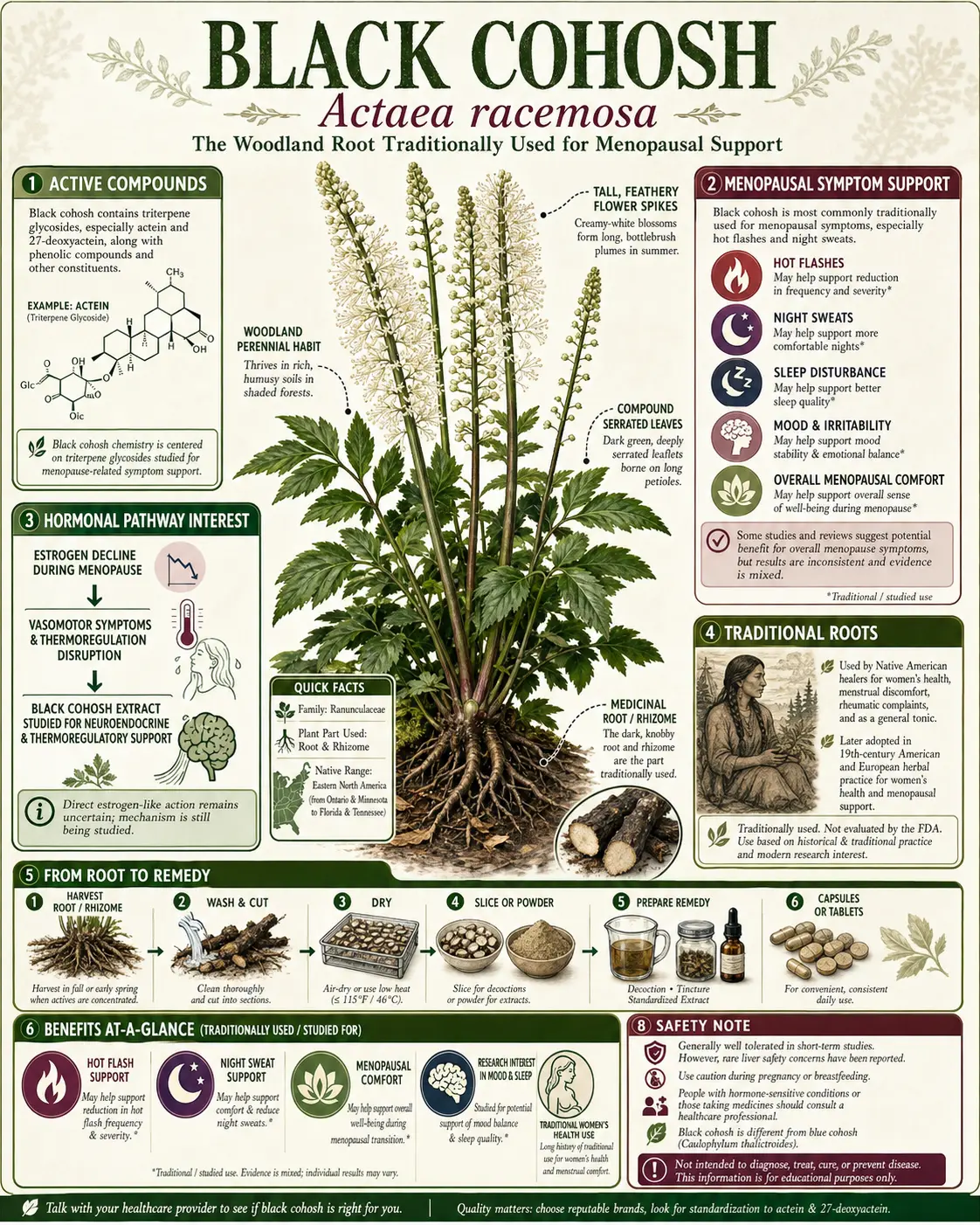
Black cohosh is a tall woodland herb native to the eastern United States and Canada, with dark, knotted rhizomes that several Native American nations — including the Cherokee, Iroquois, and Algonquian-speaking peoples — used chiefly for women's reproductive complaints and for rheumatic pain. European settlers adopted it, it spent roughly a century in the U.S. Pharmacopoeia, and from 1956 it became, via German standardized extracts, one of the most-studied botanical medicines in the world for the menopausal transition — the fuller story is told in the dedicated History & Traditional Use article.
Mechanism of Action
Despite early speculation that black cohosh acts as a phytoestrogen, modern research has established that it does not bind significantly to estrogen receptors. Instead, its mechanism appears to involve serotonergic, dopaminergic, and GABAergic neurotransmitter pathways relevant to thermoregulation and mood, along with possible effects on the hypothalamic-pituitary axis.
Documented or proposed mechanisms include:
- Modulation of serotonin 5-HT7 receptors involved in central thermoregulation — a likely explanation for hot flash reduction
- Mild dopamine receptor activity contributing to mood effects
- GABA-receptor binding by certain triterpene glycosides, supporting sleep and anxiety reduction
- Anti-inflammatory and antioxidant activity from the cycloartane triterpenes and phenolic acids
- Lack of direct estrogenic activity makes it potentially safer than hormone replacement therapy for women with hormone-sensitive conditions
The major active compounds are triterpene glycosides — including actein, 23-epi-26-deoxyactein (formerly called 27-deoxyactein), cimiracemoside, and cimigenol — along with cinnamic acid esters and isoflavones. Standardized extracts like Remifemin (the most-studied commercial product) are calibrated to triterpene glycoside content.
Menopausal Symptom Relief
The strongest clinical evidence for black cohosh is in the management of vasomotor menopausal symptoms. Multiple randomized controlled trials and meta-analyses have shown reductions in hot flash frequency and severity that, while smaller than hormone therapy, are clinically meaningful for many women. Typical findings include 25-50% reduction in hot flash frequency over 8-12 weeks of treatment.
Beyond hot flashes, black cohosh has been shown in clinical studies to improve:
- Night sweats and sleep disturbance
- Menopausal mood changes including irritability and mild depression
- Anxiety associated with the menopausal transition
- Fatigue and energy
- Joint and muscle aches related to estrogen withdrawal
- Vaginal dryness (modest effect; topical estrogen remains more effective)
For women who cannot or prefer not to use hormone replacement therapy — including breast cancer survivors and women with personal or family history of estrogen-sensitive cancers — black cohosh is one of the better-evidenced botanical options. Several trials have specifically evaluated its safety in breast cancer survivors and found no evidence of estrogenic stimulation.
Menstrual and Premenstrual Concerns
Although less extensively studied than its menopausal applications, black cohosh has a long traditional record for menstrual irregularity, dysmenorrhea (painful periods), and premenstrual mood symptoms. Modern clinical use for these indications is considered exploratory but reasonable based on its mechanism.
Particular utility may exist for women in late perimenopause with overlapping menstrual irregularity, hot flashes, and mood changes — a transitional phase where estrogen-receptor-binding herbs may be poorly tolerated.
Polycystic Ovary Syndrome and Fertility
Several clinical trials have explored black cohosh as a complementary therapy in fertility treatment for women with polycystic ovary syndrome (PCOS). When added to clomiphene citrate (a standard ovulation induction medication), black cohosh has been associated with improved endometrial thickness, more favorable hormone profiles, and higher pregnancy rates compared with clomiphene alone in some studies.
These applications should be undertaken only under the guidance of a reproductive endocrinologist or experienced naturopathic physician, as fertility protocols require careful coordination of multiple interventions.
Forms and Preparations
- Standardized extract (Remifemin and similar) — the most clinically validated form; tablets standardized to triterpene glycosides; the form used in nearly all major clinical trials
- Dried rhizome capsules — whole-rhizome powder; less precise dosing but traditional form
- Tinctures — 1:5 alcohol extracts; rapid absorption
- Combination formulas — frequently combined with St. John's wort (for menopausal mood), red clover (for hot flashes), or chasteberry (for cycle regulation)
Quality matters significantly with black cohosh: adulteration with the cheaper Asian species Actaea dahurica, Actaea cimicifuga, and Actaea heracleifolia is well documented in the supplement market. Some cases of liver toxicity historically attributed to black cohosh may actually have been due to species substitution. Choose products from manufacturers that use DNA fingerprinting or HPLC fingerprinting to verify species identity.
Recommended Dosage
- Standardized extract (Remifemin and equivalents) — 20-40 mg twice daily, providing approximately 2.5 mg of triterpene glycosides daily
- Dried rhizome powder — 40-200 mg daily of dried rhizome equivalent
- Tincture (1:5 in 60% alcohol) — 2-4 mL three times daily
- Onset — some women feel improvement within two to four weeks; full effect typically takes eight to twelve weeks
- Duration — traditionally limited to six months of continuous use, then reassess; some practitioners use it longer with periodic liver function monitoring
Cautions and Contraindications
- Liver toxicity (rare) — a small number of case reports have linked black cohosh to liver injury, though causation is debated and many cases involved unverified products possibly containing other species; baseline and periodic liver function tests are reasonable for prolonged use
- Pregnancy — contraindicated; uterine-stimulating effects and historic use to induce labor
- Breastfeeding — avoid; insufficient safety data
- Hormone-sensitive cancers — although black cohosh does not appear to be estrogenic, women with estrogen-sensitive cancers should use only under oncology guidance
- Liver disease — avoid in active liver disease or in patients taking other potentially hepatotoxic drugs
- Tamoxifen — some evidence suggests black cohosh may be safely used with tamoxifen in breast cancer survivors; clinical guidance is recommended
- Mild side effects — gastrointestinal upset, headache, and rash occur in a small percentage of users
Research Papers and References
The following PubMed search links provide curated entry points into the published clinical and mechanistic literature on Black Cohosh (Actaea racemosa). Each link opens directly in PubMed at the National Library of Medicine.
- Black cohosh for menopausal hot flashes — PubMed: black cohosh menopause hot flashes
- Cimicifuga racemosa randomized controlled trials — PubMed: Cimicifuga racemosa randomized
- Black cohosh and serotonin receptors — PubMed: black cohosh serotonin
- Black cohosh hepatotoxicity safety review — PubMed: black cohosh hepatotoxicity
- Black cohosh and breast cancer survivors — PubMed: black cohosh breast cancer
- Triterpene glycosides actein and cimiracemoside — PubMed: actein cimiracemoside
- Black cohosh quality control and adulteration — PubMed: black cohosh adulteration identification
External Authoritative Resources
- NCCIH — Herbs at a Glance
- MedlinePlus — Herbs and Supplements
- PubMed — All research on Actaea racemosa
Conditions Black Cohosh Is Used For
Each condition below links to its page. The coloured half of every capsule shows how much human evidence supports this herb for that specific use — traditional use is history, not proof, and is marked as such.
Connections
- All Herbs
- Menopause: Why the Hormones Fall and What Changes — interactive animation
- Black Cohosh Benefits Deep Dive
- Maca
- Ashwagandha
- Chamomile
- Lemon Balm
- Hormone Panel
- Stress Management
- Perimenopause
- Perimenopause Symptom Tracker
- Polycystic Ovary Syndrome
- Anxiety
- Depression
- Fatigue
- Liver Disease
- Cancer
- Non
- Hot Flashes & Night Sweats
- St Johns Wort
- Dong Quai (Angelica sinensis) — the Chinese blood tonic — a different species from European angelica
- White Peony Root (Bai Shao) — source of Total Glucosides of Paeony, an approved rheumatoid-arthritis drug in China