Slippery Elm
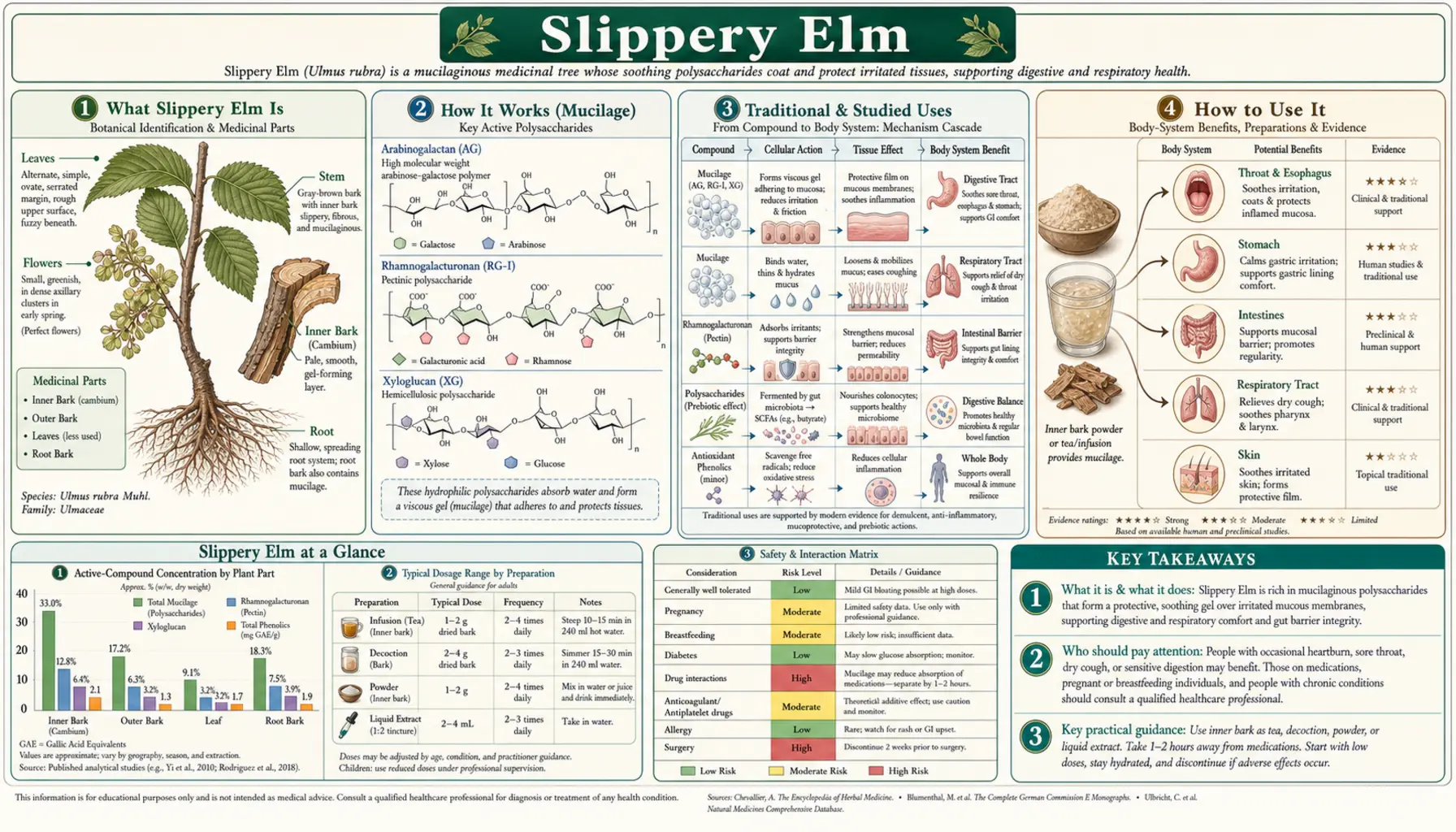
Slippery elm (Ulmus rubra) is one of the gentlest plants in the traditional medicine cabinet. The medicine is the inner bark, which is loaded with mucilage — a soluble fiber that turns slick and gel-like the moment it meets water. That gel is the whole point: it coats and soothes the lining of the throat and gut, which is why slippery elm has been used for generations for sore throats, irritating coughs, and an unsettled digestive tract, and why it still turns up in throat lozenges today. Be honest about the evidence, though: the soothing action is well understood and the throat use is sensible, but rigorous clinical trials testing slippery elm by itself are scarce — most of what we have is long traditional use, laboratory chemistry, and a few small studies of multi-herb formulas. It is low-risk for most people, with one practical catch worth remembering: that same coating can slow down how your body absorbs medicines, so take it a couple of hours apart from your other drugs.
Table of Contents
- What Slippery Elm Is
- How It Works (Mucilage)
- Traditional & Studied Uses
- How to Use It
- Safety & Cautions
- The Bottom Line
- Research Papers
- Connections
- Featured Videos
What Slippery Elm Is
Slippery elm (Ulmus rubra, also called red elm or Indian elm) is a deciduous tree native to eastern North America. The part used as medicine is not the leaves, the wood, or the showy outer bark, but the soft, pale inner bark — the layer just beneath the rough outer surface. Dried and powdered, this inner bark is the source of every traditional slippery elm preparation.
What makes it special is simple to demonstrate: chew a piece of the inner bark, or stir the powder into a little water, and it turns slippery — almost slimy — within seconds. That slick quality is where the plant gets its name, and it is the reason it has been valued for so long. Slippery elm is a classic demulcent, a substance whose job is to soothe and protect irritated surfaces, and a mucilage herb, meaning it is rich in a gel-forming soluble fiber.
Native American peoples used the inner bark as a food in lean times and as a remedy for sore throats, coughs, wounds, and digestive complaints, and it was adopted into early American and Eclectic herbal practice for the same purposes. Today its most familiar form is the throat lozenge — slippery elm is a recognized ingredient in a number of commercial throat and cough lozenges — alongside powders, teas, and capsules sold as supplements.
How It Works (Mucilage)
The active ingredient in slippery elm is its mucilage: a tangle of long-chain sugar molecules (polysaccharides) that behaves like a soluble fiber. Chemically, the slippery elm mucilage is built mainly from galactose, rhamnose, and galacturonic acid units, including an unusual 3-O-methyl-galactose sugar — a structure that was worked out in detail by carbohydrate chemists decades ago. When these polysaccharides meet water, they swell and trap it, forming a thick, viscous gel.
That gel is the mechanism. As a demulcent it works physically rather than chemically: the slick coating clings to the moist lining (the mucous membranes) of the throat, esophagus, and gut, laying down a soothing, protective film over tissue that is raw or inflamed. On an irritated throat, that barrier is thought to blunt the nerve signals that drive the cough-and-tickle reflex; in the digestive tract, it forms a comforting layer between the lining and whatever is irritating it. Traditional herbalists also describe slippery elm as encouraging the body's own protective mucus secretions, adding to the soothing effect.
This same coat-and-soothe action is shared by other demulcents — honey, marshmallow root, and licorice work on a similar principle — and it is the single thread that ties together all of slippery elm's traditional uses.
Traditional & Studied Uses
Slippery elm's uses all flow from one idea: soothing irritated surfaces. How strong the evidence is varies a lot from one use to the next, so it is worth being clear-eyed about each.
Sore throat and cough
This is slippery elm's most established and sensible role. As a demulcent, a slippery elm lozenge or tea coats the throat and can ease the dryness, scratchiness, and tickle that set off a nagging cough. Demulcents are recognized in mainstream cough guidance as a reasonable, low-risk soothing option, even though the formal evidence for cough remedies of all kinds is generally weak. It is worth being honest that the strongest demulcent trial data come from honey (a related demulcent) rather than from slippery elm specifically — but the underlying soothing mechanism is the same, and the throat use is well within reason.
Heartburn and digestive soothing
Traditionally, slippery elm is taken to calm the symptoms of heartburn and acid reflux (GERD) and a generally irritated or inflamed digestive tract. The rationale is the same protective gel, here coating the esophagus and stomach lining — conceptually similar to how alginate "raft" antacids form a soothing barrier, though slippery elm has not been tested head-to-head against them. This use rests almost entirely on tradition and the demulcent mechanism rather than on clinical trials of slippery elm itself.
IBS and inflammatory bowel symptoms
Slippery elm appears in herbal formulas aimed at irritable bowel syndrome (IBS) and other inflammatory bowel complaints, usually combined with other soothing or fiber-rich herbs. A small Australian pilot study tested two such multi-herb formulas — both of which contained slippery elm bark — and found the constipation-predominant formula improved bowel habit and several IBS symptoms, while the formula aimed at diarrhea-predominant IBS improved some symptoms but not bowel habit overall.
Here is the honest caveat: because slippery elm was only ever one ingredient among several in those formulas, that study cannot tell us how much — if any — of the benefit came from slippery elm itself versus the bilberry, cinnamon, licorice, oat bran, or lactulose alongside it. There are very few trials isolating slippery elm on its own for any digestive condition. So while it is a plausible and traditional part of a gut-soothing approach, the bowel-disease evidence should be read as preliminary and indirect, not as proof.
How to Use It
Slippery elm comes in a few simple forms, chosen to match the problem you are trying to soothe:
- Lozenges — the easiest choice for a sore throat or tickly cough. Sucking on the lozenge keeps the soothing mucilage in contact with the throat over time. This is the form you will most often find on a pharmacy shelf.
- Powdered inner bark — the most traditional form. The powder is stirred into warm water to make a thin "gruel" or tea; it thickens into a slick, slightly viscous drink as the mucilage hydrates. Some people add a little honey (another demulcent) for taste and extra soothing. The gruel can be sipped for throat or digestive comfort.
- Capsules — a convenient, taste-free way to take the powdered bark, commonly used for digestive soothing.
For digestive complaints, slippery elm is traditionally taken before meals, the idea being to lay down the protective coating ahead of food and stomach acid. Because the mucilage needs water to form its gel, any slippery elm preparation — and especially the powder or capsules — should be taken with a full glass of water. Follow the dosing on the product you buy, and see the cautions below about spacing it apart from medications.
Safety & Cautions
Slippery elm is widely regarded as safe and gentle. The inner bark is classed as "generally recognized as safe" (GRAS) for use as a food ingredient, and there are no published reports of it causing liver injury even though it has been used for a very long time. For most people the main practical issues are not toxicity but the points below.
- It can interfere with absorbing your medications. This is the most important practical caution. The same mucilage gel that soothes your gut can also coat pills and slow or reduce how well your body absorbs medicines and other supplements taken at the same time. The simple fix is timing: take slippery elm separately from your other drugs, ideally a couple of hours apart, so it does not blunt their effect. (Note: this timing advice is a sensible, mechanism-based precaution that applies to soluble-fiber demulcents in general; it is standard guidance rather than a finding from a specific slippery elm drug-interaction trial.)
- Pregnancy — traditional caution. Many sources advise avoiding slippery elm in pregnancy. This caution is largely historical: the whole or outer bark (not the inner bark used today) was at one time associated with use as an abortifacient. The inner bark sold today is a different, gentle product, but given the limited safety data in pregnancy, the cautious traditional advice is to avoid it unless a qualified provider says otherwise.
- Allergy. Allergic reactions are possible but appear to be rare; occasional skin reactions have been reported. Anyone with a known sensitivity should be cautious.
As with any supplement, tell your doctor or pharmacist you are using slippery elm — especially if you take prescription medicines — so the timing can be worked around your other treatments.
The Bottom Line
Slippery elm is a gentle, low-risk demulcent and a sensible traditional choice for soothing a sore throat, an irritating cough, or an unsettled, irritated digestive tract. Its appeal is its simplicity: a soluble-fiber mucilage that swells into a slick gel and lays a soothing, protective coat over inflamed surfaces.
Just keep your expectations matched to the evidence. The strongest rationale is mechanistic — the soothing coating itself, which is real and well understood — rather than large clinical trials. The throat-soothing use is well supported by tradition and by how demulcents work; the digestive uses are mostly traditional and mechanistic, with the limited trial data coming from multi-herb formulas rather than slippery elm alone. If you want to try it, it is inexpensive and unlikely to do harm — just remember to take it with plenty of water and to separate it from your medications by a couple of hours so it does not get in the way of their absorption.
Research Papers
- Hawrelak JA, Myers SP. Effects of two natural medicine formulations on irritable bowel syndrome symptoms: a pilot study. Journal of Alternative and Complementary Medicine. 2010;16(10):1065–1071. doi:10.1089/acm.2009.0090 — Two multi-herb formulas, both containing slippery elm bark, were tested in IBS; the constipation-predominant formula improved bowel habit and several symptoms, but because slippery elm was only one of several ingredients, the trial cannot isolate slippery elm's own contribution.
- Watts CR, Rousseau B. Slippery elm, its biochemistry, and use as a complementary and alternative treatment for laryngeal irritation. Journal of Investigational Biochemistry. 2012;1(1):17–23. doi:10.5455/jib.20120417052415 — Reviews the mucilage biochemistry behind slippery elm's soothing action and states plainly that, despite its popularity, no rigorous clinical evidence yet confirms its benefit for upper-airway/throat irritation.
- Beveridge RJ, Stoddart JF, Szarek WA, Jones JKN. Some structural features of the mucilage from the bark of Ulmus fulva (slippery elm mucilage). Carbohydrate Research. 1969;9(4):429–439. doi:10.1016/S0008-6215(00)80028-2 — The foundational chemistry paper identifying slippery elm mucilage as a polysaccharide of rhamnose, galactose, 3-O-methyl-galactose and galacturonic acid — the gel-forming fiber responsible for the demulcent effect.
- Malesker MA, Callahan-Lyon P, Ireland B, Irwin RS; CHEST Expert Cough Panel. Pharmacologic and nonpharmacologic treatment for acute cough associated with the common cold: CHEST Expert Panel Report. Chest. 2017;152(5):1021–1037. doi:10.1016/j.chest.2017.08.009 — An expert panel that includes demulcents among the nonpharmacologic options considered for acute cough, while noting the overall evidence for all common-cold cough treatments is of low quality.
- Oduwole O, Udoh EE, Oyo-Ita A, Meremikwu MM. Honey for acute cough in children. Cochrane Database of Systematic Reviews. 2018;(4):CD007094. doi:10.1002/14651858.CD007094.pub5 — The best trial evidence for a demulcent in cough is for honey, which probably eases cough symptoms more than no treatment; slippery elm is not tested here, but it illustrates the demulcent class's plausible soothing role.
- LiverTox: Clinical and Research Information on Drug-Induced Liver Injury. Slippery Elm. Bethesda (MD): National Institute of Diabetes and Digestive and Kidney Diseases. NCBI Bookshelf NBK599741 — An NIH safety monograph noting slippery elm's mucilage as the active component, its GRAS status, its lack of any reported liver injury, and that adverse effects (rare skin allergy) are uncommon.