Boswellia
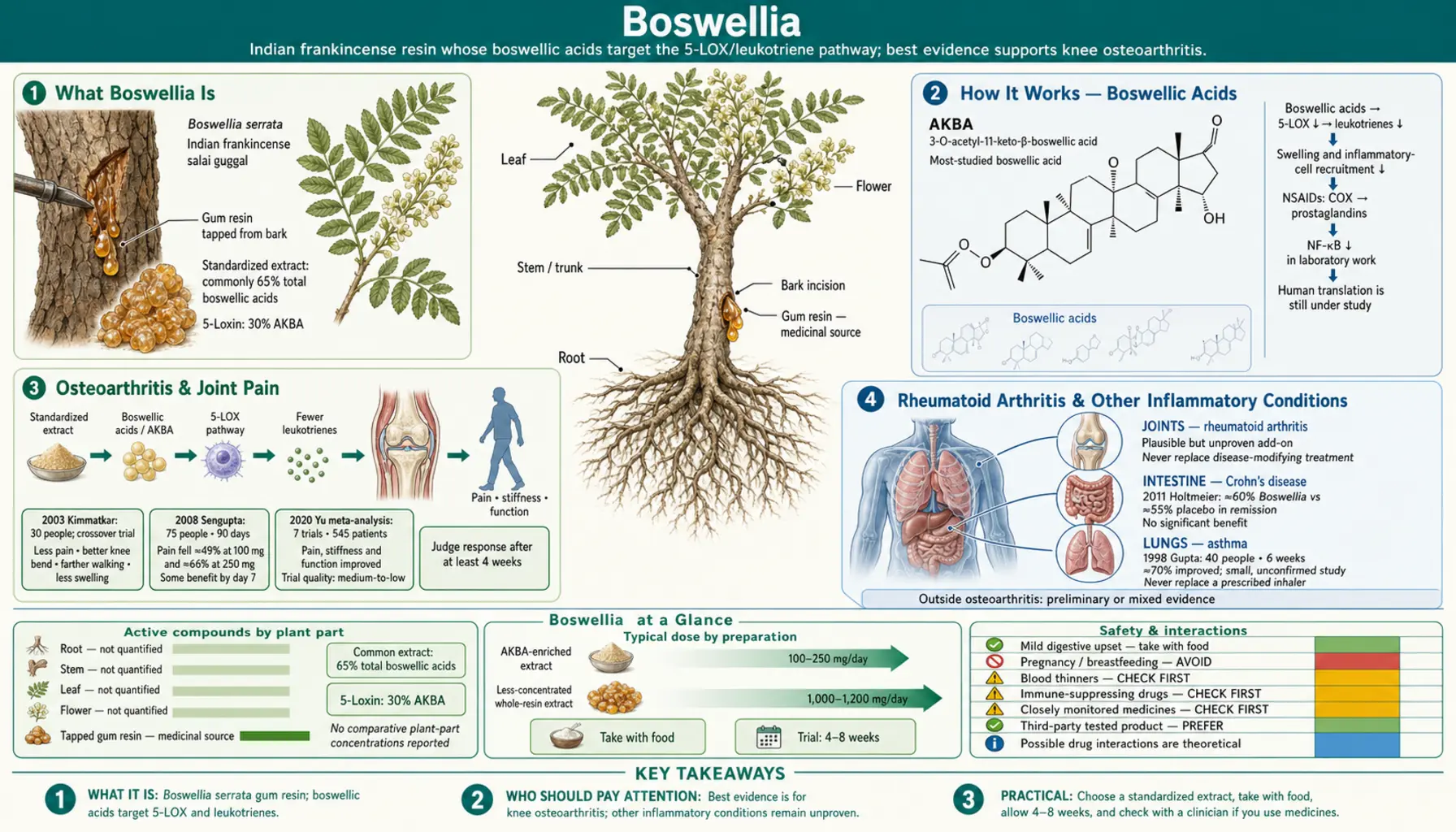
Boswellia (Boswellia serrata), the resin of a tree native to India and known as Indian frankincense, has been used in Ayurvedic medicine for centuries to calm inflammation and ease joint pain. Modern interest centers on its active compounds, the boswellic acids, which work through a different pathway than common anti-inflammatory drugs. The strongest evidence is for knee osteoarthritis, where several randomized controlled trials and a 2020 meta-analysis show meaningful reductions in pain and stiffness, though the trials are mostly small and of modest quality. For other conditions — rheumatoid arthritis, inflammatory bowel disease, and asthma — the evidence is preliminary or mixed, including at least one well-run trial that found no benefit for Crohn's disease. Boswellia is generally well tolerated, and for the right person with osteoarthritis it may be a reasonable thing to try alongside, not instead of, standard care.
Table of Contents
- What Boswellia Is
- How It Works — Boswellic Acids
- Osteoarthritis & Joint Pain
- Rheumatoid Arthritis & Other Inflammatory Conditions
- How to Use It
- Safety & Interactions
- The Bottom Line
- Key Research Papers
- Conditions It Is Used For
- Connections
- Featured Videos
What Boswellia Is
Boswellia is the gum resin tapped from the bark of the Boswellia serrata tree, which grows in the dry hills of India and parts of the Middle East and Africa. When the bark is cut, the tree weeps a fragrant resin that hardens into the aromatic substance we know as frankincense. The Indian species is often called Indian frankincense, and in traditional Ayurvedic texts it goes by the name salai guggal (sometimes written shallaki).
People have used this resin for a very long time — it appears in Ayurvedic medicine going back well over a thousand years, prescribed for joint problems, swelling, digestive complaints, and breathing difficulties. That long history is interesting, but it is not the same as proof that it works. What makes Boswellia worth a closer look today is that researchers have identified the specific molecules responsible for its effects and tested them in actual clinical trials.
When you buy a Boswellia supplement, you are usually buying a concentrated standardized extract, not the raw resin. Standardization means the manufacturer measures and guarantees a certain percentage of the active compounds in each capsule. Most products are standardized to a total of 65% boswellic acids, and the better-studied premium extracts are further enriched for one particular boswellic acid called AKBA (more on that below). Branded extracts you will see on labels include 5-Loxin (standardized to 30% AKBA) and Aflapin — both are the actual products used in the clinical trials, which is why they come up so often in the research.
How It Works — Boswellic Acids
The active ingredients in Boswellia are a family of compounds called boswellic acids. There are several of them, but the one that has drawn the most scientific attention is a mouthful named 3-O-acetyl-11-keto-β-boswellic acid, mercifully abbreviated to AKBA. AKBA is considered the most potent of the group, which is why premium extracts are enriched for it.
Here is the part that makes Boswellia genuinely different from a typical painkiller. Most over-the-counter anti-inflammatory drugs — ibuprofen, naproxen, aspirin, the whole class called NSAIDs — work by blocking an enzyme called COX (cyclooxygenase). Blocking COX reduces inflammatory messengers called prostaglandins, which is great for pain but is also why NSAIDs can irritate the stomach lining and stress the kidneys over time.
Boswellic acids take a different route. Their best-described action is blocking a separate enzyme called 5-lipoxygenase, usually shortened to 5-LOX. Think of inflammation as a factory with two main production lines. NSAIDs shut down the COX line (prostaglandins). Boswellia targets the 5-LOX line instead, which produces a different set of inflammatory chemicals called leukotrienes. Leukotrienes drive swelling, recruit inflammatory cells, and play a role in conditions from arthritis to asthma. By turning down leukotriene production, Boswellia aims to reduce inflammation through a pathway that NSAIDs largely leave untouched.
Laboratory work in the 1990s and 2000s, much of it led by the German pharmacologist H.P.T. Ammon, showed that AKBA inhibits 5-LOX in an unusual way — it binds to a specific site on the enzyme and acts as a kind of dimmer switch rather than competing head-to-head with the enzyme's normal target. Boswellic acids also appear to dial down other inflammatory signals, including a master switch called NF-κB and an enzyme involved in cartilage breakdown. It is worth being honest here: a great deal of this mechanistic work was done in test tubes and on isolated cells, sometimes at concentrations higher than what the body easily achieves after swallowing a capsule. The mechanism is real and well-characterized in the lab, but how completely it translates into the human body is still an active research question — which is exactly why the clinical trials matter more than the biochemistry.
Osteoarthritis & Joint Pain
This is where Boswellia has its strongest case. Osteoarthritis is the common "wear-and-tear" arthritis in which the cartilage cushioning a joint gradually thins, leaving bones to grind and the joint to ache, stiffen, and swell — most often in the knees. Several randomized controlled trials have tested Boswellia extracts here, and the results have been encouraging.
An early and frequently cited trial by Kimmatkar and colleagues in 2003 studied 30 people with knee osteoarthritis in a crossover design (each person took both the real extract and a placebo at different times, so they served as their own comparison). Everyone who took the Boswellia extract reported less knee pain, better knee bend, and the ability to walk farther, with less joint swelling — and the difference versus placebo was statistically significant. It was a small study, but a clean one.
A larger and more rigorous trial came from Sengupta and colleagues in 2008, testing the AKBA-enriched extract 5-Loxin in 75 people with knee osteoarthritis over 90 days. The results were striking on paper: compared with placebo, pain on a standard visual scale fell by about 49% at the lower 100 mg dose and about 66% at the 250 mg dose, with parallel improvements in the WOMAC and Lequesne function scores that doctors use to grade arthritis. Notably, some benefit appeared as early as 7 days. The same research group followed up in 2010 with a head-to-head trial of 5-Loxin and a newer extract, Aflapin, again finding significant pain and function gains within a week and continuing through 90 days.
Pulling the trials together, a 2020 systematic review and meta-analysis by Yu and colleagues combined seven randomized trials covering 545 patients. Its conclusion is the honest bottom line for this section: Boswellia appears to be an effective and reasonably safe option for osteoarthritis, with benefits for pain, stiffness, and function, and the authors suggested taking it for at least four weeks to judge whether it helps. A 2014 Cochrane review of herbal therapies for osteoarthritis reached a similar tone, rating the evidence for Boswellia serrata as showing promising trends of benefit at moderate quality.
Two cautions keep this realistic. First, the individual trials are small — most enrolled a few dozen people — and reviewers rated their overall quality as medium-to-low, with some at unclear risk of bias. Second, the very large percentage improvements reported in some industry-conducted trials may look more dramatic than what you would personally feel; effect sizes in supplement research often shrink when studies get bigger and more independent. So a fair expectation is a modest-to-moderate, real reduction in knee pain and stiffness for many people who try it — not a cure, and not a guarantee.
Rheumatoid Arthritis & Other Inflammatory Conditions
Because Boswellia tamps down inflammation, it has been tried in several conditions beyond osteoarthritis. Here the evidence gets thinner and the honest verdict is "promising in places, but not proven."
Rheumatoid arthritis (RA) is a different beast from osteoarthritis — it is an autoimmune disease in which the immune system attacks the joints. The theoretical case for Boswellia is reasonable, and a few small or combination-product studies have been done, but there is no solid body of high-quality trials showing that Boswellia reliably controls RA. RA is a serious, joint-destroying disease that genuinely needs disease-modifying prescription drugs (like methotrexate or biologics). Boswellia should not be used as a substitute for that treatment.
Inflammatory bowel disease (IBD) — ulcerative colitis and Crohn's disease — is an area where the leukotriene-blocking mechanism is biologically appealing, and early studies were hopeful. An older trial suggested a Boswellia extract worked about as well as the standard drug mesalazine for ulcerative colitis, and another reported it was comparable to mesalazine in active Crohn's disease. But the most rigorous test, a 2011 randomized, placebo-controlled trial by Holtmeier and colleagues, set out to see whether Boswellia could keep Crohn's disease in remission — and it could not. About 60% of the Boswellia group and 55% of the placebo group stayed in remission, a difference that was statistically meaningless. The extract was safe and well tolerated, but it simply did not beat placebo. This is an important, clarifying result and a good example of why we should not over-promise: a plausible mechanism and some early positive studies do not always survive a well-designed trial.
Asthma is interesting because leukotrienes are well known to drive airway inflammation — in fact, prescription asthma drugs called leukotriene blockers (such as montelukast) work on the very pathway Boswellia targets. A small 1998 trial by Gupta and colleagues gave Boswellia gum resin to 40 people with bronchial asthma for six weeks; about 70% improved on measures like breathlessness, attack frequency, and lung-function tests, versus a much smaller fraction on placebo. That is an encouraging signal, but it is a single small study from many years ago and it has not been confirmed by large modern trials. Asthma can be life-threatening, and no one should swap a prescribed inhaler for an herbal supplement.
The throughline for this whole section: outside of osteoarthritis, Boswellia is best thought of as a plausible but unproven add-on, not a treatment you would rely on for a serious inflammatory or autoimmune disease.
How to Use It
If you decide to try Boswellia, the label details matter more than the brand hype. A few practical points:
- Look for a standardized extract. The supplement should state a percentage of boswellic acids — commonly 65% total boswellic acids. The better-studied premium products also list a percentage of AKBA (for example, 5-Loxin is standardized to 30% AKBA). Raw resin or an unstandardized "Boswellia powder" gives you no way to know how much active compound you are actually getting.
- Typical trial doses. In the osteoarthritis studies, effective amounts ranged widely depending on the extract. AKBA-enriched products like 5-Loxin and Aflapin were used at roughly 100–250 mg per day of the concentrated extract. Studies using less concentrated whole-resin extracts used higher total amounts — often in the range of 1,000–1,200 mg per day, sometimes split into two or three doses. Follow the dosing on the specific product you buy, since "300 mg" of one extract is not equivalent to "300 mg" of another.
- Take it with food. Boswellic acids are fat-soluble and are absorbed better when taken with a meal that contains some fat. This also tends to reduce the chance of mild stomach upset.
- Give it time. Although some trials saw improvement within a week, the meta-analysis recommends a fair trial of at least four weeks before deciding whether it is helping you. If you have seen no difference at all after about 8 weeks at a sensible dose, it is probably not going to work for you.
Safety & Interactions
Boswellia has a reassuring safety record in the clinical trials — it is generally well tolerated, and even the trial that found no benefit for Crohn's disease specifically noted a good safety profile. Still, a few sensible cautions apply:
- Most common side effects are mild and digestive: nausea, acid reflux, stomach discomfort, or loose stools. Taking it with food usually helps.
- Pregnancy and breastfeeding: avoid Boswellia. There is not enough safety data, and traditional sources have long flagged concern about effects on the uterus. If you are pregnant, trying to conceive, or nursing, leave it alone.
- Possible drug interactions: because Boswellia is processed by the same liver enzymes (the cytochrome P450 system) that handle many prescription medications, there is a theoretical chance it could change the levels of certain drugs. If you take medications with a narrow safety margin — blood thinners, immune-suppressing drugs, or anything your doctor monitors closely with blood tests — check with a pharmacist or physician before adding it.
- Quality varies. Supplements are not regulated as strictly as medicines. Choosing a product that is third-party tested and clearly labeled with its standardization helps ensure you are getting what the label claims.
- It is an add-on, not a replacement. This is the most important point. Boswellia is not a substitute for prescribed treatment of rheumatoid arthritis, inflammatory bowel disease, asthma, or any serious condition. Talk with your clinician before starting it, especially if you have an ongoing illness or take regular medication.
The Bottom Line
Boswellia is one of the more credible herbal anti-inflammatories, mainly because we understand how it works and because it has actually been put through randomized trials rather than relying on tradition alone. Its mechanism — blocking the 5-LOX/leukotriene pathway — is genuinely different from how ibuprofen and other NSAIDs work, which makes it an appealing option for people who cannot tolerate those drugs.
The most reasonable candidate is someone with knee osteoarthritis who wants to ease pain and stiffness and is looking for a well-tolerated supplement to try alongside the basics (exercise, weight management, and whatever their doctor recommends). For that person, the evidence supports a fair, realistic expectation: a modest-to-moderate reduction in pain and improvement in function over a few weeks, in a substantial fraction of people — though not everyone responds, and the trials behind those numbers are small.
For rheumatoid arthritis, inflammatory bowel disease, or asthma, the science is too preliminary or too mixed to count on Boswellia, and at least one strong trial came up empty for Crohn's. In those settings it should never replace proven medical treatment. Used with clear eyes — standardized product, taken with food, a four-to-eight-week trial, and a conversation with your clinician first — Boswellia is a low-risk option that may modestly help joint pain. That is a fair and honest place to land.
Key Research Papers
- Sengupta K, Alluri KV, Satish AR, et al. (2008). A double blind, randomized, placebo controlled study of the efficacy and safety of 5-Loxin for treatment of osteoarthritis of the knee. Arthritis Research & Therapy, 10(4):R85. — The largest single RCT of an AKBA-enriched extract: significant, dose-dependent reductions in knee-OA pain and improved function, with some benefit by day 7.
- Kimmatkar N, Thawani V, Hingorani L, Khiyani R (2003). Efficacy and tolerability of Boswellia serrata extract in treatment of osteoarthritis of knee — a randomized double blind placebo controlled trial. Phytomedicine, 10(1):3–7. — Early crossover trial in 30 patients; everyone on Boswellia reported less knee pain, better flexion, and farther walking versus placebo.
- Sengupta K, Krishnaraju AV, Vishal AA, et al. (2010). Comparative efficacy and tolerability of 5-Loxin and Aflapin against osteoarthritis of the knee: a double blind, randomized, placebo controlled clinical study. International Journal of Medical Sciences, 7(6):366–377. — Two AKBA-standardized extracts both reduced knee-OA pain, stiffness, and disability within a week and over 90 days.
- Yu G, Xiang W, Zhang T, et al. (2020). Effectiveness of Boswellia and Boswellia extract for osteoarthritis patients: a systematic review and meta-analysis. BMC Complementary Medicine and Therapies, 20:225. — Pooled 7 trials (545 patients); Boswellia improved pain, stiffness, and function, with at least 4 weeks of use recommended — but trial quality was medium-to-low.
- Cameron M, Chrubasik S (2014). Oral herbal therapies for treating osteoarthritis. Cochrane Database of Systematic Reviews, (5):CD002947. — Independent Cochrane review rating Boswellia serrata among the herbal products with promising, moderate-quality evidence of benefit and a low adverse-event risk.
- Holtmeier W, Zeuzem S, Preiss J, et al. (2011). Randomized, placebo-controlled, double-blind trial of Boswellia serrata in maintaining remission of Crohn's disease: good safety profile but lack of efficacy. Inflammatory Bowel Diseases, 17(2):573–582. — Well-designed negative trial: Boswellia was safe but did not beat placebo at keeping Crohn's disease in remission (~60% vs ~55%).
- Ammon HPT (2016). Boswellic acids and their role in chronic inflammatory diseases. Advances in Experimental Medicine and Biology, 928:291–327. — Authoritative mechanism review explaining how AKBA and related boswellic acids inhibit 5-lipoxygenase and other inflammatory pathways.
Conditions Boswellia Is Used For
Each condition below links to its page. The coloured half of every capsule shows how much human evidence supports this herb for that specific use — traditional use is history, not proof, and is marked as such.
Connections
- All Herbs
- Turmeric
- Willow Bark
- Ginger
- Tart Cherry
- Arthritis
- Osteoarthritis — the joint disease Boswellia has its strongest trial evidence for.