Black Pepper
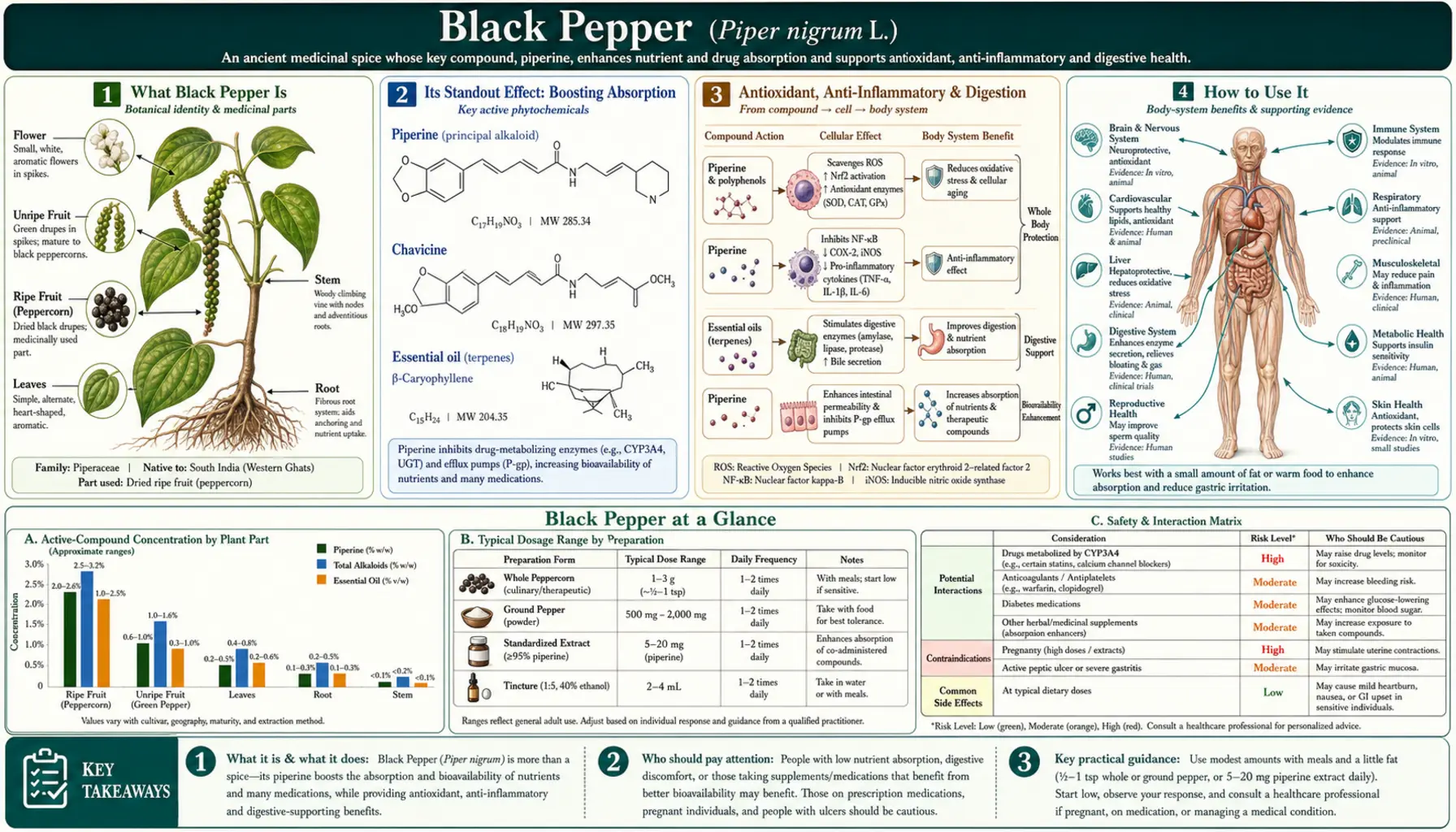
Black pepper is the dried fruit of the Piper nigrum vine and the most widely traded spice in the world — the “king of spices.” Almost everything interesting about it traces back to a single compound: an alkaloid called piperine, which gives pepper its bite. Piperine’s best-proven benefit is not something it does on its own but something it does for other compounds — it can dramatically increase how much of them your body absorbs. The classic example is curcumin from turmeric, whose absorption jumped roughly twentyfold in a landmark human study when paired with a small dose of piperine. That same absorption-boosting power is also black pepper’s main safety caveat, because it can raise blood levels of certain medications. This page explains what the evidence does — and does not — support, in plain language.
Table of Contents
- What Black Pepper Is
- Its Standout Effect: Boosting Absorption
- Antioxidant, Anti-Inflammatory & Digestion
- How to Use It
- Safety & Drug Interactions
- The Bottom Line
- Research Papers
- Connections
- Featured Videos
What Black Pepper Is
Black pepper comes from the peppercorn — the small, round dried fruit of Piper nigrum, a flowering vine native to South India and now grown across the tropics. It has been prized for thousands of years, valuable enough at times to be used like currency, and today it remains the most heavily traded spice on Earth, earning it the nickname the “king of spices.”
The compound responsible for pepper’s sharp, pungent heat is an alkaloid called piperine. Piperine is not just what you taste — it is also the source of nearly all of black pepper’s measurable effects in the body. When researchers study “black pepper,” they are usually really studying piperine.
Black, white, and green peppercorns all come from the same plant; the difference is how the fruit is picked and processed:
- Black pepper — unripe berries cooked briefly and dried until the skin shrivels and darkens. This is the most pungent and the richest in piperine.
- White pepper — fully ripened berries soaked so the dark outer layer can be rubbed off, leaving just the pale inner seed. Milder, with a slightly different flavor.
- Green pepper — the same unripe berries preserved fresh (brined or freeze-dried) rather than dried, giving a fresher, less hot taste.
(Pink “peppercorns” are a different plant entirely and not true pepper.)
Its Standout Effect: Boosting Absorption
If black pepper has one genuinely well-documented health effect, this is it. Piperine can sharply increase the bioavailability of certain other compounds — that is, how much of them actually makes it into your bloodstream instead of being broken down or pushed back out before it can be used.
The most famous example is curcumin, the main active compound in turmeric. On its own, curcumin is notoriously hard to absorb — the body clears most of it almost immediately. In a classic 1998 human study, researchers gave volunteers 2 grams of curcumin with just 20 milligrams of piperine and measured a roughly 2000% increase — about twentyfold — in curcumin levels in the blood, with no reported side effects. That single finding is the reason so many turmeric supplements today include black pepper extract.
How does such a small amount do so much? Piperine appears to work in two main ways: it temporarily slows down some of the enzymes in the gut and liver that would normally chemically “tag” and dispose of these compounds, and it interferes with a cellular pump (called P-glycoprotein) that otherwise ejects substances back out of intestinal cells. With the breakdown slowed and the pump blunted, more of the partner compound survives to enter circulation.
This effect is not limited to curcumin. Piperine has been shown to raise the absorption of various other nutrients and some pharmaceutical drugs as well. That versatility is genuinely useful — but, as the safety section explains, it is also exactly why concentrated piperine deserves respect.
Antioxidant, Anti-Inflammatory & Digestion
Beyond helping you absorb other things, piperine has shown a range of promising activities of its own. It behaves as an antioxidant (helping neutralize reactive molecules that damage cells) and an anti-inflammatory agent in laboratory and animal studies, and it has long been reported to support digestion — traditionally by stimulating the release of digestive enzymes and helping food move through the gut.
Here it is important to be honest about the strength of the evidence. Most of these findings come from cell cultures and animal experiments, not from rigorous trials in people. Reviews of piperine describe effects across an enormous list of conditions — from metabolic and inflammatory problems to neurological disease — but the bulk of that work is preclinical, and animal or test-tube results frequently fail to hold up when finally tested in humans.
So the fair way to think about these properties is as promising biological mechanisms, not proven treatments. Black pepper is a reasonable, flavorful part of a healthy diet, and the science hints at benefits worth studying further — but it is not an established remedy for any specific disease, and you should be skeptical of products that market it as one.
How to Use It
For almost everyone, the best way to enjoy black pepper is simply as a culinary spice. A practical tip: grind it fresh. Piperine and pepper’s volatile aromatic oils begin to fade once the peppercorn is cracked, so pre-ground pepper that has sat in a jar for months is noticeably weaker in both flavor and active compound. A pepper mill is one of the cheapest upgrades a kitchen can have.
The most useful pairing is the well-known turmeric-plus-black-pepper combination. Because piperine so dramatically improves curcumin absorption, adding a few twists of fresh pepper whenever you cook with turmeric — in a curry, soup, scrambled eggs, or a “golden milk” drink — is a simple, food-based way to get more out of the turmeric. A little fat in the dish helps too, since curcumin is fat-soluble.
Piperine is also sold as a supplement, most commonly under the branded extract name BioPerine, typically in doses around 5–20 mg. These are rarely taken for their own sake — their main job is to be added to other supplements (turmeric/curcumin, certain vitamins, herbal extracts) to enhance how much is absorbed. If a curcumin product already lists black pepper extract or piperine, that is what it is doing.
Safety & Drug Interactions
As a food, black pepper is very safe. The amounts used in normal cooking — even generous amounts — have an excellent safety record and are not a concern for healthy people.
The meaningful caution is the flip side of the very effect that makes piperine useful. By slowing the same gut and liver enzymes and blocking the same cellular pump described above, piperine — especially in concentrated supplement form — can raise the blood levels of certain medications. In effect, it can make a normal, correctly prescribed dose behave like a larger dose. Laboratory work confirms that piperine inhibits major drug-handling systems (the enzyme CYP3A4 and the P-glycoprotein pump), and pharmacological modeling estimates that a modest daily intake of piperine could meaningfully increase blood levels of several common drugs — including some statins, certain blood-pressure medications, and others.
This matters most for “narrow-margin” medications — drugs where the gap between a helpful dose and a harmful one is small (for example, certain blood thinners, anti-seizure drugs, immune-suppressing drugs, and some heart medications). For these, even a modest, unintended rise in blood level can be a problem.
The practical rule: normal culinary pepper is fine, but anyone taking prescription medication — particularly narrow-margin drugs — should check with a doctor or pharmacist before starting a piperine or BioPerine supplement (or a high-dose turmeric product that contains added piperine). It is also worth noting that very high supplemental doses can cause stomach and gut irritation in their own right.
The Bottom Line
Black pepper is a flavorful, inexpensive, and very safe spice that belongs in any kitchen. Its one genuinely evidence-based “superpower” is not a direct health cure but an assist: it helps your body absorb other beneficial compounds far more efficiently — above all curcumin from turmeric, where the effect is large and well documented in humans.
Its own direct health effects — antioxidant, anti-inflammatory, digestion-supporting — are biologically plausible and actively researched, but remain mostly at the laboratory and animal stage rather than proven in people. So use black pepper freely and enjoyably in cooking. Treat concentrated piperine supplements with a little more care, mainly because their absorption-boosting power can also extend to your medications.
Research Papers
- Shoba G, Joy D, Joseph T, Majeed M, Rajendran R, Srinivas PS. Influence of piperine on the pharmacokinetics of curcumin in animals and human volunteers. Planta Medica. 1998;64(4):353–356. doi:10.1055/s-2006-957450 — The landmark study: 20 mg of piperine increased curcumin bioavailability in healthy human volunteers by about 2000% (roughly twentyfold), with no reported adverse effects.
- Srinivasan K. Black pepper and its pungent principle-piperine: a review of diverse physiological effects. Critical Reviews in Food Science and Nutrition. 2007;47(8):735–748. doi:10.1080/10408390601062054 — Broad review of piperine’s reported effects — enhanced digestion, antioxidant activity, and its role boosting the bioavailability of drugs and nutrients.
- Bhardwaj RK, Glaeser H, Becquemont L, Klotz U, Gupta SK, Fromm MF. Piperine, a major constituent of black pepper, inhibits human P-glycoprotein and CYP3A4. Journal of Pharmacology and Experimental Therapeutics. 2002;302(2):645–650. doi:10.1124/jpet.102.034728 — Identifies the two-part mechanism behind piperine’s absorption-boosting (and drug-interaction) effects: inhibition of the CYP3A4 enzyme and the P-glycoprotein efflux pump.
- Dudhatra GB, Mody SK, Awale MM, et al. A comprehensive review on pharmacotherapeutics of herbal bioenhancers. The Scientific World Journal. 2012;2012:637953. doi:10.1100/2012/637953 — Reviews piperine as the prototype “bioenhancer” — the first compound scientifically validated to increase the bioavailability of co-administered drugs.
- Tripathi AK, Ray AK, Mishra SK. Molecular and pharmacological aspects of piperine as a potential molecule for disease prevention and management: evidence from clinical trials. Beni-Suef University Journal of Basic and Applied Sciences. 2022;11:16. doi:10.1186/s43088-022-00196-1 — Surveys piperine’s pharmacology and the (still limited) human clinical-trial evidence across multiple conditions.
- Choi H, et al. Predicting food–drug interactions between piperine and CYP3A4 substrate drugs using PBPK modeling. International Journal of Molecular Sciences. 2024;25(20):10955. doi:10.3390/ijms252010955 — Pharmacokinetic modeling estimating that a modest daily piperine intake (~20 mg) could meaningfully raise blood levels of several CYP3A4-handled drugs — the basis for the supplement drug-interaction caution.