Jewel Vine (Derris elliptica)
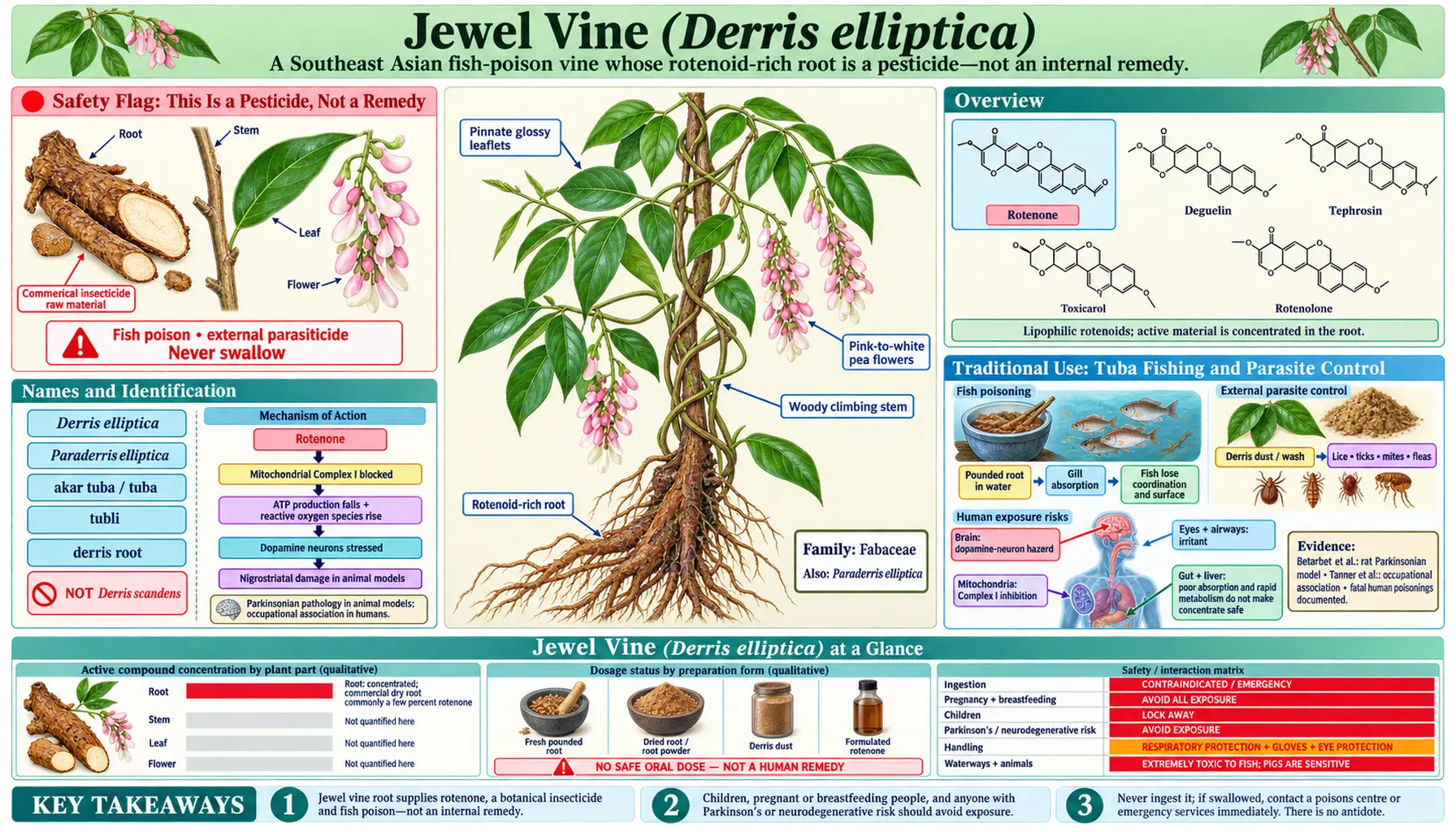
🔴 This page exists to correct a mistake. Derris elliptica — jewel vine, tuba root, akar tuba — is the classical botanical source of rotenone. Rotenone is an insecticide and a piscicide: a fish poison. Across Southeast Asia the pounded root has been thrown into dammed streams for centuries to stun fish so they can be scooped out by hand. That is what this plant is for. It is not a remedy, it has never been an internal remedy in any major traditional system, and it should never be swallowed.
Rotenone blocks complex I of the mitochondrial electron transport chain — it switches off the cell's ability to make ATP from NADH. In rodents, systemic rotenone reliably destroys dopamine neurons in the substantia nigra and produces α-synuclein inclusions, which is why it is one of the standard laboratory models of Parkinson's disease. Epidemiological work in farmworkers has associated occupational rotenone use with a higher risk of Parkinson's in humans. Deliberate ingestion of rotenone products has killed adults and at least one small child.
Jewel vine appears on herb lists mostly because of database contamination and name confusion — in particular with Derris scandens, a genuinely medicinal relative used in Thai traditional medicine with real clinical trials behind it. Those are different plants. This page explains what Derris elliptica actually is, how it is genuinely used, and why there is no dosage section below.
Table of Contents
- 🔴 Safety Flag: This Is a Pesticide, Not a Remedy
- Overview
- Names and Identification
- Traditional Use: Tuba Fishing and Parasite Control
- Active Compounds: Rotenone and the Rotenoids
- How Rotenone Works: Shutting Down Complex I
- Why Fish Die So Easily and Mammals Less So
- Rotenone and Parkinson's Disease
- Human Poisoning
- Regulatory Status and the "Natural Pesticide" Lesson
- Why It Turns Up on Herb Lists
- Forms and Preparations
- Dosage: There Is No Safe Oral Dose
- Cautions and Contraindications
- Key Research Papers
- Connections
- Featured Videos
🔴 Safety Flag: This Is a Pesticide, Not a Remedy
Four statements, plainly:
- Derris elliptica root is a commercial insecticide raw material. Between roughly the 1920s and the 1950s it was farmed on plantations in Malaya and the Dutch East Indies and shipped worldwide as "derris dust" and "derris root". The trade was priced on rotenone content, the way coffee is priced on grade.
- Its traditional use is to poison fish and external parasites, not to treat illness from the inside. Tuba fishing is a harvesting technique. Derris dust on cattle is delousing. Neither is internal medicine.
- Swallowing rotenone has killed people. There are published forensic cases of fatal rotenone poisoning after deliberate ingestion of pesticide products, and a documented paediatric death.
- Rotenone is the standard laboratory tool for causing Parkinsonian brain damage in animals. Researchers use it precisely because it works: it kills the dopamine neurons that Parkinson's disease kills.
If you have been offered Derris elliptica, "tuba root", "derris root" or "jewel vine" as a supplement, a detox, a parasite cleanse or a traditional tonic, that offer is wrong on the facts. Do not take it. If someone has swallowed a derris or rotenone product, treat it as a poisoning emergency and contact your national poisons centre or emergency services immediately.
Overview
Derris elliptica (Wall.) Benth. is a woody climbing legume in the pea family, Fabaceae — the same family as beans, peanuts, liquorice and clover. It is a vigorous liana that scrambles into forest edges and secondary growth, with pinnate leaves of glossy leaflets and drooping sprays of pink-to-white pea flowers. It is native to Southeast Asia: Malaysia, Indonesia, the Philippines, mainland Indochina and adjacent regions, and it has been planted well outside that range.
The part used is the root, and the active material is concentrated there. Roots are dug, washed, sliced or pounded, and either used fresh — the crushed root releases a milky sap — or dried and ground for storage and trade. Historically the dried powder was sold on assay: commercial derris root was traded on its rotenone percentage, commonly a few percent of dry root weight and reported considerably higher in selected cultivated strains. That variation is one reason the material is unpredictable.
A note on taxonomy: some floras now place this species in the segregate genus Paraderris, as Paraderris elliptica (Wall.) Adema. Both names refer to the same plant, and older literature and the entire pesticide record use Derris elliptica.
Names and Identification
Binomial: Derris elliptica (Wall.) Benth., also treated as Paraderris elliptica. Family: Fabaceae (Leguminosae). NCBI Taxonomy entry.
- Malay / Indonesian: akar tuba, tuba — akar means "root". "Tuba" is the general regional word for a fish-stunning plant.
- Vietnamese: dây thuốc cá — literally "the fish-medicine vine". The name says exactly what it is used for.
- Filipino: tubli.
- Chinese: 鱼藤 (yúténg) for the genus — "fish vine".
- English trade and common names: jewel vine (an English name applied loosely across the genus Derris), tuba root, derris root, derris dust, tuba plant.
⚠️ The confusion that matters: Derris elliptica is not Derris scandens
This is the single most important identification point on the page, because it is the likeliest reason someone lands here looking for a herb.
- Derris scandens (Thai: thao wan priang) is a real medicinal plant. It is used in Thai traditional medicine for musculoskeletal pain, it is on Thailand's National List of Essential Medicines as a herbal preparation, and it has been through randomised controlled trials. Kuptniratsaikul and colleagues compared a D. scandens extract with naproxen in knee osteoarthritis; Puttarak and colleagues pooled the randomised trials of D. scandens for musculoskeletal pain in a systematic review and meta-analysis. Its chemistry is flavonoid-dominated — scandenin, lupinifolin and related compounds — not rotenoid-dominated.
- Derris elliptica is the fish poison. High rotenoid content, no medicinal internal use, a pesticide history.
- Derris trifoliata, a mangrove-edge species, is also used as a fish poison in some regions.
Because databases and supplement catalogues often index at genus level — "Derris, used in traditional medicine" — the clinical reputation of D. scandens gets silently attached to D. elliptica. If a product says only "Derris", that is not enough information. Ask for the species.
The same trap exists across the fish-poison plants generally. In the Amazon, barbasco and timbó — species of Lonchocarpus, Deguelia and Tephrosia — are used the same way and contain the same rotenoids. They are botanically distinct plants, but the chemistry and the hazard are the same, and they are indexed under "traditional plant use" for the same reason.
Traditional Use: Tuba Fishing and Parasite Control
Tuba fishing
The method is old, widespread and well documented across Malaysia, Indonesia, the Philippines, Vietnam, Papua New Guinea and the Pacific. A section of slow-moving stream or a tidal pool is dammed or chosen at low water. Roots are pounded on rock until the milky sap runs, then swirled through the water. Within minutes the fish lose coordination, rise to the surface and can be picked up by hand or basket.
It is a communal harvesting practice with real cultural weight, and in many places it was governed by custom — who could do it, where, and how often — because everyone understood it emptied a stretch of water. Many countries now prohibit or restrict it, because it is indiscriminate: it kills every gill-breathing thing in the pool, including juveniles, amphibian larvae and aquatic insects, not just the fish somebody wanted.
The fish were eaten. That is the practice, and it is worth explaining rather than glossing over, because it is the fact people cite when they assume the plant must be safe. Rotenone is poorly absorbed from the mammalian gut and rapidly metabolised, and it does not accumulate much in edible flesh; the concentrations involved in a stunned pool are also low. That is why the practice persisted for centuries without visible mass poisoning. It is not a reason to conclude the root itself is safe to consume — the whole point is that the dose reaching a person eating a fish is a tiny fraction of the dose in a mouthful of root.
External parasiticide
The second genuine traditional and commercial use is external. Derris powder has been dusted or washed onto livestock, dogs and poultry against lice, ticks, mites and fleas, and used on humans in some regions against scabies and head lice. It was also a garden and crop insecticide — the "derris dust" of mid-century gardening manuals.
Even here it is not benign. Rotenone dust is a respiratory irritant, absorption through broken skin is a real route, and some species are unusually sensitive — pigs in particular are noted in the veterinary literature as poorly tolerant of rotenone preparations that other livestock handle.
What it was never used for
There is no established internal medicinal use of Derris elliptica in Ayurveda, in traditional Chinese medicine, in Thai traditional medicine, in Jamu or in Vietnamese thuốc nam. Scattered ethnobotanical surveys record topical applications for skin parasites and, occasionally, use as an abortifacient or a poison — which is a use, but not a therapy.
Active Compounds: Rotenone and the Rotenoids
Rotenone is the headline compound — a rotenoid, a modified isoflavonoid built on a complex five-ring skeleton. It is strongly lipophilic (fat-soluble), which governs almost everything about how it behaves: it crosses cell membranes easily, crosses the blood–brain barrier without needing a transporter, and does not need to be actively pumped into cells. PubChem entry for rotenone.
The root also contains a family of related rotenoids that share the mechanism at varying potency:
- Deguelin — the second most abundant rotenoid in many derris samples; also a complex I inhibitor, and separately studied as an anticancer lead compound in cell work.
- Tephrosin and toxicarol — further rotenoids.
- Rotenolone — an oxidation product that forms as material ages.
- Assorted flavonoids and stilbenoids of no established significance here.
Rotenone degrades quickly. Sunlight and warm water break it down within days — a property fisheries managers rely on when treating a lake, and the reason old derris dust loses potency on a shed shelf. Rapid environmental breakdown is genuinely good news for the ecosystem. It says nothing about what a concentrated dose does to a person before it degrades.
How Rotenone Works: Shutting Down Complex I
Every cell in your body runs the same power plant. Food-derived electrons are carried by NADH into the mitochondrial electron transport chain, handed down a series of protein complexes, and used to pump protons across the inner mitochondrial membrane. The proton gradient then drives ATP synthase, and ATP is the currency the cell spends on everything.
Rotenone jams the first station on that line. It binds at the ubiquinone-reduction site of complex I (NADH:ubiquinone oxidoreductase), blocking the transfer of electrons from the complex's terminal iron–sulfur cluster to ubiquinone. Structure–activity work by Ueno and colleagues mapped which parts of the rotenone molecule are required for that inhibition, and Schuler and Casida identified the PSST subunit of complex I as the insecticidal target site.
Two consequences follow, and the second is the reason rotenone is neurotoxic rather than merely energy-depleting:
- ATP production falls. Cells with high, unrelenting energy demand feel it first.
- Electrons back up and leak. A blocked chain spills electrons onto oxygen, generating superoxide and downstream reactive oxygen species. The cell is now simultaneously short of energy and under oxidative attack — a combination dopamine neurons are unusually bad at surviving, because dopamine metabolism is itself a source of oxidative stress and these neurons have enormous axonal arbors to power.
Because rotenone is lipophilic and uniformly distributed, it inhibits complex I everywhere in the body — and yet the damage in animal models is remarkably selective for the nigrostriatal dopamine system. That selectivity is itself a major finding: it suggests those neurons are the ones living closest to the edge of their energy budget.
Why Fish Die So Easily and Mammals Less So
Fish are killed by rotenone concentrations that would do nothing to a person standing in the same water. Fisheries agencies treat lakes at well under one part per million of active rotenone. The reason is route of exposure, not some special fish biochemistry:
- Fish absorb it across the gill. The gill is a vast, thin, highly perfused surface built to extract dissolved oxygen. A lipophilic molecule in the water walks straight across it into arterial blood, bypassing the gut and the liver entirely. Effectively, the fish receives an intravenous dose.
- Mammals absorb it poorly from the gut and metabolise it fast, largely via liver cytochrome P450 enzymes, before much reaches the circulation. Swallowed rotenone gets a first-pass mauling that gill-absorbed rotenone never sees.
This is a genuinely elegant piece of comparative toxicology, and it is also the origin of a dangerous misreading. "Safe for humans" in the pesticide literature has always meant "at agricultural residue levels, by the oral route, in a healthy adult". It has never meant that concentrated rotenone is harmless to people, and it says nothing about injected, inhaled, or chronic low-level exposure — which is exactly where the Parkinson's signal appears.
Rotenone and Parkinson's Disease
Animal evidence — strong, reproducible, and the reason this compound is famous.
- Betarbet and colleagues, in Nature Neuroscience in 2000, gave rats chronic low-dose systemic rotenone by infusion. The rats developed selective degeneration of nigrostriatal dopamine neurons, movement problems including bradykinesia and rigidity, and cytoplasmic inclusions containing α-synuclein and ubiquitin — the defining pathology of Lewy bodies in human Parkinson's disease. Before this, no toxin model had reproduced the inclusions.
- Sherer and colleagues showed the same selective dopaminergic degeneration and α-synuclein aggregation with subcutaneous dosing.
- Cannon and colleagues later published a standardised, highly reproducible rotenone protocol, which is why the model is now a workhorse in Parkinson's research laboratories.
Human evidence — epidemiological, consistent, and not proof of causation.
Tanner and colleagues studied Parkinson's disease and specific pesticide use in a case-control study nested in the US Agricultural Health Study — roughly 110 people with Parkinson's and 358 controls, all farmers or farm spouses with detailed lifetime pesticide-use histories. Use of rotenone was associated with about 2.5 times the odds of Parkinson's disease (95% confidence interval roughly 1.3 to 4.7). Paraquat, which damages the same neurons through a different mechanism, showed a similar association.
Read that carefully, in both directions. It is a real, biologically coherent finding: a compound that produces Parkinsonian pathology in animals is associated with Parkinson's disease in the humans most exposed to it. But it is a case-control study with self-reported exposure history in a farming population exposed to many chemicals, the confidence interval is wide, and the number of Parkinson's cases is small. It establishes a credible hazard, not a dose-response curve. Nobody knows what level of rotenone exposure, over what period, is required — and nobody is going to run the experiment that would find out.
What it means for you. The occupational finding concerns repeated handling of pesticide formulations over years. It is not a statement about eating one tuba-caught fish. But it is the clearest available answer to the question "what could chronic rotenone exposure do to a person?", and the answer is bad enough that no amount of traditional-use framing should persuade anyone to take this root by mouth.
Human Poisoning
Acute rotenone poisoning in humans is uncommon, because people rarely swallow pesticide concentrate. When it happens it is severe, and the case literature is unambiguous:
- De Wilde, Heyndrickx and Carton (1986) published a forensic case of fatal rotenone poisoning in a child.
- Wood and colleagues (2005), writing in Critical Care, reported a death after deliberate ingestion of a rotenone pesticide, with the clinical and analytical course documented.
- Rhee and colleagues (2016) reported a fatal poisoning with a commercial rotenone-based insecticide marketed as an organic product in Korea, with quantitative confirmation by LC–MS/MS.
The clinical picture reflects systemic mitochondrial failure: vomiting, abdominal pain, then metabolic acidosis with a raised lactate as cells switch to anaerobic metabolism, followed by cardiovascular collapse, seizures and multi-organ failure in severe cases. There is no antidote. Treatment is supportive — airway, circulation, correction of acidosis, intensive care.
Published oral LD50 values in rats span a very wide range, from roughly 100 to over 1,000 mg/kg depending on the formulation and the carrier used. That spread reflects how variably rotenone is absorbed, not a comfortable safety margin: rotenone dissolved in oil is far more dangerous than the same amount of dry powder, and pesticide formulations contain solvents and surfactants designed to improve absorption.
Regulatory Status and the "Natural Pesticide" Lesson
- European Union: approval of rotenone as a plant protection product was withdrawn in 2008, with remaining authorised uses phased out shortly afterwards.
- United States: agricultural, home-garden and pet uses were cancelled, leaving fisheries management — removing invasive or unwanted fish from lakes and streams before restocking — as the principal remaining registered use. The EPA's pesticide-ingredient pages carry the current registration picture.
- Fisheries use today generally involves formulated rotenone rather than raw derris root, applied at controlled concentrations and often neutralised downstream with potassium permanganate.
The lesson worth carrying away. For decades rotenone was the flagship "botanical" insecticide — plant-derived, biodegradable, permitted in certified organic production, and marketed as the gentle alternative to synthetics. Then the toxicology matured, the Parkinson's model was published, the epidemiology followed, and it was withdrawn from crop use in most of the developed world.
Rotenone is one of the cleanest available demonstrations that "natural" and "plant-derived" are statements about origin, not about safety. A molecule a legume evolved to kill insects is, chemically, a molecule optimised to kill things with mitochondria. We have mitochondria.
Why It Turns Up on Herb Lists
Four mechanisms, all of them mundane, all of them fixable by reading the species name:
- Genus-level indexing. Derris scandens has clinical trials and a place on Thailand's essential medicines list. Aggregated databases that index "Derris" inherit that medicinal status for every species in the genus, including this one.
- Ethnobotanical survey data taken out of context. Field surveys that record "plant used" do not always distinguish "used to treat a person" from "used to poison fish" or "used to delouse a buffalo". Downstream, a spreadsheet row says Derris elliptica — traditional use: yes.
- Anticancer cell-culture literature. Deguelin and rotenone both show cytotoxicity in cancer cell lines, because killing mitochondria kills cells. Papers describing this are real, and they are periodically misrepresented as evidence that the plant is a cancer remedy. Cytotoxicity in a dish is not selectivity in a person; rotenone kills your neurons by the same mechanism.
- Content scraping. Herb-list websites copy each other. One misclassification propagates indefinitely.
Forms and Preparations
For completeness and for accurate identification — not as instructions:
- Fresh pounded root. The traditional tuba-fishing form. Milky sap, used immediately.
- Dried root and root powder ("derris root", "tuba root"). The historic export commodity, traded on assayed rotenone content.
- Derris dust. Root powder diluted with an inert carrier for dusting crops and animals. Largely obsolete in regulated markets.
- Formulated rotenone liquids and emulsifiable concentrates. Modern piscicide products for fisheries management. Restricted-use in many jurisdictions and applied by licensed personnel.
There is no legitimate oral herbal preparation of this plant. No tincture, no decoction, no capsule, no standardised extract intended for human consumption. If you encounter one, it is being sold by someone who has confused it with another species or has not checked.
Dosage: There Is No Safe Oral Dose
This page deliberately has no dosing table.
No safe oral dose of Derris elliptica or of rotenone has been established for humans, and none should be sought. There is no therapeutic indication to dose for. There is no clinical trial that would define a threshold. The only human dose-response information in existence comes from poisonings, and the endpoint in those reports is death or intensive care.
Requests for "a small amount" or "a safe traditional dose" are asking the wrong question. The traditional dose of tuba root is the amount that empties a stream of fish, measured in armfuls of pounded root per pool, and it was never intended to enter a human body.
Cautions and Contraindications
🔴 Do not ingest Derris elliptica, derris root, tuba root or any rotenone product, in any amount, for any reason.
- If ingestion has occurred: this is a medical emergency. Contact your poisons centre or emergency services immediately. Do not wait for symptoms; do not induce vomiting unless instructed by a clinician. Bring the container or plant material if you safely can. There is no antidote — management is supportive intensive care, and it works better when started early.
- Anyone with Parkinson's disease, a family history of Parkinson's, or another neurodegenerative condition should avoid rotenone exposure of any kind, including handling formulated pesticide products.
- Pregnancy and breastfeeding: rotenone is lipophilic and crosses biological barriers freely. Avoid all exposure.
- Children: the documented paediatric fatality is reason enough. Store any rotenone-containing product locked and out of reach.
- Handling and occupational exposure: rotenone dust irritates the airways and eyes. Anyone handling derris powder or formulated rotenone should use respiratory protection, gloves and eye protection, and avoid inhaling dust or mist. The Parkinson's association in the epidemiology comes from precisely this kind of repeated occupational contact.
- Animals: rotenone is extremely toxic to fish and to aquatic invertebrates — never dispose of it into any waterway or drain. Pigs are noted as unusually sensitive among livestock. Keep treated animals and products away from ponds and aquaria.
- Do not accept genus-level labelling. "Derris extract" without a species name should be refused outright.
Key Research Papers
- Betarbet R, Sherer TB, MacKenzie G, et al. Chronic systemic pesticide exposure reproduces features of Parkinson's disease. Nature Neuroscience. 2000;3(12):1301–1306.
- Sherer TB, Kim JH, Betarbet R, et al. Subcutaneous rotenone exposure causes highly selective dopaminergic degeneration and alpha-synuclein aggregation. Experimental Neurology. 2003;179(1):9–16.
- Cannon JR, Tapias V, Na HM, et al. A highly reproducible rotenone model of Parkinson's disease. Neurobiology of Disease. 2009;34(2):279–290.
- Tanner CM, Kamel F, Ross GW, et al. Rotenone, paraquat, and Parkinson's disease. Environmental Health Perspectives. 2011;119(6):866–872.
- Schuler F, Casida JE. The insecticide target in the PSST subunit of complex I. Pest Management Science. 2001;57(10):932–940.
- Ueno H, Miyoshi H, Inoue M, et al. Structural factors of rotenone required for inhibition of various NADH–ubiquinone oxidoreductases. Biochimica et Biophysica Acta. 1996;1276(3):195–202.
- De Wilde AR, Heyndrickx A, Carton D. A case of fatal rotenone poisoning in a child. Journal of Forensic Sciences. 1986;31(4):1492–1498.
- Wood DM, Alsahaf H, Streete P, et al. Fatality after deliberate ingestion of the pesticide rotenone: a case report. Critical Care. 2005;9(3):R280–R284.
- Rhee J, Yum H, Moon S, et al. Rotenone analysis by liquid chromatography–tandem mass spectrometry with information-dependent acquisition in a fatal case of rotenone poisoning with a commercial organic insecticide being sold in Korea. Journal of Analytical Toxicology. 2016;40(6):460–465.
- Patel F. Pesticidal suicide: adult fatal rotenone poisoning. Journal of Forensic and Legal Medicine. 2011;18(7):340–342.
- Sayono S, Anwar R, Sumanto D. Evaluation of toxicity in four extract types of tuba root against dengue vector, Aedes aegypti (Diptera: Culicidae) larvae. Pakistan Journal of Biological Sciences. 2020;23(12):1530–1538.
- Kuptniratsaikul V, Pinthong T, Bunjob M, Thanakhumtorn S. Efficacy and safety of Derris scandens Benth. extracts in patients with knee osteoarthritis. Journal of Alternative and Complementary Medicine. 2011;17(2):147–153. — note: this is the different, medicinal species.
- Puttarak P, Sawangjit R, Chaiyakunapruk N. Efficacy and safety of Derris scandens (Roxb.) Benth. for musculoskeletal pain treatment: a systematic review and meta-analysis of randomized controlled trials. Journal of Ethnopharmacology. 2016;194:316–323. — again, D. scandens, not D. elliptica.
Live PubMed Searches
- Derris elliptica + rotenone
- Rotenone Parkinson's disease model
- Rotenone and mitochondrial complex I inhibition
- Human rotenone poisoning — fatal cases
- Rotenone as a piscicide in fisheries management
- Pesticide exposure and Parkinson's disease — epidemiology
- Deguelin and rotenoid pharmacology
- Derris scandens clinical trials (the other species)
- Fish-poison plants, ethnobotany and rotenoids
- α-synuclein aggregation and complex I inhibition
Connections
- All Herbs
- Toxins — where this plant genuinely belongs.
- Pesticides — rotenone's real category, and the "natural pesticide" question.
- Neurology — the organ system rotenone damages.
- Parkinson's Disease — the disease rotenone models in animals and is associated with in exposed humans.
- Glyphosate — another agricultural chemical whose human risk profile is argued in public.
- Heavy Metals — the other major class of mitochondrial and neurological toxicants.
- Andrographis — an example of how a bitter Asian medicinal plant with genuine trials differs from one with none.
- Conditions on this site that reference this page: Endocrinology · Orthopedics